

ASTM D2065-24
(Test Method)Standard Test Method for Determination of Edge Performance of Composite Wood Products Under Surfactant Accelerated Moisture Stress
General Information
- Abstract
SIGNIFICANCE AND USE
5.1 This test method provides a measure of the dimensional stability and integrity of the coated edge of various composite wood products under accelerated moisture stress. It is widely used as an indicator or predictor of the anticipated performance of composite wood products during exterior exposure. It may be used for developmental evaluation of coatings, substrates, or both. It may also be useful for quality control or monitoring of the production of coated or uncoated composite wood products.
SCOPE
1.1 This test method is intended to serve as a means for measurement of swelling and cracking of the coated or uncoated edge of a composite wood substrate that has been subjected to wetting by a test solution containing surface active agent.
1.2 The values stated in SI units are to be regarded as the standard. The values given in parentheses are for information only.
1.3 This standard does not purport to address all of the safety concerns, if any, associated with its use. It is the responsibility of the user of this standard to establish appropriate safety, health, and environmental practices and determine the applicability of regulatory limitations prior to use.
1.4 This international standard was developed in accordance with internationally recognized principles on standardization established in the Decision on Principles for the Development of International Standards, Guides and Recommendations issued by the World Trade Organization Technical Barriers to Trade (TBT) Committee.
- Status
- Published
- Publication Date
- 31-Jan-2024
- Technical Committee
- D01 - Paint and Related Coatings, Materials, and Applications
- Drafting Committee
- D01.52 - Factory Coated Wood Products
Buy Documents


ASTM D2065-24 - Standard Test Method for Determination of Edge Performance of Composite Wood Products Under Surfactant Accelerated Moisture Stress
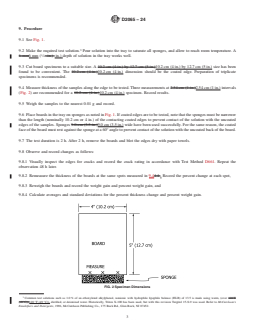

REDLINE ASTM D2065-24 - Standard Test Method for Determination of Edge Performance of Composite Wood Products Under Surfactant Accelerated Moisture Stress
Overview
ASTM D2065-24 is the internationally recognized standard test method for evaluating the edge performance of composite wood products under surfactant accelerated moisture stress. Developed by ASTM International, this method is crucial for measuring both the dimensional stability and the integrity of coated or uncoated edges of composite wood substrates-especially when these materials are exposed to moisture in exterior environments. Adhering to this standard enables manufacturers, quality control teams, and developers to assess the predicted in-use performance of composite wood products and coatings, ensuring products meet high durability standards.
Key Topics
- Moisture Stress Testing: Provides a controlled means to assess swelling, cracking, and other deterioration in composite wood edges due to moisture exposure accelerated by surfactants.
- Edge Performance Assessment: Specifically focuses on the edges, often the most vulnerable part of composite wood panels and boards.
- Crack Rating System: Uses a defined scale (from ASTM D661) to visually rate edge cracking, providing a consistent and quantitative measure for performance evaluation.
- Dimensional Changes: Tracks percent change in thickness and weight of specimens before and after testing, offering insight into water absorption and swelling resistance.
- Quality Control & Development: Serves as both a developmental evaluation tool for new coatings/substrates and a production monitoring method to maintain process consistency.
Applications
ASTM D2065-24 is widely used by:
- Manufacturers of Wood Composites: To test and refine edge treatments, coatings, or core materials for panels, flooring, and furniture exposed to outdoor or damp environments.
- Product Developers: When comparing and selecting coatings for moisture-sensitive applications, influencing innovation in moisture-barrier technologies.
- Quality Control Laboratories: For monitoring batch-to-batch consistency in production, enabling early detection of deviations that may impact product performance or longevity.
- Certification Bodies: For establishing compliance with durability claims, supporting claims in marketing and product specifications.
- Construction & Shipping: To ensure that products will withstand site exposures or transportation in humid or wet conditions without significant degradation.
Related Standards
Testing to ASTM D2065-24 often involves or references related standards for best practices and comprehensive analysis, including:
- ASTM D661: Test method for evaluating the degree of cracking of exterior paints, which is directly used in the crack rating aspect of D2065.
- ASTM E177: Practice for the use of terms precision and bias in ASTM test methods, supporting robust statistical interpretation of results.
- ASTM E691: Practice for conducting interlaboratory studies to determine the precision of a test method, referenced for validating the repeatability and reproducibility of the D2065 test.
Practical Value
Employing ASTM D2065-24 enables:
- Product Differentiation: By demonstrating superior edge performance under challenging moisture conditions, manufacturers can position their products for demanding exterior or wet-use roles.
- Reduced Failures and Claims: Regular use as a quality control tool helps minimize customer complaints and warranty claims due to premature edge failure.
- Informed Material Selection: Provides a robust, repeatable method to compare different coatings and composite formulations, supporting better design decisions.
- Conformance to International Best Practices: Adoption of this standard supports global trade and acceptance, meeting WTO TBT Committee principles for international standards.
Keywords
Composite wood testing, surfactant accelerated moisture stress, edge performance, dimensional stability, wood coatings evaluation, quality control, ASTM D2065, composite panel durability, crack rating, exterior exposure testing.
Relations
- Effective Date
- 01-Feb-2024
Buy Documents
ASTM D2065-24 - Standard Test Method for Determination of Edge Performance of Composite Wood Products Under Surfactant Accelerated Moisture Stress
REDLINE ASTM D2065-24 - Standard Test Method for Determination of Edge Performance of Composite Wood Products Under Surfactant Accelerated Moisture Stress
Get Certified
Connect with accredited certification bodies for this standard

Gozdarski inštitut Slovenije
Slovenian Forestry Institute. Forest management certification support, timber testing.
Sponsored listings
Frequently Asked Questions
ASTM D2065-24 is a standard published by ASTM International. Its full title is "Standard Test Method for Determination of Edge Performance of Composite Wood Products Under Surfactant Accelerated Moisture Stress". This standard covers: SIGNIFICANCE AND USE 5.1 This test method provides a measure of the dimensional stability and integrity of the coated edge of various composite wood products under accelerated moisture stress. It is widely used as an indicator or predictor of the anticipated performance of composite wood products during exterior exposure. It may be used for developmental evaluation of coatings, substrates, or both. It may also be useful for quality control or monitoring of the production of coated or uncoated composite wood products. SCOPE 1.1 This test method is intended to serve as a means for measurement of swelling and cracking of the coated or uncoated edge of a composite wood substrate that has been subjected to wetting by a test solution containing surface active agent. 1.2 The values stated in SI units are to be regarded as the standard. The values given in parentheses are for information only. 1.3 This standard does not purport to address all of the safety concerns, if any, associated with its use. It is the responsibility of the user of this standard to establish appropriate safety, health, and environmental practices and determine the applicability of regulatory limitations prior to use. 1.4 This international standard was developed in accordance with internationally recognized principles on standardization established in the Decision on Principles for the Development of International Standards, Guides and Recommendations issued by the World Trade Organization Technical Barriers to Trade (TBT) Committee.
SIGNIFICANCE AND USE 5.1 This test method provides a measure of the dimensional stability and integrity of the coated edge of various composite wood products under accelerated moisture stress. It is widely used as an indicator or predictor of the anticipated performance of composite wood products during exterior exposure. It may be used for developmental evaluation of coatings, substrates, or both. It may also be useful for quality control or monitoring of the production of coated or uncoated composite wood products. SCOPE 1.1 This test method is intended to serve as a means for measurement of swelling and cracking of the coated or uncoated edge of a composite wood substrate that has been subjected to wetting by a test solution containing surface active agent. 1.2 The values stated in SI units are to be regarded as the standard. The values given in parentheses are for information only. 1.3 This standard does not purport to address all of the safety concerns, if any, associated with its use. It is the responsibility of the user of this standard to establish appropriate safety, health, and environmental practices and determine the applicability of regulatory limitations prior to use. 1.4 This international standard was developed in accordance with internationally recognized principles on standardization established in the Decision on Principles for the Development of International Standards, Guides and Recommendations issued by the World Trade Organization Technical Barriers to Trade (TBT) Committee.
ASTM D2065-24 is classified under the following ICS (International Classification for Standards) categories: 79.060.01 - Wood-based panels in general. The ICS classification helps identify the subject area and facilitates finding related standards.
ASTM D2065-24 has the following relationships with other standards: It is inter standard links to ASTM D2065-03(2017). Understanding these relationships helps ensure you are using the most current and applicable version of the standard.
ASTM D2065-24 is available in PDF format for immediate download after purchase. The document can be added to your cart and obtained through the secure checkout process. Digital delivery ensures instant access to the complete standard document.
Standards Content (Sample)
This international standard was developed in accordance with internationally recognized principles on standardization established in the Decision on Principles for the
Development of International Standards, Guides and Recommendations issued by the World Trade Organization Technical Barriers to Trade (TBT) Committee.
Designation: D2065 − 24
Standard Test Method for
Determination of Edge Performance of Composite Wood
Products Under Surfactant Accelerated Moisture Stress
This standard is issued under the fixed designation D2065; the number immediately following the designation indicates the year of
original adoption or, in the case of revision, the year of last revision. A number in parentheses indicates the year of last reapproval. A
superscript epsilon (´) indicates an editorial change since the last revision or reapproval.
1. Scope 3.1.1 crack rating, n—a numerical value on a scale from 1
to 10, with 10 representing no evidence of cracking of the edge
1.1 This test method is intended to serve as a means for
(see Test Method D661).
measurement of swelling and cracking of the coated or
3.1.2 composite wood products, n—boards or other struc-
uncoated edge of a composite wood substrate that has been
tural or decorative materials manufactured from wood fibers,
subjected to wetting by a test solution containing surface active
flakes or strands and various resin binders consolidated under
agent.
heat, or pressure, or both.
1.2 The values stated in SI units are to be regarded as the
standard. The values given in parentheses are for information
4. Summary of Test Method
only.
4.1 A surfactant solution is placed in a tray that contains a
1.3 This standard does not purport to address all of the
sponge. A preweighed and calipered panel with a coated edge
safety concerns, if any, associated with its use. It is the
is placed with the edge in contact with the surfactant saturated
responsibility of the user of this standard to establish appro-
sponge for 2 h. The exposed panel is blotted dry, reweighed,
priate safety, health, and environmental practices and deter-
recalipered, and inspected for edge cracking. Percentage
mine the applicability of regulatory limitations prior to use.
weight and thickness changes are calculated and recorded.
1.4 This international standard was developed in accor-
Edge cracking is rated in accordance with Test Method D661
dance with internationally recognized principles on standard-
and recorded.
ization established in the Decision on Principles for the
Development of International Standards, Guides and Recom-
5. Significance and Use
mendations issued by the World Trade Organization Technical
5.1 This test method provides a measure of the dimensional
Barriers to Trade (TBT) Committee.
stability and integrity of the coated edge of various composite
wood products under accelerated moisture stress. It is widely
2. Referenced Documents
used as an indicator or predictor of the anticipated performance
2.1 ASTM Standards:
of composite wood products during exterior exposure. It may
D661 Test Method for Evaluating Degree of Cracking of
be used for developmental evaluation of coatings, substrates, or
Exterior Paints
both. It may also be useful for quality control or monitoring of
E177 Practice for Use of the Terms Precision and Bias in
the production of coated or uncoated composite wood prod-
ASTM Test Methods
ucts.
E691 Practice for Conducting an Interlaboratory Study to
Determine the Precision of a Test Method
6. Apparatus
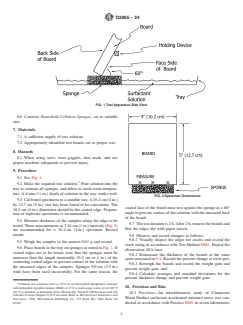
6.1 Wide Flat Tray or Pan, suitable to contain the required
3. Terminology
number of sponges and test boards. The sides must be high
3.1 Definitions of Terms Specific to This Standard:
enough to safely contain at least 6 mm ( ⁄4 in.) of solution.
6.2 Rack or Holder, suitable to support the required number
This test method is under the jurisdiction of ASTM Committee D01 on Paint of test boards at the nominal 60° angle.
and Related Coatings, Materials, and Applications and is the direct responsibility of
6.3 Micrometer or Vernier Caliper, of sufficient capacity for
Subcommittee D01.52 on Factory Coated Wood Products.
Current edition approved Feb. 1, 2024. Published March 2024. Originally the board thickness to be measured and capable of 0.1 mm
approved in 1991. Last previous edition approved in 2017 as D2065 – 03 (2017).
accuracy.
DOI: 10.1520/D2065-24.
For referenced ASTM standards, visit the ASTM website, www.astm.org, or 6.4 Balance, with sufficient capacity (typically 400 g) and
contact ASTM Customer Service at service@astm.org. For Annual Book of ASTM
0.01 g accuracy.
Standards volume information, refer to the standard’s Document Summary page on
the ASTM website. 6.5 Suitable Saw, for cutting of samples.
Copyright © ASTM International, 100 Barr Harbor Drive, PO Box C700, West Conshohocken, PA 19428-2959. United States
D2065 − 24
FIG. 1 Test Apparatus Side View
6.6 Common Household Cellulose Sponges, cut to suitable
size.
7. Materials
7.1 A sufficient supply of test solution.
7.2 Appropriately identified test boards c
...
This document is not an ASTM standard and is intended only to provide the user of an ASTM standard an indication of what changes have been made to the previous version. Because
it may not be technically possible to adequately depict all changes accurately, ASTM recommends that users consult prior editions as appropriate. In all cases only the current version
of the standard as published by ASTM is to be considered the official document.
Designation: D2065 − 03 (Reapproved 2017) D2065 − 24
Standard Test Method for
Determination of Edge Performance of Composite Wood
Products Under Surfactant Accelerated Moisture Stress
This standard is issued under the fixed designation D2065; the number immediately following the designation indicates the year of
original adoption or, in the case of revision, the year of last revision. A number in parentheses indicates the year of last reapproval. A
superscript epsilon (´) indicates an editorial change since the last revision or reapproval.
1. Scope
1.1 This test method is intended to serve as a means for measurement of swelling and cracking of the coated or uncoated edge
of a composite wood substrate that has been subjected to wetting by a test solution containing surface active agent.
1.2 The values stated in SI units are to be regarded as the standard. The values given in parentheses are for information only.
1.3 This standard does not purport to address all of the safety concerns, if any, associated with its use. It is the responsibility
of the user of this standard to establish appropriate safety and healthsafety, health, and environmental practices and determine
the applicability of regulatory limitations prior to use.
1.4 This international standard was developed in accordance with internationally recognized principles on standardization
established in the Decision on Principles for the Development of International Standards, Guides and Recommendations issued
by the World Trade Organization Technical Barriers to Trade (TBT) Committee.
2. Referenced Documents
2.1 ASTM Standards:
D661 Test Method for Evaluating Degree of Cracking of Exterior Paints
E177 Practice for Use of the Terms Precision and Bias in ASTM Test Methods
E691 Practice for Conducting an Interlaboratory Study to Determine the Precision of a Test Method
3. Terminology
3.1 Definitions of Terms Specific to This Standard:
3.1.1 crack rating, n—a numerical value on a scale from 1 to 10, with 10 representing no evidence of cracking of the edge (see
Test Method D661).
3.1.2 composite wood products, n—boards or other structural or decorative materials manufactured from wood fibers, flakes or
strands and various resin binders consolidated under heat, or pressure, or both.
4. Summary of Test Method
4.1 A surfactant solution is placed in a tray that contains a sponge. A preweighed and calipered panel with a coated edge is placed
This test method is under the jurisdiction of ASTM Committee D01 on Paint and Related Coatings, Materials, and Applications and is the direct responsibility of
Subcommittee D01.52 on Factory Coated Wood Products.
Current edition approved July 1, 2017Feb. 1, 2024. Published July 2017March 2024. Originally approved in 1991. Last previous edition approved in 20112017 as D2065 –
03 (2011). DOI: 10.1520/D2065-03R17.(2017). DOI: 10.1520/D2065-24.
For referenced ASTM standards, visit the ASTM website, www.astm.org, or contact ASTM Customer Service at service@astm.org. For Annual Book of ASTM Standards
volume information, refer to the standard’s Document Summary page on the ASTM website.
Copyright © ASTM International, 100 Barr Harbor Drive, PO Box C700, West Conshohocken, PA 19428-2959. United States
D2065 − 24
with the edge in contact with the surfactant saturated sponge for 2 h. The exposed panel is blotted dry, reweighed, recalipered, and
inspected for edge cracking. Percentage weight and thickness changes are calculated and recorded. Edge cracking is rated in
accordance with Test Method D661 and recorded.
5. Significance and Use
5.1 This test method provides a measure of the dimensional stability and integrity of the coated edge of various composite wood
products under accelerated moisture stress. It is widely used as an indicator or predictor of the anticipated performance of
composite wood products during exterior exposure. It may be used for developmental evaluation of coatings, substrates, or both.
It may also be useful for quality control or monitoring of the production of coated or uncoated composite wood products.
6. Apparatus
6.1 Wide Flat Tray or Pan, suitable to contain the required number of sponges and test boards. The sides must be high enough
to safely contain at least 6 mm ( ⁄4 in.) of solution.
6.2 Rack or Holder, suitable to support the required number of test boards at the nominal 60° angle.
6.3 Micrometer or Vernier Caliper, of sufficient capacity for the board thickness to be measured and capable of 0.1 mm accuracy.
6.4 Balance, with sufficient capacity (typically 400 g) and 0.01 g accuracy.
6.5 Suitable Saw, for cutting of samples.
6.6 Common Household Cellulose Sponges, cut to suitable size.
7. Materials
7.1 A sufficient supply of test solution.
7.2 Appropriately identified test boards cut to proper size.
...