

ASTM E1005-21
(Test Method)Standard Test Method for Application and Analysis of Radiometric Monitors for Reactor Vessel Surveillance
General Information
- Abstract
SIGNIFICANCE AND USE
5.1 Radiometric monitors shall provide a proven passive dosimetry technique for the determination of neutron fluence rate (flux density), fluence, and spectrum in a diverse variety of neutron fields. These data are required to evaluate and estimate probable long-term radiation-induced damage to nuclear reactor structural materials such as the steel used in reactor pressure vessels and their support structures.
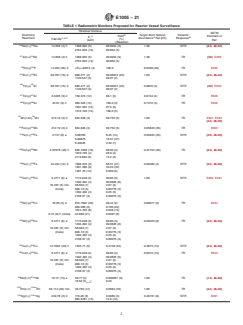
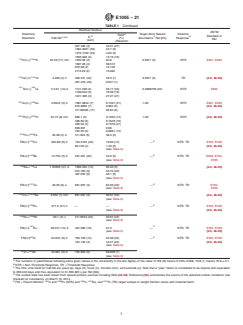
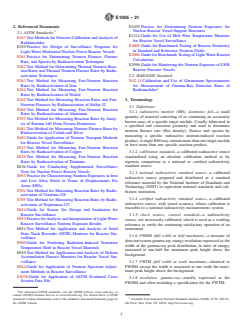
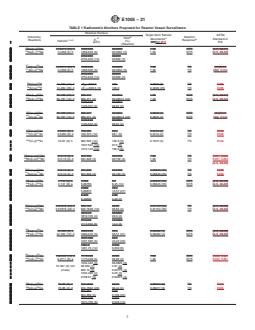
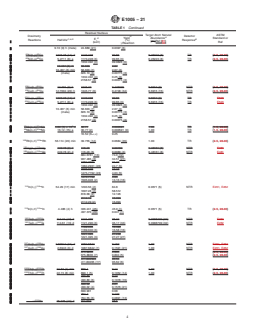
5.2 A number of radiometric monitors, their corresponding neutron activation reactions, and radioactive reaction products and some of the pertinent nuclear parameters of these RMs and products are listed in Table 1. Table 2 provides data (37) on the cumulative and independent fission yields of the important fission monitors. Not included in these tables are contributions to the yields from photo-fission, which can be especially significant for non-fissile nuclides (2-5, 27-29, 38-41). (A) All yield data are given as a percentage with associated uncertainties given as percentages of the percentage at the 1σ level.(B) For this fission yield evaluation (37), “Fast” indicates that the data was extracted from a wide range of reactor-based fission neutron spectra that can be characterized as having an average energy of ~0.4 MeV. Almost all of the fission reactions for U-238 and Th-232 occur above an effective threshold energy of ~1 MeV and, for Np-237, above ~0.2 MeV.
SCOPE
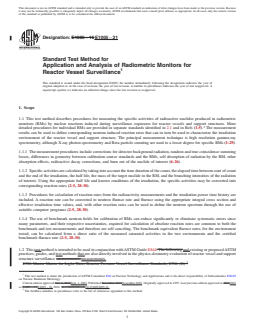
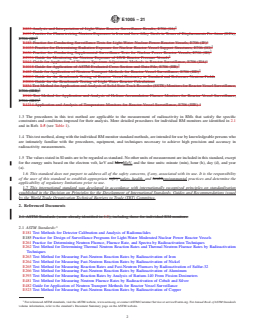
1.1 This test method describes procedures for measuring the specific activities of radioactive nuclides produced in radiometric monitors (RMs) by nuclear reactions induced during surveillance exposures for reactor vessels and support structures. More detailed procedures for individual RMs are provided in separate standards identified in 2.1 and in Refs (1-5).2 The measurement results can be used to define corresponding neutron induced reaction rates that can in turn be used to characterize the irradiation environment of the reactor vessel and support structure. The principal measurement technique is high resolution gamma-ray spectrometry, although X-ray photon spectrometry and Beta particle counting are used to a lesser degree for specific RMs (1-29).
1.1.1 The measurement procedures include corrections for detector background radiation, random and true coincidence summing losses, differences in geometry between calibration source standards and the RMs, self absorption of radiation by the RM, other absorption effects, radioactive decay corrections, and burn out of the nuclide of interest (6-26).
1.1.2 Specific activities are calculated by taking into account the time duration of the count, the elapsed time between start of count and the end of the irradiation, the half life, the mass of the target nuclide in the RM, and the branching intensities of the radiation of interest. Using the appropriate half life and known conditions of the irradiation, the specific activities may be converted into corresponding reaction rates (2-5, 28-30).
1.1.3 Procedures for calculation of reaction rates from the radioactivity measurements and the irradiation power time history are included. A reaction rate can be converted to neutron fluence rate and fluence using the appropriate integral cross section and effective irradiation time values, and, with other reaction rates can be used to define the neutron spectrum through the use of suitable computer programs (2-5, 28-30).
1.1.4 The use of benchmark neutron fields for calibration of RMs can reduce significantly or eliminate systematic errors since many parameters, and their respective uncertainties, required for calculation of absolute reaction rates are common to both the benchmark and test measurements and therefore are self canceling. The benchmark equivalent fluence rates, for the environment tested, can be calculated from a direct ratio of the measured saturated activities in the two environments and the certified benchmark fluence rate (2-5, 28-30).
1.2 This test meth...
- Status
- Published
- Publication Date
- 31-Aug-2021
- Technical Committee
- E10 - Nuclear Technology and Applications
- Drafting Committee
- E10.05 - Nuclear Radiation Metrology
Buy Documents
ASTM E1005-21 - Standard Test Method for Application and Analysis of Radiometric Monitors for Reactor Vessel Surveillance
REDLINE ASTM E1005-21 - Standard Test Method for Application and Analysis of Radiometric Monitors for Reactor Vessel Surveillance
Overview
ASTM E1005-21 – Standard Test Method for Application and Analysis of Radiometric Monitors for Reactor Vessel Surveillance provides procedures for determining neutron fluence rate, fluence, and spectrum using radiometric monitors (RMs). These passive dosimetry techniques play a critical role in the surveillance of nuclear reactor vessels and support structures, enabling the evaluation and estimation of long-term radiation-induced damage to structural materials such as reactor pressure vessel steel.
The standard details measurement methods involving gamma-ray spectrometry, X-ray spectrometry, and beta particle counting, as well as the necessary corrections and calculations to ensure high accuracy and reliability. This foundational test method is intended to support safety and longevity in nuclear power plant operation by delivering robust data for analyzing the irradiation environment and predicting material performance over time.
Key Topics
Passive Dosimetry for Reactor Surveillance
- Utilizes radiometric monitors (foils or dosimeter samples) to passively record neutron exposure within reactor environments.
- Determines neutron fluence rate (flux density), total neutron fluence, and neutron energy spectrum for accurate assessment.
Measurement Procedures
- Principal method: high-resolution gamma-ray spectrometry.
- Supplementary methods: X-ray photon spectrometry and beta particle counting for specific radiometric monitors.
- Includes corrections for background radiation, geometry differences, detector efficiency, self-absorption, decay, and nuclide burn-out.
Data Analysis and Calculations
- Converts measured specific activities into reaction rates, which can then define neutron fluence rate and spectrum.
- Uses benchmark neutron fields to calibrate radiometric monitors, reducing systematic uncertainties by direct comparison with certified standards.
- Relies on computer programs and reference nuclear data for spectrum unfolding and advanced analysis.
Quality Assurance and Calibration
- Emphasizes the use of national and certified radioactivity standard sources for instrument calibration.
- Requires regular control checks to maintain system consistency and reliability.
Applications
ASTM E1005-21 is essential in:
- Nuclear power plant surveillance – Monitoring the irradiation environment to assess and forecast radiation-induced shifts in reactor pressure vessels and their support structures.
- Material integrity evaluations – Providing critical data for estimating material embrittlement and lifespan extension strategies.
- Compliance with safety regulations – Supporting utilities and regulators with standardized, validated methods for routine surveillance and reporting.
- Benchmark testing and interlaboratory comparisons – Ensuring consistency and traceability of dosimetry across facilities through benchmark neutron fields and round-robin calibration.
By establishing robust and repeatable practices, this standard helps nuclear operators maintain safe reactor performance, optimize maintenance, and comply with regulatory requirements.
Related Standards
ASTM E1005-21 is integrated within a comprehensive framework of ASTM standards for reactor dosimetry and vessel surveillance, including:
- ASTM E844 – Guide for Sensor Set Design and Irradiation for Reactor Surveillance
- ASTM E853 – Practice for Analysis and Interpretation of Light-Water Reactor Surveillance Results
- ASTM E693 – Practice for Characterizing Neutron Exposures in Iron and Low Alloy Steels in Terms of Displacements Per Atom (DPA)
- ASTM E185 – Practice for Conducting Surveillance Tests for Light-Water Nuclear Power Reactor Vessels
- ASTM E1035 – Practice for Determining Neutron Exposures for Nuclear Reactor Vessel Support Structures
- ASTM E261, E262, E263, E264, E265, E266, E523 – Test methods for specific neutron activation reactions in various elements
- ASTM E944 – Guide for Application of Neutron Spectrum Adjustment Methods
- IEEE/ANSI N42.14 – Calibration and Usage of Germanium Detectors for Gamma-Ray Emission Measurement
By referencing and supplementing these related standards, ASTM E1005-21 ensures broad compatibility and consistent application across the nuclear industry, enhancing reactor safety and performance monitoring.
Optimize reactor surveillance and dosimetry with ASTM E1005-21 – your essential standard for accurate, reliable neutron field characterization and material performance assessment in nuclear power plants.
Relations
- Effective Date
- 01-Jul-2020
- Effective Date
- 01-Mar-2020
- Effective Date
- 01-Mar-2020
- Effective Date
- 01-Jan-2020
- Effective Date
- 01-Nov-2019
- Effective Date
- 01-Nov-2019
- Refers
ASTM E704-19 - Standard Test Method for Measuring Reaction Rates by Radioactivation of Uranium-238 - Effective Date
- 01-Oct-2019
- Effective Date
- 01-Oct-2019
- Refers
ASTM E705-18 - Standard Test Method for Measuring Reaction Rates by Radioactivation of Neptunium-237 - Effective Date
- 01-Dec-2018
- Effective Date
- 01-Dec-2018
- Effective Date
- 01-Jun-2018
- Effective Date
- 01-Feb-2018
- Effective Date
- 01-Aug-2017
- Effective Date
- 01-Aug-2017
- Effective Date
- 01-Jun-2015
Buy Documents
ASTM E1005-21 - Standard Test Method for Application and Analysis of Radiometric Monitors for Reactor Vessel Surveillance
REDLINE ASTM E1005-21 - Standard Test Method for Application and Analysis of Radiometric Monitors for Reactor Vessel Surveillance
Get Certified
Connect with accredited certification bodies for this standard

BSMI (Bureau of Standards, Metrology and Inspection)
Taiwan's standards and inspection authority.
Sponsored listings
Frequently Asked Questions
ASTM E1005-21 is a standard published by ASTM International. Its full title is "Standard Test Method for Application and Analysis of Radiometric Monitors for Reactor Vessel Surveillance". This standard covers: SIGNIFICANCE AND USE 5.1 Radiometric monitors shall provide a proven passive dosimetry technique for the determination of neutron fluence rate (flux density), fluence, and spectrum in a diverse variety of neutron fields. These data are required to evaluate and estimate probable long-term radiation-induced damage to nuclear reactor structural materials such as the steel used in reactor pressure vessels and their support structures. 5.2 A number of radiometric monitors, their corresponding neutron activation reactions, and radioactive reaction products and some of the pertinent nuclear parameters of these RMs and products are listed in Table 1. Table 2 provides data (37) on the cumulative and independent fission yields of the important fission monitors. Not included in these tables are contributions to the yields from photo-fission, which can be especially significant for non-fissile nuclides (2-5, 27-29, 38-41). (A) All yield data are given as a percentage with associated uncertainties given as percentages of the percentage at the 1σ level.(B) For this fission yield evaluation (37), “Fast” indicates that the data was extracted from a wide range of reactor-based fission neutron spectra that can be characterized as having an average energy of ~0.4 MeV. Almost all of the fission reactions for U-238 and Th-232 occur above an effective threshold energy of ~1 MeV and, for Np-237, above ~0.2 MeV. SCOPE 1.1 This test method describes procedures for measuring the specific activities of radioactive nuclides produced in radiometric monitors (RMs) by nuclear reactions induced during surveillance exposures for reactor vessels and support structures. More detailed procedures for individual RMs are provided in separate standards identified in 2.1 and in Refs (1-5).2 The measurement results can be used to define corresponding neutron induced reaction rates that can in turn be used to characterize the irradiation environment of the reactor vessel and support structure. The principal measurement technique is high resolution gamma-ray spectrometry, although X-ray photon spectrometry and Beta particle counting are used to a lesser degree for specific RMs (1-29). 1.1.1 The measurement procedures include corrections for detector background radiation, random and true coincidence summing losses, differences in geometry between calibration source standards and the RMs, self absorption of radiation by the RM, other absorption effects, radioactive decay corrections, and burn out of the nuclide of interest (6-26). 1.1.2 Specific activities are calculated by taking into account the time duration of the count, the elapsed time between start of count and the end of the irradiation, the half life, the mass of the target nuclide in the RM, and the branching intensities of the radiation of interest. Using the appropriate half life and known conditions of the irradiation, the specific activities may be converted into corresponding reaction rates (2-5, 28-30). 1.1.3 Procedures for calculation of reaction rates from the radioactivity measurements and the irradiation power time history are included. A reaction rate can be converted to neutron fluence rate and fluence using the appropriate integral cross section and effective irradiation time values, and, with other reaction rates can be used to define the neutron spectrum through the use of suitable computer programs (2-5, 28-30). 1.1.4 The use of benchmark neutron fields for calibration of RMs can reduce significantly or eliminate systematic errors since many parameters, and their respective uncertainties, required for calculation of absolute reaction rates are common to both the benchmark and test measurements and therefore are self canceling. The benchmark equivalent fluence rates, for the environment tested, can be calculated from a direct ratio of the measured saturated activities in the two environments and the certified benchmark fluence rate (2-5, 28-30). 1.2 This test meth...
SIGNIFICANCE AND USE 5.1 Radiometric monitors shall provide a proven passive dosimetry technique for the determination of neutron fluence rate (flux density), fluence, and spectrum in a diverse variety of neutron fields. These data are required to evaluate and estimate probable long-term radiation-induced damage to nuclear reactor structural materials such as the steel used in reactor pressure vessels and their support structures. 5.2 A number of radiometric monitors, their corresponding neutron activation reactions, and radioactive reaction products and some of the pertinent nuclear parameters of these RMs and products are listed in Table 1. Table 2 provides data (37) on the cumulative and independent fission yields of the important fission monitors. Not included in these tables are contributions to the yields from photo-fission, which can be especially significant for non-fissile nuclides (2-5, 27-29, 38-41). (A) All yield data are given as a percentage with associated uncertainties given as percentages of the percentage at the 1σ level.(B) For this fission yield evaluation (37), “Fast” indicates that the data was extracted from a wide range of reactor-based fission neutron spectra that can be characterized as having an average energy of ~0.4 MeV. Almost all of the fission reactions for U-238 and Th-232 occur above an effective threshold energy of ~1 MeV and, for Np-237, above ~0.2 MeV. SCOPE 1.1 This test method describes procedures for measuring the specific activities of radioactive nuclides produced in radiometric monitors (RMs) by nuclear reactions induced during surveillance exposures for reactor vessels and support structures. More detailed procedures for individual RMs are provided in separate standards identified in 2.1 and in Refs (1-5).2 The measurement results can be used to define corresponding neutron induced reaction rates that can in turn be used to characterize the irradiation environment of the reactor vessel and support structure. The principal measurement technique is high resolution gamma-ray spectrometry, although X-ray photon spectrometry and Beta particle counting are used to a lesser degree for specific RMs (1-29). 1.1.1 The measurement procedures include corrections for detector background radiation, random and true coincidence summing losses, differences in geometry between calibration source standards and the RMs, self absorption of radiation by the RM, other absorption effects, radioactive decay corrections, and burn out of the nuclide of interest (6-26). 1.1.2 Specific activities are calculated by taking into account the time duration of the count, the elapsed time between start of count and the end of the irradiation, the half life, the mass of the target nuclide in the RM, and the branching intensities of the radiation of interest. Using the appropriate half life and known conditions of the irradiation, the specific activities may be converted into corresponding reaction rates (2-5, 28-30). 1.1.3 Procedures for calculation of reaction rates from the radioactivity measurements and the irradiation power time history are included. A reaction rate can be converted to neutron fluence rate and fluence using the appropriate integral cross section and effective irradiation time values, and, with other reaction rates can be used to define the neutron spectrum through the use of suitable computer programs (2-5, 28-30). 1.1.4 The use of benchmark neutron fields for calibration of RMs can reduce significantly or eliminate systematic errors since many parameters, and their respective uncertainties, required for calculation of absolute reaction rates are common to both the benchmark and test measurements and therefore are self canceling. The benchmark equivalent fluence rates, for the environment tested, can be calculated from a direct ratio of the measured saturated activities in the two environments and the certified benchmark fluence rate (2-5, 28-30). 1.2 This test meth...
ASTM E1005-21 is classified under the following ICS (International Classification for Standards) categories: 17.240 - Radiation measurements. The ICS classification helps identify the subject area and facilitates finding related standards.
ASTM E1005-21 has the following relationships with other standards: It is inter standard links to ASTM E265-15(2020), ASTM E1018-20, ASTM E1018-20e1, ASTM E636-20, ASTM E393-19, ASTM E854-19, ASTM E704-19, ASTM E944-19, ASTM E705-18, ASTM E263-18, ASTM E844-18, ASTM E910-18, ASTM E262-17, ASTM E526-17, ASTM E185-15e1. Understanding these relationships helps ensure you are using the most current and applicable version of the standard.
ASTM E1005-21 is available in PDF format for immediate download after purchase. The document can be added to your cart and obtained through the secure checkout process. Digital delivery ensures instant access to the complete standard document.
Standards Content (Sample)
This international standard was developed in accordance with internationally recognized principles on standardization established in the Decision on Principles for the
Development of International Standards, Guides and Recommendations issued by the World Trade Organization Technical Barriers to Trade (TBT) Committee.
Designation: E1005 − 21
Standard Test Method for
Application and Analysis of Radiometric Monitors for
Reactor Vessel Surveillance
This standard is issued under the fixed designation E1005; the number immediately following the designation indicates the year of
original adoption or, in the case of revision, the year of last revision.Anumber in parentheses indicates the year of last reapproval.A
superscript epsilon (´) indicates an editorial change since the last revision or reapproval.
1. Scope 1.1.4 The use of benchmark neutron fields for calibration of
RMs can reduce significantly or eliminate systematic errors
1.1 Thistestmethoddescribesproceduresformeasuringthe
since many parameters, and their respective uncertainties,
specific activities of radioactive nuclides produced in radio-
required for calculation of absolute reaction rates are common
metric monitors (RMs) by nuclear reactions induced during
toboththebenchmarkandtestmeasurementsandthereforeare
surveillance exposures for reactor vessels and support struc-
self canceling.The benchmark equivalent fluence rates, for the
tures. More detailed procedures for individual RMs are pro-
2 environment tested, can be calculated from a direct ratio of the
vided in separate standards identified in 2.1 and in Refs (1-5).
measured saturated activities in the two environments and the
The measurement results can be used to define corresponding
certified benchmark fluence rate (2-5, 28-30).
neutron induced reaction rates that can in turn be used to
characterize the irradiation environment of the reactor vessel
1.2 This test method is intended to be used in conjunction
and support structure. The principal measurement technique is
with ASTM Guide E844 and existing or proposed ASTM
high resolution gamma-ray spectrometry, although X-ray pho-
practices, guides, and test methods that are also directly
tonspectrometryandBetaparticlecountingareusedtoalesser
involved in the physics-dosimetry evaluation of reactor vessel
degree for specific RMs (1-29).
and support structure surveillance measurements.
1.1.1 The measurement procedures include corrections for
1.3 The procedures in this test method are applicable to the
detector background radiation, random and true coincidence
measurement of radioactivity in RMs that satisfy the specific
summing losses, differences in geometry between calibration
constraints and conditions imposed for their analysis. More
source standards and the RMs, self absorption of radiation by
detailed procedures for individual RM monitors are identified
theRM,otherabsorptioneffects,radioactivedecaycorrections,
in 2.1 and in Refs 1-5 (see Table 1).
and burn out of the nuclide of interest (6-26).
1.1.2 Specific activities are calculated by taking into ac-
1.4 This test method, along with the individual RM monitor
count the time duration of the count, the elapsed time between
standard methods, are intended for use by knowledgeable
start of count and the end of the irradiation, the half life, the
persons who are intimately familiar with the procedures,
mass of the target nuclide in the RM, and the branching
equipment, and techniques necessary to achieve high precision
intensities of the radiation of interest. Using the appropriate
and accuracy in radioactivity measurements.
half life and known conditions of the irradiation, the specific
activities may be converted into corresponding reaction rates 1.5 The values stated in SI units are to be regarded as
standard. No other units of measurement are included in this
(2-5, 28-30).
1.1.3 Procedures for calculation of reaction rates from the standard,exceptfortheenergyunitsbasedontheelectronvolt,
keV and MeV, and the time units: minute (min), hour (h), day
radioactivity measurements and the irradiation power time
history are included. A reaction rate can be converted to (d), and year (a).
neutron fluence rate and fluence using the appropriate integral
1.6 This standard does not purport to address all of the
cross section and effective irradiation time values, and, with
safety concerns, if any, associated with its use. It is the
other reaction rates can be used to define the neutron spectrum
responsibility of the user of this standard to establish appro-
through the use of suitable computer programs (2-5, 28-30).
priate safety, health, and environmental practices and deter-
mine the applicability of regulatory limitations prior to use.
This test method is under the jurisdiction ofASTM Committee E10 on Nuclear
1.7 This international standard was developed in accor-
Technology and Applications and is the direct responsibility of Subcommittee
dance with internationally recognized principles on standard-
E10.05 on Nuclear Radiation Metrology.
Current edition approved Sept. 1, 2021. Published November 2021. Originally
ization established in the Decision on Principles for the
approved in 1997. Last previous edition approved in 2016 as E1005–16. DOI:
Development of International Standards, Guides and Recom-
10.1520/E1005-21.
2 mendations issued by the World Trade Organization Technical
The boldface numbers in parentheses refer to the list of references appended to
this method. Barriers to Trade (TBT) Committee.
Copyright © ASTM International, 100 Barr Harbor Drive, PO Box C700, West Conshohocken, PA 19428-2959. United States
E1005 − 21
TABLE 1 Radiometric Monitors Proposed for Reactor Vessel Surveillance
Residual Nucleus
ASTM
Dosimetry D Target Atom Natural Detector
Yield
D Standard or
A B
C,A,D E
γ
Reactions Abundance Ref (31) Response
Half-life (%)
Ref
(keV)
γ/Reaction
23 24
Na(n,γ) Na 14.958 (2) h 1368.630 (5) 99.9934 (5) 1.00 NTR (2-5, 28-32)
2754.049 (13) 99.862 (3)
27 24
Al(n,α) Na 14.958 (2) h 1368.630 (5) 99.9934 (5) 1.00 TR (32) E266
2754.049 (13) 99.862 (3)
32 32
S(n,p) P 14.284 (36) d =695.5 (3) 100.0 0.9499 (26) TR E265
β
45 46
Sc(n,γ) Sc 83.787 (16) d 889.271 (2) 99.98374 (25) 1.00 NTR (2-5, 28-32)
1120.537 (3) 99.97 (2)
46 46
Ti(n,p) Sc 83.787 (16) d 889.271 (2) 99.98374 (25) 0.0825 (3) NTR (32) E526
1120.537 (3) 99.97 (2)
47 47
Ti(n,p) Sc 3.3485 (9) d 159.373 (12) 68.1 (5) 0.0744 (2) TR E526
48 48
Ti(n,p) Sc 43.67 (9) h 983.526 (12) 100.0 (3) 0.7372 (3) TR E526
1037.522 (12) 97.5 (5)
1312.120 (12) 100.0 (5)
55 54
Mn(n,2n) Mn 312.19 (3) d 834.848 (3) 99.752 (5) 1.00 TR E261, E263
(2-5, 28-30)
54 54
Fe(n,p) Mn 312.19 (3) d 834.848 (3) 99.752 (3) 0.05845 (35) TR E263
54 55
Fe(n,γ) Fe 2.747 (8) a 5.88765 8.45 (14) 0.05845 (35) NTR (2-5, 28-30)
5.89875 16.57 (27)
6.49045 3.40 (7)
56 56
Fe(n,p) Mn 2.57878 (46) h 846.7638 (19) 98.85 (3) 0.91754 (36) TR (2-5, 28-30)
1810.726 (4) 26.9 (4)
2113.092 (6) 14.2 (3)
58 59
Fe(n,γ) Fe 44.494 (12) d 1099.245 (3) 56.51 (31) 0.00282 (4) NTR (2-5, 28-30)
1291.590 (6) 43.23 (33)
1481.70 (12) 0.059 (6)
59 60
Co(n,γ) Co 5.2711 (8) a 1173.228 (3) 99.85 (3) 1.00 NTR E262, E481
1332.492 (4) 99.9826 (6)
10.467 (6) min 58.603 (7) 2.07 (3)
(meta) 826.10 (3) 0.00775 (3)
1332.492 (4) 0.25 (3)
2158.57 (3) 0.00075 (3)
58 58
Ni(n,p) Co 70.85 (3) d 810.7602 (20) 99.44 (2) 0.68077 (9) TR E264
863.958 (6) 0.700 (22)
1674.705 (6) 0.528 (13)
9.10 (9) h (meta) 24.889 (21) 0.0397 (6)
60 60
Ni(n,p) Co 5.2711 (8) a 1173.228 (3) 99.85 (3) 0.26223 (8) TR (2-5, 28-30)
1332.492 (4) 99.9826 (6)
10.467 (6) min 58.603 (7) 2.07 (3)
(meta) 826.10 (3) 0.00775 (3)
1332.492 (4) 0.25 (3)
2158.57 (3) 0.00075 (3)
63 64
Cu(n,γ) Cu 12.7004 (20) h 1345.77 (6) 0.4748 (34) 0.6915 (15) NTR (2-5, 28-30)
63 60
Cu(n,α) Co 5.2711 (8) a 1173.228 (3) 99.85 (3) 0.6915 (15) TR E523
1332.492 (4) 99.9826 (6)
10.467 (6) min 58.603 (7) 2.07 (3)
(meta) 826.10 (3) 0.00775 (3)
1332.492 (4) 0.25 (3)
2158.57 (3) 0.00075 (3)
93 93m
Nb(n,n') Nb 16.12 (15) a 30.77 (2) 0.000591 (9) 1.00 TR (1-5, 28-30)
16.52 (K ) 9.25
α1,2
103 103m
Rh(n,n') Rh 56.114 (20) min 39.755 (12) 0.0684 (35) 1.00 TR (2-5, 28-30)
109 110m
Ag(n,γ) Ag 249.78 (2) d 116.48 (5) 0.0080 (3) 0.48161 (8) NTR E481
884.6781 (13) 74.0 (12)
E1005 − 21
TABLE 1 Continued
Residual Nucleus
ASTM
Dosimetry D Target Atom Natural Detector
Yield
D Standard or
E A B
C,A,D
Reactions γ Abundance Ref (31) Response
Half-life (%)
(keV) Ref
γ/Reaction
937.485 (3) 34.51 (27)
1384.2931 (20) 24.7 (5)
1475.7792 (23) 4.03 (5)
1505.028 (2) 13.16 (16)
115 116m
ln(n,γ) ln 54.29 (17) min 1293.56 (2) 84.8 0.9571 (5) NTR E261, E262
1097.28 (2) 58.512
818.68 (2) 12.126
2112.29 (2) 15.094
115 115m
ln(n,n') ln 4.486 (4) h 336.241 (25) 45.9 (1) 0.9571 (5) TR (2-5, 28-30)
497.370 (29) 0.047 (1)
181 182
Ta(n,γ) Ta 114.61 (13) d 1121.290 (3) 35.17 (33) 0.9998799 (32) NTR E262
1189.040 (3) 16.58 (16)
1221.395 (3) 27.27 (27)
197 198
Au(n,γ) Au 2.6943 (3) d 1087.6842 (7) 0.1591 (21) 1.00 NTR E261, E262
675.8836 (7) 0.804 (5) (2-5, 28-30)
411.80205 (17) 95.62 (6)
232 233
Th(n,γ) Th 22.15 (8) min 890.1 (5) 0.1052 (14) 1.00 NTR (2-5, 28-30)
490.80 (6) 0.1078 (16)
499.02 (4) 0.1576 (21)
699.901 0.68
764.55 (6) 0.0891 (13)
233 233
Th⇒ Pa 26.98 (2) d 311.904 (5) 38.3 (5)
144 E
FM(n,f) Ce 284.89 (6) d 133.5152 (20) 10.83 (12) — NTR, TR E704, E705
80.120 (4) 1.40 (5) (2-5, 28-30)
(see Table 2)
140 E
FM(n,f) Ba 12.753 (5) d 537.261 (25) 24.6 (5) — NTR, TR E393, E704,
(see Table 2) E705
140 140
Ba⇒ La 1.67858 (21) d 1596.203 (13) 95.40 (5) (2-5, 28-30)
815.784 (6) 23.72 (20)
487.022 (6) 46.1 (5)
(see Table 2)
137 E
FM(n,f) Cs 30.05 (8) a 661.657 (3) 84.99 (20) — NTR, TR E704,
(see Table 2) E705
137 137m
Cs⇒ Ba 2.552 (1) min 661.657 (3) 90.07 (20) (2-5, 28-30)
(see Table 2)
106 E
FM(n,f) Ru 371.5 (21) d — — — NTR, TR E704, E705
(see Table 2) (2-5, 28-30)
106 106
Ru⇒ Rh 30.1 (3) s 511.8534 (23) 20.52 (23)
(see Table 2)
103 E
FM(n,f) Ru 39.247 (13) d 497.085 (10) 91.0 — NTR, TR E704, E705
(see Table 2) (2-5, 28-30)
95 E
FM(n,f) Zr 64.032 (6) d 756.729 (12) 54.38 (22) — NTR, TR E704, E705
724.193 (3) 44.27 (22) (2-5, 28-30)
(see Table 2)
95 95
Zr⇒ Nb 34.991 (6) d 765.803 (6) 99.808 (7)
(see Table 2)
A
The numbers in parentheses following some given values is the uncertainty in the last digit(s) of the value: 0.729 (8) means 0.729± 0.008, 70.8 (1) means 70.8 ± 0.1.
B
NTR = Non-Threshold Response, TR = Threshold Response.
C
The time units listed for half-life are years (a), days (d), hours (h), minutes (min), and seconds (s). Note that a “year” herein is considered to be tropical and equivalent
to 365.242 days and thus equivalent to 31.556.926 s per Ref (32).
D
The nuclear data has been drawn from several primary sources including Refs (32-35). Reference (36) summarizes the source of the selected nuclear constants, last
checked for consistency on March 19, 2014.
E 235 239 238 237 232
FM = Fission Monitor: U and Pu (NTR) and U, Np, and Th (TR) target isotope or weight fraction varies with material batch.
E1005 − 21
2. Referenced Documents E1035Practice for Determining Neutron Exposures for
3 Nuclear Reactor Vessel Support Structures
2.1 ASTM Standards:
E1214Guide for Use of Melt Wire Temperature Monitors
E181Test Methods for Detector Calibration andAnalysis of
for Reactor Vessel Surveillance
Radionuclides
E2005Guide for Benchmark Testing of Reactor Dosimetry
E185Practice for Design of Surveillance Programs for
in Standard and Reference Neutron Fields
Light-Water Moderated Nuclear Power Reactor Vessels
E2006Guide for BenchmarkTesting of LightWater Reactor
E261Practice for Determining Neutron Fluence, Fluence
Calculations
Rate, and Spectra by Radioactivation Techniques
E2956Guide for Monitoring the Neutron Exposure of LWR
E262Test Method for Determining Thermal Neutron Reac-
Reactor Pressure Vessels
tion Rates and Thermal Neutron Fluence Rates by Radio-
activation Techniques 2.2 IEEE/ANSI Standard:
E263Test Method for Measuring Fast-Neutron Reaction N42.14Calibration and Use of Germanium Spectrometers
Rates by Radioactivation of Iron for Measurement of Gamma-Ray Emission Rates of
Radionuclides
E264Test Method for Measuring Fast-Neutron Reaction
Rates by Radioactivation of Nickel
E265Test Method for Measuring Reaction Rates and Fast-
3. Terminology
Neutron Fluences by Radioactivation of Sulfur-32
3.1 Definitions:
E266Test Method for Measuring Fast-Neutron Reaction
3.1.1 radiometric monitor (RM), dosimeter, foil—a small
Rates by Radioactivation of Aluminum
quantity of material consisting of or containing an accurately
E393Test Method for Measuring Reaction Rates by Analy-
known mass of a specific target nuclide. Usually fabricated in
sis of Barium-140 From Fission Dosimeters
a specified and consistent geometry and used to determine
E481Test Method for Measuring Neutron Fluence Rates by
neutron fluence rate (flux density), fluence and spectra by
Radioactivation of Cobalt and Silver
measuring a specific radioactive neutron-induced reaction
E482Guide for Application of Neutron Transport Methods
product.AsingleRMmaycontainmorethanonetargetnuclide
for Reactor Vessel Surveillance
or have more than one specific reaction product.
E523Test Method for Measuring Fast-Neutron Reaction
3.1.2 calibration standard—a calibrated radioactive source
Rates by Radioactivation of Copper
standardized using an absolute calibration method or by
E526Test Method for Measuring Fast-Neutron Reaction
rigorous comparison to a national or certified radioactivity
Rates by Radioactivation of Titanium
standard source.
E636 Guide for Conducting Supplemental Surveillance
Tests for Nuclear Power Reactor Vessels
3.1.3 national radioactivity standard source—a calibrated
E693Practice for Characterizing Neutron Exposures in Iron
radioactive source prepared and distributed as a standard
and Low Alloy Steels in Terms of Displacements Per
reference material by the National Institute of Standards and
Atom (DPA)
Technology (NIST) or equivalent national standards and cali-
E704Test Method for Measuring Reaction Rates by Radio-
bration institution.
activation of Uranium-238
3.1.4 certified radioactivity standard source—a calibrated
E705Test Method for Measuring Reaction Rates by Radio-
radioactive source, with stated accuracy, whose calibration is
activation of Neptunium-237
traceable to a national radioactivity measurements system.
E844Guide for Sensor Set Design and Irradiation for
Reactor Surveillance
3.1.5 check source, control standard—a radioactivity
E853PracticeforAnalysisandInterpretationofLight-Water
source, not necessarily calibrated, which is used as a working
Reactor Surveillance Neutron Exposure Results
reference to verify the continuing satisfactory operation of an
E854Test Method for Application and Analysis of Solid
instrument.
State Track Recorder (SSTR) Monitors for Reactor Sur-
3.1.6 FWHM (full width at half maximum)—a measure of
veillance
detector/system gamma-ray energy resolution expressed as the
E900Guide for Predicting Radiation-Induced Transition
width of the gamma-ray peak distribution, in units of energy,
Temperature Shift in Reactor Vessel Materials
measured at one-half the maximum peak height above the
E910Test Method for Application and Analysis of Helium
background.
Accumulation Fluence Monitors for Reactor Vessel Sur-
3.1.7 FWTM (full width at tenth maximum)—identical to
veillance
FWHM except the width is measured at one tenth the maxi-
E944Guide for Application of Neutron Spectrum Adjust-
mum peak height above the background.
ment Methods in Reactor Surveillance
E1018Guide for Application of ASTM Evaluated Cross
3.1.8 resolution, gamma-ray—usually expressed as the
Section Data File
FWHM and often including a specification for the FWTM.
For referenced ASTM standards, visit the ASTM website, www.astm.org, or
contact ASTM Customer Service at service@astm.org. For Annual Book of ASTM
Standards volume information, refer to the standard’s Document Summary page on Available fromAmerican National Standards Institute (ANSI), 25 W. 43rd St.,
the ASTM website. 4th Floor, New York, NY 10036, http://www.ansi.org.
E1005 − 21
3.1.9 peak-to-Compton-ratio—the ratio of the net height of 6.1.1.1 If more than one detector is available, the specifica-
a Gaussian fit of the gamma-ray peak to average net counts in tions can be advantageously tailored to optimize performance
channels in the relatively flat portion of the Compton con- over the range of radioactivity levels and gamma-ray energies
tinuum. to be measured.
6.1.2 Linear Amplifier, for nuclear spectroscopy—
4. Summary of Test Method
multichannelpulse-heightanalyzerwithatleast4000channels,
live time correction, and a hard copy data read out device. A
4.1 Appropriate radiation detection-measurement instru-
visual display is extremely useful and in many cases essential
ments shall be used in conjunction with suitable calibration
for efficient operations.Abuilt-in data handling and reduction
standards, nuclear parameters, and test data to quantitatively
system is necessary for processing large numbers of samples
determine the decay rate of selected radioactive nuclides
and to reduce possibility of human error.
produced in RMs during test and surveillance irradiations in
neutron fields. These results together with established cross
6.2 Thallium Activated Sodium Iodide Scintillation
sections, spectral response data, and known test parameters
Crystal—[NaI(Tl)], optically coupled to a photomultiplier tube
allow the determination of the neutron fluence rate, fluence,
with preamplifier, high voltage power supply, linear amplifier,
and spectrum. Conversely, by using well-characterized con-
multichannel analyzer with at least 400 channel capacity and a
trolled neutron fields to irradiate the selected target foils, cross
suitable data readout device. It is often feasible and advanta-
sectionsandspectralresponsedatacanbedeterminedfromthe
geoustouseaportionofthemultichannelanalyzerusedforthe
radioactivity measurements.
high resolution germanium detector system for the NaI(Tl)
detector through use of multiplexing techniques. A 3 by 3-in.
4.2 The appropriate standard method of analysis identified
integrally mounted NaI(Tl) detector is a good choice for
in Section 2 for the individual RMs shall be followed as the
general use.
individualproblemsthatmaybeencounteredandtheprecision
and bias of the analysis for that particular RM are more fully
6.3 Beta Particle Counting System, consisting of a suitable
discussed in these standards.
detector ranging from a thin end-window Geiger-Mueller type
detector, proportional counter, scintillation counter to partially
4.3 The neutron fluence rate (flux density), fluence, and
depleted silicon diodes; electronic components such as
spectral data shall be correlated to radiation induced change
preamplifiers, amplifiers, discriminator-drivers, scalers, timers
and damage in reactor materials through the use of appropriate
and high voltage power supplies to complete the system. Refer
analytical/calculational codes (see Guides E482, E693, E844,
to Test Methods E181 for preparation of apparatus and count-
E853, E900, E944, E1018, E2005, and E2006).
ing procedures.
5. Significance and Use
6.4 X-ray Spectrometry System, utilizing high resolution
lithium drifted silicon, Si(Li), or germanium X-ray detector
5.1 Radiometric monitors shall provide a proven passive
with liquid nitrogen or electro-mechanically cooled cryostat,
dosimetry technique for the determination of neutron fluence
preamplifier, amplifier and multichannel analyzer system with
rate(fluxdensity),fluence,andspectruminadiversevarietyof
at least 1000 channel capacity and suitable data readout and
neutronfields.Thesedataarerequiredtoevaluateandestimate
display devices. Multiplexing could permit use of the same
probable long-term radiation-induced damage to nuclear reac-
multichannel analyzer used for the high resolution germanium
torstructuralmaterialssuchasthesteelusedinreactorpressure
gammaspectrometerifadequatecapacityexistsortheanalyzer
vessels and their support structures.
could be dedicated to one use or the other to suit analysis
5.2 A number of radiometric monitors, their corresponding
schedules and requirements.
neutron activation reactions, and radioactive reaction products
6.5 High-Density Shielding (usually lead) around the detec-
andsomeofthepertinentnuclearparametersoftheseRMsand
tors to reduce interferences from background radiations.
productsarelistedinTable1.Table2providesdata (37)onthe
cumulative and independent fission yields of the important
6.6 Sample Positioning Hardware, to provide a number of
fission monitors. Not included in these tables are contributions
reproducible fixed positions which can be calibrated for each
to the yields from photo-fission, which can be especially
detector as appropriate to accommodate different sample ac-
significant for non-fissile nuclides (2-5, 27-29, 38-41).
tivities and sizes.
6.7 National and Certified Radioactivity Standard Sources.
6. Apparatus
6.8 Calibration and Control Standards.
6.1 Ahigh resolution gamma-ray spectrometry system con-
sisting of, but not limited to the following items: 6.9 Apparatus and reagents as listed in applicable ASTM
standards for RM analysis.
6.1.1 Gamma-Ray Detector—A high purity germanium or
lithium drifted germanium diode with its preamplifier and
7. Precautions
high-voltage (bias) power supply, and liquid nitrogen or
electro-mechanically cooled crystostat. The detector (incorpo- 7.1 Refer to Test Methods E181 and Guide E844. For high
rated into the complete spectrometry system) shall have a fluence irradiations, burn-in or burn-out of target nuclides in
resolution of ≤2.5 keV (FWHM) measured at the 1332 keV the RM must be considered. For decay chains, such as
60 140 140
Co peak with the FWTM no larger than 2 times the FWHM. Ba– La, decay corrections must take into account forma-
The peak-to-Compton ratio shall be 25 to 1 or greater. tion of a radioactive daughter by a radioactive parent. When
E1005 − 21
A
TABLE 2 Recommended Fission Yield Data
Cumulative Fission Yield (Energy Dependent) Independent Fission Yield (Energy Dependent)
Fissionable
Reaction Product
B B
Isotope
Fast Thermal Fast Thermal
232 95 -2
Th(n,f) Zr 5.4494 ± 2.9 % 1.5399 ×10 ± 37.3 %
Nb 5.4461 ± 2.9 %
Ru 0.1518 ± 6.3
106 –6
Ru 0.0532 ± 5.7 % 3.4898 × 10 ± 38.0 %
Rh 0.0532 ± 5.7 %
137 –3
Cs 6.1790 ± 5.1 % 2.4501 ×10 ± 35.0 %
137m
Ba 5.8329 ± 5.2 %
140 –2
Ba 7.6222 ± 3.2 % 2.9420 × 10 ± 40.6 %
La 7.6222 ± 3.2 %
144 –3
Ce 7.6334 ± 6.1 % 1.7491 × 10 ± 42.4 %
235 95 –2 –1
U(n,f) Zr 6.4589 ± 1.3 % 6.5042 ± 1.0 % 9.7309 × 10 ± 36.6 % 1.0044 × 10 ± 36.8 %
95 –4 –4
Nb 6.4553 ± 1.3 % 6.5006 ± 1.0 % 2.2939 × 10 ± 37.0 % 2.2213 × 10 ± 37.1 %
103 –4 –4
Ru 3.2809 ± 1.4 % 3.1118 ± 2.1 % 1.5966 × 10 ± 35.5 % 1.0372 × 10 ± 36.4 %
106 –2 –3
Ru 0.4660 ± 7.6 % 0.4096 ± 2.3 % 1.5698 × 10 ± 35.6 % 5.4091 × 10 ± 79.9 %
106 –7 –7
Rh 0.4660 ± 7.6 % 0.4096 ± 2.3 % 7.6175 × 10 ± 37.1 % 5.2533 × 10 ± 46.2 %
137 –2 –2
Cs 5.8572 ± 1.9 % 6.0897 ± 1.0 % 8.3295 × 10 ± 35.5 % 8.1095 × 10 ± 35.2 %
137m –4 –4
Ba 5.5295 ± 2.1 % 5.7492 ± 1.4 % 2.4791 × 10 ± 35.9 % 4.9138 × 10 ± 35.6 %
140 –1 –1
Ba 6.0586 ± 1.1 % 6.3444 ± 1.0 % 4.9120 × 10 ± 32.0 % 5.0254 × 10 ± 31.6 %
140 –4 –4
La 6.0594 ± 1.1 % 6.3450 ± 1.0 % 8.2570 × 10 ± 35.5 % 6.4628 × 10 ± 35.2 %
144 –2 –2
Ce 5.1578 ± 1.8 % 5.4781 ± 0.9 % 4.2616 × 10 ± 36.3 % 4.1193 × 10 ± 35.9 %
237 95 –1
Np(n,f) Zr 5.6715 ± 2.7 % 1.2618 × 10 ± 35.5 %
95 –4
Nb 5.6684 ± 2.7 % 2.8734 × 10 ± 36.3 %
103 –4
Ru 5.3778 ± 11.2 % 7.8595 × 10 ± 35.3 %
106 –1
Ru 2.2333 ± 10.8 % 1.2099 × 10 ± 35.4 %
106 –4
Rh 2.2335 ± 10.8 % 2.2083 × 10 ± 36.5 %
137 –1
Cs 6.2129 ± 3.6 % 2.9840 × 10 ± 34.6 %
137m –4
Ba 5.8651 ± 3.7 % 1.2288 × 10 ± 36.3 %
140 –1
Ba 5.7593 ± 2.0 % 4.0794 × 10 ± 32.8 %
140 –3
La 5.7674 ± 2.0 % 8.1060 × 10 ± 35.6 %
144 –2
Ce 4.1743 ± 4.8 % 3.7653 × 10 ± 34.2 %
238 95 –2
U(n,f) Zr 5.2506 ± 1.6 % 1.0941 × 10 ± 38.6 %
Nb 5.2475 ± 1.6 %
103 –5
Ru 6.0331 ± 1.8 % 3.6712 × 10 ± 34.8 %
106 –2
Ru 2.5063 ± 5.3 % 1.3091 × 10 ± 37.8 %
106 –5
Rh 2.5064 ± 5.3 % 5.2394 × 10 ± 38.0 %
137 –3
Cs 6.0045 ± 2.3 % 2.5145 × 10 ± 34.8 %
137m
Ba 5.6682 ± 2.5 %
140 –2
Ba 6.0457 ± 1.3 % 1.9061 × 10 ± 38.3 %
La 6.0457 ± 1.3 %
144 –3
Ce 4.6916 ± 2.3 % 1.2708 × 10 ± 38.1 %
239 95 –1 –1
Pu(n,f) Zr 4.6909 ± 2.5 % 4.8805 ± 1.1 % 1.7132 × 10 ± 34.8 % 1.7161 × 10 ± 35.3 %
95 –4 –4
Nb 4.6890 ± 2.5 % 4.8781 ± 1.1 % 7.9095 × 10 ± 36.0 % 3.9415× 10 ± 36.2 %
103 –3 –3
Ru 6.5709 ± 2.5 % 6.8709 ± 1.2 % 1.6105 × 10 ± 35.7 % 1.6865 × 10 ± 35.0 %
106 –1 –1
Ru 4.0375 ± 7.8 % 4.3404 ± 2.3 % 4.1824 × 10 ± 34.0 % 5.2773 × 10 ± 27.1 %
106 –3 –3
Rh 4.0394 ± 7.8 % 4.3426 ± 2.3 % 1.8578 × 10 ± 37.4 % 2.1687 × 10 ± 33.4 %
137 –1 –1
Cs 6.3098 ± 2.2 % 6.5796 ± 1.2 % 5.0890 × 10 ± 34.4 % 4.7400 × 10 ± 34.8 %
137m –3 –3
Ba 5.9624 ± 2.4 % 6.2163 ± 1.5 % 5.9273 × 10 ± 36.5 % 5.1692 × 10 ± 36.1 %
140 0 0
Ba 5.2916 ± 1
...
This document is not an ASTM standard and is intended only to provide the user of an ASTM standard an indication of what changes have been made to the previous version. Because
it may not be technically possible to adequately depict all changes accurately, ASTM recommends that users consult prior editions as appropriate. In all cases only the current version
of the standard as published by ASTM is to be considered the official document.
Designation: E1005 − 16 E1005 − 21
Standard Test Method for
Application and Analysis of Radiometric Monitors for
Reactor Vessel Surveillance
This standard is issued under the fixed designation E1005; the number immediately following the designation indicates the year of
original adoption or, in the case of revision, the year of last revision. A number in parentheses indicates the year of last reapproval. A
superscript epsilon (´) indicates an editorial change since the last revision or reapproval.
1. Scope
1.1 This test method describes procedures for measuring the specific activities of radioactive nuclides produced in radiometric
monitors (RMs) by nuclear reactions induced during surveillance exposures for reactor vessels and support structures. More
detailed procedures for individual RMs are provided in separate standards identified in 2.1 and in Refs (1-5). The measurement
results can be used to define corresponding neutron induced reaction rates that can in turn be used to characterize the irradiation
environment of the reactor vessel and support structure. The principal measurement technique is high resolution gamma-ray
spectrometry, although X-ray photon spectrometry and Beta particle counting are used to a lesser degree for specific RMs (1-29).
1.1.1 The measurement procedures include corrections for detector background radiation, random and true coincidence summing
losses, differences in geometry between calibration source standards and the RMs, self absorption of radiation by the RM, other
absorption effects, radioactive decay corrections, and burn out of the nuclide of interest (6-26).
1.1.2 Specific activities are calculated by taking into account the time duration of the count, the elapsed time between start of count
and the end of the irradiation, the half life, the mass of the target nuclide in the RM, and the branching intensities of the radiation
of interest. Using the appropriate half life and known conditions of the irradiation, the specific activities may be converted into
corresponding reaction rates (2-5, 28-30).
1.1.3 Procedures for calculation of reaction rates from the radioactivity measurements and the irradiation power time history are
included. A reaction rate can be converted to neutron fluence rate and fluence using the appropriate integral cross section and
effective irradiation time values, and, with other reaction rates can be used to define the neutron spectrum through the use of
suitable computer programs (2-5, 28-30).
1.1.4 The use of benchmark neutron fields for calibration of RMs can reduce significantly or eliminate systematic errors since
many parameters, and their respective uncertainties, required for calculation of absolute reaction rates are common to both the
benchmark and test measurements and therefore are self canceling. The benchmark equivalent fluence rates, for the environment
tested, can be calculated from a direct ratio of the measured saturated activities in the two environments and the certified
benchmark fluence rate (2-5, 28-30).
1.2 This test method is intended to be used in conjunction with ASTM Guide E844. The following and existing or proposed ASTM
practices, guides, and test methods that are also directly involved in the physics-dosimetry evaluation of reactor vessel and support
structure surveillance measurements:measurements.
E706 Master Matrix for Light-Water Reactor Pressure Vessel Surveillance Standards, E706 (O)
This test method is under the jurisdiction of ASTM Committee E10 on Nuclear Technology and Applications and is the direct responsibility of Subcommittee E10.05
on Nuclear Radiation Metrology.
Current edition approved Oct. 1, 2016Sept. 1, 2021. Published November 2016November 2021. Originally approved in 1997. Last previous edition approved in 20152016
as E1005 – 15.E1005 – 16. DOI: 10.1520/E1005-16.10.1520/E1005-21.
The boldface numbers in parentheses refer to the list of references appended to this method.
Copyright © ASTM International, 100 Barr Harbor Drive, PO Box C700, West Conshohocken, PA 19428-2959. United States
E1005 − 21
E853 Analysis and Interpretation of Light-Water Reactor Surveillance Results, E706 (IA)
E693 Practice for Characterizing Neutron Exposures in Iron and Low Alloy Steels in Terms of Displacements Per Atom (DPA),
E706 (ID)
E185 Practice for Conducting Surveillance Tests for Light-Water Nuclear Power Reactor Vessels, E706 (IF)
E1035 Practice for Determining Radiation Exposure for Nuclear Reactor Vessel Support Structures, E706 (IG)
E636 Practice for Conducting Supplemental Surveillance Tests for Nuclear Power Reactor Vessels, E706 (IH)
E2956 Guide for Monitoring the Neutron Exposure of LWR Reactor Pressure Vessels
E944 Guide for Application of Neutron Spectrum Adjustment Methods in Reactor Surveillance, E706 (IIA)
E1018 Guide for Application of ASTM Evaluated Cross Section and Data File, E706 (IIB)
E482 Guide for Application of Neutron Transport Methods for Reactor Vessel Surveillance, E706 (IID)
E2005 Guide for the Benchmark Testing of Reactor Vessel Dosimetry in Standard and Reference Neutron Fields
E2006 Guide for the Benchmark Testing of Light Water Reactor Calculations
E854 Test Method for Application and Analysis of Solid State Track Recorder (SSTR) Monitors for Reactor Vessel Surveillance,
E706 (IIIB)
E910 Test Method for Application and Analysis of Helium Accumulation Fluence Monitors for Reactor Vessel Surveillance,
E706 (IIIC)
E1214 Application and Analysis of Temperature Monitors for Reactor Vessel Surveillance, E706 (IIIE)
1.3 The procedures in this test method are applicable to the measurement of radioactivity in RMs that satisfy the specific
constraints and conditions imposed for their analysis. More detailed procedures for individual RM monitors are identified in 2.1
and in Refs 1-5 (see Table 1).
1.4 This test method, along with the individual RM monitor standard methods, are intended for use by knowledgeable persons who
are intimately familiar with the procedures, equipment, and techniques necessary to achieve high precision and accuracy in
radioactivity measurements.
1.5 The values stated in SI units are to be regarded as standard. No other units of measurement are included in this standard, except
for the energy units based on the electron volt, keV and Mev,MeV, and the time units: minute (min), hour (h), day (d), and year
(a).
1.6 This standard does not purport to address all of the safety concerns, if any, associated with its use. It is the responsibility
of the user of this standard to establish appropriate safety safety, health, and healthenvironmental practices and determine the
applicability of regulatory limitations prior to use.
1.7 This international standard was developed in accordance with internationally recognized principles on standardization
established in the Decision on Principles for the Development of International Standards, Guides and Recommendations issued
by the World Trade Organization Technical Barriers to Trade (TBT) Committee.
2. Referenced Documents
2.1 ASTM Standards (some already identified in 1.2), including those for individual RM monitors:
2.1 ASTM Standards:
E181 Test Methods for Detector Calibration and Analysis of Radionuclides
E185 Practice for Design of Surveillance Programs for Light-Water Moderated Nuclear Power Reactor Vessels
E261 Practice for Determining Neutron Fluence, Fluence Rate, and Spectra by Radioactivation Techniques
E262 Test Method for Determining Thermal Neutron Reaction Rates and Thermal Neutron Fluence Rates by Radioactivation
Techniques
E263 Test Method for Measuring Fast-Neutron Reaction Rates by Radioactivation of Iron
E264 Test Method for Measuring Fast-Neutron Reaction Rates by Radioactivation of Nickel
E265 Test Method for Measuring Reaction Rates and Fast-Neutron Fluences by Radioactivation of Sulfur-32
E266 Test Method for Measuring Fast-Neutron Reaction Rates by Radioactivation of Aluminum
E393 Test Method for Measuring Reaction Rates by Analysis of Barium-140 From Fission Dosimeters
E481 Test Method for Measuring Neutron Fluence Rates by Radioactivation of Cobalt and Silver
E482 Guide for Application of Neutron Transport Methods for Reactor Vessel Surveillance
E523 Test Method for Measuring Fast-Neutron Reaction Rates by Radioactivation of Copper
For referenced ASTM standards, visit the ASTM website, www.astm.org, or contact ASTM Customer Service at service@astm.org. For Annual Book of ASTM Standards
volume information, refer to the standard’s Document Summary page on the ASTM website.
E1005 − 21
TABLE 1 Radiometric Monitors Proposed for Reactor Vessel Surveillance
Residual Nucleus
ASTM
Target Atom Natural
Dosimetry Detector
D
Yield A
D
Abundance Standard or
B
E
C,A,D γ
Reactions Response
Half-life (%)
[31]Ref (31)
Ref
(keV)
γ/Reaction
23 24
Na(n,γ) Na 14.9574 (20) h 1368.626 99.9935 1.00 NTR (2-5, 28-31)
23 24
Na(n,γ) Na 14.958 (2) h 1368.630 (5) 99.9934 (5) 1.00 NTR (2-5, 28-32)
2754.007 99.872
2754.049 (13) 99.862 (3)
27 24
Al(n,α) Na 14.9574 (20) h 1368.626 99.9935 1.00 TR (31)E266
27 24
Al(n,α) Na 14.958 (2) h 1368.630 (5) 99.9934 (5) 1.00 TR (32) E266
2754.007 99.872
2754.049 (13) 99.862 (3)
32 32
S(n,p) P 14.284 (14) d =694.9 100. 0.9502 (9) TR E265
β
32 32
S(n,p) P 14.284 (36) d =695.5 (3) 100.0 0.9499 (26) TR E265
β
45 46
Sc(n,γ) Sc 83.788 (22) d 889.277 99.9844 1.00 NTR (2-5, 28-31)
45 46
Sc(n,γ) Sc 83.787 (16) d 889.271 (2) 99.98374 (25) 1.00 NTR (2-5, 28-32)
1120.545 99.9874
1120.537 (3) 99.97 (2)
46 46
Ti(n,p) Sc 83.788 (22) d 889.277 99.9844 0.0825 (3) NTR (31)E526
46 46
Ti(n,p) Sc 83.787 (16) d 889.271 (2) 99.98374 (25) 0.0825 (3) NTR (32) E526
1120.545 99.9874
1120.537 (3) 99.97 (2)
47 47
Ti(n,p) Sc 3.3492 (6) d 159.381 68.3 0.0744 (2) TR E526
47 47
Ti(n,p) Sc 3.3485 (9) d 159.373 (12) 68.1 (5) 0.0744 (2) TR E526
48 48
Ti(n,p) Sc 43.67 (9) h 983.526 (12) 100.0 (3) 0.7372 (3) TR E526
1037.522 (12) 97.5 (5)
1312.120 (12) 100.0 (5)
55 54
Mn(n,2n) Mn 312.13 (3) d 834.838 99.9758 1.00 TR E261, E263
55 54
Mn(n,2n) Mn 312.19 (3) d 834.848 (3) 99.752 (5) 1.00 TR E261, E263
(2-5, 28-30)
54 54
Fe(n,p) Mn 312.13 (3) d 834.838 99.9758 0.05845 (35) TR E263
54 54
Fe(n,p) Mn 312.19 (3) d 834.848 (3) 99.752 (3) 0.05845 (35) TR E263
54 55
Fe(n,γ) Fe 2.744 (9) a 5.888 8.2 0.05845 (35) NTR (2-5, 28-30)
54 55
Fe(n,γ) Fe 2.747 (8) a 5.88765 8.45 (14) 0.05845 (35) NTR (2-5, 28-30)
5.899 16.2
5.89875 16.57 (27)
6.490 2.86
6.49045 3.40 (7)
56 56
Fe(n,p) Mn 2.57878 (46) h 846.764 98.85 0.91754 (36) TR (2-5, 28-30)
56 56
Fe(n,p) Mn 2.57878 (46) h 846.7638 (19) 98.85 (3) 0.91754 (36) TR (2-5, 28-30)
1810.73 26.8872
1810.726 (4) 26.9 (4)
2113.09 14.2344
2113.092 (6) 14.2 (3)
58 59
Fe(n,γ) Fe 44.495 (9) d 1099.245 56.5 0.00282 (4) NTR (2-5, 28-30)
58 59
Fe(n,γ) Fe 44.494 (12) d 1099.245 (3) 56.51 (31) 0.00282 (4) NTR (2-5, 28-30)
1291.590 43.2
1291.590 (6) 43.23 (33)
1481.7 0.059
1481.70 (12) 0.059 (6)
59 60
Co(n,γ) Co 1925.28 (14) d 1173.228 99.85 1.00 NTR E262, E481
59 60
Co(n,γ) Co 5.2711 (8) a 1173.228 (3) 99.85 (3) 1.00 NTR E262, E481
1332.492 (4) 99.9826 (6)
10.467 (6) min 58.603 (7) 2.07 (3)
(meta) 826.10 (3) 0.00775 (3)
1332.492 (4) 0.25 (3)
2158.57 (3) 0.00075 (3)
58 58
Ni(n,p) Co 70.86 (6) d 810.7593 99.45 0.68077 (9) TR E264
58 58
Ni(n,p) Co 70.85 (3) d 810.7602 (20) 99.44 (2) 0.68077 (9) TR E264
863.951 0.69
863.958 (6) 0.700 (22)
1674.725 0.507
1674.705 (6) 0.528 (13)
E1005 − 21
TABLE 1 Continued
Residual Nucleus
ASTM
Target Atom Natural
Dosimetry D Detector
A
Yield
D Standard or
Abundance
B
C,A,D E
γ
Reactions Response
Half-life (%)
[31]Ref (31)
Ref
(keV)
γ/Reaction
9.10 (9) h (meta) 24.889 (21) 0.0397 (6)
60 60
Ni(n,p) Co 1925.28 (14) d 1173.238 99.85 0.26223 (8) TR (2-5, 28-30)
60 60
Ni(n,p) Co 5.2711 (8) a 1173.228 (3) 99.85 (3) 0.26223 (8) TR (2-5, 28-30)
1332.492 (4) 99.9826 (6)
10.467 (6) m 58.603 2.07
10.467 (6) min 58.603 (7) 2.07 (3)
(meta) 826.10 (3) 0.00775 (3)
1332.492 (4) 0.25 (3)
2158.57 (3) 0.00075 (3)
63 64
Cu(n,γ) Cu 12.701 (2) h 1345.77 0.475395 0.6917 (3) NTR (2-5, 28-30)
63 64
Cu(n,γ) Cu 12.7004 (20) h 1345.77 (6) 0.4748 (34) 0.6915 (15) NTR (2-5, 28-30)
63 60
Cu(n,α) Co 1925.28 (14) d 1173.238 99.85 0.6917 (3) TR E523
63 60
Cu(n,α) Co 5.2711 (8) a 1173.228 (3) 99.85 (3) 0.6915 (15) TR E523
1332.492 (4) 99.9826 (6)
10.467 (6) min 58.603 (7) 2.07 (3)
(meta) 826.10 (3) 0.00775 (3)
1332.492 (4) 0.25 (3)
2158.57 (3) 0.00075 (3)
93 93m 3
Nb(n,n') Nb 5.89 (5) × 10 d 30.77 0.000591 1.00 TR (1-5, 28-30)
93 93m
Nb(n,n') Nb 16.12 (15) a 30.77 (2) 0.000591 (9) 1.00 TR (1-5, 28-30)
16.52 (K ) 9.25
α1,2
103 103m
Rh(n,n') Rh 56.114 (20) min 39.755 (12) 0.0684 (35) 1.00 TR (2-5, 28-30)
109 110m
Ag(n,γ) Ag 249.78 (2) d 116.48 0.00799 0.48161 (8) NTR E481
109 110m
Ag(n,γ) Ag 249.78 (2) d 116.48 (5) 0.0080 (3) 0.48161 (8) NTR E481
884.6781 (13) 74.0 (12)
937.485 (3) 34.51 (27)
1384.2931 24.47
1384.2931 (20) 24.7 (5)
1505.028 13.16
1475.7792 (23) 4.03 (5)
1475.7792 4.03
1505.028 (2) 13.16 (16)
115 116m
ln(n,γ) ln 54.29 (17) min 1293.56 (2) 84.8 0.9571 (5) NTR E261, E262
1097.28 (2) 58.512
818.68 (2) 12.126
2112.19 15.094
2112.29 (2) 15.094
115 115m
ln(n,n') ln 4.486 (4) h 336.241 (25) 45.9 (1) 0.9571 (5) TR (2-5, 28-30)
497.370 (29) 0.047 (1)
181 182
Ta(n,γ) Ta 114.74 (12) d 1121.290 35.24 0.9998799 (32) NTR E262
181 182
Ta(n,γ) Ta 114.61 (13) d 1121.290 (3) 35.17 (33) 0.9998799 (32) NTR E262
1189.040 16.485
1189.040 (3) 16.58 (16)
1221.395 27.230
1221.395 (3) 27.27 (27)
197 198
Au(n,γ) Au 2.69517 (21) d 1087.6842 0.159 1.00 NTR E261, E262
197 198
Au(n,γ) Au 2.6943 (3) d 1087.6842 (7) 0.1591 (21) 1.00 NTR E261, E262
675.8836 0.806 (2-5, 28-30)
675.8836 (7) 0.804 (5) (2-5, 28-30)
411.802504 95.54
411.80205 (17) 95.62 (6)
232 233
Th(n,γ) Th 21.83 (4) min 890.1 0.14 1.00 NTR (2-5, 28-30)
232 233
Th(n,γ) Th 22.15 (8) min 890.1 (5) 0.1052 (14) 1.00 NTR (2-5, 28-30)
490.80 0.17
490.80 (6) 0.1078 (16)
499.02 0.21
499.02 (4) 0.1576 (21)
699.901 0.68
764.4 0.120
764.55 (6) 0.0891 (13)
. . . .⇒ Pa 26.975 (13) d 311.904 38.5
E1005 − 21
TABLE 1 Continued
Residual Nucleus
ASTM
Target Atom Natural
Dosimetry D Detector
A
Yield
D Standard or
Abundance
B
C,A,D E
γ
Reactions Response
Half-life (%)
[31]Ref (31)
Ref
(keV)
γ/Reaction
233 233
Th⇒ Pa 26.98 (2) d 311.904 (5) 38.3 (5)
144 E
FM(n,f) Ce 284.91 (5) d 133.515 11.09 — NTR, TR E704, E705
144 E
FM(n,f) Ce 284.89 (6) d 133.5152 (20) 10.83 (12) — NTR, TR E704, E705
80.120 1.36407 (2-5, 28-30)
80.120 (4) 1.40 (5) (2-5, 28-30)
(see Table 2)
140 E
FM(n,f) Ba 12.7527 (23) d 537.261 24.439 — NTR, TR E393, E704,
140 E
FM(n,f) Ba 12.753 (5) d 537.261 (25) 24.6 (5) — NTR, TR E393, E704,
(see Table 2) E705
140 140
Ba⇒ La 1.67855 (12) d 1596.21 95.4 (2-5, 28-30)
140 140
Ba⇒ La 1.67858 (21) d 1596.203 (13) 95.40 (5) (2-5, 28-30)
815.772 23.2776
815.784 (6) 23.72 (20)
487.021 45.5058
487.022 (6) 46.1 (5)
(see Table 2)
137 E
FM(n,f) Cs 30.05 (8) a 661.657 (3) 84.99 (20) — NTR, TR E704,
(see Table 2) E705
137 137m
Cs⇒ Ba 2.552 (1) min 661.657 89.90 (2-5, 28-30)
137 137m
Cs⇒ Ba 2.552 (1) min 661.657 (3) 90.07 (20) (2-5, 28-30)
(see Table 2)
106 E
FM(n,f) Ru 371.8 (18) d — — — NTR, TR E704, E705
106 E
FM(n,f) Ru 371.5 (21) d — — — NTR, TR E704, E705
(see Table 2) (2-5, 28-30)
106 106
Ru⇒ Rh 30.07 (35) s 511.8605 20.4
106 106
Ru⇒ Rh 30.1 (3) s 511.8534 (23) 20.52 (23)
(see Table 2)
103 E
FM(n,f) Ru 39.26 (2) d 497.085 91.0 — NTR, TR E704, E705
103 E
FM(n,f) Ru 39.247 (13) d 497.085 (10) 91.0 — NTR, TR E704, E705
(see Table 2) (2-5, 28-30)
95 E
FM(n,f) Zr 64.032 (6) d 756.725 54.38 — NTR, TR E704, E705
95 E
FM(n,f) Zr 64.032 (6) d 756.729 (12) 54.38 (22) — NTR, TR E704, E705
724.192 44.27 (2-5, 28-30)
724.193 (3) 44.27 (22) (2-5, 28-30)
(see Table 2)
95 95
Zr⇒ Nb 34.991 (6) d 765.803 (6) 99.808 (7)
(see Table 2)
A
The numbers in parentheses following some given values is the uncertainty in the last digit(s) of the value: 0.729 (8) means 0.729± 0.008, 70.8 (1) means 70.8 ± 0.1.
B
NTR = Non-Threshold Response, TR = Threshold Response.
C
The time units listed for half-life are years (a), days (d), hours (h), minutes (min), and seconds (s). Note that a “year” herein is considered to be tropical and equivalent
to 365.242 days and thus equivalent to 31.556.926 s per Ref (3132).
D
The nuclear data has been drawn from several primary sources including Refs (31-32-3435). Reference (3536) summarizes the source of the selected nuclear constants,
last checked for consistency on March 19, 2014.
E 235 239 238 237 232
FM = Fission Monitor: U and Pu (NTR) and U, Np, and Th (TR) target isotope or weight fraction varies with material batch.
E526 Test Method for Measuring Fast-Neutron Reaction Rates by Radioactivation of Titanium
E636 Guide for Conducting Supplemental Surveillance Tests for Nuclear Power Reactor Vessels
E693 Practice for Characterizing Neutron Exposures in Iron and Low Alloy Steels in Terms of Displacements Per Atom (DPA)
E704 Test Method for Measuring Reaction Rates by Radioactivation of Uranium-238
E705 Test Method for Measuring Reaction Rates by Radioactivation of Neptunium-237
E844 Guide for Sensor Set Design and Irradiation for Reactor Surveillance
E853 Practice for Analysis and Interpretation of Light-Water Reactor Surveillance Neutron Exposure Results
E854 Test Method for Application and Analysis of Solid State Track Recorder (SSTR) Monitors for Reactor Surveillance
E900 Guide for Predicting Radiation-Induced Transition Temperature Shift in Reactor Vessel Materials
E910 Test Method for Application and Analysis of Helium Accumulation Fluence Monitors for Reactor Vessel Surveillance
E944 Guide for Application of Neutron Spectrum Adjustment Methods in Reactor Surveillance
E1018 Guide for Application of ASTM Evaluated Cross Section Data File
E1005 − 21
E1035 Practice for Determining Neutron Exposures for Nuclear Reactor Vessel Support Structures
E1214 Guide for Use of Melt Wire Temperature Monitors for Reactor Vessel Surveillance
E2005 Guide for Benchmark Testing of Reactor Dosimetry in Standard and Reference Neutron Fields
E2006 Guide for Benchmark Testing of Light Water Reactor Calculations
E2956 Guide for Monitoring the Neutron Exposure of LWR Reactor Pressure Vessels
2.2 ANSIIEEE/ANSI Standard:
N42.14 Calibration and UsageUse of Germanium DetectorsSpectrometers for Measurement of Gamma-Ray Emission Rates of
Radionuclides
3. Terminology
3.1 Definitions:
3.1.1 radiometric monitor (RM), dosimeter, foil—a small quantity of material consisting of or containing an accurately known
mass of a specific target nuclide. Usually fabricated in a specified and consistent geometry and used to determine neutron fluence
rate (flux density), fluence and spectra by measuring a specific radioactive neutron-induced reaction product. A single RM may
contain more than one target nuclide or have more than one specific reaction product.
3.1.2 calibration standard—a calibrated radioactive source standardized using an absolute calibration method or by rigorous
comparison to a national or certified radioactivity standard source.
3.1.3 national radioactivity standard source—a calibrated radioactive source prepared and distributed as a standard reference
material by the National Institute of Standards and Technology (NIST) or equivalent national standards and calibration institution.
3.1.4 certified radioactivity standard source—a calibrated radioactive source, with stated accuracy, whose calibration is traceable
to a national radioactivity measurements system.
3.1.5 check source, control standard—a radioactivity source, not necessarily calibrated, which is used as a working reference to
verify the continuing satisfactory operation of an instrument.
3.1.6 FWHM (full width at half maximum)—a measure of detector/system gamma-ray energy resolution expressed as the width
of the gamma-ray peak distribution, in units of energy, measured at one-half the maximum peak height above the background.
3.1.7 FWTM (full width at tenth maximum)—identical to FWHM except the width is measured at one tenth the maximum peak
height above the background.
3.1.8 resolution, gamma-ray—usually expressed as the FWHM and often including a specification for the FWTM.
3.1.9 peak-to-Compton-ratio—the ratio of the net height of a Gaussian fit of the gamma-ray peak to average net counts in channels
in the relatively flat portion of the Compton continuum.
4. Summary of Test Method
4.1 Appropriate radiation detection-measurement instruments shall be used in conjunction with suitable calibration standards,
nuclear parameters, and test data to quantitatively determine the decay rate of selected radioactive nuclides produced in RMs
during test and surveillance irradiations in neutron fields. These results together with established cross sections, spectral response
data, and known test parameters allow the determination of the neutron fluence rate, fluence, and spectrum. Conversely, by using
well-characterized controlled neutron fields to irradiate the selected target foils, cross sections and spectral response data can be
determined from the radioactivity measurements.
4.2 The appropriate standard method of analysis identified in Section 2 for the individual RMs shall be followed as the individual
problems that may be encountered and the precision and bias of the analysis for that particular RM are more fully discussed in
these standards.
Available from American National Standards Institute (ANSI), 25 W. 43rd St., 4th Floor, New York, NY 10036, http://www.ansi.org.
E1005 − 21
4.3 The neutron fluence rate (flux density), fluence, and spectral data shall be correlated to radiation induced change and damage
in reactor materials through the use of appropriate analytical/calculational codes (see Guides E482, E693, E844, E853, E900, E944,
E1018, E2005, and E2006).
5. Significance and Use
5.1 Radiometric monitors shall provide a proven passive dosimetry technique for the determination of neutron fluence rate (flux
density), fluence, and spectrum in a diverse variety of neutron fields. These data are required to evaluate and estimate probable
long-term radiation-induced damage to nuclear reactor structural materials such as the steel used in reactor pressure vessels and
their support structures.
5.2 A number of radiometric monitors, their corresponding neutron activation reactions, and radioactive reaction products and
some of the pertinent nuclear parameters of these RMs and products are listed in Table 1. Table 2 provides data (3637) on the
cumulative and independent fission yields of the important fission monitors. Not included in these tables are contributions to the
yields from photo-fission, which can be especially significant for non-fissile nuclides (2-5, 27-29, 37-38-4041).
6. Apparatus
6.1 A high resolution gamma-ray spectrometry system consisting of, but not limited to the following items:
6.1.1 Gamma-Ray Detector—A high purity germanium or lithium drifted germanium diode with its preamplifier and high-voltage
(bias) power supply, and liquid nitrogen or electro-mechanically cooled crystostat. The detector (incorporated into the complete
spectrometry system) shall have a resolution of ≤2.5 keV (FWHM) measured at the 1332 keV Co peak with the FWTM no larger
than 2 times the FWHM. The peak-to-Compton ratio shall be 25 to 1 or greater.
6.1.1.1 If more than one detector is available, the specifications can be advantageously tailored to optimize performance over the
range of radioactivity levels and gamma-ray energies to be measured.
6.1.2 Linear Amplifier, for nuclear spectroscopy—multichannel pulse-height analyzer with at least 4000 channels, live time
correction, and a hard copy data read out device. A visual display is extremely useful and in many cases essential for efficient
operations. A built-in data handling and reduction system is necessary for processing large numbers of samples and to reduce
possibility of human error.
6.2 Thallium Activated Sodium Iodide Scintillation Crystal—[NaI(Tl)], optically coupled to a photomultiplier tube with
preamplifier, high voltage power supply, linear amplifier, multichannel analyzer with at least 400 channel capacity and a suitable
data readout device. It is often feasible and advantageous to use a portion of the multichannel analyzer used for the high resolution
germanium detector system for the NaI(Tl) detector through use of multiplexing techniques. A 3 by 3-in. integrally mounted
NaI(Tl) detector is a good choice for general use.
6.3 Beta Particle Counting System, consisting of a suitable detector ranging from a thin end-window Geiger-Mueller type detector,
proportional counter, scintillation counter to partially depleted silicon diodes; electronic components such as preamplifiers,
amplifiers, discriminator-drivers, scalers, timers and high voltage power supplies to complete the system. Refer to Test Methods
E181 for preparation of apparatus and counting procedures.
6.4 X-ray Spectrometry System, utilizing high resolution lithium drifted silicon, Si(Li), or germanium X-ray detector with liquid
nitrogen or electro-mechanically cooled cryostat, preamplifier, amplifier and multichannel analyzer system with at least 1000
channel capacity and suitable data readout and display devices. Multiplexing could permit use of the same multichannel analyzer
used for the high resolution germanium gamma spectrometer if adequate capacity exists or the analyzer could be dedicated to one
use or the other to suit analysis schedules and requirements.
6.5 High-Density Shielding (usually lead) around the detectors to reduce interferences from background radiations.
6.6 Sample Positioning Hardware, to provide a number of reproducible fixed positions which can be calibrated for each detector
as appropriate to accommodate different sample activities and sizes.
E1005 − 21
A
TABLE 2 Recommended Fission Yield Data
Cumulative Fission Yield (Energy Dependent) Independent Fission Yield (Energy Dependent)
Fissionable
Reaction Product
B B
Isotope
Fast Thermal Fast Thermal
232 95 –4
Th(n,f) Zr 5.5230 ± 3.1 % 9.9187 × 10 ± 36 %
232 95 -2
Th(n,f) Zr 5.4494 ± 2.9 % 1.5399 ×10 ± 37.3 %
95 –7
Nb 5.5196 ± 3.1 1.3603 × 10 ± 36 %
Nb 5.4461 ± 2.9 %
Ru 0.1538 ± 6.2
Ru 0.1518 ± 6.3
106 –8
Ru 0.0541 ± 5.7 4.292 × 10 ± 37 %
106 –6
Ru 0.0532 ± 5.7 % 3.4898 × 10 ± 38.0 %
Rh 0.0541 ± 5.7
Rh 0.0532 ± 5.7 %
137 –3
Cs 6.2965 ± 4.7 5.1397 × 10 ± 38 %
137 –3
Cs 6.1790 ± 5.1 % 2.4501 ×10 ± 35.0 %
137m –6
Ba 5.9439 ± 4.8 1.2822 × 10 ± 38 %
137m
Ba 5.8329 ± 5.2 %
140 –2
Ba 7.7121 ± 3.2 1.9353 × 10 ± 37 %
140 –2
Ba 7.6222 ± 3.2 % 2.9420 × 10 ± 40.6 %
140 –6
La 7.7121 ± 3.2 9.5381 × 10 ± 37 %
La 7.6222 ± 3.2 %
144 –3
Ce 7.6634 ± 7.2 1.0566 × 10 ± 39 %
144 –3
Ce 7.6334 ± 6.1 % 1.7491 × 10 ± 42.4 %
235 95 –3 –2
U(n,f) Zr 6.3488 ± 1.3 % 6.5018 ± 1.1 % 9.3065 × 10 ± 36 % 3.5346 × 10 ± 37 %
235 95 –2 –1
U(n,f) Zr 6.4589 ± 1.3 % 6.5042 ± 1.0 % 9.7309 × 10 ± 36.6 % 1.0044 × 10 ± 36.8 %
95 –6 –5
Nb 6.3449 ± 1.3 % 6.4979 ± 1.1 % 1.8286 × 10 ± 36 % 1.7529 × 10 ± 37 %
95 –4 –4
Nb 6.4553 ± 1.3 % 6.5006 ± 1.0 % 2.2939 × 10 ± 37.0 % 2.2213 × 10 ± 37.1 %
103 –7 –6
Ru 3.2481 ± 1.3 % 3.1033 ± 2.7 % 2.3559 × 10 ± 36 % 9.9410 × 10 ± 36 %
103 –4 –4
Ru 3.2809 ± 1.4 % 3.1118 ± 2.1 % 1.5966 × 10 ± 35.5 % 1.0372 × 10 ± 36.4 %
106 –6 –6
Ru 0.46896 ± 7.7 % 0.4103 ± 2.6 % 3.4840 × 10 ± 37 % 2.7725 × 10 ± 41 %
106 –2 –3
Ru 0.4660 ± 7.6 % 0.4096 ± 2.3 % 1.5698 × 10 ± 35.6 % 5.4091 × 10 ± 79.9 %
106 –6
Rh 0.46896 ± 7.7 % 0.4103 ± 2.6 % 3.4840 × 10 ± 37 %
106 –7 –7
Rh 0.4660 ± 7.6 % 0.4096 ± 2.3 % 7.6175 × 10 ± 37.1 % 5.2533 × 10 ± 46.2 %
137 –1 –2
Cs 5.8889 ± 1.6 % 6.2208 ± 1.1 % 1.2247 × 10 ± 36 % 7.2248 × 10 ± 35 %
137 –2 –2
Cs 5.8572 ± 1.9 % 6.0897 ± 1.0 % 8.3295 × 10 ± 35.5 % 8.1095 × 10 ± 35.2 %
137m –4 –4
Ba 5.5592 ± 1.9 % 5.8725 ± 1.4 % 1.2307 × 10 ± 36 % 1.2770 × 10 ± 36 %
137m –4 –4
Ba 5.5295 ± 2.1 % 5.7492 ± 1.4 % 2.4791 × 10 ± 35.9 % 4.9138 × 10 ± 35.6 %
140 –1 –1
Ba 5.9594 ± 0.8 % 6.3142 ± 1.5 % 2.7788 × 10 ± 35 % 2.9300 × 10 ± 35 %
140 –1 –1
Ba 6.0586 ± 1.1 % 6.3444 ± 1.0 % 4.9120 × 10 ± 32.0 % 5.0254 × 10 ± 31.6 %
140 –4 –4
La 5.9599 ± 0.8 % 6.3147 ± 1.5 % 5.7389 × 10 ± 64 % 5.1535 × 10 ± 36 %
140 –4 –4
La 6.0594 ± 1.1 % 6.3450 ± 1.0 % 8.2570 × 10 ± 35.5 % 6.4628 × 10 ± 35.2 %
144 –2 –2
Ce 5.0943 ± 1.5 % 5.4744 ± 1.0 % 2.1896 × 10 ± 37 % 3.4698 × 10 ± 37 %
144 –2 –2
Ce 5.1578 ± 1.8 % 5.4781 ± 0.9 % 4.2616 × 10 ± 36.3 % 4.1193 × 10 ± 35.9 %
237 95 –2
Np(n,f) Zr 5.6147 ± 2.7 % 3.5622 × 10 ± 35 %
237 95 –1
Np(n,f) Zr 5.6715 ± 2.7 % 1.2618 × 10 ± 35.5 %
95 –5
Nb 5.6114 ± 2.7 % 3.2984 × 10 ± 35 %
95 –4
Nb 5.6684 ± 2.7 % 2.8734 × 10 ± 36.3 %
103 –5
Ru 5.4305 ± 13 % 2.0067 × 10 ± 35 %
103 –4
Ru 5.3778 ± 11.2 % 7.8595 × 10 ± 35.3 %
106 –2
Ru 2.2791 ± 13 % 5.2077 × 10 ± 37 %
106 –1
Ru 2.2333 ± 10.8 % 1.2099 × 10 ± 35.4 %
106 –5
Rh 2.2791 ± 13 % 4.1438 × 10 ± 36 %
106 –4
Rh 2.2335 ± 10.8 % 2.2083 × 10 ± 36.5 %
137 –1
Cs
...