

ASTM E170-23
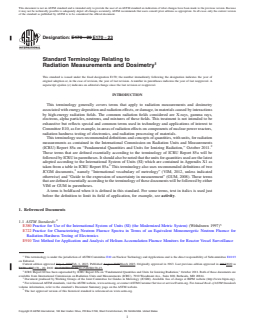
(Terminology)Standard Terminology Relating to Radiation Measurements and Dosimetry
General Information
- Abstract
- Status
- Published
- Publication Date
- 31-Jan-2023
- Technical Committee
- E10 - Nuclear Technology and Applications
- Drafting Committee
- E10.93 - Editorial
Overview
ASTM E170-23 - Standard Terminology Relating to Radiation Measurements and Dosimetry provides authoritative definitions for terms widely used in the fields of radiation measurements and dosimetry. Developed by the ASTM Committee E10 on Nuclear Technology and Applications, this terminology document harmonizes essential concepts with SI units and major international references, ensuring common understanding across disciplines engaged with ionizing radiation. It covers definitions related to energy deposition in materials, radiation effects on matter, and specialized language relevant to nuclear reactors, electronics hardness testing, and radiation processing of materials.
By outlining standardized terminology, ASTM E170-23 helps improve communication and reliability among professionals in nuclear technology, radiation safety, and quality assurance environments. Its alignment with ICRU, JCGM, NIST, and ISO documentation supports global harmonization in measurement and reporting.
Key Topics
- Fundamental Quantities: Definitions for core radiation measurement concepts such as absorbed dose, kerma, exposure, fluence, activity, and their respective units (e.g., gray, sievert, becquerel).
- Types of Radiation: Terminology covering X-rays, gamma rays, electrons, alpha particles, neutrons, and mixtures, facilitating precise discussion of radiation fields.
- Measurement Standards: Detailed terms for calibration, standard fields, certified reference materials, metrological traceability, and associated processes.
- Uncertainty and Accuracy: Clarity on measurement uncertainty (expanded, combined, aleatory, epistemic), accuracy, precision, and expression of uncertainty in line with international vocabularies.
- Dosimetry Systems and Devices: Definitions of dosimeter, dosimetry system, calorimeter, Fricke dosimeter, and related instrumentation.
- Radiation Interactions: Key concepts such as ionization, Compton scattering, bremsstrahlung, buildup factors, and neutron fluence spectra.
Applications
ASTM E170-23 terminology is applicable across a range of industries and scientific disciplines where radiation measurement and dosimetry play a critical role, including:
- Nuclear Power: Standardizing the language used to describe radiation effects on reactor components, enabling accurate dosimetry and safety analysis.
- Radiation Hardness Testing: Ensuring consistent measurement principles in the testing and certification of electronic devices for radiation environments.
- Medical Physics and Healthcare: Providing a common technical vocabulary for radiation therapy, diagnostic radiology, and health physics, supporting quality assurance and patient safety.
- Radiation Processing: Facilitating clear communication in industries utilizing radiation for materials modification, sterilization, or food processing.
- Research and Development: Enabling researchers to accurately describe, compare, and validate experimental results involving radiation and its measurement.
- Regulatory and Compliance: Supporting traceable, internationally recognized reporting in compliance with health, safety, and environmental regulations.
Related Standards
ASTM E170-23 is complemented by several reference standards and international documents, including:
- ASTM E722: Practice for Characterizing Neutron Fluence Spectra in Terms of an Equivalent Monoenergetic Neutron Fluence
- ASTM E910: Test Method for Application and Analysis of Helium Accumulation Fluence Monitors
- ICRU Report 85a: Fundamental Quantities and Units for Ionizing Radiation
- JCGM 100:2008 (GUM): Guide to the Expression of Uncertainty in Measurement
- JCGM 200:2012 (VIM): International Vocabulary of Metrology
- NIST Technical Note 1297: Guidelines for Evaluating and Expressing Uncertainty of NIST Measurement Results
- ISO 10012: Measurement Management Systems – Requirements for Measurement Processes and Measuring Equipment
Using ASTM E170-23 ensures clarity, comparability, and compliance in radiation dosimetry and measurement reporting, reinforcing best practices within both national and international contexts.
Relations
- Effective Date
- 01-Oct-2019
- Effective Date
- 01-Feb-2018
- Effective Date
- 01-Jun-2014
- Effective Date
- 01-Jan-2013
- Effective Date
- 01-Jun-2009
- Effective Date
- 01-Jun-2009
- Effective Date
- 01-Jun-2007
- Effective Date
- 15-Feb-2005
- Effective Date
- 01-Jun-2004
- Effective Date
- 01-Jun-2004
- Effective Date
- 10-Jun-2001
- Effective Date
- 10-Jun-2001
- Effective Date
- 15-Sep-1994
Get Certified
Connect with accredited certification bodies for this standard

BSMI (Bureau of Standards, Metrology and Inspection)
Taiwan's standards and inspection authority.
Sponsored listings
Frequently Asked Questions
ASTM E170-23 is a standard published by ASTM International. Its full title is "Standard Terminology Relating to Radiation Measurements and Dosimetry". This standard covers: Standard Terminology Relating to Radiation Measurements and Dosimetry
Standard Terminology Relating to Radiation Measurements and Dosimetry
ASTM E170-23 is classified under the following ICS (International Classification for Standards) categories: 01.040.17 - Metrology and measurement. Physical phenomena (Vocabularies); 17.240 - Radiation measurements. The ICS classification helps identify the subject area and facilitates finding related standards.
ASTM E170-23 has the following relationships with other standards: It is inter standard links to ASTM E722-19, ASTM E910-18, ASTM E722-14, ASTM E910-07(2013), ASTM E722-09e1, ASTM E722-09, ASTM E910-07, ASTM E722-04e2, ASTM E722-04, ASTM E722-04e1, ASTM E910-01, ASTM E910-95, ASTM E722-94(2002). Understanding these relationships helps ensure you are using the most current and applicable version of the standard.
ASTM E170-23 is available in PDF format for immediate download after purchase. The document can be added to your cart and obtained through the secure checkout process. Digital delivery ensures instant access to the complete standard document.
Standards Content (Sample)
This international standard was developed in accordance with internationally recognized principles on standardization established in the Decision on Principles for the
Development of International Standards, Guides and Recommendations issued by the World Trade Organization Technical Barriers to Trade (TBT) Committee.
Designation: E170 − 23
Standard Terminology Relating to
Radiation Measurements and Dosimetry
This standard is issued under the fixed designation E170; the number immediately following the designation indicates the year of
original adoption or, in the case of revision, the year of last revision. A number in parentheses indicates the year of last reapproval. A
superscript epsilon (´) indicates an editorial change since the last revision or reapproval.
INTRODUCTION
This terminology generally covers terms that apply to radiation measurements and dosimetry
associated with energy deposition and radiation effects, or damage, in materials caused by interactions
by high-energy radiation fields. The common radiation fields considered are X-rays, gamma rays,
electrons, alpha particles, neutrons, and mixtures of these fields. This treatment is not intended to be
exhaustive but reflects special and common terms used in technology and applications of interest to
Committee E10, as for example, in areas of radiation effects on components of nuclear power reactors,
radiation hardness testing of electronics, and radiation processing of materials.
This terminology uses recommended definitions and concepts of quantities, with units, for radiation
measurements as contained in the International Commission on Radiation Units and Measurements
(ICRU) Report 85a on “Fundamental Quantities and Units for Ionizing Radiation,” October 2011.
Those terms that are defined essentially according to the terminology of ICRU Report 85a will be
followed by ICRU in parentheses. It should also be noted that the units for quantities used are the latest
adopted according to the International System of Units (SI) which are contained in Appendix X1 as
taken from a table in ICRU Report 85a. This terminology also uses recommended definitions of two
JCGM documents, namely “International vocabulary of metrology” (VIM, 2012, unless indicated
otherwise) and “Guide to the expression of uncertainty in measurement” (GUM, 2008). Those terms
that are defined essentially according to the terminology of these documents will be followed by either
VIM or GUM in parentheses.
A term is boldfaced when it is defined in this standard. For some terms, text in italics is used just
before the definition to limit its field of application, for example, see activity.
1. Referenced Documents E380 Practice for Use of the International System of Units
(SI) (the Modernized Metric System) (Withdrawn 1997)
1.1 ASTM Standards:
E722 Practice for Characterizing Neutron Fluence Spectra in
Terms of an Equivalent Monoenergetic Neutron Fluence
for Radiation-Hardness Testing of Electronics
This terminology is under the jurisdiction of ASTM Committee E10 on Nuclear
E910 Test Method for Application and Analysis of Helium
Technology and Applications and is the direct responsibility of Subcommittee
Accumulation Fluence Monitors for Reactor Vessel Sur-
E10.93 on Editorial.
veillance
Current edition approved Feb. 1, 2023. Published March 2023. Originally
approved in 1963. Last previous edition approved in 2020 as E170 – 20. DOI:
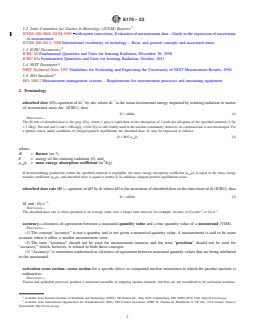
1.2 Joint Committee for Guides in Metrology (JCGM)
10.1520/E0170-23. 3
Reports:
ICRU Report 60 has been superseded by ICRU Report 85a on “Fundamental
JCGM 100:2008, GUM 1995 with minor corrections, Evalu-
Quantities and Units for Ionizing Radiation,” October 2011. Both of these
documents are available from International Commission on Radiation Units and
ation of measurement data – Guide to the expression of
Measurements (ICRU), 7910 Woodmont Ave., Suite 800, Bethesda, MD 20814.
uncertainty in measurement
Document produced by Working Groups of the Joint Committee for Guides in
JCGM 200:2012, VIM International vocabulary of metrol-
Metrology (JCGM). Available free of charge at BIPM website (http://
ogy – Basic and general concepts and associated terms
www.bipm.org).
For referenced ASTM standards, visit the ASTM website, www.astm.org, or
contact ASTM Customer Service at service@astm.org. For Annual Book of ASTM
Standards volume information, refer to the standard’s Document Summary page on The last approved version of this historical standard is referenced on www.ast-
the ASTM website. m.org.
Copyright © ASTM International, 100 Barr Harbor Drive, PO Box C700, West Conshohocken, PA 19428-2959. United States
E170 − 23
1.3 ICRU Documents: (3) “Accuracy” is sometimes understood as closeness of
ICRU 60 Fundamental Quantities and Units for Ionizing agreement between measured quantity values that are being
Radiation, December 30, 1998 attributed to the measurand.
ICRU 85a Fundamental Quantities and Units for Ionizing
activation cross section—cross section for a specific direct or
Radiation, October, 2011
compound nuclear interaction in which the product nucleus
1.4 NIST Document:
is radioactive.
NIST Technical Note 1297 Guidelines for Evaluating and
DISCUSSION—Fission and spallation processes produce a statistical
Expressing the Uncertainty of NIST Measurement
ensemble of outgoing nuclear channels, but they are not considered to
Results, 1994
be activation reactions.
1.5 ISO Standard:
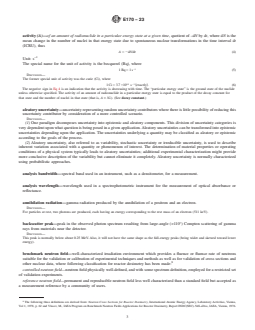
activity (A)—of an amount of radionuclide in a particular
ISO 10012 Measurement management systems – Require-
energy state at a given time, quotient of –dN by dt, where dN
ments for measurement processes and measuring equip-
is the mean change in the number of nuclei in that energy
ment
state due to spontaneous nuclear transformations in the time
2. Terminology
interval dt (ICRU), thus
A 5 2dN/dt (4)
absorbed dose (D)—quotient of dε¯ by dm, where dε¯ is the
mean incremental energy imparted by ionizing radiation to −1
Unit: s
matter of incremental mass dm. (ICRU), thus
The special name for the unit of activity is the becquerel
D 5 dε¯/dm (1) (Bq), where
DISCUSSION—The SI unit of absorbed dose is the gray (Gy), where 1
1 Bq 5 1 s (5)
gray is equivalent to the absorption of 1 joule per kilogram of the
DISCUSSION—The former special unit of activity was the curie (Ci),
specified material (1 Gy = 1 J/kg). The unit rad (1 rad = 100 erg/g =
where
0.01 Gy) is still widely used in the nuclear community; however, its
10 21
continued use is not encouraged. For a photon source under conditions 1 Ci 5 3.7 × 10 s ~exactly!. (6)
of charged particle equilibrium, the absorbed dose, D, may be ex- The negative sign in Eq 4 is an indication that the activity is de-
pressed as follows: creasing with time. The “particular energy state” is the ground state of
the nuclide unless otherwise specified. The activity of an amount of
D 5 Φ·E·μ /ρ, (2)
en
radionuclide in a particular energy state is equal to the product of the
decay constant for that state and the number of nuclei in that state (that
where:
–2 is, A = Nλ). (See decay constant.)
Φ = fluence (m ),
E = energy of the ionizing radiation (J), and
aleatory uncertainty—uncertainty representing random un-
μ /ρ = mass energy absorption coefficient (m /kg).
en certainty contributors where there is little possibility of
reducing this uncertainty contributor by consideration of a
If bremsstrahlung production within the specified material is
negligible, the mass energy absorption coefficient (μ /ρ) is equal to the
more controlled scenario.
en
mass energy transfer coefficient (μ /ρ), and absorbed dose is equal to
DISCUSSION—
tr
kerma if, in addition, charged particle equilibrium exists.
(1) One paradigm decomposes uncertainty into epistemic
and aleatory components. This division of uncertainty catego-
˙
absorbed dose rate (D)—quotient of dD by dt where dD is the
ries is very dependent upon what question is being posed in a
increment of absorbed dose in the time interval dt (ICRU),
given application. Aleatory uncertainties can be transformed
thus
into epistemic uncertainties depending upon the application.
˙
D 5 dD/dt (3)
The uncertainties underlying a quantity may be classified as
−1
aleatory or epistemic according to the goals of the process.
SI unit: Gy·s .
(2) Aleatory uncertainty, also referred to as variability,
DISCUSSION—The absorbed-dose rate is often specified as an average
−1
stochastic uncertainty or irreducible uncertainty, is used to
value over a longer time interval, for example, in units of Gy·min or
−1
Gy·h .
describe inherent variation associated with a quantity or
phenomenon of interest. The determination of material prop-
accuracy—closeness of agreement between a measured quan-
erties or operating conditions of a physical system typically
tity value and a true quantity value of a measurand (VIM).
leads to aleatory uncertainties; additional experimental charac-
DISCUSSION—
terization might provide more conclusive description of the
(1) The concept “accuracy” is not a quantity and is not
variability but cannot eliminate it completely. Aleatory uncer-
given a numerical quantity value. A measurement is said to be
tainty is normally characterized using probabilistic approaches.
more accurate when it offers a smaller measurement error.
(2) The term “accuracy” should not be used for measure-
analysis bandwidth—spectral band used in an instrument,
ment trueness and the term “precision” should not be used for
such as a densitometer, for a measurement.
“accuracy,” which, however, is related to both these concepts.
analysis wavelength—wavelength used in a spectrophotomet-
ric instrument for the measurement of optical absorbance or
Available from National Institute of Standards and Technology (NIST), 100
reflectance.
Bureau Dr., Stop 1070, Gaithersburg, MD 20899-1070, USA, http://www.nist.gov
Available from International Organization for Standardization (ISO), ISO
annihilation radiation—gamma radiation produced by the
Central Secretariat, BIBC II, Chemin de Blandonnet 8, CP 401, 1214 Vernier,
Geneva, Switzerland, http://www.iso.org. annihilation of a positron and an electron.
E170 − 23
DISCUSSION—For particles at rest, two photons are produced, each
cadmium ratio—ratio of the neutron reaction rate measured
having an energy corresponding to the rest mass of an electron (511
with a given bare neutron detector to the neutron reaction
keV).
rate measured with an identical neutron detector enclosed by
a particular cadmium cover and exposed in the same neutron
backscatter peak—peak in the observed photon spectrum
field at the same or an equivalent spatial location.
resulting from large-angle (>110°) Compton scattering of
DISCUSSION—In practice, meaningful experimental values can be
gamma rays from materials near the detector.
obtained in an isotropic neutron field by using a cadmium filter
DISCUSSION—This peak is normally below about 0.25 MeV. Also, it
approximately 1 mm thick.
will not have the same shape as the full-energy peaks (being wider and
skewed toward lower energy).
calibrated instrument—instrument that has been through a
calibration process at established time intervals.
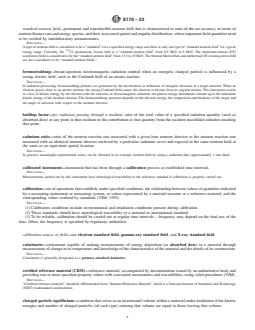
benchmark neutron field—well-characterized irradiation en-
DISCUSSION—Measurements carried out by this instrument have
vironment which provides a fluence or fluence rate of
metrological traceability to the reference standard if calibration is
neutrons suitable for the validation or calibration of experi-
properly carried out.
mental techniques and methods as well as for validation of
calibration—set of operations that establish, under specified
cross sections and other nuclear data, where following
conditions, the relationship between values of quantities
classification for reactor dosimetry has been made:
indicated by a measuring instrument or measuring system, or
controlled neutron field—neutron field physically well-
values represented by a material measure or a reference
defined, and with some spectrum definition, employed for a
material, and the corresponding values realized by standards
restricted set of validation experiments.
(VIM: 1993).
reference neutron field—permanent and reproducible neu-
DISCUSSION—
tron field less well characterized than a standard field but
(1) Calibration conditions include environmental and irra-
accepted as a measurement reference by a community of users.
diation conditions present during calibration.
standard neutron field—permanent and reproducible neutron
(2) These standards should have metrological traceability
field that is characterized to state-of-the-art accuracy in terms to a national or international standard.
of neutron fluence rate and energy spectra, and their associated
(3) To be reliable, calibration should be carried out at
spatial and angular distributions, where important field quan- regular time intervals – frequency may depend on the final use
tities need to be verified by interlaboratory measurements.
of the data. Often, the frequency is specified by regulatory
DISCUSSION—A type of neutron field is considered to be a “standard”
authorities.
over a specified energy range and there is only one type of “standard
calibration source or field—see electron standard field,
neutron field” for a given energy range. Currently, the Cf spontane-
ous fission field is a “standard neutron field” from 0.5 MeV to 8 MeV. gamma-ray standard field, and X-ray standard field.
The deuterium-tritium (DT) accelerator field is considered to be the
calorimeter—instrument capable of making measurements of
“standard neutron field” from 13.5 to 15 MeV. The thermal Maxwellian
energy deposition (or absorbed dose) in a material through
and epithermal 1/E slowing-down field are also considered to be
measurement of change in its temperature and knowledge of
“standard neutron fields.”
the characteristics of the material and the details of its
bremsstrahlung—broad-spectrum electromagnetic radiation
construction.
DISCUSSION—Calorimeter is generally designated as a primary-
emitted when an energetic charged particle is influenced by
standard dosimeter.
a strong electric field, such as the Coulomb field of an atomic
nucleus.
certified reference material (CRM)—reference material, ac-
DISCUSSION—In radiation processing, bremsstrahlung photons are
companied by documentation issued by an authoritative
generated by the deceleration or deflection of energetic electrons in a
body and providing one or more specified property values
target material. When an electron passes close to an atomic nucleus, the
with associated uncertainties and traceabilities, using valid
strong Coulomb field causes the electron to deviate from its original
procedures (VIM).
motion. This interaction results in a loss of kinetic energy by the
DISCUSSION—“Certified reference material” should be differentiated
electron with the emission of electromagnetic radiation; the photon
from “Standard Reference Material” which is a National Institute of
energy distribution extends up to the maximum kinetic energy of the
Standards and Technology (NIST) trademarked nomenclature.
incident electron. This bremsstrahlung spectrum depends on the elec-
tron energy, the composition and thickness of the target, and the angle
charged particle equilibrium—condition that exists in an
of emission with respect to the incident electron.
incremental volume within a material under irradiation if the
buildup factor—for radiation passing through a medium,
kinetic energies and number of charged particles (of each
ratio of the total value of a specified radiation quantity (such
type) entering that volume are equal to those leaving that
as absorbed dose) at any point in that medium to the
volume.
contribution to that quantity from the incident uncollided DISCUSSION—When electrons are the predominant charged particle,
the term “electron equilibrium” is often used to describe charged
radiation reaching that point.
particle equilibrium. See also the discussions attached to the definitions
of kerma and absorbed dose.
The following three definitions are derived from: Neutron Cross Sections for
coincidence sum peak—for gamma spectroscopy, peak in the
Reactor Dosimetry, International Atomic Energy Agency, Laboratory Activities,
observed photon spectrum produced at an energy corre-
Vienna, Vol 1, 1978, p. 62 and Vlasov, M., IAEA Program on Benchmark Neutron
sponding to the sum of the energies of two or more gamma-
Fields Applications for Reactor Dosimetry, Report INDC(SEC)-54/L+Dos, IAEA,
Vienna, 1976. or x-rays from a single nuclear event when the emitted
E170 − 23
neutron that initiates the fission event. The fission yields for a
photons interact with the detector within the resolving time
spontaneous fission event are distinct from those for a thermal or fast
of the measurement system.
neutron-induced fission.
combined standard uncertainty—standard uncertainty that
decay constant (λ)—of a radionuclide in a particular energy
is obtained using the individual standard uncertainties asso-
state, quotient of –dN/N by dt, where dN/N is the mean
ciated with the input quantities in a measurement model
fractional change in the number of nuclei in that energy state
(VIM).
due to spontaneous nuclear transformations in the time
DISCUSSION—In case of correlations of input quantities contributing
interval dt (ICRU), thus
to the resulting uncertainty, covariances must also be taken into account
when calculating the combined standard uncertainty.
2dN⁄N
λ 5 (11)
dt
Compton edge (E )—maximum energy value of electrons of
c
−1
the Compton scattering continuum, which is given by:
Unit: s
DISCUSSION—The quantity (ln 2)/λ is commonly called the half-life,
E
γ
E 5 E 2 (7)
T ⁄2 , of the radionuclide, that is, the time taken for the activity of an
c γ
2E
γ
11 amount of radionuclide to become half its initial value.
0.511
DISCUSSION—This value corresponds to 180° scattering of the pri-
depth-dose distribution—variation of absorbed dose with
mary photon of energy E (MeV). For a 1 MeV photon, the Compton
γ
depth from the incident surface of a material exposed to a
edge is about 0.8 MeV.
given radiation.
Compton scattering—elastic scattering of a photon by an
displacement cross section (σ )—of a target entity, for
d
atomic electron, under the condition of conservation of
displacements produced by incident charged or uncharged
momentum, that is, the vector sum of the momenta of the
particles of a given type and energy, quotient of dpa by Φ,
outgoing electron and photon is equal to the momentum of
where dpa is the mean number of displacements per target
the incident photon.
atom subjected to the fluence Φ. Thus,
DISCUSSION—The scattered photon energy, E' (in MeV), is given by
γ
σ 5 dpa/Φ (12)
d
E
γ 2
Unit: m
E' 5 (8)
γ
E ~1 2 cos θ!
γ
DISCUSSION—The special unit of cross section is the barn, b, where:
0.511
228 2 224 2
1b 5 10 m 5 10 cm (13)
where E is the incident photon energy in MeV and θ is the angle
γ
displacement dose (D )—quotient of dε¯ by dm, where dε¯ is
between the direction of the incident and scattered photon. The elec-
d d d
tron energy, E , is equal to E − E' . that part of the mean incremental energy which produces
e γ γ
atomic displacements (that is, excluding the energy that
continuum—for gamma spectroscopy, smooth distribution of
produces ionization and excitation of electrons) imparted by
energy deposited in a gamma detector arising from partial
radiation to matter of incremental mass dm, thus
energy absorption from Compton scattering or other pro-
D 5 dε¯ /dm (14)
cesses (for example, bremsstrahlung). See Compton scat- d d
−1
tering.
Unit: J·kg
DISCUSSION—A more common unit is displacements per atom (dpa)
coverage factor (k)—number larger than one by which a
(see definition).
combined standard uncertainty is multiplied to obtain an
expanded uncertainty (VIM).
displacement threshold energy (E )—minimum kinetic en-
d
DISCUSSION—Coverage factor is typically in the range of 2 to 3.
ergy imparted to a lattice atom to permanently displace it
from its initial lattice site.
cross section (σ)—of a target entity, for a particular interac-
DISCUSSION—This energy refers to the energy required to create the
tion produced by incident charged or uncharged particles of
initial Frenkel pair, that is, a vacancy-interstitial defect pair, and is
a given type and energy, quotient of N by Φ, where N is
int int
independent of subsequent defect interaction or thermal recombination
the mean number of such interactions per target entity
effects. This energy can have an angle-dependence and, in polyatomic
subjected to the fluence Φ (adapted from ICRU), thus lattices, can be different for different types of lattice atoms. Displace-
ment threshold energies in typical solids are on the order of 10-50 eV.
σ 5 N /Φ (9)
int
displacements per atom (dpa)—mean number of times each
Unit: m
atom of a solid is displaced from its lattice site during its
DISCUSSION—The special unit of cross section is the barn, b, where
exposure to radiation.
228 2 224 2
1 b 5 10 m 5 10 cm (10)
DISCUSSION—This quantity is calculated from the displacement dose
using a dislocation efficiency model such as Kinchin-Pease or
cumulative fission yield—total number of atoms of a specific
Norget-Robinson-Torrens (NRT) model.
nuclide produced directly by a fission event and via radio-
active decay of the precursors.
DISCUSSION—This definition is from INDC(NDS)-0534. The fission
Kinchin, G. H., and Pease, R. S., “The Displacement of Atoms in Solids by
yield (either independent or cumulative) varies with the energy of the
Radiation,” Reports on Progress in Physics, Vol 18, 1955, pp. 1–51.
Norgett, M. J., Robinson, M. T., and Torrens, I. M., “A Proposed Method of
Calculating Displacement Dose Rates,” Nuclear Engineering and Design, Vol 33,
Handbook of Nuclear Data for Safeguards: Database Extensions, August 2008. 1975, pp. 50–54.
E170 − 23
dosimeter—device that, when irradiated, exhibits a quantifi- into aleatory uncertainties depending upon the application. The
able change that can be related to a dosimetric quantity using uncertainties underlying a quantity may be classified as alea-
appropriate measurement instrument(s) and procedures. tory or epistemic according to the goals of the process.
DISCUSSION—As discussed in ICRU-85a, dosimetric quantities pro-
(2) The epistemic component is also called the reducible
vide a physical measure to correlate with actual or potential effects.
uncertainty and can arise from assumptions introduced in the
They are products of radiometric quantities and interaction coefficients.
derivation of the mathematical model used or simplifications
In calculations, the values of these quantities and coefficients must be
related to the correlation or dependence between physical
known, while measurements might not require this information. Dosi-
processes. This epistemic uncertainty has the possibility of
metric quantities include air kerma, exposure and absorbed dose to a
being reduced if one can gather more data or refine modeling
specified material.
assumptions. Epistemic uncertainty is not well characterized
dosimetry system—interrelated elements used for determining
by probabilistic approaches because it might be difficult to
a dosimetric quantity, including dosimeters, measurement
infer any statistical information due to the nominal lack of
instruments and their associated reference standards, and
knowledge.
procedures for their use.
epithermal neutrons—general classification of neutrons with
DISCUSSION—As discussed in ICRU-85a, dosimetric quantities pro-
energies above those of thermal neutrons; or frequently,
vide a physical measure to correlate with actual or potential effects.
neutrons with energies in the resonance range, between the
They are products of radiometric quantities and interaction coefficients.
thermal limit and some upper limit, such as 0.1 MeV (see
In calculations, the values of these quantities and coefficients must be
thermal neutrons).
known, while measurements might not require this information. Dosi-
metric quantities include air kerma, exposure and absorbed dose to a DISCUSSION—The term “epithermal neutrons” is generally used in
specified material. thermal neutron systems when two groups of neutrons are considered.
The term is not used to describe high energy neutrons in other types of
effective cadmium cut-off energy (E )—energy at which a
Cd systems such as fast or fusion reactors.
specified thickness of cadmium results in the same reaction
equivalent fission fluence—fluence of fission spectrum neu-
rate in a 1/v detector as a theoretically perfect filter which
trons that would give a detector or material response for a
has the following properties in a neutron field with a 1/E
particular reaction equal to that in a given neutron field.
energy dependence of the neutron fluence spectrum: (1) for
all energies below E , no neutrons are present after the
Cd equivalent 2200 m/s fluence (Φ )—measure of the effective
w
filter, and (2) for all energies above E , neutron reactions
Cd thermal neutron fluence made with an ideal l/v detector and
after the filter occur at the same rate as if the cadmium filter
using the 2200 m/s cross section, thus
were not present.
t
i
DISCUSSION—E varies with the cadmium thickness and geometry
Cd
Φ 5 *n~t!v dt (15)
w 0
used for the filter, and the angular distribution of incident neutrons. The
definition is applicable for detectors whose cross sections do not depart
where:
significantly from a 1/v dependence in the region of the cut-off energy,
and also for neutron fields whose neutron fluence spectrum does not
n(t) = neutron density, at time t after the beginning of the
depart significantly from a 1/E energy dependence in region of the
exposure of the detector,
cut-off energy.
v = 2200 m/s, and
t = duration of the exposure of the detector.
i
effıciency—see total efficiency and full-energy peak effi-
ciency.
DISCUSSION—The equivalent 2200 m/s fluence is often referred to as
electron equilibrium—charged-particle equilibrium for the Westcott convention fluence, or simply the Westcott fluence. The
symbol nv t is sometimes used. All neutrons are included in n(t) (not
electrons.
just thermal neutrons). The equivalent 2200 m/s is especially useful
electron standard field—electron field whose particle energy
when cadmium is not being used.
and direction, spatial uniformity, temporal profile, and flu-
` ` ` ` σ v
0 0
Reactions 5 n E,t vσ E Edt 5 n E,t v dEdt
ence rate uniformity are well established and reproducible. * * ~ ! ~ ! * * ~ !
0 0 0 0 v
`
energy calibration—process of establishing the relationship
5 n t σ v dt5Φ σ (16)
* ~ !
0 0 w 0
between photon or particle energy and channel number in the
σ v
spectrometer.
0 0
σ(E) may be expressed as for a l/v cross section. Φ may
w
DISCUSSION—The energy calibration may be as simple as building a v
not be a measured value (that is, made with a 1/v detector). It may be a
table of two or more energy-channel pairs or as complex as using a least
calculated quantity.
squares algorithm to establish a function describing the energy versus
channel relationship.
equivalent monoenergetic neutron fluence (Φ (E ))—
eq o
measure of an incident energy fluence spectrum, Φ(E), in
epistemic uncertainty—uncertainty component solely due to
terms of the fluence of monoenergetic neutrons at a specific
a lack of knowledge.
DISCUSSION—
(1) One paradigm decomposes uncertainty into epistemic
Westcott, C. H., Walker, W. H., and Alexander, T. K., “Effective Cross Sections
and aleatory components. This division of uncertainty catego-
and Cadmium Ratios for the Neutron Spectra of Thermal Reactors,” Proceedings of
ries is very dependent upon what question is being posed in a
the International Conference on Peaceful Uses of Atomic Energy, United Nations,
given application. Epistemic uncertainties can be transformed Vol 16, 1958, p. 70.
E170 − 23
energy, E , that produces the same displacement kerma, K , fluence (Φ)—quotient of dN by da, where dN is the number of
o D
in a specific material (for example, silicon) as Φ(E). particles incident on a sphere of cross-sectional area da
DISCUSSION—In applying this definition, total kerma is divided into
(ICRU), thus
two parts, ionization and displacement kerma (see Practice E722).
Φ 5 dN ⁄ da (20)
escape or pair production peak—peak in a gamma ray
−2
Unit: m
spectrum resulting from the pair production process within
DISCUSSION—In order to distinguish this quantity from the energy
the detector, subsequent annihilation of the positron
fluence, this term is sometimes referred to as “particle fluence.” The
produced, and escape from the detector of one or both of the
fluence may also be expressed as the time integral of the fluence rate.
annihilation photons (see pair production and annihilation
fluence rate (φ)—quotient of dΦ by dt, where dΦ is the
radiation).
increment of fluence in the time interval dt (ICRU), thus
single escape peak—gamma ray spectrum peak correspond-
dΦ d N
ing to escape of one of the annihilation photons from the active
φ 5 5 (21)
dt da dt
volume of the detector, where the peak energy is equal to the
original gamma ray energy minus 511 keV. −2 −1
Unit: m ·s
double escape peak—gamma ray spectrum peak correspond-
DISCUSSION—In order to distinguish this quantity from the energy
ing to escape of both of the annihilation photons from the fluence rate, this term is sometimes referred to as “particle fluence
rate.” The term flux density may be used but the term fluence rate
active volume of the detector, where the peak energy is equal
conforms to the adoption of a uniform set of terms
...
This document is not an ASTM standard and is intended only to provide the user of an ASTM standard an indication of what changes have been made to the previous version. Because
it may not be technically possible to adequately depict all changes accurately, ASTM recommends that users consult prior editions as appropriate. In all cases only the current version
of the standard as published by ASTM is to be considered the official document.
Designation: E170 − 20 E170 − 23
Standard Terminology Relating to
Radiation Measurements and Dosimetry
This standard is issued under the fixed designation E170; the number immediately following the designation indicates the year of
original adoption or, in the case of revision, the year of last revision. A number in parentheses indicates the year of last reapproval. A
superscript epsilon (´) indicates an editorial change since the last revision or reapproval.
INTRODUCTION
This terminology generally covers terms that apply to radiation measurements and dosimetry
associated with energy deposition and radiation effects, or damage, in materials caused by interactions
by high-energy radiation fields. The common radiation fields considered are X-rays, gamma rays,
electrons, alpha particles, neutrons, and mixtures of these fields. This treatment is not intended to be
exhaustive but reflects special and common terms used in technology and applications of interest to
Committee E10, as for example, in areas of radiation effects on components of nuclear power reactors,
radiation hardness testing of electronics, and radiation processing of materials.
This terminology uses recommended definitions and concepts of quantities, with units, for radiation
measurements as contained in the International Commission on Radiation Units and Measurements
(ICRU) Report 85a on “Fundamental Quantities and Units for Ionizing Radiation,” October 2011.
Those terms that are defined essentially according to the terminology of ICRU Report 85a will be
followed by ICRU in parentheses. It should also be noted that the units for quantities used are the latest
adopted according to the International System of Units (SI) which are contained in Appendix X1 as
taken from a table in ICRU Report 85a. This terminology also uses recommended definitions of two
JCGM documents, namely “International vocabulary of metrology” (VIM, 2012, unless indicated
otherwise) and “Guide to the expression of uncertainty in measurement” (GUM, 2008). Those terms
that are defined essentially according to the terminology of these documents will be followed by either
VIM or GUM in parentheses.
A term is boldfaced when it is defined in this standard. For some terms, text in italics is used just
before the definition to limit its field of application, for example, see activity.
1. Referenced Documents
1.1 ASTM Standards:
E380 Practice for Use of the International System of Units (SI) (the Modernized Metric System) (Withdrawn 1997)
E722 Practice for Characterizing Neutron Fluence Spectra in Terms of an Equivalent Monoenergetic Neutron Fluence for
Radiation-Hardness Testing of Electronics
E910 Test Method for Application and Analysis of Helium Accumulation Fluence Monitors for Reactor Vessel Surveillance
This terminology is under the jurisdiction of ASTM Committee E10 on Nuclear Technology and Applications and is the direct responsibility of Subcommittee E10.93
on Editorial.
Current edition approved July 1, 2020Feb. 1, 2023. Published August 2020March 2023. Originally approved in 1963. Last previous edition approved in 20172020 as
E170 – 17.E170 – 20. DOI: 10.1520/E0170-20.10.1520/E0170-23.
ICRU Report 60 has been superseded by ICRU Report 85a on “Fundamental Quantities and Units for Ionizing Radiation,” October 2011. Both of these documents are
available from International Commission on Radiation Units and Measurements (ICRU), 7910 Woodmont Ave., Suite 800, Bethesda, MD 20814.
Document produced by Working Groups of the Joint Committee for Guides in Metrology (JCGM). Available free of charge at BIPM website (http://www.bipm.org).
For referenced ASTM standards, visit the ASTM website, www.astm.org, or contact ASTM Customer Service at service@astm.org. For Annual Book of ASTM Standards
volume information, refer to the standard’s Document Summary page on the ASTM website.
The last approved version of this historical standard is referenced on www.astm.org.
Copyright © ASTM International, 100 Barr Harbor Drive, PO Box C700, West Conshohocken, PA 19428-2959. United States
E170 − 23
1.2 Joint Committee for Guides in Metrology (JCGM) Reports:
JCGM 100:2008, GUM 1995 , with minor corrections, Evaluation of measurement data – Guide to the expression of uncertainty
in measurement
JCGM 200:2012, VIM International vocabulary of metrology – Basic and general concepts and associated terms
1.3 ICRU Documents:
ICRU 60 Fundamental Quantities and Units for Ionizing Radiation, December 30, 1998
ICRU 85a Fundamental Quantities and Units for Ionizing Radiation, October, 2011
1.4 NIST Document:
NIST Technical Note 1297 Guidelines for Evaluating and Expressing the Uncertainty of NIST Measurement Results, 1994
1.5 ISO Standard:
ISO 10012 Measurement management systems – Requirements for measurement processes and measuring equipment
2. Terminology
absorbed dose (D)—quotient of dε¯ by dm, where dε¯ is the mean incremental energy imparted by ionizing radiation to matter
of incremental mass dm. (ICRU), thus
D 5 d¯ε/dm (1)
DISCUSSION—
The SI unit of absorbed dose is the gray (Gy), where 1 gray is equivalent to the absorption of 1 joule per kilogram of the specified material (1 Gy
= 1 J/kg). The unit rad (1 rad = 100 erg/g = 0.01 Gy) is still widely used in the nuclear community; however, its continued use is not encouraged. For
a photon source under conditions of charged particle equilibrium, the absorbed dose, D, may be expressed as follows:
D 5 Φ·E·μ /ρ, (2)
en
where:
–2
Φ = fluence (m ),
E = energy of the ionizing radiation (J), and
μ /ρ = mass energy absorption coefficient (m /kg).
en
If bremsstrahlung production within the specified material is negligible, the mass energy absorption coefficient (μ /ρ) is equal to the mass energy
en
transfer coefficient (μ /ρ), and absorbed dose is equal to kerma if, in addition, charged particle equilibrium exists.
tr
absorbed dose rate (D˙)—quotient of dD by dt where dD is the increment of absorbed dose in the time interval dt (ICRU), thus
˙
D 5 dD/dt (3)
−1
SI unit: Gy·s .
DISCUSSION—
−1 −1
The absorbed-dose rate is often specified as an average value over a longer time interval, for example, in units of Gy·min or Gy·h .
accuracy—closeness of agreement between a measured quantity value and a true quantity value of a measurand (VIM).
DISCUSSION—
(1) The concept “accuracy” is not a quantity and is not given a numerical quantity value. A measurement is said to be more
accurate when it offers a smaller measurement error.
(2) The term “accuracy” should not be used for measurement trueness and the term “precision” should not be used for
“accuracy,” which, however, is related to both these concepts.
(3) “Accuracy” is sometimes understood as closeness of agreement between measured quantity values that are being attributed
to the measurand.
activation cross section—cross section for a specific direct or compound nuclear interaction in which the product nucleus is
radioactive.
DISCUSSION—
Fission and spallation processes produce a statistical ensemble of outgoing nuclear channels, but they are not considered to be activation reactions.
Available from National Institute of Standards and Technology (NIST), 100 Bureau Dr., Stop 1070, Gaithersburg, MD 20899-1070, USA, http://www.nist.gov
Available from International Organization for Standardization (ISO), ISO Central Secretariat, BIBC II, Chemin de Blandonnet 8, CP 401, 1214 Vernier, Geneva,
Switzerland, http://www.iso.org.
E170 − 23
activity (A)—of an amount of radionuclide in a particular energy state at a given time, quotient of –dN by dt, where dN is the
mean change in the number of nuclei in that energy state due to spontaneous nuclear transformations in the time interval dt
(ICRU), thus
A 52dN/dt (4)
−1
Unit: s
The special name for the unit of activity is the becquerel (Bq), where
1 Bq5 1 s (5)
DISCUSSION—
The former special unit of activity was the curie (Ci), where
10 21
1 Ci5 3.7 ×10 s exactly . (6)
~ !
The negative sign in Eq 4 is an indication that the activity is decreasing with time. The “particular energy state” is the ground state of the nuclide
unless otherwise specified. The activity of an amount of radionuclide in a particular energy state is equal to the product of the decay constant for
that state and the number of nuclei in that state (that is, A = Nλ). (See decay constant.)
aleatory uncertainty—uncertainty representing random uncertainty contributors where there is little possibility of reducing this
uncertainty contributor by consideration of a more controlled scenario.
DISCUSSION—
(1) One paradigm decomposes uncertainty into epistemic and aleatory components. This division of uncertainty categories is
very dependent upon what question is being posed in a given application. Aleatory uncertainties can be transformed into epistemic
uncertainties depending upon the application. The uncertainties underlying a quantity may be classified as aleatory or epistemic
according to the goals of the process.
(2) Aleatory uncertainty, also referred to as variability, stochastic uncertainty or irreducible uncertainty, is used to describe
inherent variation associated with a quantity or phenomenon of interest. The determination of material properties or operating
conditions of a physical system typically leads to aleatory uncertainties; additional experimental characterization might provide
more conclusive description of the variability but cannot eliminate it completely. Aleatory uncertainty is normally characterized
using probabilistic approaches.
analysis bandwidth—spectral band used in an instrument, such as a densitometer, for a measurement.
analysis wavelength—wavelength used in a spectrophotometric instrument for the measurement of optical absorbance or
reflectance.
annihilation radiation—gamma radiation produced by the annihilation of a positron and an electron.
DISCUSSION—
For particles at rest, two photons are produced, each having an energy corresponding to the rest mass of an electron (511 keV).
backscatter peak—peak in the observed photon spectrum resulting from large-angle (>110°) Compton scattering of gamma
rays from materials near the detector.
DISCUSSION—
This peak is normally below about 0.25 MeV. Also, it will not have the same shape as the full-energy peaks (being wider and skewed toward lower
energy).
benchmark neutron field—well-characterized irradiation environment which provides a fluence or fluence rate of neutrons
suitable for the validation or calibration of experimental techniques and methods as well as for validation of cross sections and
other nuclear data, where following classification for reactor dosimetry has been made:
controlled neutron field—neutron field physically well-defined, and with some spectrum definition, employed for a restricted set
of validation experiments.
reference neutron field—permanent and reproducible neutron field less well characterized than a standard field but accepted as
a measurement reference by a community of users.
The following three definitions are derived from: Neutron Cross Sections for Reactor Dosimetry, International Atomic Energy Agency, Laboratory Activities, Vienna,
Vol 1, 1978, p. 62 and Vlasov, M., IAEA Program on Benchmark Neutron Fields Applications for Reactor Dosimetry, Report INDC(SEC)-54/L+Dos, IAEA, Vienna, 1976.
E170 − 23
standard neutron field—permanent and reproducible neutron field that is characterized to state-of-the-art accuracy in terms of
neutron fluence rate and energy spectra, and their associated spatial and angular distributions, where important field quantities need
to be verified by interlaboratory measurements.
DISCUSSION—
A type of neutron field is considered to be a “standard” over a specified energy range and there is only one type of “standard neutron field” for a given
energy range. Currently, the Cf spontaneous fission field is a “standard neutron field” from 0.5 MeV to 8 MeV. The deuterium-tritium (DT)
accelerator field is considered to be the “standard neutron field” from 13.5 to 15 MeV. The thermal Maxwellian and epithermal 1/E slowing-down field
are also considered to be “standard neutron fields.”
bremsstrahlung—broad-spectrum electromagnetic radiation emitted when an energetic charged particle is influenced by a
strong electric field, such as the Coulomb field of an atomic nucleus.
DISCUSSION—
In radiation processing, bremsstrahlung photons are generated by the deceleration or deflection of energetic electrons in a target material. When an
electron passes close to an atomic nucleus, the strong Coulomb field causes the electron to deviate from its original motion. This interaction results
in a loss of kinetic energy by the electron with the emission of electromagnetic radiation; the photon energy distribution extends up to the maximum
kinetic energy of the incident electron. This bremsstrahlung spectrum depends on the electron energy, the composition and thickness of the target, and
the angle of emission with respect to the incident electron.
buildup factor—for radiation passing through a medium, ratio of the total value of a specified radiation quantity (such as
absorbed dose) at any point in that medium to the contribution to that quantity from the incident uncollided radiation reaching
that point.
cadmium ratio—ratio of the neutron reaction rate measured with a given bare neutron detector to the neutron reaction rate
measured with an identical neutron detector enclosed by a particular cadmium cover and exposed in the same neutron field at
the same or an equivalent spatial location.
DISCUSSION—
In practice, meaningful experimental values can be obtained in an isotropic neutron field by using a cadmium filter approximately 1 mm thick.
calibrated instrument—instrument that has been through a calibration process at established time intervals.
DISCUSSION—
Measurements carried out by this instrument have metrological traceability to the reference standard if calibration is properly carried out.
calibration—set of operations that establish, under specified conditions, the relationship between values of quantities indicated
by a measuring instrument or measuring system, or values represented by a material measure or a reference material, and the
corresponding values realized by standards (VIM: 1993).
DISCUSSION—
(1) Calibration conditions include environmental and irradiation conditions present during calibration.
(2) These standards should have metrological traceability to a national or international standard.
(3) To be reliable, calibration should be carried out at regular time intervals – frequency may depend on the final use of the
data. Often, the frequency is specified by regulatory authorities.
calibration source or field—see electron standard field, gamma-ray standard field, and X-ray standard field.
calorimeter—instrument capable of making measurements of energy deposition (or absorbed dose) in a material through
measurement of change in its temperature and knowledge of the characteristics of the material and the details of its construction.
DISCUSSION—
Calorimeter is generally designated as a primary-standard dosimeter.
certified reference material (CRM)—reference material, accompanied by documentation issued by an authoritative body and
providing one or more specified property values with associated uncertainties and traceabilities, using valid procedures (VIM).
DISCUSSION—
“Certified reference material” should be differentiated from “Standard Reference Material” which is a National Institute of Standards and Technology
(NIST) trademarked nomenclature.
charged particle equilibrium—condition that exists in an incremental volume within a material under irradiation if the kinetic
energies and number of charged particles (of each type) entering that volume are equal to those leaving that volume.
E170 − 23
DISCUSSION—
When electrons are the predominant charged particle, the term “electron equilibrium” is often used to describe charged particle equilibrium. See also
the discussions attached to the definitions of kerma and absorbed dose.
coincidence sum peak—for gamma spectroscopy, peak in the observed photon spectrum produced at an energy corresponding
to the sum of the energies of two or more gamma- or x-rays from a single nuclear event when the emitted photons interact with
the detector within the resolving time of the measurement system.
combined standard uncertainty—standard uncertainty that is obtained using the individual standard uncertainties associated
with the input quantities in a measurement model (VIM).
DISCUSSION—
In case of correlations of input quantities contributing to the resulting uncertainty, covariances must also be taken into account when calculating the
combined standard uncertainty.
Compton edge (E )—maximum energy value of electrons of the Compton scattering continuum, which is given by:
c
E
γ
E 5 E 2 (7)
c γ
2E
γ
0.511
DISCUSSION—
This value corresponds to 180° scattering of the primary photon of energy E (MeV). For a 1 MeV photon, the Compton edge is about 0.8 MeV.
γ
Compton scattering—elastic scattering of a photon by an atomic electron, under the condition of conservation of momentum,
that is, the vector sum of the momenta of the outgoing electron and photon is equal to the momentum of the incident photon.
DISCUSSION—
The scattered photon energy, E' (in MeV), is given by
γ
E
γ
E' 5 (8)
γ
E 12 cos θ
~ !
γ
0.511
where E is the incident photon energy in MeV and θ is the angle between the direction of the incident and scattered photon. The electron energy,
γ
E , is equal to E − E' .
e γ γ
continuum—for gamma spectroscopy, smooth distribution of energy deposited in a gamma detector arising from partial energy
absorption from Compton scattering or other processes (for example, bremsstrahlung). See Compton scattering.
coverage factor (k)—number larger than one by which a combined standard uncertainty is multiplied to obtain an expanded
uncertainty (VIM).
DISCUSSION—
Coverage factor is typically in the range of 2 to 3.
cross section (σ)—of a target entity, for a particular interaction produced by incident charged or uncharged particles of a given
type and energy, quotient of N by Φ, where N is the mean number of such interactions per target entity subjected to the
int int
fluence Φ (adapted from ICRU), thus
σ5 N /Φ (9)
int
Unit: m
DISCUSSION—
The special unit of cross section is the barn, b, where
228 2 224 2
1 b5 10 m 5 10 cm (10)
cumulative fission yield—total number of atoms of a specific nuclide produced directly by a fission event and via radioactive
decay of the precursors.
E170 − 23
DISCUSSION—
This definition is from INDC(NDS)-0534. The fission yield (either independent or cumulative) varies with the energy of the neutron that initiates the
fission event. The fission yields for a spontaneous fission event are distinct from those for a thermal or fast neutron-induced fission.
decay constant (λ)—of a radionuclide in a particular energy state, quotient of –dN/N by dt, where dN/N is the mean fractional
change in the number of nuclei in that energy state due to spontaneous nuclear transformations in the time interval dt (ICRU),
thus
2dN⁄N
λ5 (11)
dt
−1
Unit: s
DISCUSSION—
The quantity (ln 2)/λ is commonly called the half-life, T ⁄2, of the radionuclide, that is, the time taken for the activity of an amount of radionuclide to
become half its initial value.
depth-dose distribution—variation of absorbed dose with depth from the incident surface of a material exposed to a given
radiation.
displacement cross section (σ )—of a target entity, for displacements produced by incident charged or uncharged particles of
d
a given type and energy, quotient of dpa by Φ, where dpa is the mean number of displacements per target atom subjected to the
fluence Φ. Thus,
σ 5 dpa/Φ (12)
d
Unit: m
DISCUSSION—
The special unit of cross section is the barn, b, where:
228 2 224 2
1b 5 10 m 5 10 cm (13)
displacement dose (D )—quotient of dε¯ by dm, where dε¯ is that part of the mean incremental energy which produces atomic
d d d
displacements (that is, excluding the energy that produces ionization and excitation of electrons) imparted by radiation to matter
of incremental mass dm, thus
D 5 d¯ε /dm (14)
d d
−1
Unit: J · kgJ·kg
DISCUSSION—
A more common unit is displacements per atom (dpa) (see definition).
displacement threshold energy (E )—minimum kinetic energy imparted to a lattice atom to permanently displace it from its
d
initial lattice site.
DISCUSSION—
This energy refers to the energy required to create the initial Frenkel pair, that is, a vacancy-interstitial defect pair, and is independent of subsequent
defect interaction or thermal recombination effects. This energy can have an angle-dependence and, in polyatomic lattices, can be different for different
types of lattice atoms. Displacement threshold energies in typical solids are on the order of 10-50 eV.
displacements per atom (dpa)—mean number of times each atom of a solid is displaced from its lattice site during its exposure
to radiation.
DISCUSSION—
This quantity is calculated from the displacement dose using a dislocation efficiency model such as Kinchin-Pease or Norget-Robinson-Torrens
(NRT) model.
dosimeter—device that, when irradiated, exhibits a quantifiable change that can be related to a dosimetric quantity using
appropriate measurement instrument(s) and procedures.
DISCUSSION—
As discussed in ICRU-85a, dosimetric quantities provide a physical measure to correlate with actual or potential effects. They are products of
Handbook of Nuclear Data for Safeguards: Database Extensions, August 2008.
Kinchin, G. H., and Pease, R. S., “The Displacement of Atoms in Solids by Radiation,” Reports on Progress in Physics, Vol 18, 1955, pp. 1-51.1–51.
Norgett, M. J., Robinson, M. T., and Torrens, I. M., “A Proposed Method of Calculating Displacement Dose Rates,” Nuclear Engineering and Design, Vol 33, 1975,
pp. 50-54.50–54.
E170 − 23
radiometric quantities and interaction coefficients. In calculations, the values of these quantities and coefficients must be known, while measurements
might not require this information. Dosimetric quantities include air kerma, exposure and absorbed dose to a specified material.
dosimetry system—interrelated elements used for determining a dosimetric quantity, including dosimeters, measurement
instruments and their associated reference standards, and procedures for their use.
DISCUSSION—
As discussed in ICRU-85a, dosimetric quantities provide a physical measure to correlate with actual or potential effects. They are products of
radiometric quantities and interaction coefficients. In calculations, the values of these quantities and coefficients must be known, while measurements
might not require this information. Dosimetric quantities include air kerma, exposure and absorbed dose to a specified material.
effective cadmium cut-off energy (E )—energy at which a specified thickness of cadmium results in the same reaction rate
Cd
in a 1/v detector as a theoretically perfect filter which has the following properties in a neutron field with a 1/E energy
dependence of the neutron fluence spectrum: (1) for all energies below E , no neutrons are present after the filter, and (2) for
Cd
all energies above E , neutron reactions after the filter occur at the same rate as if the cadmium filter were not present.
Cd
(1) for all energies below E , no neutrons are present after the filter, and
Cd
(2) for all energies above E , neutron reactions after the filter occur at the same rate as if the cadmium were not present.
Cd
DISCUSSION—
E varies with the cadmium thickness used as the filter and geometry,and geometry used for the filter, and the angular distribution of incident neutrons,
Cd
and ambient temperature. neutrons. The definition is applicable for detectors whose cross sections do nonot depart significantly from a 1/v dependence
in the region of the cut-off energy, and also for neutron fields whose neutron fluence spectrum does not depart significantly from a 1/E energy
dependence in region of the cut-off energy.
effıciency—see total efficiency and full-energy peak efficiency.
electron equilibrium—charged-particle equilibrium for electrons.
electron standard field—electron field whose particle energy and direction, spatial uniformity, temporal profile, and fluence
rate uniformity are well established and reproducible.
energy calibration—process of establishing the relationship between photon or particle energy and channel number in the
spectrometer.
DISCUSSION—
The energy calibration may be as simple as building a table of two or more energy-channel pairs or as complex as using a least squares algorithm to
establish a function describing the energy versus channel relationship.
epistemic uncertainty—uncertainty component solely due to a lack of knowledge.
DISCUSSION—
(1) One paradigm decomposes uncertainty into epistemic and aleatory components. This division of uncertainty categories is
very dependent upon what question is being posed in a given application. Epistemic uncertainties can be transformed into aleatory
uncertainties depending upon the application. The uncertainties underlying a quantity may be classified as aleatory or epistemic
according to the goals of the process.
(2) The epistemic component is also called the reducible uncertainty and can arise from assumptions introduced in the
derivation of the mathematical model used or simplifications related to the correlation or dependence between physical processes.
This epistemic uncertainty has the possibility of being reduced if one can gather more data or refine modeling assumptions.
Epistemic uncertainty is not well characterized by probabilistic approaches because it might be difficult to infer any statistical
information due to the nominal lack of knowledge.
epithermal neutrons—general classification of neutrons with energies above those of thermal neutrons; or frequently, neutrons
with energies in the resonance range, between the thermal limit and some upper limit, such as 0.1 MeV (see thermal neutrons).
DISCUSSION—
The term “epithermal neutrons” is generally used in thermal neutron systems when two groups of neutrons are considered. The term is not used to
describe high energy neutrons in other types of systems such as fast or fusion reactors.
equivalent fission fluence—fluence of fission spectrum neutrons that would give a detector or material response for a particular
reaction equal to that in a given neutron field.
E170 − 23
equivalent 2200 m/s fluence (Φ )—measure of the effective thermal neutron fluence made with an ideal l/v detector and using
w
the 2200 m/s cross section, thus
t
i
Φ 5 n~t!v dt (15)
*
w 0
where:
n(t) = neutron density, at time t after the beginning of the exposure of the detector,
v = 2200 m/s, and
t = duration of the exposure of the detector.
i
DISCUSSION—
The equivalent 2200 m/s fluence is often referred to as the Westcott convention fluence, or simply the Westcott fluence. The symbol nv t is sometimes
used. All neutrons are included in n(t) (not just thermal neutrons). The equivalent 2200 m/s is especially useful when cadmium is not being used.
` ` ` ` σ v `
0 0
Reactions 5 n E,t vσ E Edt 5 n E,t v dEdt 5 n t σ v dt5Φ σ (16)
* * ~ ! ~ ! * * ~ ! * ~ !
0 0 w 0
0 0 0 0 v 0
σ v
0 0
σ(E) may be expressed as for a l/v cross section. Φ may not be a measured value (that is, made with a 1/v detector). It may be a calculated
w
v
quantity.
equivalent monoenergetic neutron fluence (Φ (E ))—measure of an incident energy fluence spectrum, Φ(E), in terms of the
eq o
fluence of monoenergetic neutrons at a specific energy, E , that produces the same displacement kerma, K , in a specific material
o D
(for example, silicon) as Φ(E).
DISCUSSION—
In applying this definition, total kerma is divided into two parts, ionization and displacement kerma (see Practice E722).
escape or pair production peak—peak in a gamma ray spectrum resulting from the pair production process within the detector,
subsequent annihilation of the positron produced, and escape from the detector of one or both of the annihilation photons (see
pair production and annihilation radiation).
single escape peak—gamma ray spectrum peak corresponding to escape of one of the annihilation photons from the active
volume of the detector, where the peak energy is equal to the original gamma ray energy minus 511 keV.
double escape peak—gamma ray spectrum peak corresponding to escape of both of the annihilation photons from the active
volume of the detector, where the peak energy is equal to the original gamma ray energy minus 1.022 MeV.
expanded uncertainty—quantity defining an interval about the result of a measurement that may be expected to encompass a
large fraction of the distribution of values that could reasonably be attributed to the measurand (GUM).
(1) The fractions may be viewed as the coverage probability or level of confidence of the interval.
(2) To associate a specific level of confidence with the interval defined by the expanded uncertainty requires explicit or implicit
assumptions regarding the probability distribution characterized by the measurement result and its combined standard
uncertainty. The level of confidence that may be attributed to this interval can be known only to the extent to which such
assumptions may be justified.
(3) Expanded uncertainty is also referred to as overall uncertainty.
exposure (X)—quotient of dq by dm, where dq is the absolute value of the mean total charge of the ions of one sign
...