


ASTM F2300-10(2016)
(Test Method)Standard Test Method for Measuring the Performance of Personal Cooling Systems Using Physiological Testing
Standard Test Method for Measuring the Performance of Personal Cooling Systems Using Physiological Testing
SIGNIFICANCE AND USE
4.1 This test method can be used to quantify and compare the cooling provided by different Personal Cooling Systems (PCS) worn with a standard outer garment or with a specified protective outer garment.
4.1.1 This test method will assess the performance of PCS based on the physiological measurement of core temperature, mean skin temperature, heart rate, exposure time, oxygen consumption, and whole body sweat rate.
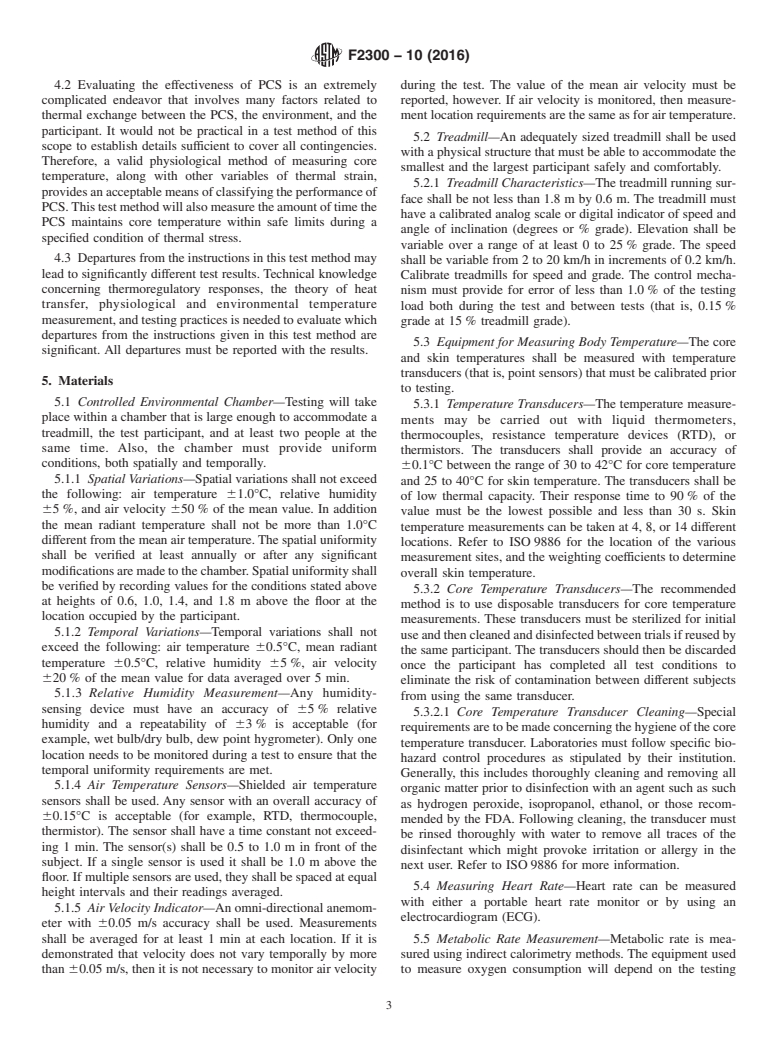
4.2 Evaluating the effectiveness of PCS is an extremely complicated endeavor that involves many factors related to thermal exchange between the PCS, the environment, and the participant. It would not be practical in a test method of this scope to establish details sufficient to cover all contingencies. Therefore, a valid physiological method of measuring core temperature, along with other variables of thermal strain, provides an acceptable means of classifying the performance of PCS. This test method will also measure the amount of time the PCS maintains core temperature within safe limits during a specified condition of thermal stress.
4.3 Departures from the instructions in this test method may lead to significantly different test results. Technical knowledge concerning thermoregulatory responses, the theory of heat transfer, physiological and environmental temperature measurement, and testing practices is needed to evaluate which departures from the instructions given in this test method are significant. All departures must be reported with the results.
SCOPE
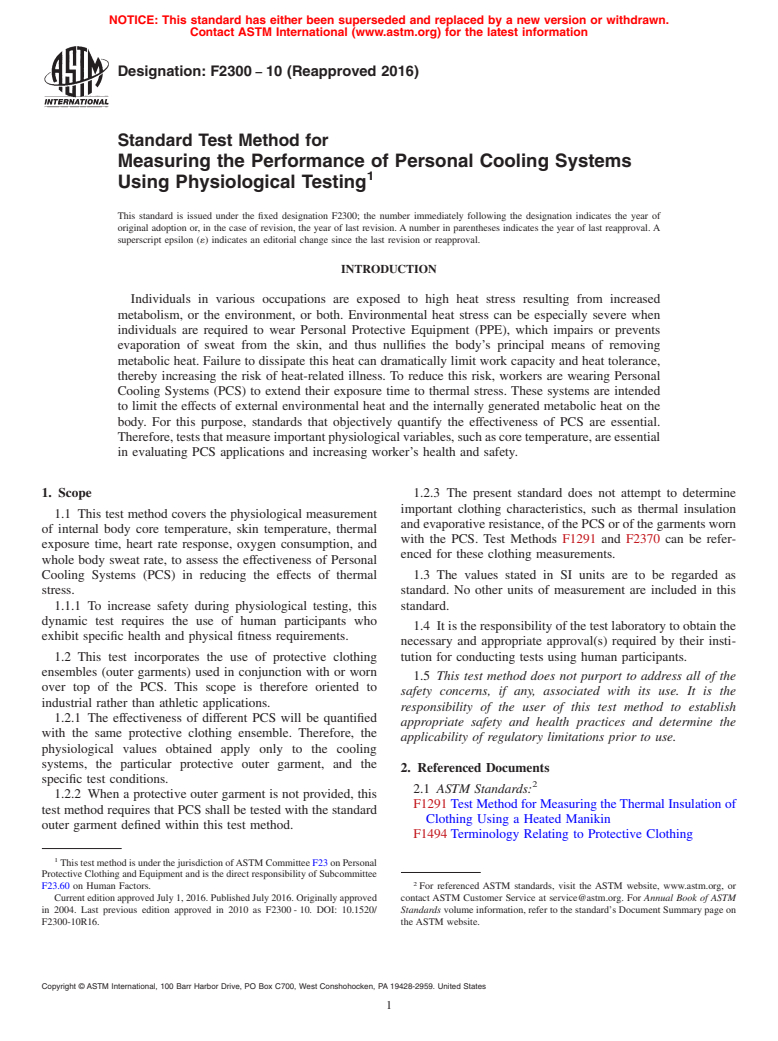
1.1 This test method covers the physiological measurement of internal body core temperature, skin temperature, thermal exposure time, heart rate response, oxygen consumption, and whole body sweat rate, to assess the effectiveness of Personal Cooling Systems (PCS) in reducing the effects of thermal stress.
1.1.1 To increase safety during physiological testing, this dynamic test requires the use of human participants who exhibit specific health and physical fitness requirements.
1.2 This test incorporates the use of protective clothing ensembles (outer garments) used in conjunction with or worn over top of the PCS. This scope is therefore oriented to industrial rather than athletic applications.
1.2.1 The effectiveness of different PCS will be quantified with the same protective clothing ensemble. Therefore, the physiological values obtained apply only to the cooling systems, the particular protective outer garment, and the specific test conditions.
1.2.2 When a protective outer garment is not provided, this test method requires that PCS shall be tested with the standard outer garment defined within this test method.
1.2.3 The present standard does not attempt to determine important clothing characteristics, such as thermal insulation and evaporative resistance, of the PCS or of the garments worn with the PCS. Test Methods F1291 and F2370 can be referenced for these clothing measurements.
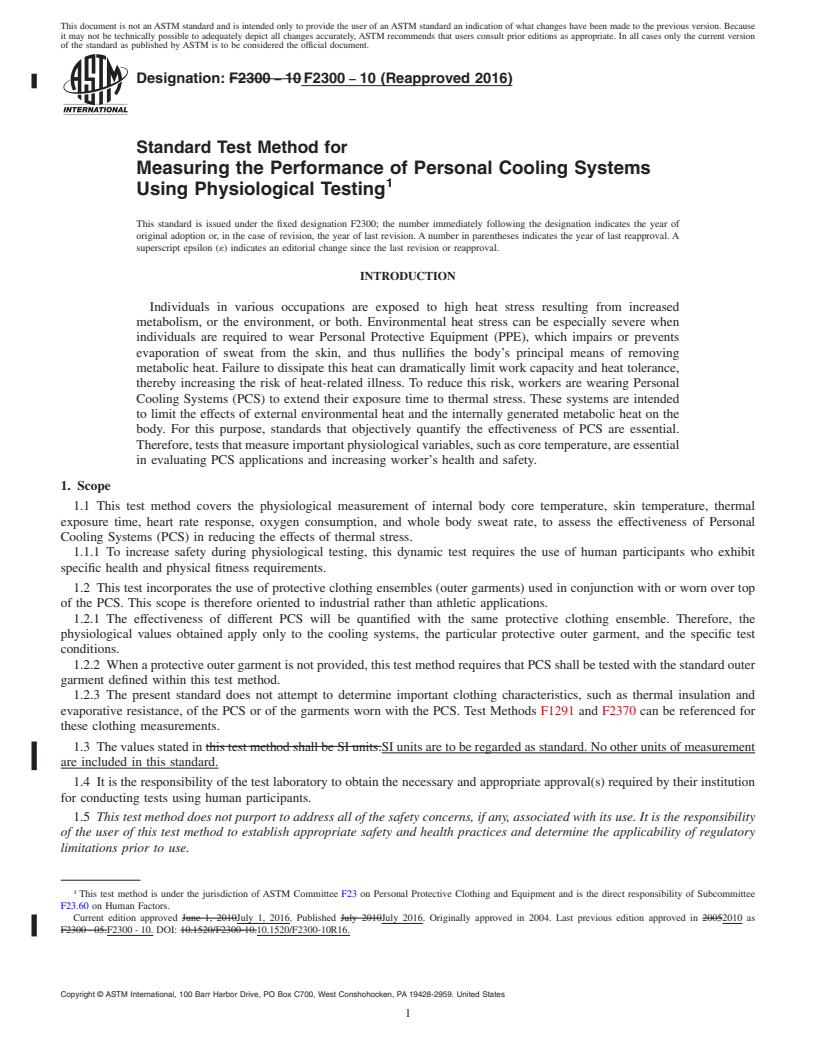
1.3 The values stated in SI units are to be regarded as standard. No other units of measurement are included in this standard.
1.4 It is the responsibility of the test laboratory to obtain the necessary and appropriate approval(s) required by their institution for conducting tests using human participants.
1.5 This test method does not purport to address all of the safety concerns, if any, associated with its use. It is the responsibility of the user of this test method to establish appropriate safety and health practices and determine the applicability of regulatory limitations prior to use.
General Information
Buy Standard
Standards Content (Sample)
NOTICE: This standard has either been superseded and replaced by a new version or withdrawn.
Contact ASTM International (www.astm.org) for the latest information
Designation: F2300 − 10 (Reapproved 2016)
Standard Test Method for
Measuring the Performance of Personal Cooling Systems
Using Physiological Testing
This standard is issued under the fixed designation F2300; the number immediately following the designation indicates the year of
original adoption or, in the case of revision, the year of last revision.Anumber in parentheses indicates the year of last reapproval.A
superscript epsilon (´) indicates an editorial change since the last revision or reapproval.
INTRODUCTION
Individuals in various occupations are exposed to high heat stress resulting from increased
metabolism, or the environment, or both. Environmental heat stress can be especially severe when
individuals are required to wear Personal Protective Equipment (PPE), which impairs or prevents
evaporation of sweat from the skin, and thus nullifies the body’s principal means of removing
metabolic heat. Failure to dissipate this heat can dramatically limit work capacity and heat tolerance,
thereby increasing the risk of heat-related illness. To reduce this risk, workers are wearing Personal
Cooling Systems (PCS) to extend their exposure time to thermal stress. These systems are intended
to limit the effects of external environmental heat and the internally generated metabolic heat on the
body. For this purpose, standards that objectively quantify the effectiveness of PCS are essential.
Therefore,teststhatmeasureimportantphysiologicalvariables,suchascoretemperature,areessential
in evaluating PCS applications and increasing worker’s health and safety.
1. Scope 1.2.3 The present standard does not attempt to determine
important clothing characteristics, such as thermal insulation
1.1 This test method covers the physiological measurement
andevaporativeresistance,ofthePCSorofthegarmentsworn
of internal body core temperature, skin temperature, thermal
with the PCS. Test Methods F1291 and F2370 can be refer-
exposure time, heart rate response, oxygen consumption, and
enced for these clothing measurements.
whole body sweat rate, to assess the effectiveness of Personal
Cooling Systems (PCS) in reducing the effects of thermal 1.3 The values stated in SI units are to be regarded as
stress. standard. No other units of measurement are included in this
1.1.1 To increase safety during physiological testing, this standard.
dynamic test requires the use of human participants who
1.4 Itistheresponsibilityofthetestlaboratorytoobtainthe
exhibit specific health and physical fitness requirements.
necessary and appropriate approval(s) required by their insti-
1.2 This test incorporates the use of protective clothing tution for conducting tests using human participants.
ensembles (outer garments) used in conjunction with or worn
1.5 This test method does not purport to address all of the
over top of the PCS. This scope is therefore oriented to
safety concerns, if any, associated with its use. It is the
industrial rather than athletic applications.
responsibility of the user of this test method to establish
1.2.1 The effectiveness of different PCS will be quantified
appropriate safety and health practices and determine the
with the same protective clothing ensemble. Therefore, the
applicability of regulatory limitations prior to use.
physiological values obtained apply only to the cooling
systems, the particular protective outer garment, and the
2. Referenced Documents
specific test conditions.
2.1 ASTM Standards:
1.2.2 When a protective outer garment is not provided, this
F1291TestMethodforMeasuringtheThermalInsulationof
test method requires that PCS shall be tested with the standard
Clothing Using a Heated Manikin
outer garment defined within this test method.
F1494Terminology Relating to Protective Clothing
ThistestmethodisunderthejurisdictionofASTMCommitteeF23onPersonal
ProtectiveClothingandEquipmentandisthedirectresponsibilityofSubcommittee
F23.60 on Human Factors. For referenced ASTM standards, visit the ASTM website, www.astm.org, or
CurrenteditionapprovedJuly1,2016.PublishedJuly2016.Originallyapproved contact ASTM Customer Service at service@astm.org. For Annual Book of ASTM
in 2004. Last previous edition approved in 2010 as F2300-10. DOI: 10.1520/ Standards volume information, refer to the standard’s Document Summary page on
F2300-10R16. the ASTM website.
Copyright © ASTM International, 100 Barr Harbor Drive, PO Box C700, West Conshohocken, PA 19428-2959. United States
F2300 − 10 (2016)
F2370Test Method for Measuring the Evaporative Resis- 3.1.6.1 Discussion—Core temperature is commonly repre-
tance of Clothing Using a Sweating Manikin sentedbyrectaltemperature,orbythemorerapidlyresponding
esophageal temperature. Core temperature is also measured by
2.2 Other Standards:
ingested telemetric thermometers in the form of a capsule.
ISO8996 Ergonomics—Determination of Metabolic Heat
3.1.7 garment, n—a single item of clothing (for example,
Production
ISO9886Ergonomics—Evaluation of Thermal Strain by shirt).
Physiological Measurements
3.1.8 maximum oxygen consumption (VO ), n—the high-
2max
The Commission for Thermal Physiology of the Interna-
est rate at which an organism can take up oxygen during
tional Union of Physiological Sciences (IUPS Thermal
aerobic metabolism.
Commission)Glossary of Terms for Thermal Physiology
3.1.8.1 Discussion—DeterminationofVO requiresvery
2max
U.S. Food and Drug Administration (FDA)—Cleared Steri-
high motivation of the individual and is expressed in mL per
lants and High Level Disinfectants with General Claims
min or as a term relative to body mass in mL per kg per min.
for Processing Reusable Medical and Dental Devices
Maximumoxygenconsumptionisoftenreferredtoasmaximal
(March 2009)
aerobic power (MAP).
3.1.9 metabolic rate, n—the rate of transformation of
3. Terminology
chemicalenergyintoheatandmechanicalworkbyaerobicand
3.1 Definitions:
anaerobic activities within an organism.
3.1.1 acclimation, n—physiological adaptations occurring
3.1.9.1 Discussion—Metabolic rate, as with VO ,is
2max
within an organism, which reduces the strain or enhances
commonly measured by indirect calorimetry, during long-term
endurance of strain, caused by artificially or experimentally
steady-state work, and is typically expressed in Watts (W).
induced stressful changes in particular environmental condi-
Metabolic rate, also referred to as energy expenditure, is
tions.
usuallyexpressedintermsofunitareaofthetotalbodysurface
3.1.1.1 Discussion—Acclimation describes the adaptive
(W/m ) or of total body mass (W/kg) when comparisons are
changes that occur within an organism in response to artifi-
made between individuals.
cially induced changes in particular climatic factors such as
3.1.10 thermal insulation, n—the resistance to dry heat
ambienttemperatureandhumidityinacontrolledenvironment.
transfer by way of conduction, convection, and radiation.
3.1.2 acclimatization, n—physiological adaptations occur-
3.1.11 thermal strain, n—anydeviationofbodytemperature
ring within an organism, which reduces the strain or enhances
induced by sustained thermal stress that cannot be fully
endurance of strain, caused by stressful changes in the natural
compensated by temperature regulation.
environment.
3.1.11.1 Discussion—Thermalstrainresultsintheactivation
3.1.3 clo, n—unit of thermal resistance defined as the
ofthermoeffectoractivitiesthatcausessustainedchangesinthe
insulationrequiredtokeeparestingman(producingheatatthe
state of non-thermal regulatory systems. Thermal strain is
rate of 58 W/m ) comfortable in an environment at 21°C, air
measurable by an increased heart rate and whole body sweat
velocity 0.1 m/s, or roughly the insulation value of typical
rate, as determined by pre and post nude mass loss.
indoor clothing.
3.1.12 thermal stress, n—any thermal change between a
3.1.3.1 Discussion—Numerically the clo is equal to 0.155
temperature regulator and its environment, which if uncom-
2 2
K·m /W, which is equal to 0.18°C·m ·h/kcal.
pensated by temperature regulation, would result in hyperther-
3.1.4 clothing ensemble, n—a group of garments worn
mia.
together on the body at the same time.
3.1.12.1 Discussion—Thermal stress is often referred to as
heat stress.
3.1.5 thermal core, n—the deep tissues of the brain, neck
and torso whose temperatures are not changed in their rela-
3.2 IUPS Thermal Commission document was referenced
tionship to each other by circulatory adjustments.
forthemodifieddefinitionsrelatedtothermalphysiologylisted
3.1.5.1 Discussion—These deep tissues comprise the most
above, and for terms related to protective clothing used in this
thermally protected tissues of the body and are most critical to
test method, refer to Terminology F1494.
temperature regulation. The thermal core is distinct from
changes in heat transfer to the environment that affects the
4. Significance and Use
appendages and other tissues of the body.
4.1 This test method can be used to quantify and compare
3.1.6 core temperature, n—the mean temperature of the
the cooling provided by different Personal Cooling Systems
thermal core.
(PCS) worn with a standard outer garment or with a specified
protective outer garment.
4.1.1 This test method will assess the performance of PCS
based on the physiological measurement of core temperature,
Available fromAmerican National Standards Institute (ANSI), 25 W. 43rd St.,
4th Floor, New York, NY 10036, http://www.ansi.org.
mean skin temperature, heart rate, exposure time, oxygen
Available from Physiology & Biophysics School of Medicine, Case Western
consumption, and whole body sweat rate.
Reserve University, 10900 Euclid Avenue Cleveland, OH 44106-4970, http://
www.iups.org.
Available from U.S. Food and Drug Administration (FDA), 10903 New
Hampshire Ave., Silver Spring, MD 20993, http://www.fda.gov. The Japanese Journal of Physiology, Vol 51, No. 2, 2001.
F2300 − 10 (2016)
4.2 Evaluating the effectiveness of PCS is an extremely during the test. The value of the mean air velocity must be
complicated endeavor that involves many factors related to reported, however. If air velocity is monitored, then measure-
thermal exchange between the PCS, the environment, and the mentlocationrequirementsarethesameasforairtemperature.
participant. It would not be practical in a test method of this
5.2 Treadmill—An adequately sized treadmill shall be used
scope to establish details sufficient to cover all contingencies.
withaphysicalstructurethatmustbeabletoaccommodatethe
Therefore, a valid physiological method of measuring core
smallest and the largest participant safely and comfortably.
temperature, along with other variables of thermal strain,
5.2.1 Treadmill Characteristics—Thetreadmillrunningsur-
providesanacceptablemeansofclassifyingtheperformanceof
face shall be not less than 1.8 m by 0.6 m. The treadmill must
PCS.Thistestmethodwillalsomeasuretheamountoftimethe
have a calibrated analog scale or digital indicator of speed and
PCS maintains core temperature within safe limits during a
angle of inclination (degrees or % grade). Elevation shall be
specified condition of thermal stress.
variable over a range of at least 0 to 25% grade. The speed
4.3 Departuresfromtheinstructionsinthistestmethodmay
shall be variable from 2 to 20 km/h in increments of 0.2 km/h.
lead to significantly different test results.Technical knowledge
Calibrate treadmills for speed and grade. The control mecha-
concerning thermoregulatory responses, the theory of heat
nism must provide for error of less than 1.0% of the testing
transfer, physiological and environmental temperature
load both during the test and between tests (that is, 0.15%
measurement,andtestingpracticesisneededtoevaluatewhich
grade at 15% treadmill grade).
departures from the instructions given in this test method are
5.3 Equipment for Measuring Body Temperature—The core
significant. All departures must be reported with the results.
and skin temperatures shall be measured with temperature
transducers(thatis,pointsensors)thatmustbecalibratedprior
5. Materials
to testing.
5.1 Controlled Environmental Chamber—Testing will take
5.3.1 Temperature Transducers—The temperature measure-
place within a chamber that is large enough to accommodate a
ments may be carried out with liquid thermometers,
treadmill, the test participant, and at least two people at the
thermocouples, resistance temperature devices (RTD), or
same time. Also, the chamber must provide uniform
thermistors. The transducers shall provide an accuracy of
conditions, both spatially and temporally.
60.1°C between the range of 30 to 42°C for core temperature
5.1.1 Spatial Variations—Spatialvariationsshallnotexceed
and 25 to 40°C for skin temperature. The transducers shall be
the following: air temperature 61.0°C, relative humidity
of low thermal capacity. Their response time to 90% of the
65%, and air velocity 650% of the mean value. In addition
value must be the lowest possible and less than 30 s. Skin
the mean radiant temperature shall not be more than 1.0°C
temperature measurements can be taken at 4, 8, or 14 different
differentfromthemeanairtemperature.Thespatialuniformity
locations. Refer to ISO9886 for the location of the various
shall be verified at least annually or after any significant
measurement sites, and the weighting coefficients to determine
modificationsaremadetothechamber.Spatialuniformityshall
overall skin temperature.
be verified by recording values for the conditions stated above
5.3.2 Core Temperature Transducers—The recommended
at heights of 0.6, 1.0, 1.4, and 1.8 m above the floor at the
method is to use disposable transducers for core temperature
location occupied by the participant.
measurements. These transducers must be sterilized for initial
5.1.2 Temporal Variations—Temporal variations shall not
useandthencleanedanddisinfectedbetweentrialsifreusedby
exceed the following: air temperature 60.5°C, mean radiant
the same participant.The transducers should then be discarded
temperature 60.5°C, relative humidity 65%, air velocity
once the participant has completed all test conditions to
620% of the mean value for data averaged over 5 min.
eliminate the risk of contamination between different subjects
5.1.3 Relative Humidity Measurement—Any humidity-
from using the same transducer.
sensing device must have an accuracy of 65% relative
5.3.2.1 Core Temperature Transducer Cleaning—Special
humidity and a repeatability of 63% is acceptable (for
requirementsaretobemadeconcerningthehygieneofthecore
example, wet bulb/dry bulb, dew point hygrometer). Only one
temperature transducer. Laboratories must follow specific bio-
location needs to be monitored during a test to ensure that the
hazard control procedures as stipulated by their institution
...
This document is not an ASTM standard and is intended only to provide the user of an ASTM standard an indication of what changes have been made to the previous version. Because
it may not be technically possible to adequately depict all changes accurately, ASTM recommends that users consult prior editions as appropriate. In all cases only the current version
of the standard as published by ASTM is to be considered the official document.
Designation: F2300 − 10 F2300 − 10 (Reapproved 2016)
Standard Test Method for
Measuring the Performance of Personal Cooling Systems
Using Physiological Testing
This standard is issued under the fixed designation F2300; the number immediately following the designation indicates the year of
original adoption or, in the case of revision, the year of last revision. A number in parentheses indicates the year of last reapproval. A
superscript epsilon (´) indicates an editorial change since the last revision or reapproval.
INTRODUCTION
Individuals in various occupations are exposed to high heat stress resulting from increased
metabolism, or the environment, or both. Environmental heat stress can be especially severe when
individuals are required to wear Personal Protective Equipment (PPE), which impairs or prevents
evaporation of sweat from the skin, and thus nullifies the body’s principal means of removing
metabolic heat. Failure to dissipate this heat can dramatically limit work capacity and heat tolerance,
thereby increasing the risk of heat-related illness. To reduce this risk, workers are wearing Personal
Cooling Systems (PCS) to extend their exposure time to thermal stress. These systems are intended
to limit the effects of external environmental heat and the internally generated metabolic heat on the
body. For this purpose, standards that objectively quantify the effectiveness of PCS are essential.
Therefore, tests that measure important physiological variables, such as core temperature, are essential
in evaluating PCS applications and increasing worker’s health and safety.
1. Scope
1.1 This test method covers the physiological measurement of internal body core temperature, skin temperature, thermal
exposure time, heart rate response, oxygen consumption, and whole body sweat rate, to assess the effectiveness of Personal
Cooling Systems (PCS) in reducing the effects of thermal stress.
1.1.1 To increase safety during physiological testing, this dynamic test requires the use of human participants who exhibit
specific health and physical fitness requirements.
1.2 This test incorporates the use of protective clothing ensembles (outer garments) used in conjunction with or worn over top
of the PCS. This scope is therefore oriented to industrial rather than athletic applications.
1.2.1 The effectiveness of different PCS will be quantified with the same protective clothing ensemble. Therefore, the
physiological values obtained apply only to the cooling systems, the particular protective outer garment, and the specific test
conditions.
1.2.2 When a protective outer garment is not provided, this test method requires that PCS shall be tested with the standard outer
garment defined within this test method.
1.2.3 The present standard does not attempt to determine important clothing characteristics, such as thermal insulation and
evaporative resistance, of the PCS or of the garments worn with the PCS. Test Methods F1291 and F2370 can be referenced for
these clothing measurements.
1.3 The values stated in this test method shall be SI units.SI units are to be regarded as standard. No other units of measurement
are included in this standard.
1.4 It is the responsibility of the test laboratory to obtain the necessary and appropriate approval(s) required by their institution
for conducting tests using human participants.
1.5 This test method does not purport to address all of the safety concerns, if any, associated with its use. It is the responsibility
of the user of this test method to establish appropriate safety and health practices and determine the applicability of regulatory
limitations prior to use.
This test method is under the jurisdiction of ASTM Committee F23 on Personal Protective Clothing and Equipment and is the direct responsibility of Subcommittee
F23.60 on Human Factors.
Current edition approved June 1, 2010July 1, 2016. Published July 2010July 2016. Originally approved in 2004. Last previous edition approved in 20052010 as
F2300 - 05.F2300 - 10. DOI: 10.1520/F2300-10.10.1520/F2300-10R16.
Copyright © ASTM International, 100 Barr Harbor Drive, PO Box C700, West Conshohocken, PA 19428-2959. United States
F2300 − 10 (2016)
2. Referenced Documents
2.1 ASTM Standards:
F1291 Test Method for Measuring the Thermal Insulation of Clothing Using a Heated Manikin
F1494 Terminology Relating to Protective Clothing
F2370 Test Method for Measuring the Evaporative Resistance of Clothing Using a Sweating Manikin
2.2 Other Standards:
ISO 8996 Ergonomics—Determination of Metabolic Heat Production
ISO 9886 Ergonomics—Evaluation of Thermal Strain by Physiological Measurements
The Commission for Thermal Physiology of the International Union of Physiological Sciences (IUPS Thermal Commis-
sion) Glossary of Terms for Thermal Physiology
U.S. Food and Drug Administration (FDA)—Cleared Sterilants and High Level Disinfectants with General Claims for
Processing Reusable Medical and Dental Devices (March 2009)
3. Terminology
3.1 Definitions:
3.1.1 acclimation, n—physiological adaptations occurring within an organism, which reduces the strain or enhances endurance
of strain, caused by artificially or experimentally induced stressful changes in particular environmental conditions.
For referenced ASTM standards, visit the ASTM website, www.astm.org, or contact ASTM Customer Service at service@astm.org. For Annual Book of ASTM Standards
volume information, refer to the standard’s Document Summary page on the ASTM website.
Available from American National Standards Institute (ANSI), 25 W. 43rd St., 4th Floor, New York, NY 10036, http://www.ansi.org.
Available from Physiology & Biophysics School of Medicine, Case Western Reserve University, 10900 Euclid Avenue Cleveland, OH 44106-4970, http://www.iups.org.
Available from U.S. Food and Drug Administration (FDA), 5600 Fishers Ln., Rockville, MD 20857,10903 New Hampshire Ave., Silver Spring, MD 20993,
http://www.fda.gov.
3.1.1.1 Discussion—
Acclimation describes the adaptive changes that occur within an organism in response to artificially induced changes in particular
climatic factors such as ambient temperature and humidity in a controlled environment.
3.1.2 acclimatization, n—physiological adaptations occurring within an organism, which reduces the strain or enhances
endurance of strain, caused by stressful changes in the natural environment.
3.1.3 clo, n—unit of thermal resistance defined as the insulation required to keep a resting man (producing heat at the rate of
58 W/m ) comfortable in an environment at 21°C, air velocity 0.1 m/s, or roughly the insulation value of typical indoor clothing.
3.1.3.1 Discussion—
2 2
Numerically the clo is equal to 0.155 K·m /W, which is equal to 0.18°C·m ·h/kcal.
3.1.4 clothing ensemble, n—a group of garments worn together on the body at the same time.
3.1.5 thermal core, n—the deep tissues of the brain, neck and torso whose temperatures are not changed in their relationship
to each other by circulatory adjustments.
3.1.5.1 Discussion—
These deep tissues comprise the most thermally protected tissues of the body and are most critical to temperature regulation. The
thermal core is distinct from changes in heat transfer to the environment that affects the appendages and other tissues of the body.
3.1.6 core temperature, n—the mean temperature of the thermal core.
3.1.6.1 Discussion—
Core temperature is commonly represented by rectal temperature, or by the more rapidly responding esophageal temperature. Core
temperature is also measured by ingested telemetric thermometers in the form of a capsule.
3.1.7 garment, n—a single item of clothing (for example, shirt).
3.1.8 maximum oxygen consumption (VO ), n—the highest rate at which an organism can take up oxygen during aerobic
2max
metabolism.
3.1.8.1 Discussion—
F2300 − 10 (2016)
Determination of VO requires very high motivation of the individual and is expressed in mL per min or as a term relative to
2max
body mass in mL per kg per min. Maximum oxygen consumption is often referred to as maximal aerobic power (MAP).
3.1.9 metabolic rate, n—the rate of transformation of chemical energy into heat and mechanical work by aerobic and anaerobic
activities within an organism.
3.1.9.1 Discussion—
Metabolic rate, as with VO , is commonly measured by indirect calorimetry, during long-term steady-state work, and is
2max
typically expressed in Watts (W). Metabolic rate, also referred to as energy expenditure, is usually expressed in terms of unit area
of the total body surface (W/m ) or of total body mass (W/kg) when comparisons are made between individuals.
3.1.10 thermal insulation, n—the resistance to dry heat transfer by way of conduction, convection, and radiation.
3.1.11 thermal strain, n—any deviation of body temperature induced by sustained thermal stress that cannot be fully
compensated by temperature regulation.
3.1.11.1 Discussion—
Thermal strain results in the activation of thermoeffector activities that causes sustained changes in the state of non-thermal
regulatory systems. Thermal strain is measurable by an increased heart rate and whole body sweat rate, as determined by pre and
post nude mass loss.
3.1.12 thermal stress, n—any thermal change between a temperature regulator and its environment, which if uncompensated by
temperature regulation, would result in hyperthermia.
3.1.12.1 Discussion—
Thermal stress is often referred to as heat stress.
3.2 IUPS Thermal Commission document was referenced for the modified definitions related to thermal physiology listed
above, and for terms related to protective clothing used in this test method, refer to Terminology F1494.
4. Significance and Use
4.1 This test method can be used to quantify and compare the cooling provided by different Personal Cooling Systems (PCS)
worn with a standard outer garment or with a specified protective outer garment.
4.1.1 This test method will assess the performance of PCS based on the physiological measurement of core temperature, mean
skin temperature, heart rate, exposure time, oxygen consumption, and whole body sweat rate.
4.2 Evaluating the effectiveness of PCS is an extremely complicated endeavor that involves many factors related to thermal
exchange between the PCS, the environment, and the participant. It would not be practical in a test method of this scope to establish
details sufficient to cover all contingencies. Therefore, a valid physiological method of measuring core temperature, along with
other variables of thermal strain, provides an acceptable means of classifying the performance of PCS. This test method will also
measure the amount of time the PCS maintains core temperature within safe limits during a specified condition of thermal stress.
4.3 Departures from the instructions in this test method may lead to significantly different test results. Technical knowledge
concerning thermoregulatory responses, the theory of heat transfer, physiological and environmental temperature measurement,
and testing practices is needed to evaluate which departures from the instructions given in this test method are significant. All
departures must be reported with the results.
5. Materials
5.1 Controlled Environmental Chamber—Testing will take place within a chamber that is large enough to accommodate a
treadmill, the test participant, and at least two people at the same time. Also, the chamber must provide uniform conditions, both
spatially and temporally.
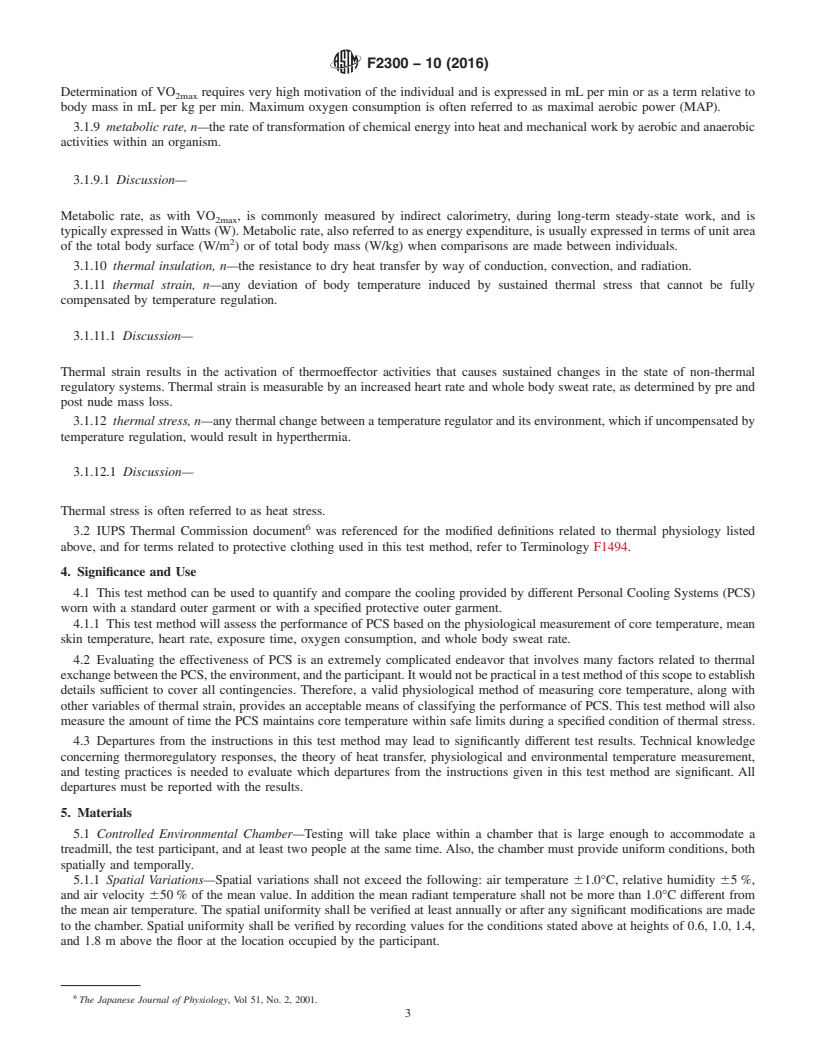
5.1.1 Spatial Variations—Spatial variations shall not exceed the following: air temperature 61.0°C, relative humidity 65 %,
and air velocity 650 % of the mean value. In addition the mean radiant temperature shall not be more than 1.0°C different from
the mean air temperature. The spatial uniformity shall be verified at least annually or after any significant modifications are made
to the chamber. Spatial uniformity shall be verified by recording values for the conditions stated above at heights of 0.6, 1.0, 1.4,
and 1.8 m above the floor at the location occupied by the participant.
The Japanese Journal of Physiology, Vol 51, No. 2, 2001.
F2300 − 10 (2016)
5.1.2 Temporal Variations—Temporal variations shall not exceed the following: air temperature 60.5°C, mean radiant
temperature 60.5°C, relative humidity 65 %, air velocity 620 % of the mean value for data averaged over 5 min.
5.1.3 Relative Humidity Measurement—Any humidity-sensing device must have an accuracy of 65 % relative humidity and a
repeatability of 63 % is acceptable (for example, wet bulb/dry bulb, dew point hygrometer). Only one location needs to be
monitored during a test to ensure that the temporal uniformity requirements are met.
5.1.4 Air Temperature Sensors—Shielded air temperature sensors shall be used. Any sensor with an overall accuracy of
60.15°C is acceptable (for example, RTD, thermocouple, thermistor). The sensor shall have a time constant not exceeding 1 min.
The sensor(s) shall be 0.5 to 1.0 m in front of the subject. If a single sensor is used it shall be 1.0 m above the floor. If multiple
sensors are used, they shall be spaced at equal height intervals and their readings averaged.
5.1.5 Air Velocity Indicator—An omni-directional anemometer with 60.05 m/s accuracy shall be used. Measurements shall be
averaged for at least 1 min at each location. If it is demonstrated that velocity does not vary temporally by more than 60.05 m/s,
then it is not necessary to monitor air velocity during the test. The value of the mean air velocity must be reported, however. If
air velocity is monitored, then measurement location requirements are the same as for air temperature.
5.2 Treadmill—An adequately sized treadmill shall be used with a physical structure that must be able to accommodate the
smallest and the largest participant safely and comfortably.
5.2.1 Treadmill Characteristics—The treadmill running surface shall be not less than 1.8 m by 0.6 m. The treadmill must have
a calibrated analog scale or digital indicator of speed and angle of inclination (degrees or % grade). Elevation shall be variable
over a range of at least 0 to 25 % grade. The speed shall be variable from 2 to 20 km/h in increments of 0.2 km/h. Calibrate
treadmills for speed and grade. The control mechanism must provide for error of less than 1.0 % of the testing load both during
the test and between tests (that is, 0.15 % grade at 15 % tread
...
Questions, Comments and Discussion
Ask us and Technical Secretary will try to provide an answer. You can facilitate discussion about the standard in here.