

ASTM E2385-11(2016)
(Guide)Standard Guide for Estimating Wildlife Exposure Using Measures of Habitat Quality
General Information
- Abstract
SIGNIFICANCE AND USE
6.1 Explicit consideration of landscape features to characterize the quality of habitat for assessment species can enhance the ecological relevance of an EcoRA. This can help avoid assessing exposure in areas in which a wildlife species would be absent because of a lack of habitat or to bound exposure estimates in areas with low habitat quality. The measure of habitat quality is used in place of the commonly used Area Use Factor (AUF). Greater ecological realism and more informed management decisions can be realized through better use of landscape features to characterize sites.
SCOPE
1.1 Ecological Risk Assessments (EcoRAs) typically focus on valued wildlife populations. Regulatory authority for conducting EcoRAs derives from various federal laws [for example, Comprehensive Environmental Response, Compensation and Liability Act 1981, (CERCLA), Resource Conservation Recovery Act (RCRA), and Federal Insecticide, Fungicide, and Rodenticide Act, (FIFRA)]. Certain procedures for conducting EcoRAs (1-4)2 have been standardized [E1689-95(2003) Standard Guide for Developing Conceptual Site Models for Contaminated Sites; E1848-96(2003) Standard Guide for Selecting and Using Ecological Endpoints for Contaminated Sites; E2020-99a Standard Guide for Data and Information Options for Conducting an Ecological Risk Assessment at Contaminated Sites; E2205/E2205M-02 Standard Guide for Risk-Based Corrective Action for Protection of Ecological resources; E1739-95(2002) Standard Guide for Risk-Based Corrective Action Applied at Petroleum Release Sites]. Specialized cases for reporting data have also been standardized [E1849-96(2002) Standard Guide for Fish and Wildlife Incident Monitoring and Reporting] as have sampling procedures to characterize vegetation [E1923-97(2003) Standard Guide for Sampling Terrestrial and Wetlands Vegetation].
1.2 Most states have enacted laws modeled after the federal acts and follow similar procedures. Typically, estimates of likely exposure levels to constituents of potential concern (CoPC) are compared to toxicity benchmark values or concentration-response profiles to establish the magnitude of risk posed by the CoPC and to inform risk managers considering potential mitigation/remediation options. The likelihood of exposure is influenced greatly by the foraging behavior and residence time of the animals of interest in the areas containing significant concentrations of the CoPC. Foraging behavior and residence time of the animals are related to landscape features (vegetation and physiognomy) that comprise suitable habitat for the species. This guide presents a framework for incorporating habitat quality into the calculation of exposure levels for use in EcoRAs.
1.3 This guide is intended only as a framework for using measures of habitat quality in species specific habitat suitability models to assist with the calculation of exposure levels in EcoRA. Information from published Habitat Suitability Index (HSI) models (5) is used in this guide. The user should become familiar with the strengths and limitations of any particular HSI model used in order to characterize uncertainty in the exposure assessment (5-7). For species that do not have published habitat suitability models, the user may elect to develop broad categorical descriptions of habitat quality for use in estimating exposure.
- Status
- Published
- Publication Date
- 31-Jan-2016
- Technical Committee
- E50 - Environmental Assessment, Risk Management and Corrective Action
- Drafting Committee
- E50.47 - Biological Effects and Environmental Fate
Overview
ASTM E2385-11(2016), titled Standard Guide for Estimating Wildlife Exposure Using Measures of Habitat Quality, establishes a framework for integrating habitat quality into wildlife exposure estimates as part of ecological risk assessments (EcoRAs). Published by ASTM International, this guide enhances the ecological relevance of environmental risk assessments by explicitly considering landscape features and habitat characteristics. It aims to improve exposure estimations by focusing not just on contaminant presence but also on where valued wildlife populations are likely to occur based on habitat suitability.
Traditional assessments often rely on the Area Use Factor (AUF) without recognizing the impact of varying habitat quality. ASTM E2385-11 provides guidance for using published Habitat Suitability Index (HSI) models and other habitat quality measures to generate more realistic, targeted, and informed wildlife exposure estimates, especially at contaminated sites regulated under laws like CERCLA, RCRA, and FIFRA.
Key Topics
- Ecological Risk Assessment (EcoRA): Outlines steps for evaluating potential ecological impacts on wildlife populations, focusing on species that are likely to inhabit or use contaminated sites.
- Habitat Quality Characterization: Describes methods for mapping, measuring, and incorporating landscape features, vegetation, and physiognomy into exposure calculations.
- Habitat Suitability Index (HSI) Models: Highlights the use of HSI models to quantify habitat suitability for assessment species, thereby informing exposure estimates.
- Framework Flexibility: Provides a structured approach that can accommodate species with or without existing habitat models, allowing users to develop categorical habitat descriptions where models are lacking.
- Data Collection and Sampling: Explains the need for site-specific sampling strategies, bias reduction, and proper calibration to support reliable habitat quality assessments.
- Regulatory Relevance: Discusses links to federal and state environmental regulations, supporting compliance and effective risk-based decision making.
Applications
- Contaminated Site Assessment: Used by risk assessors, environmental consultants, and land managers to more accurately estimate wildlife exposure at contaminated sites by integrating local habitat quality data.
- Regulatory Compliance: Supports environmental risk management under statutes such as CERCLA, RCRA, and FIFRA, as well as state regulations modeled on these federal requirements.
- Resource Management Decisions: Enables more informed mitigation and remediation strategies by narrowing risk assessment focus to habitats actually utilized by the target wildlife species.
- Ecological Data Collection: Guides the development of robust sampling plans for vegetation and habitat mapping using GIS and remote sensing technologies.
- Conservation Planning: Assists in evaluating potential impacts on wildlife during environmental permitting, brownfield redevelopment, and restoration projects by identifying critical habitats.
Related Standards
- ASTM E1689 - Guide for Developing Conceptual Site Models for Contaminated Sites
- ASTM E1848 - Guide for Selecting and Using Ecological Endpoints for Contaminated Sites
- ASTM E2020 - Guide for Data and Information Options for Conducting an Ecological Risk Assessment at Contaminated Sites
- ASTM E2205/E2205M - Guide for Risk-Based Corrective Action for Protection of Ecological Resources
- ASTM E1739 - Guide for Risk-Based Corrective Action Applied at Petroleum Release Sites
- ASTM E1849 - Guide for Fish and Wildlife Incident Monitoring and Reporting
- ASTM E1923 - Guide for Sampling Terrestrial and Wetlands Vegetation
These related standards provide additional guidance for ecological data gathering, site model development, and endpoint selection, complementing the practical application of ASTM E2385-11.
Keywords: exposure assessment, habitat quality, habitat suitability index, ecological risk assessment, wildlife exposure, contaminated sites, landscape ecology, ASTM E2385, environmental risk management, habitat mapping
Relations
- Replaces
ASTM E2385-11 - Standard Guide for Estimating Wildlife Exposure Using Measures of Habitat Quality - Effective Date
- 01-Feb-2016
- Effective Date
- 01-Apr-2015
- Effective Date
- 01-Sep-2010
- Effective Date
- 01-Mar-2010
- Effective Date
- 01-Mar-2009
- Refers
ASTM E1689-95(2008) - Standard Guide for Developing Conceptual Site Models for Contaminated Sites - Effective Date
- 01-Feb-2008
- Effective Date
- 01-Feb-2008
- Effective Date
- 10-Sep-1995
- Refers
ASTM E1739-95e1 - Standard Guide for Risk-Based Corrective Action Applied at Petroleum Release Sites - Effective Date
- 01-Jan-1995
Get Certified
Connect with accredited certification bodies for this standard

BSI Group
BSI (British Standards Institution) is the business standards company that helps organizations make excellence a habit.

TÜV Rheinland
TÜV Rheinland is a leading international provider of technical services.

TÜV SÜD
TÜV SÜD is a trusted partner of choice for safety, security and sustainability solutions.
Sponsored listings
Frequently Asked Questions
ASTM E2385-11(2016) is a guide published by ASTM International. Its full title is "Standard Guide for Estimating Wildlife Exposure Using Measures of Habitat Quality". This standard covers: SIGNIFICANCE AND USE 6.1 Explicit consideration of landscape features to characterize the quality of habitat for assessment species can enhance the ecological relevance of an EcoRA. This can help avoid assessing exposure in areas in which a wildlife species would be absent because of a lack of habitat or to bound exposure estimates in areas with low habitat quality. The measure of habitat quality is used in place of the commonly used Area Use Factor (AUF). Greater ecological realism and more informed management decisions can be realized through better use of landscape features to characterize sites. SCOPE 1.1 Ecological Risk Assessments (EcoRAs) typically focus on valued wildlife populations. Regulatory authority for conducting EcoRAs derives from various federal laws [for example, Comprehensive Environmental Response, Compensation and Liability Act 1981, (CERCLA), Resource Conservation Recovery Act (RCRA), and Federal Insecticide, Fungicide, and Rodenticide Act, (FIFRA)]. Certain procedures for conducting EcoRAs (1-4)2 have been standardized [E1689-95(2003) Standard Guide for Developing Conceptual Site Models for Contaminated Sites; E1848-96(2003) Standard Guide for Selecting and Using Ecological Endpoints for Contaminated Sites; E2020-99a Standard Guide for Data and Information Options for Conducting an Ecological Risk Assessment at Contaminated Sites; E2205/E2205M-02 Standard Guide for Risk-Based Corrective Action for Protection of Ecological resources; E1739-95(2002) Standard Guide for Risk-Based Corrective Action Applied at Petroleum Release Sites]. Specialized cases for reporting data have also been standardized [E1849-96(2002) Standard Guide for Fish and Wildlife Incident Monitoring and Reporting] as have sampling procedures to characterize vegetation [E1923-97(2003) Standard Guide for Sampling Terrestrial and Wetlands Vegetation]. 1.2 Most states have enacted laws modeled after the federal acts and follow similar procedures. Typically, estimates of likely exposure levels to constituents of potential concern (CoPC) are compared to toxicity benchmark values or concentration-response profiles to establish the magnitude of risk posed by the CoPC and to inform risk managers considering potential mitigation/remediation options. The likelihood of exposure is influenced greatly by the foraging behavior and residence time of the animals of interest in the areas containing significant concentrations of the CoPC. Foraging behavior and residence time of the animals are related to landscape features (vegetation and physiognomy) that comprise suitable habitat for the species. This guide presents a framework for incorporating habitat quality into the calculation of exposure levels for use in EcoRAs. 1.3 This guide is intended only as a framework for using measures of habitat quality in species specific habitat suitability models to assist with the calculation of exposure levels in EcoRA. Information from published Habitat Suitability Index (HSI) models (5) is used in this guide. The user should become familiar with the strengths and limitations of any particular HSI model used in order to characterize uncertainty in the exposure assessment (5-7). For species that do not have published habitat suitability models, the user may elect to develop broad categorical descriptions of habitat quality for use in estimating exposure.
SIGNIFICANCE AND USE 6.1 Explicit consideration of landscape features to characterize the quality of habitat for assessment species can enhance the ecological relevance of an EcoRA. This can help avoid assessing exposure in areas in which a wildlife species would be absent because of a lack of habitat or to bound exposure estimates in areas with low habitat quality. The measure of habitat quality is used in place of the commonly used Area Use Factor (AUF). Greater ecological realism and more informed management decisions can be realized through better use of landscape features to characterize sites. SCOPE 1.1 Ecological Risk Assessments (EcoRAs) typically focus on valued wildlife populations. Regulatory authority for conducting EcoRAs derives from various federal laws [for example, Comprehensive Environmental Response, Compensation and Liability Act 1981, (CERCLA), Resource Conservation Recovery Act (RCRA), and Federal Insecticide, Fungicide, and Rodenticide Act, (FIFRA)]. Certain procedures for conducting EcoRAs (1-4)2 have been standardized [E1689-95(2003) Standard Guide for Developing Conceptual Site Models for Contaminated Sites; E1848-96(2003) Standard Guide for Selecting and Using Ecological Endpoints for Contaminated Sites; E2020-99a Standard Guide for Data and Information Options for Conducting an Ecological Risk Assessment at Contaminated Sites; E2205/E2205M-02 Standard Guide for Risk-Based Corrective Action for Protection of Ecological resources; E1739-95(2002) Standard Guide for Risk-Based Corrective Action Applied at Petroleum Release Sites]. Specialized cases for reporting data have also been standardized [E1849-96(2002) Standard Guide for Fish and Wildlife Incident Monitoring and Reporting] as have sampling procedures to characterize vegetation [E1923-97(2003) Standard Guide for Sampling Terrestrial and Wetlands Vegetation]. 1.2 Most states have enacted laws modeled after the federal acts and follow similar procedures. Typically, estimates of likely exposure levels to constituents of potential concern (CoPC) are compared to toxicity benchmark values or concentration-response profiles to establish the magnitude of risk posed by the CoPC and to inform risk managers considering potential mitigation/remediation options. The likelihood of exposure is influenced greatly by the foraging behavior and residence time of the animals of interest in the areas containing significant concentrations of the CoPC. Foraging behavior and residence time of the animals are related to landscape features (vegetation and physiognomy) that comprise suitable habitat for the species. This guide presents a framework for incorporating habitat quality into the calculation of exposure levels for use in EcoRAs. 1.3 This guide is intended only as a framework for using measures of habitat quality in species specific habitat suitability models to assist with the calculation of exposure levels in EcoRA. Information from published Habitat Suitability Index (HSI) models (5) is used in this guide. The user should become familiar with the strengths and limitations of any particular HSI model used in order to characterize uncertainty in the exposure assessment (5-7). For species that do not have published habitat suitability models, the user may elect to develop broad categorical descriptions of habitat quality for use in estimating exposure.
ASTM E2385-11(2016) is classified under the following ICS (International Classification for Standards) categories: 11.220 - Veterinary medicine. The ICS classification helps identify the subject area and facilitates finding related standards.
ASTM E2385-11(2016) has the following relationships with other standards: It is inter standard links to ASTM E2385-11, ASTM E1739-95(2015), ASTM E1739-95(2010)e1, ASTM E2020-99a(2010), ASTM E2205/E2205M-02(2009)e1, ASTM E1689-95(2008), ASTM E1848-96(2008), ASTM E1739-95(2002), ASTM E1739-95e1. Understanding these relationships helps ensure you are using the most current and applicable version of the standard.
ASTM E2385-11(2016) is available in PDF format for immediate download after purchase. The document can be added to your cart and obtained through the secure checkout process. Digital delivery ensures instant access to the complete standard document.
Standards Content (Sample)
This international standard was developed in accordance with internationally recognized principles on standardization established in the Decision on Principles for the
Development of International Standards, Guides and Recommendations issued by the World Trade Organization Technical Barriers to Trade (TBT) Committee.
Designation: E2385 − 11 (Reapproved 2016)
Standard Guide for
Estimating Wildlife Exposure Using Measures of Habitat
Quality
This standard is issued under the fixed designation E2385; the number immediately following the designation indicates the year of
original adoption or, in the case of revision, the year of last revision. A number in parentheses indicates the year of last reapproval. A
superscript epsilon (´) indicates an editorial change since the last revision or reapproval.
1. Scope (vegetation and physiognomy) that comprise suitable habitat
for the species. This guide presents a framework for incorpo-
1.1 Ecological Risk Assessments (EcoRAs) typically focus
rating habitat quality into the calculation of exposure levels for
on valued wildlife populations. Regulatory authority for con-
use in EcoRAs.
ducting EcoRAs derives from various federal laws [for
example, Comprehensive Environmental Response, Compen- 1.3 This guide is intended only as a framework for using
sation and Liability Act 1981, (CERCLA), Resource Conser- measures of habitat quality in species specific habitat suitabil-
vation Recovery Act (RCRA), and Federal Insecticide, ity models to assist with the calculation of exposure levels in
Fungicide, and RodenticideAct, (FIFRA)]. Certain procedures EcoRA. Information from published Habitat Suitability Index
for conducting EcoRAs (1-4) have been standardized [E1689- (HSI) models (5) is used in this guide.The user should become
95(2003) Standard Guide for Developing Conceptual Site familiarwiththestrengthsandlimitationsofanyparticularHSI
Models for Contaminated Sites; E1848-96(2003) Standard model used in order to characterize uncertainty in the exposure
Guide for Selecting and Using Ecological Endpoints for assessment (5-7). For species that do not have published
Contaminated Sites; E2020-99a Standard Guide for Data and habitat suitability models, the user may elect to develop broad
Information Options for Conducting an Ecological Risk As- categorical descriptions of habitat quality for use in estimating
sessment at Contaminated Sites; E2205/E2205M-02 Standard exposure.
Guide for Risk-Based Corrective Action for Protection of
2. Referenced Documents
Ecological resources; E1739-95(2002) Standard Guide for
Risk-Based Corrective Action Applied at Petroleum Release
2.1 ASTM Standards:
Sites]. Specialized cases for reporting data have also been
E1689 Guide for Developing Conceptual Site Models for
standardized [E1849-96(2002) Standard Guide for Fish and
Contaminated Sites
Wildlife Incident Monitoring and Reporting] as have sampling
E1739 Guide for Risk-Based Corrective Action Applied at
procedures to characterize vegetation [E1923-97(2003) Stan-
Petroleum Release Sites
dard Guide for Sampling Terrestrial and Wetlands Vegetation].
E1848 Guide for Selecting and Using Ecological Endpoints
for Contaminated Sites
1.2 Most states have enacted laws modeled after the federal
E1849 Guide for Fish and Wildlife Incident Monitoring and
acts and follow similar procedures. Typically, estimates of
Reporting
likely exposure levels to constituents of potential concern
E1923 Guide for Sampling Terrestrial and Wetlands Vegeta-
(CoPC) are compared to toxicity benchmark values or
tion (Withdrawn 2013)
concentration-response profiles to establish the magnitude of
E2020 GuideforDataandInformationOptionsforConduct-
risk posed by the CoPC and to inform risk managers consid-
ing an Ecological RiskAssessment at Contaminated Sites
ering potential mitigation/remediation options. The likelihood
E2205/E2205M Guide for Risk-Based CorrectiveAction for
of exposure is influenced greatly by the foraging behavior and
Protection of Ecological Resources
residence time of the animals of interest in the areas containing
significant concentrations of the CoPC. Foraging behavior and
3. Terminology
residence time of the animals are related to landscape features
3.1 Thewords“must,”“should,”“may,”“can,”and“might”
have specific meanings in this guide. “Must” is used to express
ThisguideisunderthejurisdictionofASTMCommitteeE50onEnvironmental
Assessment, Risk Management and CorrectiveAction and is the direct responsibil-
ity of Subcommittee E50.47 on Biological Effects and Environmental Fate. For referenced ASTM standards, visit the ASTM website, www.astm.org, or
Current edition approved Feb. 1, 2016. Published May 2016. Originally contact ASTM Customer Service at service@astm.org. For Annual Book of ASTM
approved in 2004. Last previous edition approved in 2011 as E2385–11. DOI: Standards volume information, refer to the standard’s Document Summary page on
10.1520/E2385-11R16. the ASTM website.
2 4
The boldface numbers in parentheses refer to the list of references at the end of The last approved version of this historical standard is referenced on
this standard. www.astm.org.
Copyright © ASTM International, 100 Barr Harbor Drive, PO Box C700, West Conshohocken, PA 19428-2959. United States
E2385 − 11 (2016)
an absolute requirement, that is, to state that the test ought to 3.3.15 habitat suitability index—a calculated value that
be designed to satisfy the specified condition, unless the characterizes a specified landscape unit (for example, a poly-
purpose of the test requires a different design. “Should” is used gon) in terms of the features and conditions that are favorable
to state that the specified condition is recommended and ought for a particular species. Values range between 0.0 (unsuitable)
to be met if possible. Although violation of one “should” is and 1.0 (ideal).
rarelyaseriousmatter,violationofseveralwilloftenrenderthe
3.3.16 herb—aplantwithoneormorestemsthatdiebackto
results questionable. “May” is used to mean “is (are) allowed
the ground each year; (that is, graminoids and forbs).
to,” “can” is used to mean “is (are) able to,” and “might” is
3.3.17 home-range—the area around an animal’s estab-
used to mean “could be possible.” Thus, the distinction
lished home, which is traversed in normal activities. (See
between “may” and “can” is preserved, and “might” is never
foraging-range.)
used as a synonym for either “may” or “can.”
3.3.18 physiognomy—the surface features of an area.
3.2 Consistent use of terminology is essential for any
3.3.19 population—a group of individuals of the same
vegetationsamplingeffort.belowisalistoftermsthatareused
species occupying a habitat small enough to permit interbreed-
in this guide, as well as others that may be encountered
ing.
commonly in the wildlife habitat quality literature. this list is
not exhaustive. 3.3.20 remote sensing—the use of satellites or high-altitude
photography to measure geographic patterns such as vegeta-
3.3 Definitions of Terms Specific to This Standard:
tion.
3.3.1 abundance—thenumberofindividualsofonetaxonin
3.3.21 shrub—woody plant typically smaller than a tree
an area; equivalent to the term density as used in botanical
when both are mature (typically with DBH < 10 cm), often
literature.
with multiple main stems from the base. Should be defined
3.3.2 basal area (BA)—the cross-sectional area of a tree
specifically at start of project.
trunk at 1.4 m (4.5 ft) above ground. (See diameter at breast
3.3.22 tree—woody plant with a single main stem from the
height.)
base, typically>2to3m tall when mature (typically DBH >
3.3.3 biomass—the mass of vegetation per unit area.
10 cm). The operational definition should be stated explicitly
3.3.4 canopy—the uppermost layer, consisting of branches for each project.
and leaves of trees and shrubs, in a forest or woodland.
4. Habitat Approaches
3.3.5 carrying capacity—the theoretical density of organ-
isms that can be supported in a specified ecological system. 4.1 Naturalists and wildlife managers have understood, at
least in qualitative terms, the importance of critical habitat for
3.3.6 cover—the area of ground covered by plants of one or
various life history stages (for example, nesting sites, winter
more taxa.
range, etc.). Animals are drawn to suitable physical structure
3.3.7 density—the number of organisms in a specified area.
and food availability, while avoiding areas of lower quality.
The term habitat, though often used loosely as an indication of
3.3.8 diameter at breast height (DBH)—the widest point of
environmental quality, refers to the combination of physical
a tree trunk measured 1.4 m (4.5 ft) above the ground.
and biological features preferred by a particular species.
3.3.9 foraging-range—the area typically explored by an
Habitat that is great for prairie chicken is unacceptable for
animal while it is feeding. (See home-range.)
barred owls. Different habitat preferences reflect evolution and
3.3.10 forb—a non-graminoid (that is, broadleaf) herba-
adaptation of species separating from each other in “n-
ceous plant.
dimensional niche space” (8). There are differential area use
rates by different species. Animals are drawn to particular
3.3.11 geographic information system (GIS)—an integrated
featuresofthelandscapeforforaging,loafing,nesting/birthing,
spatial data base and mapping system in which geographical
etc. Some species are attracted to disturbance zones and edges,
information can be used to produce digital maps, manipulate
but others avoid such areas.
spatial data, and model spatial information. It allows the
overlay of layers of information, such as habitats or plant
4.2 Habitat Suitability Index (HSI) Models have been de-
ranges.
veloped for many species of interest. Characterization of
habitat for certain species was formalized by the U.S. Fish and
3.3.12 global positioning system (GPS)—a survey system in
WildlifeServiceinthe1990s (9).Currently,morethan160HSI
which a GPS unit is used to receive signals from satellites.
models have been published, though usage is limited for
Signals are then interpreted to provide information such as
quantitative predictions of population densities (6). Rand and
latitude and longitude or bearings for navigation, positioning,
Newman (10) describe the applicability of HSI models for
or mapping.
EcoRAingeneralterms,butprovidenoexamplesofitsuseand
3.3.13 graminoid—a grass (Poaceae), sedge (Cyperaceae),
donotgivespecificdetailstointegratehabitatinformationwith
or rush (Juncaceae).
exposure assessment or risk characterization. Freshman and
3.3.14 habitat—the collection of biological, chemical, and Menzie (11) describe two approaches to take into account
physical features of a landscape that provide conditions for an spatial differences in contaminant concentrations with respect
organism to live and reproduce. to foraging activities and the proportion of a local population
E2385 − 11 (2016)
likely to be exposed to the contaminants. Their approach does wire et al. (26) discussed the rationale for using spatially
not incorporate HSI models formally, but does demonstrate the explicit exposure models and also describe some of the
fundamental concepts for such use. Hope (12-14), Wickwire et impediments that may be deterring a broader use of such
al. (15), Linkov et al. (16, 17) and Linkov and Grebenkov (18) approaches.
have used placeholder habitat values to illustrate the effect of
5. Identifying Scenarios where Habitat Value can be
habitat on cumulative exposure levels. Kapustka et al. (5, 19)
Important in EcoRAs
and Linkov et al. (20) have described procedures to use HSIs
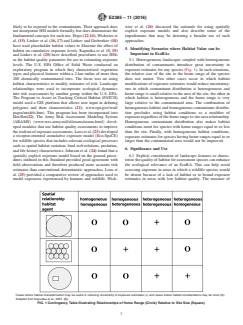
as the habitat quality parameter for use in estimating exposure 5.1 Heterogeneous landscapes coupled with heterogeneous
levels. The U.S. EPA Office of Solid Waste conducted an distribution of contaminants introduce great uncertainty in
exploratory program in which they characterized vegetation exposure estimates for any species (Fig. 1). In such situations,
types and physical features within a 2-km radius of more than the relative size of the site to the home range of the species
200 chemically contaminated sites. The focus was on using does not matter. Two other cases occur in which habitat
habitat characteristics to modify estimates of risk. Landscape modifications of exposure estimates would reduce uncertainty;
relationships were used to incorporate ecological dynamics one in which contaminant distribution is heterogeneous and
into risk assessments by another group within the U.S. EPA. home range is small relative to the area of the site, the other in
The Program to Assist in Tracking Critical Habitat (PATCH)
which habitat is heterogeneous and the home range is very
model used a GIS platform that allows user input in defining large relative to the contaminated area. The combination of
polygons and their characteristics (21); www.epa.gov/wed/
homogeneous habitat and homogeneous contaminant distribu-
pages/models.htm). This program has been incorporated into tion precludes using habitat conditions as a modifier of
HexSim(22). The Army Risk Assessment Modeling System exposure regardless of the home range to site area relationship.
(ARAMS) (www.wes.army.mil/el/arams/arams.html) devel- Homogeneous contaminant distribution also makes habitat
oped modules that use habitat quality assessments to improve conditions moot for species with home ranges equal to or less
therealismofexposureassessments.Loosetal. (23)developed than the site. Finally, with homogeneous habitat conditions,
a receptor-oriented cumulative exposure model (Eco-SpaCE) exposure estimates for species having home ranges equal to or
for wildlife species that includes relevant ecological processes larger than the contaminated area would not be improved.
such as spatial habitat variation, food web relations, predation,
6. Significance and Use
and life history characteristics. Johnson et al. (24) found that a
spatially explicit exposure model based on the general proce- 6.1 Explicit consideration of landscape features to charac-
dures outlined in this Standard provided good agreement with terize the quality of habitat for assessment species can enhance
field observations and therefore produced more accurate risk the ecological relevance of an EcoRA. This can help avoid
estimates than conventional deterministic approaches. Loos et assessing exposure in areas in which a wildlife species would
al. (25) provided a comparative review of approaches used to be absent because of a lack of habitat or to bound exposure
model exposures experienced by humans and wildlife. Wick- estimates in areas with low habitat quality. The measure of
Cases where habitat characterization may be useful in reducing uncertainty of exposure estimates (+) and cases where habitat considerations may be moot (O).
Adapted from Kapustka et al., 2001, (5).
FIG. 1 Contingency Table Illustrating Relationships of Home Range (Circle) Relative to Site Size (Square).
E2385 − 11 (2016)
habitat quality is used in place of the commonly usedArea Use 9. Calibration and Standardization
Factor (AUF). Greater ecological realism and more informed
9.1 Though useful information may be obtained from direct
management decisions can be realized through better use of
application of habitat quality index models, added value may
landscape features to characterize sites.
result from calibration of model parameters to population
density data generated at or near the project area during recent
7. Interference
times (within a period that generally reflects current ecological
7.1 Observed population density in field tests often is lower
conditions).
than expected based on HSI values (6). Such information can
be interpreted as a deficiency. However, it can also be that
10. Procedure
expectations of precision are too great and beyond the capa-
10.1 Overview:
bility of the model (7). HSI model predictions should be
10.1.1 The U.S. EPA (1, 3) described an overall process for
viewed as an indication of potential carrying capacity gener-
the performance of EcoRAs. Specifically it provides a frame-
alized over time, rather than a static predictor of population
work for incorporating habitat quality characteristics into
density, and then the models can be useful. An environmental
exposure and effects calculations; however, it proposed no
factor governs the maximum response attainable by an organ-
specific methods for doing so. This guide describes the steps
ism; at any interval along a parameter gradient, other variables
within the three stages (problem formulation, analysis, and
may curtail attainment of the potential. In statistical
characterization) of the U.S. EPA EcoRA process. The proce-
descriptions, the relationship can be characterized as having
dures that follow describe the steps to incorporate landscape
increasing variance as the quality of habitat increases. If
features into the environmental management process.
applied to wildlife populations, limiting factors such as food
Specifically, an iterative approach is recommended to guide
supply, predation, or human disturbance may override the
selection of appropriate assessment species, keyed to wildlife
apparent quality of habitat for the species of interest. Thus in
distribution ranges, and to a database of habitat suitability
low habitat quality areas, the observed populations are near
models. The choice of assessment species is cross-linked with
zero; but in higher quality habitat areas, observed populations
the EPAexposure handbook species (2). Data collection needs
may range from near zero to some predicted maximum.
for reconnaissance-, screening- and definitive-level character-
7.2 Metabolic energy requirements may result in animals in
ization of habitat quality for potential assessment species are
poor-quality habitats to forage longer and consume more food
dictated by the project specific sampling and analysis plan that
to obtain basal metabolic needs (13). Caution should be
would be used to generate spatially explicit descriptions of
exercised when interpreting results, especially for individuals
habitat quality for various assessment species. Finally, calcu-
confined entirely within contaminated areas.
lations are presented that allocate exposure estimates using
both habitat quality and spatial variations in chemical concen-
7.3 If site data are evaluated as part of a calibration step,
tration or intensity of other agents (for example, magnitude of
caution should be exercised when interpreting results as
biological or physical stressor impinging on the assessment
individuals may move some distance away from the area in
species).
which they received a particular exposure (13).
10.1.2 Habitat considerations can be incorporated into the
8. Sampling Design
U.S. EPA Framework (1) for EcoRAs and the 8-step guidance
8.1 Typically, site-specific information is required to quan- (3) for conducting risk assessments at superfund sites (5).
tify variables used in calculating indices of habitat quality.The Ecological risk assessments should be performed only in those
Principal Investigator has the responsibility to design a sam- cases where ecological receptors occur or would likely occur,
pling plan that will yield sufficient information, governed by but for the influence of one or more agents (Fig. 2). A simple
project specific data quality objectives [ASTM E1923- reconnaissance of the project area by qualified persons should
be conducted at the earliest stages of a project in order to
97(2003) Standard Guide for Sampling Terrestrial and Wet-
lands Vegetation; (27, 28)]. Information needs are dictated by ascertain the actual or potential occurrence of ecological
receptors. If receptors are not present or would not likely occur
the selection of assessment species and the respective habitat
quality models. (for example, an asphalt parking area in an urban/industrial
zone), then it would be impractical to proceed with an EcoRA.
8.2 Precision is, in essence, the repeatability of a measure-
ment. Precision is seldom possible without repeating a study 10.2 Problem Formulation Phase:
exactly, which is rarely feasible or possible for field studies. 10.2.1 The key goals of problem formulation are to outline
Bias occurs when samples are not representative of the the potential problem and develop a plan for analyzing and
landscape being sampled. Bias can occur when a sampling characterizing risk. Three interdependent products of problem
scheme is purposely, or inadvertently, designed to measure formulation are the identification of assessment species, iden-
only certain parts of a landscape (when a complete represen- tification of assessment endpoints, and construction of the
tation is desired), or when sampling units are chosen to yield conceptual model of the site (3). The EPA framework can be
certain results. Sampling is most susceptible to bias in the expanded to incorporate species-specific habitat quality into
sampling design, where plot or point placement determines the iterative steps used in problem formulation. Selection of
whatlandscapefeatureissampled.Randomizationofsampling contaminants of concern and developing an analysis plan are
locations will eliminate much bias, but choice of statistical not affected by the inclusion of habitat considerations in the
methods and sampling units should also be examined for bias. process.
E2385 − 11 (2016)
FIG. 2 Process Flow-Diagram Illustrating the Places Where Habitat Considerations can be Used in the
Ecological Risk Assessment Framework (CC=carrying capacity)
10.2.2 Landscape Mapping: suitability for many species. Even very coarse resolution
10.2.2.1 Early in problem formulation, landscape cover landscape maps can be informative as to whether a risk
types should be identified and mapped. Also, other features assessment is even necessary. For example, if no suitable
critical to particular wildlife use patterns that can affect habitat exists at the site (for example, if the site is entirely
ecological resources, such as areas subject to human activities, paved), an EcoRA may not be warranted. Mapping unit
should be noted. Mapping creates a picture of the site that is resolution should be considered carefully, as it has conse-
critical to determining the interaction of the stressors with the quences for subsequent decisions in the EcoRA process.
receptors, and such relationships are used in computing habitat Apparent homogeneity of the landscape, spatial extent of
E2385 − 11 (2016)
stressors of interest, potential home-range/foraging range of money in order to obtain the requisite data. High profile sites
wildlife species, and cost are important factors in defining the (that is, sites of great interest to the public or with societal
appropriate mapping unit resolution.
importance) may warrant the expenditures to gather the infor-
10.2.3 Ecological Context of the Site: mation. However, for most sites collection of basic biological
or ecological data is beyond consideration. In such situations,
10.2.3.1 Readily available information about the site and its
a transparent process could facilitate communication among
surrounding’s ecological characteristics should be compiled.
stakeholders and improve acceptance of the risk assessment.
This may include information on geomorphology, potential
natural vegetation, fauna, climate, surface water
10.2.4.3 A prioritized list of potential assessment species
characteristics, disturbance regime, and land uses. There are
relevant to a particular site should be developed from a
two reasons for gathering this information. The first, in
comprehensive wildlife species list compiled from prior
conjunction with the habitat map, is to identify a suite of
knowledge of the site. Priority might be given to species
species from which appropriate assessment species may be
according to their perceived societal value
...