

ASTM D187-24
(Test Method)Standard Test Method for Burning Quality of Kerosene
General Information
- Abstract
SIGNIFICANCE AND USE
5.1 Since the information provided by this test method is largely qualitative in nature, specific limits covering the following characteristics are required in referring to this test method in specifications for kerosene:
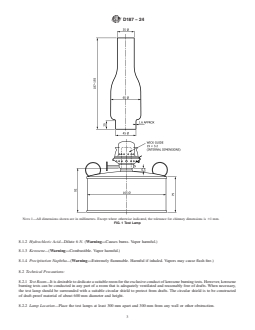
5.1.1 Duration of the test: 16 h is understood, if not otherwise specified;
5.1.2 Permissible change in flame shape and dimensions during the test;
5.1.3 Description of the acceptable appearance of the chimney deposit.
SCOPE
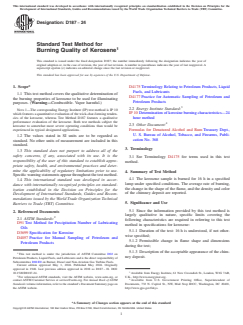
1.1 This test method covers the qualitative determination of the burning properties of kerosene to be used for illuminating purposes. (Warning—Combustible. Vapor harmful.)
Note 1: The corresponding Energy Institute (IP) test method is IP 10 which features a quantitative evaluation of the wick-char-forming tendencies of the kerosene, whereas Test Method D187 features a qualitative performance evaluation of the kerosene. Both test methods subject the kerosene to somewhat more severe operating conditions than would be experienced in typical designated applications.
1.2 The values stated in SI units are to be regarded as standard. No other units of measurement are included in this standard.
1.3 This standard does not purport to address all of the safety concerns, if any, associated with its use. It is the responsibility of the user of this standard to establish appropriate safety, health, and environmental practices and determine the applicability of regulatory limitations prior to use. Specific warning statements appear throughout the test method.
1.4 This international standard was developed in accordance with internationally recognized principles on standardization established in the Decision on Principles for the Development of International Standards, Guides and Recommendations issued by the World Trade Organization Technical Barriers to Trade (TBT) Committee.
- Status
- Published
- Publication Date
- 30-Apr-2024
- Technical Committee
- D02 - Petroleum Products, Liquid Fuels, and Lubricants
- Drafting Committee
- D02.E0 - Burner, Diesel and Non-Aviation Gas Turbine Fuels
Overview
ASTM D187-24: Standard Test Method for Burning Quality of Kerosene sets out a qualitative procedure for determining the burning properties of kerosene intended for illuminating purposes. Developed by ASTM International, this test method is widely recognized for its role in ensuring kerosene’s reliability, performance, and safety when used in lamps and similar devices. The method evaluates critical factors such as flame characteristics and chimney deposits under controlled conditions, providing valuable insights for manufacturers, distributors, and regulatory bodies involved with petroleum products.
Key Topics
Burning Quality Evaluation:
- The test examines how kerosene burns over a 16-hour period in a specifically designed lamp.
- Key performance indicators include:
- Changes in flame shape, height, and width during the test
- Average burning rate
- Density and color of chimney deposits formed
Qualitative Focus:
- This method is qualitative rather than quantitative, emphasizing visual and descriptive assessment rather than precise numerical measurements.
- Limits and acceptability criteria for flame and deposits must be specified in any kerosene specification referencing ASTM D187.
Sampling and Safety:
- Proper sampling is crucial to obtaining representative results, following ASTM D4057 and D4177 procedures to avoid contamination.
- Strict adherence to safety, health, and environmental practices is emphasized, given the combustible nature of kerosene and test reagents.
Test Apparatus and Procedure:
- A specified lamp assembly, wick type, and sight gauge are used for consistent results.
- Detailed preparation and pre-conditioning of equipment, including cleaning chimneys and pre-treating wicks, are required before testing.
- The procedure involves lamp set-up, wick trimming, test initiation, observation, and documentation of results.
Applications
Practical Value for Industry:
- Kerosene Suppliers: Ensures product meets acceptable burning performance for consumers, reducing complaints and safety incidents.
- Lamp Manufacturers: Verifies compatibility of lamps and wicks with common kerosene products.
- Regulatory Compliance: Assists authorities and standards organizations in certifying kerosene brands for safe public use.
- Quality Control: Used by laboratories in batch testing to monitor consistency across production lots.
End-User Benefits:
- Helps guarantee a smokeless, stable flame and minimal chimney sooting-key for safety, air quality, and lighting efficiency.
- Reduces maintenance and cleaning frequency for users of kerosene lamps.
International Relevance:
- Developed according to WTO TBT principles, making it suitable for global trade and regulatory harmonization.
Related Standards
Key referenced and associated standards include:
- ASTM D3699: Specification for Kerosine - defines physical and compositional requirements for kerosene products.
- ASTM D4057 & D4177: Practices for manual and automatic sampling of petroleum and petroleum products.
- ASTM D91: Test Method for Precipitation Number of Lubricating Oils - occasionally used for materials in kerosene testing.
- ASTM D4175: Terminology relating to petroleum products, liquid fuels, and lubricants.
- IP 10 (Energy Institute): A quantitative test for wick-char-forming tendencies in kerosene; provides complementary but distinct information to ASTM D187.
For those involved in fuel quality assurance or regulatory compliance, referencing and understanding ASTM D187-24 alongside these associated standards ensures comprehensive kerosene burning quality evaluation and safer market products.
Keywords: ASTM D187-24, burning quality, kerosene, flame shape, chimney deposit, wick performance, petroleum product testing, illuminating oil standards, kerosene lamp testing.
Get Certified
Connect with accredited certification bodies for this standard

Element Materials Technology
Materials testing and product certification.

ABS Group Brazil
ABS Group certification services in Brazil.

ABS Quality Evaluations Inc.
American Bureau of Shipping quality certification.
Sponsored listings
Frequently Asked Questions
ASTM D187-24 is a standard published by ASTM International. Its full title is "Standard Test Method for Burning Quality of Kerosene". This standard covers: SIGNIFICANCE AND USE 5.1 Since the information provided by this test method is largely qualitative in nature, specific limits covering the following characteristics are required in referring to this test method in specifications for kerosene: 5.1.1 Duration of the test: 16 h is understood, if not otherwise specified; 5.1.2 Permissible change in flame shape and dimensions during the test; 5.1.3 Description of the acceptable appearance of the chimney deposit. SCOPE 1.1 This test method covers the qualitative determination of the burning properties of kerosene to be used for illuminating purposes. (Warning—Combustible. Vapor harmful.) Note 1: The corresponding Energy Institute (IP) test method is IP 10 which features a quantitative evaluation of the wick-char-forming tendencies of the kerosene, whereas Test Method D187 features a qualitative performance evaluation of the kerosene. Both test methods subject the kerosene to somewhat more severe operating conditions than would be experienced in typical designated applications. 1.2 The values stated in SI units are to be regarded as standard. No other units of measurement are included in this standard. 1.3 This standard does not purport to address all of the safety concerns, if any, associated with its use. It is the responsibility of the user of this standard to establish appropriate safety, health, and environmental practices and determine the applicability of regulatory limitations prior to use. Specific warning statements appear throughout the test method. 1.4 This international standard was developed in accordance with internationally recognized principles on standardization established in the Decision on Principles for the Development of International Standards, Guides and Recommendations issued by the World Trade Organization Technical Barriers to Trade (TBT) Committee.
SIGNIFICANCE AND USE 5.1 Since the information provided by this test method is largely qualitative in nature, specific limits covering the following characteristics are required in referring to this test method in specifications for kerosene: 5.1.1 Duration of the test: 16 h is understood, if not otherwise specified; 5.1.2 Permissible change in flame shape and dimensions during the test; 5.1.3 Description of the acceptable appearance of the chimney deposit. SCOPE 1.1 This test method covers the qualitative determination of the burning properties of kerosene to be used for illuminating purposes. (Warning—Combustible. Vapor harmful.) Note 1: The corresponding Energy Institute (IP) test method is IP 10 which features a quantitative evaluation of the wick-char-forming tendencies of the kerosene, whereas Test Method D187 features a qualitative performance evaluation of the kerosene. Both test methods subject the kerosene to somewhat more severe operating conditions than would be experienced in typical designated applications. 1.2 The values stated in SI units are to be regarded as standard. No other units of measurement are included in this standard. 1.3 This standard does not purport to address all of the safety concerns, if any, associated with its use. It is the responsibility of the user of this standard to establish appropriate safety, health, and environmental practices and determine the applicability of regulatory limitations prior to use. Specific warning statements appear throughout the test method. 1.4 This international standard was developed in accordance with internationally recognized principles on standardization established in the Decision on Principles for the Development of International Standards, Guides and Recommendations issued by the World Trade Organization Technical Barriers to Trade (TBT) Committee.
ASTM D187-24 is classified under the following ICS (International Classification for Standards) categories: 75.160.20 - Liquid fuels. The ICS classification helps identify the subject area and facilitates finding related standards.
ASTM D187-24 is available in PDF format for immediate download after purchase. The document can be added to your cart and obtained through the secure checkout process. Digital delivery ensures instant access to the complete standard document.
Standards Content (Sample)
This international standard was developed in accordance with internationally recognized principles on standardization established in the Decision on Principles for the
Development of International Standards, Guides and Recommendations issued by the World Trade Organization Technical Barriers to Trade (TBT) Committee.
Designation: D187 − 24
Standard Test Method for
Burning Quality of Kerosene
This standard is issued under the fixed designation D187; the number immediately following the designation indicates the year of
original adoption or, in the case of revision, the year of last revision. A number in parentheses indicates the year of last reapproval. A
superscript epsilon (´) indicates an editorial change since the last revision or reapproval.
This standard has been approved for use by agencies of the U.S. Department of Defense.
1. Scope* D4175 Terminology Relating to Petroleum Products, Liquid
Fuels, and Lubricants
1.1 This test method covers the qualitative determination of
D4177 Practice for Automatic Sampling of Petroleum and
the burning properties of kerosene to be used for illuminating
Petroleum Products
purposes. (Warning—Combustible. Vapor harmful.)
2.2 Energy Institute Standard:
NOTE 1—The corresponding Energy Institute (IP) test method is IP 10
IP 10 Determination of kerosine burning characteristics—24
which features a quantitative evaluation of the wick-char-forming tenden-
cies of the kerosene, whereas Test Method D187 features a qualitative
hour method
performance evaluation of the kerosene. Both test methods subject the
2.3 Other Document:
kerosene to somewhat more severe operating conditions than would be
experienced in typical designated applications. Formulas for Denatured Alcohol and Rum Treasury Dept.,
U. S. Bureau of Alcohol, Tobacco, and Firearms, Publi-
1.2 The values stated in SI units are to be regarded as
cation No. 368
standard. No other units of measurement are included in this
standard.
3. Terminology
1.3 This standard does not purport to address all of the
safety concerns, if any, associated with its use. It is the
3.1 See Terminology D4175 for terms used in this test
responsibility of the user of this standard to establish appro-
method.
priate safety, health, and environmental practices and deter-
mine the applicability of regulatory limitations prior to use.
4. Summary of Test Method
Specific warning statements appear throughout the test method.
4.1 The kerosene sample is burned for 16 h in a specified
1.4 This international standard was developed in accor-
lamp under specified conditions. The average rate of burning,
dance with internationally recognized principles on standard-
the change in the shape of the flame, and the density and color
ization established in the Decision on Principles for the
of the chimney deposit are reported.
Development of International Standards, Guides and Recom-
mendations issued by the World Trade Organization Technical
5. Significance and Use
Barriers to Trade (TBT) Committee.
5.1 Since the information provided by this test method is
2. Referenced Documents
largely qualitative in nature, specific limits covering the
2.1 ASTM Standards:
following characteristics are required in referring to this test
D91 Test Method for Precipitation Number of Lubricating
method in specifications for kerosene:
Oils
5.1.1 Duration of the test: 16 h is understood, if not other-
D3699 Specification for Kerosine
wise specified;
D4057 Practice for Manual Sampling of Petroleum and
5.1.2 Permissible change in flame shape and dimensions
Petroleum Products
during the test;
5.1.3 Description of the acceptable appearance of the chim-
This test method is under the jurisdiction of ASTM Committee D02 on
ney deposit.
Petroleum Products, Liquid Fuels, and Lubricants and is the direct responsibility of
Subcommittee D02.E0 on Burner, Diesel and Non-Aviation Gas Turbine Fuels.
Current edition approved May 1, 2024. Published May 2024. Originally
approved in 1948. Last previous edition approved in 2018 as D187 – 18. DOI:
10.1520/D0187-24. Available from Energy Institute, 61 New Cavendish St., London, W1G 7AR,
For referenced ASTM standards, visit the ASTM website, www.astm.org, or U.K., http://www.energyinst.org.
contact ASTM Customer Service at service@astm.org. For Annual Book of ASTM Available from U.S. Government Printing Office, Superintendent of
Standards volume information, refer to the standard’s Document Summary page on Documents, 732 N. Capitol St., NW, Mail Stop IDCC, Washington, DC 20401,
the ASTM website. http://www.gpo.gov/fdsys.
*A Summary of Changes section appears at the end of this standard
Copyright © ASTM International, 100 Barr Harbor Drive, PO Box C700, West Conshohocken, PA 19428-2959. United States
D187 − 24
6. Apparatus wick-guide or dome will hinder attainment of the prescribed
5 flame shape and render subsequent qualitative ratings unreli-
6.1 Lamp Assembly, conforming essentially to the shape
able.
and dimensions shown in Fig. 1. It is essential to ensure that the
burner fits vertically into the oil reservoir and that the wick- 6.2 Wick, 19 mm paraffin flat, super quality, containing
guide has parallel sides and is centrally disposed in relation to approximately 43 ends of three-ply yarn, woven double plain
the slot in the dome of the burner. Any distortion of the weave with stitching ends, one blue stripe on one face and one
green stripe on the reverse face, woven with approximately 16
picks per 10 mm, and weighing normally 15 g ⁄m. After
weaving, the wick shall be boiled in distilled water and dried
thoroughly.
The sole source of supply of the apparatus known to the committee (Stanhope-
Seta Limited) no longer manufactures the apparatus. The committee has decided to 6.2.1 The wick shall then be made into rolls and left for
maintain this standard since there are several existing laboratories that have the
seven days before it is cut into 200 mm lengths. The lengths
apparatus and can continue to run the method. If you become aware of any
shall then be packed into suitable containers. The ash of the
alternative suppliers, please provide this information to ASTM International
wick shall not exceed 0.4 % by weight.
Headquarters. Your comments will receive careful consideration at a meeting of the
responsible technical committee, which you may attend.
6.3 Sight Gage —A suitable flame-size measuring device,
accurate to 1 mm. The sight gage shown in Fig. 2 is satisfac-
tory.
7. Reagents and Materials
7.1 Formula 3A Denatured Ethanol—See Formulas for
Denatured Alcohol and Rum.
7.2 Hydrochloric Acid, Dilute (approximately 6 N).
7.3 Kerosene—See Specification D3699.
7.4 Precipitation Naphtha—See Reagent section in Test
Method D91.
8. Hazards
8.1 Specific Safety Hazards:
8.1.1 Formula 3A Denatured Ethanol—(Warning—
Flammable. Denatured—cannot be made nontoxic.)
8.1.2 Hydrochloric Acid—Dilute 6 N. (Warning—Causes
burns. Vapor harmful.)
8.1.3 Kerosene—(Warning—Combustible. Vapor harmful.)
8.1.4 Precipitation Naphtha—(Warning—Extremely flam-
mable. Harmful if inhaled. Vapors may cause flash fire.)
8.2 Technical Precautions:
NOTE 1—All dimensions shown are in millimetres. Except where
otherwise indicated, the tolerance for chimney dimensions is 61 mm.
FIG. 1 Test Lamp FIG. 2 Sight Gage
D187 − 24
8.2.1 Test Room—It is desirable to dedicate a suitable room from the Soxhlet extraction apparatus, lay flat between sheets
for the exclusive conduct of kerosene burning tests. However, of filter paper, and press gently to remove excess moisture.
kerosene burning tests can be conducted in any part of a room Extract the wick with Formula 3A denatured ethanol
that is adequately ventilated and reasonably free of drafts. (Warning—Flammable. Denatured—cannot be made non-
When necessary, the test lamp should be surrounded with a toxic) for 3 h in an uninsulated Soxhlet extraction apparatus,
suitable circular shield to protect from drafts. The circular drain the ethanol as completely as possible from the Soxhlet
shield is to be constructed of draft-proof material of about extractor and continue the extraction with ASTM precipitation
600 mm diameter and height. naphtha (Warning—Extremely flammable. Harmful if in-
8.2.2 Lamp Location—Place the test lamps at least 300 mm haled. Vapors may cause flash fire) for 1 h.
apart and 300 mm from any wall or other obstruction.
11. Procedure
8.2.3 Test Temperature—Maintain test room temperature
above 15 °C and allow the temperature of the kerosene to
11.1 Dry the wick in an oven (Warning—Avoid skin
approach equilibrium room temperature within at least 5 °C.
contact with exposed hot surfaces by use of protective equip-
ment) at 105 °C for 1 h. While still hot, soak the wick in th
...
This document is not an ASTM standard and is intended only to provide the user of an ASTM standard an indication of what changes have been made to the previous version. Because
it may not be technically possible to adequately depict all changes accurately, ASTM recommends that users consult prior editions as appropriate. In all cases only the current version
of the standard as published by ASTM is to be considered the official document.
Designation: D187 − 18 D187 − 24
Standard Test Method for
Burning Quality of Kerosene
This standard is issued under the fixed designation D187; the number immediately following the designation indicates the year of
original adoption or, in the case of revision, the year of last revision. A number in parentheses indicates the year of last reapproval. A
superscript epsilon (´) indicates an editorial change since the last revision or reapproval.
This standard has been approved for use by agencies of the U.S. Department of Defense.
1. Scope*
1.1 This test method covers the qualitative determination of the burning properties of kerosene to be used for illuminating
purposes. (Warning—Combustible. Vapor harmful.)
NOTE 1—The corresponding Energy Institute (IP) test method is IP 10 which features a quantitative evaluation of the wick-char-forming tendencies of
the kerosene, whereas Test Method D187 features a qualitative performance evaluation of the kerosene. Both test methods subject the kerosene to
somewhat more severe operating conditions than would be experienced in typical designated applications.
1.2 The values stated in SI units are to be regarded as standard. No other units of measurement are included in this standard.
1.3 This standard does not purport to address all of the safety concerns, if any, associated with its use. It is the responsibility
of the user of this standard to establish appropriate safety, health, and environmental practices and determine the applicability of
regulatory limitations prior to use. Specific warning statements appear throughout the test method.
1.4 This international standard was developed in accordance with internationally recognized principles on standardization
established in the Decision on Principles for the Development of International Standards, Guides and Recommendations issued
by the World Trade Organization Technical Barriers to Trade (TBT) Committee.
2. Referenced Documents
2.1 ASTM Standards:
D91 Test Method for Precipitation Number of Lubricating Oils
D3699 Specification for Kerosine
D4057 Practice for Manual Sampling of Petroleum and Petroleum Products
D4175 Terminology Relating to Petroleum Products, Liquid Fuels, and Lubricants
D4177 Practice for Automatic Sampling of Petroleum and Petroleum Products
2.2 Energy Institute Standard:
IP 10 Determination of kerosine burning characteristics—24 hour method
2.3 Other Document:
Formulas for Denatured Alcohol and Rum Treasury Dept., U. S. Bureau of Alcohol, Tobacco, and Firearms, Publication No. 368
This test method is under the jurisdiction of ASTM Committee D02 on Petroleum Products, Liquid Fuels, and Lubricants and is the direct responsibility of Subcommittee
D02.E0 on Burner, Diesel, Diesel and Non-Aviation Gas Turbine, and Marine Turbine Fuels.
Current edition approved April 1, 2018May 1, 2024. Published April 2018May 2024. Originally approved in 1948. Last previous edition approved in 20132018 as
D187 – 08 (2013).D187 – 18. DOI: 10.1520/D0187-18.10.1520/D0187-24.
For referenced ASTM standards, visit the ASTM website, www.astm.org, or contact ASTM Customer Service at service@astm.org. For Annual Book of ASTM Standards
volume information, refer to the standard’s Document Summary page on the ASTM website.
Available from Energy Institute, 61 New Cavendish St., London, W1G 7AR, U.K., http://www.energyinst.org.
Available from U.S. Government Printing Office, Superintendent of Documents, 732 N. Capitol St., NW, Mail Stop IDCC, Washington, DC 20401, http://www.gpo.gov/
fdsys.
*A Summary of Changes section appears at the end of this standard
Copyright © ASTM International, 100 Barr Harbor Drive, PO Box C700, West Conshohocken, PA 19428-2959. United States
D187 − 24
3. Terminology
3.1 See Terminology D4175 for terms used in this test method.
4. Summary of Test Method
4.1 The kerosene sample is burned for 16 h in a specified lamp under specified conditions. The average rate of burning, the change
in the shape of the flame, and the density and color of the chimney deposit are reported.
5. Significance and Use
5.1 Since the information provided by this test method is largely qualitative in nature, specific limits covering the following
characteristics are required in referring to this test method in specifications for kerosene:
5.1.1 Duration of the test: 16 h is understood, if not otherwise specified;
5.1.2 Permissible change in flame shape and dimensions during the test;
5.1.3 Description of the acceptable appearance of the chimney deposit.
6. Apparatus
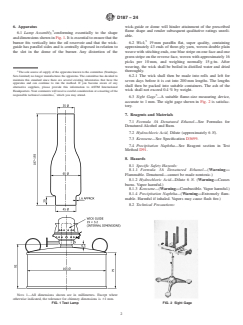
6.1 Lamp Assembly, conforming essentially to the shape and dimensions shown in Fig. 1. It is essential to ensure that the burner
fits vertically into the oil reservoir and that the wick-guide has parallel sides and is centrally disposed in relation to the slot in the
dome of the burner. Any distortion of the wick-guide or dome will hinder attainment of the prescribed flame shape and render
subsequent qualitative ratings unreliable.
6.2 Wick, 19 mm paraffin flat, super quality, containing approximately 43 ends of three-ply yarn, woven double plain weave with
stitching ends, one blue stripe on one face and one green stripe on the reverse face, woven with approximately 16 picks per 10 mm,
and weighing normally 15 g ⁄m. After weaving, the wick shall be boiled in distilled water and dried thoroughly.
6.2.1 The wick shall then be made into rolls and left for seven days before it is cut into 200 mm lengths. The lengths shall then
be packed into suitable containers. The ash of the wick shall not exceed 0.4 % by weight.
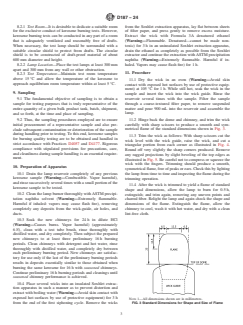
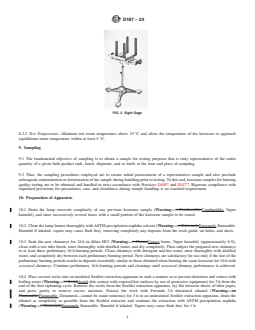
6.3 Sight Gage —A suitable flame-size measuring device, accurate to 1 mm. The sight gage shown in Fig. 2 is satisfactory.
7. Reagents and Materials
7.1 Formula 3A Denatured Ethanol—See Formulas for Denatured Alcohol and Rum.
7.2 Hydrochloric Acid, Dilute (approximately 6 N).
7.3 Kerosene—See Specification D3699.
7.4 Precipitation Naphtha—See Reagent section in Test Method D91.
8. Hazards
8.1 Specific Safety Hazards:
8.1.1 Formula 3A Denatured Ethanol—(Warning—Flammable. Denatured—cannot be made nontoxic.)
The sole source of supply of the apparatus known to the committee at this time is Stanhope-Seta Limited, Park Close, Englefield Green, Egham, Surrey, England TW20
OXD. If you are aware of (Stanhope-Seta Limited) no longer manufactures the apparatus. The committee has decided to maintain this standard since there are several existing
laboratories that have the apparatus and can continue to run the method. If you become aware of any alternative suppliers, please provide this information to ASTM
International Headquarters. Your comments will receive careful consideration at a meeting of the responsible technical committee, which you may attend.
D187 − 24
NOTE 1—All dimensions shown are in millimetres. Except where otherwise indicated, the tolerance for chimney dimensions is 61 mm.
FIG. 1 Test Lamp
8.1.2 Hydrochloric Acid—Dilute 6 N. (Warning—Causes burns. Vapor harmful.)
8.1.3 Kerosene—(Warning—Combustible. Vapor harmful.)
8.1.4 Precipitation Naphtha—(Warning—Extremely flammable. Harmful if inhaled. Vapors may cause flash fire.)
8.2 Technical Precautions:
8.2.1 Test Room—It is desirable to dedicate a suitable room for the exclusive conduct of kerosene burning tests. However, kerosene
burning tests can be conducted in any part of a room that is adequately ventilated and reasonably free of drafts. When necessary,
the test lamp should be surrounded with a suitable circular shield to protect from drafts. The circular shield is to be constructed
of draft-proof material of about 600 mm diameter and height.
8.2.2 Lamp Location—Place the test lamps at least 300 mm apart and 300 mm from any wall or other obstruction.
D187 − 24
FIG. 2 Sight Gage
8.2.3 Test Temperature—Maintain test room temperature above 15 °C and allow the temperature of the kerosene to approach
equilibrium room temperature within at least 5 °C.
9. Sampling
9.1 The fundamental objective of sampling is to obtain a sample for testing purposes that is truly representative of the entire
quantity of a given bulk product tank, batch, shipment, and so forth, at the time and place of sampling.
9.2 Thus, the sampling procedures employed are to ensure initial procurement of a representative sample and also preclude
subsequent contamination or deterioration of the sample during handling prior to testing. To this end, kerosene samples for burning
quality testing are to be obtained and handled in strict accordance with Practices D4057 and D4177. Rigorous
...