

ASTM D5016-16
(Test Method)Standard Test Method for Total Sulfur in Coal and Coke Combustion Residues Using a High-Temperature Tube Furnace Combustion Method with Infrared Absorption
General Information
- Abstract
SIGNIFICANCE AND USE
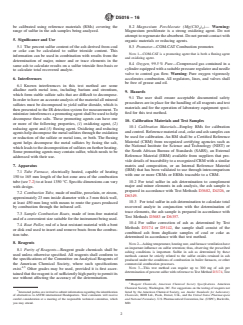
5.1 The percent sulfur content of the ash derived from coal or coke can be calculated to sulfur trioxide content. This information can be used in combination with results from the determination of major, minor and or trace elements in the same ash to calculate results on a sulfur trioxide free-basis or to calculate total recovered analyte.
SCOPE
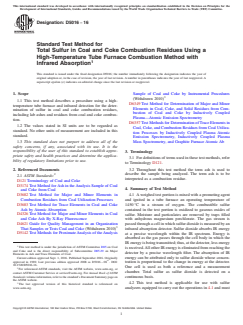
1.1 This test method describes a procedure using a high-temperature tube furnace and infrared detection for the determination of sulfur in coal and coke combustion residues, including lab ashes and residues from coal and coke combustion.
1.2 The values stated in SI units are to be regarded as standard. No other units of measurement are included in this standard.
1.3 This standard does not purport to address all of the safety concerns, if any, associated with its use. It is the responsibility of the user of this standard to establish appropriate safety and health practices and determine the applicability of regulatory limitations prior to use.
- Status
- Published
- Publication Date
- 31-Aug-2016
- Technical Committee
- D05 - Coal and Coke
- Drafting Committee
- D05.29 - Major Elements in Ash and Trace Elements of Coal
Buy Documents
ASTM D5016-16 - Standard Test Method for Total Sulfur in Coal and Coke Combustion Residues Using a High-Temperature Tube Furnace Combustion Method with Infrared Absorption
REDLINE ASTM D5016-16 - Standard Test Method for Total Sulfur in Coal and Coke Combustion Residues Using a High-Temperature Tube Furnace Combustion Method with Infrared Absorption
Overview
ASTM D5016-16 is the Standard Test Method for Total Sulfur in Coal and Coke Combustion Residues Using a High-Temperature Tube Furnace Combustion Method with Infrared Absorption. Developed by ASTM International, this method establishes a reliable laboratory procedure for measuring total sulfur content in combustion residues (ash) generated from coal and coke. The method uses a high-temperature tube furnace for sample combustion and an infrared detector for quantifying sulfur dioxide, ensuring precise results important for regulatory compliance, quality control, and environmental monitoring within energy, utility, and materials sectors.
Key Topics
- Purpose: Provides an accurate means of measuring total sulfur in the residue from coal and coke combustion, including lab ashes.
- Methodology:
- Samples are combusted at high temperatures in a tube furnace in an oxygen-rich environment.
- Sulfur in the sample oxidizes to sulfur dioxide (SO₂), which is then measured by infrared absorption.
- Results can be expressed as sulfur trioxide (SO₃) content for further analysis.
- Calibration and Reference Materials:
- Calibration must utilize certified reference materials (CRMs) covering the expected sulfur range.
- Ongoing calibration verification is required for consistent results.
- Analysis Precision:
- The method defines repeatability and reproducibility limits to ensure reliable measurement of sulfur content across laboratories.
- Applicability:
- Specifically designed for coal and coke ash but relevant for any combustion residue analysis where sulfur measurement is critical.
- Interferences:
- Certain alkaline earth metals may interfere with sulfur release. Use of promoting agents improves decomposition of stable sulfates.
Applications
ASTM D5016-16 is widely used in:
- Power Generation: Supporting environmental emission controls and process optimization in coal-fired power plants by providing accurate sulfur levels in ash.
- Environmental Compliance: Facilitating calculation of sulfur emissions and pollutant tracking for regulatory reporting.
- Materials Quality Control: Enabling comparison of feedstock and waste stream compositions for coke production facilities and coal suppliers.
- Laboratory Analysis: Used for routine analysis in labs dedicated to materials testing, fuel characterization, and regulatory certification.
- Ash Characterization: Results can be combined with data from other analyses for comprehensive ash and residue profiling, important for waste management and resource recovery.
Related Standards
For comprehensive coal, coke, and combustion residue evaluation, ASTM D5016-16 is typically used in conjunction with the following ASTM standards:
- D121: Terminology of Coal and Coke
- D3174: Test Method for Ash in the Analysis Sample of Coal and Coke
- D3682: Test Method for Major and Minor Elements in Combustion Residues from Coal Utilization Processes
- D3683: Test Method for Trace Elements in Coal and Coke Ash by Atomic Absorption
- D4326: Test Method for Major and Minor Elements in Coal and Coke Ash by X-Ray Fluorescence
- D6349: Test Method for Determination of Major and Minor Elements in Coal, Coke, and Solid Residues from Combustion by Inductively Coupled Plasma
- D6357: Test Methods for Determination of Trace Elements in Coal, Coke, and Combustion Residues by Advanced Spectrometry Techniques
Practical Value
- Highly Accurate: The high-temperature tube furnace and IR absorption technique delivers sensitive and accurate sulfur measurements.
- Supports Compliance: Results are critical for reporting sulfur content as required by environmental regulations and emission control programs.
- Flexible Application: The method addresses detection in a variety of residue types and supports adjustment for interferences, making it adaptable for routine and non-standard samples.
- Quality Assurance: The use of CRMs and calibration protocols ensures data consistency for interlaboratory comparability.
By following ASTM D5016-16, organizations ensure reliable sulfur analysis in coal and coke combustion residues, supporting operational efficiency, regulatory compliance, and environmental responsibility.
Relations
- Effective Date
- 01-Sep-2016
- Effective Date
- 01-Mar-2024
- Effective Date
- 01-Sep-2015
- Refers
ASTM D3174-12 - Standard Test Method for Ash in the Analysis Sample of Coal and Coke from Coal - Effective Date
- 01-Nov-2012
- Effective Date
- 01-Apr-2011
- Effective Date
- 01-Apr-2011
- Refers
ASTM D3174-11 - Standard Test Method for Ash in the Analysis Sample of Coal and Coke from Coal - Effective Date
- 01-Apr-2011
- Refers
ASTM D3174-04(2010) - Standard Test Method for Ash in the Analysis Sample of Coal and Coke from Coal - Effective Date
- 01-Dec-2010
- Effective Date
- 01-Nov-2009
- Effective Date
- 01-Oct-2009
- Effective Date
- 01-Feb-2009
- Effective Date
- 15-Feb-2008
- Effective Date
- 01-Feb-2008
- Effective Date
- 01-Feb-2008
- Effective Date
- 01-Jun-2007
Buy Documents
ASTM D5016-16 - Standard Test Method for Total Sulfur in Coal and Coke Combustion Residues Using a High-Temperature Tube Furnace Combustion Method with Infrared Absorption
REDLINE ASTM D5016-16 - Standard Test Method for Total Sulfur in Coal and Coke Combustion Residues Using a High-Temperature Tube Furnace Combustion Method with Infrared Absorption
Get Certified
Connect with accredited certification bodies for this standard

Element Materials Technology
Materials testing and product certification.

ABS Group Brazil
ABS Group certification services in Brazil.

ABS Quality Evaluations Inc.
American Bureau of Shipping quality certification.
Sponsored listings
Frequently Asked Questions
ASTM D5016-16 is a standard published by ASTM International. Its full title is "Standard Test Method for Total Sulfur in Coal and Coke Combustion Residues Using a High-Temperature Tube Furnace Combustion Method with Infrared Absorption". This standard covers: SIGNIFICANCE AND USE 5.1 The percent sulfur content of the ash derived from coal or coke can be calculated to sulfur trioxide content. This information can be used in combination with results from the determination of major, minor and or trace elements in the same ash to calculate results on a sulfur trioxide free-basis or to calculate total recovered analyte. SCOPE 1.1 This test method describes a procedure using a high-temperature tube furnace and infrared detection for the determination of sulfur in coal and coke combustion residues, including lab ashes and residues from coal and coke combustion. 1.2 The values stated in SI units are to be regarded as standard. No other units of measurement are included in this standard. 1.3 This standard does not purport to address all of the safety concerns, if any, associated with its use. It is the responsibility of the user of this standard to establish appropriate safety and health practices and determine the applicability of regulatory limitations prior to use.
SIGNIFICANCE AND USE 5.1 The percent sulfur content of the ash derived from coal or coke can be calculated to sulfur trioxide content. This information can be used in combination with results from the determination of major, minor and or trace elements in the same ash to calculate results on a sulfur trioxide free-basis or to calculate total recovered analyte. SCOPE 1.1 This test method describes a procedure using a high-temperature tube furnace and infrared detection for the determination of sulfur in coal and coke combustion residues, including lab ashes and residues from coal and coke combustion. 1.2 The values stated in SI units are to be regarded as standard. No other units of measurement are included in this standard. 1.3 This standard does not purport to address all of the safety concerns, if any, associated with its use. It is the responsibility of the user of this standard to establish appropriate safety and health practices and determine the applicability of regulatory limitations prior to use.
ASTM D5016-16 is classified under the following ICS (International Classification for Standards) categories: 75.160.10 - Solid fuels. The ICS classification helps identify the subject area and facilitates finding related standards.
ASTM D5016-16 has the following relationships with other standards: It is inter standard links to ASTM D5016-08e1, ASTM D121-15(2024), ASTM D121-15, ASTM D3174-12, ASTM D3683-11, ASTM D4326-11, ASTM D3174-11, ASTM D3174-04(2010), ASTM D6349-09, ASTM D121-09a, ASTM D121-09, ASTM D121-08, ASTM D6349-08, ASTM D6349-08e1, ASTM D6349-07. Understanding these relationships helps ensure you are using the most current and applicable version of the standard.
ASTM D5016-16 is available in PDF format for immediate download after purchase. The document can be added to your cart and obtained through the secure checkout process. Digital delivery ensures instant access to the complete standard document.
Standards Content (Sample)
This international standard was developed in accordance with internationally recognized principles on standardization established in the Decision on Principles for the
Development of International Standards, Guides and Recommendations issued by the World Trade Organization Technical Barriers to Trade (TBT) Committee.
Designation: D5016 − 16
Standard Test Method for
Total Sulfur in Coal and Coke Combustion Residues Using a
High-Temperature Tube Furnace Combustion Method with
Infrared Absorption
This standard is issued under the fixed designation D5016; the number immediately following the designation indicates the year of
original adoption or, in the case of revision, the year of last revision. A number in parentheses indicates the year of last reapproval. A
superscript epsilon (´) indicates an editorial change since the last revision or reapproval.
1. Scope Sample of Coal and Coke by Instrumental Procedures
(Withdrawn 2010)
1.1 This test method describes a procedure using a high-
D6349 Test Method for Determination of Major and Minor
temperature tube furnace and infrared detection for the deter-
Elements in Coal, Coke, and Solid Residues from Com-
mination of sulfur in coal and coke combustion residues,
bustion of Coal and Coke by Inductively Coupled
including lab ashes and residues from coal and coke combus-
Plasma—Atomic Emission Spectrometry
tion.
D6357 TestMethodsforDeterminationofTraceElementsin
1.2 The values stated in SI units are to be regarded as
Coal, Coke, and Combustion Residues from Coal Utiliza-
standard. No other units of measurement are included in this
tion Processes by Inductively Coupled Plasma Atomic
standard.
Emission Spectrometry, Inductively Coupled Plasma
1.3 This standard does not purport to address all of the
Mass Spectrometry, and Graphite Furnace Atomic Ab
safety concerns, if any, associated with its use. It is the
responsibility of the user of this standard to establish appro-
3. Terminology
priate safety and health practices and determine the applica-
3.1 For definitions of terms used in these test methods, refer
bility of regulatory limitations prior to use.
to Terminology D121.
2. Referenced Documents 3.2 Throughout this test method the term ash is used to
2 describe the sample being analyzed. The term ash is to be
2.1 ASTM Standards:
interpreted as a combustion residue.
D121 Terminology of Coal and Coke
D3174 Test Method forAsh in theAnalysis Sample of Coal
4. Summary of Test Method
and Coke from Coal
D3682 Test Method for Major and Minor Elements in 4.1 Aweighed test portion is mixed with a promoting agent
Combustion Residues from Coal Utilization Processes and ignited in a tube furnace an operating temperature of
D3683 Test Method for Trace Elements in Coal and Coke
1450 °C in a stream of oxygen. The combustible sulfur
Ash by Atomic Absorption contained in the test portion is oxidized to gaseous oxides of
D4326 Test Method for Major and Minor Elements in Coal
sulfur. Moisture and particulates are removed by traps filled
and Coke Ash By X-Ray Fluorescence with anhydrous magnesium perchlorate. The gas stream is
D4621 Guide for Quality Management in an Organization
passedthroughacellinwhichsulfurdioxideismeasuredbyan
That Samples or Tests Coal and Coke (Withdrawn 2010) infrared absorption detector. Sulfur dioxide absorbs IR energy
D5142 Test Methods for ProximateAnalysis of theAnalysis
at a precise wavelength within the IR spectrum. Energy is
absorbed as the gas passes through the cell body in which the
IRenergyisbeingtransmitted;thus,atthedetector,lessenergy
This test method is under the jurisdiction of ASTM Committee D05 on Coal
isreceived.AllotherIRenergyiseliminatedfromreachingthe
and Coke and is the direct responsibility of Subcommittee D05.29 on Major
detector by a precise wavelength filter. The absorption of IR
Elements in Ash and Trace Elements of Coal.
energy can be attributed only to sulfur dioxide whose concen-
Current edition approved Sept. 1, 2016. Published September 2016. Originally
ɛ1
approved in 1989. Last previous edition approved 2008 as D5016 – 08 . DOI:
tration is proportional to the change in energy at the detector.
10.1520/D5016-16.
One cell is used as both a reference and a measurement
For referenced ASTM standards, visit the ASTM website, www.astm.org, or
chamber. Total sulfur as sulfur dioxide is detected on a
contact ASTM Customer Service at service@astm.org. For Annual Book of ASTM
Standards volume information, refer to the standard’s Document Summary page on continuous basis.
the ASTM website.
4.2 This test method is applicable for use with sulfur
The last approved version of this historical standard is referenced on
www.astm.org. analyzers equipped to carry out the operations in 4.1 and must
Copyright © ASTM International, 100 Barr Harbor Drive, PO Box C700, West Conshohocken, PA 19428-2959. United States
D5016 − 16
be calibrated using reference materials (RMs) covering the 8.2 Magnesium Perchlorate (Mg(ClO ) )— Warning:
4 2
range of sulfur in the ash samples being analyzed. Magnesium perchlorate is a strong oxidizing agent. Do not
attempttoregeneratetheabsorbent.Donotpermitcontactwith
5. Significance and Use
organic materials or reducing agents.
5.1 The percent sulfur content of the ash derived from coal
8.3 Promotor—COM-CAT Combustion promoter.
or coke can be calculated to sulfur trioxide content. This
NOTE 1—COM-CAT is a promoting agent that is both a fluxing agent
information can be used in combination with results from the
and oxidizing agent.
determination of major, minor and or trace elements in the
8.4 Oxygen, 99.5 % Pure—Compressed gas contained in a
same ash to calculate results on a sulfur trioxide free-basis or
cylinderequippedwithasuitablepressureregulatorandneedle
to calculate total recovered analyte.
valve to control gas flow. Warning: Pure oxygen vigorously
accelerates combustion. All regulators, lines, and valves shall
6. Interferences
be free of grease and oil.
6.1 Known interferences in this test method are some
alkaline earth metal ions, including barium and strontium,
9. Hazards
which form stable sulfate salts that are difficult to decompose.
9.1 The user shall ensure acceptable documented safety
In order to have an accurate analysis of the material all mineral
procedures are in place for the handling of all reagents and test
sulfates must be decomposed to yield sulfur dioxide, which is
materials and for the operation of laboratory equipment speci-
then presented to the IR detection system for measurement. To
fied for this test method.
minimize interferences a promoting agent shall be used to help
decompose these salts. These promoting agents can have one
10. Calibration Materials and Test Samples
or more of the following properties, (1) oxidizing agent, (2)
10.1 Calibration Materials—Employ RMs for calibration
reducing agent and (3) fluxing agent. Oxidizing and reducing
andcontrol.Referencematerialcoal,cokeandashsamplescan
agentshelpdecomposethemetalsulfatesthroughtheoxidation
be used for calibration. An RM shall be a Certified Reference
or reduction of the sulfate or metal ions, or both. The fluxing
Material (CRM) from recognized certifying agencies such as
agent helps decompose the metal sulfates by fusing the salt,
the National Institute for Science and Technology (NIST) or
whichleadstothedecompositionofsulfatesonfurtherheating.
the South African Bureau of Standards (SABS), an External
Some promoting agents may contain sulfur, which needs to be
Reference Material (ERM) available from suppliers that pro-
addressed with their use.
vide details of traceability to a recognized CRM with a similar
matrix and composition, or an Internal Reference Material
7. Apparatus
(IRM) that has been validated to use through intercomparison
7.1 Tube Furnace, electrically heated, capable of heating
with one or more CRMs or ERMs traceable to a CRM.
150 to 165 mm length of the hot zone area of the combustion
tube (see 7.2) to at least 1350 °C. Specific dimensions can vary 10.2 For total sulfur in ash determination to complement
major and minor elements in ash analysis, the ash sample is
with design.
prepared in accordance with Test Methods D3682, D4326,or
7.2 Combustion Tube, made of mullite, porcelain, or zircon,
D6349.
approximately 23 mm inside diameter with a 3 mm thick wall,
10.3 For total sulfur in ash determination to calculate total
at least 450 mm long with means to route the gases produced
recovered analyte in conjunction with the determination of
by combustion through the infrared cell.
trace elements, the ash sample is prepared in accordance with
7.3 Sample Combustion Boats, made of iron-free material
Test Methods D3683 or D6357.
and of a convenient size suitable for the instrument being used.
10.4 For sulfur correction of ash as determined by Test
7.4 Boat Puller, rod of a heat resistant material with a bent
Methods D3174 or D5142, the sample shall consist of the
or disk end used to insert and remove boats from the combus-
combined ash from duplicate samples of coal or coke as
tion tube.
determined in accordance with that test method.
8. Reagents
NOTE2—Ashingtemperature,heatingrate,andfurnaceventilationhave
an important influence on sulfur retention; thus, observing the prescribed
8.1 Purity of Reagents—Reagent grade chemicals shall be
ashing conditions is important. Sulfur in ash as determined by these
used unless otherwise specified. All reagents shall conform to
methods cannot be strictly related to the sulfur oxides retained in ash
the specifications of the Committee on Analytical Reagents of
produced under the conditions of combustion in boiler furnaces, or other
the American Chemical Society, where such specifications commercial combustion processes.
4,5
NOTE 3—This test method can require up to 300 mg of ash per
exist. Other grades may be used, provided it is first ascer-
determinationofpercentsulfurwithreferencetoTestMethodD3174,Test
tainedthatthereagentisofsufficientlyhighpuritytopermitits
use without affecting the accuracy of the determination.
Reagent Chemicals, American Chemical Society Specifications. American
Chemical Society, Washington, DC. For suggestions on the testing of reagents not
Interested parties are invited to submit information regarding the identification listed by the American Chemical Society, see Analar Standards for Laboratory
of alternatives to ASTM international Headquarters. Your comments will receive Chemicals, BDH Ltd., Poole, Dorset, U.K., and the United States Pharmacopeia
careful consideration at a meeting of the responsible technical committee, which and National Formulary. U.S. Pharmaceutical Convention, Inc. (USPC), Rockville,
you may attend. MD.
D5016 − 16
TABLE 1 Instrument Parameters TABLE 2 Number of Reference Materials Needed for Calibration
Furnace Temperature 1450 °C Curve Type Degree Minimum Number of
Comparator Level 0.3 RMs
Lance Delay 10 Linear 1 3
Minimum Run Time 120 s Quadratic 2 4
Maximum Run Time 300 s Cubic 3 5
Method D3682,Test Method D4326,Test Method D5142, orTest Method
tion of calibration in accordance with Guide D4621 are not
D6349; therefore, it can be necessary to ash additional coal or coke.
met, the calibration procedure of 11.2.1 shall be repeated.
NOTE 5—Some RMs, especially ashes with very low sulfur contents,
11. Procedure
may not be acceptable for use as periodic calibration verifications. This is
11.1 Instrument Preparation/Verification—Use of COM-
duetothedifficultyofdecomposingthemineralsulfatesintheashandthe
CAT requires the instrument to meet the parameters listed in low sulfur contents. The infrared detection system only functions to
measure the sulfur dioxide presented for measurement.
Table1.Verifytheinstrumentmeetsthesespecificationsbefore
conducting instrument calibration or analysis (see Note 4).
11.3 Analysis Procedure:
11.3.1 Stabilize and calibrate the analyzer (see 11.2).
11.2 Calibration of the Infrared Detection System—
11.3.2 Weigh 250 mg of the test sample to the nearest
Calibration of the infrared detector system is accomplished
0.1 mg (sample mass may have to be adjusted in order for the
when a measurable amount of sulfur dioxide is presented for
sulfur mass fraction to land within the calibration range).
detection using the conditions outlined in Table 1. Select
Carefully blend the weighed test portion with approximately
Reference Materials (RMs) with known sulfur values in the
1.0 g COM-CAT. Spread the mixture evenly in the combustion
range of the samples to be analyzed. For the initial calibration
boat. Position
...
This document is not an ASTM standard and is intended only to provide the user of an ASTM standard an indication of what changes have been made to the previous version. Because
it may not be technically possible to adequately depict all changes accurately, ASTM recommends that users consult prior editions as appropriate. In all cases only the current version
of the standard as published by ASTM is to be considered the official document.
´1
Designation: D5016 − 08 D5016 − 16
Standard Test Method for
Total Sulfur in Coal and Coke Combustion Residues Using a
High-Temperature Tube Furnace Combustion Method with
Infrared Absorption
This standard is issued under the fixed designation D5016; the number immediately following the designation indicates the year of
original adoption or, in the case of revision, the year of last revision. A number in parentheses indicates the year of last reapproval. A
superscript epsilon (´) indicates an editorial change since the last revision or reapproval.
ε NOTE—Table A1.1 was editorially revised in July 2009.
1. Scope
1.1 This test method describes a procedure using a high-temperature tube furnace and infrared detection for the determination
of sulfur in coal and coke combustion residues, including lab ashes and residues from coal and coke combustion.
1.2 The values stated in SI units are to be regarded as standard. No other units of measurement are included in this standard.
1.3 This standard does not purport to address all of the safety concerns, if any, associated with its use. It is the responsibility
of the user of this standard to establish appropriate safety and health practices and determine the applicability of regulatory
limitations prior to use.
2. Referenced Documents
2.1 ASTM Standards:
D121 Terminology of Coal and Coke
D3174 Test Method for Ash in the Analysis Sample of Coal and Coke from Coal
D3682 Test Method for Major and Minor Elements in Combustion Residues from Coal Utilization Processes
D3683 Test Method for Trace Elements in Coal and Coke Ash by Atomic Absorption
D4326 Test Method for Major and Minor Elements in Coal and Coke Ash By X-Ray Fluorescence
D4621 Guide for Quality Management in an Organization That Samples or Tests Coal and Coke (Withdrawn 2010)
D5142 Test Methods for Proximate Analysis of the Analysis Sample of Coal and Coke by Instrumental Procedures (Withdrawn
2010)
D6349 Test Method for Determination of Major and Minor Elements in Coal, Coke, and Solid Residues from Combustion of
Coal and Coke by Inductively Coupled Plasma—Atomic Emission Spectrometry
D6357 Test Methods for Determination of Trace Elements in Coal, Coke, and Combustion Residues from Coal Utilization
Processes by Inductively Coupled Plasma Atomic Emission Spectrometry, Inductively Coupled Plasma Mass Spectrometry,
and Graphite Furnace Atomic Ab
3. Terminology
3.1 For definitions of terms used in these test methods, refer to Terminology D121.
3.2 Throughout this test method the term ash is used to describe the sample being analyzed. The term ash is to be interpreted
as a combustion residue.
4. Summary of Test Method
4.1 A weighed test portion is mixed with a promoting agent and ignited in a tube furnace an operating temperature of
1450°C1450 °C in a stream of oxygen. The combustible sulfur contained in the test portion is oxidized to gaseous oxides of sulfur.
This test method is under the jurisdiction of ASTM Committee D05 on Coal and Coke and is the direct responsibility of Subcommittee D05.29 on Major Elements in
Ash and Trace Elements of Coal.
Current edition approved Feb. 1, 2008Sept. 1, 2016. Published February 2008September 2016. Originally approved in 1989. Last previous edition approved 20072008
ɛ1
as D5016 – 07a.D5016 – 08 . DOI: 10.1520/D5016-08E01.10.1520/D5016-16.
For referenced ASTM standards, visit the ASTM website, www.astm.org, or contact ASTM Customer Service at service@astm.org. For Annual Book of ASTM Standards
volume information, refer to the standard’s Document Summary page on the ASTM website.
The last approved version of this historical standard is referenced on www.astm.org.
Copyright © ASTM International, 100 Barr Harbor Drive, PO Box C700, West Conshohocken, PA 19428-2959. United States
D5016 − 16
Moisture and particulates are removed by traps filled with anhydrous magnesium perchlorate. The gas stream is passed through
a cell in which sulfur dioxide is measured by an infrared absorption detector. Sulfur dioxide absorbs IR energy at a precise
wavelength within the IR spectrum. Energy is absorbed as the gas passes through the cell body in which the IR energy is being
transmitted; thus, at the detector, less energy is received. All other IR energy is eliminated from reaching the detector by a precise
wavelength filter. The absorption of IR energy can be attributed only to sulfur dioxide whose concentration is proportional to the
change in energy at the detector. One cell is used as both a reference and a measurement chamber. Total sulfur as sulfur dioxide
is detected on a continuous basis.
4.2 This test method is applicable for use with sulfur analyzers equipped to carry out the operations in 4.1 and must be calibrated
using reference materials (RMs) covering the range of sulfur in the ash samples being analyzed.
5. Significance and Use
5.1 The percent sulfur content of the ash derived from coal or coke can be calculated to sulfur trioxide content. This information
can be used in combination with results from the determination of major, minor and or trace elements in the same ash to calculate
results on a sulfur trioxide free-basis or to calculate total recovered analyte.
6. Interferences
6.1 Known interferences in this test method are some alkaline earth metal ions, including barium and strontium, which form
stable sulfate salts that are difficult to decompose. In order to have an accurate analysis of the material all mineral sulfates must
be decomposed to yield sulfur dioxide, which is then presented to the IR detection system for measurement. To minimize
interferences a promoting agent shall be used to help decompose these salts. These promoting agents can have one or more of the
following properties, (1) oxidizing agent, (2) reducing agent and (3) fluxing agent. Oxidizing and reducing agents help decompose
the metal sulfates through the oxidation or reduction of the sulfate or metal ions, or both. The fluxing agent helps decompose the
metal sulfates by fusing the salt, which leads to the decomposition of sulfates on further heating. Some promoting agents may
contain sulfur, which needs to be addressed with their use.
7. Apparatus
7.1 Tube Furnace, electrically heated, capable of heating 150 to 165-mm 165 mm length of the hot zone area of the combustion
tube (see 7.2) to at least 1350°C.1350 °C. Specific dimensions can vary with design.
7.2 Combustion Tube, made of mullite, porcelain, or zircon, approximately 23-mm23 mm inside diameter with a 3-mm3 mm
thick wall, at least 450 mm long with means to route the gases produced by combustion through the infrared cell.
7.3 Sample Combustion Boats, made of iron-free material and of a convenient size suitable for the instrument being used.
7.4 Boat Puller, rod of a heat resistant material with a bent or disk end used to insert and remove boats from the combustion
tube.
8. Reagents
8.1 Purity of Reagents—Reagent grade chemicals shall be used unless otherwise specified. All reagents shall conform to the
4,5
specifications of the Committee on Analytical Reagents of the American Chemical Society, where such specifications exist.
Other grades may be used, provided it is first ascertained that the reagent is of sufficiently high purity to permit its use without
affecting the accuracy of the determination.
8.2 Magnesium Perchlorate (Mg(ClO ) )— Warning: Magnesium perchlorate is a strong oxidizing agent. Do not attempt to
4 2
regenerate the absorbent. Do not permit contact with organic materials or reducing agents.
8.3 Promotor—COM-CAT Combustion promoterpromoter.
NOTE 1—COM-CAT is a promoting agent that is both a fluxing agent and oxidizing agent.
8.4 Oxygen, 99.5 % Pure—Compressed gas contained in a cylinder equipped with a suitable pressure regulator and needle valve
to control gas flow. Warning: Pure oxygen vigorously accelerates combustion. All regulators, lines, and valves shall be free of
grease and oil.
9. Hazards
9.1 The user shall ensure acceptable documented safety procedures are in place for the handling of all reagents and test materials
and for the operation of laboratory equipment specified for this test method.
Interested parties are invited to submit information regarding the identification of alternatives to ASTM international Headquarters. Your comments will receive careful
consideration at a meeting of the responsible technical committee, which you may attend.
Reagent Chemicals, American Chemical Society Specifications. American Chemical Society, Washington, DC. For suggestions on the testing of reagents not listed by
the American Chemical Society, see Analar Standards for Laboratory Chemicals, BDH Ltd., Poole, Dorset, U.K., and the United States Pharmacopeia and National
Formulary. U.S. Pharmaceutical Convention, Inc. (USPC), Rockville, MD.
D5016 − 16
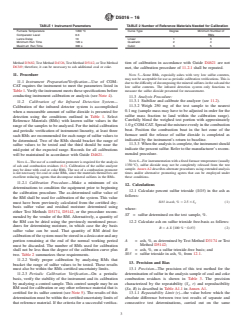
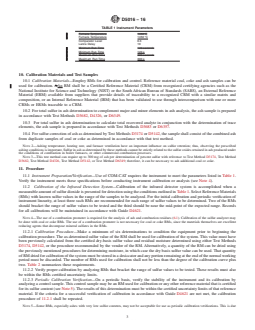
TABLE 1 Instrument Parameters
Furnace Temperature 1450°C
Furnace Temperature 1450 °C
Comparator Level 0.3
Lance Delay 10
Minimum Run Time 120 seconds
Minimum Run Time 120 s
Maximum Run Time 300 seconds
Maximum Run Time 300 s
10. Calibration Materials and Test Samples
10.1 Calibration Materials—Employ RMs for calibration and control. Reference material coal, coke and ash samples can be
used for calibration. AAn RM shall be a Certified Reference Material (CRM) from recognized certifying agencies such as the
National Institute for Science and Technology (NIST) or the South African Bureau of Standards (SABS), an External Reference
Material (ERM) available from suppliers that provide details of traceability to a recognized CRM with a similar matrix and
composition, or an Internal Reference Material (IRM) that has been validated to use through intercomparison with one or more
CRMs or ERMs traceable to a CRM.
10.2 For total sulfur in ash determination to complement major and minor elements in ash analysis, the ash sample is prepared
in accordance with Test Methods D3682, D4326, or D6349.
10.3 For total sulfur in ash determination to calculate total recovered analyte in conjunction with the determination of trace
elements, the ash sample is prepared in accordance with Test Methods D3683 or D6357.
10.4 For sulfur correction of ash as determined by Test Methods D3174 or D5142, the sample shall consist of the combined ash
from duplicate samples of coal or coke as determined in accordance with that test method.
NOTE 2—Ashing temperature, heating rate, and furnace ventilation have an important influence on sulfur retention; thus, observing the prescribed
ashing conditions is important. Sulfur in ash as determined by these methods cannot be strictly related to the sulfur oxides retained in ash produced under
the conditions of combustion in boiler furnaces, or other commercial combustion processes.
NOTE 3—This test method can require up to 300 mg of ash per determination of percent sulfur with reference to Test Method D3174, Test Method
D3682, Test Method D4326, Test Method D5142, or Test Method D6349; therefore, it can be necessary to ash additional coal or coke.
11. Procedure
11.1 Instrument Preparation/Verification—Use of COM-CAT requires the instrument to meet the parameters listed in Table 1.
Verify the instrument meets these specifications before conducting instrument calibration or analysis (see Note 4).
11.2 Calibration of the Infrared Detection System—Calibration of the infrared detector system is accomplished when a
measurable amount of sulfur dioxide is presented for detection using the conditions outlined in Table 1. Select Reference Materials
(RMs) with known sulfur values in the range of the samples to be analyzed. For the initial calibration and periodic verification of
instrument linearity, at least three such RMs are recommended for each range of sulfur values to be determined. Two of the RMs
should bracket the range of sulfur values to be tested and the third should be near the mid-point of the expected range. Records
for all calibrations will be maintained in accordance with Guide D4621.
NOTE 4—The use of a combustion promoter is required for the analysis of ash and combustion residues (6.1). Calibration of the sulfur analyzer may
be done with coal or coke RMs. The use of a combustion promoter is not necessary for coal or coke RMs, since the materials themselves are excellent
reducing agents that decompose mineral sulfates in the RMs.
11.2.1 Calibration Procedure—Make a minimum of six determinations to condition the equipment prior to beginning the
calibration procedure. The as-determined sulfur value of the RM shall be used for calibration of the system. This value must have
been previously calculated from the certified dry-basis sulfur value and residual moisture determined using either Test Methods
D3174, D5142, or the procedure recommended by the vendor of the RM. Alternatively, a quantity of the RM can be dried using
the previously mentioned procedures for determining moisture, in which case the dry basis sulfur value can be used. That quantity
of RM dried for calibration of the system must be stored in a desiccator and any portion remaining at the end of the normal working
period must be discarded. The number of RMs used for calibration shall not be less than the degree of the calibration curve plus
two. Table 2 summarizes these requirements.
11.2.2 Verify proper calibration by analyzing RMs that bracket the range of sulfur values to be tested. These results must also
be within the RMs certified uncertainty limits.
11.2.3 Periodic Calibration Verification—On a periodic basis, verify the stability of the instrument and its calibration by
analyzin
...