


ASTM F2009-20
(Test Method)Standard Test Method for Determining the Axial Disassembly Force of Taper Connections of Modular Prostheses
Standard Test Method for Determining the Axial Disassembly Force of Taper Connections of Modular Prostheses
SIGNIFICANCE AND USE
4.1 This test method helps to assess the axial locking force of a modular taper. Some types of devices that may utilize this type of connection are the modular shoulder and modular hip prostheses. Additional means of evaluating the locking mechanisms of tapers may be appropriate, depending upon the design of the device.
4.2 This test method may not be appropriate for all implant applications. The user is cautioned to consider the appropriateness of the practice in view of the materials and design being tested and their potential application.
4.3 While this test method may be used to measure the force required to disengage tapers, any comparison of such data for various component designs must take into consideration the size of the implant and the type of locking mechanism evaluated.
SCOPE
1.1 This test method establishes a standard methodology for determining the force required, under laboratory conditions, to disassemble tapers of implants that are otherwise not intended to release. Some examples are the femoral components of a total or partial hip replacement or shoulder in which the head and base component are secured together by a self-locking taper.
1.2 This test method has been developed primarily for evaluation of metal and ceramic head designs on metal tapers but may have application to other materials and designs.
1.3 The values stated in SI units are to be regarded as standard. No other units of measurement are included in this standard.
1.4 This standard does not purport to address all of the safety concerns, if any, associated with its use. It is the responsibility of the user of this standard to establish appropriate safety, health, and environmental practices and determine the applicability of regulatory limitations prior to use.
1.5 This international standard was developed in accordance with internationally recognized principles on standardization established in the Decision on Principles for the Development of International Standards, Guides and Recommendations issued by the World Trade Organization Technical Barriers to Trade (TBT) Committee.
General Information
- Status
- Published
- Publication Date
- 29-Feb-2020
- Technical Committee
- F04 - Medical and Surgical Materials and Devices
- Drafting Committee
- F04.22 - Arthroplasty
Relations
- Effective Date
- 01-Jun-2014
- Effective Date
- 01-Jun-2010
- Effective Date
- 01-Nov-2009
- Effective Date
- 01-Apr-2009
- Effective Date
- 01-Dec-2008
- Effective Date
- 01-Jan-2007
- Effective Date
- 10-Aug-2003
- Effective Date
- 10-Nov-2002
- Effective Date
- 10-Apr-2001
- Effective Date
- 10-Apr-2001
Overview
ASTM F2009-20 is the internationally recognized standard test method for determining the axial disassembly force of taper connections in modular prostheses. Developed by ASTM International, this standard establishes a consistent laboratory procedure to quantitatively measure the force required to separate the taper components in modular implants, such as those used in hip and shoulder endoprostheses. The method is essential for evaluating the mechanical integrity and stability of modular connections, particularly where reliable locking mechanisms are critical for the function and longevity of the implant.
Modular prostheses frequently utilize self-locking tapers to secure components like femoral heads and bases in total or partial joint replacements. Accurate assessment of the axial disassembly force helps manufacturers, regulatory bodies, and clinicians ensure that these connections will perform reliably in clinical use.
Key Topics
- Test Methodology: The standard outlines procedures for preparing test specimens, assembling the taper connection under controlled conditions, and applying an axial tensile force to separate the components.
- Scope of Application: While developed primarily for metal and ceramic head designs on metal tapers, the method may also apply to other material combinations and implant designs after appropriate evaluation.
- Fixture and Equipment: The test requires precise fixturing to align the taper axis and specialized testing machines capable of delivering controlled compressive or tensile forces as per ASTM E4 guidelines.
- Sample Preparation: Test specimens must match the finished implant in taper geometry and material characteristics to ensure meaningful results. Recommendations for cleaning and handling are included to prevent contamination.
- Data and Reporting: Results should include maximum disassembly force, assembly methods, specimen characterization, and a load-displacement graph. Descriptions of any unique assembly or disassembly fixtures and any deviations from the standard should be reported.
- Consideration of Implant Design: Comparisons of axial disassembly force across different designs require careful consideration of implant size and locking mechanism type.
Applications
ASTM F2009-20 is widely used in the following areas:
- Quality assurance in implant manufacturing: Ensures that modular taper connections meet minimum performance requirements for mechanical stability.
- Comparative evaluation of prosthesis designs: Allows benchmarking of new components against established designs, provided care is taken to account for differences in geometry and locking mechanisms.
- Regulatory submissions: Serves as a reference method for demonstrating compliance with international medical device regulations related to modular joint replacements.
- Research and development: Provides a standardized framework for testing innovative materials or connection mechanisms in orthopedic implant design.
By using this standard, manufacturers and researchers can assess the reliability of modular taper connections under controlled laboratory conditions, increasing confidence in clinical performance and supporting patient safety.
Related Standards
- ASTM E4 - Practices for Force Verification of Testing Machines: Specifies requirements for calibration and performance of the testing equipment used in this method.
- ASTM F1636 (Withdrawn) - Specification for Bores and Cones for Modular Femoral Heads: Previously provided dimensional standards for interfaces relevant to some modular prosthesis designs.
- Other Modular Prosthesis Standards: Consider referencing additional ASTM and ISO standards related to the design and testing of orthopedic implants for comprehensive evaluation and comparison.
Keywords: ASTM F2009, axial disassembly force, taper connections, modular prostheses, hip prosthesis, shoulder prosthesis, biomedical implants, disassembly test method, arthroplasty, implant stability, orthopedic device testing.
Buy Documents

ASTM F2009-20 - Standard Test Method for Determining the Axial Disassembly Force of Taper Connections of Modular Prostheses
REDLINE ASTM F2009-20 - Standard Test Method for Determining the Axial Disassembly Force of Taper Connections of Modular Prostheses
Get Certified
Connect with accredited certification bodies for this standard

BSI Group
BSI (British Standards Institution) is the business standards company that helps organizations make excellence a habit.

TÜV Rheinland
TÜV Rheinland is a leading international provider of technical services.

TÜV SÜD
TÜV SÜD is a trusted partner of choice for safety, security and sustainability solutions.
Sponsored listings
Frequently Asked Questions
ASTM F2009-20 is a standard published by ASTM International. Its full title is "Standard Test Method for Determining the Axial Disassembly Force of Taper Connections of Modular Prostheses". This standard covers: SIGNIFICANCE AND USE 4.1 This test method helps to assess the axial locking force of a modular taper. Some types of devices that may utilize this type of connection are the modular shoulder and modular hip prostheses. Additional means of evaluating the locking mechanisms of tapers may be appropriate, depending upon the design of the device. 4.2 This test method may not be appropriate for all implant applications. The user is cautioned to consider the appropriateness of the practice in view of the materials and design being tested and their potential application. 4.3 While this test method may be used to measure the force required to disengage tapers, any comparison of such data for various component designs must take into consideration the size of the implant and the type of locking mechanism evaluated. SCOPE 1.1 This test method establishes a standard methodology for determining the force required, under laboratory conditions, to disassemble tapers of implants that are otherwise not intended to release. Some examples are the femoral components of a total or partial hip replacement or shoulder in which the head and base component are secured together by a self-locking taper. 1.2 This test method has been developed primarily for evaluation of metal and ceramic head designs on metal tapers but may have application to other materials and designs. 1.3 The values stated in SI units are to be regarded as standard. No other units of measurement are included in this standard. 1.4 This standard does not purport to address all of the safety concerns, if any, associated with its use. It is the responsibility of the user of this standard to establish appropriate safety, health, and environmental practices and determine the applicability of regulatory limitations prior to use. 1.5 This international standard was developed in accordance with internationally recognized principles on standardization established in the Decision on Principles for the Development of International Standards, Guides and Recommendations issued by the World Trade Organization Technical Barriers to Trade (TBT) Committee.
SIGNIFICANCE AND USE 4.1 This test method helps to assess the axial locking force of a modular taper. Some types of devices that may utilize this type of connection are the modular shoulder and modular hip prostheses. Additional means of evaluating the locking mechanisms of tapers may be appropriate, depending upon the design of the device. 4.2 This test method may not be appropriate for all implant applications. The user is cautioned to consider the appropriateness of the practice in view of the materials and design being tested and their potential application. 4.3 While this test method may be used to measure the force required to disengage tapers, any comparison of such data for various component designs must take into consideration the size of the implant and the type of locking mechanism evaluated. SCOPE 1.1 This test method establishes a standard methodology for determining the force required, under laboratory conditions, to disassemble tapers of implants that are otherwise not intended to release. Some examples are the femoral components of a total or partial hip replacement or shoulder in which the head and base component are secured together by a self-locking taper. 1.2 This test method has been developed primarily for evaluation of metal and ceramic head designs on metal tapers but may have application to other materials and designs. 1.3 The values stated in SI units are to be regarded as standard. No other units of measurement are included in this standard. 1.4 This standard does not purport to address all of the safety concerns, if any, associated with its use. It is the responsibility of the user of this standard to establish appropriate safety, health, and environmental practices and determine the applicability of regulatory limitations prior to use. 1.5 This international standard was developed in accordance with internationally recognized principles on standardization established in the Decision on Principles for the Development of International Standards, Guides and Recommendations issued by the World Trade Organization Technical Barriers to Trade (TBT) Committee.
ASTM F2009-20 is classified under the following ICS (International Classification for Standards) categories: 11.040.40 - Implants for surgery, prosthetics and orthotics. The ICS classification helps identify the subject area and facilitates finding related standards.
ASTM F2009-20 has the following relationships with other standards: It is inter standard links to ASTM E4-14, ASTM E4-10, ASTM E4-09a, ASTM E4-09, ASTM E4-08, ASTM E4-07, ASTM E4-03, ASTM E4-02, ASTM E4-01, ASTM E4-99. Understanding these relationships helps ensure you are using the most current and applicable version of the standard.
ASTM F2009-20 is available in PDF format for immediate download after purchase. The document can be added to your cart and obtained through the secure checkout process. Digital delivery ensures instant access to the complete standard document.
Standards Content (Sample)
This international standard was developed in accordance with internationally recognized principles on standardization established in the Decision on Principles for the
Development of International Standards, Guides and Recommendations issued by the World Trade Organization Technical Barriers to Trade (TBT) Committee.
Designation: F2009 − 20
Standard Test Method for
Determining the Axial Disassembly Force of Taper
Connections of Modular Prostheses
This standard is issued under the fixed designation F2009; the number immediately following the designation indicates the year of
original adoption or, in the case of revision, the year of last revision. A number in parentheses indicates the year of last reapproval. A
superscript epsilon (´) indicates an editorial change since the last revision or reapproval.
1. Scope 3. Summary of Test Method
3.1 The axial disassembly test method provides a means to
1.1 This test method establishes a standard methodology for
measure the axial locking strength of the taper connection for
determining the force required, under laboratory conditions, to
modular prostheses.
disassemble tapers of implants that are otherwise not intended
to release. Some examples are the femoral components of a
3.2 Following assembly, an axial tensile force is applied to
total or partial hip replacement or shoulder in which the head
disassemble the taper connection and the maximum force is
and base component are secured together by a self-locking
recorded.
taper.
4. Significance and Use
1.2 This test method has been developed primarily for
4.1 This test method helps to assess the axial locking force
evaluation of metal and ceramic head designs on metal tapers
of a modular taper. Some types of devices that may utilize this
but may have application to other materials and designs.
type of connection are the modular shoulder and modular hip
1.3 The values stated in SI units are to be regarded as
prostheses.Additional means of evaluating the locking mecha-
standard. No other units of measurement are included in this
nisms of tapers may be appropriate, depending upon the design
standard.
of the device.
1.4 This standard does not purport to address all of the
4.2 This test method may not be appropriate for all implant
safety concerns, if any, associated with its use. It is the
applications. The user is cautioned to consider the appropriate-
responsibility of the user of this standard to establish appro-
ness of the practice in view of the materials and design being
priate safety, health, and environmental practices and deter-
tested and their potential application.
mine the applicability of regulatory limitations prior to use.
4.3 Whilethistestmethodmaybeusedtomeasuretheforce
1.5 This international standard was developed in accor-
required to disengage tapers, any comparison of such data for
dance with internationally recognized principles on standard-
various component designs must take into consideration the
ization established in the Decision on Principles for the
size of the implant and the type of locking mechanism
Development of International Standards, Guides and Recom-
evaluated.
mendations issued by the World Trade Organization Technical
Barriers to Trade (TBT) Committee.
5. Apparatus
5.1 The cone portion of the assembly shall be constrained
2. Referenced Documents
by suitable fixtures that can sustain high loads.
2.1 ASTM Standards:
5.2 The fixtures shall be constructed so that the line of load
E4 Practices for Force Verification of Testing Machines
application is aligned with the axes of the male and female
taper components within 61°.
5.2.1 For example, modular heads may be assembled by a
This test method is under the jurisdiction ofASTM Committee F04 on Medical solid metal 100° cone as shown in Fig. 1. The cone should
and Surgical Materials and Devices and is the direct responsibility of Subcommittee
provide line contact around the diameter of the head.
F04.22 on Arthroplasty.
5.2.2 For example, modular heads may be disassembled
Current edition approved March 1, 2020. Published May 2020. Originally
with a metal cage that surrounds the head and provides even
approved in 2000. Last previous edition approved in 2011 as F2009 – 00 (2011).
DOI: 10.1520/F2009-20.
contact around the inferior edge of the head as shown in Fig. 2.
For referenced ASTM standards, visit the ASTM website, www.astm.org, or
5.2.3 One method to minimize misalignment and off-axis
contact ASTM Customer Service at service@astm.org. For Annual Book of ASTM
loading during constant rate assembly is to include thrust
Standards volume information, refer to the standard’s Document Summary page on
the ASTM website. bearing for self-centering of the taper with the assembly cone.
Copyright © ASTM International, 100 Barr Harbor Drive, PO Box C700, West Conshohocken, PA 19428-2959. United States
F2009 − 20
5.3 The testing machine shall conform to the requirements
of Practices E4. The loads used to determine the attachment
strength shall be within the range of the testing machine as
defined in Practices E4.
5.4 The test machine should be capable of delivering a
compressiveandtensileforceataconstantdisplacementrateor
constant force rate. The test machine should have a load
monitoring and recording system.
6. Sampling and Test Specimens
6.1 The male and female taper components can be finished
implants or they can be simplified test specimens. The test
specimens shall have tapers manufactured to the specifications
of a finished implant, including material, and preferably
manufactured with the same equipment.
6.2 Thesupportingmaterialaroundthefemaletapershallbe
similar in size and shape to the finished implant.
6.3 A minimum of five taper assemblies shall be tested to
determine the axial disassembly force between the tapered
components. Pairing of the components shall be random unless
otherwise reported. The appropriateness of performing mul-
tiple tests on the same taper connection will depend on the
design and application of the device.
6.4 Sterilization of test components is not required unless it
FIG. 1 Modular Head Assembly
has known effects on the parts being evaluated. Generally,
sterilization does not have an effect on metallic materials.
7. Procedure
7.1 Following normal laboratory cleaning procedures to
remove any debris or other surface contaminants, the taper
components are assembled on a suitable test machine. A
suggested procedure for cleaning and drying of the specimens
is given in Appendix X1.
7.2 Each specimen should be characterized prior to testing.
This information may include, but is not limited to, the
following: material, hardness, bore and taper diameters,
concentricity, surface roughness, taper angle, and length of
engagement.
7.3 Tapers can be assembled using two methods. Depending
ontheintendeduse,theusermayusetheassemblymethodthat
best suits the taper application.
7.3.1 Constant Rate Assembly Method—A 2 kN peak static
load is applied to the taper component along the long axis of
the taper within 61°; the load may be applied using a constant
displacement rate un
...
This document is not an ASTM standard and is intended only to provide the user of an ASTM standard an indication of what changes have been made to the previous version. Because
it may not be technically possible to adequately depict all changes accurately, ASTM recommends that users consult prior editions as appropriate. In all cases only the current version
of the standard as published by ASTM is to be considered the official document.
Designation: F2009 − 00 (Reapproved 2011) F2009 − 20
Standard Test Method for
Determining the Axial Disassembly Force of Taper
Connections of Modular Prostheses
This standard is issued under the fixed designation F2009; the number immediately following the designation indicates the year of
original adoption or, in the case of revision, the year of last revision. A number in parentheses indicates the year of last reapproval. A
superscript epsilon (´) indicates an editorial change since the last revision or reapproval.
1. Scope
1.1 This test method establishes a standard methodology for determining the force required, under laboratory conditions, to
disassemble tapers of implants that are otherwise not intended to release. Some examples are the femoral components of a total
or partial hip replacement or shoulder in which the head and base component are secured together by a self-locking taper.
1.2 This test method has been developed primarily for evaluation of metal and ceramic head designs on metal tapers but may
have application to other materials and designs.
1.3 The values stated in SI units are to be regarded as standard. No other units of measurement are included in this standard.
1.4 This standard does not purport to address all of the safety concerns, if any, associated with its use. It is the responsibility
of the user of this standard to establish appropriate safety safety, health, and healthenvironmental practices and determine the
applicability of regulatory limitations prior to use.
1.5 This international standard was developed in accordance with internationally recognized principles on standardization
established in the Decision on Principles for the Development of International Standards, Guides and Recommendations issued
by the World Trade Organization Technical Barriers to Trade (TBT) Committee.
2. Referenced Documents
2.1 ASTM Standards:
E4 Practices for Force Verification of Testing Machines
F1636 Specification for Bores and Cones for Modular Femoral Heads (Withdrawn 2001)
3. Summary of Test Method
3.1 The axial disassembly test method provides a means to measure the axial locking strength of the taper connection for
modular prostheses.
3.2 Following assembly, an axial tensile force is applied to disassemble the taper connection and the maximum force is
recorded.
4. Significance and Use
4.1 This test method helps to assess the axial locking force of a modular taper. Examples of these devices are described in
Specification F1636. Some types of devices that may utilize this type of connection are the modular shoulder and modular hip
prostheses. Additional means of evaluating the locking mechanisms of tapers may be appropriate, depending upon the design of
the device.
4.2 This test method may not be appropriate for all implant applications. The user is cautioned to consider the appropriateness
of the practice in view of the materials and design being tested and their potential application.
4.3 While this test method may be used to measure the force required to disengage tapers, any comparison of such data for
various component designs must take into consideration the size of the implant and the type of locking mechanism evaluated.
This test method is under the jurisdiction of ASTM Committee F04 on Medical and Surgical Materials and Devices and is the direct responsibility of Subcommittee
F04.22 on Arthroplasty.
Current edition approved March 1, 2011March 1, 2020. Published April 2011May 2020. Originally approved in 2000. Last previous edition approved in 20052011 as F2009
– 00 (2005).(2011). DOI: 10.1520/F2009-00R11.10.1520/F2009-20.
For referenced ASTM standards, visit the ASTM website, www.astm.org, or contact ASTM Customer Service at service@astm.org. For Annual Book of ASTM Standards
volume information, refer to the standard’s Document Summary page on the ASTM website.
Copyright © ASTM International, 100 Barr Harbor Drive, PO Box C700, West Conshohocken, PA 19428-2959. United States
F2009 − 20
5. Apparatus
5.1 The cone portion of the assembly shall be constrained by suitable fixtures that can sustain high loads.
5.2 The fixtures shall be constructed so that the line of load application is aligned with the axes of the male and female taper
components within 61°.
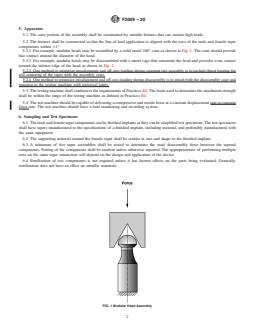
5.2.1 For example, modular heads may be assembled by a solid metal 100° cone as shown in Fig. 1. The cone should provide
line contact around the diameter of the head.
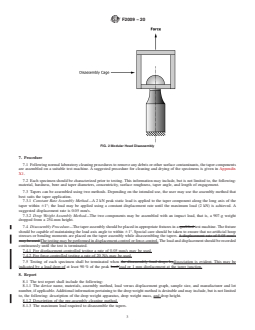
5.2.2 For example, modular heads may be disassembled with a metal cage that surrounds the head and provides even contact
around the inferior edge of the head as shown in Fig. 2.
5.2.3 One method to minimize misalignment and off-axis loading during constant rate assembly is to include thrust bearing for
self-centering of the taper with the assembly cone.
5.2.4 One method to minimize misalignment and off-axis loading during disassembly is to attach both the disassembly cage and
trunnion to the testing machine with universal joints.
5.3 The testing machine shall conform to the requirements of Practices E4. The loads used to determine the attachment strength
shall be within the range of the testing machine as defined in Practices E4.
5.4 The test machine should be capable of delivering a compressive and tensile force at a constant displacement rate or constant
force rate. The test machine should have a load monitoring and recording system.
6. Sampling and Test Specimens
6.1 The male and female taper components can be finished implants or they can be simplified test specimens. The test specimens
shall have tapers manufactured to the specifications of a finished implant, including material, and preferably manufactured with
the same equipment.
6.2 The supporting material around the female taper shall be similar in size and shape to the finished implant.
6.3 A minimum of five taper assemblies shall be tested to determine the axial disassembly force between the tapered
components. Pairing of the components shall be random unless otherwise reported. The appropriateness of performing multiple
tests on the same taper connection will depend on the design and application of the device.
6.4 Sterilization of test components is not required unless it has known effects on the parts being evaluated. Generally,
sterilization does not have an effect on metallic materials.
FIG. 1 Modular Head Assembly
F2009 − 20
FIG. 2 Modular Head Disassembly
7. Procedure
7.1 Following normal laboratory cleaning procedures to remove any debris or other surface contaminants, the taper components
are assembled on a suitable test machine. A suggested procedure for cleaning and drying of the specimens is given in Appendix
X1.
7.2 Each specimen should be characterized prior to testing. This information may include, but is not limited to, the following:
material, hardness, bore and taper diameters, concentricity, surface roughness, taper angle, and length of engagement.
7.3 Tapers can be assembled using two methods. Depending on the intended use, the user may use the assembly method that
best suits the taper applicati
...
Questions, Comments and Discussion
Ask us and Technical Secretary will try to provide an answer. You can facilitate discussion about the standard in here.
Loading comments...