

ASTM C781-20
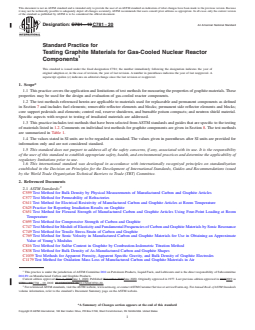
(Practice)Standard Practice for Testing Graphite Materials for Gas-Cooled Nuclear Reactor Components
General Information
- Abstract
SIGNIFICANCE AND USE
4.1 Property data obtained with the recommended test methods identified herein may be used for research and development, design, manufacturing control, specifications, performance evaluation, and regulatory statutes pertaining to nuclear reactors that utilize graphite.
4.2 The referenced test methods are applicable primarily to specimens in the non-irradiated and non-oxidized state. Testing irradiated specimens often requires specimen geometries that do not meet the requirements of the standard. Specific instructions or recommendations with respect to testing non-conforming geometries can be found in STP 15784 and/or Guide D7775. When testing irradiated specimens at elevated temperatures, the effects of annealing should be considered (see Note 1).
Note 1: Exposure to fast neutron radiation will result in atomic and microstructural changes to graphite. This radiation damage occurs when energetic particles, such as fast neutrons, impinge on the crystal lattice and displace carbon atoms from their equilibrium positions, creating a lattice vacancy and an interstitial carbon atom. The lattice strain that results from displacement damage causes significant structural and property changes in the graphite and is a function of the irradiation temperature and dose. When the temperature of the graphite is brought above the temperature at which it was irradiated, enough energy is provided that the structure of the graphite will anneal back to its original condition. Therefore, measurement techniques that bring the specimen temperature above the irradiation temperature can result in property values that change during the measurement process. For this reason, measurements made on irradiated test specimens below the irradiation temperature will produce results that are representative of the irradiation damage. However, measurements made at temperatures above the irradiation temperature could include the effects of annealing.
4.3 Additional test methods are in preparation a...
SCOPE
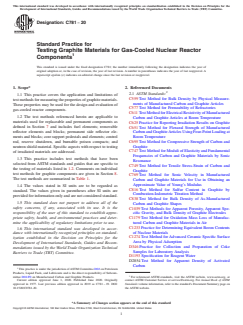
1.1 This practice covers the application and limitations of test methods for measuring the properties of graphite materials. These properties may be used for the design and evaluation of gas-cooled reactor components.
1.2 The test methods referenced herein are applicable to materials used for replaceable and permanent components as defined in Section 7 and includes fuel elements; removable reflector elements and blocks; permanent side reflector elements and blocks; core support pedestals and elements; control rod, reserve shutdown, and burnable poison compacts; and neutron shield material. Specific aspects with respect to testing of irradiated materials are addressed.
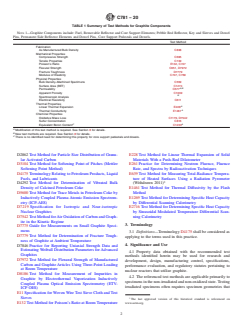
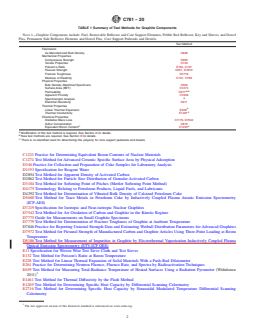
1.3 This practice includes test methods that have been selected from ASTM standards and guides that are specific to the testing of materials listed in 1.2. Comments on individual test methods for graphite components are given in Section 8. The test methods are summarized in Table 1.
1.4 The values stated in SI units are to be regarded as standard. The values given in parentheses after SI units are provided for information only and are not considered standard.
1.5 This standard does not purport to address all of the safety concerns, if any, associated with its use. It is the responsibility of the user of this standard to establish appropriate safety, health, and environmental practices and determine the applicability of regulatory limitations prior to use.
1.6 This international standard was developed in accordance with internationally recognized principles on standardization established in the Decision on Principles for the Development of International Standards, Guides and Recommendations issued by the World Trade Organization Technical Barriers to Trade (TBT) Committee.
- Status
- Published
- Publication Date
- 31-May-2020
- Technical Committee
- D02 - Petroleum Products, Liquid Fuels, and Lubricants
- Drafting Committee
- D02.F0 - Manufactured Carbon and Graphite Products
Buy Documents
ASTM C781-20 - Standard Practice for Testing Graphite Materials for Gas-Cooled Nuclear Reactor Components
REDLINE ASTM C781-20 - Standard Practice for Testing Graphite Materials for Gas-Cooled Nuclear Reactor Components
Overview
ASTM C781-20: Standard Practice for Testing Graphite Materials for Gas-Cooled Nuclear Reactor Components provides guidance on test methods for evaluating the properties of graphite materials intended for use in gas-cooled nuclear reactor systems. Developed by ASTM International, this standard is a fundamental reference for researchers, designers, manufacturers, and regulators working with graphite components in nuclear applications. The practice aligns with internationally recognized standardization principles and emphasizes the reliability and reproducibility of property data vital for the safety, efficiency, and regulatory compliance of nuclear reactors utilizing graphite.
Key Topics
- Property Measurement: The standard covers test methods for measuring mechanical, physical, thermal, and chemical properties of graphite materials, both as-manufactured and after irradiation.
- Component Coverage: Methods are applicable to graphite components used in reactors, including fuel elements, reflector elements, core support structures, control rod and shutdown compacts, neutron shield material, and special blocks for pebble bed reactors.
- Non-Irradiated and Irradiated Specimens: While the referenced test methods primarily address non-irradiated, non-oxidized materials, the standard outlines considerations and provides guidance for testing irradiated specimens, particularly regarding the effects of temperature and annealing.
- Data Use: Generated data supports research and development, design validation, manufacturing control, specification development, operational performance evaluation, and adherence to regulatory requirements.
Applications
Practical applications of ASTM C781-20 include:
- Design Validation: Ensures that graphite components meet stringent nuclear reactor performance and safety criteria.
- Manufacturing Control: Supports quality assurance during the fabrication of graphite reactor parts through standardized testing protocols.
- Performance Evaluation: Facilitates the assessment of graphite behavior under operational stresses, including the effects of irradiation and high temperature encountered in reactor environments.
- Regulatory Compliance: Provides a recognized basis for reporting and justifying component properties to regulatory authorities.
- Component Replacement and Inspection: Enables informed decisions regarding maintenance, replacement, or inspection of reactor graphite parts, including fuel elements and core supports.
Typical graphite components covered include:
- Replaceable and permanent fuel elements
- Removable reflector blocks
- Core support pedestals and columns
- Control rod and reactivity control compacts
- Pebble bed reactor reflector blocks
Related Standards
ASTM C781-20 references and complements several other key ASTM standards, including:
- C559 - Bulk Density by Physical Measurements of Manufactured Carbon and Graphite Articles
- C611 - Electrical Resistivity of Carbon and Graphite at Room Temperature
- C695 - Compressive Strength of Carbon and Graphite
- C651/D7972 - Flexural Strength (Four-Point/Three-Point Loading)
- C749 - Tensile Stress-Strain of Carbon and Graphite
- C747/C769 - Modulus of Elasticity and Sonic Velocity
- C1039 - Apparent Porosity and Bulk Density of Graphite Electrodes
- C1179 - Oxidation Mass Loss in Air
- C8186 - Measurement of Impurities in Graphite
- E228/E1461 - Thermal Expansion and Thermal Diffusivity
Consult the full text for the complete list and for specific application instructions for each test method.
Practical Value
By following ASTM C781-20, organizations in the nuclear industry ensure that graphite materials used in gas-cooled reactors are tested and characterized uniformly. This helps to:
- Reduce variability in material performance
- Support international collaboration and regulatory acceptance
- Improve reactor reliability and operational life
- Enhance safety by enabling early detection of material degradation
Keywords: graphite testing, nuclear graphite, gas-cooled reactor, mechanical properties, thermal properties, chemical analysis, ASTM C781-20, reactor component standards, nuclear safety, graphite materials, performance evaluation, reactor fuel elements.
Relations
- Effective Date
- 01-Jun-2020
- Refers
ASTM D4175-23a - Standard Terminology Relating to Petroleum Products, Liquid Fuels, and Lubricants - Effective Date
- 15-Dec-2023
- Effective Date
- 01-Dec-2023
- Effective Date
- 01-Nov-2023
- Effective Date
- 01-Oct-2023
- Refers
ASTM D4175-23e1 - Standard Terminology Relating to Petroleum Products, Liquid Fuels, and Lubricants - Effective Date
- 01-Jul-2023
- Effective Date
- 01-May-2020
- Effective Date
- 01-May-2020
- Effective Date
- 01-May-2020
- Effective Date
- 01-May-2020
- Effective Date
- 01-Apr-2020
- Effective Date
- 01-Nov-2019
- Effective Date
- 01-Dec-2018
- Effective Date
- 01-Oct-2018
- Effective Date
- 01-Apr-2018
Buy Documents
ASTM C781-20 - Standard Practice for Testing Graphite Materials for Gas-Cooled Nuclear Reactor Components
REDLINE ASTM C781-20 - Standard Practice for Testing Graphite Materials for Gas-Cooled Nuclear Reactor Components
Get Certified
Connect with accredited certification bodies for this standard

DNV
DNV is an independent assurance and risk management provider.

Lloyd's Register
Lloyd's Register is a global professional services organisation specialising in engineering and technology.
DNV Energy Systems
Energy and renewable energy certification.
Sponsored listings
Frequently Asked Questions
ASTM C781-20 is a standard published by ASTM International. Its full title is "Standard Practice for Testing Graphite Materials for Gas-Cooled Nuclear Reactor Components". This standard covers: SIGNIFICANCE AND USE 4.1 Property data obtained with the recommended test methods identified herein may be used for research and development, design, manufacturing control, specifications, performance evaluation, and regulatory statutes pertaining to nuclear reactors that utilize graphite. 4.2 The referenced test methods are applicable primarily to specimens in the non-irradiated and non-oxidized state. Testing irradiated specimens often requires specimen geometries that do not meet the requirements of the standard. Specific instructions or recommendations with respect to testing non-conforming geometries can be found in STP 15784 and/or Guide D7775. When testing irradiated specimens at elevated temperatures, the effects of annealing should be considered (see Note 1). Note 1: Exposure to fast neutron radiation will result in atomic and microstructural changes to graphite. This radiation damage occurs when energetic particles, such as fast neutrons, impinge on the crystal lattice and displace carbon atoms from their equilibrium positions, creating a lattice vacancy and an interstitial carbon atom. The lattice strain that results from displacement damage causes significant structural and property changes in the graphite and is a function of the irradiation temperature and dose. When the temperature of the graphite is brought above the temperature at which it was irradiated, enough energy is provided that the structure of the graphite will anneal back to its original condition. Therefore, measurement techniques that bring the specimen temperature above the irradiation temperature can result in property values that change during the measurement process. For this reason, measurements made on irradiated test specimens below the irradiation temperature will produce results that are representative of the irradiation damage. However, measurements made at temperatures above the irradiation temperature could include the effects of annealing. 4.3 Additional test methods are in preparation a... SCOPE 1.1 This practice covers the application and limitations of test methods for measuring the properties of graphite materials. These properties may be used for the design and evaluation of gas-cooled reactor components. 1.2 The test methods referenced herein are applicable to materials used for replaceable and permanent components as defined in Section 7 and includes fuel elements; removable reflector elements and blocks; permanent side reflector elements and blocks; core support pedestals and elements; control rod, reserve shutdown, and burnable poison compacts; and neutron shield material. Specific aspects with respect to testing of irradiated materials are addressed. 1.3 This practice includes test methods that have been selected from ASTM standards and guides that are specific to the testing of materials listed in 1.2. Comments on individual test methods for graphite components are given in Section 8. The test methods are summarized in Table 1. 1.4 The values stated in SI units are to be regarded as standard. The values given in parentheses after SI units are provided for information only and are not considered standard. 1.5 This standard does not purport to address all of the safety concerns, if any, associated with its use. It is the responsibility of the user of this standard to establish appropriate safety, health, and environmental practices and determine the applicability of regulatory limitations prior to use. 1.6 This international standard was developed in accordance with internationally recognized principles on standardization established in the Decision on Principles for the Development of International Standards, Guides and Recommendations issued by the World Trade Organization Technical Barriers to Trade (TBT) Committee.
SIGNIFICANCE AND USE 4.1 Property data obtained with the recommended test methods identified herein may be used for research and development, design, manufacturing control, specifications, performance evaluation, and regulatory statutes pertaining to nuclear reactors that utilize graphite. 4.2 The referenced test methods are applicable primarily to specimens in the non-irradiated and non-oxidized state. Testing irradiated specimens often requires specimen geometries that do not meet the requirements of the standard. Specific instructions or recommendations with respect to testing non-conforming geometries can be found in STP 15784 and/or Guide D7775. When testing irradiated specimens at elevated temperatures, the effects of annealing should be considered (see Note 1). Note 1: Exposure to fast neutron radiation will result in atomic and microstructural changes to graphite. This radiation damage occurs when energetic particles, such as fast neutrons, impinge on the crystal lattice and displace carbon atoms from their equilibrium positions, creating a lattice vacancy and an interstitial carbon atom. The lattice strain that results from displacement damage causes significant structural and property changes in the graphite and is a function of the irradiation temperature and dose. When the temperature of the graphite is brought above the temperature at which it was irradiated, enough energy is provided that the structure of the graphite will anneal back to its original condition. Therefore, measurement techniques that bring the specimen temperature above the irradiation temperature can result in property values that change during the measurement process. For this reason, measurements made on irradiated test specimens below the irradiation temperature will produce results that are representative of the irradiation damage. However, measurements made at temperatures above the irradiation temperature could include the effects of annealing. 4.3 Additional test methods are in preparation a... SCOPE 1.1 This practice covers the application and limitations of test methods for measuring the properties of graphite materials. These properties may be used for the design and evaluation of gas-cooled reactor components. 1.2 The test methods referenced herein are applicable to materials used for replaceable and permanent components as defined in Section 7 and includes fuel elements; removable reflector elements and blocks; permanent side reflector elements and blocks; core support pedestals and elements; control rod, reserve shutdown, and burnable poison compacts; and neutron shield material. Specific aspects with respect to testing of irradiated materials are addressed. 1.3 This practice includes test methods that have been selected from ASTM standards and guides that are specific to the testing of materials listed in 1.2. Comments on individual test methods for graphite components are given in Section 8. The test methods are summarized in Table 1. 1.4 The values stated in SI units are to be regarded as standard. The values given in parentheses after SI units are provided for information only and are not considered standard. 1.5 This standard does not purport to address all of the safety concerns, if any, associated with its use. It is the responsibility of the user of this standard to establish appropriate safety, health, and environmental practices and determine the applicability of regulatory limitations prior to use. 1.6 This international standard was developed in accordance with internationally recognized principles on standardization established in the Decision on Principles for the Development of International Standards, Guides and Recommendations issued by the World Trade Organization Technical Barriers to Trade (TBT) Committee.
ASTM C781-20 is classified under the following ICS (International Classification for Standards) categories: 27.120.10 - Reactor engineering. The ICS classification helps identify the subject area and facilitates finding related standards.
ASTM C781-20 has the following relationships with other standards: It is inter standard links to ASTM C781-19, ASTM D4175-23a, ASTM C838-16(2023), ASTM D4292-23, ASTM C747-23, ASTM D4175-23e1, ASTM C651-20, ASTM D7972-14(2020), ASTM C559-16(2020), ASTM C749-15(2020), ASTM C1274-12(2020), ASTM C577-19, ASTM D3104-14a(2018), ASTM D8186-18, ASTM E1269-11(2018). Understanding these relationships helps ensure you are using the most current and applicable version of the standard.
ASTM C781-20 is available in PDF format for immediate download after purchase. The document can be added to your cart and obtained through the secure checkout process. Digital delivery ensures instant access to the complete standard document.
Standards Content (Sample)
This international standard was developed in accordance with internationally recognized principles on standardization established in the Decision on Principles for the
Development of International Standards, Guides and Recommendations issued by the World Trade Organization Technical Barriers to Trade (TBT) Committee.
Designation: C781 − 20
Standard Practice for
Testing Graphite Materials for Gas-Cooled Nuclear Reactor
Components
This standard is issued under the fixed designation C781; the number immediately following the designation indicates the year of
original adoption or, in the case of revision, the year of last revision. A number in parentheses indicates the year of last reapproval. A
superscript epsilon (´) indicates an editorial change since the last revision or reapproval.
1. Scope* 2. Referenced Documents
2.1 ASTM Standards:
1.1 This practice covers the application and limitations of
C559 Test Method for Bulk Density by Physical Measure-
testmethodsformeasuringthepropertiesofgraphitematerials.
ments of Manufactured Carbon and Graphite Articles
These properties may be used for the design and evaluation of
C577 Test Method for Permeability of Refractories
gas-cooled reactor components.
C611 TestMethodforElectricalResistivityofManufactured
1.2 The test methods referenced herein are applicable to
Carbon and Graphite Articles at Room Temperature
materials used for replaceable and permanent components as
C625 Practice for Reporting Irradiation Results on Graphite
defined in Section 7 and includes fuel elements; removable
C651 Test Method for Flexural Strength of Manufactured
reflector elements and blocks; permanent side reflector ele- CarbonandGraphiteArticlesUsingFour-PointLoadingat
ments and blocks; core support pedestals and elements; control Room Temperature
C695 Test Method for Compressive Strength of Carbon and
rod, reserve shutdown, and burnable poison compacts; and
Graphite
neutron shield material. Specific aspects with respect to testing
C747 Test Method for Moduli of Elasticity and Fundamental
of irradiated materials are addressed.
Frequencies of Carbon and Graphite Materials by Sonic
1.3 This practice includes test methods that have been
Resonance
selected from ASTM standards and guides that are specific to
C749 Test Method for Tensile Stress-Strain of Carbon and
the testing of materials listed in 1.2. Comments on individual
Graphite
test methods for graphite components are given in Section 8.
C769 Test Method for Sonic Velocity in Manufactured
The test methods are summarized in Table 1.
Carbon and Graphite Materials for Use in Obtaining an
Approximate Value of Young’s Modulus
1.4 The values stated in SI units are to be regarded as
C816 Test Method for Sulfur Content in Graphite by
standard. The values given in parentheses after SI units are
Combustion-Iodometric Titration Method
provided for information only and are not considered standard.
C838 Test Method for Bulk Density of As-Manufactured
1.5 This standard does not purport to address all of the
Carbon and Graphite Shapes
safety concerns, if any, associated with its use. It is the
C1039 Test Methods for Apparent Porosity, Apparent Spe-
responsibility of the user of this standard to establish appro-
cific Gravity, and Bulk Density of Graphite Electrodes
priate safety, health, and environmental practices and deter-
C1179 Test Method for Oxidation Mass Loss of Manufac-
mine the applicability of regulatory limitations prior to use. tured Carbon and Graphite Materials in Air
C1233 Practice for Determining Equivalent Boron Contents
1.6 This international standard was developed in accor-
of Nuclear Materials
dance with internationally recognized principles on standard-
C1274 Test Method forAdvanced Ceramic Specific Surface
ization established in the Decision on Principles for the
Area by Physical Adsorption
Development of International Standards, Guides and Recom-
D346 Practice for Collection and Preparation of Coke
mendations issued by the World Trade Organization Technical
Samples for Laboratory Analysis
Barriers to Trade (TBT) Committee.
D1193 Specification for Reagent Water
D2854 Test Method for Apparent Density of Activated
Carbon
This practice is under the jurisdiction of ASTM Committee D02 on Petroleum
Products, Liquid Fuels, and Lubricants and is the direct responsibility of Subcom-
mittee D02.F0 on Manufactured Carbon and Graphite Products. For referenced ASTM standards, visit the ASTM website, www.astm.org, or
Current edition approved June 1, 2020. Published June 2020. Originally contact ASTM Customer Service at service@astm.org. For Annual Book of ASTM
approved in 1977. Last previous edition approved in 2019 as C781 – 19. DOI: Standards volume information, refer to the standard’s Document Summary page on
10.1520/C0781-20. the ASTM website.
*A Summary of Changes section appears at the end of this standard
Copyright © ASTM International, 100 Barr Harbor Drive, PO Box C700, West Conshohocken, PA 19428-2959. United States
C781 − 20
TABLE 1 Summary of Test Methods for Graphite Components
NOTE 1—Graphite Components include: Fuel, Removable Reflector and Core Support Elements; Pebble Bed Reflector, Key and Sleeves and Dowel
Pins, Permanent Side Reflector Elements and Dowel Pins, Core Support Pedestals and Dowels.
Test Method
Fabrication
As Manufactured Bulk Density C838
Mechanical Properties
Compressive Strength C695
Tensile Properties C749
Poisson’s Ratio E132, C747
Flexural Strength C651, D7972
Fracture Toughness D7779
Modulus of Elasticity C747, C769
Physical Properties
Bulk Density–Machined Specimens C559
Surface Area (BET) C1274
A,B
Permeability C577
Apparent Porosity C1039
B
Spectroscopic Analysis
Electrical Resistivity C611
Thermal Properties
A
Linear Thermal Expansion E228
A
Thermal Conductivity E1461
Chemical Properties
Oxidative Mass Loss C1179, D7542
Sulfur Concentration C816
C A
Equivalent Boron Content C1233
A
Modification of this test method is required. See Section 8 for details.
B
New test methods are required. See Section 8 for details.
C
There is no identified need for determining this property for core support pedestals and dowels.
D2862 Test Method for Particle Size Distribution of Granu- E228 Test Method for Linear Thermal Expansion of Solid
lar Activated Carbon Materials With a Push-Rod Dilatometer
D3104 Test Method for Softening Point of Pitches (Mettler E261 Practice for Determining Neutron Fluence, Fluence
Softening Point Method) Rate, and Spectra by Radioactivation Techniques
D4175 Terminology Relating to Petroleum Products, Liquid E639 Test Method for Measuring Total-Radiance Tempera-
Fuels, and Lubricants ture of Heated Surfaces Using a Radiation Pyrometer
D4292 Test Method for Determination of Vibrated Bulk (Withdrawn 2011)
Density of Calcined Petroleum Coke E1461 Test Method for Thermal Diffusivity by the Flash
D5600 Test Method for Trace Metals in Petroleum Coke by Method
Inductively Coupled Plasma Atomic Emission Spectrom- E1269 Test Method for Determining Specific Heat Capacity
etry (ICP-AES) by Differential Scanning Calorimetry
D7219 Specification for Isotropic and Near-isotropic E2716 Test Method for Determining Specific Heat Capacity
Nuclear Graphites by Sinusoidal Modulated Temperature Differential Scan-
D7542 Test Method forAir Oxidation of Carbon and Graph- ning Calorimetry
ite in the Kinetic Regime
3. Terminology
D7775 Guide for Measurements on Small Graphite Speci-
mens
3.1 Definitions—Terminology D4175 shall be considered as
D7779 Test Method for Determination of Fracture Tough-
applying to the terms used in this practice.
ness of Graphite at Ambient Temperature
4. Significance and Use
D7846 Practice for Reporting Uniaxial Strength Data and
Estimating Weibull Distribution Parameters forAdvanced
4.1 Property data obtained with the recommended test
Graphites
methods identified herein may be used for research and
D7972 Test Method for Flexural Strength of Manufactured
development, design, manufacturing control, specifications,
Carbon and Graphite Articles Using Three-Point Loading
performance evaluation, and regulatory statutes pertaining to
at Room Temperature
nuclear reactors that utilize graphite.
D8186 Test Method for Measurement of Impurities in
4.2 The referenced test methods are applicable primarily to
Graphite by Electrothermal Vaporization Inductively
specimensinthenon-irradiatedandnon-oxidizedstate.Testing
Coupled Plasma Optical Emission Spectrometry (ETV-
irradiated specimens often requires specimen geometries that
ICP OES)
E11 Specification for Woven Wire Test Sieve Cloth and Test
Sieves
The last approved version of this historical standard is referenced on
E132 Test Method for Poisson’s Ratio at Room Temperature www.astm.org.
C781 − 20
do not meet the requirements of the standard. Specific instruc- dowel pins, and for the insertion of a handling machine pickup
tions or recommendations with respect to testing non- head. A fuel element may also contain channels for reactivity
conforming geometries can be found in STP 1578 and/or control material (control rods), reserve shutdown compacts,
Guide D7775. When testing irradiated specimens at elevated and burnable poison compacts, and nuclear instrumentation.
temperatures, the effects of annealing should be considered 7.2.2 The fuel elements serve multiple functions, including
(see Note 1). (1)verticalandlateralmechanicalsupportforthefuelelements
and removable reflector elements above and adjacent to them,
NOTE 1—Exposure to fast neutron radiation will result in atomic and
and for the fuel, reactivity control materials, and nuclear
microstructural changes to graphite. This radiation damage occurs when
instrumentation within them, (2) moderation of fast neutrons
energeticparticles,suchasfastneutrons,impingeonthecrystallatticeand
displace carbon atoms from their equilibrium positions, creating a lattice
within the core region, (3) a thermal reservoir and conductor
vacancy and an interstitial carbon atom.The lattice strain that results from
for nuclear heat generated in the fuel, (4) a physical constraint
displacementdamagecausessignificantstructuralandpropertychangesin
for the flow of coolant gases, and (5) a guide for and
the graphite and is a function of the irradiation temperature and dose.
containment of fuel material, reactivity control materials, and
When the temperature of the graphite is brought above the temperature at
which it was irradiated, enough energy is provided that the structure of the nuclear instrumentation.
graphite will anneal back to its original condition. Therefore, measure-
7.2.3 Aremovable reflector element is a removable graphite
ment techniques that bring the specimen temperature above the irradiation
element that contains channels for the alignment dowel pins
temperature can result in property values that change during the measure-
and the insertion of a handling machine pickup head. A
ment process. For this reason, measurements made on irradiated test
removable reflector element may also contain channels for the
specimens below the irradiation temperature will produce results that are
representative of the irradiation damage. However, measurements made at passage of coolant gas, reactivity control materials (control
temperaturesabovetheirradiationtemperaturecouldincludetheeffectsof
rods), neutron flux control materials (neutron shield materials),
annealing.
and nuclear instrumentation.
4.3 Additional test methods are in preparation and will be
7.2.4 The primary function of the removable reflector ele-
incorporated. The user is cautioned to employ the latest
ments that are located at the boundaries of the active reactor
revision.
core (fuel elements) is to provide moderation of fast neutrons
escaping from and reflection of thermal neutrons back into the
5. Sample Selection
active core region.
5.1 All test specimens should be selected from materials 7.2.5 Except for support, guide, and containment of fuel
that are representative of those to be used in the intended material, removable reflector elements may also serve any of
application. the functions listed in 7.2.2.
7.3 Permanent Side Reflector Element:
6. Test Reports
7.3.1 Apermanent side reflector element is a graphite block
6.1 Test results should be reported in accordance with the
that is designed to remain permanently in the core but may be
reporting requirements included in the applicable test method.
removed for inspection and replacement, if necessary. A
Where relevant, information on grade designation, lot number,
permanent side reflector element contains channels for align-
billet number, orientation, and location (position of sample in
ment dowel pins. It may also contain channels for neutron flux
the original billet) shall be provided.
control materials (boronated steel pins) and nuclear
instrumentation,andrecessedareasalongitslengthonitsouter
6.2 Information on specimen irradiation conditions shall be
periphery to provide channels for the passage of coolant gas
reported in accordance with Practices C625 and E261 or
between the element and the metallic lateral restraint for the
referenced to source information of equivalent content.
reactor core.
GRAPHITE COMPONENTS
7.3.2 The permanent side reflector elements encircle the
active (fuel) elements and passive (removable reflector) ele-
7. Description and Function
ments of the reactor core and serve multiple functions, includ-
7.1 The following are identified as typical components of a ing (1) vertical and lateral mechanical support for the perma-
graphite moderated gas-cooled reactor based on historical
nent side reflector elements above and beside them, (2) lateral
designs. This list is not intended to be inclusive of all possible mechanical support for the fuel, removable reflector, and core
components, which will depend upon the particular reactor support elements, (3) moderation of fast neutrons within the
design. reflectorregion, (4)reflectionofthermalneutronsbackintothe
core region, and (5) support, guide, and containment of nuclear
7.2 Fuel and Removable Reflector Elements:
instrumentation and neutron flux control materials (boronated
7.2.1 In manufactured carbons and graphites, a fuel element
steel pins) for reducing the neutron flux to metallic structures
is a removable graphite element that contains channels for the
outside the permanent side reflector boundary.
passage of coolant gas, the fuel material (typically in the form
of a compact containing coated particle fuel), the alignment 7.4 Core Support Pedestals and Elements:
7.4.1 A core support pedestal is a graphite column that is
designedtoremainpermanentlyinthecorebutcanberemoved
Tzelepi, N. and Carroll, M., Eds., Graphite Testing for Nuclear Applications:
for inspection and replacement, if necessary. A core support
The Significance of Test Specimen Volume and Geometry and the Statistical
pedestal has a central reduced cross-section (dog bone shape)
Significance of Test Specimen Population, STP1578-EB,ASTM International, West
Conshohocken, PA, 2014, https://doi.org/10.1520/STP1578-EB that at its upper end contains channels for the passage of
C781 − 20
coolant gas, alignment dowel pins, and for the insertion of a rectangular parallelepipeds. Test Method C559 is used when a
handling machine pickup head, and at its lower end contains a higher degree of accuracy is required. The procedures of Test
recessed region for locating it with respect to the metallic Method C559 are modified in Annex A2 to provide for the
structure that supports the graphite core support assembly. A measurement of bulk density of non-uniform specimens.
core support element is a graphite element that contains
8.1.3 Graphitization Temperature—The graphitization tem-
channels for alignment dowel pins and for the insertion of a
perature of a full-size billet is estimated from a laboratory
handling machine pickup head.The core support elements may
correlation between Specific Electrical Resistivity (SER) (Test
also contain channels for the passage of coolant gas, neutron Method C611) and heat treatment temperature. The method is
flux control materials, and nuclear instrumentation.
described in Annex A3.
7.4.2 The primary function of the core support pedestals is
8.2 Mechanical Properties:
to provide for vertical mechanical support for core support
8.2.1 Compressive Strength—Determine compressive
elements and permanent side reflector elements above them. In
strength in accordance with Test Method C695.
addition, core support pedestals provide for lateral mechanical
8.2.2 Tensile Strength—Determine tensile strength in accor-
support for adjacent core support pedestals and permanent side
dance with Test Method C749 and Guide D7775.
reflector elements and physical constraint for the flow of
8.2.3 Flexural Strength—Determine flexural strength in ac-
coolant gases. The primary function of the core support
cordance with Test Method C651 or D7972.
elements is to provide for vertical mechanical support for core
8.2.4 Fracture Toughness—Determine fracture toughness in
support, fuel, and removable reflector elements above them. In
accordance with Test Method D7779.
addition, core support elements provide for lateral mechanical
8.2.5 Modulus of Elasticity and Poisson’s Ratio—Determine
support for adjacent core support and permanent side reflector
modulus of elasticity in accordance with Test Method C747.
elementsandmayprovideforthephysicalconstraintofcoolant
Poisson’s ratio can be determined using Test Method E132.
gases and for the support, guide, and containment of neutron
Sonic velocity (Test Method C769) may be used to give an
flux control materials and nuclear instrumentation.
approximate Young’s Modulus.
7.5 Pebble Bed Modular Reactor Reflector Blocks:
8.3 Physical Properties:
7.5.1 The fuel form of a pebble bed reactor is typically a
60 mm diameter sphere (pebble) containing graphite-carbon 8.3.1 Bulk Density—See 8.1.2.
matrix and coated particle fuel.
8.3.2 Surface Area—The determination of the specific sur-
7.5.2 The Pebble Bed reactor core structure consists of a face area (BET) shall be in accordance with Test Method
graphite reflector supported and surrounded by a metallic core
C1274.
barrel.The graphite reflector is comprised of a large number of
8.3.3 Gaseous Permeability—Test Method C577 for mea-
graphite blocks arranged in circular rings of separate columns.
suring gaseous permeability must be modified to permit the
The graphite reflector can be subdivided into three subsystems,
additional use of helium as the permeating medium and the use
namely, the bottom, side, and top reflector. The side reflector
of alternative geometries for specimens and specimen holders.
may be split into an inner replaceable reflector and an outer
8.3.4 Apparent Porosity—The determination of the apparent
permanent reflector. The graphite reflector blocks are inter-
porosity shall be in accordance with Test Method C1039.
linked within each circular ring by graphite keys set in
8.4 Thermal Properties:
machined channels in the reflector blocks. Certain Pebble Bed
8.4.1 Coeffıcient of Thermal Expansion of Graphite—
reactors designs have annular fuelled cores, and thus the
Determine the linear coefficient of thermal expansion (CTE) of
reactor contains a central graphite column.
graphite of all grain sizes in (general) accordance with Test
7.5.3 The primary function of the reflector blocks that are
Method E228. Test specimens of cylindrical or prismatic
located at the boundary of the active reactor core (fuelled
geometry shall be used. The diameter or transverse-edge
region) is to provide for moderation of fast neutrons escaping
length, respectively, shall be no less than five times the
from, and reflection of thermal neutrons back into, the active
maximum grain size of the graphite, and in no case smaller
core region.
than 4 mm. The length of the test specimen shall be at least
7.5.4 Replaceable reflector blocks contain vertical channels
25 mm, preferably 50 mm to 125 mm. The report shall include
for the reactivity control rods and reserve shutdown system.
the temperature range over which the CTE was measured.
Thesechannelscontaingraphitesleevestoeliminatecrossflow
8.4.2 Thermal Conductivity—Calculate the thermal conduc-
of reactor coolant gas.
tivity from the thermal diffusivity as determined by Test
Method E1461.The required calculation is described in Annex
8. Test Methods
A4.
8.1 Fabrication:
8.5 Chemical Properties:
8.1.1 Coeffıcient of Thermal Expansion of Coke—The
8.5.1 Oxidation—Determine the oxidative mass loss in air
method known as the flour-based graphitized rod CTE test is
in accordance with Test Method C1179. (Atest method for the
described in Annex A1.
determination of oxidation rate in air is in preparation.)
8.1.2 Bulk Density—Determine bulk density on as-
8.5.2 Chemical Impurities:
manufactured or machined specimens in accordance with Test
Methods C838 and C559, respectively. Test Method C838 8.5.2.1 The chemical impurities shall be measured in accor-
includes shaped articles other than right circular cylinders and dance with D5600 or D8186.
C781 − 20
8.5.2.2 Determine sulfur concentration in accordance with 9. Keywords
Test Method C816.
9.1 chemical properties; graphite; gas-cooled nuclear reac-
8.5.2.3 A method for determining boron levels is described
tors; mechanical properties; neutronic properties; physical
in Annex A5.
properties; thermal properties
8.5.3 Equivalent Boron Content—Test Method C1233 shall
be used to calculate equivalent boron content. The elements
specified in D7219 shall be measured for the determination of
the equivalent boron content.
ANNEXES
(Mandatory Information)
A1. QUALIFICATION CTE TEST FOR CALCINED COKE
A1.1 Scope—This method is applicable to the manufacture U.S. Standard No. 10 screen) then covered with about 50 mm
of graphite test rods from calcined petroleum or coal tar pitch of the same packing media. The sagger is placed into a furnace
coke of any origin.
at 100 °C and heated at about 90 °C⁄h to 120 °C⁄h to 850 °C to
900 °C and held for 1 h to 3 h. The sagger shall be furnace
A1.2 Sampling
cooled to less than 300 °C before opening and unpacking the
A1.2.1 Coke samples that are submitted for testing shall
rods. The rods may be cleaned using coarse sandpaper if
properly represent those lots, barges, railcars, or trucks which
required.
are received by the manufacturing locations.
A1.3.3 Graphitizing—The baked specimens are placed
...
This document is not an ASTM standard and is intended only to provide the user of an ASTM standard an indication of what changes have been made to the previous version. Because
it may not be technically possible to adequately depict all changes accurately, ASTM recommends that users consult prior editions as appropriate. In all cases only the current version
of the standard as published by ASTM is to be considered the official document.
Designation: C781 − 19 C781 − 20 An American National Standard
Standard Practice for
Testing Graphite Materials for Gas-Cooled Nuclear Reactor
Components
This standard is issued under the fixed designation C781; the number immediately following the designation indicates the year of
original adoption or, in the case of revision, the year of last revision. A number in parentheses indicates the year of last reapproval. A
superscript epsilon (´) indicates an editorial change since the last revision or reapproval.
1. Scope*
1.1 This practice covers the application and limitations of test methods for measuring the properties of graphite materials. These
properties may be used for the design and evaluation of gas-cooled reactor components.
1.2 The test methods referenced herein are applicable to materials used for replaceable and permanent components as defined
in Section 7 and includes fuel elements; removable reflector elements and blocks; permanent side reflector elements and blocks;
core support pedestals and elements; control rod, reserve shutdown, and burnable poison compacts; and neutron shield material.
Specific aspects with respect to testing of irradiated materials are addressed.
1.3 This practice includes test methods that have been selected from ASTM standards and guides that are specific to the testing
of materials listed in 1.2. Comments on individual test methods for graphite components are given in Section 8. The test methods
are summarized in Table 1.
1.4 The values stated in SI units are to be regarded as standard. The values given in parentheses after SI units are provided for
information only and are not considered standard.
1.5 This standard does not purport to address all of the safety concerns, if any, associated with its use. It is the responsibility
of the user of this standard to establish appropriate safety, health, and environmental practices and determine the applicability of
regulatory limitations prior to use.
1.6 This international standard was developed in accordance with internationally recognized principles on standardization
established in the Decision on Principles for the Development of International Standards, Guides and Recommendations issued
by the World Trade Organization Technical Barriers to Trade (TBT) Committee.
2. Referenced Documents
2.1 ASTM Standards:
C559 Test Method for Bulk Density by Physical Measurements of Manufactured Carbon and Graphite Articles
C577 Test Method for Permeability of Refractories
C611 Test Method for Electrical Resistivity of Manufactured Carbon and Graphite Articles at Room Temperature
C625 Practice for Reporting Irradiation Results on Graphite
C651 Test Method for Flexural Strength of Manufactured Carbon and Graphite Articles Using Four-Point Loading at Room
Temperature
C695 Test Method for Compressive Strength of Carbon and Graphite
C747 Test Method for Moduli of Elasticity and Fundamental Frequencies of Carbon and Graphite Materials by Sonic Resonance
C749 Test Method for Tensile Stress-Strain of Carbon and Graphite
C769 Test Method for Sonic Velocity in Manufactured Carbon and Graphite Materials for Use in Obtaining an Approximate
Value of Young’s Modulus
C816 Test Method for Sulfur Content in Graphite by Combustion-Iodometric Titration Method
C838 Test Method for Bulk Density of As-Manufactured Carbon and Graphite Shapes
C1039 Test Methods for Apparent Porosity, Apparent Specific Gravity, and Bulk Density of Graphite Electrodes
C1179 Test Method for Oxidation Mass Loss of Manufactured Carbon and Graphite Materials in Air
This practice is under the jurisdiction of ASTM Committee D02 on Petroleum Products, Liquid Fuels, and Lubricants and is the direct responsibility of Subcommittee
D02.F0 on Manufactured Carbon and Graphite Products.
Current edition approved Nov. 1, 2019June 1, 2020. Published November 2019June 2020. Originally approved in 1977. Last previous edition approved in 20182019 as
C781 – 18.C781 – 19. DOI: 10.1520/C0781-19.10.1520/C0781-20.
For referenced ASTM standards, visit the ASTM website, www.astm.org, or contact ASTM Customer Service at service@astm.org. For Annual Book of ASTM Standards
volume information, refer to the standard’s Document Summary page on the ASTM website.
*A Summary of Changes section appears at the end of this standard
Copyright © ASTM International, 100 Barr Harbor Drive, PO Box C700, West Conshohocken, PA 19428-2959. United States
C781 − 20
TABLE 1 Summary of Test Methods for Graphite Components
NOTE 1—Graphite Components include: Fuel, Removable Reflector and Core Support Elements; Pebble Bed Reflector, Key and Sleeves and Dowel
Pins, Permanent Side Reflector Elements and Dowel Pins, Core Support Pedestals and Dowels.
Test Method
Fabrication
As Manufactured Bulk Density C838
Mechanical Properties
Compressive Strength C695
Tensile Properties C749
Poisson’s Ratio E132, C747
Flexural Strength C651, D7972
Fracture Toughness D7779
Modulus of Elasticity C747, C769
Physical Properties
Bulk Density–Machined Specimens C559
Surface Area (BET) C1274
A,B
Permeability C577
Apparent Porosity C1039
B
Spectroscopic Analysis
Electrical Resistivity C611
Thermal Properties
A
Linear Thermal Expansion E228
A
Thermal Conductivity E1461
Chemical Properties
Oxidative Mass Loss C1179, D7542
Sulfur Concentration C816
C A
Equivalent Boron Content C1233
A
Modification of this test method is required. See Section 8 for details.
B
New test methods are required. See Section 8 for details.
C
There is no identified need for determining this property for core support pedestals and dowels.
C1233 Practice for Determining Equivalent Boron Contents of Nuclear Materials
C1274 Test Method for Advanced Ceramic Specific Surface Area by Physical Adsorption
D346 Practice for Collection and Preparation of Coke Samples for Laboratory Analysis
D1193 Specification for Reagent Water
D2854 Test Method for Apparent Density of Activated Carbon
D2862 Test Method for Particle Size Distribution of Granular Activated Carbon
D3104 Test Method for Softening Point of Pitches (Mettler Softening Point Method)
D4175 Terminology Relating to Petroleum Products, Liquid Fuels, and Lubricants
D4292 Test Method for Determination of Vibrated Bulk Density of Calcined Petroleum Coke
D5600 Test Method for Trace Metals in Petroleum Coke by Inductively Coupled Plasma Atomic Emission Spectrometry
(ICP-AES)
D7219 Specification for Isotropic and Near-isotropic Nuclear Graphites
D7542 Test Method for Air Oxidation of Carbon and Graphite in the Kinetic Regime
D7775 Guide for Measurements on Small Graphite Specimens
D7779 Test Method for Determination of Fracture Toughness of Graphite at Ambient Temperature
D7846 Practice for Reporting Uniaxial Strength Data and Estimating Weibull Distribution Parameters for Advanced Graphites
D7972 Test Method for Flexural Strength of Manufactured Carbon and Graphite Articles Using Three-Point Loading at Room
Temperature
D8186 Test Method for Measurement of Impurities in Graphite by Electrothermal Vaporization Inductively Coupled Plasma
Optical Emission Spectrometry (ETV-ICP OES)
E11 Specification for Woven Wire Test Sieve Cloth and Test Sieves
E132 Test Method for Poisson’s Ratio at Room Temperature
E228 Test Method for Linear Thermal Expansion of Solid Materials With a Push-Rod Dilatometer
E261 Practice for Determining Neutron Fluence, Fluence Rate, and Spectra by Radioactivation Techniques
E639 Test Method for Measuring Total-Radiance Temperature of Heated Surfaces Using a Radiation Pyrometer (Withdrawn
2011)
E1461 Test Method for Thermal Diffusivity by the Flash Method
E1269 Test Method for Determining Specific Heat Capacity by Differential Scanning Calorimetry
E2716 Test Method for Determining Specific Heat Capacity by Sinusoidal Modulated Temperature Differential Scanning
Calorimetry
The last approved version of this historical standard is referenced on www.astm.org.
C781 − 20
3. Terminology
3.1 Definitions—Terminology D4175 shall be considered as applying to the terms used in this practice.
4. Significance and Use
4.1 Property data obtained with the recommended test methods identified herein may be used for research and development,
design, manufacturing control, specifications, performance evaluation, and regulatory statutes pertaining to nuclear reactors that
utilize graphite.
4.2 The referenced test methods are applicable primarily to specimens in the non-irradiated and non-oxidized state. Testing
irradiated specimens often requires specimen geometries that do not meet the requirements of the standard. Specific instructions
or recommendations with respect to testing non-conforming geometries can be found in STP 1578 and/or Guide D7775. When
testing irradiated specimens at elevated temperatures, the effects of annealing should be considered (see Note 1).
NOTE 1—Exposure to fast neutron radiation will result in atomic and microstructural changes to graphite. This radiation damage occurs when energetic
particles, such as fast neutrons, impinge on the crystal lattice and displace carbon atoms from their equilibrium positions, creating a lattice vacancy and
an interstitial carbon atom. The lattice strain that results from displacement damage causes significant structural and property changes in the graphite and
is a function of the irradiation temperature and dose. When the temperature of the graphite is brought above the temperature at which it was irradiated,
enough energy is provided that the structure of the graphite will anneal back to its original condition. Therefore, measurement techniques that bring the
specimen temperature above the irradiation temperature can result in property values that change during the measurement process. For this reason,
measurements made on irradiated test specimens below the irradiation temperature will produce results that are representative of the irradiation damage.
However, measurements made at temperatures above the irradiation temperature could include the effects of annealing.
4.3 Additional test methods are in preparation and will be incorporated. The user is cautioned to employ the latest revision.
5. Sample Selection
5.1 All test specimens should be selected from materials that are representative of those to be used in the intended application.
6. Test Reports
6.1 Test results should be reported in accordance with the reporting requirements included in the applicable test method. Where
relevant, information on grade designation, lot number, billet number, orientation, and location (position of sample in the original
billet) shall be provided.
6.2 Information on specimen irradiation conditions shall be reported in accordance with Practices C625 and E261 or referenced
to source information of equivalent content.
GRAPHITE COMPONENTS
7. Description and Function
7.1 The following are identified as typical components of a graphite moderated gas-cooled reactor based on historical designs.
This list is not intended to be inclusive of all possible components, which will depend upon the particular reactor design.
7.2 Fuel and Removable Reflector Elements:
7.2.1 In manufactured carbons and graphites, a fuel element is a removable graphite element that contains channels for the
passage of coolant gas, the fuel material (typically in the form of a compact containing coated particle fuel), the alignment dowel
pins, and for the insertion of a handling machine pickup head. A fuel element may also contain channels for reactivity control
material (control rods), reserve shutdown compacts, and burnable poison compacts, and nuclear instrumentation.
7.2.2 The fuel elements serve multiple functions, including (1) vertical and lateral mechanical support for the fuel elements and
removable reflector elements above and adjacent to them, and for the fuel, reactivity control materials, and nuclear instrumentation
within them, (2) moderation of fast neutrons within the core region, (3) a thermal reservoir and conductor for nuclear heat
generated in the fuel, (4) a physical constraint for the flow of coolant gases, and (5) a guide for and containment of fuel material,
reactivity control materials, and nuclear instrumentation.
7.2.3 A removable reflector element is a removable graphite element that contains channels for the alignment dowel pins and
the insertion of a handling machine pickup head. A removable reflector element may also contain channels for the passage of
coolant gas, reactivity control materials (control rods), neutron flux control materials (neutron shield materials), and nuclear
instrumentation.
7.2.4 The primary function of the removable reflector elements that are located at the boundaries of the active reactor core (fuel
elements) is to provide moderation of fast neutrons escaping from and reflection of thermal neutrons back into the active core
region.
Tzelepi, N. and Carroll, M., Eds., Graphite Testing for Nuclear Applications: The Significance of Test Specimen Volume and Geometry and the Statistical Significance
of Test Specimen Population, STP1578-EB, ASTM International, West Conshohocken, PA, 2014, https://doi.org/10.1520/STP1578-EB
C781 − 20
7.2.5 Except for support, guide, and containment of fuel material, removable reflector elements may also serve any of the
functions listed in 7.2.2.
7.3 Permanent Side Reflector Element:
7.3.1 A permanent side reflector element is a graphite block that is designed to remain permanently in the core but may be
removed for inspection and replacement, if necessary. A permanent side reflector element contains channels for alignment dowel
pins. It may also contain channels for neutron flux control materials (boronated steel pins) and nuclear instrumentation, and
recessed areas along its length on its outer periphery to provide channels for the passage of coolant gas between the element and
the metallic lateral restraint for the reactor core.
7.3.2 The permanent side reflector elements encircle the active (fuel) elements and passive (removable reflector) elements of
the reactor core and serve multiple functions, including (1) vertical and lateral mechanical support for the permanent side reflector
elements above and beside them, (2) lateral mechanical support for the fuel, removable reflector, and core support elements, (3)
moderation of fast neutrons within the reflector region, (4) reflection of thermal neutrons back into the core region, and (5) support,
guide, and containment of nuclear instrumentation and neutron flux control materials (boronated steel pins) for reducing the
neutron flux to metallic structures outside the permanent side reflector boundary.
7.4 Core Support Pedestals and Elements:
7.4.1 A core support pedestal is a graphite column that is designed to remain permanently in the core but can be removed for
inspection and replacement, if necessary. A core support pedestal has a central reduced cross-section (dog bone shape) that at its
upper end contains channels for the passage of coolant gas, alignment dowel pins, and for the insertion of a handling machine
pickup head, and at its lower end contains a recessed region for locating it with respect to the metallic structure that supports the
graphite core support assembly. A core support element is a graphite element that contains channels for alignment dowel pins and
for the insertion of a handling machine pickup head. The core support elements may also contain channels for the passage of
coolant gas, neutron flux control materials, and nuclear instrumentation.
7.4.2 The primary function of the core support pedestals is to provide for vertical mechanical support for core support elements
and permanent side reflector elements above them. In addition, core support pedestals provide for lateral mechanical support for
adjacent core support pedestals and permanent side reflector elements and physical constraint for the flow of coolant gases. The
primary function of the core support elements is to provide for vertical mechanical support for core support, fuel, and removable
reflector elements above them. In addition, core support elements provide for lateral mechanical support for adjacent core support
and permanent side reflector elements and may provide for the physical constraint of coolant gases and for the support, guide, and
containment of neutron flux control materials and nuclear instrumentation.
7.5 Pebble Bed Modular Reactor Reflector Blocks:
7.5.1 The fuel form of a pebble bed reactor is typically a 60 mm diameter sphere (pebble) containing graphite-carbon matrix
and coated particle fuel.
7.5.2 The Pebble Bed reactor core structure consists of a graphite reflector supported and surrounded by a metallic core barrel.
The graphite reflector is comprised of a large number of graphite blocks arranged in circular rings of separate columns. The
graphite reflector can be subdivided into three subsystems, namely, the bottom, side, and top reflector. The side reflector may be
split into an inner replaceable reflector and an outer permanent reflector. The graphite reflector blocks are interlinked within each
circular ring by graphite keys set in machined channels in the reflector blocks. Certain Pebble Bed reactors designs have annular
fuelled cores, and thus the reactor contains a central graphite column.
7.5.3 The primary function of the reflector blocks that are located at the boundary of the active reactor core (fuelled region) is
to provide for moderation of fast neutrons escaping from, and reflection of thermal neutrons back into, the active core region.
7.5.4 Replaceable reflector blocks contain vertical channels for the reactivity control rods and reserve shutdown system. These
channels contain graphite sleeves to eliminate cross flow of reactor coolant gas.
8. Test Methods
8.1 Fabrication:
8.1.1 Coeffıcient of Thermal Expansion of Coke—The method known as the flour-based graphitized rod CTE test is described
in Annex A1.
8.1.2 Bulk Density—Determine bulk density on as-manufactured or machined specimens in accordance with Test Methods C838
and C559, respectively. Test Method C838 includes shaped articles other than right circular cylinders and rectangular
parallelepipeds. Test Method C559 is used when a higher degree of accuracy is required. The procedures of Test Method C559 are
modified in Annex A2 to provide for the measurement of bulk density of non-uniform specimens.
8.1.3 Graphitization Temperature—The graphitization temperature of a full-size billet is estimated from a laboratory correlation
between Specific Electrical Resistivity (SER) (Test Method C611) and heat treatment temperature. The method is described in
Annex A3.
8.2 Mechanical Properties:
8.2.1 Compressive Strength—Determine compressive strength in accordance with Test Method C695.
8.2.2 Tensile Strength—Determine tensile strength in accordance with Test Method C749 and Guide D7775.
C781 − 20
8.2.3 Flexural Strength—Determine flexural strength in accordance with Test Method C651 or D7972.
8.2.4 Fracture Toughness—Determine fracture toughness in accordance with Test Method D7779.
8.2.5 Modulus of Elasticity and Poisson’s Ratio—Determine modulus of elasticity in accordance with Test Method C747.
Poisson’s ratio can be determined using Test Method E132. Sonic velocity (Test Method C769) may be used to give an approximate
Young’s Modulus.
8.3 Physical Properties:
8.3.1 Bulk Density—See 8.1.2.
8.3.2 Surface Area—The determination of the specific surface area (BET) shall be in accordance with Test Method C1274.
8.3.3 Gaseous Permeability—Test Method C577 for measuring gaseous permeability must be modified to permit the additional
use of helium as the permeating medium and the use of alternative geometries for specimens and specimen holders.
8.3.4 Apparent Porosity—The determination of the apparent porosity shall be in accordance with Test Method C1039.
8.4 Thermal Properties:
8.4.1 Coeffıcient of Thermal Expansion of Graphite—Determine the linear coefficient of thermal expansion (CTE) of graphite
of all grain sizes in (general) accordance with Test Method E228. Test specimens of cylindrical or prismatic geometry shall be used.
The diameter or transverse-edge length, respectively, shall be no less than five times the maximum grain size of the graphite, and
in no case smaller than 4 mm. The length of the test specimen shall be at least 25 mm, preferably 50 mm to 125 mm. The report
shall include the temperature range over which the CTE was measured.
8.4.2 Thermal Conductivity—Calculate the thermal conductivity from the thermal diffusivity as determined by Test Method
E1461. The required calculation is described in Annex A4.
8.5 Chemical Properties:
8.5.1 Oxidation—Determine the oxidative mass loss in air in accordance with Test Method C1179. (A test method for the
determination of oxidation rate in air is in preparation.)
8.5.2 Chemical Impurities:
8.5.2.1 The chemical impurities shall be measured in accordance with D5600. An or D8186alternative test method for
determining impurity concentrations in nuclear graphite by spectroscopic methods is in preparation.
8.5.2.2 Determine sulfur concentration in accordance with Test Method C816.
8.5.2.3 A method for determining boron levels is described in Annex A5.
8.5.3 Equivalent Boron Content—Test Method C1233 shall be used to calculate equivalent boron content. The elements
specified in D7219 shall be measured for the determination of the equivalent boron content.
9. Keywords
9.1 chemical properties; graphite; gas-cooled nuclear reactors; mechanical properties; neutronic properties; physical properties;
thermal properties
ANNEXES
(Mandatory Information)
A1. QUALIFICATION CTE TEST FOR CALCINED COKE
A1.1 Scope—This method is applicable to the manufacture of graphite test rods from calcined petroleum or coal tar pitch coke
of any origin.
A1.2 Sampling
A1.2.1 Coke samples that are submitted for testing shall properly represent those lots, barges, railcars, or trucks which are received
by the manufacturing locations.
A1.2.2 The coke sample shall be collected in accordance with Practice D346.
A1.2.3 Approximately 0.5 kg of calcined coke shall be riffled from a larger sample.
C781 − 20
A1.3 Procedure
A1.3.1 Preparation of Green Test Specimen—The sample of calcined coke shall be split into equal parts and one half retained for
possible recheck. The other half is dried at 110 °C for 2 h and then crushed in one cycle to pass through a U.S. Standard 6.35 mm
screen. The crushed sample i
...