

ASTM G187-23
(Test Method)Standard Test Method for Measurement of Soil Resistivity Using the Two-Electrode Soil Box Method
General Information
- Abstract
SIGNIFICANCE AND USE
5.1 The resistivity of the surrounding soil environment is a factor in the corrosion of underground structures. High resistivity soils are generally not as corrosive as low resistivity soils. The resistivity of the soil is one of many factors that influence the service life of a buried structure. Soil resistivity may affect the material selection and the location of a structure.5
5.2 Soil resistivity is of particular importance and interest in the corrosion process because it is basic in the analysis of corrosion problems and the design of corrective measures.
5.3 The test method is focused to provide an accurate, expeditious measurement of soil resistivity to assist in the determination of a soil’s corrosive nature. Test Method G57 emphasizes an in situ measurement commonly utilized in the design of a buried structures’ corrosion control (cathodic protection systems’ ground bed design, and so forth), but also includes information and procedures on a four-pin soil box method. The two-electrode soil box method is an accurate and more expeditious method than the four-pin soil box and often complements the four-pin, in situ soil resistivity method.
5.4 The saturated soil resistivity determined by this test method does not necessarily indicate the minimum soil resistivity.
SCOPE
1.1 This test method covers the equipment and procedures for the measurement of soil resistivity, for soil samples removed from the ground, for use in the assessment and control of corrosion of buried structures.
1.2 Procedures allow for this test method to be used in the field or in the laboratory.
1.3 The test method procedures are for the resistivity measurement of soil samples in the saturated condition and in the as-received condition.
1.4 The values stated in SI units are to be regarded as the standard. The values given in parentheses are for information only. Soil resistivity values are reported in ohm-centimeter.
1.5 This standard does not purport to address all of the safety concerns, if any, associated with its use. It is the responsibility of the user of this standard to establish appropriate safety, health, and environmental practices and to determine the applicability of regulatory limitations prior to use.
1.6 This international standard was developed in accordance with internationally recognized principles on standardization established in the Decision on Principles for the Development of International Standards, Guides and Recommendations issued by the World Trade Organization Technical Barriers to Trade (TBT) Committee.
- Status
- Published
- Publication Date
- 31-Oct-2023
- Technical Committee
- G01 - Corrosion of Metals
- Drafting Committee
- G01.10 - Corrosion in Soils
Buy Documents
ASTM G187-23 - Standard Test Method for Measurement of Soil Resistivity Using the Two-Electrode Soil Box Method
REDLINE ASTM G187-23 - Standard Test Method for Measurement of Soil Resistivity Using the Two-Electrode Soil Box Method
Overview
ASTM G187-23, titled Standard Test Method for Measurement of Soil Resistivity Using the Two-Electrode Soil Box Method, provides procedures and requirements for accurately determining the resistivity of soil samples. Developed by ASTM International, this standard is essential for assessing the corrosive potential of soil environments that may impact the longevity and maintenance of buried structures such as pipelines, cables, and other underground installations.
Soil resistivity is a primary indicator used in evaluating how soil environments may accelerate or inhibit corrosion processes. Knowing the resistivity of soil can influence decisions regarding material selection, protective measures, and site selection for underground components.
Key Topics
- Soil Resistivity Measurement: Describes the use of the two-electrode soil box method to determine the electrical resistance of a soil sample, which is then used to calculate soil resistivity.
- Equipment and Apparatus: Outlines requirements for the soil box (non-conductive, known dimensions), end-plate electrodes (corrosion-resistant metals), soil resistance meter, and other necessary tools.
- Sampling and Handling: Guidance on proper collection, labeling, and handling of representative soil samples, either in the field or laboratory, both in as-received and saturated conditions.
- Procedure: Step-by-step instructions, including sample preparation, soil box filling, compacting, saturating with distilled or deionized water, and measuring resistance.
- Calculations: Explains the use of the soil box factor (based on box dimensions) to calculate resistivity in ohm-centimeter from measured resistance. Includes temperature correction guidance.
- Reporting: Specifies essential data for comprehensive documentation, including sample location, test conditions, measured resistance, calculated resistivity, and any deviations from the method.
Applications
The ASTM G187-23 standard is widely used in:
- Corrosion Control Design: Aids in the evaluation and design of corrosion protection strategies for buried pipelines, cables, tanks, and structural components. Soil resistivity data obtained from this method is fundamental in cathodic protection system design and risk assessment.
- Site Assessment for Construction: Assists engineers, geotechnical specialists, and contractors in selecting appropriate materials and construction approaches based on soil corrosivity.
- Quality Assurance and Research: Used by laboratories, consultants, and research institutions to benchmark soil conditions and assess the performance of underground structure protection systems.
- Supplemental Analysis: Complements field-based methodologies (such as the Wenner four-electrode method) and offers a rapid, repeatable laboratory alternative for obtaining reliable soil resistivity values.
Related Standards
For a comprehensive approach, ASTM G187-23 should be used in conjunction with:
- ASTM G57: Test Method for Measurement of Soil Resistivity Using the Wenner Four-Electrode Method, favored for in situ field measurements.
- ASTM D1193: Specification for Reagent Water, referenced for sample saturation.
- ASTM E691: Practice for Conducting an Interlaboratory Study to Determine the Precision of a Test Method.
- ASTM G193: Terminology and Acronyms Relating to Corrosion.
- UNS Standards: For the specification of suitable electrode materials (e.g., stainless steels S30400/S30403, S31600/S31603).
Practical Value
The two-electrode soil box method delivers a fast and reliable means to assess soil corrosivity, supporting critical decisions throughout the lifecycle of buried infrastructure. The results inform corrosion risk assessments, aid in optimizing design and maintenance practices, and help ensure compliance with industry best practices for corrosion prevention and mitigation.
When used properly, ASTM G187-23 enhances the safety, performance, and durability of underground structures by providing essential data for materials engineering and corrosion management.
Relations
- Effective Date
- 01-Nov-2023
- Referred By
ASTM G162-23 - Standard Practice for Conducting and Evaluating Laboratory Corrosion Tests in Soils - Effective Date
- 01-Nov-2023
- Effective Date
- 01-Nov-2023
- Effective Date
- 01-Nov-2023
- Referred By
ASTM G200-20 - Standard Test Method for Measurement of Oxidation-Reduction Potential (ORP) of Soil - Effective Date
- 01-Nov-2023
- Referred By
ASTM D7765-18a - Standard Practice for Use of Foundry Sand in Structural Fill and Embankments - Effective Date
- 01-Nov-2023
Buy Documents
ASTM G187-23 - Standard Test Method for Measurement of Soil Resistivity Using the Two-Electrode Soil Box Method
REDLINE ASTM G187-23 - Standard Test Method for Measurement of Soil Resistivity Using the Two-Electrode Soil Box Method
Get Certified
Connect with accredited certification bodies for this standard

CIS Institut d.o.o.
Personal Protective Equipment (PPE) certification body. Notified Body NB-2890 for EU Regulation 2016/425 PPE.

Kiwa BDA Testing
Building and construction product certification.
Kmetijski inštitut Slovenije
Agricultural Institute of Slovenia. Soil testing, plant health, agricultural product analysis.
Sponsored listings
Frequently Asked Questions
ASTM G187-23 is a standard published by ASTM International. Its full title is "Standard Test Method for Measurement of Soil Resistivity Using the Two-Electrode Soil Box Method". This standard covers: SIGNIFICANCE AND USE 5.1 The resistivity of the surrounding soil environment is a factor in the corrosion of underground structures. High resistivity soils are generally not as corrosive as low resistivity soils. The resistivity of the soil is one of many factors that influence the service life of a buried structure. Soil resistivity may affect the material selection and the location of a structure.5 5.2 Soil resistivity is of particular importance and interest in the corrosion process because it is basic in the analysis of corrosion problems and the design of corrective measures. 5.3 The test method is focused to provide an accurate, expeditious measurement of soil resistivity to assist in the determination of a soil’s corrosive nature. Test Method G57 emphasizes an in situ measurement commonly utilized in the design of a buried structures’ corrosion control (cathodic protection systems’ ground bed design, and so forth), but also includes information and procedures on a four-pin soil box method. The two-electrode soil box method is an accurate and more expeditious method than the four-pin soil box and often complements the four-pin, in situ soil resistivity method. 5.4 The saturated soil resistivity determined by this test method does not necessarily indicate the minimum soil resistivity. SCOPE 1.1 This test method covers the equipment and procedures for the measurement of soil resistivity, for soil samples removed from the ground, for use in the assessment and control of corrosion of buried structures. 1.2 Procedures allow for this test method to be used in the field or in the laboratory. 1.3 The test method procedures are for the resistivity measurement of soil samples in the saturated condition and in the as-received condition. 1.4 The values stated in SI units are to be regarded as the standard. The values given in parentheses are for information only. Soil resistivity values are reported in ohm-centimeter. 1.5 This standard does not purport to address all of the safety concerns, if any, associated with its use. It is the responsibility of the user of this standard to establish appropriate safety, health, and environmental practices and to determine the applicability of regulatory limitations prior to use. 1.6 This international standard was developed in accordance with internationally recognized principles on standardization established in the Decision on Principles for the Development of International Standards, Guides and Recommendations issued by the World Trade Organization Technical Barriers to Trade (TBT) Committee.
SIGNIFICANCE AND USE 5.1 The resistivity of the surrounding soil environment is a factor in the corrosion of underground structures. High resistivity soils are generally not as corrosive as low resistivity soils. The resistivity of the soil is one of many factors that influence the service life of a buried structure. Soil resistivity may affect the material selection and the location of a structure.5 5.2 Soil resistivity is of particular importance and interest in the corrosion process because it is basic in the analysis of corrosion problems and the design of corrective measures. 5.3 The test method is focused to provide an accurate, expeditious measurement of soil resistivity to assist in the determination of a soil’s corrosive nature. Test Method G57 emphasizes an in situ measurement commonly utilized in the design of a buried structures’ corrosion control (cathodic protection systems’ ground bed design, and so forth), but also includes information and procedures on a four-pin soil box method. The two-electrode soil box method is an accurate and more expeditious method than the four-pin soil box and often complements the four-pin, in situ soil resistivity method. 5.4 The saturated soil resistivity determined by this test method does not necessarily indicate the minimum soil resistivity. SCOPE 1.1 This test method covers the equipment and procedures for the measurement of soil resistivity, for soil samples removed from the ground, for use in the assessment and control of corrosion of buried structures. 1.2 Procedures allow for this test method to be used in the field or in the laboratory. 1.3 The test method procedures are for the resistivity measurement of soil samples in the saturated condition and in the as-received condition. 1.4 The values stated in SI units are to be regarded as the standard. The values given in parentheses are for information only. Soil resistivity values are reported in ohm-centimeter. 1.5 This standard does not purport to address all of the safety concerns, if any, associated with its use. It is the responsibility of the user of this standard to establish appropriate safety, health, and environmental practices and to determine the applicability of regulatory limitations prior to use. 1.6 This international standard was developed in accordance with internationally recognized principles on standardization established in the Decision on Principles for the Development of International Standards, Guides and Recommendations issued by the World Trade Organization Technical Barriers to Trade (TBT) Committee.
ASTM G187-23 is classified under the following ICS (International Classification for Standards) categories: 13.080.99 - Other standards related to soil quality. The ICS classification helps identify the subject area and facilitates finding related standards.
ASTM G187-23 has the following relationships with other standards: It is inter standard links to ASTM G187-18, ASTM G162-23, ASTM G57-20, ASTM G218-19, ASTM G200-20, ASTM D7765-18a. Understanding these relationships helps ensure you are using the most current and applicable version of the standard.
ASTM G187-23 is available in PDF format for immediate download after purchase. The document can be added to your cart and obtained through the secure checkout process. Digital delivery ensures instant access to the complete standard document.
Standards Content (Sample)
This international standard was developed in accordance with internationally recognized principles on standardization established in the Decision on Principles for the
Development of International Standards, Guides and Recommendations issued by the World Trade Organization Technical Barriers to Trade (TBT) Committee.
Designation: G187 − 23
Standard Test Method for
Measurement of Soil Resistivity Using the Two-Electrode
Soil Box Method
This standard is issued under the fixed designation G187; the number immediately following the designation indicates the year of
original adoption or, in the case of revision, the year of last revision. A number in parentheses indicates the year of last reapproval. A
superscript epsilon (´) indicates an editorial change since the last revision or reapproval.
1. Scope G57 Test Method for Measurement of Soil Resistivity Using
the Wenner Four-Electrode Method
1.1 This test method covers the equipment and procedures
G193 Terminology and Acronyms Relating to Corrosion
for the measurement of soil resistivity, for soil samples
removed from the ground, for use in the assessment and control 2.2 UNS Standards:
of corrosion of buried structures. UNS Designation S30400 & S30403
UNS Designation S31600 & S31603
1.2 Procedures allow for this test method to be used in the
field or in the laboratory.
3. Terminology
1.3 The test method procedures are for the resistivity
3.1 Definitions:
measurement of soil samples in the saturated condition and in
3.1.1 conductivity, n—A measure of the ability of a material
the as-received condition.
to conduct an electrical charge (conductivity is the reciprocal
1.4 The values stated in SI units are to be regarded as the
of resistivity).
standard. The values given in parentheses are for information
3.1.2 saturated soil, n—soil whose entire soil porosity is
only. Soil resistivity values are reported in ohm-centimeter.
filled with water.
1.5 This standard does not purport to address all of the
3.1.3 soil box factor, n—A factor which is determined by a
safety concerns, if any, associated with its use. It is the
two-electrode soil box’s internal dimensions (cross sectional
responsibility of the user of this standard to establish appro-
area/distance between electrode plates). The soil box factor is
priate safety, health, and environmental practices and to
multiplied by the measured resistance of a substance in the soil
determine the applicability of regulatory limitations prior to
box to obtain that substance’s resistivity.
use.
3.1.4 soil resistance meter, n—An instrument capable of
1.6 This international standard was developed in accor-
measuring soil resistance.
dance with internationally recognized principles on standard-
ization established in the Decision on Principles for the
3.1.5 soil resistivity, n—The electrical resistance between
Development of International Standards, Guides and Recom-
opposite faces of a unit cube of material, typically expressed in
mendations issued by the World Trade Organization Technical
ohm-meter, ohm-cm, or similar units; the reciprocal of con-
Barriers to Trade (TBT) Committee.
ductivity.
3.1.6 two-electrode soil box, n—A non-conductive container
2. Referenced Documents
of known internal dimensions with two end plate electrodes for
2.1 ASTM Standards:
measuring a substance’s resistivity.
D1193 Specification for Reagent Water
3.2 The terminology used herein, if not specifically defined
E691 Practice for Conducting an Interlaboratory Study to
otherwise, shall be in accordance with Terminology G193.
Determine the Precision of a Test Method
Definitions provided herein and not given in Terminology
G193 are limited only to this standard.
This test method is under the jurisdiction of ASTM Committee G01 on
4. Summary of Test Method
Corrosion of Metals and is the direct responsibility of Subcommittee G01.10 on
Corrosion in Soils.
4.1 The two-electrode soil box method is predicated on
Current edition approved Nov. 1, 2023. Published December 2023. Originally
measuring the resistance between two electrodes located on
approved in 2005. Last previous edition approved in 2018 as G187 – 18. DOI:
10.1520/G0187-23.
For referenced ASTM standards, visit the ASTM website, www.astm.org, or
contact ASTM Customer Service at service@astm.org. For Annual Book of ASTM
Standards volume information, refer to the standard’s Document Summary page on UNS (Unified Numbering System) was developed jointly by ASTM Interna-
the ASTM website. tional and SAE International.
Copyright © ASTM International, 100 Barr Harbor Drive, PO Box C700, West Conshohocken, PA 19428-2959. United States
G187 − 23
opposing faces of a soil box containing a saturated or as- non-conductive and able to maintain its desired dimensions
received soil sample. That resistance is then converted to (polycarbonate plastics). The box shall be readily cleanable to
resistivity based on the soil box factor as discussed in Section avoid contamination by previous samples. See Fig. 2.
11.
6.3 Soil Extraction Tool—The soil extraction tool size and
design will vary based on the size and design of the soil box.
5. Significance and Use
It should be non-metallic so as to avoid damage to the soil box
5.1 The resistivity of the surrounding soil environment is a
during use, and it should fit snugly within the soil box to
factor in the corrosion of underground structures. High resis-
facilitate removal of the soil sample after completion of each
tivity soils are generally not as corrosive as low resistivity
test. It should be rigid enough to aid in compaction of the soil
soils. The resistivity of the soil is one of many factors that
sample in the soil box, and it should have a straight edge to
influence the service life of a buried structure. Soil resistivity
facilitate levelling of the soil sample after compaction. The soil
may affect the material selection and the location of a struc-
extraction tool may be a commercially available utensil de-
ture.
signed specifically for use with the soil box. In lieu of this, any
5.2 Soil resistivity is of particular importance and interest in suitable implement such as a plastic putty knife or custom
the corrosion process because it is basic in the analysis of shaped plastic tool may be used.
corrosion problems and the design of corrective measures.
6.4 Four Terminal Resistance Meter—Commercially avail-
5.3 The test method is focused to provide an accurate, able four terminal soil resistance meters are commonly used for
expeditious measurement of soil resistivity to assist in the
measuring soil resistivity. They offer convenience, ease of use,
determination of a soil’s corrosive nature. Test Method G57 and repeatability. Soil resistance meters yield direct readings in
emphasizes an in situ measurement commonly utilized in the
ohms, which are multiplied by the appropriate factor for the
design of a buried structures’ corrosion control (cathodic specific two-electrode soil box. The meter utilized may limit
protection systems’ ground bed design, and so forth), but also
the upper range of resistivity, which can be measured. In such
includes information and procedures on a four-pin soil box cases, the resistivity should be reported as greater than the
method. The two-electrode soil box method is an accurate and
meter’s upper limit.
more expeditious method than the four-pin soil box and often
6.5 Wiring—18 AWG to 22 AWG insulated stranded copper
complements the four-pin, in situ soil resistivity method.
wire.
5.4 The saturated soil resistivity determined by this test
NOTE 1—It is important to make reliable, low-impedance electrical
method does not necessarily indicate the minimum soil resis-
connections. Ensure that all terminals are clean, and all wiring connections
tivity.
are made securely.
6.6 Thermometer—A device for measuring temperature.
6. Apparatus
6.7 Miscellaneous—Depending on how and where the soil
6.1 The equipment required for the measurement of the
will be analyzed, one or more of the following may be needed:
resistivity of soil samples, either in the field or in the
hand auger, post-hole diggers, sample bags, glass container,
laboratory, consists of a two-electrode soil box, a soil resis-
indelible marker, etc.
tance meter, wiring to make the necessary connections and a
soil extraction tool with straightedge. A two-electrode soil box,
soil resistance meter and its electrical connections are shown in 7. Reagents and Materials
Fig. 1.
7.1 Distilled or deionized water (Type IV grade as refer-
6.2 Two-Electrode Soil Box —Two-electrode soil boxes can enced in Specification D1193) to saturate samples.
be constructed in various sizes provided the inside dimensions
7.2 Commerically available solutions (VWR Conductivity
are known. Design and construction shall incorporate materials
Calibration Standards ) in the range of 1000 ohm-cm,
that are durable and machinable. The two end plate electrodes
5000 ohm-cm, and 10 000 ohm-cm are recommended for this
shall be constructed of a clean, polished corrosion-resistant
purpose.
metal or alloy (that is, UNS Designation type S30400/S30403
or UNS S31600/S31603 stainless steel) that will not form a
8. Sampling Test Specimens, and Test Units
heavy oxide film or otherwise add significant resistance. The
8.1 Soil samples may be brought to the surface using an
body of the box shall be constructed of a material that is
auger, post hole digger, shovel, etc. or can be collected from
the sides of an excavated trench. Soil samples shall be
Method of Test for the Resistivity of Soils Material, Texas State Department of
representative of the area of interest. Where the stratum of
Highways and Public Transportation – Materials and Tests Division, Test Method
interest contains a variety of soil types, it is desirable to sample
Tex-129-E, November 1986.
Method for Estimating the Service Life of Steel Culverts, California State
each type separately. Foreign material such as gravel, small
Department of Transportation – Engineering Service Center, California Test 643,
stones, roots, twigs, and so forth shall be avoided during
November 1999.
6 collection of the sample.
The sole source of supply of the apparatus known to the committee at this time
is VWR International, 1310 Goshen Parkway, West Chester, PA 19380, USA. If you
8.2 Collected soil samples that are to be tested in the
are aware of alternative suppliers, please provide this information to ASTM
laboratory shall be placed in an appropriate sealable container
International Headquarters. Your comments will receive careful consideration at a
meeting of the responsible technical committee, which you may attend. or polyethylene-type bag to prevent contamination and water
G187 − 23
FIG. 1 Typical Connections for Use of Soil Box with Soil Resista
...
This document is not an ASTM standard and is intended only to provide the user of an ASTM standard an indication of what changes have been made to the previous version. Because
it may not be technically possible to adequately depict all changes accurately, ASTM recommends that users consult prior editions as appropriate. In all cases only the current version
of the standard as published by ASTM is to be considered the official document.
Designation: G187 − 18 G187 − 23
Standard Test Method for
Measurement of Soil Resistivity Using the Two-Electrode
Soil Box Method
This standard is issued under the fixed designation G187; the number immediately following the designation indicates the year of
original adoption or, in the case of revision, the year of last revision. A number in parentheses indicates the year of last reapproval. A
superscript epsilon (´) indicates an editorial change since the last revision or reapproval.
1. Scope
1.1 This test method covers the equipment and procedures for the measurement of soil resistivity, for soil samples removed from
the ground, for use in the assessment and control of corrosion of buried structures.
1.2 Procedures allow for this test method to be used in the field or in the laboratory.
1.3 The test method procedures are for the resistivity measurement of soil samples in the saturated condition and in the as-received
condition.
1.4 The values stated in SI units are to be regarded as the standard. The values given in parentheses are for information only. Soil
resistivity values are reported in ohm-centimeter.
1.5 This standard does not purport to address all of the safety concerns, if any, associated with its use. It is the responsibility
of the user of this standard to establish appropriate safety, health, and environmental practices and to determine the applicability
of regulatory limitations prior to use.
1.6 This international standard was developed in accordance with internationally recognized principles on standardization
established in the Decision on Principles for the Development of International Standards, Guides and Recommendations issued
by the World Trade Organization Technical Barriers to Trade (TBT) Committee.
2. Referenced Documents
2.1 ASTM Standards:
D1193 Specification for Reagent Water
E691 Practice for Conducting an Interlaboratory Study to Determine the Precision of a Test Method
G57 Test Method for Measurement of Soil Resistivity Using the Wenner Four-Electrode Method
G193 Terminology and Acronyms Relating to Corrosion
2.2 UNS Standards:
UNS Designation S30400 & S30403
UNS Designation S31600 & S31603
This test method is under the jurisdiction of ASTM Committee G01 on Corrosion of Metals and is the direct responsibility of Subcommittee G01.10 on Corrosion in
Soils.
Current edition approved May 1, 2018Nov. 1, 2023. Published July 2018December 2023. Originally approved in 2005. Last previous edition approved in 20122018 as
G187 – 12a.G187 – 18. DOI: 10.1520/G0187-18.10.1520/G0187-23.
For referenced ASTM standards, visit the ASTM website, www.astm.org, or contact ASTM Customer Service at service@astm.org. For Annual Book of ASTM Standards
volume information, refer to the standard’s Document Summary page on the ASTM website.
UNS (Unified Numbering System) was developed jointly by ASTM International and SAE International.
Copyright © ASTM International, 100 Barr Harbor Drive, PO Box C700, West Conshohocken, PA 19428-2959. United States
G187 − 23
3. Terminology
3.1 Definitions:
3.1.1 conductivity, n—A measure of the ability of a material to conduct an electrical charge (conductivity is the reciprocal of
resistivity).
3.1.2 soil resistivity, n—The electrical resistance between opposite faces of a unit cube of material, typically expressed in
ohm-meter, ohm-cm, or similar units; the reciprocal of conductivity.
3.1.2 saturated soil, n—soil whose entire soil porosity is filled with water.
3.1.3 soil box factor, n—A factor which is determined by a two-electrode soil box’s internal dimensions (cross sectional
area/distance between electrode plates). The soil box factor is multiplied by the measured resistance of a substance in the soil box
to obtain that substance’s resistivity.
3.1.4 soil resistance meter, n—An instrument capable of measuring soil resistance.
3.1.5 soil resistivity, n—The electrical resistance between opposite faces of a unit cube of material, typically expressed in
ohm-meter, ohm-cm, or similar units; the reciprocal of conductivity.
3.1.6 two-electrode soil box, n—A non-conductive container of known internal dimensions with two end plate electrodes for
measuring a substance’s resistivity.
3.2 The terminology used herein, if not specifically defined otherwise, shall be in accordance with Terminology G193. Definitions
provided herein and not given in Terminology G193 are limited only to this standard.
4. Summary of Test Method
4.1 The two-electrode soil box method is predicated on measuring the resistance between two electrodes located on opposing faces
of a soil box containing a saturated or as-received soil sample. That resistance is then converted to resistivity based on the soil box
factor as discussed in Section 11.
5. Significance and Use
5.1 The resistivity of the surrounding soil environment is a factor in the corrosion of underground structures. High resistivity soils
are generally not as corrosive as low resistivity soils. The resistivity of the soil is one of many factors that influence the service
life of a buried structure. Soil resistivity may affect the material selection and the location of a structure.
5.2 Soil resistivity is of particular importance and interest in the corrosion process because it is basic in the analysis of corrosion
problems and the design of corrective measures.
5.3 The test method is focused to provide an accurate, expeditious measurement of soil resistivity to assist in the determination
of a soil’s corrosive nature. Test Method G57 emphasizes an in situ measurement commonly utilized in the design of a buried
structures’ corrosion control (cathodic protection systems’ ground bed design, and so forth), but also includes information and
procedures on a four-pin soil box method. The two-electrode soil box method is an accurate and more expeditious method than
the four-pin soil box and often complimentscomplements the four-pin, in situ soil resistivity method.
5.4 The saturated soil resistivity determined by this test method does not necessarily indicate the minimum soil resistivity.
Method of Test for the Resistivity of Soils Material, Texas State Department of Highways and Public Transportation – Materials and Tests Division, Test Method
Tex-129-E, November 1986.
Method for Estimating the Service Life of Steel Culverts, California State Department of Transportation – Engineering Service Center, California Test 643, November
1999.
G187 − 23
6. Apparatus
6.1 The equipment required for the measurement of the resistivity of soil samples, either in the field or in the laboratory, consists
of a two-electrode soil box, a soil resistance meter, wiring to make the necessary connections and a soil extraction tool with
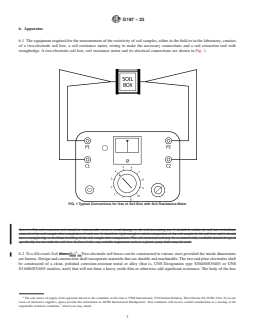
straightedge. A two-electrode soil box, soil resistance meter and its electrical connections are shown in Fig. 1.
FIG. 1 Typical Connections for Use of Soil Box with Soil Resistance Meter
NOTE 1—The soil extraction tool should be non-metallic so as to avoid damage to the soil box during use. It should fit within the soil box to facilitate
removal of the soil sample after completion of each test. It should be rigid enough to aid in compaction of the soil sample in the soil box, and it should
have a straight edge to facilitate levelling of the soil sample after compaction. The soil extraction tool may be a commercially available utensil designed
specifically for use with the soil box. In lieu of this, any suitable implement such as a plastic putty knife may be used.
6.2 Two-Electrode Soil Box—Box —Two-electrode soil boxes can be constructed in various sizes provided the inside dimensions
are known. Design and construction shall incorporate materials that are durable and machinable. The two end plate electrodes shall
be constructed of a clean, polished corrosion-resistant metal or alloy (that is, UNS Designation type S30400/S30403 or UNS
S31600/S31603 stainless steel) that will not form a heavy oxide film or otherwise add significant resistance. The body of the box
The sole source of supply of the apparatus known to the committee at this time is VWR International, 1310 Goshen Parkway, West Chester, PA 19380, USA. If you are
aware of alternative suppliers, please provide this information to ASTM International Headquarters. Your comments will receive careful consideration at a meeting of the
responsible technical committee, which you may attend.
G187 − 23
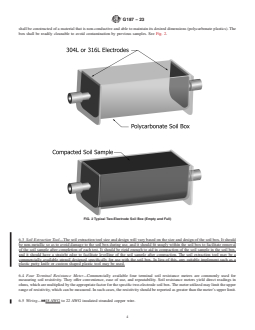
shall be constructed of a material that is non-conductive and able to maintain its desired dimensions (polycarbonate plastics). The
box shall be readily cleanable to avoid contamination by previous samples. See Fig. 2.
FIG. 2 Typical Two-Electrode Soil Box (Empty and Full)
6.3 Soil Extraction Tool—The soil extraction tool size and design will vary based on the size and design of the soil box. It should
be non-metallic so as to avoid damage to the soil box during use, and it should fit snugly within the soil box to facilitate removal
of the soil sample after completion of each test. It should be rigid enough to aid in compaction of the soil sample in the soil box,
and it should have a straight edge to facilitate levelling of the soil sample after compaction. The soil extraction tool may be a
commercially available utensil designed specifically for use with the soil box. In lieu of this, any suitable implement such as a
plastic putty knife or custom shaped plastic tool may be used.
6.4 Four Terminal Resistance Meter—Commercially available four terminal soil resistance meters are commonly used for
measuring soil resistivity. They offer convenience, ease of use, and repeatability. Soil resistance meters yield direct readings in
ohms, which are multiplied by the appropriate factor for the specific two-electrode soil box. The meter utilized may limit the upper
range of resistivity, which can be measured. In such cases, the resistivity should be reported as greater than the meter’s upper limit.
6.5 Wiring—1818 AWG to 22 AWG insulated stranded copper wire.
G187 − 23
NOTE 1—It is important to make reliable, low-impedance electrical connections. Ensure that all terminals are clean, and all wiring connections are made
securely.
6.6 Thermometer—A device for measuring temperature.
6.7 Miscellaneous—Depending on how and where the soil will be analyzed, one or more of the following may be needed: hand
auger, post-hole diggers, sample bags, glass container, soil thermometer, indelible marker, etc.
7. Reagents and Materials
7.1 Distilled or deionized water (Type IV grade as referenced in Specification D1193) to saturate samples.
7.2 Commerically available solutions (VWR Conductivity Calibration Standards ) in the range of 1000, 5000,1000 ohm-cm,
5000 ohm-cm, and 10 000 ohm-cm are recommended for this purpose.
8. Sampling Test Specimens, and Test Units
8.1 Soil samples may be brought to the surface using an auger, post hole digger, shovel, etc. or can be collected from the sides
of an excavated trench. Soil samples shall be representative of the area of interest. Where the stratum of interest contains a variety
of soil types, it is desirable to sample each type separately. Foreign material such as gravel, small stones, roots, twigs, and
...