


ASTM E23-24
(Test Method)Standard Test Methods for Notched Bar Impact Testing of Metallic Materials
Standard Test Methods for Notched Bar Impact Testing of Metallic Materials
SIGNIFICANCE AND USE
5.1 These test methods of impact testing relate specifically to the behavior of metal when subjected to a single application of a force resulting in multi-axial stresses associated with a notch, coupled with high rates of loading and in some cases with high or low temperatures. For some materials and temperatures the results of impact tests on notched specimens, when correlated with service experience, have been found to predict the likelihood of brittle fracture accurately. Further information on significance appears in Appendix X1.
SCOPE
1.1 These test methods describe notched-bar impact testing of metallic materials by the Charpy (simple-beam) test and the Izod (cantilever-beam) test. They give the requirements for: test specimens, test procedures, test reports, test machines (see Annex A1) verifying Charpy impact machines (see Annex A2), optional test specimen configurations (see Annex A3), designation of test specimen orientation (see Terminology E1823), and determining the shear fracture appearance (see Annex A4). In addition, information is provided on the significance of notched-bar impact testing (see Appendix X1), and methods of measuring the center of strike (see Appendix X2).
1.2 These test methods do not address the problems associated with impact testing at temperatures below –196 °C (77 K).
1.3 The values stated in SI units are to be regarded as standard. No other units of measurement are included in this standard.
1.3.1 Exception—Section 9 and Annex A4 provide inch-pound units for information only.
1.4 This standard does not purport to address all of the safety concerns, if any, associated with its use. It is the responsibility of the user of this standard to establish appropriate safety, health, and environmental practices and determine the applicability of regulatory limitations prior to use. Specific precautionary statements are given in Section 6.
1.5 This international standard was developed in accordance with internationally recognized principles on standardization established in the Decision on Principles for the Development of International Standards, Guides and Recommendations issued by the World Trade Organization Technical Barriers to Trade (TBT) Committee.
General Information
- Status
- Published
- Publication Date
- 31-Mar-2024
- Technical Committee
- E28 - Mechanical Testing
- Drafting Committee
- E28.07 - Impact Testing
Relations
- Effective Date
- 01-Apr-2024
- Effective Date
- 01-Apr-2024
- Referred By
ASTM E2298-18 - Standard Test Method for Instrumented Impact Testing of Metallic Materials - Effective Date
- 01-Apr-2024
- Effective Date
- 01-Apr-2024
- Effective Date
- 01-Apr-2024
- Effective Date
- 01-Apr-2024
- Effective Date
- 01-Apr-2024
- Effective Date
- 01-Apr-2024
- Referred By
ASTM E2248-18 - Standard Test Method for Impact Testing of Miniaturized Charpy V-notch Specimens - Effective Date
- 01-Apr-2024
- Effective Date
- 01-Apr-2024
- Effective Date
- 01-Apr-2024
- Effective Date
- 01-Apr-2024
- Effective Date
- 01-Apr-2024
- Effective Date
- 01-Apr-2024
- Referred By
ASTM A1058-19 - Standard Test Methods for Mechanical Testing of Steel Products—Metric - Effective Date
- 01-Apr-2024
Overview
ASTM E23-24: Standard Test Methods for Notched Bar Impact Testing of Metallic Materials specifies procedures for determining the toughness and impact resistance of metals using notched specimens. This international standard, developed by ASTM, outlines Charpy (simple-beam) and Izod (cantilever-beam) impact tests, covering specimen preparation, testing conditions, machine verification, and reporting requirements. Impact tests play a critical role in assessing the material's performance under rapid loading, especially in predicting susceptibility to brittle fracture.
Key Topics
- Test Methods: ASTM E23-24 details the procedures for Charpy and Izod impact testing, both of which use notched bar specimens to evaluate the absorbed energy during fracture.
- Specimen Requirements: Specifications include dimensions, notch configurations (V-notch, U-notch), material orientation, and finish. Special configurations are provided for powder metallurgy materials.
- Temperature Effects: The standard covers testing at various temperatures, vital for materials prone to ductile-to-brittle transition. Procedures for specimen conditioning and temperature measurement are included, though testing below -196°C (77K) is not addressed.
- Machine Verification: Annual direct and indirect verification of impact machines is required, ensuring accuracy and repeatability of test results. Details for analog and digital machine calibration are outlined.
- Test Reporting: Comprehensive reporting guidelines specify the inclusion of specimen details, test parameters, absorbed energy, lateral expansion, shear fracture appearance, and machine verification records.
Applications
The ASTM E23-24 standard is widely used across industries such as automotive, aerospace, shipbuilding, and construction where the mechanical integrity of metals under impact loading is critical. Key applications include:
- Quality Control: Manufacturers apply these impact tests to verify material performance and detect discrepancies in batches of materials.
- Material Selection: Engineers use impact test data to select suitable metals for structures exposed to dynamic forces or extreme temperatures.
- Research and Development: Laboratories employ Charpy and Izod tests to study the effects of alloying, heat treatment, or manufacturing processes on toughness.
- Failure Analysis: Correlating field failures with impact test data helps predict the risk of brittle fracture and improve material selection for critical components.
- Regulatory Compliance: The standard is referenced by industry codes and government agencies to ensure safety and reliability in end-use applications.
Related Standards
ASTM E23-24 aligns with a family of ASTM and international standards on mechanical testing and fracture analysis, including:
- ASTM E6: Terminology Relating to Methods of Mechanical Testing
- ASTM E29: Significant Digits in Test Data
- ASTM E177: Use of Terms Precision and Bias
- ASTM E691: Interlaboratory Study for Test Method Precision
- ASTM E1823: Terminology Relating to Fatigue and Fracture Testing
- ASTM B925: Production and Preparation of Powder Metallurgy Test Specimens
- ASTM E2298: Instrumented Impact Testing of Metallic Materials
Adhering to ASTM E23-24 ensures consistency, reliability, and global acceptance in notched bar impact testing of metallic materials. Utilizing this standard helps organizations meet quality requirements, demonstrate due diligence, and enhance the safety and longevity of metal products and structures.
Buy Documents
ASTM E23-24 - Standard Test Methods for Notched Bar Impact Testing of Metallic Materials
REDLINE ASTM E23-24 - Standard Test Methods for Notched Bar Impact Testing of Metallic Materials
Get Certified
Connect with accredited certification bodies for this standard

Element Materials Technology
Materials testing and product certification.

Inštitut za kovinske materiale in tehnologije
Institute of Metals and Technology. Materials testing, metallurgical analysis, NDT.
Sponsored listings
Frequently Asked Questions
ASTM E23-24 is a standard published by ASTM International. Its full title is "Standard Test Methods for Notched Bar Impact Testing of Metallic Materials". This standard covers: SIGNIFICANCE AND USE 5.1 These test methods of impact testing relate specifically to the behavior of metal when subjected to a single application of a force resulting in multi-axial stresses associated with a notch, coupled with high rates of loading and in some cases with high or low temperatures. For some materials and temperatures the results of impact tests on notched specimens, when correlated with service experience, have been found to predict the likelihood of brittle fracture accurately. Further information on significance appears in Appendix X1. SCOPE 1.1 These test methods describe notched-bar impact testing of metallic materials by the Charpy (simple-beam) test and the Izod (cantilever-beam) test. They give the requirements for: test specimens, test procedures, test reports, test machines (see Annex A1) verifying Charpy impact machines (see Annex A2), optional test specimen configurations (see Annex A3), designation of test specimen orientation (see Terminology E1823), and determining the shear fracture appearance (see Annex A4). In addition, information is provided on the significance of notched-bar impact testing (see Appendix X1), and methods of measuring the center of strike (see Appendix X2). 1.2 These test methods do not address the problems associated with impact testing at temperatures below –196 °C (77 K). 1.3 The values stated in SI units are to be regarded as standard. No other units of measurement are included in this standard. 1.3.1 Exception—Section 9 and Annex A4 provide inch-pound units for information only. 1.4 This standard does not purport to address all of the safety concerns, if any, associated with its use. It is the responsibility of the user of this standard to establish appropriate safety, health, and environmental practices and determine the applicability of regulatory limitations prior to use. Specific precautionary statements are given in Section 6. 1.5 This international standard was developed in accordance with internationally recognized principles on standardization established in the Decision on Principles for the Development of International Standards, Guides and Recommendations issued by the World Trade Organization Technical Barriers to Trade (TBT) Committee.
SIGNIFICANCE AND USE 5.1 These test methods of impact testing relate specifically to the behavior of metal when subjected to a single application of a force resulting in multi-axial stresses associated with a notch, coupled with high rates of loading and in some cases with high or low temperatures. For some materials and temperatures the results of impact tests on notched specimens, when correlated with service experience, have been found to predict the likelihood of brittle fracture accurately. Further information on significance appears in Appendix X1. SCOPE 1.1 These test methods describe notched-bar impact testing of metallic materials by the Charpy (simple-beam) test and the Izod (cantilever-beam) test. They give the requirements for: test specimens, test procedures, test reports, test machines (see Annex A1) verifying Charpy impact machines (see Annex A2), optional test specimen configurations (see Annex A3), designation of test specimen orientation (see Terminology E1823), and determining the shear fracture appearance (see Annex A4). In addition, information is provided on the significance of notched-bar impact testing (see Appendix X1), and methods of measuring the center of strike (see Appendix X2). 1.2 These test methods do not address the problems associated with impact testing at temperatures below –196 °C (77 K). 1.3 The values stated in SI units are to be regarded as standard. No other units of measurement are included in this standard. 1.3.1 Exception—Section 9 and Annex A4 provide inch-pound units for information only. 1.4 This standard does not purport to address all of the safety concerns, if any, associated with its use. It is the responsibility of the user of this standard to establish appropriate safety, health, and environmental practices and determine the applicability of regulatory limitations prior to use. Specific precautionary statements are given in Section 6. 1.5 This international standard was developed in accordance with internationally recognized principles on standardization established in the Decision on Principles for the Development of International Standards, Guides and Recommendations issued by the World Trade Organization Technical Barriers to Trade (TBT) Committee.
ASTM E23-24 is classified under the following ICS (International Classification for Standards) categories: 77.040.10 - Mechanical testing of metals. The ICS classification helps identify the subject area and facilitates finding related standards.
ASTM E23-24 has the following relationships with other standards: It is inter standard links to ASTM E23-23a, ASTM B94-18, ASTM E2298-18, ASTM A746-18(2022), ASTM F3056-14(2021), ASTM F2924-14(2021), ASTM F3055-14a(2021), ASTM B929-23, ASTM E2248-18, ASTM B1013-22, ASTM B848/B848M-21, ASTM E1820-23b, ASTM B176-18, ASTM A327/A327M-22, ASTM A1058-19. Understanding these relationships helps ensure you are using the most current and applicable version of the standard.
ASTM E23-24 is available in PDF format for immediate download after purchase. The document can be added to your cart and obtained through the secure checkout process. Digital delivery ensures instant access to the complete standard document.
Standards Content (Sample)
This international standard was developed in accordance with internationally recognized principles on standardization established in the Decision on Principles for the
Development of International Standards, Guides and Recommendations issued by the World Trade Organization Technical Barriers to Trade (TBT) Committee.
Designation: E23 − 24 An American National Standard
Standard Test Methods for
Notched Bar Impact Testing of Metallic Materials
This standard is issued under the fixed designation E23; the number immediately following the designation indicates the year of original
adoption or, in the case of revision, the year of last revision. A number in parentheses indicates the year of last reapproval. A superscript
epsilon (´) indicates an editorial change since the last revision or reapproval.
This standard has been approved for use by agencies of the U.S. Department of Defense.
1. Scope* 2. Referenced Documents
1.1 These test methods describe notched-bar impact testing
2.1 ASTM Standards:
of metallic materials by the Charpy (simple-beam) test and the
B925 Practices for Production and Preparation of Powder
Izod (cantilever-beam) test. They give the requirements for:
Metallurgy (PM) Test Specimens
test specimens, test procedures, test reports, test machines (see
E6 Terminology Relating to Methods of Mechanical Testing
Annex A1) verifying Charpy impact machines (see Annex A2),
E29 Practice for Using Significant Digits in Test Data to
optional test specimen configurations (see Annex A3), desig-
Determine Conformance with Specifications
nation of test specimen orientation (see Terminology E1823),
E177 Practice for Use of the Terms Precision and Bias in
and determining the shear fracture appearance (see Annex A4).
ASTM Test Methods
In addition, information is provided on the significance of
E691 Practice for Conducting an Interlaboratory Study to
notched-bar impact testing (see Appendix X1), and methods of
Determine the Precision of a Test Method
measuring the center of strike (see Appendix X2).
E1823 Terminology Relating to Fatigue and Fracture Testing
E2298 Test Method for Instrumented Impact Testing of
1.2 These test methods do not address the problems associ-
Metallic Materials
ated with impact testing at temperatures below –196 °C (77 K).
1.3 The values stated in SI units are to be regarded as
3. Terminology
standard. No other units of measurement are included in this
3.1 Definitions of Terms Common to Mechanical Testing
standard.
1.3.1 Exception—Section 9 and Annex A4 provide inch- from Terminology E6:
pound units for information only.
3.1.1 absorbed energy, [FL], n—work spent to fracture a
specimen in a single pendulum swing, as measured by a
1.4 This standard does not purport to address all of the
safety concerns, if any, associated with its use. It is the compensated indicating device.
responsibility of the user of this standard to establish appro-
3.1.2 drop height, h, [L], n—the center of strike vertical
priate safety, health, and environmental practices and deter-
distance between the free-hanging position and the latched
mine the applicability of regulatory limitations prior to use.
position.
Specific precautionary statements are given in Section 6.
3.2 Definitions of Terms Specific to This Standard:
1.5 This international standard was developed in accor-
3.2.1 direct verification, n—process that ensures all parts
dance with internationally recognized principles on standard-
that may affect measured absorbed energy are within specified
ization established in the Decision on Principles for the
dimensional tolerances.
Development of International Standards, Guides and Recom-
mendations issued by the World Trade Organization Technical
3.2.2 free-hanging position, n—position of the pendulum
Barriers to Trade (TBT) Committee.
after oscillation stops such that the potential and kinetic energy
is zero.
These test methods are under the jurisdiction of ASTM Committee E28 on
Mechanical Testing and are the direct responsibility of Subcommittee E28.07 on
Impact Testing. For referenced ASTM standards, visit the ASTM website, www.astm.org, or
Current edition approved April 1, 2024. Published May 2024. Originally contact ASTM Customer Service at service@astm.org. For Annual Book of ASTM
approved in 1933. Last previous edition approved 2023 as E23 – 23a. DOI: Standards volume information, refer to the standard’s Document Summary page on
10.1520/E0023-24. the ASTM website.
*A Summary of Changes section appears at the end of this standard
Copyright © ASTM International, 100 Barr Harbor Drive, PO Box C700, West Conshohocken, PA 19428-2959. United States
E23 − 24
3.2.3 free swing, n—uninterrupted (without a test specimen) 7.2.2 Procedures for indirect verification of Charpy
pendulum swing from the latched position as recorded by the machines, using verification specimens, are given in A2.4.
indicating device (see A2.3.8.1). Charpy impact machines require direct and indirect verification
annually.
3.2.4 indirect verification, n—process that ensures the aver-
age absorbed energy from testing a set of verification speci-
8. Test Specimens
mens corresponds to the certified absorbed energy within a
specified tolerance (see A2.4.1). 8.1 Configuration and Orientation:
8.1.1 Specimens shall be taken from the material as speci-
3.2.5 latched position, n—position of the pendulum on the
fied by the applicable specification.
release mechanism prior to being released to perform a test.
8.1.2 The specimens shown in Fig. 1 and Fig. 2 are those
3.2.6 lateral expansion [L], n—the maximum increase in the
most widely used and most generally satisfactory. They are
thickness of the specimen as a result of the impact test,
particularly suitable for ferrous metals, excepting cast iron.
expressed in mm.
The Charpy specimen designations are V-notch and U-notch.
3.2.6.1 Discussion—Lateral expansion is used as a measure
of ductility. NOTE 1—Keyhole notch specimen is similar to U-notch, except the
notch width is 1.6 mm or less.
3.2.7 range capacity, n—maximum available energy for a
8.1.3 The specimens commonly found suitable for powder
specific pendulum setting.
metallurgy materials is shown in Fig. 3. Powder metallurgy
3.2.7.1 Discussion—On single range machines this corre-
impact test specimens shall be produced following the proce-
sponds to the machine capacity.
dure in Practices B925. The impact test results of these
3.2.8 shear fracture appearance, SFA, n—the amount of
materials are affected by specimen orientation. Therefore,
fracture surface in the specimen that failed in a shear (stable)
unless otherwise specified, the position of the specimen in the
mode, expressed in percent.
machine shall be such that the pendulum will strike a surface
that is parallel to the compacting direction. For powder
4. Summary of Test Method
metallurgy materials the impact test results are reported as
4.1 The essential features of an impact test are: a suitable
unnotched absorbed energy.
specimen (specimens of several different types are recognized),
8.1.4 Sub-size and supplementary specimen recommenda-
a set of anvils, and specimen supports on which the test
tions are given in Annex A3.
specimen is placed to receive the blow of the moving mass, a
8.2 Specimen Machining:
moving mass that has sufficient energy to break the specimen
8.2.1 When heat-treated materials are being evaluated, the
placed in its path, and an indicating device for measuring the
specimen shall be finish machined, including notching, after
absorbed energy of the broken specimen.
the final heat treatment, unless it can be demonstrated that the
5. Significance and Use
impact properties of specimens machined before heat treatment
are identical to those machined after heat treatment.
5.1 These test methods of impact testing relate specifically
8.2.2 Notches shall be smoothly machined, but polishing
to the behavior of metal when subjected to a single application
has proven generally unnecessary.
of a force resulting in multi-axial stresses associated with a
notch, coupled with high rates of loading and in some cases
NOTE 2—Variations in notch dimensions will affect the results of the
with high or low temperatures. For some materials and
tests. Appendix X1.2 illustrates the effects from varying notch dimensions
on V-notch specimens.
temperatures the results of impact tests on notched specimens,
NOTE 3—In keyhole notch specimens, carefully drill the round hole
when correlated with service experience, have been found to
with a slow feed rate. Exercise care in cutting the slot to ensure that the
predict the likelihood of brittle fracture accurately. Further
surface of the drilled hole opposite the slot is not damaged.
information on significance appears in Appendix X1.
8.2.3 Identification marks shall only be placed in the fol-
lowing locations on specimens: either of the 10 mm square
6. Precautions in Operation of Machine
ends; the side of the specimen that faces up when the specimen
6.1 Safety precautions should be taken to protect personnel
is positioned in the anvils (see Note 4); or the side of the
from the swinging pendulum, flying broken specimens, and
specimen opposite the notch. No markings, on any side of the
hazards associated with specimen warming and cooling media.
specimen, shall be within 10 mm of the center line of the notch.
Permanent markers, laser engraving, scribes, electrostatic
7. Apparatus
pencils, and other reasonable marking methods may be used
7.1 General Requirements:
for identification purposes. However, some marking methods
7.1.1 The testing machine shall be a pendulum type of rigid
can result in damage to the specimens if not used correctly. For
construction.
example, excessive heat from electrostatic pencils or deforma-
7.1.2 The testing machine shall be designed and built to
tion to the specimen from stamping can change the mechanical
conform with the requirements given in Annex A1.
properties of the specimen. Therefore, care shall always be
7.2 Inspection and Verification:
7.2.1 Procedures for direct verification of impact machines
are provided in A2.2 and A2.3. The items listed in A2.2 require
Report of Subcommittee XV on Impact Testing of Committee A03 on Cast Iron,
direct verification annually. Proceedings, ASTM, Vol 33 Part 1, 1933.
E23 − 24
ID Number Description Dimension Tolerance
1 Length of specimen 55 mm +0/-2.5 mm
2 Centering of notch ±1 mm
3 Notch length to edge 90° ±2°
4 Adjacent sides angle 90° ±0.17°
5 Width 10 mm ±0.075 mm
6 Thickness 10 mm ±0.075 mm
7V Ligament length, Type V 8 mm ±0.025 mm
7U Ligament length, Type U 5 mm ±0.075 mm
8V Radius of notch, Type V 0.25 mm ±0.025 mm
8U Radius of notch, Type U 1 mm ±0.025 mm
9 Angle of notch 45° ±1°
A Surface finish requirements 2 μm (Ra) #
B Surface finish requirements 4 μm (Ra) #
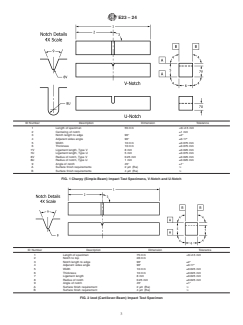
FIG. 1 Charpy (Simple-Beam) Impact Test Specimens, V-Notch and U-Notch
ID Number Description Dimension Tolerance
1 Length of specimen 75 mm +0/-2.5 mm
2 Notch to top 28 mm
3 Notch length to edge 90° ±2°
4 Adjacent sides angle 90° ±0.17°
5 Width 10 mm ±0.025 mm
6 Thickness 10 mm ±0.025 mm
7 Ligament length 8 mm ±0.025 mm
8 Radius of notch 0.25 mm ±0.025 mm
9 Angle of notch 45° ±1°
A Surface finish requirement 2 μm (Ra) #
B Surface finish requirement 4 μm (Ra) #
FIG. 2 Izod (Cantilever-Beam) Impact Test Specimen
E23 − 24
COMPACTING DIRECTION ↓
STRIKING DIRECTION →
ID Number Description Dimension Tolerance
1 Length of Charpy specimen 55 mm ±1.0 mm
1 Length of Izod specimen 75 mm ±1.5 mm
2 Width 10.00 mm ±0.13 mm
3 Thickness 10.00 mm ±0.13 mm
4 Adjacent sides angle 90° ±0.17°
FIG. 3 Powder Metallurgy (PM) Unnotched Charpy and Izod Impact Test Specimens
taken to avoid damage to the specimen. Stamping and other After the testing machine has been ascertained to comply with
marking processes that result in deformation of the specimen Annex A1 and Annex A2, carry out the routine check as
should only be used on the ends of the specimens, prior to follows:
notching. 9.1.1.1 Visually examine the striker and anvils for obvious
damage and wear.
NOTE 4—Careful consideration should be given before placing identi-
9.1.1.2 Check the machine with a free swing. The indicating
fication marks on the side of the specimen to be placed up when positioned
device shall indicate zero on machines reading directly in
in the anvils. If the test operator is not careful, the specimen can be placed
in the machine with the identification marking resting on the specimen
absorbed energy. On machines reading in degrees, the reading
supports (that is, facing down). Under these circumstances, the absorbed
shall correspond to zero absorbed energy on the conversion
energy value obtained may be unreliable.
formula or table furnished by the machine manufacturer. On
8.2.4 Unless otherwise specified by product or customer
machines that do not compensate for total frictional losses, the
specifications, standard test specimens shall conform to the
analog scale will not indicate zero. In this case, the indicated
dimensions and tolerances shown in Fig. 1 or any other
values, when converted to absorbed energy, shall be corrected
applicable figure in this test method.
for total frictional losses that are assumed to be proportional to
the arc of the swing.
NOTE 5—The type of specimen chosen depends largely upon the
9.1.1.3 The percent friction and windage loss shall not
characteristics of the material to be tested. Often a given specimen is not
equally satisfactory for soft nonferrous metals and hardened steels;
exceed 0.4 % of the range capacity being tested and should not
therefore, many types of specimens are recognized. In general, sharper
change by more than 10 % of the percent friction and windage
and deeper notches are required to distinguish differences in very ductile
loss measurements previously recorded on the machine. If the
materials or when using low testing velocities. Side-grooved specimens
percent friction and windage loss does exceed 0.4 % or is
have been used to minimize absorbed energy variability for high-strength
significantly different from previous measurements, check the
and ductile materials.
indicating device, the release mechanism, and the bearings for
9. Procedure
wear and damage. However, if the machine has not been used
9.1 Preparation of the Apparatus: recently, let the pendulum swing for 50 to 100 cycles, and
9.1.1 Perform a routine procedure for checking impact repeat the percent friction and windage loss test before
machines at the beginning of each day, each shift, or just prior undertaking repairs to the machine. To ensure that percent
to testing on a machine used intermittently. The results of these friction and windage loss is within allowable tolerance, use one
routine checks should be kept in a log book for the machine. of the following evaluation procedures:
E23 − 24
(1) For a machine equipped with an analog scale: as the holding temperature (see Note 9). The maximum change
in the temperature of the specimen allowed for the interval
Raise the pendulum to the latched position;
Move the analog scale pointer to the range capacity being used;
between the temperature conditioning treatment and impact is
Release the pendulum (without a specimen in the machine);
not specified here, because it is dependent on the material
Allow the pendulum to cycle five times (a forward and a backward
being tested and the application. The user of nontraditional or
swing together count as one cycle);
Prior to the sixth forward swing set the analog scale pointer to
lesser used temperature conditioning and transfer methods (or
between 5 % and 10 % of the range capacity being used;
specimen sizes) shall show that the temperature change for the
After the sixth forward swing record the value indicated by the
specimen prior to impact is comparable to or less than the
analog scale pointer (convert to absorbed energy if necessary);
Divide the energy reading by 10;
temperature change for a standard size specimen of the same
Divide by the range capacity being used, and
material that has been thermally conditioned in a commonly
Multiply by 100 to get the percent friction and windage loss.
used medium (oil, air, nitrogen, acetone, methanol), and
(2) A machine equipped with a digital display:
transferred for impact within 5 s (see Note 9). Three tempera-
Determine the percent friction and windage loss per manufac-
ture conditioning and transfer methods used in the past are:
turer’s procedure.
liquid bath thermal conditioning and transfer to the specimen
(3) For machine equipped with both an analog scale and
supports with centering tongs; furnace thermal conditioning
digital display:
and robotic transfer to the specimen supports; placement of the
Determine the percent friction and windage loss using the same
specimen on the supports followed by in situ heating and
indicating device used to report absorbed energy (11.1.6 and
cooling.
A2.4).
9.2.4.1 For liquid bath cooling or heating use a suitable
NOTE 6—Prior to the 2012 version, the percent friction and windage
container, which has a grid or another type of specimen
loss was based on 11 (half) swings and the analog scale pointer was not
positioning fixture. Cover the specimens, when immersed, with
engaged on the first swing. Now the pointer is engaged on the first swing.
at least 25 mm (1 in.) of the liquid, and position so that the
The difference is that the friction, windage, and analog scale pointer
mechanism losses associated with the first swing are no longer assumed to
notch area is not closer than 25 mm to the sides or bottom of
be zero. On the first swing the pointer should go to 0.00, so any friction
the container, and no part of the specimen is in contact with the
and windage losses that will be recorded will only show up on the
container. Place the device used to measure the temperature of
following 10 (half) swings.
the bath in the center of a group of the specimens. Agitate the
9.2 Test Temperature Considerations:
bath and hold at the desired temperature within 61 °C (62 °F).
9.2.1 The temperature of testing affects the impact proper-
Thermally condition the specimens for at least 5 min before
ties of most materials. For materials with a body centered cubic
testing, unless a shorter thermal conditioning time can be
structure, a transition in fracture mode occurs over a tempera-
shown to be valid by measurements with thermocouples. Leave
ture range that depends on the chemical composition and
the device (tongs, for example) used to handle the specimens in
microstructure of the material. Test temperatures may be
the bath for at least 5 min before testing, and return the device
chosen to characterize material behavior at fixed values, or
to the bath between tests.
over a range of temperatures to characterize the transition
9.2.4.2 When using a gas medium, position the specimens
region, lower shelf, or upper shelf behavior, or all of these. The
so that the gas circulates around them and hold the gas at the
choice of test temperature is the responsibility of the user of
desired temperature within 61 °C (62 °F) for at least 30 min.
this test method and will depend on the specific application.
Leave the device used to remove the specimen from the
For tests performed at room temperature, the temperature
medium in the medium except when handling the specimens.
should be 20 °C 6 5 °C.
NOTE 7—Temperatures up to +260 °C may be obtained with certain
9.2.2 The temperature of a specimen can change signifi-
oils, but “flash-point” temperatures should be carefully observed.
cantly during the interval it is removed from the temperature
NOTE 8—For testing at temperatures down to –196 °C (77 °K), standard
conditioning environment, transferred to the impact machine,
testing procedures have been found to be adequate for most metals.
NOTE 9—A study has shown that a specimen heated to 100 °C in water
and the fracture event is completed (see Note 9). When using
can cool 10 °C in the 5 s allowed for transfer to the specimen supports.
a heating or cooling medium near its boiling point, use data
Other studies, using cooling media that are above their boiling points at
from the references in Note 9 or calibration data with thermo-
room temperature have also shown large changes in specimen temperature
couples to confirm that the specimen is within the stated
during the transfer of specimens to the machine anvils. In addition, some
temperature tolerances when the striker contacts the specimen.
materials change temperature dramatically during impact testing at
cryogenic temperatures due to adiabatic heating.
If excessive adiabatic heating is expected, monitor the speci-
men temperature near the notch during fracture.
9.3 Charpy Test Procedure:
9.2.3 Verify temperature-measuring equipment at least ev-
9.3.1 The Charpy test procedure may be summarized as
ery six months. If liquid-in-glass thermometers are used, an
follows: the test specimen is thermally conditioned and posi-
initial verification shall be sufficient, however, the device shall
tioned on the specimen supports against the anvils; the pendu-
be inspected for problems, such as the separation of liquid, at
lum is released without vibration, and the specimen is impacted
least every six months.
9.2.4 Hold the specimen at the desired temperature within
Nanstad, R. K., Swain, R. L. and Berggren, R. G., “Influence of Thermal
61 °C (62 °F) in the temperature conditioning environment.
Conditioning Media on Charpy Specimen Test Temperature,”Charpy Impact Test:
Any method of heating or cooling or transferring the specimen
Factors and Variables, ASTM STP 1072, ASTM, 1990, pp. 195-210.
to the anvils may be used provided the temperature of the
Tobler R. L. Et al.,“ Charpy Impact Tests Near Absolute Zero,” Journal of
specimen immediately prior to fracture is essentially the same Testing and Evaluation, Vol 19, 1 1992.
E23 − 24
by the striker. Information is obtained from the machine and (see A1.10.1). The tongs illustrated in Fig. 4 are for centering
from the broken specimen. V-notch specimens. If non V-notch specimens are used, modi-
9.3.1.1 The 8 mm striker shall be used, unless the 2 mm
fication of the tong design may be necessary. If an end-
striker is specified.
centering device is used, caution shall be taken to ensure that
low-energy high-strength specimens will not rebound off this
NOTE 10—For some materials, the striker radius can significantly affect
device into the pendulum and cause erroneously high recorded
the results.
absorbed energy values. Many such devices are permanent
9.3.2 To position a test specimen in the machine, self-
fixtures of machines, and if the clearance between the end of a
centering tongs similar to those shown in Fig. 4 should be used
ID Number Designation Dimension, mm ID Number Designation Dimension, mm
1 Support (notch side) length 39.93 + 0 –0.051 8B 10 mm specimen width 1.52 to 1.65
5 mm specimen width 0.69 to 0.81
3 mm specimen width 0.36 to 0.48
2 Support (notch side) height 7.94 ± 1 9 Solder pad length 17.46 ± 1
3 Insert angle 44.5 ± 0.5° 10 Solder pad extension 4.76 ± 1
4 Radius on support 2 ± 1 11 Solder pad height 9.5 ± 1
5 Support width 9.5 ± 1 12 rod 7.94 ± 1
6 Notch center 19.96 13 1.588 ± 1
7 Notch center 19.96 14 Solder pad width 9.5 ± 1
8A 10 mm specimen width 1.60 to 1.70
5 mm specimen width 0.74 to 0.80
3 mm specimen width 0.45 to 0.51
FIG. 4 Centering Tongs for V-Notch Charpy Specimens
E23 − 24
specimen in the test position and the centering device is not 9.4.3 Clamp the specimen firmly in the support vise so that
approximately 13 mm, the broken specimens may rebound into the centerline of the notch is in the plane of the top of the vise
the pendulum. within 0.125 mm. Prepare the indicating device (set the analog
scale pointer at the range capacity or initialize the digital
9.3.3 To conduct the test, prepare the machine by raising the
pendulum to the latched position, prepare the indicating device display, or both) and release the pendulum smoothly. Sections
9.3.3.1 – 9.3.3.3, also apply when testing Izod specimens.
(set the analog scale pointer at the range capacity, or initialize
the digital display, or both), position the specimen on the
specimen supports against the anvils, and release the pendu- 10. Information Obtainable from Impact Tests
lum. If a liquid bath or gas medium is being used for thermal
10.1 The absorbed energy shall be taken as the difference
conditioning, perform the following sequence in less than 5 s
between the energy in the striking member at the instant of
(for 10 mm × 10 mm × 55 mm specimens, see 9.2.4). Remove
impact with the specimen and the energy remaining after
the test specimen from its cooling (or heating) medium with
breaking the specimen. This absorbed energy value is deter-
centering tongs that have been temperature conditioned with
mined by the indicating device which has been corrected for
the test specimen, place the specimen in the test position, and
total frictional losses.
release the pendulum smoothly. If a test specimen has been
removed from the temperature conditioning bath and it is
10.2 Lateral expansion measurement methods shall take
questionable that the test can be conducted within the 5 s time
into account the fact that the fracture path seldom bisects the
frame, return the specimen to the bath for the time required in
point of maximum expansion on both sides of a specimen. One
9.2 before testing.
half of a broken specimen may include the maximum expan-
9.3.3.1 If a fractured impact specimen does not separate into sion for both sides, one side only, or neither. Therefore, the
two pieces, report it as unbroken (see 10.2.2 for separation
expansion on each side of each specimen half shall be
instructions). Unbroken specimens with absorbed energies of measured relative to the plane defined by the undeformed
less than 80 % of the range capacity may be averaged with
portion on the side of the specimen, as shown in Fig. 5. For
values from broken specimens. If the absorbed energy exceeds example, if A is greater than A , and A is less than A , then the
1 2 3 4
80 % of the range capacity and the specimen passes completely
lateral expansion is the sum of A + A .
1 4
between the anvils, report the value as approximate (see Note
10.2.1 Before making any lateral expansion measurements,
11) and do not average it with other values. If an unbroken
it is essential that the two specimen halves are visually
specimen does not pass between the machine anvils, (for
examined for burrs that may have formed during impact
example, it stops the pendulum), the result shall be reported as
testing; if the burrs will influence the lateral expansion
exceeding the range capacity. A specimen shall never be struck
measurements, they shall be removed (by rubbing on emery
more than once.
cloth or any other suitable method), making sure that the
protrusions to be measured are not rubbed during the removal
NOTE 11—Absorbed energy values above 80 % of the range capacity
of the burr. Then, examine each fracture surface to ascertain
are inaccurate. Ideally an impact test would be conducted at a constant
impact velocity. In a pendulum-type test, the velocity decreases as the
that the protrusions have not been damaged by contacting an
fracture progresses. For specimens that have absorbed energies approach-
anvil, a machine mounting surface, etc. Lateral expansion shall
ing 80 % of the range capacity, the velocity of the pendulum decreases (to
not be measured on a specimen with this type of damage.
about 45 % of the initial velocity) during fracture to the point that accurate
absorbed energies are no longer obtained. 10.2.2 Lateral expansion measurements shall be reported as
follows. An unbroken specimen can be reported as broken if
9.3.3.2 If a specimen jams in the machine, disregard the
the specimen can be separated by pushing the hinged halves
results and check the machine thoroughly for damage or
together once and then pulling them apart without further
misalignment, which would affect its direct verification, indi-
fatiguing the specimen, and the lateral expansion measured for
rect verification, or both.
the unbroken specimen (prior to bending) is equal to or greater
9.3.3.3 To prevent recording an erroneous indicated value,
than that measured for the separated halves. In the case where
caused by jarring the analog scale pointer when locking the
a specimen cannot be separated into two halves, the lateral
pendulum in its latched position, read the value for each test
expansion can be measured as long as the shear lips can be
from the analog scale prior to locking the pendulum for the
accessed without interference from the hinged ligament that
next test.
has been deformed during testing. The specimen shall be
9.4 Izod Test Procedure: reported as unbroken.
9.4.1 The Izod test procedure may be summarized as
10.2.3 Lateral expansion may be measured easily by using a
follows: the test specimen is positioned in the specimen-
gauge like the one shown in Fig. 6 (assembly and details shown
holding fixture and the pendulum is released without vibration.
in Fig. 7). Using this type of gauge the measurement is made
Information is obtained from the machine and from the broken
with the following procedure: orient the specimen halves so
specimen. The details are described as follows:
that the compression sides are facing each other, take one half
9.4.2 Testing at temperatures other than room temperature is of the fractured specimen and press it against the anvil and
difficult because the specimen-holding fixture for Izod speci- indicator plunger and record the reading, make a similar
mens is often part of the base of the machine and cannot be measurement on the other half (same side) of the fractured
readily cooled (or heated). Consequently, Izod testing should specimen and disregard the lower of the two values, do the
be performed at room temperature. same for the other side of the fractured specimen, report the
E23 − 24
FIG. 5 Halves of Broken Charpy V-Notch Impact Specimen Illustrating the Measurement of Lateral Expansion, Dimensions A , A , A ,
1 2 3
A and Original Thickness, Dimension B
FIG. 6 Lateral Expansion Gauge for Charpy Impact Specimens
sum of the maximum expansions for the 2 sides as the lateral Fracture Region) and the area of unstable fracture region,
expansion for the specimen.
divided by the total fractured area, times 100. The measure-
ment methods described in Annex A4 provide estimates for the
10.3 The shear fracture appearance may be determined
area of the unstable fracture region (directly or indirectly), but
using a variety of methods. The approach and the acceptable
do not consider details of the fracture mode for the unstable
methods are defined in Annex A4. For each method, the user
region. The unstable fracture region could be 100 % cleavage,
shall distinguish between regions formed by stable crack
a mixture of cleavage and ductile-dimple fracture
growth mechanisms, and regions formed by unstable crack
morphologies, a mixture of intergranular and ductile-dimple
growth mechanisms. For purposes of this Test Method, the
fracture morphologies, or a mixture of other fracture mor-
“shear area” consists of those portions of the fracture surface
phologies.
that form by stable crack growth (Fracture Initiation Region,
Shear Lips, and Final Fracture Region), as shown in Fig. 8.
NOTE 12—Carbon steels often exhibit a classic cleavage region that
The shear fracture appearance is typically calculated as the
identifies the unstable fracture region with a well-defined area of shiny
difference between the total fractured area (Fracture Initiation
fracture that is easy to recognize and measure. Other steels, such as
Region, Shear Lips, Unstable Fracture Region, and Final quenched and tempered SAE 4340, alloys have a region of unstable
E23 − 24
ID Number Dimension, mm ID Number Dimension, mm
1 12.7 15 1.6
2 6.4 16 6.4
3 88.9 17 17.5
4 171.5 18 15.9
5 47.6 19 1.7
6 50.8 20 8.3
7 101.6 21 6.1
8 88.9 22 19.1
9 12.7 23 66.7
10 44.5 24 19.1
11 12.7 25 60.3
12 43.2
13 88.9
14 158.8
FIG. 7 Assembly and Details for Lateral Expansion Gauge
fracture that consists of an intimate mixture of cleavage facets and ductile
11.1.4 Test temperature (if room temperature, report actual
dimples (only apparent at high magnifications). Some embrittled steels
temperature),
can exhibit partially intergranular fracture, as well. In these cases the area
11.1.5 For Charpy testing specify the striker radius as 8 mm
of unstable fracture may not be as easy to identify.
or 2 mm,
11. Test Report and Test Records
11.1.6 Absorbed energy,
11.1 The test report shall include the following information
11.1.7 Unbroken specimens and whether or not they were
(for each specimen tested):
used in the average
11.1.1 Conformance to Test Method E23-YR (where YR is
11.1.8 Any specimens for which the absorbed energy ex-
edition year),
ceeds 80% of the range capacity, report the value as approxi-
11.1.2 Specimen type, per Fig. 1 or any other applicable
mate or exceeding the range capacity (see 9.3.3.1), and
figure in this test method. Any deviations shall be reported.
11.1.3 Specimen size (if sub-size specimen), 11.1.9 Any other contractual requirements.
E23 − 24
12. Precision and Bias
12.1 An Interlaboratory study used CVN verification speci-
mens of low-energy and of high-energy to find sources of
variation in the CVN absorbed energy. Data from 29 labora-
tories were included with each laboratory testing one set of five
verification specimens of each energy level. Except being
limited to only two energy levels (by availability of verification
specimens), Practice E691 was followed for the design and
analysis of the data; the details are given in ASTM Research
Report No. RR:E28-1014.
12.2 Precision—The Precision information given below is
for the average CVN absorbed energy of five test determina-
tions at each laboratory for each material.
Material Low-Energy High-Energy
J J
Absorbed Energy 15.9 96.2
95 % Repeatability Limits 2.4 8.3
95 % Reproducibility Limits 2.7 9.2
The terms repeatability and reproducibility limits are used as
defined in Practice E177. The respective standard deviations
NOTE 1—Measure average dimensions A and B to the nearest 0.5 mm.
among test results may be obtained by dividing the above
Determine the shear fracture appearance using Table A4.1 or Table A4.2.
FIG. 8 Schematic of the Fracture Surface of a Charpy V-Notch limits by 2.8.
Impact Test Specimen Showing the Various Region of Fracture
12.3 Bias—Bias cannot be defined for CVN absorbed en-
ergy. The physical simplicity of the pendulum design is
complicated by complex energy loss mechanisms within the
11.2 The test records should include the following informa-
machine and the specimen. Therefore, there is no absolute
tion in addition to the information in 11.1:
standard to which the absorbed energy can be compared.
11.2.1 Impact machine manufacturer, serial number, most
recent successful direct and indirect verification dates, and
13. Keywords
verified range for Charpy testing or direct verification date and
13.1 Charpy test; shear fracture appearance; impact test;
range capacity for Izod testing.
Izod test; notched specimens; pendulum machine
11.2.2 Lateral expansion,
11.2.3 Shear fracture appearance (See Note A4.1),
11.2.4 Specimen orientation, and 6
Supporting data have been filed at ASTM International Headquarters and may
11.2.5 Specimen location. be obtained by requesting Research Report RR: RR:E28-1014.
ANNEXES
(Mandatory Information)
A1. GENERAL REQUIREMENTS FOR IMPACT MACHINES
A1.1 The machine frame shall be equipped with a bubble A1.2 An analog scale and digital display, graduated in
level or a machined surface suitable for establishing levelness degrees or absorbed energy, on which readings can be esti-
of the axis of pendulum bearings or, alternatively, the levelness
mated in increments of 0.25 % of the range capacity or less
of the axis of rotation of the pendulum may be measured
shall be furnished for the machine.
directly. The machine shall be level to within 3:1000 and
A1.2.1 The analog scales and digital displays may be
securely bolted to a concrete floor not less than 150 mm thick
compensated for total frictional losses. The error in the
or, when this is not practical, the machine shall be bolted to a
indicating device at any point shall not exceed 0.2 % of the
foundation having a mass not less than 40 times that of the
range capacity or 0.4 % of the reading, whichever is larger.
pendulum. The bolts shall be tightened as specified by the
(See A2.3.8.)
machine manufacturer.
E23 − 24
A1.3 The total frictional losses of the machine during the A1.7 The height of the center of strike in the latched
swing in the striking direction shall not exceed 0.75 % of the position, above its free-hanging position, shall be within 0.4 %
range capacity, and pendulum energy loss from friction in the
of the range capacity divided by the supporting force, mea-
analog scale pointer mechanism shall not exceed 0.25 % of sured as described in A2.3.5.1. If total frictional losses are
range capacity. See A2.3.8 for total frictional losses calcula-
compensated for by increasing the drop height, the drop height
tions. may be increased by not more than 1 %.
A1.4 At the free-hanging position, the striker shall be within
A1.8 The mechanism for releasing the pendulum from its
2.5 mm from the test specimen. The indicating device shall latched position shall operate freely and permit release of the
read within 0.2 % of the range capacity when the striker of the
pendulum without initial impulse, retardation, or side vibra-
pendulum is held against the test specimen. The plane of swing
tion. If the same lever used to release the pendulum is also used
of the pendulum shall be perpendicular to the transverse axis of
to engage the brake, means shall be provided for preventing the
the Charpy anvils or Izod vise within 3:1000.
brake from being accidentally engaged.
A1.5 Transverse play of the pendulum at the striker shall not
A1.9 Specimen clearance is needed to ensure satisfactory
exceed 0.75 mm under a transverse force of 4 % of the
results when testing materials of different strengths and com-
effective weight of the pendulum applied at the center of strike.
positions. The test specimen shall exit the machine with a
Radial play of the pendulum bearings shall not exceed
minimum of interference. Pendulums used on Charpy ma-
0.075 mm.
chines are of three basic designs, as shown in Fig. A1.1.
A1.6 The impact velocity (tangential velocity) of the pen- A1.9.1 When using a C-type pendulum or a compound
dulum at the center of strike shall not be less than 3 nor more pendulum, the broken specimen will not rebound into the
than 6 m/s. pendulum and slow it down if the clearance at the end of the
FIG. A1.1 Typical Pendulums and Anvils for Charpy Machines, Shown with Modifications to Minimize Jamming
E23 − 24
specimen is at least 13 mm or if the specimen is deflected out A1.10.1 Means shall be provided (see Fig. A1.2) to locate
of the machine by some arrangement such as that shown in Fig. and support the test specimen against two anvils in such a
A1.1. position that the center of the notch is located within 0.25 mm
of the midpoint between the anvils (see 9.3.2).
A1.9.2 When using a U-type pendulum, means shall be
provided to prevent the broken specimen from rebounding
A1.10.2 The Charpy anvils and specimen supports shall
against the pendulum (see Fig. A1.1). In most U-type pendu-
conform to the dimensions and tolerances shown in Fig. A1.2.
lum machines, steel shrouds should be designed and installed
Other dimensions of the anvils and specimen supports should
to the following requirements: (a) thickness of approximately
be such as to minimize interference between the pendulum and
1.5 mm, (b) minimum hardness of 45 HRC, (c) radius of less
broken specimens.
than 1.5 mm at the underside corners, and (d) positioned so that
A1.10.3 The center line of the striker shall advance in the
the clearance between them and the pendulum overhang (both
plane that is within 0.40 mm of the midpoint between the
top and sides) does not exceed 1.5 mm. In machines where the
supporting edges of the anvils shown in Fig. A1.2 Top View.
opening within the pendulum permits clearance between the
The striker shall be perpendicular to the longitudinal axis of the
ends of a specimen (resting on the specimen supports) and the
specimen within 5:1000 shown in Fig. A1.2 Right View. The
shrouds, and this clearance is at least 13 mm, the requirements
striker shall be parallel within 1:1000 to the face of a perfectly
(a) and (d) need not apply.
square test specimen held against the anvils shown in Fig. A1.2
A1.10 Charpy Apparatus: Front View.
ID Num Designation Dimension Tolerance
1 Span between anvils 40.00 mm ±0.05 mm
2 Anvil radius 1.00 mm ±0.05 mm
3 Anvil angle 80° ±2°
4 Anvil-Support angle 90° ±0.15°
A and B Surface finish, Anvils 0.1μm (R ) #
a
A1 and A2 Anvils coplanar 0 <0.05 mm
C1 and C2 Supports coplanar 0 <0.12 mm
FIG. A1.2 Charpy Anvils and Specimen Supports
E23 − 24
ID Num Designation Dimension Tolerance
1 Striker radius, 8 mm Striker 8.00 mm ±0.05 mm
2 Striker width, 8 mm Striker 4.00 mm ±0.05 mm
3 Striker corner radii, 8 mm Striker 0.25 mm +0.50/-0.05 mm
4 Striker angle, 8 mm Striker 30° ±2°
A and B Striker Finish, 8 mm Striker 0.1μm (R ) #
a
5 Striker radius, 2 mm Striker 2.00 mm +0.50/-0 mm
6 Striker angle, 2 mm Striker 30° ±1°
FIG. A1.3 Charpy Strikers
A1.10.4 The striker shall conform to dimensions and toler- with a 2 μm (R ) finish or better, and shall clamp the specimen
a
ances shown in Fig. A1.3. The standard 8 mm striker is shown firmly at the notch with the clamping force applied in the
in Fig. A1.3(a) and optional 2 mm striker is shown in Fig.
direction of impact. For rectangular specimens, the clamping
A1.3(b).
surfaces shall be flat and parallel within 0.025 mm. For
cylindrical specimens, the clamping surfaces shall be con-
A1.11 Izod Apparatus:
toured to match the specimen and each surface shall contact a
A1.11.1 Means shall be provided (see Fig. A1.4) for clamp-
minimum of π/2 rad (90°) of the specimen circumference.
ing the specimen in such a position that the face of the
A1.11.2 The dimensions of the striker and its position
specimen is parallel to the striker within 1:1000. The edges of
relative to the specimen clamps shall be as shown in Fig. A1.4.
the clamping surfaces shall be sharp angles of 90° 6 1° with
radii less than 0.40 mm. The clamping surfaces shall be smooth
E23 − 24
NOTE 1—All dimensional tolerances shall be 60.05 mm unless otherwise specified.
NOTE 2—The clamping surfaces of A and B shall be flat and parallel within 0.025 mm.
NOTE 3— Surface finish on striker and vise shall be 2 μm (R ).
a
NOTE 4—Striker width shall be greater than that of the specimen being tested.
FIG. A1.4 Izod (Cantilever-Beam) Impact Test
A2. VERIFICATION OF PENDULUM IMPACT MACHINES
A2.1 The verification of impact machines has two parts:di- (such as pendulum and indicating device linearity) require
rect verification, which consists of inspecting the machine to direct verification each year unless a problem is evident. Only
ensure that the requirements of this annex and Annex A1 are the items cited in A2.2 require direct verification annually.
met, and indirect verification, which entails the testing of Other parts of the machine require direct verification at least
verification specimens. once, when the machine is new, or when parts are replaced.
A2.1.1 Izod machines require direct verification annually.
A2.1.3 Charpy machines do not require immediate indirect
verification after removal and replacement of the striker or
A2.1.2 Charpy machines require direct and indirect verifi-
anvils, or both, that were on the machine when it was verified
cation annually. Data is valid only when produced within 365
provided the following safeguards are implemented: (1) an
days following the date of the most recent successful indirect
organizational procedure for the change is developed and
verification test. Charpy machines shall also be verified imme-
followed, (2) high-strength low-energy quality control speci-
diately after replacing parts that may affect the measured
mens (see A2.4.1.1 for guidance in absorbed
...
This document is not an ASTM standard and is intended only to provide the user of an ASTM standard an indication of what changes have been made to the previous version. Because
it may not be technically possible to adequately depict all changes accurately, ASTM recommends that users consult prior editions as appropriate. In all cases only the current version
of the standard as published by ASTM is to be considered the official document.
Designation: E23 − 23a E23 − 24 An American National Standard
Standard Test Methods for
Notched Bar Impact Testing of Metallic Materials
This standard is issued under the fixed designation E23; the number immediately following the designation indicates the year of original
adoption or, in the case of revision, the year of last revision. A number in parentheses indicates the year of last reapproval. A superscript
epsilon (´) indicates an editorial change since the last revision or reapproval.
This standard has been approved for use by agencies of the U.S. Department of Defense.
1. Scope*
1.1 These test methods describe notched-bar impact testing of metallic materials by the Charpy (simple-beam) test and the Izod
(cantilever-beam) test. They give the requirements for: test specimens, test procedures, test reports, test machines (see Annex A1)
verifying Charpy impact machines (see Annex A2), optional test specimen configurations (see Annex A3), designation of test
specimen orientation (see Terminology E1823), and determining the shear fracture appearance (see Annex A4). In addition,
information is provided on the significance of notched-bar impact testing (see Appendix X1), and methods of measuring the center
of strike (see Appendix X2).
1.2 These test methods do not address the problems associated with impact testing at temperatures below –196 °C (77 K).
1.3 The values stated in SI units are to be regarded as standard. No other units of measurement are included in this standard.
1.3.1 Exception—Section 9 and Annex A4 provide inch-pound units for information only.
1.4 This standard does not purport to address all of the safety concerns, if any, associated with its use. It is the responsibility
of the user of this standard to establish appropriate safety, health, and environmental practices and determine the applicability of
regulatory limitations prior to use. Specific precautionary statements are given in Section 6.
1.5 This international standard was developed in accordance with internationally recognized principles on standardization
established in the Decision on Principles for the Development of International Standards, Guides and Recommendations issued
by the World Trade Organization Technical Barriers to Trade (TBT) Committee.
2. Referenced Documents
2.1 ASTM Standards:
B925 Practices for Production and Preparation of Powder Metallurgy (PM) Test Specimens
E6 Terminology Relating to Methods of Mechanical Testing
E29 Practice for Using Significant Digits in Test Data to Determine Conformance with Specifications
E177 Practice for Use of the Terms Precision and Bias in ASTM Test Methods
E691 Practice for Conducting an Interlaboratory Study to Determine the Precision of a Test Method
E1823 Terminology Relating to Fatigue and Fracture Testing
E2298 Test Method for Instrumented Impact Testing of Metallic Materials
These test methods are under the jurisdiction of ASTM Committee E28 on Mechanical Testing and are the direct responsibility of Subcommittee E28.07 on Impact
Testing.
Current edition approved March 1, 2023April 1, 2024. Published April 2023May 2024. Originally approved in 1933. Last previous edition approved 2023 as
E23 – 23.E23 – 23a. DOI: 10.1520/E0023-23A.10.1520/E0023-24.
For referenced ASTM standards, visit the ASTM website, www.astm.org, or contact ASTM Customer Service at service@astm.org. For Annual Book of ASTM Standards
volume information, refer to the standard’s Document Summary page on the ASTM website.
*A Summary of Changes section appears at the end of this standard
Copyright © ASTM International, 100 Barr Harbor Drive, PO Box C700, West Conshohocken, PA 19428-2959. United States
E23 − 24
3. Terminology
3.1 Definitions of Terms Common to Mechanical Testing:Testing from Terminology E6:
3.1.1 absorbed energy, [FL],n—work spent to fracture a specimen in a single pendulum swing, as measured by a compensated
indicating device.
3.1.2 drop height, h, [L],n—the center of strike vertical distance between the free-hanging position and the latched position.
3.2 Definitions of Terms Specific to This Standard:
3.2.1 absorbed energy, [FL],n—work spent to fracture a specimen in a single pendulum swing, as measured by a compensated
indicating device.
3.2.1 direct verification, n—process that ensures all parts that may affect measured absorbed energy are within specified
dimensional tolerances.
3.2.2 free-hanging position, n—position of the pendulum after oscillation stops such that the potential and kinetic energy is zero.
3.2.3 free swing, n—uninterrupted (without a test specimen) pendulum swing from the latched position as recorded by the
indicating device (see A2.3.8.1).
3.2.4 indirect verification, n—process that ensures the average absorbed energy from testing a set of verification specimens
corresponds to the certified absorbed energy within a specified tolerance (see A2.4.1).
3.2.5 latched position, n—position of the pendulum on the release mechanism prior to being released to perform a test.
3.2.6 lateral expansion [L],n—the maximum increase in the thickness of the specimen as a result of the impact test, expressed in
mm.
3.2.6.1 Discussion—
Lateral expansion is used as a measure of ductility.
3.2.7 range capacity, n—maximum available energy for a specific pendulum setting.
3.2.7.1 Discussion—
On single range machines this corresponds to the machine capacity.
3.2.8 shear fracture appearance, SFA, n—the amount of fracture surface in the specimen that failed in a shear (stable) mode,
expressed in percent.
4. Summary of Test Method
4.1 The essential features of an impact test are: a suitable specimen (specimens of several different types are recognized), a set
of anvils, and specimen supports on which the test specimen is placed to receive the blow of the moving mass, a moving mass
that has sufficient energy to break the specimen placed in its path, and an indicating device for measuring the absorbed energy of
the broken specimen.
5. Significance and Use
5.1 These test methods of impact testing relate specifically to the behavior of metal when subjected to a single application of a
force resulting in multi-axial stresses associated with a notch, coupled with high rates of loading and in some cases with high or
low temperatures. For some materials and temperatures the results of impact tests on notched specimens, when correlated with
service experience, have been found to predict the likelihood of brittle fracture accurately. Further information on significance
appears in Appendix X1.
6. Precautions in Operation of Machine
6.1 Safety precautions should be taken to protect personnel from the swinging pendulum, flying broken specimens, and hazards
associated with specimen warming and cooling media.
E23 − 24
7. Apparatus
7.1 General Requirements:
7.1.1 The testing machine shall be a pendulum type of rigid construction.
7.1.2 The testing machine shall be designed and built to conform with the requirements given in Annex A1.
7.2 Inspection and Verification:
7.2.1 Procedures for direct verification of impact machines are provided in A2.2 and A2.3. The items listed in A2.2 require direct
verification annually.
7.2.2 Procedures for indirect verification of Charpy machines, using verification specimens, are given in A2.4. Charpy impact
machines require direct and indirect verification annually.
8. Test Specimens
8.1 Configuration and Orientation:
8.1.1 Specimens shall be taken from the material as specified by the applicable specification.
8.1.2 The specimens shown in Fig. 1 and Fig. 2 are those most widely used and most generally satisfactory. They are particularly
ID Number Description Dimension Tolerance
1 Length of specimen 55 mm +0/-2.5 mm
2 Centering of notch ±1 mm
3 Notch length to edge 90° ±2°
4 Adjacent sides angle 90° ±0.17°
5 Width 10 mm ±0.075 mm
6 Thickness 10 mm ±0.075 mm
7V Ligament length, Type V 8 mm ±0.025 mm
7U Ligament length, Type U 5 mm ±0.075 mm
8V Radius of notch, Type V 0.25 mm ±0.025 mm
8U Radius of notch, Type U 1 mm ±0.025 mm
9 Angle of notch 45° ±1°
A Surface finish requirements 2 μm (Ra) #
B Surface finish requirements 4 μm (Ra) #
FIG. 1 Charpy (Simple-Beam) Impact Test Specimens, V-Notch and U-Notch
E23 − 24
ID Number Description Dimension Tolerance
1 Length of specimen 75 mm +0/-2.5 mm
2 Notch to top 28 mm
3 Notch length to edge 90° ±2°
4 Adjacent sides angle 90° ±0.17°
5 Width 10 mm ±0.025 mm
6 Thickness 10 mm ±0.025 mm
7 Ligament length 8 mm ±0.025 mm
8 Radius of notch 0.25 mm ±0.025 mm
9 Angle of notch 45° ±1°
A Surface finish requirement 2 μm (Ra) #
B Surface finish requirement 4 μm (Ra) #
FIG. 2 Izod (Cantilever-Beam) Impact Test Specimen
suitable for ferrous metals, excepting cast iron. The Charpy specimen designations are V-notch and U-notch.
NOTE 1—Keyhole notch specimen is similar to U-notch, except the notch width is 1.6 mm or less.
8.1.3 The specimens commonly found suitable for powder metallurgy materials is shown in Fig. 3. Powder metallurgy impact test
specimens shall be produced following the procedure in Practices B925. The impact test results of these materials are affected by
specimen orientation. Therefore, unless otherwise specified, the position of the specimen in the machine shall be such that the
pendulum will strike a surface that is parallel to the compacting direction. For powder metallurgy materials the impact test results
are reported as unnotched absorbed energy.
COMPACTING DIRECTION ↓
STRIKING DIRECTION →
ID Number Description Dimension Tolerance
1 Length of Charpy specimen 55 mm ±1.0 mm
1 Length of Izod specimen 75 mm ±1.5 mm
2 Width 10.00 mm ±0.13 mm
3 Thickness 10.00 mm ±0.13 mm
4 Adjacent sides angle 90° ±0.17°
FIG. 3 Powder Metallurgy (PM) Unnotched Charpy and Izod Impact Test Specimens
Report of Subcommittee XV on Impact Testing of Committee A03 on Cast Iron, Proceedings, ASTM, Vol 33 Part 1, 1933.
E23 − 24
8.1.4 Sub-size and supplementary specimen recommendations are given in Annex A3.
8.2 Specimen Machining:
8.2.1 When heat-treated materials are being evaluated, the specimen shall be finish machined, including notching, after the final
heat treatment, unless it can be demonstrated that the impact properties of specimens machined before heat treatment are identical
to those machined after heat treatment.
8.2.2 Notches shall be smoothly machined, but polishing has proven generally unnecessary.
NOTE 2—Variations in notch dimensions will affect the results of the tests. Appendix X1.2 illustrates the effects from varying notch dimensions on V-notch
specimens.
NOTE 3—In keyhole notch specimens, carefully drill the round hole with a slow feed rate. Exercise care in cutting the slot to ensure that the surface of
the drilled hole opposite the slot is not damaged.
8.2.3 Identification marks shall only be placed in the following locations on specimens: either of the 10 mm square ends; the side
of the specimen that faces up when the specimen is positioned in the anvils (see Note 4); or the side of the specimen opposite the
notch. No markings, on any side of the specimen, shall be within 10 mm of the center line of the notch. Permanent markers, laser
engraving, scribes, electrostatic pencils, and other reasonable marking methods may be used for identification purposes. However,
some marking methods can result in damage to the specimens if not used correctly. For example, excessive heat from electrostatic
pencils or deformation to the specimen from stamping can change the mechanical properties of the specimen. Therefore, care shall
always be taken to avoid damage to the specimen. Stamping and other marking processes that result in deformation of the specimen
should only be used on the ends of the specimens, prior to notching.
NOTE 4—Careful consideration should be given before placing identification marks on the side of the specimen to be placed up when positioned in the
anvils. If the test operator is not careful, the specimen can be placed in the machine with the identification marking resting on the specimen supports (that
is, facing down). Under these circumstances, the absorbed energy value obtained may be unreliable.
8.2.4 Unless otherwise specified by product or customer specifications, standard test specimens shall conform to the dimensions
and tolerances shown in Fig. 1 or any other applicable figure in this test method.
NOTE 5—The type of specimen chosen depends largely upon the characteristics of the material to be tested. Often a given specimen is not equally
satisfactory for soft nonferrous metals and hardened steels; therefore, many types of specimens are recognized. In general, sharper and deeper notches
are required to distinguish differences in very ductile materials or when using low testing velocities. Side-grooved specimens have been used to minimize
absorbed energy variability for high-strength and ductile materials.
9. Procedure
9.1 Preparation of the Apparatus:
9.1.1 Perform a routine procedure for checking impact machines at the beginning of each day, each shift, or just prior to testing
on a machine used intermittently. The results of these routine checks should be kept in a log book for the machine. After the testing
machine has been ascertained to comply with Annex A1 and Annex A2, carry out the routine check as follows:
9.1.1.1 Visually examine the striker and anvils for obvious damage and wear.
9.1.1.2 Check the machine with a free swing. The indicating device shall indicate zero on machines reading directly in absorbed
energy. On machines reading in degrees, the reading shall correspond to zero absorbed energy on the conversion formula or table
furnished by the machine manufacturer. On machines that do not compensate for total frictional losses, the analog scale will not
indicate zero. In this case, the indicated values, when converted to absorbed energy, shall be corrected for total frictional losses
that are assumed to be proportional to the arc of the swing.
9.1.1.3 The percent friction and windage loss shall not exceed 0.4 % of the range capacity being tested and should not change by
more than 10 % of the percent friction and windage loss measurements previously recorded on the machine. If the percent friction
and windage loss does exceed 0.4 % or is significantly different from previous measurements, check the indicating device, the
release mechanism, and the bearings for wear and damage. However, if the machine has not been used recently, let the pendulum
E23 − 24
swing for 50 to 100 cycles, and repeat the percent friction and windage loss test before undertaking repairs to the machine. To
ensure that percent friction and windage loss is within allowable tolerance, use one of the following evaluation procedures:
(1) For a machine equipped with an analog scale:
Raise the pendulum to the latched position;
Move the analog scale pointer to the range capacity being used;
Release the pendulum (without a specimen in the machine);
Allow the pendulum to cycle five times (a forward and a backward
swing together count as one cycle);
Prior to the sixth forward swing set the analog scale pointer to
between 5 % and 10 % of the range capacity being used;
After the sixth forward swing record the value indicated by the
analog scale pointer (convert to absorbed energy if necessary);
Divide the energy reading by 10;
Divide by the range capacity being used, and
Multiply by 100 to get the percent friction and windage loss.
(2) A machine equipped with a digital display:
Determine the percent friction and windage loss per manufacturer’s procedure.
(3) For machine equipped with both an analog scale and digital display:
Determine the percent friction and windage loss using the same indicating device used to report absorbed energy (11.1.6 and A2.4).
NOTE 6—Prior to the 2012 version, the percent friction and windage loss was based on 11 (half) swings and the analog scale pointer was not engaged
on the first swing. Now the pointer is engaged on the first swing. The difference is that the friction, windage, and analog scale pointer mechanism losses
associated with the first swing are no longer assumed to be zero. On the first swing the pointer should go to 0.00, so any friction and windage losses that
will be recorded will only show up on the following 10 (half) swings.
9.2 Test Temperature Considerations:
9.2.1 The temperature of testing affects the impact properties of most materials. For materials with a body centered cubic structure,
a transition in fracture mode occurs over a temperature range that depends on the chemical composition and microstructure of the
material. Test temperatures may be chosen to characterize material behavior at fixed values, or over a range of temperatures to
characterize the transition region, lower shelf, or upper shelf behavior, or all of these. The choice of test temperature is the
responsibility of the user of this test method and will depend on the specific application. For tests performed at room temperature,
the temperature should be 20 °C 6 5 °C.
9.2.2 The temperature of a specimen can change significantly during the interval it is removed from the temperature conditioning
environment, transferred to the impact machine, and the fracture event is completed (see Note 9). When using a heating or cooling
medium near its boiling point, use data from the references in Note 9 or calibration data with thermocouples to confirm that the
specimen is within the stated temperature tolerances when the striker contacts the specimen. If excessive adiabatic heating is
expected, monitor the specimen temperature near the notch during fracture.
9.2.3 Verify temperature-measuring equipment at least every six months. If liquid-in-glass thermometers are used, an initial
verification shall be sufficient, however, the device shall be inspected for problems, such as the separation of liquid, at least every
six months.
9.2.4 Hold the specimen at the desired temperature within 61 °C (62 °F) in the temperature conditioning environment. Any
method of heating or cooling or transferring the specimen to the anvils may be used provided the temperature of the specimen
immediately prior to fracture is essentially the same as the holding temperature (see Note 9). The maximum change in the
temperature of the specimen allowed for the interval between the temperature conditioning treatment and impact is not specified
here, because it is dependent on the material being tested and the application. The user of nontraditional or lesser used temperature
conditioning and transfer methods (or specimen sizes) shall show that the temperature change for the specimen prior to impact is
comparable to or less than the temperature change for a standard size specimen of the same material that has been thermally
conditioned in a commonly used medium (oil, air, nitrogen, acetone, methanol), and transferred for impact within 5 s (see Note
9). Three temperature conditioning and transfer methods used in the past are: liquid bath thermal conditioning and transfer to the
specimen supports with centering tongs; furnace thermal conditioning and robotic transfer to the specimen supports; placement of
the specimen on the supports followed by in situ heating and cooling.
9.2.4.1 For liquid bath cooling or heating use a suitable container, which has a grid or another type of specimen positioning fixture.
Cover the specimens, when immersed, with at least 25 mm (1 in.) of the liquid, and position so that the notch area is not closer
than 25 mm to the sides or bottom of the container, and no part of the specimen is in contact with the container. Place the device
used to measure the temperature of the bath in the center of a group of the specimens. Agitate the bath and hold at the desired
E23 − 24
temperature within 61 °C (62 °F). Thermally condition the specimens for at least 5 min before testing, unless a shorter thermal
conditioning time can be shown to be valid by measurements with thermocouples. Leave the device (tongs, for example) used to
handle the specimens in the bath for at least 5 min before testing, and return the device to the bath between tests.
9.2.4.2 When using a gas medium, position the specimens so that the gas circulates around them and hold the gas at the desired
temperature within 61 °C (62 °F) for at least 30 min. Leave the device used to remove the specimen from the medium in the
medium except when handling the specimens.
NOTE 7—Temperatures up to +260 °C may be obtained with certain oils, but “flash-point” temperatures should be carefully observed.
NOTE 8—For testing at temperatures down to –196 °C (77 °K), standard testing procedures have been found to be adequate for most metals.
NOTE 9—A study has shown that a specimen heated to 100 °C in water can cool 10 °C in the 5 s allowed for transfer to the specimen supports. Other
studies, using cooling media that are above their boiling points at room temperature have also shown large changes in specimen temperature during the
transfer of specimens to the machine anvils. In addition, some materials change temperature dramatically during impact testing at cryogenic temperatures
due to adiabatic heating.
9.3 Charpy Test Procedure:
9.3.1 The Charpy test procedure may be summarized as follows: the test specimen is thermally conditioned and positioned on the
specimen supports against the anvils; the pendulum is released without vibration, and the specimen is impacted by the striker.
Information is obtained from the machine and from the broken specimen.
9.3.1.1 The 8 mm striker shall be used, unless the 2 mm striker is specified.
NOTE 10—For some materials, the striker radius can significantly affect the results.
9.3.2 To position a test specimen in the machine, self-centering tongs similar to those shown in Fig. 4 should be used (see
A1.10.1). The tongs illustrated in Fig. 4 are for centering V-notch specimens. If non V-notch specimens are used, modification of
the tong design may be necessary. If an end-centering device is used, caution shall be taken to ensure that low-energy high-strength
specimens will not rebound off this device into the pendulum and cause erroneously high recorded absorbed energy values. Many
such devices are permanent fixtures of machines, and if the clearance between the end of a specimen in the test position and the
centering device is not approximately 13 mm, the broken specimens may rebound into the pendulum.
9.3.3 To conduct the test, prepare the machine by raising the pendulum to the latched position, prepare the indicating device (set
the analog scale pointer at the range capacity, or initialize the digital display, or both), position the specimen on the specimen
supports against the anvils, and release the pendulum. If a liquid bath or gas medium is being used for thermal conditioning,
perform the following sequence in less than 5 s (for 10 mm × 10 mm × 55 mm specimens, see 9.2.4). Remove the test specimen
from its cooling (or heating) medium with centering tongs that have been temperature conditioned with the test specimen, place
the specimen in the test position, and release the pendulum smoothly. If a test specimen has been removed from the temperature
conditioning bath and it is questionable that the test can be conducted within the 5 s time frame, return the specimen to the bath
for the time required in 9.2 before testing.
9.3.3.1 If a fractured impact specimen does not separate into two pieces, report it as unbroken (see 10.2.2 for separation
instructions). Unbroken specimens with absorbed energies of less than 80 % of the range capacity may be averaged with values
from broken specimens. If the absorbed energy exceeds 80 % of the range capacity and the specimen passes completely between
the anvils, report the value as approximate (see Note 11) and do not average it with other values. If an unbroken specimen does
not pass between the machine anvils, (for example, it stops the pendulum), the result shall be reported as exceeding the range
capacity. A specimen shall never be struck more than once.
NOTE 11—Absorbed energy values above 80 % of the range capacity are inaccurate. Ideally an impact test would be conducted at a constant impact
velocity. In a pendulum-type test, the velocity decreases as the fracture progresses. For specimens that have absorbed energies approaching 80 % of the
range capacity, the velocity of the pendulum decreases (to about 45 % of the initial velocity) during fracture to the point that accurate absorbed energies
are no longer obtained.
Nanstad, R. K., Swain, R. L. and Berggren, R. G., “Influence of Thermal Conditioning Media on Charpy Specimen Test Temperature,”Charpy Impact Test: Factors and
Variables, ASTM STP 1072, ASTM, 1990, pp. 195-210.
Tobler R. L. Et al.,“ Charpy Impact Tests Near Absolute Zero,” Journal of Testing and Evaluation, Vol 19, 1 1992.
E23 − 24
ID Number Designation Dimension, mm ID Number Designation Dimension, mm
1 Support (notch side) length 39.93 + 0 –0.051 8B 10 mm specimen width 1.52 to 1.65
5 mm specimen width 0.69 to 0.81
3 mm specimen width 0.36 to 0.48
2 Support (notch side) height 7.94 ± 1 9 Solder pad length 17.46 ± 1
3 Insert angle 44.5 ± 0.5° 10 Solder pad extension 4.76 ± 1
4 Radius on support 2 ± 1 11 Solder pad height 9.5 ± 1
5 Support width 9.5 ± 1 12 rod 7.94 ± 1
6 Notch center 19.96 13 1.588 ± 1
7 Notch center 19.96 14 Solder pad width 9.5 ± 1
8A 10 mm specimen width 1.60 to 1.70
5 mm specimen width 0.74 to 0.80
3 mm specimen width 0.45 to 0.51
FIG. 4 Centering Tongs for V-Notch Charpy Specimens
9.3.3.2 If a specimen jams in the machine, disregard the results and check the machine thoroughly for damage or misalignment,
which would affect its direct verification, indirect verification, or both.
9.3.3.3 To prevent recording an erroneous indicated value, caused by jarring the analog scale pointer when locking the pendulum
in its latched position, read the value for each test from the analog scale prior to locking the pendulum for the next test.
9.4 Izod Test Procedure:
E23 − 24
9.4.1 The Izod test procedure may be summarized as follows: the test specimen is positioned in the specimen-holding fixture and
the pendulum is released without vibration. Information is obtained from the machine and from the broken specimen. The details
are described as follows:
9.4.2 Testing at temperatures other than room temperature is difficult because the specimen-holding fixture for Izod specimens is
often part of the base of the machine and cannot be readily cooled (or heated). Consequently, Izod testing should be performed
at room temperature.
9.4.3 Clamp the specimen firmly in the support vise so that the centerline of the notch is in the plane of the top of the vise within
0.125 mm. Prepare the indicating device (set the analog scale pointer at the range capacity or initialize the digital display, or both)
and release the pendulum smoothly. Sections 9.3.3.1 – 9.3.3.3, also apply when testing Izod specimens.
10. Information Obtainable from Impact Tests
10.1 The absorbed energy shall be taken as the difference between the energy in the striking member at the instant of impact with
the specimen and the energy remaining after breaking the specimen. This absorbed energy value is determined by the indicating
device which has been corrected for total frictional losses.
10.2 Lateral expansion measurement methods shall take into account the fact that the fracture path seldom bisects the point of
maximum expansion on both sides of a specimen. One half of a broken specimen may include the maximum expansion for both
sides, one side only, or neither. Therefore, the expansion on each side of each specimen half shall be measured relative to the plane
defined by the undeformed portion on the side of the specimen, as shown in Fig. 5. For example, if A is greater than A , and A
1 2 3
is less than A , then the lateral expansion is the sum of A + A .
4 1 4
10.2.1 Before making any lateral expansion measurements, it is essential that the two specimen halves are visually examined for
burrs that may have formed during impact testing; if the burrs will influence the lateral expansion measurements, they shall be
removed (by rubbing on emery cloth or any other suitable method), making sure that the protrusions to be measured are not rubbed
during the removal of the burr. Then, examine each fracture surface to ascertain that the protrusions have not been damaged by
contacting an anvil, a machine mounting surface, etc. Lateral expansion shall not be measured on a specimen with this type of
damage.
10.2.2 Lateral expansion measurements shall be reported as follows. An unbroken specimen can be reported as broken if the
specimen can be separated by pushing the hinged halves together once and then pulling them apart without further fatiguing the
specimen, and the lateral expansion measured for the unbroken specimen (prior to bending) is equal to or greater than that
FIG. 5 Halves of Broken Charpy V-Notch Impact Specimen Illustrating the Measurement of Lateral Expansion, Dimensions A , A , A ,
2 3
A and Original Thickness, Dimension B
E23 − 24
measured for the separated halves. In the case where a specimen cannot be separated into two halves, the lateral expansion can
be measured as long as the shear lips can be accessed without interference from the hinged ligament that has been deformed during
testing. The specimen shall be reported as unbroken.
10.2.3 Lateral expansion may be measured easily by using a gauge like the one shown in Fig. 6 (assembly and details shown in
Fig. 7). Using this type of gauge the measurement is made with the following procedure: orient the specimen halves so that the
compression sides are facing each other, take one half of the fractured specimen and press it against the anvil and indicator plunger
and record the reading, make a similar measurement on the other half (same side) of the fractured specimen and disregard the lower
of the two values, do the same for the other side of the fractured specimen, report the sum of the maximum expansions for the
2 sides as the lateral expansion for the specimen.
10.3 The shear fracture appearance may be determined using a variety of methods. The approach and the acceptable methods are
defined in Annex A4. For each method, the user shall distinguish between regions formed by stable crack growth mechanisms, and
regions formed by unstable crack growth mechanisms. For purposes of this Test Method, the “shear area” consists of those portions
of the fracture surface that form by stable crack growth (Fracture Initiation Region, Shear Lips, and Final Fracture Region), as
shown in Fig. 8.
The shear fracture appearance is typically calculated as the difference between the total fractured area (Fracture Initiation
Region, Shear Lips, Unstable Fracture Region, and Final Fracture Region) and the area of unstable fracture region, divided by the
total fractured area, times 100. The measurement methods described in Annex A4 provide estimates for the area of the unstable
fracture region (directly or indirectly), but do not consider details of the fracture mode for the unstable region. The unstable fracture
region could be 100 % cleavage, a mixture of cleavage and ductile-dimple fracture morphologies, a mixture of intergranular and
ductile-dimple fracture morphologies, or a mixture of other fracture morphologies.
NOTE 12—Carbon steels often exhibit a classic cleavage region that identifies the unstable fracture region with a well-defined area of shiny fracture that
is easy to recognize and measure. Other steels, such as quenched and tempered SAE 4340, alloys have a region of unstable fracture that consists of an
intimate mixture of cleavage facets and ductile dimples (only apparent at high magnifications). Some embrittled steels can exhibit partially intergranular
fracture, as well. In these cases the area of unstable fracture may not be as easy to identify.
11. Test Report and Test Records
11.1 The test report shall include the following information (for each specimen tested):
11.1.1 Conformance to Test Method E23-YR (where YR is edition year),
11.1.2 Specimen type, per Fig. 1 or any other applicable figure in this test method. Any deviations shall be reported.
11.1.3 Specimen size (if sub-size specimen),
FIG. 6 Lateral Expansion Gauge for Charpy Impact Specimens
E23 − 24
ID Number Dimension, mm ID Number Dimension, mm
1 12.7 15 1.6
2 6.4 16 6.4
3 88.9 17 17.5
4 171.5 18 15.9
5 47.6 19 1.7
6 50.8 20 8.3
7 101.6 21 6.1
8 88.9 22 19.1
9 12.7 23 66.7
10 44.5 24 19.1
11 12.7 25 60.3
12 43.2
13 88.9
14 158.8
FIG. 7 Assembly and Details for Lateral Expansion Gauge
11.1.4 Test temperature (if room temperature, report actual temperature),
11.1.5 For Charpy testing specify the striker radius as 8 mm or 2 mm,
11.1.6 Absorbed energy,
11.1.7 Unbroken specimens and whether or not they were used in the average
11.1.8 Any specimens for which the absorbed energy exceeds 80% of the range capacity, report the value as approximate or
exceeding the range capacity (see 9.3.3.1), and
11.1.9 Any other contractual requirements.
E23 − 24
NOTE 1—Measure average dimensions A and B to the nearest 0.5 mm. Determine the shear fracture appearance using Table A4.1 or Table A4.2.
FIG. 8 Schematic of the Fracture Surface of a Charpy V-Notch Impact Test Specimen Showing the Various Region of Fracture
11.2 The test records should include the following information in addition to the information in 11.1:
11.2.1 Impact machine manufacturer, serial number, most recent successful direct and indirect verification dates, and verified
range for Charpy testing or direct verification date and range capacity for Izod testing.
11.2.2 Lateral expansion,
11.2.3 Shear fracture appearance (See Note A4.1),
11.2.4 Specimen orientation, and
11.2.5 Specimen location.
12. Precision and Bias
12.1 An Interlaboratory study used CVN verification specimens of low-energy and of high-energy to find sources of variation in
the CVN absorbed energy. Data from 29 laboratories were included with each laboratory testing one set of five verification
specimens of each energy level. Except being limited to only two energy levels (by availability of verification specimens), Practice
E691 was followed for the design and analysis of the data; the details are given in ASTM Research Report No. RR:E28-1014.
12.2 Precision—The Precision information given below is for the average CVN absorbed energy of five test determinations at each
laboratory for each material.
Material Low-Energy High-Energy
J J
Absorbed Energy 15.9 96.2
95 % Repeatability Limits 2.4 8.3
95 % Reproducibility Limits 2.7 9.2
The terms repeatability and reproducibility limits are used as defined in Practice E177. The respective standard deviations among
test results may be obtained by dividing the above limits by 2.8.
Supporting data have been filed at ASTM International Headquarters and may be obtained by requesting Research Report RR: RR:E28-1014.
E23 − 24
12.3 Bias—Bias cannot be defined for CVN absorbed energy. The physical simplicity of the pendulum design is complicated by
complex energy loss mechanisms within the machine and the specimen. Therefore, there is no absolute standard to which the
absorbed energy can be compared.
13. Keywords
13.1 Charpy test; shear fracture appearance; impact test; Izod test; notched specimens; pendulum machine
ANNEXES
(Mandatory Information)
A1. GENERAL REQUIREMENTS FOR IMPACT MACHINES
A1.1 The machine frame shall be equipped with a bubble level or a machined surface suitable for establishing levelness of the
axis of pendulum bearings or, alternatively, the levelness of the axis of rotation of the pendulum may be measured directly. The
machine shall be level to within 3:1000 and securely bolted to a concrete floor not less than 150 mm thick or, when this is not
practical, the machine shall be bolted to a foundation having a mass not less than 40 times that of the pendulum. The bolts shall
be tightened as specified by the machine manufacturer.
A1.2 An analog scale and digital display, graduated in degrees or absorbed energy, on which readings can be estimated in
increments of 0.25 % of the range capacity or less shall be furnished for the machine.
A1.2.1 The analog scales and digital displays may be compensated for total frictional losses. The error in the indicating device
at any point shall not exceed 0.2 % of the range capacity or 0.4 % of the reading, whichever is larger. (See A2.3.8.)
A1.3 The total frictional losses of the machine during the swing in the striking direction shall not exceed 0.75 % of the range
capacity, and pendulum energy loss from friction in the analog scale pointer mechanism shall not exceed 0.25 % of range capacity.
See A2.3.8 for total frictional losses calculations.
A1.4 At the free-hanging position, the striker shall be within 2.5 mm from the test specimen. The indicating device shall read
within 0.2 % of the range capacity when the striker of the pendulum is held against the test specimen. The plane of swing of the
pendulum shall be perpendicular to the transverse axis of the Charpy anvils or Izod vise within 3:1000.
A1.5 Transverse play of the pendulum at the striker shall not exceed 0.75 mm under a transverse force of 4 % of the effective
weight of the pendulum applied at the center of strike. Radial play of the pendulum bearings shall not exceed 0.075 mm.
A1.6 The impact velocity (tangential velocity) of the pendulum at the center of strike shall not be less than 3 nor more than 6 m/s.
A1.7 The height of the center of strike in the latched position, above its free-hanging position, shall be within 0.4 % of the range
capacity divided by the supporting force, measured as described in A2.3.5.1. If total frictional losses are compensated for by
increasing the drop height, the drop height may be increased by not more than 1 %.
E23 − 24
A1.8 The mechanism for releasing the pendulum from its latched position shall operate freely and permit release of the pendulum
without initial impulse, retardation, or side vibration. If the same lever used to release the pendulum is also used to engage the
brake, means shall be provided for preventing the brake from being accidentally engaged.
A1.9 Specimen clearance is needed to ensure satisfactory results when testing materials of different strengths and compositions.
The test specimen shall exit the machine with a minimum of interference. Pendulums used on Charpy machines are of three basic
designs, as shown in Fig. A1.1.
A1.9.1 When using a C-type pendulum or a compound pendulum, the broken specimen will not rebound into the pendulum and
slow it down if the clearance at the end of the specimen is at least 13 mm or if the specimen is deflected out of the machine by
some arrangement such as that shown in Fig. A1.1.
A1.9.2 When using a U-type pendulum, means shall be provided to prevent the broken specimen from rebounding against the
pendulum (see Fig. A1.1). In most U-type pendulum machines, steel shrouds should be designed and installed to the following
requirements: (a) thickness of approximately 1.5 mm, (b) minimum hardness of 45 HRC, (c) radius of less than 1.5 mm at the
underside corners, and (d) positioned so that the clearance between them and the pendulum overhang (both top and sides) does
not exceed 1.5 mm. In machines where the opening within the pendulum permits clearance between the ends of a specimen (resting
on the specimen supports) and the shrouds, and this clearance is at least 13 mm, the requirements (a) and (d) need not apply.
A1.10 Charpy Apparatus:
FIG. A1.1 Typical Pendulums and Anvils for Charpy Machines, Shown with Modifications to Minimize Jamming
E23 − 24
A1.10.1 Means shall be provided (see Fig. A1.2) to locate and support the test specimen against two anvils in such a position that
the center of the notch is located within 0.25 mm of the midpoint between the anvils (see 9.3.2).
A1.10.2 The Charpy anvils and specimen supports shall conform to the dimensions and tolerances shown in Fig. A1.2. Other
dimensions of the anvils and specimen supports should be such as to minimize interference between the pendulum and broken
specimens.
A1.10.3 The center line of the striker shall advance in the plane that is within 0.40 mm of the midpoint between the supporting
edges of the anvils shown in Fig. A1.2 Top View. The striker shall be perpendicular to the longitudinal axis of the specimen within
5:1000 shown in Fig. A1.2 Right View. The striker shall be parallel within 1:1000 to the face of a perfectly square test specimen
held against the anvils shown in Fig. A1.2 Front View.
ID Num Designation Dimension Tolerance
1 Span between anvils 40.00 mm ±0.05 mm
2 Anvil radius 1.00 mm ±0.05 mm
3 Anvil angle 80° ±2°
4 Anvil-Support angle 90° ±0.15°
A and B Surface finish, Anvils 0.1μm (R ) #
a
A1 and A2 Anvils coplanar 0 <0.05 mm
C1 and C2 Supports coplanar 0 <0.12 mm
FIG. A1.2 Charpy Anvils and Specimen Supports
E23 − 24
ID Num Designation Dimension Tolerance
1 Striker radius, 8 mm Striker 8.00 mm ±0.05 mm
2 Striker width, 8 mm Striker 4.00 mm ±0.05 mm
3 Striker corner radii, 8 mm Striker 0.25 mm +0.50/-0.05 mm
4 Striker angle, 8 mm Striker 30° ±2°
A and B Striker Finish, 8 mm Striker 0.1μm (R ) #
a
5 Striker radius, 2 mm Striker 2.00 mm +0.50/-0 mm
6 Striker angle, 2 mm Striker 30° ±1°
FIG. A1.3 Charpy Strikers
A1.10.4 The striker shall conform to dimensions and tolerances shown in Fig. A1.3. The standard 8 mm striker is shown in Fig.
A1.3(a) and optional 2 mm striker is shown in Fig. A1.3(b).
A1.11 Izod Apparatus:
A1.11.1 Means shall be provided (see Fig. A1.4) for clamping the specimen in such a position that the face of the specimen is
parallel to the striker within 1:1000. The edges of the clamping surfaces shall be sharp angles of 90° 6 1° with radii less than 0.40
mm. The clamping surfaces shall be smooth with a 2 μm (R ) finish or better, and shall clamp the specimen firmly at the notch
a
with the clamping force applied in the direction of impact. For rectangular specimens, the clamping surfaces shall be flat and
parallel within 0.025 mm. For cylindrical specimens, the clamping surfaces shall be contoured to match the specimen and each
surface shall contact a minimum of π/2 rad (90°) of the specimen circumference.
A1.11.2 The dimensions of the striker and its position relative to the specimen clamps shall be as shown in Fig. A1.4.
E23 − 24
NOTE 1—All dimensional tolerances shall be 60.05 mm unless otherwise specified.
NOTE 2—The clamping surfaces of A and B shall be flat and parallel within 0.025 mm.
NOTE 3— Surface finish on striker and vise shall be 2 μm (R ).
a
NOTE 4—Striker width shall be greater than that of the specimen being tested.
FIG. A1.4 Izod (Cantilever-Beam) Impact Test
A2. VERIFICATION OF PENDULUM IMPACT MACHINES
A2.1 The verification of impact machines has two parts:direct verification, which consists of inspecting the machine to ensure that
the requirements of this annex and Annex A1 are met, and indirect verification, which entails the testing of verification specimens.
A2.1.1 Izod machines require direct verification annually.
A2.1.2 Charpy machines require direct and indirect verification annually. Data is valid only when produced within 365 days
following the date of the most recent successful indirect verification test. Charpy machines shall also be verified immediately after
replacing parts that may affect the measured absorbed energy, after making repairs or adjustments, after they have been moved,
or whenever there is reason to doubt the accuracy of the results, without regard to the time interval. These restrictions include cases
where parts, which may affect the measured absorbed energy,
...
Questions, Comments and Discussion
Ask us and Technical Secretary will try to provide an answer. You can facilitate discussion about the standard in here.
Loading comments...