

ASTM F2118-14(2020)
(Test Method)Standard Test Method for Constant Amplitude of Force Controlled Fatigue Testing of Acrylic Bone Cement Materials
General Information
- Abstract
SIGNIFICANCE AND USE
5.1 This test method describes a uniaxial, constant amplitude, fully reversed fatigue test to characterize the fatigue performance of a uniform cylindrical waisted specimen manufactured from acrylic bone cement.
5.2 This test method considers two approaches to evaluating the fatigue performance of bone cement:
5.2.1 Testing is conducted at three stress levels to characterize the general fatigue behavior of a cement over a range of stresses. The stress level and resultant cycles to failure of the specimens can be plotted on an S-N diagram.
5.2.2 Another approach is to determine the fatigue life of a particular cement. The fatigue life for orthopaedic bone cement is to be determined up to 5 million (5 × 10⁶) cycles.
5.3 This test method does not define or suggest required levels of performance of bone cement. This fatigue test method is not intended to represent the clinical use of orthopaedic bone cement, but rather to characterize the material using standard and well-established methods. The user is cautioned to consider the appropriateness of this test method in view of the material being tested and its potential application.
5.4 It is widely reported that multiple clinical factors affect the fatigue performance of orthopaedic bone cement; however, the actual mechanisms involves multiple factors. Clinical factors which may affect the performance of bone cement include: temperature and humidity, mixing method, time of application, surgical technique, bone preparation, implant design, anatomical site, and patient factors, among others. This test method does not specifically address all of these clinical factors. The test method can be used to compare different acrylic bone cement formulations and products and different mixing methods and environments (that is, mixing temperature, vacuum, centrifugation, and so forth).
SCOPE
1.1 This test method describes test procedures for evaluating the constant amplitude, uniaxial, tension-compression uniform fatigue performance of acrylic bone cement materials.
1.2 This test method is relevant to orthopedic bone cements based on acrylic resins, as specified in Specification F451 and ISO 16402. The procedures in this test method may or may not apply to other surgical cement materials.
1.3 It is not the intention of this test method to define levels of performance of these materials. It is not the intention of this test method to directly simulate the clinical use of these materials, but rather to allow for comparison between acrylic bone cements to evaluate fatigue behavior under specified conditions.
1.4 A rationale is given in Appendix X2.
1.5 The values stated in SI units are to be regarded as standard. No other units of measurement are included in this standard.
1.6 This standard does not purport to address all of the safety concerns, if any, associated with its use. It is the responsibility of the user of this standard to establish appropriate safety, health, and environmental practices and determine the applicability of regulatory limitations prior to use.
1.7 This international standard was developed in accordance with internationally recognized principles on standardization established in the Decision on Principles for the Development of International Standards, Guides and Recommendations issued by the World Trade Organization Technical Barriers to Trade (TBT) Committee.
- Status
- Published
- Publication Date
- 31-Aug-2020
- Technical Committee
- F04 - Medical and Surgical Materials and Devices
- Drafting Committee
- F04.15 - Material Test Methods
Overview
ASTM F2118-14(2020) is a standard test method developed by ASTM International for constant amplitude of force-controlled fatigue testing of acrylic bone cement materials. This method provides a way to evaluate the fatigue performance of acrylic bone cements using a uniaxial, tension-compression, fully reversed cyclic loading protocol. The standard is especially relevant for orthopedic applications where acrylic bone cements are used, such as securing prosthetic implants. By establishing consistent test procedures, specimen preparation methods, and reporting requirements, ASTM F2118 ensures reliable comparison between different bone cement formulations and mixing methods.
Key Topics
- Fatigue Testing Methodology: Describes procedures for evaluating the fatigue properties of acrylic bone cement using uniform cylindrical waisted specimens in uniaxial, fully reversed cyclic loading conditions.
- Test Approaches:
- Evaluation at multiple stress levels, with cycles to failure plotted on an S-N (Stress vs. Number of Cycles) diagram.
- Determination of fatigue life up to 5 million cycles for a particular bone cement.
- Specimen Preparation: Outlines standards for specimen geometry, fabrication (direct molding), and conditioning in phosphate-buffered saline at 37°C to simulate relevant physiological conditions.
- Statistical Analysis: Emphasizes appropriate statistical techniques, including mean and median fatigue life calculations, confidence intervals, and use of parametric and non-parametric tests for group comparisons.
- Reporting Requirements: Details comprehensive documentation, including material details, test conditions, specimen rejection criteria, failure modes, and analytical methods.
Applications
ASTM F2118-14(2020) is instrumental for:
- Comparative Material Assessment: Allows researchers, manufacturers, and regulatory agencies to compare fatigue behavior across different acrylic bone cement formulations, manufacturing processes, and mixing environments, such as temperature or vacuum conditions.
- Research and Development: Facilitates the evaluation of new acrylic bone cement products or processes by providing a validated method to measure high-cycle fatigue life under standardized conditions.
- Quality Assurance: Supports manufacturers in establishing batch-to-batch consistency and quality control of acrylic bone cement products by enabling routine fatigue testing.
- Regulatory Approval: Provides a recognized international standard that can be referenced for product submissions to regulatory bodies.
- Biomechanical Studies: Enables orthopedic researchers to better understand how bone cements behave under cyclic loads, contributing data relevant to prosthetic joint longevity and performance.
Note: While the test simulates certain physiological conditions, it does not directly represent all clinical factors (such as surgical technique or patient-specific variables) affecting bone cement performance in vivo.
Related Standards
- ASTM F451: Specification for acrylic bone cement, detailing material properties and requirements relevant to F2118 fatigue testing.
- ISO 16402: Flexural fatigue testing of acrylic resin cements used in orthopedics.
- ASTM E466: Practice for conducting force-controlled constant amplitude axial fatigue tests of metallic materials.
- ASTM E467: Practice for verification of constant amplitude dynamic forces in an axial fatigue testing system.
- ASTM E1823: Terminology relating to fatigue and fracture testing.
Practical Value
Using ASTM F2118-14(2020) ensures:
- Consistency in Testing: Enables reproducible fatigue test results, critical for comparing materials and meeting regulatory requirements.
- Enhanced Product Safety: Helps identify bone cement formulations with superior fatigue resistance, reducing risk of prosthesis loosening or failure.
- International Acceptance: Developed in line with internationally recognized standardization principles, supporting global market access and product approval.
By incorporating this standard into testing protocols, stakeholders in orthopedic materials and devices benefit from reliable, comparable data on acrylic bone cement fatigue performance. This contributes to improved patient outcomes and advancements in orthopedic device technology.
Keywords: ASTM F2118, acrylic bone cement, fatigue testing, orthopedic cements, cyclic loading, material comparison, SN diagram, biomedical materials, quality assurance, regulatory compliance
Relations
- Effective Date
- 15-Feb-2024
- Effective Date
- 01-Feb-2024
- Effective Date
- 01-Feb-2020
- Effective Date
- 01-Jun-2018
- Effective Date
- 15-Dec-2012
- Effective Date
- 15-Nov-2012
- Effective Date
- 01-Sep-2012
- Effective Date
- 01-Aug-2012
- Effective Date
- 15-May-2012
- Effective Date
- 15-Mar-2012
- Effective Date
- 01-Nov-2011
- Effective Date
- 01-Jun-2011
- Effective Date
- 01-Jul-2010
- Effective Date
- 01-Jun-2010
- Effective Date
- 01-Jan-2010
Get Certified
Connect with accredited certification bodies for this standard

DIBt (Deutsches Institut für Bautechnik)
German Institute for Building Technology.
DIN CERTCO
DIN Group product certification.

Aboma Certification B.V.
Specialized in construction, metal, and transport sectors.
Sponsored listings
Frequently Asked Questions
ASTM F2118-14(2020) is a standard published by ASTM International. Its full title is "Standard Test Method for Constant Amplitude of Force Controlled Fatigue Testing of Acrylic Bone Cement Materials". This standard covers: SIGNIFICANCE AND USE 5.1 This test method describes a uniaxial, constant amplitude, fully reversed fatigue test to characterize the fatigue performance of a uniform cylindrical waisted specimen manufactured from acrylic bone cement. 5.2 This test method considers two approaches to evaluating the fatigue performance of bone cement: 5.2.1 Testing is conducted at three stress levels to characterize the general fatigue behavior of a cement over a range of stresses. The stress level and resultant cycles to failure of the specimens can be plotted on an S-N diagram. 5.2.2 Another approach is to determine the fatigue life of a particular cement. The fatigue life for orthopaedic bone cement is to be determined up to 5 million (5 × 10⁶) cycles. 5.3 This test method does not define or suggest required levels of performance of bone cement. This fatigue test method is not intended to represent the clinical use of orthopaedic bone cement, but rather to characterize the material using standard and well-established methods. The user is cautioned to consider the appropriateness of this test method in view of the material being tested and its potential application. 5.4 It is widely reported that multiple clinical factors affect the fatigue performance of orthopaedic bone cement; however, the actual mechanisms involves multiple factors. Clinical factors which may affect the performance of bone cement include: temperature and humidity, mixing method, time of application, surgical technique, bone preparation, implant design, anatomical site, and patient factors, among others. This test method does not specifically address all of these clinical factors. The test method can be used to compare different acrylic bone cement formulations and products and different mixing methods and environments (that is, mixing temperature, vacuum, centrifugation, and so forth). SCOPE 1.1 This test method describes test procedures for evaluating the constant amplitude, uniaxial, tension-compression uniform fatigue performance of acrylic bone cement materials. 1.2 This test method is relevant to orthopedic bone cements based on acrylic resins, as specified in Specification F451 and ISO 16402. The procedures in this test method may or may not apply to other surgical cement materials. 1.3 It is not the intention of this test method to define levels of performance of these materials. It is not the intention of this test method to directly simulate the clinical use of these materials, but rather to allow for comparison between acrylic bone cements to evaluate fatigue behavior under specified conditions. 1.4 A rationale is given in Appendix X2. 1.5 The values stated in SI units are to be regarded as standard. No other units of measurement are included in this standard. 1.6 This standard does not purport to address all of the safety concerns, if any, associated with its use. It is the responsibility of the user of this standard to establish appropriate safety, health, and environmental practices and determine the applicability of regulatory limitations prior to use. 1.7 This international standard was developed in accordance with internationally recognized principles on standardization established in the Decision on Principles for the Development of International Standards, Guides and Recommendations issued by the World Trade Organization Technical Barriers to Trade (TBT) Committee.
SIGNIFICANCE AND USE 5.1 This test method describes a uniaxial, constant amplitude, fully reversed fatigue test to characterize the fatigue performance of a uniform cylindrical waisted specimen manufactured from acrylic bone cement. 5.2 This test method considers two approaches to evaluating the fatigue performance of bone cement: 5.2.1 Testing is conducted at three stress levels to characterize the general fatigue behavior of a cement over a range of stresses. The stress level and resultant cycles to failure of the specimens can be plotted on an S-N diagram. 5.2.2 Another approach is to determine the fatigue life of a particular cement. The fatigue life for orthopaedic bone cement is to be determined up to 5 million (5 × 10⁶) cycles. 5.3 This test method does not define or suggest required levels of performance of bone cement. This fatigue test method is not intended to represent the clinical use of orthopaedic bone cement, but rather to characterize the material using standard and well-established methods. The user is cautioned to consider the appropriateness of this test method in view of the material being tested and its potential application. 5.4 It is widely reported that multiple clinical factors affect the fatigue performance of orthopaedic bone cement; however, the actual mechanisms involves multiple factors. Clinical factors which may affect the performance of bone cement include: temperature and humidity, mixing method, time of application, surgical technique, bone preparation, implant design, anatomical site, and patient factors, among others. This test method does not specifically address all of these clinical factors. The test method can be used to compare different acrylic bone cement formulations and products and different mixing methods and environments (that is, mixing temperature, vacuum, centrifugation, and so forth). SCOPE 1.1 This test method describes test procedures for evaluating the constant amplitude, uniaxial, tension-compression uniform fatigue performance of acrylic bone cement materials. 1.2 This test method is relevant to orthopedic bone cements based on acrylic resins, as specified in Specification F451 and ISO 16402. The procedures in this test method may or may not apply to other surgical cement materials. 1.3 It is not the intention of this test method to define levels of performance of these materials. It is not the intention of this test method to directly simulate the clinical use of these materials, but rather to allow for comparison between acrylic bone cements to evaluate fatigue behavior under specified conditions. 1.4 A rationale is given in Appendix X2. 1.5 The values stated in SI units are to be regarded as standard. No other units of measurement are included in this standard. 1.6 This standard does not purport to address all of the safety concerns, if any, associated with its use. It is the responsibility of the user of this standard to establish appropriate safety, health, and environmental practices and determine the applicability of regulatory limitations prior to use. 1.7 This international standard was developed in accordance with internationally recognized principles on standardization established in the Decision on Principles for the Development of International Standards, Guides and Recommendations issued by the World Trade Organization Technical Barriers to Trade (TBT) Committee.
ASTM F2118-14(2020) is classified under the following ICS (International Classification for Standards) categories: 91.100.10 - Cement. Gypsum. Lime. Mortar. The ICS classification helps identify the subject area and facilitates finding related standards.
ASTM F2118-14(2020) has the following relationships with other standards: It is inter standard links to ASTM E1823-24a, ASTM E1823-24, ASTM E1823-20, ASTM D2196-18, ASTM E1823-12e, ASTM E1823-12d, ASTM E1823-12c, ASTM E1823-12b, ASTM E1823-12a, ASTM E1823-12, ASTM E467-08e1, ASTM E1823-11, ASTM D2196-10, ASTM E1823-10a, ASTM E1823-10. Understanding these relationships helps ensure you are using the most current and applicable version of the standard.
ASTM F2118-14(2020) is available in PDF format for immediate download after purchase. The document can be added to your cart and obtained through the secure checkout process. Digital delivery ensures instant access to the complete standard document.
Standards Content (Sample)
This international standard was developed in accordance with internationally recognized principles on standardization established in the Decision on Principles for the
Development of International Standards, Guides and Recommendations issued by the World Trade Organization Technical Barriers to Trade (TBT) Committee.
Designation: F2118 − 14 (Reapproved 2020)
Standard Test Method for
Constant Amplitude of Force Controlled Fatigue Testing of
Acrylic Bone Cement Materials
This standard is issued under the fixed designation F2118; the number immediately following the designation indicates the year of
original adoption or, in the case of revision, the year of last revision.Anumber in parentheses indicates the year of last reapproval.A
superscript epsilon (´) indicates an editorial change since the last revision or reapproval.
1. Scope 2. Referenced Documents
2.1 ASTM Standards:
1.1 This test method describes test procedures for evaluat-
D412TestMethodsforVulcanizedRubberandThermoplas-
ing the constant amplitude, uniaxial, tension-compression uni-
tic Elastomers—Tension
form fatigue performance of acrylic bone cement materials.
D792Test Methods for Density and Specific Gravity (Rela-
1.2 This test method is relevant to orthopedic bone cements
tive Density) of Plastics by Displacement
based on acrylic resins, as specified in Specification F451 and
D1084Test Methods for Viscosity of Adhesives
ISO16402.Theproceduresinthistestmethodmayormaynot
D2090Test Method for Clarity and Cleanness of Paint and
apply to other surgical cement materials.
Ink Liquids (Withdrawn 2007)
D2196Test Methods for Rheological Properties of Non-
1.3 It is not the intention of this test method to define levels
Newtonian Materials by Rotational Viscometer
of performance of these materials. It is not the intention of this
D2240Test Method for Rubber Property—Durometer Hard-
test method to directly simulate the clinical use of these
ness
materials, but rather to allow for comparison between acrylic
E466Practice for Conducting Force Controlled Constant
bone cements to evaluate fatigue behavior under specified
Amplitude Axial Fatigue Tests of Metallic Materials
conditions.
E467Practice for Verification of Constant Amplitude Dy-
1.4 A rationale is given in Appendix X2. namic Forces in an Axial Fatigue Testing System
E1823TerminologyRelatingtoFatigueandFractureTesting
1.5 The values stated in SI units are to be regarded as
F451Specification for Acrylic Bone Cement
standard. No other units of measurement are included in this
2.2 ISO Standard:
standard.
ISO 16402Flexural Fatigue Testing of Acrylic Resin Ce-
1.6 This standard does not purport to address all of the
ments Used in Orthopedics
safety concerns, if any, associated with its use. It is the
3. Terminology
responsibility of the user of this standard to establish appro-
priate safety, health, and environmental practices and deter-
3.1 Unless otherwise given, the definitions for fatigue ter-
mine the applicability of regulatory limitations prior to use.
minology given in Terminology E1823 will be used.
1.7 This international standard was developed in accor-
3.2 Definitions:
dance with internationally recognized principles on standard-
3.2.1 mean fatigue life at N cycles—the average number of
ization established in the Decision on Principles for the
cycles to failure at the specified load level. For the purposes of
Development of International Standards, Guides and Recom-
thistestmethod,thefatiguelifewillbedeterminedat5million
mendations issued by the World Trade Organization Technical
load cycles. A rationale for this is provided in X2.4.
Barriers to Trade (TBT) Committee.
For referenced ASTM standards, visit the ASTM website, www.astm.org, or
contact ASTM Customer Service at service@astm.org. For Annual Book of ASTM
ThistestmethodisunderthejurisdictionofASTMCommitteeF04onMedical Standards volume information, refer to the standard’s Document Summary page on
andSurgicalMaterialsandDevicesandisthedirectresponsibilityofSubcommittee the ASTM website.
F04.15 on Material Test Methods. The last approved version of this historical standard is referenced on
Current edition approved Sept. 1, 2020. Published September 2020. Originally www.astm.org.
approved in 2001. Last previous edition approved in 2014 as F2118–14. Available fromAmerican National Standards Institute (ANSI), 25 W. 43rd St.,
DOI:10.1520/F2118-14R20. 4th Floor, New York, NY 10036, http://www.ansi.org.
Copyright © ASTM International, 100 Barr Harbor Drive, PO Box C700, West Conshohocken, PA 19428-2959. United States
F2118 − 14 (2020)
3.2.2 median fatigue life at a given stress level—thenumber mixing methods and environments (that is, mixing
of cycles to failure at which 50% of the tested samples failed temperature, vacuum, centrifugation, and so forth).
at the specified stress level.
6. Apparatus
3.2.3 runout—a predetermined number of cycles at which
the testing on a particular specimen will be stopped, and no
6.1 Uniaxial Load Frame—A testing machine capable of
further testing on that specimen will be performed. For the
applying cyclic sinusoidal tensile and compressive loads.
purposes of this test method, the runout will be 5 million load
6.1.1 Thecrossheadsoftheloadframeshallbealignedsuch
cycles.
that the alignment meets the requirements of section 8.2 of
Practice E466. The alignment should be checked at both the
3.2.4 specimenfailure—theconditionatwhichthespecimen
maximumtensileandminimumcompressiveloadtobeapplied
completelybreaksorisdamagedtosuchanextentthattheload
during the course of a test program.
frame is no longer able to apply the intended stress within the
required limits.
6.2 Cycle Counter—Adevice capable of counting the num-
ber of loading cycles applied to a specimen during the course
3.2.5 stress level—the value of stress at which a series of
duplicate tests are performed. For the purposes of this test of a fatigue test.
method, the stress level is reported as the maximum stress
6.3 Load Cell—A load cell capable of measuring dynamic
applied to the specimen.
tensile and compressive loads in accordance with Practice
E467.
4. Summary of Test Method
6.4 Limit—A device capable of detecting when a test pa-
4.1 Uniformcylindricalreducedgagesectiontestspecimens
rameter (for example, load magnitude, actuator displacement,
are manufactured from acrylic bone cement and mounted in a
directcurrent(DC)error,andsoforth)reachesalimitingvalue,
uniaxial fatigue frame. The specimen is subjected to fully
at which time the test is stopped and the current cycle count
reversed tensile and compressive loading in a sinusoidal cyclic
recorded.
manner at a specified frequency in phosphate buffered saline
(PBS).Thefatigueloadingiscontinueduntilthespecimenfails 6.5 Environmental Chamber—A chamber designed to im-
merse the fatigue specimen completely in a solution. The
orapredeterminednumberofcycles(run-outlimit)isreached.
chamber should have provisions for maintaining a constant
5. Significance and Use
temperature to an accuracy of 62°C.
5.1 This test method describes a uniaxial, constant
amplitude,fullyreversedfatiguetesttocharacterizethefatigue 7. Test Specimen
performance of a uniform cylindrical waisted specimen manu-
7.1 Test specimens shall be fabricated from cement that is
factured from acrylic bone cement.
representative of the final product with regard to materials,
5.2 Thistestmethodconsiderstwoapproachestoevaluating manufacturing processes, sterilization, and packaging. Certain
sterilization methods (for example, gamma sterilization of the
the fatigue performance of bone cement:
5.2.1 Testing is conducted at three stress levels to charac- powder) have been shown to have an effect on fatigue
performance. Any deviations of the test cement from the
terize the general fatigue behavior of a cement over a range of
stresses. The stress level and resultant cycles to failure of the clinically used product must be reported.
specimens can be plotted on an S-N diagram.
7.2 Cylindrical reduced gage section test specimens with a
5.2.2 Another approach is to determine the fatigue life of a
straight 5-mm diameter by 10-mm-long gage section shall be
particularcement.Thefatiguelifefororthopaedicbonecement
used. The diameter of the specimen ends shall be substantially
is to be determined up to 5 million (5 × 10 ) cycles.
greater than the gage diameter to ensure that fracture occurs in
the gage section.Asmooth surface of the test specimen in the
5.3 This test method does not define or suggest required
levelsofperformanceofbonecement.Thisfatiguetestmethod radius or taper between the specimen ends and gage section is
essential to reduce variation in reported fatigue life. Suggested
isnotintendedtorepresenttheclinicaluseoforthopaedicbone
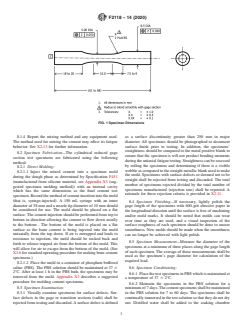
cement, but rather to characterize the material using standard specimen dimensions are provided in Fig. 1.
and well-established methods. The user is cautioned to con-
sider the appropriateness of this test method in view of the 8. Specimen Preparation
material being tested and its potential application.
8.1 Cement Mixing:
5.4 It is widely reported that multiple clinical factors affect 8.1.1 Store the liquid and powder portions of the cement
the fatigue performance of orthopaedic bone cement; however, according to the manufacturer’s instructions before mixing.
the actual mechanisms involves multiple factors. Clinical 8.1.2 Allow the mixing equipment to equilibrate to room
factors which may affect the performance of bone cement temperaturebeforemixing.Recordtheroomtemperatureatthe
include: temperature and humidity, mixing method, time of onset of mixing.
application, surgical technique, bone preparation, implant 8.1.3 Mix the powder and liquid components according to
design,anatomicalsite,andpatientfactors,amongothers.This the manufacturer’s instructions and begin recording the time
test method does not specifically address all of these clinical using a stopwatch when the liquid and powder are initially
factors. The test method can be used to compare different mixed. Report any deviations from the manufacturer’s storage
acrylic bone cement formulations and products and different and mixing recommendations.
F2118 − 14 (2020)
FIG. 1 Specimen Dimensions
8.1.4 Report the mixing method and any equipment used. as a surface discontinuity greater than 250 mm in major
The method used for mixing the cement may affect its fatigue diameter. All specimens should be photographed to document
behavior. See X2.13 for further information. surface finish prior to testing. In addition, the specimens’
straightness should be compared to the metal positive blank to
8.2 Specimen Fabrication—The cylindrical reduced gage
ensure that the specimen is will not product bending moments
section test specimens are fabricated using the following
duringtheuniaxialfatiguetesting.Straightnesscanbeassessed
method:
by rolling the specimens and determining if there is a visible
8.2.1 Direct Molding:
wobbleascomparedtothestraightmetallicblankusedtomake
8.2.1.1 Inject the mixed cement into a specimen mold
the mold. Specimens with surface defects or deemed not to be
during the dough phase as determined by Specification F451
straight shall be rejected from testing and discarded. The total
(manufactured from silicone material, see Appendix X3 (sug-
number of specimens rejected divided by the total number of
gested specimen molding method)) with an internal cavity
specimens manufactured (rejection rate) shall be reported. A
which has the same dimensions as the final cement test
rationale for these rejection criteria is provided in X2.11.
specimen.Recordthemethodofcementinsertionintothemold
(that is, syringe-injected). A 150 mL syringe with an inner
8.4 Specimen Finishing—If necessary, lightly polish the
diameter of 38 mm and a nozzle tip diameter of 10 mm should
gage length of the specimens with 600-grit abrasive paper in
be considered for use. The mold should be placed on a flat
the longitudinal direction until the surface is free of machining
surface.The cement injection should be performed from top to
and/or mold marks. It should be noted that molds can wear
bottom in direction allowing the cement to flow down axially
over time as they are used, and a visual inspection of the
to the bottom . The bottom of the mold is placed on a flat
surface roughness of each specimen should be done to ensure
surface as the bone cement is being injected into the mold
smoothness. New molds should be made when the smoothness
unixaially from the top down. If air is entrapped and leads to
can no longer be achieved with light polish.
resistance to injection, the mold should be rocked back and
8.5 Specimen Measurement—Measure the diameter of the
forth to release trapped air from the bottom of the mold. This
specimens at a minimum of three places along the gage length
will allow for air to escape from the bottom of the mold. (See
of each specimen.The average of these measurements shall be
X3.6forstandardoperatingprocedureformakingbonecement
used as the specimen’s gage diameter for calculation of the
specimens.)
required load.
8.2.1.2 Place the mold in a container of phosphate buffered
saline (PBS). The PBS solution should be maintained at 37 6
8.6 Specimen Conditioning:
2°C.After at least1hinthePBS bath, the specimens may be
8.6.1 PlacethetestspecimensinPBSwhichismaintainedat
removed from the mold. Appendix X3 describes a suggested
a temperature of 37 6 2°C.
procedure for molding cement specimens.
8.6.2 Maintain the specimens in the PBS solution for a
8.3 Specimen Examination: minimumof7days.Thecementspecimensshallbemaintained
8.3.1 Visually examine specimens for surface defects. Sur- in the PBS solution for 7 to 60 days. The specimens shall be
face defects in the gage or transition sections (radii) shall be continuallyimmersedinthetestsolutionsothattheydonotdry
rejected from testing and discarded.Asurface defect is defined out. Distilled water shall be added to the soaking chamber
F2118 − 14 (2020)
during the soaking period to make up for evaporation loss. investigated should be considered when determining the ap-
Each specimen should be soaked up to the time immediately propriate sample size; while this may require more than 15
before its being mounted on the load frame. See X2.5 for specimensperbonecementformulationateachstresslevel,15
further information. is the recommended minimum number to test. See X2.12 for
further information.
9. Fatigue Test Procedures
9.6 Set the cycle counter and limit settings of the test frame
9.1 Mount one specimen at a time in a test frame test such controllertorecordthecumulativenumberofcyclesappliedto
that a uniaxial load is applied. Collets, Jacob’s chucks, or
the test specimen and the appropriate test limits values to
pressurized grips should be used to firmly grip the specimen at indicate specimen failure or deviations from the intended load
each end. Ensure that the longitudinal centerline of the test
system performance.
specimen is aligned with test machine loading axis such that
9.7 After the solution has reached the temperature require-
bending moments are minimized. Testing of multiple speci-
mentsin9.2,activatethetestframecontrollertobeginthetest.
mens on the same fixture in parallel or series shall not be
9.8 Testing shall continue until specimen failure or the
performed as this complicates and changes the stress state in
the individual specimens when cracks occur and propagate run-out limit is reached.
through the specimen, effectively changing the modulus of
each individual specimen being tested. 10. Calculation and Interpretation of Results
9.2 Mountanenvironmentalchamberontheloadframeand
10.1 The maximum stress and the cycles to failure for each
fill with fresh PBS solution immediately after the specimen is
specimen should be recorded and plotted on an Stress Level
mounted to keep the specimen from drying out. The chamber
versusnumberofcyclesdiagram,whichisaplotofthenumber
should be filled to a level such that the entire specimen is
of cycles to failure on the x-axis at each of the stress levels
immersed. Distilled water shall be added to the test chamber
examined on the y-axis. The techniques used to measure mean
duringthecourseofatesttomakeupforanyevaporationloss.
fatigue lives, as well as to compare statistical differences
The temperature controller should be programmed and acti-
betweensamplegroups,andcalculatefatiguelifearedescribed
vated to heat the test solution to 37°C, and then maintain that
in 10.2 – 10.6.
temperature within 62°C. Fatigue testing should not begin
10.2 Mean Fatigue Life—For each stress level, the mean
until at least ⁄2 h after the solution temperature has reached
fatigue life and standard deviation about the mean shall be
37°C to ensure equilibration.
determined assuming a log-normal distribution; that is, assum-
9.3 Program the test frame controller to apply a fully
ing that the log-transformed number of cycles to failure is
reversed sinusoidal cyclic waveform at a constant frequency.
approximately normally distributed (1). The mean log fatigue
Whentestingatfrequenciesabove5Hz,theusershouldverify
life is determined as follows.Asample size of N specimens is
that,fortheformulationbeingtested,thechosenfrequencyhas
tested, and the total number of cycles to failure for each
a negligible effect on the test results. See X2.6 for further
(denoted N) is recorded. Next take the natural log of the
i
information.
number of cycles: X = ln(N). The mean log number of cycles
i i
to failure is obtained via the sample mean:
9.4 Program the test frame controller to apply the desired
N
maximum stress level and a stress ratio of R = –1, indicating
X
i
H
X 5 (1)
fully reversed loading. A rationale for using fully reversed log (
N
i51
loading is provided in X2.10. The load shall be calculated by
where:
multiplying the desired stress by the specimen’s cross-section
N = total number of specimens in the sample group,
area,basedoneachspecimen’sgagediameterasdeterminedin
N = number of cycles to failure of ith specimen,
8.5. i
X = log-transformed number of cycles to failure of ith
i
9.4.1 Report the stress level to the nearest 0.5 MPa.
specimen: X = ln(N), and
9.4.2 Determine the appropriate data acquisition frequency i i
¯
X = mean log fatigue life.
log
to adequately document the loads and displacements achieved
during the testing.
10.2.1 Usingasimilarapproach,thesamplestandarddevia-
9.4.3 When developing an S-N curve (see 10.1), it is
tion of the log fatigue life (S ) is determined.
X
log
recommended that testing be conducted at the following
N
H
maximum stress levels: 15, 12.5, and 10 MPa. Other stress ~X 2 X !
i log
SH 5Π(2)
X (
log
levelsmayalsobeappropriatefororthopedicapplicationssuch N 21
i51
as the hip and knee. However, stress levels of 5, 7, and 9 MPa
10.2.2 Theseareexpressedinmorefamiliarterms,ascycles
should be considered for spinal applications in vertebroplasty
to failure, by calculating the following:
and kyphoplasty. See X2.7 for a rationale regarding the
H
X
selection of the recommended stress levels.
log
Meanfatiguelife 5e (3)
9.5 Number of Specimens—When developing an S-N curve,
aminimumof15specimensshallbetestedateachstresslevel.
The desired statistical power of the comparison and the
Theboldfacenumbersinparenthesesrefertothelistofreferencesattheendof
variabilitytobeexpectedfromthecementformulation(s)being this standard.
F2118 − 14 (2020)
10.2.3 A95% lower and upper bound for the mean number distributed, or the variances of the different bone cements are
of cycles to failure can be obtained using the following unequal), non-parametric statistical methods are suggested for
formulas (using the delta method, see X4.1): use in determining statistical differences between sample
H H groups.Non-parametrictestsarebaseduponthemedian,rather
X X
log log
e 621.96* e SH (4)
~ !
X
log
than the mean, and are therefore more robust because they are
less influenced by the highly skewed nature of the data. In
10.3 Parametric Statistical Comparisons—Statistical differ-
addition,asthesetestsarebasedonranks,ratherthanuponthe
ences between specimen groups may be determined by com-
actualobservationvalues,theresultsarethesameregardlessof
monlyusedmethodssuchasatwo-sampleindependentt-testto
whether or not the data are log-transformed. The Mann-
compare two groups, or analysis of variance (ANOVA) to
Whitney U test (equivalent to the Wilcoxon rank sum test) is
compare more than two groups. This comparison is performed
recommended for comparing two groups, and the Kruskal-
at each stress level using published methods (2) which are
Wallis test is recommended for comparing three or more
available through many commercial statistical software pack-
groups.Thiscomparisonisperformedateachstresslevelusing
ages. The use of these tests requires several assumptions; the
published methods (2) which are available through many
two most relevant are normality and equal variances. That is,
commercial statistical software packages.
these tests assume that the number of cycles to failure in each
bone cement at each stress level is approximately normally
10.5 Recommendations for Analysis—In light of these
distributed, and that the variance of these normal distributions
discussions, as well as an examination of the “round-robin”
is the same for all of the bone cements. These are relatively
data and the observation that the number of cycles to failure
strong assumptions, which may not be upheld. It is therefore
must be non-negative and may be highly skewed (Appendix
recommended that these assumptions be assessed. Tests to
X5), an assumption of normality is somewhat tenuous. For the
assess normality include the Lillie for test and the Shapiro-
numberofsamplessuggestedhere(n=15perbonecement)itis
Wilk test (3). However, these tests are based on large samples
recommendedthatnon-parametrictests,whicharemorerobust
approximations, and having a sample size on the order of
to non-normal data, be used for statistical inference and to
15–30 observations per group may not be sufficient to guaran-
compare different types of bone cement.
tee reliable performance.
10.6 A brief description of the fracture characteristics;
10.3.1 Often, the decision as to whether to analyze data on
results of post-test photography or scanning electron micros-
an untransformed or log-scale is based on a test for normality;
copy or both; identification of fatigue mechanism; and the
the most common of these is the Shapiro-Wilk test (4). Based
relative degree of transgranular and intergranular cracking
on a small simulation study using the results of the “round-
wouldbehighlybeneficial.Inaddition,allfracturedspecimens
robin” experiment, we found that the test rejects samples from
shall be examined visually for pores and failure occurring
atruenormaldistributionapproximately7.5%ofthetime(out
outside the gauge area.
of an expected 5%). If the data is assumed to arise from a
gamma distribution (a highly skewed distribution which ap-
11. Report
pearstobeareasonablefittothisdata),theuntransformeddata
11.1 The test report shall include the following:
is not rejected approximately 27% of the time. This implies
11.1.1 Manufacturer and brand of bone cement.
that reliance on the Shapiro-Wilk test may lead to incorrect
11.1.2 Product catalog number, lot number, and expiration
applicationofstatisticaltestsassumingnormality;thisislikely
date. If the cement is not in its final packing or sterilized, then
if a relatively small number of specimens are tested (for
the manufacturing date should be provided and noted that the
example, N=15).
bone cement components were not sterilized.
10.3.2 Itisoftenrecommendedthataparametricanalysisbe
11.1.3 Composition of bone cement polymer powder and
performed using the log-transformed data—this assumes that
liquid.
the number of cycles to failure follows a log-normal distribu-
11.1.4 Deviations from clinically used product (if appli-
tion. If this is the case, then analyzing on the log scale would
cable).
be expected to improve the normality of the data; the number
11.1.5 Descriptionofcementstorage,roomtemperatureand
of cycles is highly skewed with all values being non-negative,
relative humidity during bone cement mixing, mixing method
and some having extremely high values. Taking the log of the
(that is, report duration of mixing, wait time (if applicable),
number of cycles is believed to make the resulting data more
determination of dough time, application time, and hardening
approximately normally distributed. In addition, calculating
time), and any deviations from the manufacturer’s recommen-
themeanbasedonthelogscalereducestheeffectofextremely
dations.
large or small values (for example, outliers) on the sample
11.1.5.1 If vacuum mixing is used, the information and
mean.Thedisadvantageofanalyzingonthelogscaleisthatthe
parameters described in 8.1.3 shall be reported.
unitsareintermsoflogcyclesratherthancycles.However,the
11.1.6 Description of specimen fabrication method.
transformed value can be back-transformed to the original
11.1.7 Description of specimen examination procedures,
scale (and an approximate 95% confidence interval can be
rejection rate, rejection criteria and rationale for the rejection
estimated via the delta method as shown in 10.2).
criteria.
10.4 Non-parametricStatisticalComparisons—Insituations 11.1.8 Durationofpreconditioning,providedeitherforeach
in which the parametric statistical tests are not appropriate (for specimen, or expressed as an average and range of duration.
example, the number of cycles is not approximately normally 11.1.9 Cyclic frequency.
F2118 − 14 (2020)
11.1.10 A summary of the maximum cyclic stress and 11.1.13 The mean fatigue life at each load level.Adescrip-
cycles to failure for each specimen tested. tion of the analytical or statistical techniques used for deter-
11.1.10.1 Peak/valleyloadanddisplacementdatainorderto
mining the fatigue life should be included.
document the loads and displacements each sample experi-
11.1.14 Any deviations from the specified test method.
enced during testing.
11.1.11 A summary for each sample group describing at
12. Keywords
each stress level the following parameters:
12.1 acrylic bone cement; fatigue; fatigue life
11.1.11.1 Mean fatigue life, along with the standard devia-
tion and 95% confidence interval as presented in 10.2.
11.1.12 A description of the failure mode and failure loca-
tion for each specimen that failed. Scanning electron micros-
copy (SEM) is suggested to identify the failure mode.
APPENDIXES
(Nonmandatory Information)
X1. FORMULAS
W 2 n m1n11 /2
X1.1 Formulas are presented following the notation of @ ~ ! #
W* 5
g
Hollander and Wolfe (5).
mn~N11! mn
2 t 21 t t 11
ΠH ~ ! ~ !J
( j j j
12 12N N 21
~ !
j51
X1.2 Formula for Wilcoxon Rank Sum Test:
where g represents the number of tied groups (thus, if there
X1.2.1 The Wilcoxon rank sum test (which is equivalent to
are no ties, g=N and the formula simplifies to the first form).
the Mann-Whitney test) is a non-parametric analog of the
X1.3 Formula for Kruskal-Wallis Test:
two-sample t-test.
X1.3.1 The Kruskal-Wallis test is an extension of the
X1.2.2 This test assumes that there are two independent
Wilcoxon rank sum test to more than two independent groups;
groups, and the question of interest is whether the medians of
it is a non-parametric analog of the 1-way ANOVA.
the two groups are equal. To implement the test, refer to the m
X1.3.2 To implement this test, first order all N of the
observations from the first group as X and the n observations
observations from all of the k groups from smallest to largest.
from the second group as Y. Order all of the observations from
Denote as r the rank of observation X , and the number of
ij ij
smallest to largest, and assign ranks to each observation.
samples in the jth group as n. Calculate:
j
Denote the rank of all of the values from the second group as
n
j
R
S , ., S . j
1 n
R 5 r and R 5
j ( ij j
n
i51
j
X1.2.3 Calculatethesumoftheranksoftheobservationsin
X1.3.3 The test statistic for the Kruskal-Wallis test is then
the second group:
calculated as:
n
k
12 R
W 5 S j
( j
H 5 23 N11
S D ~ !
j51
(
N N11 n
~ !
j51
j
X1.2.4 To test for equivalence of medians in a 2-sided test,
X1.3.4 Compare Htoaχ (chi-squarewith k-1degreesof
k-1
calculate the test statistic: freedom)distribution,andrejectthenullhypothesisofequality
2 2
of medians across groups if H≥χ , where χ is the 1
k-1,α k-1,1-α
W 2 n m1n11 /2
@ ~ ! #
W* 5
–αthpercentilefromachi-squaredistributionwith k-1degrees
=mn m1n11 /12
~ !
of freedom.
X1.3.5 If there are ties present in the data, calculate the
and refer W* to a standard normal distribution; that is, reject
modified test statistic:
the null hypothesis of equal medians if |W*| ≥ z , where
1-α/2
z is the 1 – α/2th percentile from the standard normal
1-α/2 H
H' 5
g
distribution.
1 2 t 21 / N 2 N
S ~ ! ~ !D
( j
j51
X1.2.5 If there are ties in the ranks, assign the average rank
to each of the tied values, and adjust the test statistic W*as
where g represents the number of tied groups (thus, if there
follows: are no ties, g=N and the formula simplifies to the first form).
F2118 − 14 (2020)
X2. RATIONALE
X2.1 This test method is intended to provide the user with X2.6 Becauseacrylicbonecementisaviscoelasticmaterial,
standard and well established procedures for evaluating the its cyclic stress-strain behavior is rate-dependent. However,
fatigue properties of bone cement materials. Specimen frequencies up to 5 Hz has been shown not to affect the cycles
parameters, test procedures, data analysis techniques, and to failure for polymethyl methacrylate (PMMA) based bone
cement that were tested (7). It has been shown in tension-
reporting requirements are provided.
tension tests that an elevation in the testing frequency tends to
X2.2 The test method does not specify the mixing condi-
increase the fatigue life of bone cement (8). The user is
tions to use for the preparation of the test specimens. Consid-
cautionedtoverifyfromtheliteratureorfromnewteststhatfor
erable research is currently being performed on bone cement
the formulation being tested the use of any elevated frequency
and the committee did not want to unnecessarily limit the
should not have an effect on the reported results.
conditionsorparametersthatarebeinginvestigatedbyexclud-
X2.7 When establishing load levels at which to test bone
ing them from the standard.
cements, it is important that the specimens are subjected to
stresslevelswhichthecementwouldlikelyexperience in-vivo.
X2.3 It is important to realize that this test method is
Fornormaljointloading,thenominaltensilestresslevelsinthe
intended to characterize the bone cement material—not the
cementmantlesurroundingastablehipstemarereportedtobe
bone cement which is used in vivo. Some consideration has
between 3 and 11 MPa (9-11). The specified maximum stress
been given to the parameters which the cement encounters
levels are chosen to provide sufficient finite life fatigue data to
during in vivo use (37°C temperature and PBS solution);
develop an S-N curve, while providing some data in the range
however, it is not practical to try and completely simulate the
ofexpected in vivostresses.Theloadlevelsmaydependonthe
clinical use of bone cement.The results obtained from this test
location of use (for example, hip versus knee versus spine). In
method characterize the bone cement material for a specified
the past, some investigators have recommended fitting a
set of conditions, but they may not necessarily reflect the
survival curve to the failure data and comparing bone cements
cement’s clinical performance.
fromdifferentexperimentsbycalculatingtheexpectednumber
of cycles to failure for a common load level for both cements;
X2.4 The orthopedic literature generally reports that joint
this is not recommended. Fitting such curves makes a number
replacement patients may be expected to take 2 million to 3
of assumptions about the data, which may not be valid, or
million steps per year (1 million to 1.5 million gait cycles).
testable. Further, attempting to fit a model with several
Therefore bone cement, when used for securing artificial hip
parameters based on only three load levels could lead to
andkneejoints,isexposedtomillionsofloadingcyclesduring
over-fitting the dataset, resulting in the model performing
its use. It is appropriate to expect that the fatigue testing of
poorlyforotherdata.Finally,usingsuchamodeltoextrapolate
bone cement would likewise subject the test specimens to
(for example, predicting the expected number of cycles to
millions of cycles. However, it should be kept in mind that the
failure at a load level not examined in the experiment) is
fatigue testing cycles described herein may not be directly
statistically questionable and could lead to unstable and inac-
correlatedwiththedurationofclinicalimplantationbecauseof
curate estimates. It is instead recommended that any compari-
the limitations described in X2.3. The committee has chosen a
sons be performed by matching the stress level directly (for
runout limit of 5 million load cycles to provide a reasonable
example,comparingthenumberofcyclestofailureat10,12.5,
representation of the high cycle fatigue loading to which bone
and 15 MPa across different labs).
cement is exposed while also addressing the economic and
practical considerations of testing at realistic load rates (see
X2.8 Differences in specimen fabrication method (user
X2.6) in a reasonable period of time.
experience, cement application to mold technique, mold mate-
rials) may lead to different test results for the same cement,
X2.5 It is recognized that the total time for which the
tested under identical conditions (12). The scientific literature
specimensarepresoakedmayhaveanimportanteffectontheir
does not provide a clear indication as to the preferred method
fatigue performance since fluid uptake and polymer degrada-
of specimen fabrication. For the current time, the standard
tion are functions of time. Most articles in the literature have
providesarecommendedprocedure,whileallowingalternative
reported presoaking cement specimens for a minimum of 7
methods, provided they are fully described. The user is
days.Thistestmethodprovidesamaximumpresoakingtimeof
cautioned against comparing different sets of data generated
60 days to reasonably minimize the effect of different presoak-
using this even though the same procedures are used for
ing times on the results. It has been shown that most formu-
specimenpreparationbecauseofvariabilityinspecimenprepa-
lations of acrylic cement will experience a weight gain of 2.0
ration from one investigator to another. Whenever possible,
to 2.5% during an extended soak period of 100 days (6).Itis
investigator(s)shouldplantotesttheirownconcurrentcontrols
recommendedthattheuseridentifyauniformpresoaktimethat
for comparisons and not rely on previously published values.
bringsthespecimenstoaweight-gainplateauatwhichtheyare
gaininglessthan0.2%oftheirweightperweek.Asreasonably X2.9 Fatigue of the cement mantle has been implicated as
possible, all of the test specimens should have the same one of the mechanisms leading to orthopaedic prosthesis
soaking time before testing. loosening and eventual arthroplasty failure (13). Fractographic
F2118 − 14 (2020)
analysis of cement explanted from failed prostheses demon- bone cements is desired, a larger number of specimens from
strates characteristics consistent with PMMA fatigue crack each should be tested to ensure sufficient power to rule out a
initiation and propagation to failure (14). The polymer difference of a given magnitude.
chemistry, molecular weight, radiopacifier, voids, mixing
X2.12.1 Elaboration on Sample Size for Non-parametric
method, and sterilization method have all been presented by
Approaches Recommended in theASTM Bone CementAnalysis
various authors as influencing the fatigue properties of bone
Standard—Parametric analyses (for example, (8) t-test and
cement.Thetestmethoddescribedhereinprovidesameansfor
ANOVA) assume that the data being analyzed are approxi-
evaluatingtheeffectofthesevariousparametersinacontrolled
mately normally distributed. Non-parametric analogs (for
manner.
example, Mann-Whitney / Wilcoxon rank sum test and
Kruskal-Wallis test) do not make this assumption, and are
X2.10 The cement mantle surrounding hip and knee im-
therefore more appropriate if there is concern regarding the
plantsissubjectedtocomplextensileandcompressivestresses.
normality of the data being analyzed.Alimitation to the use of
Generally, fatigue cracks will only initiate and extend under
thesemethodsistheperceivedabsenceofsamplesizeformulas
localized tensile stresses. Fully reversed loading has been
fornon-parametricmethods.Here,weprovidethreeoptionsfor
selected for this test method for two reasons: (1) for a given
estimating the sample size required to detect a significant
maximum stress, fully reversed loading provides the most
difference between two (or more) different bone cements: use
conservative estimate of fatigue performance, and (2) the vast
of parametric sample size formulas as a ballpark estimate, a
majority of the bone cement fatigue data in the U.S. literature
direct sample size formula for the Wilcoxon rank sum test, or
uses fully reversed loading.
simulation. These are discussed in turn in the following
X2.11 The rejection criteria should be used to identify sections.
specimens based on the specimens having surface defects.The
X2.12.1.1 Use Parametric Approaches as a Rough
surface finish should be free of any surface defect that may
Estimate—One approach to sample size estimation in non-
influence the fatigue performance of the specimen. While
parametric analyses is to calculate the sample size for the
internal defects may result in a lower number of cycles to
corresponding parametric test, then use that sample size as a
failure, the current method suggest that these specimens be
ballpark estimate for the sample size required for the non-
randomized and tested at the different stress levels. Therefore,
parametric approach. This method is generally reasonably
specimenswithsurfacedefectsshouldbenotbetestedbecause
accurate, due to the statistical concept of relative efficiency.
surface defects can have a great influence on the cycles to
Relative efficiency is a means of comparing various statistical
failure reported for this specific material in using this specific
tests based on the standard error of the test statistic. For
testsetup.However,internaldefectdetectedonX-rayormicro example, Hollander and Wolfe (5) report that the relative
CT should be used to help determine if there is a correlation
efficiency of the Wilcoxon rank sum test relative to the
between cycles to failure and porosity in the gauge length. parametric analog (two sample t -test) is at least 86.4%. This
means that if the data were analyzed with the Wilcoxon rank
X2.12 Aminimumof15specimenswasconsideredtobean
sum test rather than the two-sample t-test, the efficiency loss
appropriatebalanceof (1)therequirementforhavingsufficient
would be approximately 14% or less. This loss in efficiency
data to allow statistical comparisons and generation of the S-N
can be dealt with by slightly increasing the sample size if the
curve with (2) the resources required to perform high-cycle
non-parametric analysis is used. Many commercially available
fatigue testing. The user is encouraged to calculate the power
programs will conduct sample size estimates for the two-
of the test comparisons, using well-published methods (2), for
sample t-test.
the particular cement formulation(s) being investigated to
X2.12.1.2 Sample Size Formulas Presented by Noether—
determine the appropriateness of the sample size used. Based
Noether (15) provides sample size formulas for several com-
on the variability seen in the data from the “round-robin”
monly encountered non-parametric tests, including the Wil-
experiment, a sample size of 15 specimens per bone cement at
coxon rank sum test. Assuming that an equal number of
12.5 MPa stress level would have approximately 80% power
observations will be selected from both groups, the total
to detect a difference in the number of cycles of approximately
sample size (N) associated with a type I error rate (α) and
140000 cycles . As a result, if only 15 specimens per bone
power 1 – β is obtained via:
cement are used and the statistical analysis is not significant,
z 1z
~ !
12α 12β
the correct conclusion is not that the two bone cements are
N 52n 5
3~p''20.5!
equivalent, but that the difference in fatigue life is less than
140,000 cycles. If more precision on the equivalence of the
where z and z are the 1 – αand1– β percentiles of the
1-α 1-β
standard normal distribution, respectively. p'' represents the
expected probability that samples from group 1 are larger than
6 2
This number was estimated as follows. The data from the round-robin analysis
samples from group 2; that is, 1⁄n U, where n is the number of
was used to fit a gamma distribution for the number of cycles to failure. 15 random
specimens in each group (N/2 if the two groups have the same
draws from this gamma distribution were sampled. 15 different random draws were
number of specimens), and U is the expected Mann-Whitney
selectedfromagammadistributionwiththesameparameters,butshiftedtotheright
test statistic.
by parameter delta. By varying delta, and comparing the number of times the
simulated data found a statistically significant difference between the two groups,
X2.12.1.3 Simulation—Athird approach is to use computer
thethresholdvalueof140,000wasdetermined,asithasapproximately85%power
when the data are analyzed with the Wilcoxon rank sum test. simulation (sometimes referred to as Monte Carlo studies) to
F2118 − 14 (2020)
estimate the required sample size. Simulations routinely used to this have been reported (17, 18-21).
in statistical research to obtain estimates which are impossible
X2.14 In 2002, a round-robin experiment was conducted in
or intractable to solve for directly (16). An example of how
order to establish the precision and accuracy to be expected
simulation could be used in the context of sample size
from this test method (see Appendix X5). Six different labo-
estimation for non-parametric approaches is the following.
ratories followed a standardized procedure based on the
First, a candidate distribution for the number of cycles to
previous version of this standard. The main findings of this
breakingforthetwodifferentbonecementsisselectedinorder
experiment are summarized below; further details of the
to have characteristics similar to those expected in the experi-
procedure, data, and analysis can be found in the appendix.
ment (for example, mean, median, or standard deviation
X2.14.1 The data were log-transformed, but the data from
expected). Next, some number of specimens (N) are drawn
most of the labs was still not approximately normal based on
from each of these two distributions and the Wilcoxon rank
significant p-values for the Shapiro-Wilk test. Samples which
sum test applied to the resulting samples. This process is
were rejected due to radiographic defects showed a significant
repeated 1,000 times, and the number of times the test is
decrease in the number of cycles to failure relative to radio-
statistically significant divided by 1,000 is the estimated
graphically acceptable samples; this was consistent regardless
statisticalpowerofthetestatthatsamplesize.Theprocesscan
of whether the data were analyzed as number of cycles to
be repeated using a larger value of N until one associated with
failure or log-transformed number of cycles to failure, or
the desired power is obtained. Typically, simulation studies
analysis method (parametric or non-parametric).
require programming in some computer language (for
example, R, SAS, Fortran, C++) and may benefit from input X2.14.2 There was also significant variation between the
results obtained at each laboratory. This highlights the impor-
from a statistician.
tance of following the testing procedure presented in this
X2.13 In general, hand mixing under ambient pressure will standard as closely as possible, as well as documenting all
produce specimens with the shortest fatigue life. Other meth-
relevant testing parameters. Clarifications and modifications
ods of mixing (for example, vacuum mixing and centrifuga- have been made to the molding material and preparation of the
tion) generally produce specimens with similar or greater
specimens to improve the quality of
...