

ASTM C1012/C1012M-24
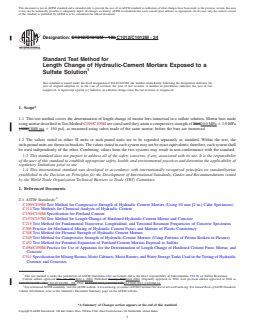
(Test Method)Standard Test Method for Length Change of Hydraulic-Cement Mortars Exposed to a Sulfate Solution
General Information
- Abstract
SIGNIFICANCE AND USE
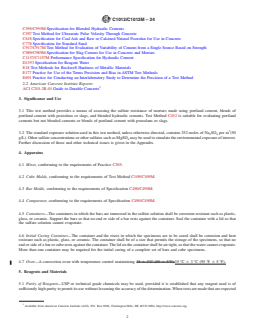
3.1 This test method provides a means of assessing the sulfate resistance of mortars made using portland cement, blends of portland cement with pozzolans or slags, and blended hydraulic cements. Test Method C452 is suitable for evaluating portland cements but not blended cements or blends of portland cement with pozzolans or slags.
3.2 The standard exposure solution used in this test method, unless otherwise directed, contains 352 moles of Na2SO4 per m3(50 g/L). Other sulfate concentrations or other sulfates such as MgSO4 may be used to simulate the environmental exposure of interest. Further discussion of these and other technical issues is given in the Appendix.
SCOPE
1.1 This test method covers the determination of length change of mortar bars immersed in a sulfate solution. Mortar bars made using mortar described in Test Method C109/C109M are cured until they attain a compressive strength of 20.0 MPa ± 1.0 MPa [3000 psi ± 150 psi], as measured using cubes made of the same mortar, before the bars are immersed.
1.2 The values stated in either SI units or inch-pound units are to be regarded separately as standard. Within the text, the inch-pound units are shown in brackets. The values stated in each system may not be exact equivalents; therefore, each system shall be used independently of the other. Combining values from the two systems may result in non-conformance with the standard.
1.3 This standard does not purport to address all of the safety concerns, if any, associated with its use. It is the responsibility of the user of this standard to establish appropriate safety, health, and environmental practices and determine the applicability of regulatory limitations prior to use.
1.4 This international standard was developed in accordance with internationally recognized principles on standardization established in the Decision on Principles for the Development of International Standards, Guides and Recommendations issued by the World Trade Organization Technical Barriers to Trade (TBT) Committee.
- Status
- Published
- Publication Date
- 31-Mar-2024
- Technical Committee
- C01 - Cement
- Drafting Committee
- C01.29 - Sulfate Resistance
Buy Documents
ASTM C1012/C1012M-24 - Standard Test Method for Length Change of Hydraulic-Cement Mortars Exposed to a Sulfate Solution
REDLINE ASTM C1012/C1012M-24 - Standard Test Method for Length Change of Hydraulic-Cement Mortars Exposed to a Sulfate Solution
Overview
ASTM C1012/C1012M-24, Standard Test Method for Length Change of Hydraulic-Cement Mortars Exposed to a Sulfate Solution, is an internationally recognized method developed by ASTM International. This standard provides a reliable procedure to evaluate the sulfate resistance of portland cement, blended hydraulic cements, and combinations of portland cement with pozzolans or slags. Using this method, laboratories can determine the length change that occurs in mortar bars when exposed to sulfate environments, a key indicator of sulfate attack and durability.
Sulfate attack is a leading cause of deterioration in concrete structures exposed to environments containing sulfate ions, such as soil or groundwater. By quantifying expansion due to sulfate exposure, ASTM C1012/C1012M-24 helps organizations assess and select appropriate cementitious materials for long-term performance.
Key Topics
Assessment of Sulfate Resistance
The standard offers a means to measure the resistance of hydraulic-cement mortars against sulfate attack. Mortar bars, prepared and cured to a target compressive strength, are immersed in a sulfate solution, and their length change over time is systematically measured.Scope and Procedure
- Applies to mortars made with portland cement (ASTM C150/C150M), blended cements (ASTM C595/C595M), and cements with pozzolans or slags (ASTM C618, C989/C989M).
- Bars are prepared using proportions from ASTM C109/C109M, cured until a compressive strength of approximately 20 MPa (3000 psi) is reached, then immersed in a sodium sulfate solution.
- Periodic readings of length change are taken using a standardized comparator, with measurements typically scheduled over periods up to 18 months.
Testing Accuracy and Reporting
The standard emphasizes consistency and repeatability, including guidance on specimen preparation, solution maintenance, and result calculation. Reporting must detail material specifics, initial and subsequent length change values, and observations regarding specimen condition.
Applications
Cement Qualification and Specification
Manufacturers and quality control laboratories use ASTM C1012/C1012M-24 to verify that cements and cementitious blends meet specified sulfate resistance criteria, ensuring product suitability for sulfate-exposed environments.Material Development and Research
Researchers rely on this method to investigate new cement formulations, compare performance of different additives (e.g., fly ash, slag), and simulate field performance for infrastructure projects.Structural Durability Assessment
Consulting engineers and designers use the test results as part of the durability classification for concrete in chemically aggressive environments, supporting compliance with building codes, specifications, and sustainability guidelines.Regulatory and International Acceptance
The method supports harmonized practice globally, in alignment with World Trade Organization (WTO) principles for international standards, facilitating use in cross-border projects and procurement.
Related Standards
- ASTM C109/C109M
Test Method for Compressive Strength of Hydraulic Cement Mortars. - ASTM C150/C150M
Specification for Portland Cement. - ASTM C595/C595M
Specification for Blended Hydraulic Cements. - ASTM C618
Specification for Coal Fly Ash and Raw or Calcined Natural Pozzolan for Use in Concrete. - ASTM C989/C989M
Specification for Slag Cement for Use in Concrete and Mortars. - ASTM C452
Test Method for Potential Expansion of Portland-Cement Mortars Exposed to Sulfate. - ACI C201-2R-01
Guide to Durable Concrete. - ASTM C157/C157M
Test Method for Length Change of Hardened Hydraulic-Cement Mortar and Concrete.
Keywords: sulfate resistance, hydraulic-cement mortars, length change, ASTM C1012, sulfate attack, blended cements, pozzolans, slag, concrete durability, cement testing, standard test methods.
Relations
- Effective Date
- 01-Apr-2024
- Effective Date
- 15-Jul-2021
- Effective Date
- 01-Apr-2024
- Effective Date
- 01-Apr-2024
- Referred By
ASTM C183/C183M-23 - Standard Practice for Sampling and the Amount of Testing of Hydraulic Cement - Effective Date
- 01-Apr-2024
- Referred By
ASTM C989/C989M-24 - Standard Specification for Slag Cement for Use in Concrete and Mortars - Effective Date
- 01-Apr-2024
- Effective Date
- 01-Apr-2024
- Effective Date
- 01-Apr-2024
- Effective Date
- 01-Apr-2024
- Effective Date
- 01-Apr-2024
- Effective Date
- 01-Apr-2024
- Effective Date
- 01-Apr-2024
Buy Documents
ASTM C1012/C1012M-24 - Standard Test Method for Length Change of Hydraulic-Cement Mortars Exposed to a Sulfate Solution
REDLINE ASTM C1012/C1012M-24 - Standard Test Method for Length Change of Hydraulic-Cement Mortars Exposed to a Sulfate Solution
Get Certified
Connect with accredited certification bodies for this standard

DIBt (Deutsches Institut für Bautechnik)
German Institute for Building Technology.
DIN CERTCO
DIN Group product certification.

Aboma Certification B.V.
Specialized in construction, metal, and transport sectors.
Sponsored listings
Frequently Asked Questions
ASTM C1012/C1012M-24 is a standard published by ASTM International. Its full title is "Standard Test Method for Length Change of Hydraulic-Cement Mortars Exposed to a Sulfate Solution". This standard covers: SIGNIFICANCE AND USE 3.1 This test method provides a means of assessing the sulfate resistance of mortars made using portland cement, blends of portland cement with pozzolans or slags, and blended hydraulic cements. Test Method C452 is suitable for evaluating portland cements but not blended cements or blends of portland cement with pozzolans or slags. 3.2 The standard exposure solution used in this test method, unless otherwise directed, contains 352 moles of Na2SO4 per m3(50 g/L). Other sulfate concentrations or other sulfates such as MgSO4 may be used to simulate the environmental exposure of interest. Further discussion of these and other technical issues is given in the Appendix. SCOPE 1.1 This test method covers the determination of length change of mortar bars immersed in a sulfate solution. Mortar bars made using mortar described in Test Method C109/C109M are cured until they attain a compressive strength of 20.0 MPa ± 1.0 MPa [3000 psi ± 150 psi], as measured using cubes made of the same mortar, before the bars are immersed. 1.2 The values stated in either SI units or inch-pound units are to be regarded separately as standard. Within the text, the inch-pound units are shown in brackets. The values stated in each system may not be exact equivalents; therefore, each system shall be used independently of the other. Combining values from the two systems may result in non-conformance with the standard. 1.3 This standard does not purport to address all of the safety concerns, if any, associated with its use. It is the responsibility of the user of this standard to establish appropriate safety, health, and environmental practices and determine the applicability of regulatory limitations prior to use. 1.4 This international standard was developed in accordance with internationally recognized principles on standardization established in the Decision on Principles for the Development of International Standards, Guides and Recommendations issued by the World Trade Organization Technical Barriers to Trade (TBT) Committee.
SIGNIFICANCE AND USE 3.1 This test method provides a means of assessing the sulfate resistance of mortars made using portland cement, blends of portland cement with pozzolans or slags, and blended hydraulic cements. Test Method C452 is suitable for evaluating portland cements but not blended cements or blends of portland cement with pozzolans or slags. 3.2 The standard exposure solution used in this test method, unless otherwise directed, contains 352 moles of Na2SO4 per m3(50 g/L). Other sulfate concentrations or other sulfates such as MgSO4 may be used to simulate the environmental exposure of interest. Further discussion of these and other technical issues is given in the Appendix. SCOPE 1.1 This test method covers the determination of length change of mortar bars immersed in a sulfate solution. Mortar bars made using mortar described in Test Method C109/C109M are cured until they attain a compressive strength of 20.0 MPa ± 1.0 MPa [3000 psi ± 150 psi], as measured using cubes made of the same mortar, before the bars are immersed. 1.2 The values stated in either SI units or inch-pound units are to be regarded separately as standard. Within the text, the inch-pound units are shown in brackets. The values stated in each system may not be exact equivalents; therefore, each system shall be used independently of the other. Combining values from the two systems may result in non-conformance with the standard. 1.3 This standard does not purport to address all of the safety concerns, if any, associated with its use. It is the responsibility of the user of this standard to establish appropriate safety, health, and environmental practices and determine the applicability of regulatory limitations prior to use. 1.4 This international standard was developed in accordance with internationally recognized principles on standardization established in the Decision on Principles for the Development of International Standards, Guides and Recommendations issued by the World Trade Organization Technical Barriers to Trade (TBT) Committee.
ASTM C1012/C1012M-24 is classified under the following ICS (International Classification for Standards) categories: 91.100.10 - Cement. Gypsum. Lime. Mortar. The ICS classification helps identify the subject area and facilitates finding related standards.
ASTM C1012/C1012M-24 has the following relationships with other standards: It is inter standard links to ASTM C1012/C1012M-18b, ASTM C109/C109M-21, ASTM C1894-22, ASTM C1709-22, ASTM C183/C183M-23, ASTM C989/C989M-24, ASTM C311/C311M-24, ASTM C1157/C1157M-23, ASTM C1600/C1600M-23, ASTM C1240-20, ASTM C595/C595M-23, ASTM C1904-22. Understanding these relationships helps ensure you are using the most current and applicable version of the standard.
ASTM C1012/C1012M-24 is available in PDF format for immediate download after purchase. The document can be added to your cart and obtained through the secure checkout process. Digital delivery ensures instant access to the complete standard document.
Standards Content (Sample)
This international standard was developed in accordance with internationally recognized principles on standardization established in the Decision on Principles for the
Development of International Standards, Guides and Recommendations issued by the World Trade Organization Technical Barriers to Trade (TBT) Committee.
Designation: C1012/C1012M − 24
Standard Test Method for
Length Change of Hydraulic-Cement Mortars Exposed to a
Sulfate Solution
This standard is issued under the fixed designation C1012/C1012M; the number immediately following the designation indicates the
year of original adoption or, in the case of revision, the year of last revision. A number in parentheses indicates the year of last
reapproval. A superscript epsilon (´) indicates an editorial change since the last revision or reapproval.
1. Scope* C114 Test Methods for Chemical Analysis of Hydraulic
Cement
1.1 This test method covers the determination of length
C150/C150M Specification for Portland Cement
change of mortar bars immersed in a sulfate solution. Mortar
C157/C157M Test Method for Length Change of Hardened
bars made using mortar described in Test Method C109/
Hydraulic-Cement Mortar and Concrete
C109M are cured until they attain a compressive strength of
C215 Test Method for Fundamental Transverse,
20.0 MPa 6 1.0 MPa [3000 psi 6 150 psi], as measured using
Longitudinal, and Torsional Resonant Frequencies of
cubes made of the same mortar, before the bars are immersed.
Concrete Specimens
1.2 The values stated in either SI units or inch-pound units
C305 Practice for Mechanical Mixing of Hydraulic Cement
are to be regarded separately as standard. Within the text, the
Pastes and Mortars of Plastic Consistency
inch-pound units are shown in brackets. The values stated in
C348 Test Method for Flexural Strength of Hydraulic-
each system may not be exact equivalents; therefore, each
Cement Mortars
system shall be used independently of the other. Combining
C349 Test Method for Compressive Strength of Hydraulic-
values from the two systems may result in non-conformance
Cement Mortars (Using Portions of Prisms Broken in
with the standard.
Flexure)
1.3 This standard does not purport to address all of the
C452 Test Method for Potential Expansion of Portland-
safety concerns, if any, associated with its use. It is the
Cement Mortars Exposed to Sulfate
responsibility of the user of this standard to establish appro-
C490/C490M Practice for Use of Apparatus for the Deter-
priate safety, health, and environmental practices and deter-
mination of Length Change of Hardened Cement Paste,
mine the applicability of regulatory limitations prior to use.
Mortar, and Concrete
1.4 This international standard was developed in accor-
C511 Specification for Mixing Rooms, Moist Cabinets,
dance with internationally recognized principles on standard-
Moist Rooms, and Water Storage Tanks Used in the
ization established in the Decision on Principles for the
Testing of Hydraulic Cements and Concretes
Development of International Standards, Guides and Recom-
C595/C595M Specification for Blended Hydraulic Cements
mendations issued by the World Trade Organization Technical
C597 Test Method for Ultrasonic Pulse Velocity Through
Barriers to Trade (TBT) Committee.
Concrete
2. Referenced Documents
C618 Specification for Coal Ash and Raw or Calcined
Natural Pozzolan for Use in Concrete
2.1 ASTM Standards:
C778 Specification for Standard Sand
C109/C109M Test Method for Compressive Strength of
C917/C917M Test Method for Evaluation of Variability of
Hydraulic Cement Mortars (Using 50 mm [2 in.] Cube
Cement from a Single Source Based on Strength
Specimens)
C989/C989M Specification for Slag Cement for Use in
Concrete and Mortars
This test method is under the jurisdiction of ASTM Committee C01 on Cement
C1157/C1157M Performance Specification for Hydraulic
and is the direct responsibility of Subcommittee C01.29 on Sulfate Resistance.
Cement
Current edition approved April 1, 2024. Published April 2024. Originally
D1193 Specification for Reagent Water
approved in 1984. Last previous edition approved in 2018 as C1012/C1012M – 18b.
DOI: 10.1520/C1012_C1012M-24. E18 Test Methods for Rockwell Hardness of Metallic Ma-
For referenced ASTM standards, visit the ASTM website, www.astm.org, or
terials
contact ASTM Customer Service at service@astm.org. For Annual Book of ASTM
E177 Practice for Use of the Terms Precision and Bias in
Standards volume information, refer to the standard’s Document Summary page on
the ASTM website. ASTM Test Methods
*A Summary of Changes section appears at the end of this standard
Copyright © ASTM International, 100 Barr Harbor Drive, PO Box C700, West Conshohocken, PA 19428-2959. United States
C1012/C1012M − 24
E691 Practice for Conducting an Interlaboratory Study to tions of the Committee on Analytical Reagents for the
Determine the Precision of a Test Method American Chemical Society where such specifications are
available.
2.2 American Concrete Institute Reports:
ACI C201-2R-01 Guide to Durable Concrete
5.2 Purity of Water—Unless otherwise indicated, references
to water shall be understood to mean reagent water conforming
3. Significance and Use
to Type IV of Specification D1193.
3.1 This test method provides a means of assessing the 5.3 Sodium Sulfate (Na SO )—Check the water content by
2 4
sulfate resistance of mortars made using portland cement,
loss on ignition each time the solution is prepared. Any
blends of portland cement with pozzolans or slags, and blended anhydrous or hydrated sodium sulfate may be used if the water
hydraulic cements. Test Method C452 is suitable for evaluating
content of the salt is checked by loss on ignition and proper
portland cements but not blended cements or blends of portland corrections made to account for the specified sulfate concen-
cement with pozzolans or slags.
tration.
3.2 The standard exposure solution used in this test method,
5.4 Sulfate Solution—Each litre of solution shall contain
unless otherwise directed, contains 352 moles of Na SO per 50.0 g of Na SO dissolved in 900 mL of water, and shall be
2 4
2 4
m (50 g/L). Other sulfate concentrations or other sulfates such
diluted with additional distilled or deionized water to obtain
as MgSO may be used to simulate the environmental exposure 1.0 L of solution. Mix the solution on the day before use, cover,
of interest. Further discussion of these and other technical
and store at 23.0 °C 6 2.0 °C [73.5 °F 6 3.5 °F]. Determine
issues is given in the Appendix. the pH of the solution before use; reject the solution if the pH
range is outside 6.0 to 8.0. Maintain the volume proportion of
4. Apparatus sulfate solution to mortar bars in a storage container at 4.0 6
0.5 volumes of solution to 1 volume of mortar bars. For mortar
4.1 Mixer, conforming to the requirements of Practice C305.
bars 1 in. by 1 in. by 11 ⁄4 in. (volume of 184 mL [11.25 in. ]),
4.2 Cube Molds, conforming to the requirements of Test
this is 645 mL to 830 mL of solution per mortar bar in the
Method C109/C109M.
storage container. For mortar bars 25 mm by 25 mm by
4.3 Bar Molds, conforming to the requirements of Specifi- 285 mm (volume 178 mL), this is 625 mL to 800 mL of
cation C490/C490M. solution per mortar bar in the storage container.
4.4 Comparator, conforming to the requirements of Speci- 5.5 Materials:
fication C490/C490M. 5.5.1 Graded Standard Sand, as specified in Specification
C778.
4.5 Containers—The containers in which the bars are im-
5.5.2 Stainless Steel Gauge Studs, as specified in Specifica-
mersed in the sulfate solution shall be corrosion resistant such
tion C490/C490M.
as plastic, glass, or ceramic. Support the bars so that no end or
side of a bar rests against the container. Seal the container with
6. Hazards
a lid so that the sulfate solution cannot evaporate.
6.1 Warning—Fresh hydraulic cementitious mixtures are
4.6 Initial Curing Container—The container and the risers
caustic and may cause chemical burns to skin and tissue upon
in which the specimens are to be cured shall be corrosion and
prolonged exposure.
heat resistant such as plastic, glass, or ceramic. The container
shall be of a size that permits the storage of the specimens, so
7. Preparing Mortars
that no end or side of a bar or cube rests against the container.
The lid on the container shall be air tight, so that the water 7.1 Make mortars as described in Test Method C109/
cannot evaporate. More than one container may be required for C109M, that is, 1 part cement to 2.75 parts of sand by mass.
the initial curing of a complete set of bars and cube specimens. Use a water-cement ratio by mass of 0.485 for all non-air-
entraining Specification C150/C150M cements and 0.460 for
4.7 Oven—A convection oven with temperature control
all air-entraining Specification C150/C150M cements. Use a
maintaining 35 °C 6 3 °C (95 °F 6 5 °F).
water-cement ratio by mass of 0.485 for non-air-entraining
Specification C595/C595M or C1157/C1157M cements. For
5. Reagents and Materials
mixtures consisting of a Specification C150/C150M, C595/
5.1 Purity of Reagents—USP or technical grade chemicals
C595M, or C1157/C1157M cement and a pozzolan or slag
may be used, provided it is established that any reagent used is
cement, use a water-cementitious materials ratio that develops
of sufficiently high purity to permit its use without lessening
the accuracy of the determination. When tests are made that are
expected to produce results that are close to an acceptance-
ACS Reagent Chemicals, Specifications and Procedures for Reagents and
rejection value, it is recommended that reagent grade chemi-
Standard-Grade Reference Materials, American Chemical Society, Washington,
cals be used. Such chemicals shall conform to the specifica-
DC. For suggestions on the testing of reagents not listed by the American Chemical
Society, see Analar Standards for Laboratory Chemicals, BDH Ltd., Poole, Dorset,
U.K., and the United States Pharmacopeia and National Formulary, U.S. Pharma-
copeial Convention, Inc. (USPC), Rockville, MD.
3 5
Available from American Concrete Institute (ACI), P.O. Box 9094, Farmington See Manual of Cement Testing, Section on Safety, Annual Book of ASTM
Hills, MI 48333-9094, http://www.concrete.org. Standards, Vol 04.01.
C1012/C1012M − 24
a flow within 65 of that of the cement mortar without is designated as the initial length. The storage temperature and
additional pozzolan or slag cement at a water-cement ratio of test temperature shall be 23.0 °C 6 2.0 °C [73.5 °F 6 3.5 °F].
0.485.
NOTE 3—If the value for strength at 24 h is less than 20.0 MPa
[2850 psi] and additional testing on the same day is not possible, or, is
8. Specimen Molds and Initial Curing Container
unlikely to yield a value over 20.0 MPa [2850 psi] and the strength is over
21 MPa [3150 psi] when tested early the next day, it is not necessary to
8.1 Prepare the specimen molds in accordance with the
remake the batch. If the two cubes do not meet the required strength,
requirements of Specification C490/C490M except the interior
continue curing the cubes and bars as referenced in 9.2. in a curing tank
surfaces of the mold shall be covered with a release agent. A of saturated limewater at 23.0 °C 6 2.0 °C [73.5 °F 6 3.5 °F].
release agent will be acceptable if it serves as a parting agent
9.3 Storage of Test Bars during Exposure to Test Solution—
without affecting the setting of the cement and without leaving
Cover the container of the bars and test solution, and seal it to
any residue that will inhibit the penetration of water into the
prevent evaporation from the inside, or dilution with water
specimen.
from the outside. (See Note 4.) The storage temperature and
test temperature shall be 23.0 °C 6 2.0 °C [73.5 °F 6 3.5 °F].
NOTE 1—TFE-fluorocarbon tape complies with the requirements for a
(See Note 5.)
mold release agent.
8.2 Prepare Curing Container: NOTE 4—Gaffers tape or duct tape has been found to be suitable for
sealing the container.
8.2.1 Prior to molding the test specimen, prepare the initial
NOTE 5—This is the same temperature and temperature range as that
curing container by placing risers on the bottom of the
specified for moist rooms in Specification C511.
container to elevate molds above the intended water level. Fill
9.4 Measurements of Length Change—At 1 week, 2 weeks,
the container with preheated water at 35 °C 6 3 °C (95 °F 6
3 weeks, 4 weeks, 8 weeks, 13 weeks, and 15 weeks after the
5 °F), making sure that the water does not exceed the top of the
bars are placed in the sulfate solution, test them for length
risers.
change using the length comparator in accordance with Speci-
fication C490/C490M. Review the data at 15 weeks. Make the
9. Procedure
subsequent measurements at 17 weeks, 26 weeks, 39 weeks,
9.1 Molding and Initial Curing of Specimens—Mold the test
and 52 weeks. If at any time the rate of change between
bars in accordance with Test Method C157/C157M. Mold the
readings is great, insert other readings as needed to ensure the
cubes in accordance with Test Method C109/C109M. A set of
intervals are short enough to permit observing and reporting
specimens to test one cementitious product consists of 6 bars
the behavior of the bars. If compliance with the 18-month
and up to 21 cubes (Note 2). Immediately after molding cover
expansion limit for Exposure Class S3 is required, measure the
the molds with a rigid steel, glass, or plastic plate, and place the
bars at 17 weeks, 26 weeks, 39 weeks, 52 weeks, 65 weeks,
mold in the curing container on top of the risers. Cover the
and 78 weeks (Note 6).
container with a lid and seal the lid so as to prevent evaporation
NOTE 6—Some documents referencing this method include limits on
and place the container into an oven at 35 °C 6 3 °C (95 °F 6
expansion of mortars at 6 months, 12 months, or 18 months. These times
1 1
5 °F) for 23 ⁄2 h 6 30 min. At 23 ⁄2 h 6 30 min, remove molds
are sufficiently close to 26 weeks, 52 weeks, and 78 weeks, respectively,
from container and demold the specimens.
within the 2 % tolerance on elapsed time in subsection 9.5, that mortar
expansions at those times can be used to evaluate whether a mortar meets
NOTE 2—The set of cubes consists of 21 cubes to be tested as described
those limits. For example, ACI PRC 201.2-23 references an 18-month
herein when significant information on the strength development rate is
expansion limit for Exposure Class S3, and the same limit can be
not available. When information is available (as for example, from the use
evaluated at 78 weeks.
of the procedures of Test Method C917/C917M) that would justify making
fewer cubes, only those needed to confirm the time the mortar achieves
9.4.1 Details of Measurement of Bars for Length Change:
20.0 MPa 6 1.0 MPa [3000 psi 6 150 psi] are needed.
9.4.1.1 Clean the hole in the base of the comparator into
9.2 Subsequent Curing and Preparation for Test—After which the gauge stud on the lower end of the bar fits (this hole
tends to collect water and sand and should be cleaned after
demolding, store all bars and cubes, except the two to be tested,
in a curing tank of saturated limewater at 23.0 °C 6 2.0 °C every reading). Read and record the comparator indication of
the length of the reference bar. Take one bar out of immersion,
[73.5 °F 6 3.5 °F]. Test two cubes in compression in accor-
dance with Test Method C109/C109M after demolding when blot the pins, put the bar in the comparator, read, and record the
indication. Return the bar to immersion and clean the hole in
the specimens have cooled to ambient temperature under moist
cloths. If the mean strength of the two cubes is 20 MPa the base of the comparator. Take out the second bar and treat it
in a like manner. Return the second bar to immersion, record
[2850 psi] or more, observe and record comparator readings in
accordance with Specification C490/C490M and as prescribed the reading, and clean the hole in the base of the comparator.
Continue the procedure until all bars have been read, returned
in the section on Measurements of Length Change and place all
to immersion, and the readings recorded, cleaning the hole in
the bars in the sulfate solution. If 20 MPa [2850 psi] is not
the bottom of the comparator each time. After reading the last
achieved, store the demolded cubes and mortar bars in the
bar, clean the hole in the comparator base and read and record
curing tank and test additional cubes (see Note 3). Predict from
the reference-bar indication.
the first two cubes when a compressive strength of at least
20 MPa [2850 psi] will be reached. Verify the prediction, and 9.4.1.2 When the required strength of the mortar is achieved
at that time observe and record comparator readings and place in accordance with 9.2, store the bars in fresh sulfate solution.
all the bars in the sulfate solution (Note 3). This measurement At subsequent readings for length change, proceed as described
C1012/C1012M − 24
in 9.4.1.1; cleaning the socket in the base of the comparator number of bars (n), standard deviation of length change, and
before reading the reference bar initially and after reading each coefficient of variation of length change. Include the length
mortar bar. Record reference bar and mortar bar readings. Read change of all measurable bars in the reported average. A valid
and record the reference bar again after measurement of the last length change determination shall be the average of at least
bar. Blot only around the pins (Note 7). Return each bar to the three bars at each test age.
used sulfate solution after reading. Discard the used solution
11.2 Report any variation from the procedure outlined in the
after reading of the bars at only standard intervals: 1 week,
text as it relates to solution composition, concentration, or
2 weeks, 3 weeks, 4 weeks, 8 weeks, 13 weeks, 15 weeks,
temperature, mortar proportions, age, or maturity, and so forth.
17 weeks, 26 weeks, 39 weeks, 52 weeks, 65 weeks, and 78
NOTE 8—Guidance on preparing a test report is provided in Appendix
weeks. Rinse the container once with water, pouring out water
X2.
and debris. Replace the frame holding the bars in the container,
12. Precision and Bias
fill the container with enough new sulfate solution to immerse
bars, and secure the lid on the container.
12.1 The precision of this test method has been evaluated by
cooperative testing and found to vary with the type of cement
NOTE 7—The purpose of the minimal blotting of the pins and no
studied, hence separate precision statements are given.
blotting of the bars is to avoid drying and shrinkage of the bars. It has been
observed that if the pins are blotted, and the bar placed in the comparator 12.1.1 Blended Cements—The single-operator standard de-
and the dial read, and the bar is then wiped gently with a dry cloth, the bar
viation has been found to be 0.010 % for expansions between
will shrink measurably. Therefore, drying should be minimized.
0.04 % and 0.07 %. Therefore, results of two properly con-
9.4.2 Examination of Specimens After Measuring Length ducted tests by the same operator on the same blended cement
Change—When the bars seem to have behaved in an unusual
Type IP or IS, should not differ from each other by more than
way or when the test is part of a research study, test the 0.028 %. The multi-laboratory standard deviation has been
specimens for warping by placing them on a plane surface so
found to be 0.020 % for expansions between 0.04 % and
that the ends are curved down and the maximum bowing 0.07 %. Therefore, results of two properly conducted tests on
measured. Note cracking (presence, location, type); also note
the same blended
...
This document is not an ASTM standard and is intended only to provide the user of an ASTM standard an indication of what changes have been made to the previous version. Because
it may not be technically possible to adequately depict all changes accurately, ASTM recommends that users consult prior editions as appropriate. In all cases only the current version
of the standard as published by ASTM is to be considered the official document.
Designation: C1012/C1012M − 18b C1012/C1012M − 24
Standard Test Method for
Length Change of Hydraulic-Cement Mortars Exposed to a
Sulfate Solution
This standard is issued under the fixed designation C1012/C1012M; the number immediately following the designation indicates the
year of original adoption or, in the case of revision, the year of last revision. A number in parentheses indicates the year of last
reapproval. A superscript epsilon (´) indicates an editorial change since the last revision or reapproval.
1. Scope*
1.1 This test method covers the determination of length change of mortar bars immersed in a sulfate solution. Mortar bars made
using mortar described in Test Method C109/C109M are cured until they attain a compressive strength of 20.020.0 MPa 6 1.0 MPa
[3000[3000 psi 6 150 psi], as measured using cubes made of the same mortar, before the bars are immersed.
1.2 The values stated in either SI units or inch-pound units are to be regarded separately as standard. Within the text, the
inch-pound units are shown in brackets. The values stated in each system may not be exact equivalents; therefore, each system shall
be used independently of the other. Combining values from the two systems may result in non-conformance with the standard.
1.3 This standard does not purport to address all of the safety concerns, if any, associated with its use. It is the responsibility
of the user of this standard to establish appropriate safety, health, and environmental practices and determine the applicability of
regulatory limitations prior to use.
1.4 This international standard was developed in accordance with internationally recognized principles on standardization
established in the Decision on Principles for the Development of International Standards, Guides and Recommendations issued
by the World Trade Organization Technical Barriers to Trade (TBT) Committee.
2. Referenced Documents
2.1 ASTM Standards:
C109/C109M Test Method for Compressive Strength of Hydraulic Cement Mortars (Using 50 mm [2 in.] Cube Specimens)
C114 Test Methods for Chemical Analysis of Hydraulic Cement
C150/C150M Specification for Portland Cement
C157/C157M Test Method for Length Change of Hardened Hydraulic-Cement Mortar and Concrete
C215 Test Method for Fundamental Transverse, Longitudinal, and Torsional Resonant Frequencies of Concrete Specimens
C305 Practice for Mechanical Mixing of Hydraulic Cement Pastes and Mortars of Plastic Consistency
C348 Test Method for Flexural Strength of Hydraulic-Cement Mortars
C349 Test Method for Compressive Strength of Hydraulic-Cement Mortars (Using Portions of Prisms Broken in Flexure)
C452 Test Method for Potential Expansion of Portland-Cement Mortars Exposed to Sulfate
C490/C490M Practice for Use of Apparatus for the Determination of Length Change of Hardened Cement Paste, Mortar, and
Concrete
C511 Specification for Mixing Rooms, Moist Cabinets, Moist Rooms, and Water Storage Tanks Used in the Testing of Hydraulic
Cements and Concretes
This test method is under the jurisdiction of ASTM Committee C01 on Cement and is the direct responsibility of Subcommittee C01.29 on Sulfate Resistance.
Current edition approved Dec. 15, 2018April 1, 2024. Published January 2019April 2024. Originally approved in 1984. Last previous edition approved in 2018 as
C1012/C1012M – 18a.C1012/C1012M – 18b. DOI: 10.1520/C1012_C1012M-18B.10.1520/C1012_C1012M-24.
For referenced ASTM standards, visit the ASTM website, www.astm.org, or contact ASTM Customer Service at service@astm.org. For Annual Book of ASTM Standards
volume information, refer to the standard’s Document Summary page on the ASTM website.
*A Summary of Changes section appears at the end of this standard
Copyright © ASTM International, 100 Barr Harbor Drive, PO Box C700, West Conshohocken, PA 19428-2959. United States
C1012/C1012M − 24
C595/C595M Specification for Blended Hydraulic Cements
C597 Test Method for Ultrasonic Pulse Velocity Through Concrete
C618 Specification for Coal Ash and Raw or Calcined Natural Pozzolan for Use in Concrete
C778 Specification for Standard Sand
C917/C917M Test Method for Evaluation of Variability of Cement from a Single Source Based on Strength
C989/C989M Specification for Slag Cement for Use in Concrete and Mortars
C1157/C1157M Performance Specification for Hydraulic Cement
D1193 Specification for Reagent Water
E18 Test Methods for Rockwell Hardness of Metallic Materials
E177 Practice for Use of the Terms Precision and Bias in ASTM Test Methods
E691 Practice for Conducting an Interlaboratory Study to Determine the Precision of a Test Method
2.2 American Concrete Institute Reports:
ACI C201-2R-01 Guide to Durable Concrete
3. Significance and Use
3.1 This test method provides a means of assessing the sulfate resistance of mortars made using portland cement, blends of
portland cement with pozzolans or slags, and blended hydraulic cements. Test Method C452 is suitable for evaluating portland
cements but not blended cements or blends of portland cement with pozzolans or slags.
3.2 The standard exposure solution used in this test method, unless otherwise directed, contains 352 moles of Na SO per m (50
2 4
g/L). Other sulfate concentrations or other sulfates such as MgSO may be used to simulate the environmental exposure of interest.
Further discussion of these and other technical issues is given in the Appendix.
4. Apparatus
4.1 Mixer, conforming to the requirements of Practice C305.
4.2 Cube Molds, conforming to the requirements of Test Method C109/C109M.
4.3 Bar Molds, conforming to the requirements of Specification C490/C490M.
4.4 Comparator, conforming to the requirements of Specification C490/C490M.
4.5 Containers—The containers in which the bars are immersed in the sulfate solution shall be corrosion resistant such as plastic,
glass, or ceramic. Support the bars so that no end or side of a bar rests against the container. Seal the container with a lid so that
the sulfate solution cannot evaporate.
4.6 Initial Curing Container—The container and the risers in which the specimens are to be cured shall be corrosion and heat
resistant such as plastic, glass, or ceramic. The container shall be of a size that permits the storage of the specimens, so that no
end or side of a bar or cube rests against the container. The lid on the container shall be air tight, so that the water cannot evaporate.
More than one container may be required for the initial curing of a complete set of bars and cube specimens.
4.7 Oven—A convection oven with temperature control maintaining 35 6 3°C (95 6 5°F).35 °C 6 3 °C (95 °F 6 5 °F).
5. Reagents and Materials
5.1 Purity of Reagents—USP or technical grade chemicals may be used, provided it is established that any reagent used is of
sufficiently high purity to permit its use without lessening the accuracy of the determination. When tests are made that are expected
Available from American Concrete Institute (ACI), P.O. Box 9094, Farmington Hills, MI 48333-9094, http://www.concrete.org.
C1012/C1012M − 24
to produce results that are close to an acceptance-rejection value, it is recommended that reagent grade chemicals be used. Such
chemicals shall conform to the specifications of the Committee on Analytical Reagents for the American Chemical Society where
such specifications are available.
5.2 Purity of Water—Unless otherwise indicated, references to water shall be understood to mean reagent water conforming to
Type IV of Specification D1193.
5.3 Sodium Sulfate (Na SO )—Check the water content by loss on ignition each time the solution is prepared. Any anhydrous or
2 4
hydrated sodium sulfate may be used if the water content of the salt is checked by loss on ignition and proper corrections made
to account for the specified sulfate concentration.
5.4 Sulfate Solution—Each litre of solution shall contain 50.0 g of Na SO dissolved in 900 mL of water, and shall be diluted with
2 4
additional distilled or deionized water to obtain 1.0 L of solution. Mix the solution on the day before use, cover, and store at 23.0
6 2.0°C [73.5 6 3.5°F].23.0 °C 6 2.0 °C [73.5 °F 6 3.5 °F]. Determine the pH of the solution before use; reject the solution if
the pH range is outside 6.0 to 8.0. Maintain the volume proportion of sulfate solution to mortar bars in a storage container at 4.0
6 0.5 volumes of solution to 1 volume of mortar bars. For mortar bars 1 by 1 by 111 in. by 1 in. by 11 ⁄4 in. (volume of 184 mL
[11.25 in. ]), this is 645645 mL to 830 mL of solution per mortar bar in the storage container. For mortar bars 25 by 25 by 285
mm 25 mm by 25 mm by 285 mm (volume 178 mL), this is 625625 mL to 800 mL of solution per mortar bar in the storage
container.
5.5 Materials:
5.5.1 Graded Standard Sand, as specified in Specification C778.
5.5.2 Stainless Steel Gauge Studs, as specified in Specification C490/C490M.
6. Hazards
6.1 Warning—Fresh hydraulic cementitious mixtures are caustic and may cause chemical burns to skin and tissue upon prolonged
exposure.Warning—Fresh hydraulic cementitious mixtures are caustic and may cause chemical burns to skin and tissue upon
prolonged exposure.
7. Preparing Mortars
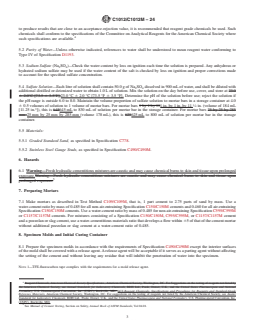
7.1 Make mortars as described in Test Method C109/C109M, that is, 1 part cement to 2.75 parts of sand by mass. Use a
water-cement ratio by mass of 0.485 for all non-air-entraining Specification C150/C150M cements and 0.460 for all air-entraining
Specification C150/C150M cements. Use a water-cement ratio by mass of 0.485 for non-air-entraining Specification C595/C595M
or C1157/C1157M cements. For mixtures consisting of a Specification C150/C150M, C595/C595M, or C1157/C1157M cement
and a pozzolan or slag cement, use a water-cementitious materials ratio that develops a flow within 65 of that of the cement mortar
without additional pozzolan or slag cement at a water-cement ratio of 0.485.
8. Specimen Molds and Initial Curing Container
8.1 Prepare the specimen molds in accordance with the requirements of Specification C490/C490M except the interior surfaces
of the mold shall be covered with a release agent. A release agent will be acceptable if it serves as a parting agent without affecting
the setting of the cement and without leaving any residue that will inhibit the penetration of water into the specimen.
NOTE 1—TFE-fluorocarbon tape complies with the requirements for a mold release agent.
Reagent Chemicals, American Chemical Society Specifications , American Chemical Society, Washington, DC. For Suggestions on the testing of reagents not listed by
the American Chemical Society, see Annual Standards for Laboratory Chemicals, BDH Ltd., Poole, Dorset, U.K., and the United States Pharmacopeia and National
Formulary, U.S. Pharmacopeial Convention, Inc. (USPC), Rockville, MD. ACS Reagent Chemicals, Specifications and Procedures for Reagents and Standard-Grade
Reference Materials, American Chemical Society, Washington, DC. For suggestions on the testing of reagents not listed by the American Chemical Society, see Analar
Standards for Laboratory Chemicals, BDH Ltd., Poole, Dorset, U.K., and the United States Pharmacopeia and National Formulary, U.S. Pharmacopeial Convention, Inc.
(USPC), Rockville, MD.
See Manual of Cement Testing, Section on Safety, Annual Book of ASTM Standards, Vol 04.01.
C1012/C1012M − 24
8.2 Prepare Curing Container:
8.2.1 Prior to molding the test specimen, prepare the initial curing container by placing risers on the bottom of the container to
elevate molds above the intended water level. Fill the container with preheated water at 35 6 3°C (95 6 5°F),35 °C 6 3 °C (95 °F
6 5 °F), making sure that the water does not exceed the top of the risers.
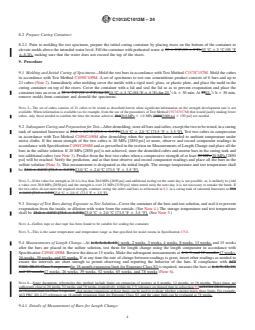
9. Procedure
9.1 Molding and Initial Curing of Specimens—Mold the test bars in accordance with Test Method C157/C157M. Mold the cubes
in accordance with Test Method C109/C109M. A set of specimens to test one cementitious product consists of 6 bars and up to
21 cubes (Note 2). Immediately after molding cover the molds with a rigid steel, glass, or plastic plate, and place the mold in the
curing container on top of the risers. Cover the container with a lid and seal the lid so as to prevent evaporation and place the
1 1
container into an oven at 35 6 3°C (95 6 5°F) for 2335 °C 6 3 °C (95 °F 6 5 °F) for 23 ⁄2 h 6 30 min. At 2323 ⁄2 h 6 30 min,
remove molds from container and demold the specimens.
NOTE 2—The set of cubes consists of 21 cubes to be tested as described herein when significant information on the strength development rate is not
available. When information is available (as for example, from the use of the procedures of Test Method C917/C917M) that would justify making fewer
cubes, only those needed to confirm the time the mortar achieves 20.020.0 MPa 6 1.0 MPa [3000[3000 psi 6 150 psi] are needed.
9.2 Subsequent Curing and Preparation for Test—After demolding, store all bars and cubes, except the two to be tested, in a curing
tank of saturated limewater at 23.0 6 2.0°C [73.5 6 3.5°F].23.0 °C 6 2.0 °C [73.5 °F 6 3.5 °F]. Test two cubes in compression
in accordance with Test Method C109/C109M after demolding when the specimens have cooled to ambient temperature under
moist cloths. If the mean strength of the two cubes is 20 MPa [2850 psi] or more, observe and record comparator readings in
accordance with Specification C490/C490M and as prescribed in the section on Measurements of Length Change and place all the
bars in the sulfate solution. If 20 MPa [2850 psi] is not achieved, store the demolded cubes and mortar bars in the curing tank and
test additional cubes (see Note 3). Predict from the first two cubes when a compressive strength of at least 20 MPa 20 MPa [2850
psi] will be reached. Verify the prediction, and at that time observe and record comparator readings and place all the bars in the
sulfate solution (Note 3). This measurement is designated as the initial length. The storage temperature and test temperature shall
be 23.0 6 2.0°C [73.5 6 3.5°F].23.0 °C 6 2.0 °C [73.5 °F 6 3.5 °F].
NOTE 3—If the value for strength at 24 h is less than 20.0 MPa [2850 psi] and additional testing on the same day is not possible, or, is unlikely to yield
a value over 20.0 MPa [2850 psi] and the strength is over 21 MPa [3150 psi] when tested early the next day, it is not necessary to remake the batch. If
the two cubes do not meet the required strength, continue curing the cubes and bars as referenced in 9.2. in a curing tank of saturated limewater at 23.0
6 2.0°C [73.5 6 3.5°F]23.0 °C 6 2.0 °C [73.5 °F 6 3.5 °F].
9.3 Storage of Test Bars during Exposure to Test Solution—Cover the container of the bars and test solution, and seal it to prevent
evaporation from the inside, or dilution with water from the outside. (See Note 4.) The storage temperature and test temperature
shall be 23.0 6 2.0°C [73.5 6 3.5°F].23.0 °C 6 2.0 °C [73.5 °F 6 3.5 °F]. (See Note 5.)
NOTE 4—Gaffers tape or duct tape has been found to be suitable for sealing the container.
NOTE 5—This is the same temperature and temperature range as that specified for moist rooms in Specification C511.
9.4 Measurements of Length Change—At 1, 2, 3, 4, 8, 13,1 week, 2 weeks, 3 weeks, 4 weeks, 8 weeks, 13 weeks, and 15 weeks
after the bars are placed in the sulfate solution, test them for length change using the length comparator in accordance with
Specification C490/C490M. Review the data at 15 weeks. Make the subsequent measurements at 4, 6, 9, and 12 months.17 weeks,
26 weeks, 39 weeks, and 52 weeks. If at any time the rate of change between readings is great, insert other readings as needed to
ensure the intervals are short enough to permit observing and reporting the behavior of the bars. If compliance with ACI
C201-2R-01 Class 3 exposure the 18-month expansion limit for Exposure Class S3 is required, measure the bars at 4, 6, 9, 12, 15,
and 18 months17 weeks, 26 weeks, 39 weeks, 52 weeks, 65 weeks, and 78 weeks (Note 6).
NOTE 6—Some documents referencing this method include limits on expansion of mortars at 6 months, 12 months, or 18 months. These times are
sufficiently close to 26 weeks, 52 weeks, and 78 weeks, respectively, within the 2 % tolerance on elapsed time in subsection 9.5ACI C201-2R-01 requires
an 18-month limit for Class 3 exposure., that mortar expansions at those times can be used to evaluate whether a mortar meets those limits. For example,
ACI PRC 201.2-23 references an 18-month expansion limit for Exposure Class S3, and the same limit can be evaluated at 78 weeks.
9.4.1 Details of Measurement of Bars for Length Change:
C1012/C1012M − 24
9.4.1.1 Clean the hole in the base of the comparator into which the gauge stud on the lower end of the bar fits (this hole tends
to collect water and sand and should be cleaned after every reading). Read and record the comparator indication of the length of
the reference bar. Take one bar out of immersion, blot the pins, put the bar in the comparator, read, and record the indication. Return
the bar to immersion and clean the hole in the base of the comparator. Take out the second bar and treat it in a like manner. Return
the second bar to immersion, record the reading, and clean the hole in the base of the comparator. Continue the procedure until
all bars have been read, returned to immersion, and the readings recorded, cleaning the hole in the bottom of the comparator each
time. After reading the last bar, clean the hole in the comparator base and read and record the reference-bar indication.
9.4.1.2 When the required strength of the mortar is achieved in accordance with 9.2, store the bars in fresh sulfate solution. At
subsequent readings for length change, proceed as described in 9.4.1.1; cleaning the socket in the base of the comparator before
reading the reference bar initially and after reading each mortar bar. Record reference bar and mortar bar readings. Read and record
the reference bar again after measurement of the last bar. Blot only around the pins (Note 7). Return each bar to the used sulfate
solution after reading. Discard the used solution after reading of the bars at only standard intervals: 1, 2, 3, 4, 8, 13, and 15 weeks
and 4, 6, 9, 12, 15, and 18 months. 1 week, 2 weeks, 3 weeks, 4 weeks, 8 weeks, 13 weeks, 15 weeks, 17 weeks, 26 weeks,
39 weeks, 52 weeks, 65 weeks, and 78 weeks. Rinse the container once with water, pouring out water and debris. Replace the frame
holding the bars in the container, fill the container with enough new sulfate solution to immerse bars, and secure the lid on the
container.
NOTE 7—The purpose of the minimal blotting of the pins and no blotting of the bars is to avoid drying and shrinkage of the bars. It has been observed
that if the pins are blotted, and the bar placed in the comparator and the dial read, and the bar is then wiped gently with a dry cloth, the bar will shrink
measurably. Therefore, drying should be minimized.
9.4.2 Examination of Specimens After Measuring Length Change—When the bars seem to have behaved in an unusual way or
when the test is part of a research study, test the specimens for warping by placing them on a plane surface so that the ends are
curved down and the maximum bowing measured. Note cracking (presence, location, type); also note surface deposits, mottling,
exudations (nature, thickness, type).
9.5 Tolerance on Time—All references to elapsed time in 9.4 are intended to have a tolerance of 62 %.
10. Calculation
10.1 Calculate the length change at any age as follows:
L 2 L
x i
Δ L5 ×100 (1)
L
g
L 2 L
x i
Δ L5 ×100 (1)
L
g
where:
ΔL = change in length at x age, %,
L = comparator reading of specimen at x age—reference bar comparator reading at x age,
x
L = initial comparator reading of specimen-reference bar comparator reading, at the same time, and
i
Lg = nominal gauge length, or 250 mm [10 in.] as applicable (see Practice C490/C490M).
L = nominal gauge length, or 250 mm [10 in.] as applicable (see Practice C490/C490M).
g
10.2 Calculate length change values for each bar to the nearest 0.001 % and report averages to the nearest 0.01 %.
11. Report
11.1 Report type of cement, and, if blending material is used, its identification and amount and whether cement and blending
material, if used, meet the applicable specifications. Report the initial comparator reading of each bar at the time of immersion in
sulfate solution; this is the base value for calculation of length changes. Report the subsequent length changes in percent of base
value to the nearest 0.001 % for individual bars and the nearest 0.01 % for averages. Comment on the visual condition of bars at
end of the test. With each report of mean length change of bars at a particular age, report number of bars (n), stand
...