

ASTM A451/A451M-20
(Specification)Standard Specification for Centrifugally Cast Austenitic Steel Pipe for High-Temperature Service
General Information
- Abstract
ABSTRACT
This specification covers the standard for centrifugally cast austenitic alloy steel pipe for use in high-temperature, corrosive, or nuclear pressure service. The pipe shall receive a heat treatment at the required temperature and holding time followed by quenching in water or rapid cool by other means. The pipe shall be machined on the inner and outer surfaces and shall conform to specified roughness value. Heat and product analysis shall be done to determine the chemical composition and shall conform to the required carbon, manganese, phosphorus, sulfur, silicon, nickel, chromium, molybdenum, columbium, tantalum, and nitrogen contents. Hydrostatic and tension tests shall be performed and shall conform to the required tensile strength, yield strength, and elongation.
SCOPE
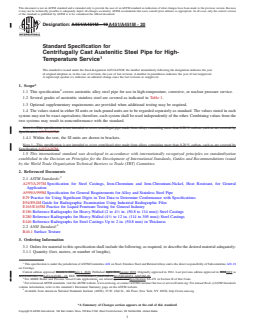
1.1 This specification2 covers austenitic alloy steel pipe for use in high-temperature, corrosive, or nuclear pressure service.
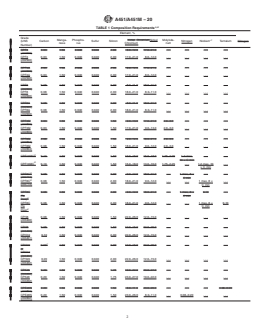
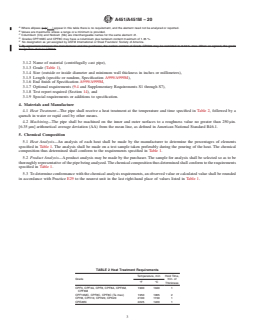
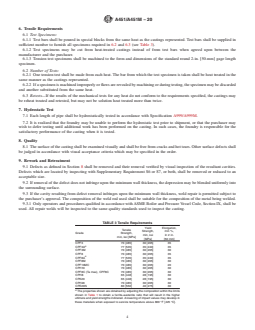
1.2 Several grades of austenitic stainless steel are covered as indicated in Table 1.
1.3 Optional supplementary requirements are provided when additional testing may be required.
1.4 The values stated in either SI units or inch-pound units are to be regarded separately as standard. The values stated in each system may not be exact equivalents; therefore, each system shall be used independently of the other. Combining values from the two systems may result in nonconformance with the standard.
1.4.1 Within the text, the SI units are shown in brackets.
Note 1: This specification is not intended to cover centrifugal pipe made from alloys containing more than 0.20 % carbon, such as are covered by Specification A297/A297M.
1.5 This international standard was developed in accordance with internationally recognized principles on standardization established in the Decision on Principles for the Development of International Standards, Guides and Recommendations issued by the World Trade Organization Technical Barriers to Trade (TBT) Committee.
- Status
- Published
- Publication Date
- 30-Jun-2020
- Technical Committee
- A01 - Steel, Stainless Steel and Related Alloys
- Drafting Committee
- A01.18 - Castings
Buy Documents
ASTM A451/A451M-20 - Standard Specification for Centrifugally Cast Austenitic Steel Pipe for High-Temperature Service
REDLINE ASTM A451/A451M-20 - Standard Specification for Centrifugally Cast Austenitic Steel Pipe for High-Temperature Service
Overview
ASTM A451/A451M-20 is the standard specification developed by ASTM International for centrifugally cast austenitic alloy steel pipe intended for use in high-temperature, corrosive, or nuclear pressure service. This standard outlines the requirements for material composition, mechanical properties, heat treatment, surface finish, and testing to ensure reliable performance in demanding industrial applications. The specification applies to a range of austenitic stainless steel grades produced using centrifugal casting processes, and prescribes both SI and inch-pound unit systems for dimensional tolerances and property values.
Key Topics
- Material Grades: Covers several grades of austenitic stainless steel, each with specific limits for elements such as carbon, manganese, phosphorus, sulfur, silicon, nickel, chromium, molybdenum, niobium (columbium), tantalum, and nitrogen.
- Manufacturing & Heat Treatment: Pipes must undergo heat treatment at specified temperatures and holding times, followed by water quenching or rapid cooling by other means, to achieve optimal mechanical properties.
- Surface Finish: Internal and external surfaces are to be machined to meet defined roughness values, ensuring a maximum average surface deviation.
- Mechanical & Chemical Testing:
- Chemical Composition Analysis: Heat and product analyses verify compliance with composition requirements.
- Mechanical Testing: Hydrostatic and tension (tensile strength, yield strength, elongation) tests are required for each heat.
- Additional Testing: Optional supplementary tests can include flattening, radiographic, and liquid penetrant examinations.
- Dimensional Tolerances: The specification details permissible variations in wall thickness and other critical dimensions.
- Product Identification: Each pipe must be legibly marked with manufacturer details, the ASTM designation, grade, and traceable heat or serial numbers.
Applications
The centrifugally cast austenitic steel pipes specified in ASTM A451/A451M-20 are engineered for use in environments demanding high resistance to heat, corrosion, and pressure. Major application areas include:
- Power Generation and Nuclear Plants: High-temperature steam piping, heat exchangers, and nuclear reactor pressure systems.
- Petrochemical and Chemical Processing: Pipes for transferring chemicals, acids, or other corrosive materials under pressure and elevated temperatures.
- Refineries and Industrial Furnaces: Furnace tubing, reformer tubes, transfer lines, or other components subjected to both high mechanical and thermal stresses.
- General Industrial Usage: Any facility requiring robust, corrosion-resistant piping for high-pressure or high-temperature service.
Related Standards
ASTM A451/A451M-20 references several other key international and national standards to ensure comprehensive quality:
- ASTM A297/A297M: For steel castings of higher carbon alloys not covered by A451/A451M.
- ASTM A999/A999M: General requirements for alloy and stainless steel pipes, including dimensions and tolerances.
- ASTM E29, E94/E94M, E165/E165M, E186, E280, E446: Standards for testing practices and radiographic or liquid penetrant examination methods.
- ANSI B46.1: Defines surface texture requirements for machined pipe surfaces.
- ASME Boiler and Pressure Vessel Code, SA-451: For applications involving boiler and pressure vessel codes, reference to the equivalent ASME specification is advised.
Keywords: ASTM A451, centrifugally cast austenitic steel pipe, high-temperature service, stainless steel pipe, pressure service, heat treatment, mechanical properties, corrosion resistance, nuclear piping, industrial standards, ASTM International
Relations
- Effective Date
- 01-Jul-2020
- Effective Date
- 01-Sep-2019
- Effective Date
- 01-Sep-2017
- Effective Date
- 01-May-2017
- Effective Date
- 01-Sep-2016
- Effective Date
- 01-Dec-2015
- Effective Date
- 01-May-2014
- Effective Date
- 01-Apr-2013
- Effective Date
- 01-May-2012
- Effective Date
- 15-May-2011
- Effective Date
- 01-May-2010
- Effective Date
- 01-Jan-2010
- Refers
ASTM E446-10 - Standard Reference Radiographs for Steel Castings Up to 2 in. (50.8 mm) in Thickness - Effective Date
- 01-Jan-2010
- Effective Date
- 01-Oct-2009
- Effective Date
- 01-Nov-2008
Buy Documents
ASTM A451/A451M-20 - Standard Specification for Centrifugally Cast Austenitic Steel Pipe for High-Temperature Service
REDLINE ASTM A451/A451M-20 - Standard Specification for Centrifugally Cast Austenitic Steel Pipe for High-Temperature Service
Get Certified
Connect with accredited certification bodies for this standard

Element Materials Technology
Materials testing and product certification.

Inštitut za kovinske materiale in tehnologije
Institute of Metals and Technology. Materials testing, metallurgical analysis, NDT.
Sponsored listings
Frequently Asked Questions
ASTM A451/A451M-20 is a technical specification published by ASTM International. Its full title is "Standard Specification for Centrifugally Cast Austenitic Steel Pipe for High-Temperature Service". This standard covers: ABSTRACT This specification covers the standard for centrifugally cast austenitic alloy steel pipe for use in high-temperature, corrosive, or nuclear pressure service. The pipe shall receive a heat treatment at the required temperature and holding time followed by quenching in water or rapid cool by other means. The pipe shall be machined on the inner and outer surfaces and shall conform to specified roughness value. Heat and product analysis shall be done to determine the chemical composition and shall conform to the required carbon, manganese, phosphorus, sulfur, silicon, nickel, chromium, molybdenum, columbium, tantalum, and nitrogen contents. Hydrostatic and tension tests shall be performed and shall conform to the required tensile strength, yield strength, and elongation. SCOPE 1.1 This specification2 covers austenitic alloy steel pipe for use in high-temperature, corrosive, or nuclear pressure service. 1.2 Several grades of austenitic stainless steel are covered as indicated in Table 1. 1.3 Optional supplementary requirements are provided when additional testing may be required. 1.4 The values stated in either SI units or inch-pound units are to be regarded separately as standard. The values stated in each system may not be exact equivalents; therefore, each system shall be used independently of the other. Combining values from the two systems may result in nonconformance with the standard. 1.4.1 Within the text, the SI units are shown in brackets. Note 1: This specification is not intended to cover centrifugal pipe made from alloys containing more than 0.20 % carbon, such as are covered by Specification A297/A297M. 1.5 This international standard was developed in accordance with internationally recognized principles on standardization established in the Decision on Principles for the Development of International Standards, Guides and Recommendations issued by the World Trade Organization Technical Barriers to Trade (TBT) Committee.
ABSTRACT This specification covers the standard for centrifugally cast austenitic alloy steel pipe for use in high-temperature, corrosive, or nuclear pressure service. The pipe shall receive a heat treatment at the required temperature and holding time followed by quenching in water or rapid cool by other means. The pipe shall be machined on the inner and outer surfaces and shall conform to specified roughness value. Heat and product analysis shall be done to determine the chemical composition and shall conform to the required carbon, manganese, phosphorus, sulfur, silicon, nickel, chromium, molybdenum, columbium, tantalum, and nitrogen contents. Hydrostatic and tension tests shall be performed and shall conform to the required tensile strength, yield strength, and elongation. SCOPE 1.1 This specification2 covers austenitic alloy steel pipe for use in high-temperature, corrosive, or nuclear pressure service. 1.2 Several grades of austenitic stainless steel are covered as indicated in Table 1. 1.3 Optional supplementary requirements are provided when additional testing may be required. 1.4 The values stated in either SI units or inch-pound units are to be regarded separately as standard. The values stated in each system may not be exact equivalents; therefore, each system shall be used independently of the other. Combining values from the two systems may result in nonconformance with the standard. 1.4.1 Within the text, the SI units are shown in brackets. Note 1: This specification is not intended to cover centrifugal pipe made from alloys containing more than 0.20 % carbon, such as are covered by Specification A297/A297M. 1.5 This international standard was developed in accordance with internationally recognized principles on standardization established in the Decision on Principles for the Development of International Standards, Guides and Recommendations issued by the World Trade Organization Technical Barriers to Trade (TBT) Committee.
ASTM A451/A451M-20 is classified under the following ICS (International Classification for Standards) categories: 77.140.80 - Iron and steel castings. The ICS classification helps identify the subject area and facilitates finding related standards.
ASTM A451/A451M-20 has the following relationships with other standards: It is inter standard links to ASTM A451/A451M-19, ASTM A297/A297M-19, ASTM A999/A999M-17, ASTM A297/A297M-17, ASTM A999/A999M-16, ASTM A999/A999M-15, ASTM A297/A297M-14, ASTM A999/A999M-13, ASTM A999/A999M-12, ASTM A999/A999M-11, ASTM A297/A297M-10, ASTM E280-10, ASTM E446-10, ASTM A999/A999M-04a(2009), ASTM A297/A297M-08a. Understanding these relationships helps ensure you are using the most current and applicable version of the standard.
ASTM A451/A451M-20 is available in PDF format for immediate download after purchase. The document can be added to your cart and obtained through the secure checkout process. Digital delivery ensures instant access to the complete standard document.
Standards Content (Sample)
This international standard was developed in accordance with internationally recognized principles on standardization established in the Decision on Principles for the
Development of International Standards, Guides and Recommendations issued by the World Trade Organization Technical Barriers to Trade (TBT) Committee.
Designation:A451/A451M −20
Standard Specification for
Centrifugally Cast Austenitic Steel Pipe for High-
Temperature Service
This standard is issued under the fixed designationA451/A451M; the number immediately following the designation indicates the year
of original adoption or, in the case of revision, the year of last revision. A number in parentheses indicates the year of last reapproval.
A superscript epsilon (´) indicates an editorial change since the last revision or reapproval.
1. Scope* A999/A999M Specification for General Requirements for
2 Alloy and Stainless Steel Pipe
1.1 This specification covers austenitic alloy steel pipe for
E29 Practice for Using Significant Digits in Test Data to
use in high-temperature, corrosive, or nuclear pressure service.
Determine Conformance with Specifications
1.2 Severalgradesofausteniticstainlesssteelarecoveredas
E94/E94M Guide for Radiographic Examination Using In-
indicated in Table 1.
dustrial Radiographic Film
1.3 Optional supplementary requirements are provided E165/E165M Practice for Liquid Penetrant Testing for Gen-
eral Industry
when additional testing may be required.
E186 Reference Radiographs for Heavy-Walled (2 to 4 ⁄2 in.
1.4 The values stated in either SI units or inch-pound units
(50.8 to 114 mm)) Steel Castings
are to be regarded separately as standard. The values stated in
E280 Reference Radiographs for Heavy-Walled (4 ⁄2 to 12
each system may not be exact equivalents; therefore, each
in. (114 to 305 mm)) Steel Castings
system shall be used independently of the other. Combining
E446 Reference Radiographs for Steel Castings Up to 2 in.
values from the two systems may result in nonconformance
(50.8 mm) in Thickness
with the standard.
2.2 ANSI Standard:
1.4.1 Within the text, the SI units are shown in brackets.
B46.1 Surface Texture
NOTE 1—This specification is not intended to cover centrifugal pipe
made from alloys containing more than 0.20 % carbon, such as are
3. Ordering Information
covered by Specification A297/A297M.
1.5 This international standard was developed in accor- 3.1 Orders for material to this specification shall include the
following, as required, to describe the desired material ad-
dance with internationally recognized principles on standard-
ization established in the Decision on Principles for the equately:
Development of International Standards, Guides and Recom- 3.1.1 Quantity (feet, meters, or number of lengths),
mendations issued by the World Trade Organization Technical 3.1.2 Name of material (centrifugally cast pipe),
Barriers to Trade (TBT) Committee. 3.1.3 Grade (Table 1),
3.1.4 Size (outside or inside diameter and minimum wall
thickness in inches or millimeters),
2. Referenced Documents
3.1.5 Length (specific or random, Specification A999/
2.1 ASTM Standards:
A999M),
A297/A297M Specification for Steel Castings, Iron-
3.1.6 End finish of Specification A999/A999M,
Chromium and Iron-Chromium-Nickel, Heat Resistant,
3.1.7 Optional requirements (9.4 and Supplementary Re-
for General Application
quirements S1 through S7),
3.1.8 Test report required (Section 14), and
3.1.9 Special requirements or additions to specification.
This specification is under the jurisdiction ofASTM Committee A01 on Steel,
Stainless Steel and Related Alloys and is the direct responsibility of Subcommittee
4. Materials and Manufacture
A01.18 on Castings.
Current edition approved July 1, 2020. Published August 2020. Originally
4.1 HeatTreatment—The pipe shall receive a heat treatment
approved in 1961. Last previous edition approved in 2019 as A451/A451M – 19.
at the temperature and time specified in Table 2, followed by a
DOI: 10.1520/A0451_A0451M-20.
quench in water or rapid cool by other means.
For ASME Boiler and Pressure Vessel Code applications, see related Specifi-
cation SA-451 in Section II of that Code.
For referenced ASTM standards, visit the ASTM website, www.astm.org, or
contact ASTM Customer Service at service@astm.org. For Annual Book of ASTM
Standards volume information, refer to the standard’s Document Summary page on Available fromAmerican National Standards Institute (ANSI), 25 W. 43rd St.,
the ASTM website. 4th Floor, New York, NY 10036, http://www.ansi.org.
*A Summary of Changes section appears at the end of this standard
Copyright © ASTM International, 100 Barr Harbor Drive, PO Box C700, West Conshohocken, PA 19428-2959. United States
A451/A451M−20
A,B
TABLE 1 Composition Requirements
Element, %
Grade
Manga- Phospho- Molybde-
C
(UNS Carbon Sulfur Silicon Chromium Nickel Nitrogen Niobium Tantalum
nese rus num
Number)
CPF3 0.03 1.50 0.040 0.040 2.00 17.0–21.0 8.0–12.0 . . . . . . . . . . . .
(J92500)
CPF3A 0.03 1.50 0.040 0.040 2.00 17.0–21.0 8.0–12.0 . . . . . . . . . . . .
(J92500)
CPF8 0.08 1.50 0.040 0.040 2.00 18.0–21.0 8.0–11.0 . . . . . . . . . . . .
(J92600)
CPF8A 0.08 1.50 0.040 0.040 2.00 18.0–21.0 8.0–11.0 . . . . . . . . . . . .
(J92600)
CPF3M 0.03 1.50 0.040 0.040 1.50 17.0–21.0 9.0–13.0 2.0–3.0 . . . . . . . . .
(J92800)
CPF8M 0.08 1.50 0.040 0.040 1.50 18.0–21.0 9.0–12.0 2.0–3.0 . . . . . . . . .
(J92804)
D
CPF10MC 0.10 1.50 0.040 0.040 1.50 15.0–18.0 13.0–16.0 1.75–2.25 . . . 1.2 max, 10 .
×Cmin
D
CPF8C 0.08 1.50 0.040 0.040 2.00 18.0–21.0 9.0–12.0 . . . . . . 1 max, 8 × .
(J92710)
Cmin
CPF8C 0.08 1.50 0.040 0.040 2.00 18.0–21.0 9.0–12.0 . . . . . . 1 max, 8 × 0.10
(Ta Cmin
E
max)
CPH8 0.08 1.50 0.040 0.040 1.50 22.0–26.0 12.0–15.0 . . . . . . . . . . . .
(J93400)
CPH10 0.10 1.50 0.040 0.040 2.00 22.0–26.0 12.0–15.0 . . . . . . . . . . . .
(J93401)
CPH20 0.20 1.50 0.040 0.040 2.00 22.0–26.0 12.0–15.0 . . . . . . . . . . . .
(J93402)
CPK20 0.20 1.50 0.040 0.040 1.75 23.0–27.0 19.0–22.0 . . . . . . . . . . . .
(J94202)
CPE20N 0.20 1.50 0.040 0.040 1.50 23.0–26.0 8.0–11.0 . . . 0.08–0.20 . . . . . .
(J92802)
A
Where ellipses (. . .) appear in this table there is no requirement, and the element need not be analyzed or reported.
B
Values are maximums unless a range or a minimum is provided.
C
Columbium (Cb) and Niobium (Nb) are interchangeable names for the same element 41.
D
Grades CPF10MC and CPF8C may have a columbium plus tantalum content maximum of 1.35 %.
E
No designation as yet assigned by ASTM International or Steel Founders’ Society of America.
TABLE 2 Heat Treatment Requirements
specified in Table 1. The analysis shall be made on a test
Temperature, min Hold Time,
sample taken preferably during the pouring of the heat. The
Grade h/in. of
chemical composition thus determined shall conform to the
°F °C
Thickness
requirements specified in Table 1.
CPF3, CPF3A, CPF8, CPF8A, CPF3M, 1900 1040 1
CPF8M
5.2 Product Analysis—A product analysis may be made by
CPF10MC, CPF8C, CPF8C (Ta max) 1950 1065 2
CPH8, CPH10, CPH20, CPK20 2100 1150 1 thepurchaser.Thesampleforanalysisshallbeselectedsoasto
CPE20N 2225 1220 1
be thoroughly representative of the pipe being analyzed. The
chemical composition thus determined shall conform to the
requirements specified in Table 1.
4.2 Machining—The pipe shall be machined on the inner
andoutersurfacestoaroughnessvaluenogreaterthan250 µin.
5.3 To determine conformance with the chemical analysis
[6.35 µm] arithmetical average deviation (AA) from the mean
requirements, an observed value or calculated value shall be
line, as defined in American National Standard B46.1.
rounded in accordance with Practice E29 to the nearest unit in
5. Chemical Composition
the last right-hand place of values listed in Table 1.
5.1 Heat Analysis—An analysis of each heat shall be made
by the manufacturer to determine the percentages of elements
A451/A451M−20
6. Tensile Requirements defects shall be judged in accordance with visual acceptance
criteria which may be specified in the order.
6.1 Test Specimens:
6.1.1 Test bars shall be poured in special blocks from the
9. Rework and Retreatment
same heat as the castings represented. Test bars shall be
supplied in sufficient number to furnish all specimens required
9.1 Defects as defined in Section 8 shall be removed and
in 6.2 and 6.3 (see Table 3).
their removal verified by visual inspection of the resultant
6.1.2 Test specimens may be cut from heat-treated castings
cavities. Defects which are located by inspecting with Supple-
instead of from test bars when agreed upon between the
mentary Requirement S6 or S7, or both, shall be removed or
manufacturer and the purchaser.
reduced to an acceptable size.
6.1.3 Tension test specimens shall be machined to the form
9.2 If removal of the defect does not infringe upon the
and dimensions of the standard round 2-in. [50-mm] gage
minimum wall thickness, the depression may be blended
length specimen.
uniformly into the surrounding surface.
6.2 Number of Tests:
9.3 If the cavity resulting from defect removal infringes
6.2.1 Onetensiontestshallbemadefromeachheat.Thebar
upon the minimum wall thickness, weld repair is permitte
...
This document is not an ASTM standard and is intended only to provide the user of an ASTM standard an indication of what changes have been made to the previous version. Because
it may not be technically possible to adequately depict all changes accurately, ASTM recommends that users consult prior editions as appropriate. In all cases only the current version
of the standard as published by ASTM is to be considered the official document.
Designation: A451/A451M − 19 A451/A451M − 20
Standard Specification for
Centrifugally Cast Austenitic Steel Pipe for High-
Temperature Service
This standard is issued under the fixed designation A451/A451M; the number immediately following the designation indicates the year
of original adoption or, in the case of revision, the year of last revision. A number in parentheses indicates the year of last reapproval.
A superscript epsilon (´) indicates an editorial change since the last revision or reapproval.
1. Scope*
1.1 This specification covers austenitic alloy steel pipe for use in high-temperature, corrosive, or nuclear pressure service.
1.2 Several grades of austenitic stainless steel are covered as indicated in Table 1.
1.3 Optional supplementary requirements are provided when additional testing may be required.
1.4 The values stated in either SI units or inch-pound units are to be regarded separately as standard. The values stated in each
system may not be exact equivalents; therefore, each system shall be used independently of the other. Combining values from the
two systems may result in nonconformance with the standard.
NOTE 1—This specification is not intended to cover centrifugal pipe made from alloys containing more than 0.20 % carbon, such as are covered by
Specification A297/A297M.
1.4.1 Within the text, the SI units are shown in brackets.
NOTE 1—This specification is not intended to cover centrifugal pipe made from alloys containing more than 0.20 % carbon, such as are covered by
Specification A297/A297M.
1.5 This international standard was developed in accordance with internationally recognized principles on standardization
established in the Decision on Principles for the Development of International Standards, Guides and Recommendations issued
by the World Trade Organization Technical Barriers to Trade (TBT) Committee.
2. Referenced Documents
2.1 ASTM Standards:
A297/A297M Specification for Steel Castings, Iron-Chromium and Iron-Chromium-Nickel, Heat Resistant, for General
Application
A999/A999M Specification for General Requirements for Alloy and Stainless Steel Pipe
E29 Practice for Using Significant Digits in Test Data to Determine Conformance with Specifications
E94/E94M Guide for Radiographic Examination Using Industrial Radiographic Film
E165/E165M Practice for Liquid Penetrant Testing for General Industry
E186 Reference Radiographs for Heavy-Walled (2 to 4 ⁄2 in. (50.8 to 114 mm)) Steel Castings
E280 Reference Radiographs for Heavy-Walled (4 ⁄2 to 12 in. (114 to 305 mm)) Steel Castings
E446 Reference Radiographs for Steel Castings Up to 2 in. (50.8 mm) in Thickness
2.2 ANSI Standard:
B46.1 Surface Texture
3. Ordering Information
3.1 Orders for material to this specification shall include the following, as required, to describe the desired material adequately:
3.1.1 Quantity (feet, meters, or number of lengths),
This specification is under the jurisdiction of ASTM Committee A01 on Steel, Stainless Steel and Related Alloys and is the direct responsibility of Subcommittee A01.18
on Castings.
Current edition approved March 1, 2019July 1, 2020. Published April 2019August 2020. Originally approved in 1961. Last previous edition approved in 20142019 as
A451/A451M – 14.A451/A451M – 19. DOI: 10.1520/A0451_A0451M-19.10.1520/A0451_A0451M-20.
For ASME Boiler and Pressure Vessel Code applications, see related specificationSpecification SA-451 in Section II of that Code.
For referenced ASTM standards, visit the ASTM website, www.astm.org, or contact ASTM Customer Service at service@astm.org. For Annual Book of ASTM Standards
volume information, refer to the standard’s Document Summary page on the ASTM website.
Available from American National Standards Institute (ANSI), 25 W. 43rd St., 4th Floor, New York, NY 10036, http://www.ansi.org.
*A Summary of Changes section appears at the end of this standard
Copyright © ASTM International, 100 Barr Harbor Drive, PO Box C700, West Conshohocken, PA 19428-2959. United States
A451/A451M − 20
A,B
TABLE 1 Composition Requirements
Element, %
Grade
Manga- Phospho- Nickel ChromiumNickel Molybde-
C
(UNS Carbon Sulfur Silicon Nitrogen Niobium Tantalum Nitrogen
nese rus Chromium num
Number)
CPF3 0.03 1.50 0.040 0.040 2.00 8.0–12.0 17.0–21.0 . . . . . . . . . . . .
(J92500)
CPF3 0.03 1.50 0.040 0.040 2.00 17.0–21.0 8.0–12.0 . . . . . . . . . . . .
(J92500)
CPF3A 0.03 1.50 0.040 0.040 2.00 8.0–12.0 17.0–21.0 . . . . . . . . . . . .
(J92500)
CPF3A 0.03 1.50 0.040 0.040 2.00 17.0–21.0 8.0–12.0 . . . . . . . . . . . .
(J92500)
CPF8 0.08 1.50 0.040 0.040 2.00 8.0–11.0 18.0–21.0 . . . . . . . . . . . .
(J92600)
CPF8 0.08 1.50 0.040 0.040 2.00 18.0–21.0 8.0–11.0 . . . . . . . . . . . .
(J92600)
CPF8A 0.08 1.50 0.040 0.040 2.00 8.0–11.0 18.0–21.0 . . . . . . . . . . . .
(J92600)
CPF8A 0.08 1.50 0.040 0.040 2.00 18.0–21.0 8.0–11.0 . . . . . . . . . . . .
(J92600)
CPF3M 0.03 1.50 0.040 0.040 1.50 9.0–13.0 17.0–21.0 2.0–3.0 . . . . . . . . .
(J92800)
CPF3M 0.03 1.50 0.040 0.040 1.50 17.0–21.0 9.0–13.0 2.0–3.0 . . . . . . . . .
(J92800)
CPF8M 0.08 1.50 0.040 0.040 1.50 9.0–12.0 18.0–21.0 2.0–3.0 . . . . . . . . .
(J92804)
CPF8M 0.08 1.50 0.040 0.040 1.50 18.0–21.0 9.0–12.0 2.0–3.0 . . . . . . . . .
(J92804)
D
CPF10MC 0.10 1.50 0.040 0.040 1.50 13.0–16.0 15.0–18.0 1.75–2.25 1.2 max, . . . . . .
10 × C min
D
CPF10MC 0.10 1.50 0.040 0.040 1.50 15.0–18.0 13.0–16.0 1.75–2.25 . . . 1.2 max, 10 . . .
× C min
D
CPF8C 0.08 1.50 0.040 0.040 2.00 9.0–12.0 18.0–21.0 . . . 1 max, 8 × . . . . . .
(J92710)
C min
D
CPF8C 0.08 1.50 0.040 0.040 2.00 18.0–21.0 9.0–12.0 . . . . . . 1 max, 8 × . . .
(J92710)
C min
CPF8C 0.08 1.50 0.040 0.040 2.00 9.0–12.0 18.0–21.0 . . . 1 max, 8 × 0.10 . . .
(Ta C min
E
max)
CPF8C 0.08 1.50 0.040 0.040 2.00 18.0–21.0 9.0–12.0 . . . . . . 1 max, 8 × 0.10
(Ta C min
E
max)
CPH8 0.08 1.50 0.040 0.040 1.50 22.0–26.0 12.0–15.0 . . . . . . . . . . . .
(J93400)
CPH8 0.08 1.50 0.040 0.040 1.50 12.0–15.0 22.0–26.0 . . . . . . . . . . . .
(J93400)
CPH10 0.10 1.50 0.040 0.040 2.00 22.0–26.0 12.0–15.0 . . . . . . . . . . . .
(J93401)
F
CPH20 0.20 1.50 0.040 0.040 2.00 12.0–15.0 22.0–26.0 . . . . . . . . . . . .
or
CPH10
(J93402)
CPH20 0.20 1.50 0.040 0.040 2.00 22.0–26.0 12.0–15.0 . . . . . . . . . . . .
(J93402)
CPK20 0.20 1.50 0.040 0.040 1.75 19.0–22.0 23.0–27.0 . . . . . . . . . . . .
(J94202)
CPK20 0.20 1.50 0.040 0.040 1.75 23.0–27.0 19.0–22.0 . . . . . . . . . . . .
(J94202)
CPE20N 0.20 1.50 0.040 0.040 1.50 8.0–11.0 23.0–26.0 . . . . . . . . . 0.08–0.20
(J92802)
CPE20N 0.20 1.50 0.040 0.040 1.50 23.0–26.0 8.0–11.0 . . . 0.08–0.20 . . . . . .
(J92802)
A451/A451M − 20
A
Where ellipses (.) (. . .) appear in this table there is no requirement, and the element need not be analyzed or reported.
B
Values are maximums unless a range or a minimum is provided.
C
Columbium (Cb) and Niobium (Nb) are interchangeable names for the same element 41.
D
Grades CPF10MC and CPF8C may have a columbium plus tantalum content maximum of 1.35 %.
E
No designation as yet assigned by ASTM International or Steel Founders’ Society of America.
F
By agreement between the manufacturer and the purchaser, the carbon content of Grade CPH20 may be restricted to 0.10 % max. When so agreed, the grade
designation shall be CPH10.
3.1.2 Name of material (centrifugally cast pipe),
3.1.3 Grade (Table 1),
3.1.4 Size (outside or inside diameter and minimum wall thickness in inches or millimeters),
3.1.5 Length (specific or random, Specification A999/A999M),
3.1.6 End finish of Specification A999/A999M,
3.1.7 Optional requirements (9.4 and Supplementary Requirements S1 through S7),
3.1.8 Test report required (Section 14), and
3.1.9 Special requirements or additions to specification.
4. Materials and Manufacture
4.1 Heat Treatment—The pipe shall receive a heat treatment at the temperature and time specified in Table 2, followed by a
quench in water or rapid cool by other means.
4.2 Machining—The pipe shall be machined on the inner and outer surfaces to a roughness value no greater than 250 μin.
[6.35 μm] arithmetical average deviation (AA) from the mean line, as defined in American National Standard B46.1.
5. Chemical Composition
5.1 Heat Analysis—An analysis of each heat shall be made by the manufacturer to determine the percentages of elements
specified in Table 1. The analysis shall be made on a test sample taken preferably during the pouring of the heat. The chemical
composition thus determined shall conform to the requirements specified in Table 1.
5.2 Product Analysis—A product analysis may be made by the purchaser. The sample for analysis shall be selected so as to be
thoroughly representative of the pipe being analyzed. The chemical composition thus determined shall conform to the requirements
specified in Table 1.
5.3 To determine conformance with the chemical analysis requirements, an observed value or calculated value shall be rounded
in accordance with Practice E29 to the nearest unit in the last right-hand place of values listed in Table 1.
TABLE 2 Heat Treatment Requirements
Temperature, min Hold Time,
Grade h/in. of
°F °C
Thickness
CPF3, CPF3A, CPF8, CPF8A, CPF3M, 1900 1040 1
CPF8M
CPF10MC, CPF8C, CPF8C (Ta max) 1950 1065 2
CPH8, CPH10, CPH20, CPK20 2100 1150 1
CPE20N 2225 1220 1
A451/A451M − 20
6. Tensile Requirements
6.1 Test Specimens:
6.1.1 Test bars shall be poured in special blocks from the same heat as the castings represented. Test bars shall be supplied in
sufficient number to furnish all specimens required in 6.2 and 6.3 (see Table 3).
6.1.2 Test specimens may be cut from heat-treated castings instead of from test bars when agreed upon between the
manufacturer and the purchaser.
6.1.3 Tension test specimens shall be machined to the form and dimensions of the standard round 2-in. [50-mm] gage length
specimen.
6.2 Number of Tests:
6.2.1 One tension test shall be made from each heat. The bar from which the test specimen
...