


ASTM C1116/C1116M-10a(2015)
(Specification)Standard Specification for Fiber-Reinforced Concrete
Standard Specification for Fiber-Reinforced Concrete
ABSTRACT
This specification covers all forms of fiber-reinforced concrete that are delivered to a purchaser with the ingredients uniformly mixed. This specification may also apply to fiber-reinforced concrete intended for shotcreting by the dry-mix process when sampling and testing is possible at the point of placement. It, however, does not cover the placement, consolidation, curing, or protection of the fiber-reinforced concrete after delivery to the purchaser. Materials are classified according to the type of fiber incorporated, which are: Type I, steel fiber-reinforced concrete that contains stainless, alloy, or carbon steel fibers; Type II, glass fiber-reinforced concrete that contains alkali-resistant glass fibers; Type III, synthetic fiber-reinforced concrete that contains synthetic fibers; and Type IV, natural fiber-reinforced concrete that contains cellulose fibers. The fiber-reinforced concretes shall be furnish either by batch mixing or continuous mixing, and shall be free of fiber balls when delivered to the point designated by the purchaser. Tolerances, acceptance criteria, and performance requirements for workability and air content are discussed thoroughly.
SCOPE
1.1 This specification covers all forms of fiber-reinforced concrete that are delivered to a purchaser with the ingredients uniformly mixed, and that can be sampled and tested at the point of delivery. It does not cover the placement, consolidation, curing, or protection of the fiber-reinforced concrete after delivery to the purchaser.
1.2 Certain sections of this specification are also applicable to fiber-reinforced concrete intended for shotcreting by the dry-mix process when sampling and testing of concrete is possible only at the point of placement. In this case, the sections dealing with batching plant, mixing equipment, mixing and delivery, and measurement of workability and air content, are not applicable.
1.3 This specification does not cover thin-section glass fiber-reinforced concrete manufactured by the spray-up process that is under the jurisdiction of ASTM Subcommittee C27.40.
1.4 The values stated in either SI units or inch-pound units are to be regarded separately as standard. The values stated in each system may not be exact equivalents; therefore, each system shall be used independently of the other. Combining values from the two systems may result in non-conformance with the standard.
1.5 The following precautionary statement pertains only to the test method portion, Sections 15 and 18, of this specification: This standard does not purport to address all of the safety concerns, if any, associated with its use. It is the responsibility of the user of this standard to establish appropriate safety and health practices and determine the applicability of regulatory limitations prior to use.
General Information
Buy Standard
Standards Content (Sample)
NOTICE: This standard has either been superseded and replaced by a new version or withdrawn.
Contact ASTM International (www.astm.org) for the latest information
Designation: C1116/C1116M − 10a (Reapproved 2015)
Standard Specification for
Fiber-Reinforced Concrete
This standard is issued under the fixed designation C1116/C1116M; the number immediately following the designation indicates the year
of original adoption or, in the case of revision, the year of last revision. A number in parentheses indicates the year of last reapproval.
A superscript epsilon (´) indicates an editorial change since the last revision or reapproval.
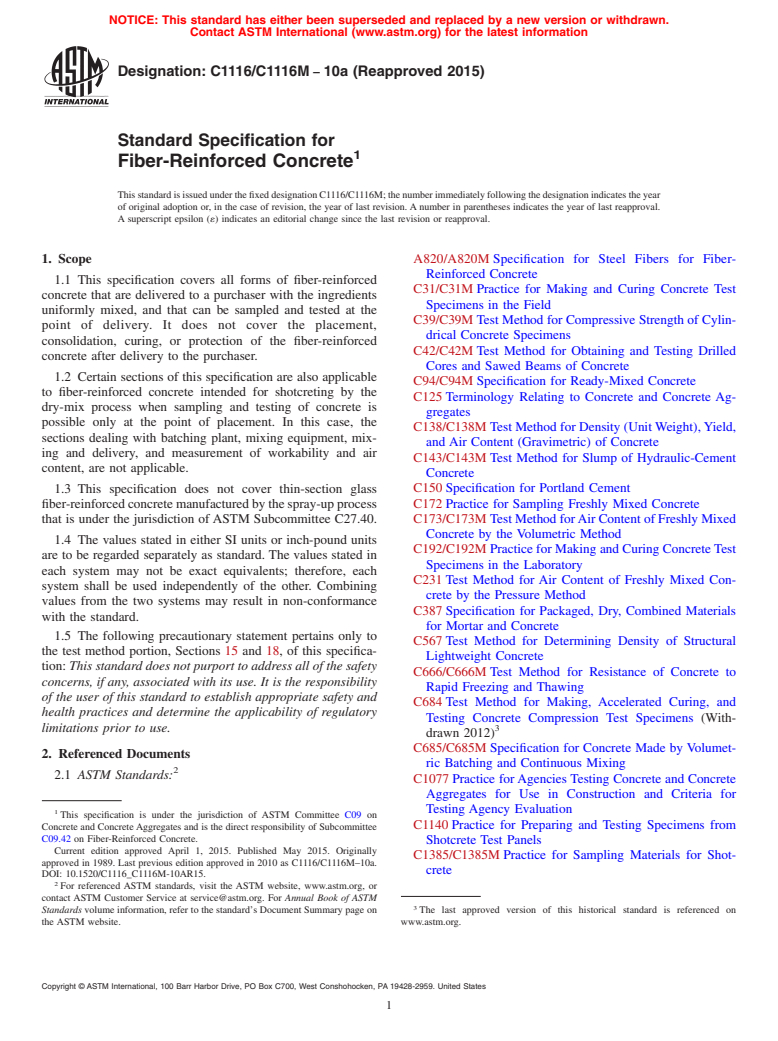
1. Scope A820/A820M Specification for Steel Fibers for Fiber-
Reinforced Concrete
1.1 This specification covers all forms of fiber-reinforced
C31/C31M Practice for Making and Curing Concrete Test
concrete that are delivered to a purchaser with the ingredients
Specimens in the Field
uniformly mixed, and that can be sampled and tested at the
C39/C39M Test Method for Compressive Strength of Cylin-
point of delivery. It does not cover the placement,
drical Concrete Specimens
consolidation, curing, or protection of the fiber-reinforced
C42/C42M Test Method for Obtaining and Testing Drilled
concrete after delivery to the purchaser.
Cores and Sawed Beams of Concrete
1.2 Certain sections of this specification are also applicable
C94/C94M Specification for Ready-Mixed Concrete
to fiber-reinforced concrete intended for shotcreting by the
C125 Terminology Relating to Concrete and Concrete Ag-
dry-mix process when sampling and testing of concrete is
gregates
possible only at the point of placement. In this case, the
C138/C138M Test Method for Density (Unit Weight), Yield,
sections dealing with batching plant, mixing equipment, mix-
and Air Content (Gravimetric) of Concrete
ing and delivery, and measurement of workability and air
C143/C143M Test Method for Slump of Hydraulic-Cement
content, are not applicable.
Concrete
1.3 This specification does not cover thin-section glass C150 Specification for Portland Cement
C172 Practice for Sampling Freshly Mixed Concrete
fiber-reinforced concrete manufactured by the spray-up process
that is under the jurisdiction of ASTM Subcommittee C27.40. C173/C173M Test Method for Air Content of Freshly Mixed
Concrete by the Volumetric Method
1.4 The values stated in either SI units or inch-pound units
C192/C192M Practice for Making and Curing Concrete Test
are to be regarded separately as standard. The values stated in
Specimens in the Laboratory
each system may not be exact equivalents; therefore, each
C231 Test Method for Air Content of Freshly Mixed Con-
system shall be used independently of the other. Combining
crete by the Pressure Method
values from the two systems may result in non-conformance
C387 Specification for Packaged, Dry, Combined Materials
with the standard.
for Mortar and Concrete
1.5 The following precautionary statement pertains only to
C567 Test Method for Determining Density of Structural
the test method portion, Sections 15 and 18, of this specifica-
Lightweight Concrete
tion: This standard does not purport to address all of the safety
C666/C666M Test Method for Resistance of Concrete to
concerns, if any, associated with its use. It is the responsibility
Rapid Freezing and Thawing
of the user of this standard to establish appropriate safety and
C684 Test Method for Making, Accelerated Curing, and
health practices and determine the applicability of regulatory
Testing Concrete Compression Test Specimens (With-
limitations prior to use. 3
drawn 2012)
C685/C685M Specification for Concrete Made by Volumet-
2. Referenced Documents
ric Batching and Continuous Mixing
2.1 ASTM Standards:
C1077 Practice for Agencies Testing Concrete and Concrete
Aggregates for Use in Construction and Criteria for
1 Testing Agency Evaluation
This specification is under the jurisdiction of ASTM Committee C09 on
C1140 Practice for Preparing and Testing Specimens from
Concrete and Concrete Aggregates and is the direct responsibility of Subcommittee
C09.42 on Fiber-Reinforced Concrete.
Shotcrete Test Panels
Current edition approved April 1, 2015. Published May 2015. Originally
C1385/C1385M Practice for Sampling Materials for Shot-
approved in 1989. Last previous edition approved in 2010 as C1116/C1116M–10a.
crete
DOI: 10.1520/C1116_C1116M-10AR15.
For referenced ASTM standards, visit the ASTM website, www.astm.org, or
contact ASTM Customer Service at service@astm.org. For Annual Book of ASTM
Standards volume information, refer to the standard’s Document Summary page on The last approved version of this historical standard is referenced on
the ASTM website. www.astm.org.
Copyright © ASTM International, 100 Barr Harbor Drive, PO Box C700, West Conshohocken, PA 19428-2959. United States
C1116/C1116M − 10a (2015)
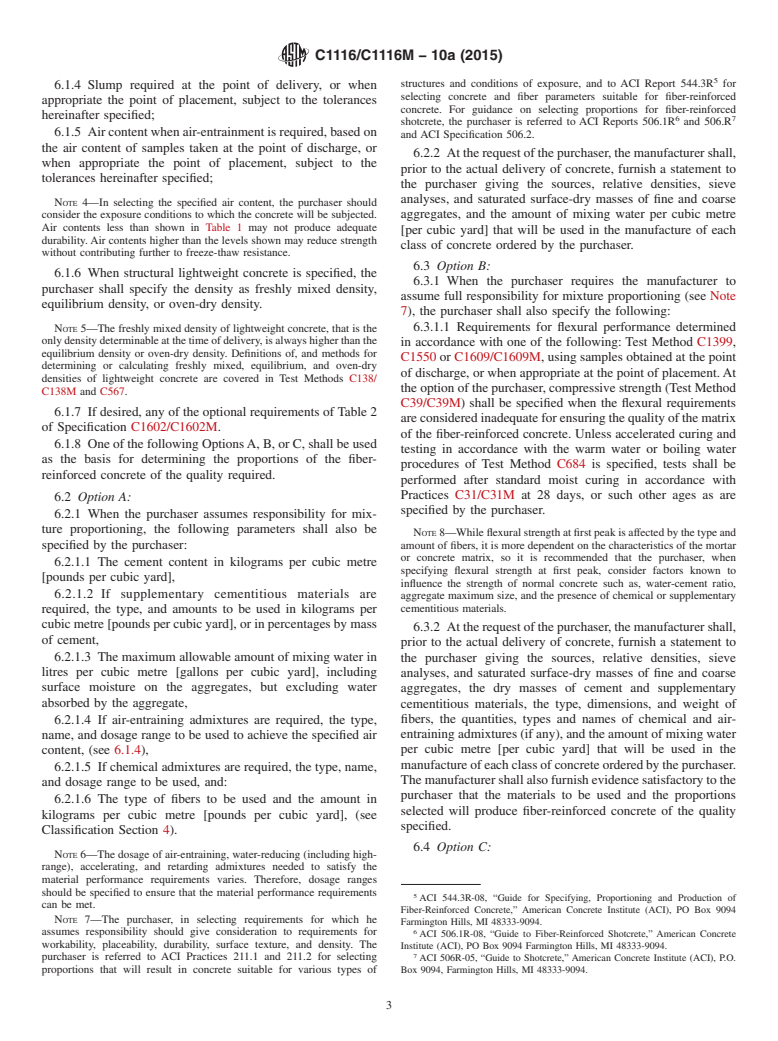
C1399 Test Method for Obtaining Average Residual- 4.1.1 Type I Steel Fiber-Reinforced Concrete—Contains
Strength of Fiber-Reinforced Concrete stainless steel, alloy steel, or carbon steel fibers conforming to
C1436 Specification for Materials for Shotcrete Specification A820/A820M.
C1480 Specification for Packaged, Pre-Blended, Dry, Com-
4.1.2 Type II Glass Fiber-Reinforced Concrete—Contains
bined Materials for Use in Wet or Dry Shotcrete Applica-
alkali-resistant (AR) glass fibers conforming to Specification
tion
C1666/C1666M.
C1550 Test Method for Flexural Toughness of Fiber Rein-
4.1.3 Type III Synthetic Fiber-Reinforced Concrete—
forced Concrete (Using Centrally Loaded Round Panel)
Contains synthetic fibers for which documentary evidence can
C1602/C1602M Specification for Mixing Water Used in the
be produced confirming their resistance to deterioration when
Production of Hydraulic Cement Concrete
in contact with the moisture and alkalis present in cement paste
C1604/C1604M Test Method for Obtaining and Testing
and the substances present in admixtures throughout the
Drilled Cores of Shotcrete
anticipated useful life of the structure (see Note 2 and 4.2).
C1609/C1609M Test Method for Flexural Performance of
When Type III fiber-reinforced concrete contains polyolefin
Fiber-Reinforced Concrete (Using Beam With Third-Point
fibers, they shall conform to Specification D7508/D7508M.
Loading)
NOTE 2—Fibers such as polyolefins (polypropylene and polyethylene),
C1666/C1666M Specification for Alkali Resistant (AR)
nylon, and carbon have been shown to be durable in concrete.
Glass Fiber for GFRC and Fiber-Reinforced Concrete and
4.1.4 Type IV Natural Fiber-Reinforced Concrete—Contains
Cement
natural fibers for which documentary evidence can be produced
D6942 Test Method for Stability of Cellulose Fibers in
confirming their resistance to deterioration when in contact
Alkaline Environments
with the moisture and alkalis present in cement paste and the
D7357 Specification for Cellulose Fibers for Fiber-
substances present in admixtures throughout the anticipated
Reinforced Concrete
useful life of the structure. When Type IV fiber-reinforced
D7508/D7508M Specification for Polyolefin Chopped
concrete contains cellulose fibers they shall conform to Speci-
Strands for Use in Concrete
fication D7357.
2.2 ACI Standards and Reports:
NOTE 3—The classification, natural fibers, refers to a population of
211.1 Standard Practice for Selecting Proportions for
fibers that are manufactured from natural fibrous resources and are used
Normal, Heavyweight, and Mass Concrete
for the first time in concrete. Depending on the initial raw material and the
211.2 Standard Practice for Selecting Proportions for Struc-
manufacturing process employed to produce the fiber, the final physical
tural Lightweight Concrete
and chemical fiber properties in this general classification can vary greatly.
Some natural fibers are susceptible to deterioration from exposure to
506.2 Specification for Materials, Proportioning and Appli-
alkalis; Test Method D6942 may be used to determine the susceptibility of
cation of Shotcrete
these fibers to deterioration as a result of exposure to alkalis in concrete.
Conversely, many other natural fiber types are highly resistant to alkalis
3. Terminology
and can remain in concrete with no degradation for the complete product
life cycle.
3.1 Definitions
3.1.1 For definitions of terms used in this specification, refer
4.2 When the purchaser chooses to permit the use of fibers
to Terminology C125.
other than those complying with the classifications in 4.1, the
manufacturer or supplier shall show evidence satisfactory to
3.2 Definitions of Terms Specific to This Standard:
the purchaser that the type of fiber proposed for use shows
3.2.1 manufacturer, n—the producer who furnishes the
resistance to deterioration when in contact with the moisture
fiber-reinforced concrete.
and alkalis present in cement paste and the substances present
3.2.2 purchaser, n—the owner, or representative thereof,
in admixtures throughout the anticipated useful life of the
who buys the fiber-reinforced concrete.
structure.
4. Classification
5. Basis of Purchase
4.1 This specification classifies fiber-reinforced concrete by
5.1 The basis of purchase for fiber-reinforced concrete shall
the material type of the fiber incorporated.
be in accordance with the Basis of Purchase Sections of
NOTE 1—The performance of fiber-reinforced concrete depends upon
Specification C94/C94M or Specification C685/C685M.
the susceptibility of the fibers to physical damage during mixing or
shotcreting and to chemical damage on exposure to the cement paste
6. Ordering Information
solution, which is highly alkaline and may also contain carbon dioxide,
chlorides, sulfates or oxygen. Improper methods of fiber addition to a
6.1 In the absence of designated applicable general
concrete mix can lead to balling of some types of fiber; consult
specifications, the purchaser shall specify the following:
manufacturer for advice as to correct method before use. The magnitude
of improvements in the mechanical properties of the concrete or shotcrete
6.1.1 Type of fiber-reinforced concrete required. See Sec-
imparted by fibers can also reflect the material characteristics, geometry,
tion 4.
and design of the fiber type.
6.1.2 Type of cement at the purchaser’s option, otherwise
the cement shall be Type 1 meeting the requirements of
Specification C150;
Available from American Concrete Institute (ACI), P.O. Box 9094, Farmington
Hills, MI 48333-9094, http://www.aci-int.org. 6.1.3 Designated size, or sizes, of coarse aggregates;
C1116/C1116M − 10a (2015)
structures and conditions of exposure, and to ACI Report 544.3R for
6.1.4 Slump required at the point of delivery, or when
selecting concrete and fiber parameters suitable for fiber-reinforced
appropriate the point of placement, subject to the tolerances
concrete. For guidance on selecting proportions for fiber-reinforced
hereinafter specified;
6 7
shotcrete, the purchaser is referred to ACI Reports 506.1R and 506.R
6.1.5 Air content when air-entrainment is required, based on
and ACI Specification 506.2.
the air content of samples taken at the point of discharge, or
6.2.2 At the request of the purchaser, the manufacturer shall,
when appropriate the point of placement, subject to the
prior to the actual delivery of concrete, furnish a statement to
tolerances hereinafter specified;
the purchaser giving the sources, relative densities, sieve
analyses, and saturated surface-dry masses of fine and coarse
NOTE 4—In selecting the specified air content, the purchaser should
consider the exposure conditions to which the concrete will be subjected. aggregates, and the amount of mixing water per cubic metre
Air contents less than shown in Table 1 may not produce adequate
[per cubic yard] that will be used in the manufacture of each
durability. Air contents higher than the levels shown may reduce strength
class of concrete ordered by the purchaser.
without contributing further to freeze-thaw resistance.
6.3 Option B:
6.1.6 When structural lightweight concrete is specified, the
6.3.1 When the purchaser requires the manufacturer to
purchaser shall specify the density as freshly mixed density,
assume full responsibility for mixture proportioning (see Note
equilibrium density, or oven-dry density.
7), the purchaser shall also specify the following:
6.3.1.1 Requirements for flexural performance determined
NOTE 5—The freshly mixed density of lightweight concrete, that is the
only density determinable at the time of delivery, is always higher than the
in accordance with one of the following: Test Method C1399,
equilibrium density or oven-dry density. Definitions of, and methods for
C1550 or C1609/C1609M, using samples obtained at the point
determining or calculating freshly mixed, equilibrium, and oven-dry
of discharge, or when appropriate at the point of placement. At
densities of lightweight concrete are covered in Test Methods C138/
the option of the purchaser, compressive strength (Test Method
C138M and C567.
C39/C39M) shall be specified when the flexural requirements
6.1.7 If desired, any of the optional requirements of Table 2
are considered inadequate for ensuring the quality of the matrix
of Specification C1602/C1602M.
of the fiber-reinforced concrete. Unless accelerated curing and
6.1.8 One of the following Options A, B, or C, shall be used
testing in accordance with the warm water or boiling water
as the basis for determining the proportions of the fiber-
procedures of Test Method C684 is specified, tests shall be
reinforced concrete of the quality required.
performed after standard moist curing in accordance with
Practices C31/C31M at 28 days, or such other ages as are
6.2 Option A:
specified by the purchaser.
6.2.1 When the purchaser assumes responsibility for mix-
ture proportioning, the following parameters shall also be
NOTE 8—While flexural strength at first peak is affected by the type and
specified by the purchaser: amount of fibers, it is more dependent on the characteristics of the mortar
or concrete matrix, so it is recommended that the purchaser, when
6.2.1.1 The cement content in kilograms per cubic metre
specifying flexural strength at first peak, consider factors known to
[pounds per cubic yard],
influence the strength of normal concrete such as, water-cement ratio,
6.2.1.2 If supplementary cementitious materials are
aggregate maximum size, and the presence of chemical or supplementary
cementitious materials.
required, the type, and amounts to be used in kilograms per
cubic metre [pounds per cubic yard], or in percentages by mass
6.3.2 At the request of the purchaser, the manufacturer shall,
of cement,
prior to the actual delivery of concrete, furnish a statement to
6.2.1.3 The maximum allowable amount of mixing water in
the purchaser giving the sources, relative densities, sieve
litres per cubic metre [gallons per cubic yard], including analyses, and saturated surface-dry mass
...
This document is not an ASTM standard and is intended only to provide the user of an ASTM standard an indication of what changes have been made to the previous version. Because
it may not be technically possible to adequately depict all changes accurately, ASTM recommends that users consult prior editions as appropriate. In all cases only the current version
of the standard as published by ASTM is to be considered the official document.
Designation: C1116/C1116M − 10a C1116/C1116M − 10a (Reapproved 2015)
Standard Specification for
Fiber-Reinforced Concrete
This standard is issued under the fixed designation C1116/C1116M; the number immediately following the designation indicates the year
of original adoption or, in the case of revision, the year of last revision. A number in parentheses indicates the year of last reapproval.
A superscript epsilon (´) indicates an editorial change since the last revision or reapproval.
1. Scope*Scope
1.1 This specification covers all forms of fiber-reinforced concrete that are delivered to a purchaser with the ingredients
uniformly mixed, and that can be sampled and tested at the point of delivery. It does not cover the placement, consolidation, curing,
or protection of the fiber-reinforced concrete after delivery to the purchaser.
1.2 Certain sections of this specification are also applicable to fiber-reinforced concrete intended for shotcreting by the dry-mix
process when sampling and testing of concrete is possible only at the point of placement. In this case, the sections dealing with
batching plant, mixing equipment, mixing and delivery, and measurement of workability and air content, are not applicable.
1.3 This specification does not cover thin-section glass fiber-reinforced concrete manufactured by the spray-up process that is
under the jurisdiction of ASTM Subcommittee C27.40.
1.4 The values stated in either SI units or inch-pound units are to be regarded separately as standard. The values stated in each
system may not be exact equivalents; therefore, each system shall be used independently of the other. Combining values from the
two systems may result in non-conformance with the standard.
1.5 The following precautionary statement pertains only to the test method portion, Sections 15 and 18, of this specification:
This standard does not purport to address all of the safety concerns, if any, associated with its use. It is the responsibility of the
user of this standard to establish appropriate safety and health practices and determine the applicability of regulatory limitations
prior to use.
2. Referenced Documents
2.1 ASTM Standards:
A820/A820M Specification for Steel Fibers for Fiber-Reinforced Concrete
C31/C31M Practice for Making and Curing Concrete Test Specimens in the Field
C39/C39M Test Method for Compressive Strength of Cylindrical Concrete Specimens
C42/C42M Test Method for Obtaining and Testing Drilled Cores and Sawed Beams of Concrete
C94/C94M Specification for Ready-Mixed Concrete
C125 Terminology Relating to Concrete and Concrete Aggregates
C138/C138M Test Method for Density (Unit Weight), Yield, and Air Content (Gravimetric) of Concrete
C143/C143M Test Method for Slump of Hydraulic-Cement Concrete
C150 Specification for Portland Cement
C172 Practice for Sampling Freshly Mixed Concrete
C173/C173M Test Method for Air Content of Freshly Mixed Concrete by the Volumetric Method
C192/C192M Practice for Making and Curing Concrete Test Specimens in the Laboratory
C231 Test Method for Air Content of Freshly Mixed Concrete by the Pressure Method
C387 Specification for Packaged, Dry, Combined Materials for Mortar and Concrete
C567 Test Method for Determining Density of Structural Lightweight Concrete
C666/C666M Test Method for Resistance of Concrete to Rapid Freezing and Thawing
C684 Test Method for Making, Accelerated Curing, and Testing Concrete Compression Test Specimens (Withdrawn 2012)
This specification is under the jurisdiction of ASTM Committee C09 on Concrete and Concrete Aggregates and is the direct responsibility of Subcommittee C09.42 on
Fiber-Reinforced Concrete.
Current edition approved Dec. 1, 2010April 1, 2015. Published January 2011May 2015. Originally approved in 1989. Last previous edition approved in 2010 as
C1116/C1116M–10.–10a. DOI: 10.1520/C1116_C1116M-10a.10.1520/C1116_C1116M-10AR15.
For referenced ASTM standards, visit the ASTM website, www.astm.org, or contact ASTM Customer Service at service@astm.org. For Annual Book of ASTM Standards
volume information, refer to the standard’s Document Summary page on the ASTM website.
The last approved version of this historical standard is referenced on www.astm.org.
*A Summary of Changes section appears at the end of this standard
Copyright © ASTM International, 100 Barr Harbor Drive, PO Box C700, West Conshohocken, PA 19428-2959. United States
C1116/C1116M − 10a (2015)
C685/C685M Specification for Concrete Made by Volumetric Batching and Continuous Mixing
C1077 Practice for Agencies Testing Concrete and Concrete Aggregates for Use in Construction and Criteria for Testing Agency
Evaluation
C1140 Practice for Preparing and Testing Specimens from Shotcrete Test Panels
C1385/C1385M Practice for Sampling Materials for Shotcrete
C1399 Test Method for Obtaining Average Residual-Strength of Fiber-Reinforced Concrete
C1436 Specification for Materials for Shotcrete
C1480 Specification for Packaged, Pre-Blended, Dry, Combined Materials for Use in Wet or Dry Shotcrete Application
C1550 Test Method for Flexural Toughness of Fiber Reinforced Concrete (Using Centrally Loaded Round Panel)
C1602/C1602M Specification for Mixing Water Used in the Production of Hydraulic Cement Concrete
C1604/C1604M Test Method for Obtaining and Testing Drilled Cores of Shotcrete
C1609/C1609M Test Method for Flexural Performance of Fiber-Reinforced Concrete (Using Beam With Third-Point Loading)
C1666/C1666M Specification for Alkali Resistant (AR) Glass Fiber for GFRC and Fiber-Reinforced Concrete and Cement
D6942 Test Method for Stability of Cellulose Fibers in Alkaline Environments
D7357 Specification for Cellulose Fibers for Fiber-Reinforced Concrete
D7508/D7508M Specification for Polyolefin Chopped Strands for Use in Concrete
2.2 ACI Standards and Reports:
211.1 Standard Practice for Selecting Proportions for Normal, Heavyweight, and Mass Concrete
211.2 Standard Practice for Selecting Proportions for Structural Lightweight Concrete
506.2 Specification for Materials, Proportioning and Application of Shotcrete
3. Terminology
3.1 Definitions
3.1.1 For definitions of terms used in this specification, refer to Terminology C125.
3.2 Definitions of Terms Specific to This Standard:
3.2.1 manufacturer, n—the producer who furnishes the fiber-reinforced concrete.
3.2.2 purchaser, n—the owner, or representative thereof, who buys the fiber-reinforced concrete.
4. Classification
4.1 This specification classifies fiber-reinforced concrete by the material type of the fiber incorporated.
NOTE 1—The performance of fiber-reinforced concrete depends upon the susceptibility of the fibers to physical damage during mixing or shotcreting
and to chemical damage on exposure to the cement paste solution, which is highly alkaline and may also contain carbon dioxide, chlorides, sulfates or
oxygen. Improper methods of fiber addition to a concrete mix can lead to balling of some types of fiber; consult manufacturer for advice as to correct
method before use. The magnitude of improvements in the mechanical properties of the concrete or shotcrete imparted by fibers can also reflect the
material characteristics, geometry, and design of the fiber type.
4.1.1 Type I Steel Fiber-Reinforced Concrete—Contains stainless steel, alloy steel, or carbon steel fibers conforming to
Specification A820/A820M.
4.1.2 Type II Glass Fiber-Reinforced Concrete—Contains alkali-resistant (AR) glass fibers conforming to Specification
C1666/C1666M.
4.1.3 Type III Synthetic Fiber-Reinforced Concrete—Contains synthetic fibers for which documentary evidence can be produced
confirming their resistance to deterioration when in contact with the moisture and alkalis present in cement paste and the substances
present in admixtures throughout the anticipated useful life of the structure (see Note 2 and 4.2). When Type III fiber-reinforced
concrete contains polyolefin fibers, they shall conform to Specification D7508/D7508M.
NOTE 2—Fibers such as polyolefins (polypropylene and polyethylene), nylon, and carbon have been shown to be durable in concrete.
4.1.4 Type IV Natural Fiber-Reinforced Concrete—Contains natural fibers for which documentary evidence can be produced
confirming their resistance to deterioration when in contact with the moisture and alkalis present in cement paste and the substances
present in admixtures throughout the anticipated useful life of the structure. When Type IV fiber-reinforced concrete contains
cellulose fibers they shall conform to Specification D7357.
NOTE 3—The classification, natural fibers, refers to a population of fibers that are manufactured from natural fibrous resources and are used for the
first time in concrete. Depending on the initial raw material and the manufacturing process employed to produce the fiber, the final physical and chemical
fiber properties in this general classification can vary greatly. Some natural fibers are susceptible to deterioration from exposure to alkalis; Test Method
D6942 may be used to determine the susceptibility of these fibers to deterioration as a result of exposure to alkalis in concrete. Conversely, many other
natural fiber types are highly resistant to alkalis and can remain in concrete with no degradation for the complete product life cycle.
4.2 When the purchaser chooses to permit the use of fibers other than those complying with the classifications in 4.1, the
manufacturer or supplier shall show evidence satisfactory to the purchaser that the type of fiber proposed for use shows resistance
Available from American Concrete Institute (ACI), P.O. Box 9094, Farmington Hills, MI 48333-9094, http://www.aci-int.org.
C1116/C1116M − 10a (2015)
to deterioration when in contact with the moisture and alkalis present in cement paste and the substances present in admixtures
throughout the anticipated useful life of the structure.
5. Basis of Purchase
5.1 The basis of purchase for fiber-reinforced concrete shall be in accordance with the Basis of Purchase Sections of
Specification C94/C94M or Specification C685/C685M.
6. Ordering Information
6.1 In the absence of designated applicable general specifications, the purchaser shall specify the following:
6.1.1 Type of fiber-reinforced concrete required. See Section 4.
6.1.2 Type of cement at the purchaser’s option, otherwise the cement shall be Type 1 meeting the requirements of Specification
C150;
6.1.3 Designated size, or sizes, of coarse aggregates;
6.1.4 Slump required at the point of delivery, or when appropriate the point of placement, subject to the tolerances hereinafter
specified;
6.1.5 Air content when air-entrainment is required, based on the air content of samples taken at the point of discharge, or when
appropriate the point of placement, subject to the tolerances hereinafter specified;
NOTE 4—In selecting the specified air content, the purchaser should consider the exposure conditions to which the concrete will be subjected. Air
contents less than shown in Table 1 may not produce adequate durability. Air contents higher than the levels shown may reduce strength without
contributing further to freeze-thaw resistance.
6.1.6 When structural lightweight concrete is specified, the purchaser shall specify the density as freshly mixed density,
equilibrium density, or oven-dry density.
NOTE 5—The freshly mixed density of lightweight concrete, that is the only density determinable at the time of delivery, is always higher than the
equilibrium density or oven-dry density. Definitions of, and methods for determining or calculating freshly mixed, equilibrium, and oven-dry densities
of lightweight concrete are covered in Test Methods C138/C138M and C567.
6.1.7 If desired, any of the optional requirements of Table 2 of Specification C1602/C1602M.
6.1.8 One of the following Options A, B, or C, shall be used as the basis for determining the proportions of the fiber-reinforced
concrete of the quality required.
6.2 Option A:
6.2.1 When the purchaser assumes responsibility for mixture proportioning, the following parameters shall also be specified by
the purchaser:
6.2.1.1 The cement content in kilograms per cubic metre [pounds per cubic yard],
6.2.1.2 If supplementary cementitious materials are required, the type, and amounts to be used in kilograms per cubic metre
[pounds per cubic yard], or in percentages by mass of cement,
6.2.1.3 The maximum allowable amount of mixing water in litres per cubic metre [gallons per cubic yard], including surface
moisture on the aggregates, but excluding water absorbed by the aggregate,
6.2.1.4 If air-entraining admixtures are required, the type, name, and dosage range to be used to achieve the specified air content,
(see 6.1.4),
6.2.1.5 If chemical admixtures are required, the type, name, and dosage range to be used, and:
6.2.1.6 The type of fibers to be used and the amount in kilograms per cubic metre [pounds per cubic yard], (see Classification
Section 4).
NOTE 6—The dosage of air-entraining, water-reducing (including high-range), accelerating, and retarding admixtures needed to satisfy the material
performance requirements varies. Therefore, dosage ranges should be specified to ensure that the material performance requirements can be met.
NOTE 7—The purchaser, in selecting requirements for which he assumes responsibility should give consideration to requirements for workability,
placeability, durability, surface texture, and density. The purchaser is referred to ACI Practices 211.1 and 211.2 for selecting proportions that will result
in concrete suitable for various types of structures and conditions of exposure, and to ACI Report 544.3R for selecting concrete and fiber parameters
suitable for fiber-reinforced concrete. For guidance on selecting proportions for fiber-reinforced shotcrete, the purchaser is referred to ACI Reports
6 7
506.1R and 506.R and ACI Specification 506.2.
6.2.2 At the request of the purchaser, the manufacturer shall, prior to the actual delivery of concrete, furnish a statement to the
purchaser giving the sources, relative densities, sieve analyses, and saturated surface-dry masses of fine and coarse aggregates, and
the amount of mixing water per cubic metre [per cubic yard] that will be used in the manufacture of each class of concrete ordered
by the purchaser.
6.3 Option B:
ACI 544.3R-08, “Guide for Specifying, Proportioning and Production of Fiber-Reinforced Concrete,” American Concrete Institute (ACI), PO Box 9094 Farmington Hills,
MI 48333-9094.
ACI 506.1R-08, “Guide to Fiber-Rein
...
Questions, Comments and Discussion
Ask us and Technical Secretary will try to provide an answer. You can facilitate discussion about the standard in here.