

ASTM C730-98(2021)
(Test Method)Standard Test Method for Knoop Indentation Hardness of Glass
General Information
- Abstract
SIGNIFICANCE AND USE
4.1 The Knoop indentation hardness is one of many properties that is used to characterize glasses. Attempts have been made to relate Knoop indentation hardness to tensile strength, grinding speeds, and other hardness scales, but no generally accepted methods are available. Such conversions are limited in scope and should be used with caution, except for special cases where a reliable basis for the conversion has been obtained by comparison tests.
SCOPE
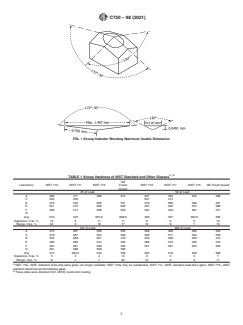
1.1 This test method covers the determination of the Knoop indentation hardness of glass and the verification of Knoop indentation hardness testing machines using standard glasses.
1.2 This standard does not purport to address all of the safety concerns, if any, associated with its use. It is the responsibility of the user of this standard to establish appropriate safety, health, and environmental practices and determine the applicability of regulatory limitations prior to use.
1.3 This international standard was developed in accordance with internationally recognized principles on standardization established in the Decision on Principles for the Development of International Standards, Guides and Recommendations issued by the World Trade Organization Technical Barriers to Trade (TBT) Committee.
- Status
- Published
- Publication Date
- 31-Dec-2020
- Technical Committee
- C14 - Glass and Glass Products
- Drafting Committee
- C14.04 - Physical and Mechanical Properties
Overview
ASTM C730-98(2021): Standard Test Method for Knoop Indentation Hardness of Glass establishes procedures for determining the Knoop hardness of glass materials and for verifying the performance of Knoop indentation hardness testing machines using standard reference glasses. As an internationally recognized standard, ASTM C730 is applied to a wide range of glass products and materials, helping ensure consistent physical property characterization across industries.
Knoop indentation hardness testing is a micro-indentation method widely used for glass because it provides a quantitative measure of resistance to deformation. This property is significant for understanding the mechanical performance, durability, and suitability of glass for various applications.
Key Topics
- Knoop Hardness Number (KHN): The test produces a Knoop hardness number, calculated from the applied load and the indentation's projected area. This quantitative value enables consistent material comparisons.
- Test Specimens: Recommendations include using ground and polished glass surfaces for the most accurate results, minimizing deviations due to surface finish.
- Testing Apparatus: The method details requirements for indentation devices, calibration procedures, and measurement accuracy. Two types of testing machines are permitted: purpose-built units and microscope accessories.
- Standardization of Procedures: The standard prescribes specific loading rates, dwell times, and indenter specifications, ensuring repeatability and comparability.
- Verification: Procedures for regular machine calibration and validation with standard reference glasses support ongoing measurement reliability.
- Reporting: The test also establishes minimum requirements for documenting test results, including the mean KHN, number of indentations, test load, surface preparation details, and standard deviation.
Applications
This ASTM standard is applicable wherever characterization of glass hardness is needed for quality assurance, research, or product development. Typical industries and use cases include:
- Glass Manufacturing: Supporting internal quality control of glass plates, tubes, optical components, and specialty glasses by verifying mechanical hardness properties.
- Product Development: Facilitating the selection of suitable glass types for applications demanding specific hardness or wear resistance characteristics.
- Academic Research: Providing a standardized basis for comparing new glass formulations, surface coatings, or treatments.
- Process Optimization: Assisting in the assessment of manufacturing variables or post-processing steps (e.g., ion exchange, annealing) that can alter surface hardness.
- Verification of Test Equipment: Ensuring reliable Knoop hardness values by calibrating machines against known reference materials.
Note that while Knoop hardness is sometimes related to other properties-such as tensile strength or resistance to abrasion-direct conversions are not standardized and should be performed with caution unless rigorously supported by empirical data.
Related Standards
ASTM C730-98(2021) references and complements several other standards relevant to indentation hardness and glass characterization:
- ASTM E384: Standard Test Method for Microindentation Hardness of Materials. Provides a broader description of microindentation testing, including Knoop and Vickers methods, applicable to various materials.
- ASTM E4: Practices for Force Verification of Testing Machines. Details procedures for the calibration of the force delivered by test machines.
- NIST Standard Glasses: Reference materials for calibration and verification purposes.
For comprehensive mechanical property assessment of glass, users should consider ASTM C730 in conjunction with applicable companion standards.
Summary
By following ASTM C730-98(2021), users ensure reproducible and internationally accepted measurement of the Knoop indentation hardness of glass. This standard supports quality assurance, research, and the reliable comparison of glass products, thereby promoting safety, performance, and innovation within the materials industry.
Keywords: Knoop hardness, ASTM C730, indentation hardness, glass testing, microindentation, glass quality, mechanical properties of glass, hardness testing standards.
Relations
- Effective Date
- 01-Jun-2014
- Effective Date
- 01-Jun-2010
- Effective Date
- 01-Feb-2010
- Effective Date
- 01-Feb-2010
- Effective Date
- 01-Nov-2009
- Effective Date
- 01-May-2009
- Effective Date
- 01-Apr-2009
- Effective Date
- 01-Dec-2008
- Effective Date
- 15-Mar-2008
- Effective Date
- 15-Mar-2008
- Effective Date
- 01-Jan-2008
- Effective Date
- 15-Dec-2007
- Effective Date
- 01-Jul-2007
- Effective Date
- 01-Jan-2007
- Effective Date
- 15-Nov-2006
Frequently Asked Questions
ASTM C730-98(2021) is a standard published by ASTM International. Its full title is "Standard Test Method for Knoop Indentation Hardness of Glass". This standard covers: SIGNIFICANCE AND USE 4.1 The Knoop indentation hardness is one of many properties that is used to characterize glasses. Attempts have been made to relate Knoop indentation hardness to tensile strength, grinding speeds, and other hardness scales, but no generally accepted methods are available. Such conversions are limited in scope and should be used with caution, except for special cases where a reliable basis for the conversion has been obtained by comparison tests. SCOPE 1.1 This test method covers the determination of the Knoop indentation hardness of glass and the verification of Knoop indentation hardness testing machines using standard glasses. 1.2 This standard does not purport to address all of the safety concerns, if any, associated with its use. It is the responsibility of the user of this standard to establish appropriate safety, health, and environmental practices and determine the applicability of regulatory limitations prior to use. 1.3 This international standard was developed in accordance with internationally recognized principles on standardization established in the Decision on Principles for the Development of International Standards, Guides and Recommendations issued by the World Trade Organization Technical Barriers to Trade (TBT) Committee.
SIGNIFICANCE AND USE 4.1 The Knoop indentation hardness is one of many properties that is used to characterize glasses. Attempts have been made to relate Knoop indentation hardness to tensile strength, grinding speeds, and other hardness scales, but no generally accepted methods are available. Such conversions are limited in scope and should be used with caution, except for special cases where a reliable basis for the conversion has been obtained by comparison tests. SCOPE 1.1 This test method covers the determination of the Knoop indentation hardness of glass and the verification of Knoop indentation hardness testing machines using standard glasses. 1.2 This standard does not purport to address all of the safety concerns, if any, associated with its use. It is the responsibility of the user of this standard to establish appropriate safety, health, and environmental practices and determine the applicability of regulatory limitations prior to use. 1.3 This international standard was developed in accordance with internationally recognized principles on standardization established in the Decision on Principles for the Development of International Standards, Guides and Recommendations issued by the World Trade Organization Technical Barriers to Trade (TBT) Committee.
ASTM C730-98(2021) is classified under the following ICS (International Classification for Standards) categories: 81.040.10 - Raw materials and raw glass. The ICS classification helps identify the subject area and facilitates finding related standards.
ASTM C730-98(2021) has the following relationships with other standards: It is inter standard links to ASTM E4-14, ASTM E4-10, ASTM E384-10e1, ASTM E384-10, ASTM E4-09a, ASTM E384-09, ASTM E4-09, ASTM E4-08, ASTM E384-08a, ASTM E384-08ae1, ASTM E384-08, ASTM E384-07a, ASTM E384-07, ASTM E4-07, ASTM E384-06. Understanding these relationships helps ensure you are using the most current and applicable version of the standard.
ASTM C730-98(2021) is available in PDF format for immediate download after purchase. The document can be added to your cart and obtained through the secure checkout process. Digital delivery ensures instant access to the complete standard document.
Standards Content (Sample)
This international standard was developed in accordance with internationally recognized principles on standardization established in the Decision on Principles for the
Development of International Standards, Guides and Recommendations issued by the World Trade Organization Technical Barriers to Trade (TBT) Committee.
Designation: C730 − 98 (Reapproved 2021)
Standard Test Method for
Knoop Indentation Hardness of Glass
This standard is issued under the fixed designation C730; the number immediately following the designation indicates the year of
original adoption or, in the case of revision, the year of last revision.Anumber in parentheses indicates the year of last reapproval.A
superscript epsilon (´) indicates an editorial change since the last revision or reapproval.
1. Scope KHN 5 ~P/A ! 5 ~P/d C ! (1)
p p
1.1 This test method covers the determination of the Knoop
where:
indentation hardness of glass and the verification of Knoop
P = load, kgf,
indentation hardness testing machines using standard glasses.
A = projected area of the indentation, mm ,
p
d = length of the long diagonal of the indentation, mm,
1.2 This standard does not purport to address all of the
C = ⁄2 (cot A/2×tan B/2),
safety concerns, if any, associated with its use. It is the
p
A = included longitudinal edge angle (see Fig. 1), and
responsibility of the user of this standard to establish appro-
B = included transverse edge angle (see Fig. 1).
priate safety, health, and environmental practices and deter-
mine the applicability of regulatory limitations prior to use.
3.1.1.2 Knoop indentation hardness tests in glass are made
1.3 This international standard was developed in accor-
at a test load of 100 gf (0.1 kgf).
dance with internationally recognized principles on standard-
3.1.1.3 The rate of indenter motion prior to contact with the
ization established in the Decision on Principles for the
specimen shall be 0.20 60.05 mm/min. This low rate of load
Development of International Standards, Guides and Recom-
application tends to alleviate the effect of the magnitude of the
mendations issued by the World Trade Organization Technical
load on Knoop hardness number.
Barriers to Trade (TBT) Committee.
3.1.1.4 The indenter should remain in contact with the
specimen between 20 and 30 s. Most of the calibrated
2. Referenced Documents
machines that are used for making Knoop hardness tests are
2.1 ASTM Standards:
dash-pot controlled and this dwell time is consistent with the
E4Practices for Force Verification of Testing Machines
adjustment of the dash-pot to meet the loading rate standard.
E384Test Method for Microindentation Hardness of Mate-
3.1.1.5 Table 1 gives the Knoop hardness of several glasses
rials
as a function of load when the loading rate and dwell time are
held at the values recommended above.
3. Terminology
3.1.2 Knoop indentation hardness test—anindentationhard-
3.1 Definitions of Terms Specific to This Standard: Defini-
ness test using a calibrated machine to force a pointed,
tions of Terms Specific to This Standard
rhombic-base, pyramidal diamond indenter having specified
3.1.1 Knoop hardness number (KHN)—a number obtained
faceangles,underapredeterminedload,intothesurfaceofthe
by dividing the applied load in kilograms-force (kgf) by the
2 material under test and to measure the long diagonal of the
projected area of the indentation in square millimetres (mm ),
resulting impression after removal of the load.
computed from the measured long diagonal of the indentation
andtheincludededgeanglesofthediamond;itisassumedthat
NOTE 1—Ageneral description of the Knoop indentation hardness test
the indentation is an imprint of the undeformed indenter.
is given in Test Method E384. The present method differs from this
description only in areas required by the special nature of glasses.
3.1.1.1 The Knoop hardness number (KHN) is computed as
follows:
4. Significance and Use
This test method is under the jurisdiction of ASTM Committee C14 on Glass
4.1 The Knoop indentation hardness is one of many prop-
and Glass Products and is the direct responsibility of Subcommittee C14.04 on
erties that is used to characterize glasses. Attempts have been
Physical and Mechanical Properties.
made to relate Knoop indentation hardness to tensile strength,
Current edition approved Jan. 1, 2021. Published February 2021. Originally
grinding speeds, and other hardness scales, but no generally
approved in 1972. Last previous edition approved in 2013 as C730–98 (2013).
DOI: 10.1520/C0730-98R21.
accepted methods are available. Such conversions are limited
For referenced ASTM standards, visit the ASTM website, www.astm.org, or
in scope and should be used with caution, except for special
contact ASTM Customer Service at service@astm.org. For Annual Book of ASTM
cases where a reliable basis for the conversion has been
Standards volume information, refer to the standard’s Document Summary page on
the ASTM website. obtained by comparison tests.
Copyright ©ASTM International, 100 Barr Harbor Drive, PO Box C700, West Conshohocken, PA19428-2959. United States
C730 − 98 (2021)
FIG. 1 Knoop Indenter Showing Maximum Usable Dimension
A ,B
TABLE 1 Knoop Hardness of NIST Standard and Other Glasses
GE
Laboratory NIST 710 NIST 711 NIST 715 Fused NIST 710 NIST 711 NIST 715 GE Fused Quartz
Quartz
25 gf Load 50 gf Load
A 486 411 589 614 497 394 575 559
C 594 450 537 415
D 479 426 505 541 478 380 538 501
E 521 415 608 620 497 392 574 586
F 498 414 568 643 484 403 567 577
G
Avg 516 423 567.5 609.5 499 397 563.5 556
Departure, max, % 15 6 11 11 8 5 5 10
Range, max, % 22 9 18 17 12 9 7 15
100 gf Load 200 gf Load
A 475 387 558 554 468 380 550 523
C 478 387 554 593 468 371 544 530
D 452 368 521 473 433 360 529 474
E 490 396 544 530 488 372 546 510
F 467 381 538 524 457 367 524 502
G 481 388 550 558
Avg 474 384.5 544 539 463 370 539 508
Departure, max, % 5 4 4 12 6 3 3 7
Range, max, % 8 7 7 22 12 5 5 11
A
NIST 710—NIST standard soda-lime-silica glass (no longer available; NIST 710a may be substituted), NIST 711—NIST standard lead-silica glass. NIST 715—NIST
standard alkali-free aluminosilicate glass.
B
These data were obtained fromASTM round-robin testing.
C730 − 98 (2021)
5. Apparatus investigating a surface coating or treatment, he cannot grind
and polish the sample. Experience has shown that six inden-
5.1 Testing Machines:
tations on a ground and polished surface of glass will repro-
5.1.1 There are two general types of machines available for
duce within 61%. Six indentations on an “as-received”
making this test. One type is a self-contained unit built for this
surfacemaybeasbadas 610%.Groundandpolishedsurfaces
purpose,andtheothertypeisanaccessoryavailabletoexisting
should be used. If this is not possible, the number of indenta-
microscopes. Usually, this second type is fitted on an inverted-
tions should be increased.
stage microscope. Good descriptions of the various machines
3,4
6.1.3 Radius of Curvature—The KHN obtained will be
are available.
affected even when the curvature is only in the direction of the
5.1.2 Designofthemachineshouldbesuchthattheloading
shortdiagonal.CareshouldbeusedwhenrelatingKHNvalues
rate, dwell time, and applied load can be standardized within
obtained on curved surfaces to those obtained on polished flat
the limits set forth in 3.1.1.2 – 3.1.1.4. It is an advantage to
surfaces.
eliminatethehumanelementwheneverpossiblebyappropriate
machine design. The machine should be designed so that
7. Verification of Apparatus
vibrationsinducedatthebeginningofatestwillbedampedout
7.1 Verification of Load—Most of the machines available
by the time the indenter touches the sample.
for Knoop hardness testing use a loaded beam. This beam
5.1.3 Thecalibrationofthebalancebeamshouldbechecked
should be tested for zero load. An indentation should not be
monthly or as needed. Indentations in standard glasses are also
visible with zero load, but the indenter should contact the
used to check calibration when needed.
sample.Avisibleindentationshouldbeobtainedwithaloadof
5.2 Indenter:
0.1 gf. Other methods of verifying the load application are
5.2.1 The indenter shall meet the specifications for Knoop
given in Practices E4.
indenters. See Test Method E384.
7.2 Verification by Standard Glasses—Table 1 gives the
5.2.2 Fig. 1 shows the indenter and its maximum usable
Knoop hardness of several standard glasses. Knoop hardness
dimensions. The diagonals have an approximate ratio of 7:1,
1 measurement on a piece of one of these glasses that has been
and the depth of the indentation is about ⁄30 the length of the
ground and polished within the last 24 h should agree with the
long diagonal. A perfect Knoop indenter has the following
value in the table 65%. Tests should be made using 100 gf.
angle
...