

ASTM C158-23
(Test Method)Standard Test Methods for Strength of Glass by Flexure (Determination of Modulus of Rupture)
General Information
- Abstract
SIGNIFICANCE AND USE
4.1 For the purpose of this test, glasses and glass-ceramics are considered brittle (perfectly elastic) and to have the property that fracture normally occurs at the surface of the test specimen from the principal tensile stress. The flexural strength is considered a valid measure of the tensile strength subject to the considerations that follow.
4.2 The flexural strength for a group of test specimens is influenced by variables associated with the test procedure. Such factors are specified in the test procedure or required to be stated in the report. These include but are not limited to the rate of stressing, the test environment, and the area of the specimen subjected to stress.
4.2.1 In addition, the variables having the greatest effect on the flexural strength value for a group of test specimens are the condition of the surfaces and glass quality near the surfaces in regard to the number and severity of stress-concentrating discontinuities or flaws, and the degree of prestress existing in the specimens. Each of these can represent an inherent part of the strength characteristic being determined or can be a random interfering factor in the measurement.
4.2.2 Test Method A is designed to include the condition of the surface of the specimen as a factor in the measured strength. Therefore, subjecting a fixed and significant area of the surface to the maximum tensile stress is desirable. Since the number and severity of surface flaws in glass are primarily determined by manufacturing and handling processes, this test method is limited to products from which specimens of suitable size can be obtained with minimal dependence of measured strength upon specimen preparation techniques. This test method is therefore designated as a test for flexural strength of flat glass.
4.2.3 Test Method B describes a general procedure for test, applicable to specimens of rectangular or elliptical cross section. This test method is based on the assumption that a comparative ...
SCOPE
1.1 These test methods cover the determination of the flexural strength (the modulus of rupture in bending) of glass and glass-ceramics.
1.2 These test methods are applicable to annealed and prestressed glasses and glass-ceramics available in varied forms. Alternative test methods are described; the test method used shall be determined by the purpose of the test and geometric characteristics of specimens representative of the material.
1.2.1 Test Method A is a test for flexural strength of flat glass.
1.2.2 Test Method B is a comparative test for flexural strength of glass and glass-ceramics.
1.3 The test methods appear in the following order:
Sections
Test Method A
7 to 10
Test Method B
11 to 16
1.4 This standard does not purport to address all of the safety concerns, if any, associated with its use. It is the responsibility of the user of this standard to establish appropriate safety, health, and environmental practices and determine the applicability of regulatory limitations prior to use.
1.5 This international standard was developed in accordance with internationally recognized principles on standardization established in the Decision on Principles for the Development of International Standards, Guides and Recommendations issued by the World Trade Organization Technical Barriers to Trade (TBT) Committee.
- Status
- Published
- Publication Date
- 31-Oct-2023
- Technical Committee
- C14 - Glass and Glass Products
- Drafting Committee
- C14.04 - Physical and Mechanical Properties
Buy Documents
ASTM C158-23 - Standard Test Methods for Strength of Glass by Flexure (Determination of Modulus of Rupture)
REDLINE ASTM C158-23 - Standard Test Methods for Strength of Glass by Flexure (Determination of Modulus of Rupture)
Overview
ASTM C158-23: Standard Test Methods for Strength of Glass by Flexure (Determination of Modulus of Rupture), developed by ASTM International, establishes procedures for measuring the flexural strength-also known as the modulus of rupture-of glass and glass-ceramic materials. These methods apply to annealed and prestressed glasses in varied forms, serving as key references for manufacturers and quality assurance professionals. The standard plays a critical role in ensuring that glass products meet essential mechanical property requirements for safety, performance, and durability in both industrial and consumer applications.
Key Topics
- Flexural (Bending) Strength: The standard defines methodologies to determine the maximum tensile stress a glass specimen can withstand before fracture, reflecting practical tensile strength for brittle materials.
- Modulus of Rupture: This parameter quantifies the strength of glass materials under bending, directly informing designers and engineers about product reliability under load.
- Test Variables: Flexural strength results are influenced by various factors such as specimen preparation, surface condition, test environment, loading rate, and the area subjected to stress. The standard requires these variables to be controlled or reported to ensure reliable comparisons.
- Surface Condition and Prestress: The quality and condition of glass surfaces, as well as any intentional prestressing, significantly affect measured strength, highlighting the importance of manufacturing and handling processes.
- Alternative Procedures: Two test methods are outlined:
- Test Method A: Focused on flat glass, incorporating surface condition as a key variable.
- Test Method B: Provides a general, comparative procedure suitable for rectangular or elliptical specimens and evaluating effects such as environment or stress duration.
- Reporting Requirements: The document specifies detailed reporting of test conditions, specimen characteristics, test environments, and individual results to facilitate transparency and repeatability.
Applications
ASTM C158-23 is widely used in:
- Quality Assurance and Specification: Validates flexural strength of flat glass, architectural glass, glass-ceramic cookware, and specialty products to meet industry standards.
- Product Development: Informs improvements in manufacturing processes by assessing how variables like surface treatment or prestressing techniques influence mechanical performance.
- Research and Comparative Studies: Provides a standardized approach for comparing different glass compositions, heat treatments, and surface finishes, aiding in the development of new materials.
- Safety Assessment: Supports safety evaluations in construction, automotive, and appliance sectors by verifying glass strength properties under representative service conditions.
- Regulatory Compliance: Ensures conformity with international market requirements and technical barriers to trade as outlined by the World Trade Organization.
Related Standards
- ASTM C148: Test Methods for Polariscopic Examination of Glass Containers-examines residual stress in glass.
- ASTM E4: Practices for Force Calibration and Verification of Testing Machines-ensures accuracy in force application during mechanical tests.
- IEEE/ASTM SI 10: American National Standard for Use of the International System of Units (SI).
Other relevant documents may include regional building codes and additional ASTM standards governing glass properties and testing protocols.
This summary offers a clear understanding of the purpose, scope, and practical value of ASTM C158-23, supporting its use as a key standard in the evaluation and certification of glass products across industries. Use this standard to ensure reliable determination of glass flexural strength, support regulatory compliance, and drive robust product development.
Relations
- Effective Date
- 01-Nov-2023
- Effective Date
- 01-Nov-2023
- Effective Date
- 01-Nov-2023
- Effective Date
- 01-Nov-2023
- Effective Date
- 01-Nov-2023
Buy Documents
ASTM C158-23 - Standard Test Methods for Strength of Glass by Flexure (Determination of Modulus of Rupture)
REDLINE ASTM C158-23 - Standard Test Methods for Strength of Glass by Flexure (Determination of Modulus of Rupture)
Frequently Asked Questions
ASTM C158-23 is a standard published by ASTM International. Its full title is "Standard Test Methods for Strength of Glass by Flexure (Determination of Modulus of Rupture)". This standard covers: SIGNIFICANCE AND USE 4.1 For the purpose of this test, glasses and glass-ceramics are considered brittle (perfectly elastic) and to have the property that fracture normally occurs at the surface of the test specimen from the principal tensile stress. The flexural strength is considered a valid measure of the tensile strength subject to the considerations that follow. 4.2 The flexural strength for a group of test specimens is influenced by variables associated with the test procedure. Such factors are specified in the test procedure or required to be stated in the report. These include but are not limited to the rate of stressing, the test environment, and the area of the specimen subjected to stress. 4.2.1 In addition, the variables having the greatest effect on the flexural strength value for a group of test specimens are the condition of the surfaces and glass quality near the surfaces in regard to the number and severity of stress-concentrating discontinuities or flaws, and the degree of prestress existing in the specimens. Each of these can represent an inherent part of the strength characteristic being determined or can be a random interfering factor in the measurement. 4.2.2 Test Method A is designed to include the condition of the surface of the specimen as a factor in the measured strength. Therefore, subjecting a fixed and significant area of the surface to the maximum tensile stress is desirable. Since the number and severity of surface flaws in glass are primarily determined by manufacturing and handling processes, this test method is limited to products from which specimens of suitable size can be obtained with minimal dependence of measured strength upon specimen preparation techniques. This test method is therefore designated as a test for flexural strength of flat glass. 4.2.3 Test Method B describes a general procedure for test, applicable to specimens of rectangular or elliptical cross section. This test method is based on the assumption that a comparative ... SCOPE 1.1 These test methods cover the determination of the flexural strength (the modulus of rupture in bending) of glass and glass-ceramics. 1.2 These test methods are applicable to annealed and prestressed glasses and glass-ceramics available in varied forms. Alternative test methods are described; the test method used shall be determined by the purpose of the test and geometric characteristics of specimens representative of the material. 1.2.1 Test Method A is a test for flexural strength of flat glass. 1.2.2 Test Method B is a comparative test for flexural strength of glass and glass-ceramics. 1.3 The test methods appear in the following order: Sections Test Method A 7 to 10 Test Method B 11 to 16 1.4 This standard does not purport to address all of the safety concerns, if any, associated with its use. It is the responsibility of the user of this standard to establish appropriate safety, health, and environmental practices and determine the applicability of regulatory limitations prior to use. 1.5 This international standard was developed in accordance with internationally recognized principles on standardization established in the Decision on Principles for the Development of International Standards, Guides and Recommendations issued by the World Trade Organization Technical Barriers to Trade (TBT) Committee.
SIGNIFICANCE AND USE 4.1 For the purpose of this test, glasses and glass-ceramics are considered brittle (perfectly elastic) and to have the property that fracture normally occurs at the surface of the test specimen from the principal tensile stress. The flexural strength is considered a valid measure of the tensile strength subject to the considerations that follow. 4.2 The flexural strength for a group of test specimens is influenced by variables associated with the test procedure. Such factors are specified in the test procedure or required to be stated in the report. These include but are not limited to the rate of stressing, the test environment, and the area of the specimen subjected to stress. 4.2.1 In addition, the variables having the greatest effect on the flexural strength value for a group of test specimens are the condition of the surfaces and glass quality near the surfaces in regard to the number and severity of stress-concentrating discontinuities or flaws, and the degree of prestress existing in the specimens. Each of these can represent an inherent part of the strength characteristic being determined or can be a random interfering factor in the measurement. 4.2.2 Test Method A is designed to include the condition of the surface of the specimen as a factor in the measured strength. Therefore, subjecting a fixed and significant area of the surface to the maximum tensile stress is desirable. Since the number and severity of surface flaws in glass are primarily determined by manufacturing and handling processes, this test method is limited to products from which specimens of suitable size can be obtained with minimal dependence of measured strength upon specimen preparation techniques. This test method is therefore designated as a test for flexural strength of flat glass. 4.2.3 Test Method B describes a general procedure for test, applicable to specimens of rectangular or elliptical cross section. This test method is based on the assumption that a comparative ... SCOPE 1.1 These test methods cover the determination of the flexural strength (the modulus of rupture in bending) of glass and glass-ceramics. 1.2 These test methods are applicable to annealed and prestressed glasses and glass-ceramics available in varied forms. Alternative test methods are described; the test method used shall be determined by the purpose of the test and geometric characteristics of specimens representative of the material. 1.2.1 Test Method A is a test for flexural strength of flat glass. 1.2.2 Test Method B is a comparative test for flexural strength of glass and glass-ceramics. 1.3 The test methods appear in the following order: Sections Test Method A 7 to 10 Test Method B 11 to 16 1.4 This standard does not purport to address all of the safety concerns, if any, associated with its use. It is the responsibility of the user of this standard to establish appropriate safety, health, and environmental practices and determine the applicability of regulatory limitations prior to use. 1.5 This international standard was developed in accordance with internationally recognized principles on standardization established in the Decision on Principles for the Development of International Standards, Guides and Recommendations issued by the World Trade Organization Technical Barriers to Trade (TBT) Committee.
ASTM C158-23 is classified under the following ICS (International Classification for Standards) categories: 81.040.10 - Raw materials and raw glass. The ICS classification helps identify the subject area and facilitates finding related standards.
ASTM C158-23 has the following relationships with other standards: It is inter standard links to ASTM C158-02(2017), ASTM C1279-13(2019), ASTM F561-19, ASTM C1684-18(2023), ASTM F1538-03(2017). Understanding these relationships helps ensure you are using the most current and applicable version of the standard.
ASTM C158-23 is available in PDF format for immediate download after purchase. The document can be added to your cart and obtained through the secure checkout process. Digital delivery ensures instant access to the complete standard document.
Standards Content (Sample)
This international standard was developed in accordance with internationally recognized principles on standardization established in the Decision on Principles for the
Development of International Standards, Guides and Recommendations issued by the World Trade Organization Technical Barriers to Trade (TBT) Committee.
Designation: C158 − 23
Standard Test Methods for
Strength of Glass by Flexure (Determination of Modulus of
Rupture)
This standard is issued under the fixed designation C158; the number immediately following the designation indicates the year of
original adoption or, in the case of revision, the year of last revision. A number in parentheses indicates the year of last reapproval. A
superscript epsilon (´) indicates an editorial change since the last revision or reapproval.
This standard has been approved for use by agencies of the U.S. Department of Defense.
1. Scope 2. Referenced Documents
2.1 ASTM Standards:
1.1 These test methods cover the determination of the
C148 Test Methods for Polariscopic Examination of Glass
flexural strength (the modulus of rupture in bending) of glass
Containers
and glass-ceramics.
E4 Practices for Force Calibration and Verification of Test-
1.2 These test methods are applicable to annealed and
ing Machines
prestressed glasses and glass-ceramics available in varied
SI10-02 IEEE/ASTM SI 10 American National Standard for
forms. Alternative test methods are described; the test method
Use of the International System of Units (SI): The Modern
used shall be determined by the purpose of the test and
Metric System
geometric characteristics of specimens representative of the
3. Terminology
material.
1.2.1 Test Method A is a test for flexural strength of flat
3.1 Definitions:
glass.
3.1.1 glass-ceramics—solid materials, predominantly crys-
talline in nature, formed by the controlled crystallization of
1.2.2 Test Method B is a comparative test for flexural
glasses.
strength of glass and glass-ceramics.
3.1.2 flexural strength—the value of maximum tensile stress
1.3 The test methods appear in the following order:
in the extreme fiber of a beam loaded to failure in bending.
Sections
Test Method A 7 to 10 3.1.3 prestressed—material in which a significant and con-
Test Method B 11 to 16
trolled degree of compressive stress has been deliberately
1.4 This standard does not purport to address all of the produced in the surfaces.
safety concerns, if any, associated with its use. It is the
3.1.4 standard laboratory atmosphere—an atmosphere hav-
responsibility of the user of this standard to establish appro-
ing a temperature of 23 °C 6 2 °C and a relative humidity of
priate safety, health, and environmental practices and deter-
40 % 6 10 %.
mine the applicability of regulatory limitations prior to use.
3.2 Definitions of Terms Specific to This Standard:
1.5 This international standard was developed in accor-
3.2.1 abraded—describes a test specimen that has at least a
dance with internationally recognized principles on standard-
portion of the area of maximum surface tensile stress during
ization established in the Decision on Principles for the
testing subjected to an operationally defined procedure for
Development of International Standards, Guides and Recom-
mechanical abrasion. The severity and uniformity of abrasion
mendations issued by the World Trade Organization Technical
should be sufficient to ensure origin of failure substantially in
Barriers to Trade (TBT) Committee.
the region of maximum stress.
3.2.2 annealed glass—describes a specimen that shall not
have a temper or degree of residual stress resulting from prior
These test methods are under the jurisdiction of ASTM Committee C14 on
Glass and Glass Products and are the direct responsibility of Subcommittee C14.04
on Physical and Mechanical Properties. For referenced ASTM standards, visit the ASTM website, www.astm.org, or
Current edition approved Nov. 1, 2023. Published November 2023. Originally contact ASTM Customer Service at service@astm.org. For Annual Book of ASTM
approved in 1940. Last previous edition approved in 2017 as C158 – 02 (2017). Standards volume information, refer to the standard’s Document Summary page on
DOI: 10.1520/C0158-23. the ASTM website.
Copyright © ASTM International, 100 Barr Harbor Drive, PO Box C700, West Conshohocken, PA 19428-2959. United States
C158 − 23
thermal treatment in excess of the following limits when ration is necessary to obtain comparable strength values. The
measured polarimetrically (see Annex A1): use of a controlled abrasion of the specimen as a final
3.2.2.1 Specimens of rectangular section shall not have a normalizing procedure is recommended for such comparative
tensile stress at the midplane of more than 1.4 MPa (200 psi) tests.
nor more than 2.8 MPa (400 psi) compression at the surface.
4.2.4 A comparative abraded strength, determined as sug-
3.2.2.2 Specimens in rod form may be examined by viewing
gested in Test Method B, is not to be considered as a minimum
through a diameter at least four diameters from an end. The
value characteristic of the material tested nor as directly related
apparent central axial tension shall not exceed 0.90 MPa
to a maximum attainable strength value through test of
(130 psi). Surface compression, if measured on sections cut
specimens with identical flaws. The operationally defined
from the rods, shall not exceed 2.8 MPa (400 psi) when viewed
abrasion procedure undoubtedly produces flaws of differing
axially.
severity when applied to varied materials, and the measured
comparative strengths describe the relative ability to withstand
4. Significance and Use externally induced stress as affected by the specific abrasion
procedure.
4.1 For the purpose of this test, glasses and glass-ceramics
4.2.5 Test environment (ambient air, inert gas, vacuum, etc.)
are considered brittle (perfectly elastic) and to have the
including moisture content (for example, relative humidity)
property that fracture normally occurs at the surface of the test
may have an influence on the flexural strength. Testing to
specimen from the principal tensile stress. The flexural strength
evaluate the maximum strength potential of a glass can be
is considered a valid measure of the tensile strength subject to
conducted in inert environments and/or at sufficiently rapid
the considerations that follow.
testing rates to minimize any environmental effects.
4.2 The flexural strength for a group of test specimens is
Conversely, testing can be conducted in environments, test
influenced by variables associated with the test procedure.
modes, and test rates representative of service conditions to
Such factors are specified in the test procedure or required to be
evaluate flexural performance under use conditions.
stated in the report. These include but are not limited to the rate
of stressing, the test environment, and the area of the specimen
5. Interferences
subjected to stress.
5.1 Additional experimental errors which may arise during
4.2.1 In addition, the variables having the greatest effect on
testing should be minimized (1-3).
the flexural strength value for a group of test specimens are the
condition of the surfaces and glass quality near the surfaces in
5.2 Calculation of the flexural strength using equations
regard to the number and severity of stress-concentrating
derived based on linear bending theory will lead to an
discontinuities or flaws, and the degree of prestress existing in
overestimate of the flexural strength when large beam deflec-
the specimens. Each of these can represent an inherent part of
tions are present.
the strength characteristic being determined or can be a random
5.3 Wedging stress effects along the tensile surface in the
interfering factor in the measurement.
vicinity of the contact load line may lead to failure when the
4.2.2 Test Method A is designed to include the condition of
ratio of thickness to moment or distance between adjacent
the surface of the specimen as a factor in the measured
support and loading edges is large.
strength. Therefore, subjecting a fixed and significant area of
the surface to the maximum tensile stress is desirable. Since the
5.4 Eccentric loading, improper choice of span dimensions,
number and severity of surface flaws in glass are primarily
non-parallel rollers, friction, contact stresses, wedging stresses
determined by manufacturing and handling processes, this test
caused by non-rotating rollers, beam overhang, and contact
method is limited to products from which specimens of suitable
point tangency shifting can introduce localized failure not
size can be obtained with minimal dependence of measured
representative of the flexural strength under ideal loading
strength upon specimen preparation techniques. This test
conditions.
method is therefore designated as a test for flexural strength of
5.5 Fabrication of test specimens can introduce dimensional
flat glass.
variations that may have pronounced effects on the measured
4.2.3 Test Method B describes a general procedure for test,
flexural mechanical properties and behavior (for example,
applicable to specimens of rectangular or elliptical cross
flexural strength, failure location, etc.).
section. This test method is based on the assumption that a
5.5.1 Initial beam curvature and nonflat and nonparallel
comparative measurement of strength on groups of specimens
thickness along the length of the specimen may lead to errors
is of significance for many purposes such as: determining the
(for example, beam twisting).
effect of environment or stress duration, the effectiveness of
5.5.2 Rounded or chamfered corners should be used to
varied prestressing techniques, and strengths characteristic of
reduce edge failures in specimens of rectangular cross section.
glass-ceramics of differing composition or heat treatment. In
Corner radii and chamfers should be kept small such that the
this test method, the surfaces of the specimens are not assumed
change in moment of inertia is small.
to be characteristic of a product or material, but are considered
to be determined by the procedures used to prepare the
specimens. Though the stated procedure permits a wide varia-
tion in both specimen size and test geometry, use of identical
The boldface numbers in parentheses refer to a list of references located at the
test conditions and equivalent procedures for specimen prepa- end of this standard.
C158 − 23
FIG. 1 Pinned Bearing Edges
6. Apparatus performed with the direction of grind or polish parallel to the
longitudinal axis. The radius of the corner shall not exceed
6.1 Testing Machine—The loading mechanism shall be
1.6 mm ( ⁄16 in.).
sufficiently adjustable to give the required uniform rate of
increase of stress. The load-measuring system shall be essen- 7.2 Size of Specimens—The specimens shall be approxi-
tially free of inertial lag at the loading rates used and shall be mately 250 mm (10 in.) in length and 38 mm 6 3 mm (1 ⁄2 in.
equipped with means for retaining indication of the maximum 6 ⁄8 in.) in width. The specimens should be at least 4 mm and
load applied to the specimen. The accuracy of the testing not more than 10 mm in thickness. The variation in width or
machine shall conform to the requirements of Practice E4. thickness shall not exceed 5 % from one end to the other.
6.2 Bearing Edges—Cylindrical bearing edges of approxi- 7.3 Number of Specimens—At least 30 specimens shall be
mately 3 mm ( ⁄8 in.) radius shall be used for the support of the used for one test and shall preferably be taken from several
test specimen and the application of the load. The bearing sheets, or regions of a single sheet.
edges shall be of steel and sufficiently hardened to prevent
7.4 Examination of Specimens—Any specimen may be re-
excessive deformation under load. Four-point loading tests
jected prior to test for observable defects considered likely to
shall be performed with the loading member pivoted about a
affect the flexural strength. To be considered representative of
central transverse axis to ensure equal distribution of load
annealed glass the specimens must meet the requirement of
between the two bearing edges. For the testing of specimens of
3.2.2. At least 30 % of the specimens shall be examined for
rectangular section, both loading bearing edges and one sup-
residual stress. If any of these fail to meet the requirement, the
port bearing edge also shall be provided laterally to compen-
remainder of the specimens shall be examined and those
sate for irregularities of the test specimen. Fig. 1 shows a
exceeding the stated limit shall be rejected.
suitable arrangement using pinned bearing edges. In test of
7.5 Float Glass—The surface of float glass in contact with
specimens of a circular or elliptical section, the fixed cylindri-
tin has been found to be lower in strength (4) as compared to
cal support edges may have a curvature of approximately
the “air” surface. For comparative tests, therefore, surface
76 mm (3 in.) in the plane of the bearing edge to stabilize the
orientation should be kept constant.
alignment of the specimens. Such support edges are shown in
Fig. 2.
8. Procedure
TEST METHOD A—TEST FOR FLEXURAL
8.1 Space the supporting edges of the test fixture approxi-
STRENGTH OF FLAT GLASS
mately 200 mm (8 in.) apart and centrally position the loading
edges with a separation of approximately 100 mm (4 in.).
7. Test Specimens
Break specimens having cut edges with the cutter marks on the
7.1 Preparation of Specimens—Test specimens shall be cut face under compression. Carefully place each specimen in the
from the sheet stock with a diamond or a cutting wheel. Both test fixture to minimize possible damage and to ensure align-
longitudinal cuts shall be on the same original surface and none ment of specimen in the fixture. The permissible maximum
of the original edge of the sheet shall be used as a longitudinal fiber stress due to initial load on the specimen shall not exceed
side of the specimen. End cuts may be on either surface. The 25 % of the mean flexural strength. Load the specimen at a
direction of cutting of half of the total number of specimens constant rate to failure. For annealed glass the rate of loading
shall be perpendicular to the direction of cutting of the shall correspond to a rate of increase of maximum stress of
remainder. Specimens that must be cut from sheet stock prior 1.1 MPa ⁄s 6 0.2 MPa/s (10 000 psi ⁄min 6 2000 psi/min). Test
to the use of a prestressing treatment shall have the corners of prestressed glasses with the increase of maximum stress per
the longitudinal edges rounded to minimize damage to the minute between 80 % and 120 % of the flexural strength. The
edges in the prestressing process. All operations shall be first six specimens of the group may be tested at a loading rate
C158 − 23
FIG. 2 Fixed Cylindrical Support Edges
based on an estimate of the flexural strength and the average
P = breaking load including initial load, N (lbf),
value for these specimens used to correct this estimate. If range
P = initial load, N (lbf),
of width and thickness variation in the specimens is less than a = moment arm or distance between adjacent support
5 %, the mean values may be used to represent all specimens
and loading edges, mm (in.),
for the purpose of calculation of rate of loading. b = width of specimen, mm (in.),
d = thickness of specimen, mm (in.),
8.2 Determine the thickness and width of each specimen to
t = time from start of continuous loading to rupture, s
an accuracy of 61 %. To avoid damage from gaging in the
(min), and
critical area, take measurements prior to testing near each end
ΔP/Δt = rate of increase of load, N/s (lbf/min).
with a separation equal to the support span, and average the
values. Measurements following test shall be in the uniformly
10. Report
stressed region of the specimen.
10.1 Report the following:
8.3 Determine the location of point of failure and note it as
10.1.1 Test method used,
edge or face origin. Plastic or other tape of low elastic modulus
10.1.2 Identification of the glass tested, including any spe-
may be used on the compressive surface to contain the
cial treatment (for specimens derived from manufacturing
fragmentation and allow observation of point of failure for
processes that are asymmetric in nature; for example, the float
highly prestressed specimens. Report all values, although
process, the side of the sheet placed in tension during test shall
segregation of edge break values is permitted.
be identified, if possible),
10.1.3 Classification as annealed or prestressed glass,
9. Calculation
10.1.4 Test environment if other than standard laboratory
atmosphere,
9.1 Calculate the flexural strength, initial maximum fiber
10.1.5 Rate of increase of maximum stress,
stress, and rate of increase of stress as follows:
9.1.1 Flexural strength: 10.1.6 Value of flexural strength for each specimen and
designation of point of failure as edge or face, and
3Pa
σ 5 (1)
10.1.7 Average value of the flexural strength for the group
bd
and the standard deviation estimate of the mean. Separate
9.1.2 Maximum stress due to initial load if present:
values may be determined for edge and face origins.
3P a
0 NOTE 1—See Appendix X2 for conversion to inch-pound units and
σ 5 (2)
0 2
bd
other non-SI units from SI units.
9.1.3 Rate of increase of maximum stress:
TEST METHOD B—COMPARATIVE TEST FOR
FLEXURAL STRENGTH OF GLASS AND GLASS-
3a ΔP
R 5 ×
CERAMICS
bd Δt
σ 2 σ
11. Interferences
R 5 (3)
t
11.1 Care should be exercised in all handling of specimens
where:
to avoid the introduction of random and severe flaws.
σ = flexural strength, MPa (psi),
11.2 Abrasion of specimens of rectangular section should be
σ = maximum fiber stress due to initial load if present,
performed so that corners are not subjected to abrasion.
MPa (psi),
Abrasion should be limited to the region of uniform tensile
R = rate of increase of maximum fiber stress, MPa/s
stress between the loading edges, and it should cover a
(psi/min),
significant fraction of this area.
C158 − 23
11.3 Following an abrasion procedure, a minimum time of 12.3.2 Specimens of glass described as annealed must meet
1 h must elapse before taping or testing of specimens (see the requirements of 3.2.2. At least 30 % of the specimens shall
A2.2). be examined for residual stress. If any of these are not within
the requirements, the remainder of the specimens shall be
11.4 Deflectometers, if used during testing, should not
examined and those exceeding the stated limit shall be rejected.
contact the tension face of the specimen.
11.5 If tests are performed at temperatures deviating from
13. Test Conditions
ambient, it is necessary to allow the specimen to reach thermal
13.1 Specimens of Rectangular Section—The moment arm
equilibrium to eliminate the presence of thermally induced
or separation of adjacent support and loading edges shall be
stresses in the specimen. The report should indicate the thermal
greater than the width of the specimen and at least four times
history prior to testing.
the thickness of the specimen. The separation of the loading
edges shall be not less than 19 mm ( ⁄4 in.) and at least three
12. Test Specimens
times the thickness of the specimen. Within these limitations
12.1 Preparation of Specimens: the test geometry may be adjusted to accommodate the loading
range of the testing machine. It should be noted that for highly
12.1.1 Specimens of rectangular cross section may be pre-
prestressed materials the possibility of excessive flexure
pared by any sequence of conventional operations such as
(greater than approximately one half the specimen thickness)
cutting, sawing, grinding, or polishing. Longitudinal edges on
and end slope may exist at large span-to-thickness ratios (see
the face to be placed in tension should be chamfered or
5.2).
rounded. The corner radius shall be a minimum value sufficient
to eliminate edge breaks and shall not exceed one tenth the
13.2 Specimens of Round or Elliptical Section—The mo-
thickness in specimens approaching a square cross section.
ment arm or separation of support and loading edges shall be
Specimens shall have equivalent size and manufacturing pro-
at least four times the vertical diameter of the specimen. The
cedures in groups to be compared. The specimen length shall
separation of the loading edges shall be not less than 19 mm
be at least 12.7 mm ( ⁄2 in.) greater in length than the support
( ⁄4 in.) and at least three times the vertical diameter. Within
span used in test. The width to thickness ratio is recommended
these limitations the test geometry may be adjusted to accom-
to be between 2:1 and 10:1. The minimum width shall be
modate the loading range of the testing machine. It should be
9.5 mm ( ⁄8 in.), although specimens of greater width are
noted that low moment arm-to-diameter ratios may result in
desirable. The variation in width or thickness shall not exceed
undesirable high contact stresses from the bearing edges.
3 % over the length of the specimen equal to the support span.
13.3 Three-Point Loading—Although not generally
12.1.2 Specimens in rod form may be prepared as drawn
recommended, three-point loading is acceptable under the
cane or by procedures such as core drilling and centerless
following circumstances:
grinding. Equivalent sizes and manufacturing procedures shall
13.3.1 For establishing experimental correlation with exist-
be used on specimens for comparison. The specimen length
ing three-point loading data, and
shall be at least 12.7 mm ( ⁄2 in.) greater than the support span
13.3.2 When the distribution of glass defects or flaws (see
used in the test. The diameter shall be optional, with a
4.2.1) is such that their presence is unavoidable within the
minimum value of 4.76 mm ( ⁄16 in.). The variation in a
minimum distance between the loading points as specified in
measured diameter shall not exceed 3 % over the length of the
13.1 and 13.2. Such defects or flaws must be noncharacteristic
specimen equal to the support span. The length-to-diameter
to the glass composition and of no primary interest to the
ratio shall be greater than 10:1. Specimens may be elliptical in
strength study.
section, but the minor diameter shall not be less than 80 % of
13.3.3 For three-point loading, make the separation of the
the major diameter. The specimen shall be straight within
1 loading edges zero while maintaining all other requirements in
3 mm in 100 mm (or ⁄8 in. in 4 in
...
This document is not an ASTM standard and is intended only to provide the user of an ASTM standard an indication of what changes have been made to the previous version. Because
it may not be technically possible to adequately depict all changes accurately, ASTM recommends that users consult prior editions as appropriate. In all cases only the current version
of the standard as published by ASTM is to be considered the official document.
Designation: C158 − 02 (Reapproved 2017) C158 − 23
Standard Test Methods for
Strength of Glass by Flexure (Determination of Modulus of
Rupture)
This standard is issued under the fixed designation C158; the number immediately following the designation indicates the year of
original adoption or, in the case of revision, the year of last revision. A number in parentheses indicates the year of last reapproval. A
superscript epsilon (´) indicates an editorial change since the last revision or reapproval.
This standard has been approved for use by agencies of the U.S. Department of Defense.
1. Scope
1.1 These test methods cover the determination of the flexural strength (the modulus of rupture in bendingbending) of glass and
glass-ceramics.
1.2 These test methods are applicable to annealed and prestressed glasses and glass-ceramics available in varied forms. Alternative
test methods are described; the test method used shall be determined by the purpose of the test and geometric characteristics of
specimens representative of the material.
1.2.1 Test Method A is a test for modulus of rupture flexural strength of flat glass.
1.2.2 Test Method B is a comparative test for modulus of rupture flexural strength of glass and glass-ceramics.
1.3 The test methods appear in the following order:
Sections
Test Method A 6 to 9
Test Method A 7 to 10
Test Method B 10 to 15
Test Method B 11 to 16
1.4 This standard does not purport to address all of the safety concerns, if any, associated with its use. It is the responsibility
of the user of this standard to establish appropriate safety, health, and environmental practices and determine the applicability of
regulatory limitations prior to use. Specific hazard statements are given in Section 10 and A1.5, A2.3.3, A2.4.3 and A2.5.3.
1.5 This international standard was developed in accordance with internationally recognized principles on standardization
established in the Decision on Principles for the Development of International Standards, Guides and Recommendations issued
by the World Trade Organization Technical Barriers to Trade (TBT) Committee.
2. Referenced Documents
2.1 ASTM Standards:
C148 Test Methods for Polariscopic Examination of Glass Containers
E4 Practices for Force Calibration and Verification of Testing Machines
These test methods are under the jurisdiction of ASTM Committee C14 on Glass and Glass Products and are the direct responsibility of Subcommittee C14.04 on Physical
and Mechanical Properties.
Current edition approved Nov. 1, 2017Nov. 1, 2023. Published November 2017November 2023. Originally approved in 1940. Last previous edition approved in 20122017
as C158 – 02 (2012).(2017). DOI: 10.1520/C0158-02R17.10.1520/C0158-23.
For referenced ASTM standards, visit the ASTM website, www.astm.org, or contact ASTM Customer Service at service@astm.org. For Annual Book of ASTM Standards
volume information, refer to the standard’s Document Summary page on the ASTM website.
Copyright © ASTM International, 100 Barr Harbor Drive, PO Box C700, West Conshohocken, PA 19428-2959. United States
C158 − 23
SI10-02 IEEE/ASTM SI 10 American National Standard for Use of the International System of Units (SI): The Modern Metric
System
3. Terminology
3.1 Definitions:
3.1.1 glass-ceramics—solid materials, predominantly crystalline in nature, formed by the controlled crystallization of glasses.
3.1.2 modulus of rupture in bending—flexural strength—the value of maximum tensile or compressive stress (whichever causes
failure) stress in the extreme fiber of a beam loaded to failure in bending computed from the flexure formula: bending.
M c
S 5 (1)
b
I
where:
M = maximum bending moment, computed from the maximum load and the original moment arm,
c = initial distance from the neutral axis to the extreme fiber where failure occurs, and
I = initial moment of inertia of the cross section about the neutral axis.
3.1.3 prestressed—material in which a significant and controlled degree of compressive stress has been deliberately produced in
the surfaces.
3.1.4 standard laboratory atmosphere—an atmosphere having a temperature of 23 6 2°C23 °C 6 2 °C and a relative humidity
of 4040 % 6 10 %.
3.2 Definitions of Terms Specific to This Standard:
3.2.1 abraded—describes a test specimen that has at least a portion of the area of maximum surface tensile stress during testing
subjected to an operationally defined procedure for mechanical abrasion. The severity and uniformity of abrasion should be
sufficient to ensure origin of failure substantially in the region of maximum stress.
3.2.2 annealed glass—describes a specimen that shall not have a temper or degree of residual stress resulting from prior thermal
treatment in excess of the following limits when measured polarimetrically (see Annex A1):
3.2.2.1 Specimens of rectangular section shall not have a tensile stress at the midplane of more than 1.38-MPa (200-psi)1.4 MPa
(200 psi) nor more than 2.76-MPa (400-psi)2.8 MPa (400 psi) compression at the surface.
3.2.2.2 Specimens in rod form may be examined by viewing through a diameter at least four diameters from an end. The apparent
central axial tension shall not exceed 0.92 MPa (133 psi).0.90 MPa (130 psi). Surface compression, if measured on sections cut
from the rods, shall not exceed 2.762.8 MPa (400 psi) when viewed axially.
4. Significance and Use
4.1 For the purpose of this test, glasses and glass-ceramics are considered brittle (perfectly elastic) and to have the property that
fracture normally occurs at the surface of the test specimen from the principal tensile stress. The modulus of rupture flexural
strength is considered a valid measure of the tensile strength subject to the considerations discussed below.that follow.
4.2 It is recognized that the modulus of rupture for a group of test specimens is influenced by variables associated with the test
procedure. These include the rate of stressing, test environment, and the area of the specimen subjected to stress. Such factors are
specified in the test procedure or required to be stated in the report.
4.3 It is also recognized that the variables having the greatest effect on the modulus of rupture value for a group of test specimens
are the condition of the surfaces and glass quality near the surfaces in regard to the number and severity of stress-concentrating
discontinuities or flaws, and the degree of prestress existing in the specimens. Each of these can represent an inherent part of the
strength characteristic being determined or can be a random interfering factor in the measurement.
4.4 Test Method A is designed to include the condition of the surface of the specimen as a factor in the measured strength. It is,
C158 − 23
therefore, desirable to subject a fixed and significant area of the surface to the maximum tensile stress. Since the number and
severity of surface flaws in glass are primarily determined by manufacturing and handling processes, this test method is limited
to products from which specimens of suitable size can be obtained with minimal dependence of measured strength upon specimen
preparation techniques. This test method is therefore designated as a test for modulus of rupture of flat glass.
4.2 Test Method B describes a general procedure for test, applicable to specimens of rectangular or elliptical cross section. This
test method is based on the assumption that a comparative measurement of strength on groups of specimens is of significance for
many purposes, such as determining the effect of environment or stress duration, or the effectiveness of varied prestressing
techniques or strengths characteristic of glass-ceramics of differing composition or heat treatment. In this test method the surfaces
of the specimens are not assumed to be characteristic of a product or material, but are considered to be determined by the
procedures used to prepare the specimens. Though the stated procedure permits a wide variation in both specimen size and test
geometry, it is necessary to use identical test conditions and equivalent procedures for specimen preparation to obtain comparable
strength values. The use of a controlled abrasion of the specimen as a final normalizing procedure is recommended for such
comparative tests.The flexural strength for a group of test specimens is influenced by variables associated with the test procedure.
Such factors are specified in the test procedure or required to be stated in the report. These include but are not limited to the rate
of stressing, the test environment, and the area of the specimen subjected to stress.
4.2.1 In addition, the variables having the greatest effect on the flexural strength value for a group of test specimens are the
condition of the surfaces and glass quality near the surfaces in regard to the number and severity of stress-concentrating
discontinuities or flaws, and the degree of prestress existing in the specimens. Each of these can represent an inherent part of the
strength characteristic being determined or can be a random interfering factor in the measurement.
4.2.2 Test Method A is designed to include the condition of the surface of the specimen as a factor in the measured strength.
Therefore, subjecting a fixed and significant area of the surface to the maximum tensile stress is desirable. Since the number and
severity of surface flaws in glass are primarily determined by manufacturing and handling processes, this test method is limited
to products from which specimens of suitable size can be obtained with minimal dependence of measured strength upon specimen
preparation techniques. This test method is therefore designated as a test for flexural strength of flat glass.
4.2.3 Test Method B describes a general procedure for test, applicable to specimens of rectangular or elliptical cross section. This
test method is based on the assumption that a comparative measurement of strength on groups of specimens is of significance for
many purposes such as: determining the effect of environment or stress duration, the effectiveness of varied prestressing
techniques, and strengths characteristic of glass-ceramics of differing composition or heat treatment. In this test method, the
surfaces of the specimens are not assumed to be characteristic of a product or material, but are considered to be determined by
the procedures used to prepare the specimens. Though the stated procedure permits a wide variation in both specimen size and test
geometry, use of identical test conditions and equivalent procedures for specimen preparation is necessary to obtain comparable
strength values. The use of a controlled abrasion of the specimen as a final normalizing procedure is recommended for such
comparative tests.
4.2.4 A comparative abraded strength, determined as suggested in Test Method B, is not to be considered as a minimum value
characteristic of the material tested nor as directly related to a maximum attainable strength value through test of specimens with
identical flaws. The operationally defined abrasion procedure undoubtedly produces flaws of differing severity when applied to
varied materials, and the measured comparative strengths describe the relative ability to withstand externally induced stress as
affected by the specific abrasion procedure.
4.2.5 Test environment (ambient air, inert gas, vacuum, etc.) including moisture content (for example, relative humidity) may have
an influence on the flexural strength. Testing to evaluate the maximum strength potential of a glass can be conducted in inert
environments and/or at sufficiently rapid testing rates to minimize any environmental effects. Conversely, testing can be conducted
in environments, test modes, and test rates representative of service conditions to evaluate flexural performance under use
conditions.
4.6 A comparative abraded strength, determined as suggested in Test Method B, is not to be considered as a minimum value
characteristic of the material tested nor as directly related to a maximum attainable strength value through test of specimens with
identical flaws. The operationally defined abrasion procedure undoubtedly produces flaws of differing severity when applied to
varied materials, and the measured comparative strengths describe the relative ability to withstand externally induced stress as
affected by the specific abrasion procedure.
C158 − 23
FIG. 1 Pinned Bearing Edges
5. Interferences
5.1 Additional experimental errors which may arise during testing should be minimized (1-3).
5.2 Calculation of the flexural strength using equations derived based on linear bending theory will lead to an overestimate of the
flexural strength when large beam deflections are present.
5.3 Wedging stress effects along the tensile surface in the vicinity of the contact load line may lead to failure when the ratio of
thickness to moment or distance between adjacent support and loading edges is large.
5.4 Eccentric loading, improper choice of span dimensions, non-parallel rollers, friction, contact stresses, wedging stresses caused
by non-rotating rollers, beam overhang, and contact point tangency shifting can introduce localized failure not representative of
the flexural strength under ideal loading conditions.
5.5 Fabrication of test specimens can introduce dimensional variations that may have pronounced effects on the measured flexural
mechanical properties and behavior (for example, flexural strength, failure location, etc.).
5.5.1 Initial beam curvature and nonflat and nonparallel thickness along the length of the specimen may lead to errors (for
example, beam twisting).
5.5.2 Rounded or chamfered corners should be used to reduce edge failures in specimens of rectangular cross section. Corner radii
and chamfers should be kept small such that the change in moment of inertia is small.
6. Apparatus
6.1 Testing Machine—The loading mechanism shall be sufficiently adjustable to give the required uniform rate of increase of
stress. The load-measuring system shall be essentially free of inertial lag at the loading rates used and shall be equipped with means
for retaining indication of the maximum load applied to the specimen. The accuracy of the testing machine shall conform to the
requirements of Practice E4.
6.2 Bearing Edges—Cylindrical bearing edges of approximately 3-mm3 mm ( ⁄8-in.) in.) radius shall be used for the support of
the test specimen and the application of the load. The bearing edges shall be of steel and sufficiently hardened to prevent excessive
deformation under load. Two-pointFour-point loading tests shall be performed with the loading member pivoted about a central
transverse axis to ensure equal distribution of load between the two bearing edges. For the testing of specimens of rectangular
section, both loading bearing edges and one support bearing edge also shall be provided laterally to compensate for irregularities
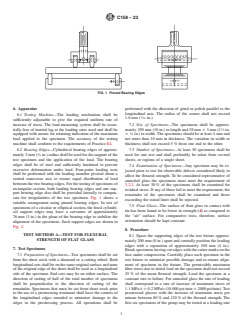
of the test specimen. Fig. 1 shows a suitable arrangement using pinned bearing edges. In test of specimens of a circular or elliptical
section, the fixed cylindrical support edges may have a curvature of approximately 76 mm (3 in.) in the plane of the bearing edge
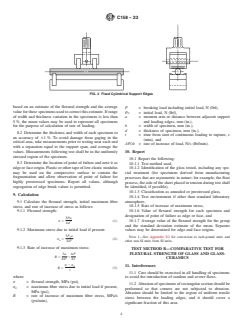
to stabilize the alignment of the specimens. Such support edges are shown in Fig. 2.
The boldface numbers in parentheses refer to a list of references located at the end of this standard.
C158 − 23
FIG. 2 Fixed Cylindrical Support Edges
TEST METHOD A—TEST FOR MODULUS OF RUPTURE FLEXURAL STRENGTH OF FLAT GLASS
7. Test Specimens
7.1 Preparation of Specimens—Test specimens shall be cut from the sheet stock with a diamond or a cutting wheel. Both
longitudinal cuts shall be on the same original surface and none of the original edge of the sheet shall be used as a longitudinal
side of the specimen. End cuts may be on either surface. The direction of cutting of half of the total number of specimens shall
be perpendicular to the direction of cutting of the remainder. Specimens that must be cut from sheet stock prior to the use of a
prestressing treatment shall have the corners of the longitudinal edges rounded to minimize damage to the edges in the prestressing
process. All operations shall be performed with the direction of grind or polish parallel to the longitudinal axis. The radius of the
corner shall not exceed 1.6 mm ( ⁄16 in.).
7.2 Size of Specimens—The specimens shall be approximately 250 mm (10 in.) in length and 38.1 6 3.238 mm 6 3 mm (1 ⁄2 in.
6 ⁄8 in.) in width. The specimens should be at least 4 mm and not more than 10 mm in thickness. The variation in width or
thickness shall not exceed 5 % from one end to the other.
7.3 Number of Specimens—At least 30 specimens shall be used for one test and shall preferably be taken from several sheets, or
regions of a single sheet.
7.4 Examination of Specimens—Any specimen may be rejected prior to test for observable defects considered likely to affect the
modulus of rupture. flexural strength. To be considered representative of annealed glass the specimens must meet the requirement
of 3.2.2. At least 30 % of the specimens shall be examined for residual stress. If any of these fail to meet the requirement, the
remainder of the specimens shall be examined and those exceeding the stated limit shall be rejected.
7.5 Float Glass—The surface of float glass in contact with tin has been found to be lower in strength (14) as compared to the “air”
surface. For comparative tests, therefore, surface orientation should be kept constant.
8. Procedure
8.1 Space the supporting edges of the test fixture approximately 200 mm (8.00(8 in.) apart and centrally position the loading edges
with a separation of approximately 100 mm (4.00(4 in.). Break specimens having cut edges with the cutter marks on the face under
compression. Carefully place each specimen in the test fixture to minimize possible damage and to ensure alignment of specimen
in the fixture. The permissible maximum fiber stress due to initial load on the specimen shall not exceed 25 % of the mean modulus
of rupture. flexural strength. Load the specimen at a constant rate to failure. For annealed glass the rate of loading shall correspond
to a rate of increase of maximum stress of 1.11.1 MPa ⁄s 6 0.2 MPa/s (10 000(10 000 psi ⁄min 6 2000 psi/min). Test prestressed
glasses with the increase of maximum stress per minute between 8080 % and 120 % of the modulus of rupture. flexural strength.
The first six specimens of the group may be tested at a loading rate based on an estimate of the modulus of rupture flexural strength
and the average value for these specimens used to correct this estimate. If range of width and thickness variation in the specimens
is less than 5 %, the mean values may be used to represent all specimens for the purpose of calculation of rate of loading.
C158 − 23
8.2 Determine the thickness and width of each specimen to an accuracy of 61 %. To avoid damage from gaging in the critical
area, take measurements prior to testing near each end with a separation equal to the support span, and average the values.
Measurements following test shall be in the uniformly stressed region of the specimen.
8.3 Determine the location of point of failure and note it as edge or face origin. Plastic or other tape of low elastic modulus may
be used on the compressive surface to contain the fragmentation and allow observation of point of failure for highly prestressed
specimens. Report all values, although segregation of edge break values is permitted.
9. Calculation
9.1 Calculate the modulus of rupture, flexural strength, initial maximum fiber stress, and rate of increase of stress as follows:
9.1.1 Modulus of rupture: Flexural strength:
3 La
S 5 (1)
bd
3Pa
σ 5 (1)
bd
9.1.2 Maximum stress due to initial load if present:
3 L a
S 5 (2)
0 2
bd
3P a
σ 5 (2)
0 2
bd
9.1.3 Rate of increase of maximum stress:
3a ΔL
R 5 × (3)
bd Δt
S
R 5 S 2
t
3a ΔP
R 5 ×
bd Δt
σ 2 σ
R 5 (3)
t
where:
S = modulus of rupture, MPa (psi),
σ = flexural strength, MPa (psi),
S = maximum fiber stress due to initial load if present, MPa (psi),
σ = maximum fiber stress due to initial load if present, MPa (psi),
R = rate of increase of maximum fiber stress, MPa/s (psi/min),
L = breaking load including initial load, N (lbf),
P = breaking load including initial load, N (lbf),
L = initial load, N (lbf),
P = initial load, N (lbf),
a = moment arm or distance between adjacent support and loading edges, mm (in.),
b = width of specimen, mm (in.),
d = thickness of specimen, mm (in.),
t = time from start of continuous loading to rupture, s (min), and
ΔL/Δt = rate of increase of load, N/s (lbf/min).
ΔP/Δt = rate of increase of load, N/s (lbf/min).
C158 − 23
10. Report
10.1 Report the following:
10.1.1 Test method used,
10.1.2 Identification of the glass tested, including any special treatment (for specimens derived from manufacturing processes that
are asymmetric in nature; for example, the float process, the side of the sheet placed in tension during test shall be identified, if
possible),
10.1.3 Classification as annealed or prestressed glass,
10.1.4 Test environment if other than standard laboratory atmosphere,
10.1.5 Rate of increase of maximum stress,
10.1.6 Value of modulus of rupture flexural strength for each specimen and designation of point of failure as edge or face, and
10.1.7 Average value of the modulus of rupture flexural strength for the group and the standard deviation estimate of the mean.
Separate values may be determined for edge and face origins.
NOTE 1—See Annex A3Appendix X2 for conversion fromto inch-pound units and other non-SI units tofrom SI units.
TEST METHOD B—COMPARATIVE TEST FOR MODULUS OF RUPTURE FLEXURAL STRENGTH OF GLASS
AND GLASS-CERAMICS
10. Hazards
10.1 Care should be exercised in all handling of specimens to avoid the introduction of random and severe flaws.
10.2 Abrasion of specimens of rectangular section should be performed so that corners are not subjected to abrasion. Abrasion
should be limited to the region of uniform tensile stress between the loading edges, and it should cover a significant fraction of
this area.
10.3 Following an abrasion procedure, a minimum time of 1 h must elapse before taping or testing of specimens (see A2.2).
10.4 Deflectometers, if used during testing, should not contact the tension face of the specimen.
10.5 If tests are performed at temperatures deviating from ambient, it is necessary to allow the specimen to reach thermal
equilibrium to eliminate the presence of thermally induced stresses in the specimen. The report should indicate the thermal history
prior to testing.
11. Interferences
11.1 Care should be exercised in all handling of specimens to avoid the introduction of random and severe flaws.
11.2 Abrasion of specimens of rectangular section should be performed so that corners are not subjected to abrasion. Abrasion
should be limited to the region of uniform tensile stress between the loading edges, and it should cover a significant fraction of
this area.
11.3 Following an abrasion procedure, a minimum time of 1 h must elapse before taping or testing of specimens (see A2.2).
11.4 Deflectometers, if used during testing, should not contact the tension face of the specimen.
C158 − 23
11.5 If tests are performed at temperatures deviating from ambient, it is necessary to allow the specimen to reach thermal
equilibrium to eliminate the presence of thermally induced stresses in the specimen. The report should indicate the thermal history
prior to testing.
12. Test Specimens
12.1 Preparation of Specimens:
12.1.1 Specimens of rectangular cross section may be prepared by any sequence of conventional operations such as cutting,
sawing, grinding, or polishing. Longitudinal edges on the face to be placed in tension should be chamfered or rounded. The corner
radius shall be a minimum value sufficient to eliminate edge breaks and shall not exceed one tenth the thickness in specimens
approaching a square cross section. Specimens shall have equivalent size and manufacturing procedures in groups to be compared.
The specimen length shall be at least 12.7 mm ( ⁄2 in.) greater in length than the support span used in test. The width to thickness
ratio is recommended to be between 2:1 and 10:1. The minimum width shall be 9.5 mm ( ⁄8 in.), although specimens of greater
width are desirable. The variation in width or thickness shall not exceed 3 % over the length of the specimen equal to the support
span.
12.1.2 Specimens in rod form may be prepared as drawn cane or by procedures such as core drilling and centerless grinding.
Equivalent sizes and manufacturing procedures shall be used on specimens for comparison. The specimen length shall be at least
12.7 mm ( ⁄2 in.) greater than the support span used in the test. The diameter shall be optional, with a minimum value of 4.76 mm
( ⁄16 in.). The variation in a measured diameter shall not exceed 3 % over the length of the specimen equal to the support span.
The length-to-diameter ratio shall be greater than 10:1. Specimens may be elliptical in section, but the minor diameter shall not
be less than 80 % of the major diameter. The specimen shall be straight within 3 mm in 100 mm 3 mm in 100 mm (or ⁄8 in. in
4 in.). The curvature shall be limited to a single plane containing the major or minor diameter of any ellipticity, if this ellipticity
exceeds 5 %.
12.2 Number of Specimens:
12.2.1 It is recommended that at least 30 specimens shall be available for one test if a controlled abrasion procedure is not used
as a normalizing procedure. Utilization of
...