

ASTM F1921/F1921M-12(2023)
(Test Method)Standard Test Methods for Hot Seal Strength (Hot Tack) of Thermoplastic Polymers and Blends Comprising the Sealing Surfaces of Flexible Webs
General Information
- Abstract
SIGNIFICANCE AND USE
5.1 In form-fill operations, sealed areas of packages are frequently subject to disruptive forces while still hot. If the hot seals have inadequate resistance to these forces, breakage can occur during the packaging process. These test methods measure hot seal strength and can be used to characterize and rank materials in their ability to perform in commercial applications where this quality is critical.
SCOPE
1.1 These two test methods cover laboratory measurement of the strength of heatseals formed between thermoplastic surfaces of flexible webs, immediately after a seal has been made and before it cools to ambient temperature (hot tack strength).
1.2 These test methods are restricted to instrumented hot tack testing, requiring a testing machine that automatically heatseals a specimen and immediately determines strength of the hot seal at a precisely measured time after conclusion of the sealing cycle. An additional prerequisite is that the operator shall have no influence on the test after the sealing sequence has begun. These test methods do not cover non-instrumented manual procedures employing springs, levers, pulleys and weights, where test results can be influenced by operator technique.
1.3 Two variations of the instrumented hot tack test are described in these test methods, differing primarily in two respects: (a) rate of grip separation during testing of the sealed specimen, and (b) whether the testing machine generates the cooling curve of the material under test, or instead makes a measurement of the maximum force observed following a set delay time. Both test methods may be used to test all materials within the scope of these test methods and within the range and capacity of the machine employed. They are described in Section 4.
1.4 SI units are preferred and shall be used in referee decisions. Values stated herein in inch-pound units are to be regarded separately and may not be exact equivalents to SI units. Therefore, each system shall be used independently of the other. Combining values from the two systems may result in non-conformance with the standard.
1.5 This standard does not purport to address all of the safety concerns, if any, associated with its use. It is the responsibility of the user of this standard to establish appropriate safety, health, and environmental practices and determine the applicability of regulatory limitations prior to use. The operator of the equipment is to be aware of pinch points as the seal jaws come together to make a seal, hot surfaces of the jaws, and sharp instruments used to cut specimens. It is recommended that the operator review safety precautions from the equipment supplier.
1.6 This international standard was developed in accordance with internationally recognized principles on standardization established in the Decision on Principles for the Development of International Standards, Guides and Recommendations issued by the World Trade Organization Technical Barriers to Trade (TBT) Committee.
- Status
- Published
- Publication Date
- 31-Mar-2023
- Technical Committee
- F02 - Primary Barrier Packaging
- Drafting Committee
- F02.20 - Physical Properties
Overview
ASTM F1921/F1921M-12(2023), titled Standard Test Methods for Hot Seal Strength (Hot Tack) of Thermoplastic Polymers and Blends Comprising the Sealing Surfaces of Flexible Webs, defines robust laboratory procedures for evaluating the hot seal strength – also known as hot tack – of thermoplastic materials used in flexible packaging. Developed by ASTM International, this standard is significant in commercial packaging, especially in form-fill-seal operations, where the integrity of a heat seal under thermal and mechanical stress is crucial.
The standard specifies instrumented test methods to measure the strength of heat seals immediately after sealing, before the seal has cooled to ambient temperature. This allows users to characterize and compare the hot tack performance of various thermoplastic films and blends under conditions simulating real-world packaging operations.
Keywords: hot seal strength, hot tack, flexible webs, thermoplastic polymers, instrumented test methods, packaging integrity, ASTM F1921.
Key Topics
- Purpose of Testing: Measures the resistance of sealed areas to disruptive forces shortly after sealing, when the material is still hot and particularly vulnerable.
- Test Methods: Covers two instrumented hot tack test variations:
- Method A (Fixed Delay): Measures hot tack strength at set delay intervals after the seal jaw opens.
- Method B (Variable Delay): Measures maximum force following a specified delay time.
- Test Equipment: Uses an automated machine capable of forming a seal, applying precise temperature and pressure, and measuring seal strength without operator influence.
- Parameters and Variables:
- Control of sealing jaw temperature, dwell time, pressure, and rate of grip separation.
- Measurement of various failure modes, including adhesive and cohesive failure, delamination, and burnthrough.
- Result Analysis: Produces a hot tack curve, plotting sealing temperature against measured hot tack strength, to evaluate and compare different materials.
Applications
ASTM F1921/F1921M-12(2023) is essential in industries relying on flexible barrier packaging for products such as food, pharmaceuticals, personal care, and industrial materials. Typical applications include:
- Quality Control: Assures packaging material integrity during high-speed automatic packaging processes, minimizing seal failures that can lead to contamination or product loss.
- Material Selection and Development: Ranks and compares thermoplastic films and blends according to their hot tack performance, supporting R&D departments in selecting optimal materials for heat sealing in demanding applications.
- Process Optimization: Helps packaging engineers set appropriate sealing temperatures, dwell times, and pressures for reliable, high-speed form-fill-seal operations.
- Compliance and Reporting: Provides a standardized method for evaluating seal strength, ensuring conformance to industry requirements, customer specifications, and regulatory guidelines.
Related Standards
Several ASTM standards are closely related to the testing of heat seals and flexible packaging materials:
- ASTM D882: Test Method for Tensile Properties of Thin Plastic Sheeting
- ASTM E171: Practice for Conditioning and Testing Flexible Barrier Packaging
- ASTM E691: Practice for Conducting an Interlaboratory Study to Determine the Precision of a Test Method
- ASTM F88: Test Method for Seal Strength of Flexible Barrier Materials
- ASTM F2029: Practices for Making Laboratory Heat Seals for Determination of Heat Sealability of Flexible Barrier Materials
Practical Value
Implementing ASTM F1921/F1921M-12(2023) enhances the reliability of flexible packaging by providing an objective, reproducible means to assess hot tack strength. By applying these standardized test methods, manufacturers reduce the risk of package failure during production, boost consumer safety, and improve product shelf life. This standard supports innovation in packaging materials and strengthens the competitive edge of companies investing in quality packaging solutions.
Relations
- Effective Date
- 01-May-2013
- Effective Date
- 01-Nov-2011
- Effective Date
- 01-Jan-2009
- Effective Date
- 01-Oct-2008
- Effective Date
- 01-Apr-2008
- Effective Date
- 01-May-2007
- Effective Date
- 01-Apr-2007
- Effective Date
- 01-Apr-2006
- Effective Date
- 01-Nov-2005
- Effective Date
- 01-Apr-2005
- Effective Date
- 10-Apr-2002
- Effective Date
- 10-Apr-2002
- Effective Date
- 10-Apr-2002
- Effective Date
- 10-May-2000
- Effective Date
- 10-May-2000
Get Certified
Connect with accredited certification bodies for this standard

DIN CERTCO
DIN Group product certification.

Smithers Quality Assessments
US management systems and product certification.
Sponsored listings
Frequently Asked Questions
ASTM F1921/F1921M-12(2023) is a standard published by ASTM International. Its full title is "Standard Test Methods for Hot Seal Strength (Hot Tack) of Thermoplastic Polymers and Blends Comprising the Sealing Surfaces of Flexible Webs". This standard covers: SIGNIFICANCE AND USE 5.1 In form-fill operations, sealed areas of packages are frequently subject to disruptive forces while still hot. If the hot seals have inadequate resistance to these forces, breakage can occur during the packaging process. These test methods measure hot seal strength and can be used to characterize and rank materials in their ability to perform in commercial applications where this quality is critical. SCOPE 1.1 These two test methods cover laboratory measurement of the strength of heatseals formed between thermoplastic surfaces of flexible webs, immediately after a seal has been made and before it cools to ambient temperature (hot tack strength). 1.2 These test methods are restricted to instrumented hot tack testing, requiring a testing machine that automatically heatseals a specimen and immediately determines strength of the hot seal at a precisely measured time after conclusion of the sealing cycle. An additional prerequisite is that the operator shall have no influence on the test after the sealing sequence has begun. These test methods do not cover non-instrumented manual procedures employing springs, levers, pulleys and weights, where test results can be influenced by operator technique. 1.3 Two variations of the instrumented hot tack test are described in these test methods, differing primarily in two respects: (a) rate of grip separation during testing of the sealed specimen, and (b) whether the testing machine generates the cooling curve of the material under test, or instead makes a measurement of the maximum force observed following a set delay time. Both test methods may be used to test all materials within the scope of these test methods and within the range and capacity of the machine employed. They are described in Section 4. 1.4 SI units are preferred and shall be used in referee decisions. Values stated herein in inch-pound units are to be regarded separately and may not be exact equivalents to SI units. Therefore, each system shall be used independently of the other. Combining values from the two systems may result in non-conformance with the standard. 1.5 This standard does not purport to address all of the safety concerns, if any, associated with its use. It is the responsibility of the user of this standard to establish appropriate safety, health, and environmental practices and determine the applicability of regulatory limitations prior to use. The operator of the equipment is to be aware of pinch points as the seal jaws come together to make a seal, hot surfaces of the jaws, and sharp instruments used to cut specimens. It is recommended that the operator review safety precautions from the equipment supplier. 1.6 This international standard was developed in accordance with internationally recognized principles on standardization established in the Decision on Principles for the Development of International Standards, Guides and Recommendations issued by the World Trade Organization Technical Barriers to Trade (TBT) Committee.
SIGNIFICANCE AND USE 5.1 In form-fill operations, sealed areas of packages are frequently subject to disruptive forces while still hot. If the hot seals have inadequate resistance to these forces, breakage can occur during the packaging process. These test methods measure hot seal strength and can be used to characterize and rank materials in their ability to perform in commercial applications where this quality is critical. SCOPE 1.1 These two test methods cover laboratory measurement of the strength of heatseals formed between thermoplastic surfaces of flexible webs, immediately after a seal has been made and before it cools to ambient temperature (hot tack strength). 1.2 These test methods are restricted to instrumented hot tack testing, requiring a testing machine that automatically heatseals a specimen and immediately determines strength of the hot seal at a precisely measured time after conclusion of the sealing cycle. An additional prerequisite is that the operator shall have no influence on the test after the sealing sequence has begun. These test methods do not cover non-instrumented manual procedures employing springs, levers, pulleys and weights, where test results can be influenced by operator technique. 1.3 Two variations of the instrumented hot tack test are described in these test methods, differing primarily in two respects: (a) rate of grip separation during testing of the sealed specimen, and (b) whether the testing machine generates the cooling curve of the material under test, or instead makes a measurement of the maximum force observed following a set delay time. Both test methods may be used to test all materials within the scope of these test methods and within the range and capacity of the machine employed. They are described in Section 4. 1.4 SI units are preferred and shall be used in referee decisions. Values stated herein in inch-pound units are to be regarded separately and may not be exact equivalents to SI units. Therefore, each system shall be used independently of the other. Combining values from the two systems may result in non-conformance with the standard. 1.5 This standard does not purport to address all of the safety concerns, if any, associated with its use. It is the responsibility of the user of this standard to establish appropriate safety, health, and environmental practices and determine the applicability of regulatory limitations prior to use. The operator of the equipment is to be aware of pinch points as the seal jaws come together to make a seal, hot surfaces of the jaws, and sharp instruments used to cut specimens. It is recommended that the operator review safety precautions from the equipment supplier. 1.6 This international standard was developed in accordance with internationally recognized principles on standardization established in the Decision on Principles for the Development of International Standards, Guides and Recommendations issued by the World Trade Organization Technical Barriers to Trade (TBT) Committee.
ASTM F1921/F1921M-12(2023) is classified under the following ICS (International Classification for Standards) categories: 83.120 - Reinforced plastics. The ICS classification helps identify the subject area and facilitates finding related standards.
ASTM F1921/F1921M-12(2023) has the following relationships with other standards: It is inter standard links to ASTM E691-13, ASTM E691-11, ASTM D882-09, ASTM E691-08, ASTM F2029-08, ASTM F88-07, ASTM E171-94(2007), ASTM F88-06, ASTM E691-05, ASTM F88-05, ASTM D882-00, ASTM D882-01, ASTM D882-02, ASTM F2029-00, ASTM F88-00. Understanding these relationships helps ensure you are using the most current and applicable version of the standard.
ASTM F1921/F1921M-12(2023) is available in PDF format for immediate download after purchase. The document can be added to your cart and obtained through the secure checkout process. Digital delivery ensures instant access to the complete standard document.
Standards Content (Sample)
This international standard was developed in accordance with internationally recognized principles on standardization established in the Decision on Principles for the
Development of International Standards, Guides and Recommendations issued by the World Trade Organization Technical Barriers to Trade (TBT) Committee.
Designation: F1921/F1921M − 12 (Reapproved 2023)
Standard Test Methods for
Hot Seal Strength (Hot Tack) of Thermoplastic Polymers and
Blends Comprising the Sealing Surfaces of Flexible Webs
This standard is issued under the fixed designation F1921/F1921M; the number immediately following the designation indicates the year
of original adoption or, in the case of revision, the year of last revision. A number in parentheses indicates the year of last reapproval.
A superscript epsilon (´) indicates an editorial change since the last revision or reapproval.
1. Scope priate safety, health, and environmental practices and deter-
mine the applicability of regulatory limitations prior to use.
1.1 These two test methods cover laboratory measurement
The operator of the equipment is to be aware of pinch points as
of the strength of heatseals formed between thermoplastic
the seal jaws come together to make a seal, hot surfaces of the
surfaces of flexible webs, immediately after a seal has been
jaws, and sharp instruments used to cut specimens. It is
made and before it cools to ambient temperature (hot tack
recommended that the operator review safety precautions from
strength).
the equipment supplier.
1.2 These test methods are restricted to instrumented hot
1.6 This international standard was developed in accor-
tack testing, requiring a testing machine that automatically
dance with internationally recognized principles on standard-
heatseals a specimen and immediately determines strength of
ization established in the Decision on Principles for the
the hot seal at a precisely measured time after conclusion of the
Development of International Standards, Guides and Recom-
sealing cycle. An additional prerequisite is that the operator
mendations issued by the World Trade Organization Technical
shall have no influence on the test after the sealing sequence
Barriers to Trade (TBT) Committee.
has begun. These test methods do not cover non-instrumented
manual procedures employing springs, levers, pulleys and
2. Referenced Documents
weights, where test results can be influenced by operator
2.1 ASTM Standards:
technique.
D882 Test Method for Tensile Properties of Thin Plastic
1.3 Two variations of the instrumented hot tack test are
Sheeting
described in these test methods, differing primarily in two
E171 Practice for Conditioning and Testing Flexible Barrier
respects: (a) rate of grip separation during testing of the sealed
Packaging
specimen, and (b) whether the testing machine generates the
E691 Practice for Conducting an Interlaboratory Study to
cooling curve of the material under test, or instead makes a
Determine the Precision of a Test Method
measurement of the maximum force observed following a set
F88 Test Method for Seal Strength of Flexible Barrier
delay time. Both test methods may be used to test all materials
Materials
within the scope of these test methods and within the range and
F2029 Practices for Making Laboratory Heat Seals for
capacity of the machine employed. They are described in
Determination of Heat Sealability of Flexible Barrier
Section 4.
Materials as Measured by Seal Strength
1.4 SI units are preferred and shall be used in referee
decisions. Values stated herein in inch-pound units are to be 3. Terminology
regarded separately and may not be exact equivalents to SI
3.1 Definitions:
units. Therefore, each system shall be used independently of
3.1.1 adhesive failure, n—a failure mode in which the seal
the other. Combining values from the two systems may result
fails at the original interface between the surfaces being sealed.
in non-conformance with the standard.
3.1.2 breadth, n—temperature range over which peel force
1.5 This standard does not purport to address all of the
of a seal is (relatively) constant.
safety concerns, if any, associated with its use. It is the
3.1.3 burnthrough, n—a state or condition of a heatseal
responsibility of the user of this standard to establish appro-
characterized by melted holes and thermal distortion.
These test methods are under the jurisdiction of ASTM Committee F02 on
Primary Barrier Packaging and are the direct responsibility of subcommittee F02.20
on Physical Properties. For referenced ASTM standards, visit the ASTM website, www.astm.org, or
Current edition approved April 1, 2023. Published April 2023. Originally contact ASTM Customer Service at service@astm.org. For Annual Book of ASTM
approved in 1998. Last previous edition approved in 2018 as F1921/F1921M – Standards volume information, refer to the standard’s Document Summary page on
12(2018). DOI: 10.1520/F1921-12R23. the ASTM website.
Copyright © ASTM International, 100 Barr Harbor Drive, PO Box C700, West Conshohocken, PA 19428-2959. United States
F1921/F1921M − 12 (2023)
3.1.3.1 Discussion—Burnthrough indicates that the sealing 3.1.12.1 Discussion—This is the basic curve used for com-
conditions (time or temperature, or both) were too high to paring materials for their hot tack performance. It shows not
produce an acceptable seal. only the maximum hot seal strength achievable by each
material and the sealing temperature required, but also the
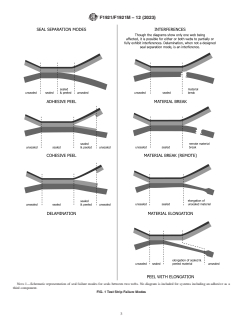
3.1.4 cohesive failure, n—a failure mode where either or
breadth of the sealing temperature range at any specified level
both of the sealed webs fails by splitting approximately parallel
of hot tack. The portion of the curve at higher sealing
to the seal, and the seal itself remains intact.
temperatures may be affected by failure of the substrate rather
3.1.4.1 Discussion—Refer to Fig. 1. The term may be
than the seal and may not be an accurate representation of hot
defined somewhat differently when applied to sealing systems
tack strength.
involving an adhesive material as a separate component.
3.1.13 seal initiation temperature, n—sealing temperature at
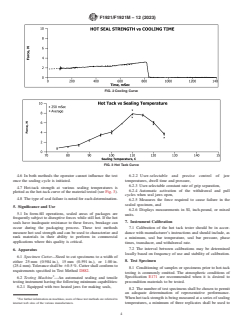
3.1.5 cooling curve, n—the graphical depiction of the in-
which a heatseal of minimum measureable strength is pro-
crease in strength of the seal with time, as it cools during the
duced.
period immediately following conclusion of the sealing cycle
(for example, see Fig. 2). 3.1.14 sealing pressure, n—force required, with transfer of
3.1.5.1 Discussion—The cooling curve is a plot of hot seal heat, to fuse two surfaces together to form a seal. Pressure
strength versus cooling time. The portion of the cooling curve settings may be different than the actual applied pressure and
of greatest practical significance is the first 1000 ms following should be verified as part of instrument calibration.
opening of the heatseal jaws.
3.1.15 sealing temperature, n—maximum temperature
3.1.6 cooling time, n—time in the instrument cycle between reached at the interface between the two web surfaces being
the opening of the seal jaws and the termination of the peel sealed during the dwell time of the sealing cycle.
force measurement. 3.1.15.1 Discussion—Sealing temperature will equal jaw
temperature (both jaws at same temperature) if the dwell time
3.1.7 cycle, n—the combination of instrument mechanical
is long enough for the interface to reach equilibrium with the
and electrical operations automatically performed from initia-
jaws. At this point, seal strength will no longer rise with
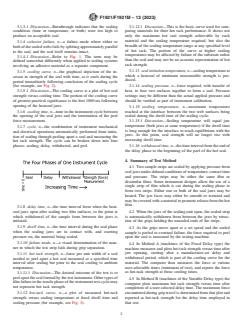
tion of sealing through peeling apart a seal and measuring the
increasing dwell time.
hot tack strength. The cycle can be broken down into four
phases: sealing, delay, withdrawal, and peel. 3.1.16 withdrawal time, n—the time interval from the end of
the delay phase to the beginning of the peel of the hot seal.
4. Summary of Test Method
4.1 Two sample strips are sealed by applying pressure from
seal jaws under defined conditions of temperature, contact time
and pressure. The strips may be either the same film or
dissimilar films. Some instrument designs allow the use of a
single strip of film which is cut during the sealing phase to
form two strips. Either one or both of the seal jaws may be
heated. The jaw faces may either be smooth or textured and
may be covered with a material to promote release from the hot
film.
3.1.8 delay time, n—the time interval from when the heat-
4.2 When the jaws of the sealing unit open, the sealed strip
seal jaws open after sealing two film surfaces, to the point at
which withdrawal of the sample from between the jaws is is automatically withdrawn from between the jaws by retrac-
tion of the grips holding the unsealed ends of the strips.
initiated.
3.1.9 dwell time, n—the time interval during the seal phase
4.3 As the grips move apart at a set speed and the sealed
when the sealing jaws are in contact with, and exerting
sample is peeled to eventual failure, the force required to peel
pressure on, the material being sealed.
open the seal is measured by the testing machine.
3.1.10 failure mode, n—a visual determination of the man-
4.4 In Method A (machines of the Fixed Delay type) the
ner in which the test strip fails during grip separation.
machine measures and plots hot tack strength versus time after
jaw opening, starting after a manufacturer-set delay and
3.1.11 hot tack strength, n—force per unit width of a seal
withdrawal period, which is part of the cooling curve for the
needed to peel apart a hot seal measured at a specified time
material. The computer then measures the force at various
interval after sealing but prior to the seal cooling to ambient
user-selectable times (minimum of two), and reports the force
temperature.
as hot-tack strength at those cooling times.
3.1.11.1 Discussion—The desired outcome of the test is to
peel apart the seal formed by the test instrument. Other types of
4.5 In Method B (machines of the Variable Delay type) the
film failure in the tensile phase of the instrument test cycle may
computer plots maximum hot tack strength versus time after
not represent hot tack strength.
completion of a user-selected delay time. The maximum force
3.1.12 hot-tack curve, n—a plot of measured hot-tack encountered during grip travel is determined from that plot and
strength versus sealing temperature at fixed dwell time and reported as hot-tack strength for the delay time employed in
sealing pressure (for example, see Fig. 3). that test.
F1921/F1921M − 12 (2023)
NOTE 1—Schematic representation of seal failure modes for seals between two webs. No diagram is included for systems including an adhesive as a
third component.
FIG. 1 Test Strip Failure Modes
F1921/F1921M − 12 (2023)
FIG. 2 Cooling Curve
FIG. 3 Hot Tack Curve
4.6 In both methods the operator cannot influence the test 6.2.2 User-selectable and precise control of jaw
once the sealing cycle is initiated. temperatures, dwell time and pressure,
6.2.3 User-selectable constant rate of grip separation,
4.7 Hot-tack strength at various sealing temperatures is
6.2.4 Automatic activation of the withdrawal and pull
plotted as the hot-tack curve of the material tested (see Fig. 3).
cycles when seal jaws open,
4.8 The type of seal failure is noted for each determination.
6.2.5 Measures the force required to cause failure in the
sealed specimen, and
5. Significance and Use
6.2.6 Displays measurements in SI, inch-pound, or mixed
5.1 In form-fill operations, sealed areas of packages are
units.
frequently subject to disruptive forces while still hot. If the hot
7. Instrument Calibration
seals have inadequate resistance to these forces, breakage can
occur during the packaging process. These test methods
7.1 Calibration of the hot tack tester should be in accor-
measure hot seal strength and can be used to characterize and
dance with manufacturer’s instructions and should include, as
rank materials in their ability to perform in commercial
a minimum, seal bar temperature, seal bar pressure, phase
applications where this quality is critical.
times, transducer, and withdrawal rate.
7.2 The interval between calibrations may be determined
6. Apparatus
locally based on frequency of use and stability of calibration.
6.1 Specimen Cutter—Sized to cut specimens to a width of
8. Test Specimen
either 25 mm (0.984 in.), 15 mm (0.591 in.), or 1.00 in.
(25.4 mm). Tolerance shall be 60.5 %. Cutter shall conform to
8.1 Conditioning of samples or specimens prior to hot-tack
requirements specified in Test Method D882.
testing is commonly omitted. The atmospheric conditions of
Specification E171 are recommended when it is desired to
6.2 Testing Machine —An automated sealing and tensile
precondition materials to be tested.
testing instrument having the following minimum capabilities:
6.2.1 Equipped with two heated jaws for making seals,
8.2 The number of test specimens shall be chosen to permit
an adequate determination of representative performance.
When hot tack strength is being measured at a series of sealing
For further information on machines, users of these test methods are referred to
internet web sites of the various manufacturers. temperatures, a minimum of three replicates shall be used to
F1921/F1921M − 12 (2023)
determine the mean value at each temperature. When the
Delay time (user-selectable): 100 ms
Clamp separation rate: 1200 cm/min
measurements are not part of a series where an identifiable
trend is expected, a minimum of five replicates shall be
9.4 Start the machine. It will progress through the seal,
employed. delay, withdrawal, and hot tack strength-testing phases of the
test cycle, and automatically record numerical test data.
8.3 Specimens may be prepared by cutting test material in
either the machine direction (MD) or the transverse direction 9.5 Remove strip from grips. Observe and record mode of
(TD). If the direction of seal stress is of concern, the direction
specimen failure. For meaningful evaluation and comparison
in which the samples are cut should be noted in the final report. of materials, in all test methods and with all types of testing
machines, this step is essential. The mode of failure shall be
8.4 Specimen width may be either 25 mm, 15 mm, or 1.00
determined visually for each specimen tested, in accordance
in. Test results shall identify the width used. Specimen length
with the following or a similar classification, and the results
must be adequate for the testing machine (range of 25 cm to
included in the test report:
35 cm; 10 in. to 14 in.).
Failure Mode, see Fig. 1 (equivalent to Test
8.5 A typical hot tack curve may require 25 to 50 specimens
Method F88, Fig. 4)
of each material. Adhesive failure of the seal; peel
Cohesive failure of the material
8.6 Specimens that fail at some obvious film flaw such as a
Delamination of surface layer (s) from substrate
Break of mate
...