

ASTM E1996-23
(Specification)Standard Specification for Performance of Exterior Windows, Curtain Walls, Doors, and Impact Protective Systems Impacted by Windborne Debris in Hurricanes
General Information
- Abstract
ABSTRACT
This specification covers exterior windows, glazed curtain walls, doors and impact protective systems used in buildings located in geographic regions that are prone to hurricanes. The test specimens shall be Fenestration assemblies, and impact protective systems; which shall be tested using the large missile test, and small missile test. The air pressure cycling, missiles, and impact location are also detailed.
SCOPE
1.1 This specification covers exterior windows, glazed curtain walls, doors, and impact protective systems used in buildings located in geographic regions that are prone to hurricanes.
1.1.1 Exception—Exterior garage doors and rolling doors are governed by ANSI/DASMA 115 and are beyond the scope of this specification.
1.2 This specification provides the information required to conduct Test Method E1886.
1.3 Qualification under this specification provides a basis for judgment of the ability of applicable elements of the building envelope to remain unbreached during a hurricane; thereby minimizing the damaging effects of hurricanes on the building interior and reducing the magnitude of internal pressurization. While this standard was developed for hurricanes, it may be used for other types of similar windstorms capable of generating windborne debris.
1.4 This specification provides a uniform set of guidelines based upon currently available information and research.2 As new information and research becomes available it will be considered.
1.5 All values are stated in SI units and are to be regarded as standard. Values given in parentheses are for information only. Where certain values contained in reference documents cited and quoted herein are stated in inch-pound units, they must be converted by the user.
1.6 The following precautionary statement pertains only to the test method portion, Section 5, of this specification: This standard does not purport to address all of the safety concerns, if any, associated with its use. It is the responsibility of the user of this standard to establish appropriate safety, health, and environmental practices and determine the applicability of regulatory limitations prior to use.
1.7 This international standard was developed in accordance with internationally recognized principles on standardization established in the Decision on Principles for the Development of International Standards, Guides and Recommendations issued by the World Trade Organization Technical Barriers to Trade (TBT) Committee.
- Status
- Published
- Publication Date
- 30-Jun-2023
- Technical Committee
- E06 - Performance of Buildings
- Drafting Committee
- E06.51 - Performance of Windows, Doors, Skylights and Curtain Walls
Buy Documents
ASTM E1996-23 - Standard Specification for Performance of Exterior Windows, Curtain Walls, Doors, and Impact Protective Systems Impacted by Windborne Debris in Hurricanes
REDLINE ASTM E1996-23 - Standard Specification for Performance of Exterior Windows, Curtain Walls, Doors, and Impact Protective Systems Impacted by Windborne Debris in Hurricanes
Overview
ASTM E1996-23, “Standard Specification for Performance of Exterior Windows, Curtain Walls, Doors, and Impact Protective Systems Impacted by Windborne Debris in Hurricanes,” establishes criteria for testing and qualifying exterior fenestration systems and impact protective systems used in hurricane-prone regions. Developed by ASTM International, this specification is essential for ensuring that exterior building elements such as windows, glazed curtain walls, doors, and impact protection systems are robust enough to withstand windborne debris impacts during hurricanes and similar severe windstorms. The standard is a critical tool for building designers, manufacturers, and regulatory authorities seeking to minimize hurricane-related damage and improve occupant safety by maintaining the integrity of the building envelope.
Key Topics
- Scope and Applicability: Covers exterior windows, glazed curtain walls, doors, and impact protective systems in hurricane-prone regions. Not applicable to garage and rolling doors, which are covered under ANSI/DASMA 115.
- Referenced Test Methods: Provides guidelines and requirements to perform ASTM E1886, which outlines the test procedures for evaluating specimen resistance to windborne debris and pressure cycling.
- Missile Impact Testing: Specifies large and small missile impact tests to simulate real hurricane debris impacts. Test criteria are based on building classification, wind zone, and assembly elevation.
- Pass/Fail Criteria: Outlines precise criteria for evaluating test outcomes, ensuring that no breach or significant tear occurs, and that protected openings are not compromised.
- Substitution and Qualification: Describes the process for qualifying alternatives or modifications to initially tested assemblies, offering clear requirements for substitutions and the necessary scope of further testing or engineering evaluation.
Applications
ASTM E1996-23 is widely used for specifying performance requirements in the following contexts:
- Building Design and Construction: Architects and engineers reference this standard to select windows, doors, and façade systems that provide reliable impact protection in regions susceptible to hurricanes or strong windstorms.
- Product Testing and Certification: Manufacturers of fenestration and impact protection products use ASTM E1996-23 as a framework for testing and certifying their products for use in hurricane zones, ensuring compliance with national and international building codes.
- Regulatory Compliance: Local authorities and code officials rely on this standard to verify that installed products meet the necessary performance specifications for safety and protection against windborne debris.
- Retrofits and Upgrades: Building owners and facility managers reference this standard when upgrading existing structures to enhance resilience against hurricanes and minimize internal pressurization and damage.
- Essential Facilities: Critical infrastructure such as hospitals, emergency shelters, fire and police stations must meet the “Enhanced Protection” levels outlined in the standard to ensure continued operation during and after hurricane events.
Related Standards
To ensure comprehensive and consistent protection, ASTM E1996-23 references and aligns with several other key standards, including:
- ASTM E1886: Test Method for Performance of Exterior Windows, Curtain Walls, Doors, and Impact Protective Systems Impacted by Missile(s) and Exposed to Cyclic Pressure Differentials.
- ASCE/SEI 7: Minimum Design Loads and Associated Criteria for Buildings and Other Structures by the American Society of Civil Engineers, which dictates wind speed and risk category determinations.
- ANSI/DASMA 115: Standard for Testing Sectional Garage Doors and Rolling Doors for structural performance under missile impact and cyclic wind pressure.
- International Residential Code (IRC): Provides further context for residential construction and compliance requirements.
- ASTM C719, C1135, D3575, E631: Additional referenced ASTM standards covering material properties, terminology, and specific test procedures for fenestration systems.
Keywords: hurricane impact protection, exterior windows, curtain walls, doors, windborne debris, building envelope, ASTM E1996, impact protective systems, missile testing, cyclic pressure loading, fenestration standards.
Relations
- Refers
ASTM D3575-20 - Standard Test Methods for Flexible Cellular Materials Made from Olefin Polymers - Effective Date
- 01-Feb-2020
- Effective Date
- 01-Oct-2019
- Effective Date
- 01-May-2019
- Effective Date
- 01-Dec-2015
- Effective Date
- 01-Mar-2015
- Effective Date
- 01-Nov-2014
- Effective Date
- 15-Jul-2014
- Refers
ASTM D3575-14 - Standard Test Methods for Flexible Cellular Materials Made From Olefin Polymers - Effective Date
- 01-Jan-2014
- Effective Date
- 01-Oct-2013
- Effective Date
- 01-Sep-2013
- Effective Date
- 15-Jun-2013
- Effective Date
- 01-Jan-2011
- Effective Date
- 15-Jun-2010
- Refers
ASTM D3575-08 - Standard Test Methods for Flexible Cellular Materials Made From Olefin Polymers - Effective Date
- 01-Feb-2008
- Effective Date
- 01-Jun-2006
Buy Documents
ASTM E1996-23 - Standard Specification for Performance of Exterior Windows, Curtain Walls, Doors, and Impact Protective Systems Impacted by Windborne Debris in Hurricanes
REDLINE ASTM E1996-23 - Standard Specification for Performance of Exterior Windows, Curtain Walls, Doors, and Impact Protective Systems Impacted by Windborne Debris in Hurricanes
Get Certified
Connect with accredited certification bodies for this standard

DIBt (Deutsches Institut für Bautechnik)
German Institute for Building Technology.
DIN CERTCO
DIN Group product certification.

Aboma Certification B.V.
Specialized in construction, metal, and transport sectors.
Sponsored listings
Frequently Asked Questions
ASTM E1996-23 is a technical specification published by ASTM International. Its full title is "Standard Specification for Performance of Exterior Windows, Curtain Walls, Doors, and Impact Protective Systems Impacted by Windborne Debris in Hurricanes". This standard covers: ABSTRACT This specification covers exterior windows, glazed curtain walls, doors and impact protective systems used in buildings located in geographic regions that are prone to hurricanes. The test specimens shall be Fenestration assemblies, and impact protective systems; which shall be tested using the large missile test, and small missile test. The air pressure cycling, missiles, and impact location are also detailed. SCOPE 1.1 This specification covers exterior windows, glazed curtain walls, doors, and impact protective systems used in buildings located in geographic regions that are prone to hurricanes. 1.1.1 Exception—Exterior garage doors and rolling doors are governed by ANSI/DASMA 115 and are beyond the scope of this specification. 1.2 This specification provides the information required to conduct Test Method E1886. 1.3 Qualification under this specification provides a basis for judgment of the ability of applicable elements of the building envelope to remain unbreached during a hurricane; thereby minimizing the damaging effects of hurricanes on the building interior and reducing the magnitude of internal pressurization. While this standard was developed for hurricanes, it may be used for other types of similar windstorms capable of generating windborne debris. 1.4 This specification provides a uniform set of guidelines based upon currently available information and research.2 As new information and research becomes available it will be considered. 1.5 All values are stated in SI units and are to be regarded as standard. Values given in parentheses are for information only. Where certain values contained in reference documents cited and quoted herein are stated in inch-pound units, they must be converted by the user. 1.6 The following precautionary statement pertains only to the test method portion, Section 5, of this specification: This standard does not purport to address all of the safety concerns, if any, associated with its use. It is the responsibility of the user of this standard to establish appropriate safety, health, and environmental practices and determine the applicability of regulatory limitations prior to use. 1.7 This international standard was developed in accordance with internationally recognized principles on standardization established in the Decision on Principles for the Development of International Standards, Guides and Recommendations issued by the World Trade Organization Technical Barriers to Trade (TBT) Committee.
ABSTRACT This specification covers exterior windows, glazed curtain walls, doors and impact protective systems used in buildings located in geographic regions that are prone to hurricanes. The test specimens shall be Fenestration assemblies, and impact protective systems; which shall be tested using the large missile test, and small missile test. The air pressure cycling, missiles, and impact location are also detailed. SCOPE 1.1 This specification covers exterior windows, glazed curtain walls, doors, and impact protective systems used in buildings located in geographic regions that are prone to hurricanes. 1.1.1 Exception—Exterior garage doors and rolling doors are governed by ANSI/DASMA 115 and are beyond the scope of this specification. 1.2 This specification provides the information required to conduct Test Method E1886. 1.3 Qualification under this specification provides a basis for judgment of the ability of applicable elements of the building envelope to remain unbreached during a hurricane; thereby minimizing the damaging effects of hurricanes on the building interior and reducing the magnitude of internal pressurization. While this standard was developed for hurricanes, it may be used for other types of similar windstorms capable of generating windborne debris. 1.4 This specification provides a uniform set of guidelines based upon currently available information and research.2 As new information and research becomes available it will be considered. 1.5 All values are stated in SI units and are to be regarded as standard. Values given in parentheses are for information only. Where certain values contained in reference documents cited and quoted herein are stated in inch-pound units, they must be converted by the user. 1.6 The following precautionary statement pertains only to the test method portion, Section 5, of this specification: This standard does not purport to address all of the safety concerns, if any, associated with its use. It is the responsibility of the user of this standard to establish appropriate safety, health, and environmental practices and determine the applicability of regulatory limitations prior to use. 1.7 This international standard was developed in accordance with internationally recognized principles on standardization established in the Decision on Principles for the Development of International Standards, Guides and Recommendations issued by the World Trade Organization Technical Barriers to Trade (TBT) Committee.
ASTM E1996-23 is classified under the following ICS (International Classification for Standards) categories: 91.060.10 - Walls. Partitions. Facades; 91.060.50 - Doors and windows. The ICS classification helps identify the subject area and facilitates finding related standards.
ASTM E1996-23 has the following relationships with other standards: It is inter standard links to ASTM D3575-20, ASTM E1886-19, ASTM C1135-19, ASTM C1135-15, ASTM E631-15, ASTM E631-14, ASTM C719-14, ASTM D3575-14, ASTM E1886-13a, ASTM E1886-13, ASTM C719-13, ASTM C1135-00(2011), ASTM C719-93(2010), ASTM D3575-08, ASTM E631-06. Understanding these relationships helps ensure you are using the most current and applicable version of the standard.
ASTM E1996-23 is available in PDF format for immediate download after purchase. The document can be added to your cart and obtained through the secure checkout process. Digital delivery ensures instant access to the complete standard document.
Standards Content (Sample)
This international standard was developed in accordance with internationally recognized principles on standardization established in the Decision on Principles for the
Development of International Standards, Guides and Recommendations issued by the World Trade Organization Technical Barriers to Trade (TBT) Committee.
Designation: E1996 − 23
Standard Specification for
Performance of Exterior Windows, Curtain Walls, Doors, and
Impact Protective Systems Impacted by Windborne Debris
in Hurricanes
This standard is issued under the fixed designation E1996; the number immediately following the designation indicates the year of
original adoption or, in the case of revision, the year of last revision. A number in parentheses indicates the year of last reapproval. A
superscript epsilon (´) indicates an editorial change since the last revision or reapproval.
1. Scope environmental practices and determine the applicability of
regulatory limitations prior to use.
1.1 This specification covers exterior windows, glazed cur-
1.7 This international standard was developed in accor-
tain walls, doors, and impact protective systems used in
dance with internationally recognized principles on standard-
buildings located in geographic regions that are prone to
ization established in the Decision on Principles for the
hurricanes.
Development of International Standards, Guides and Recom-
1.1.1 Exception—Exterior garage doors and rolling doors
mendations issued by the World Trade Organization Technical
are governed by ANSI/DASMA 115 and are beyond the scope
of this specification. Barriers to Trade (TBT) Committee.
1.2 This specification provides the information required to
2. Referenced Documents
conduct Test Method E1886.
2.1 ASTM Standards:
1.3 Qualification under this specification provides a basis
C719 Test Method for Adhesion and Cohesion of Elasto-
for judgment of the ability of applicable elements of the
meric Joint Sealants Under Cyclic Movement (Hockman
building envelope to remain unbreached during a hurricane;
Cycle)
thereby minimizing the damaging effects of hurricanes on the
C1135 Test Method for Determining Tensile Adhesion Prop-
building interior and reducing the magnitude of internal
erties of Structural Sealants
pressurization. While this standard was developed for
D3575 Test Methods for Flexible Cellular Materials Made
hurricanes, it may be used for other types of similar wind-
from Olefin Polymers
storms capable of generating windborne debris.
E631 Terminology of Building Constructions
1.4 This specification provides a uniform set of guidelines
E1886 Test Method for Performance of Exterior Windows,
based upon currently available information and research. As
Curtain Walls, Doors, and Impact Protective Systems
new information and research becomes available it will be
Impacted by Missile(s) and Exposed to Cyclic Pressure
considered.
Differentials
1.5 All values are stated in SI units and are to be regarded
2.2 ANSI/DASMA Standard:
as standard. Values given in parentheses are for information
ANSI/DASMA 115 Standard Method for Testing Sectional
only. Where certain values contained in reference documents
Garage Doors and Rolling Doors: Determination of Struc-
cited and quoted herein are stated in inch-pound units, they
tural Performance Under Missile Impact and Cyclic Wind
must be converted by the user.
Pressure
1.6 The following precautionary statement pertains only to
2.3 ASCE/SEI Standard:
the test method portion, Section 5, of this specification: This
ASCE/SEI 7 American Society of Civil Engineers Minimum
standard does not purport to address all of the safety concerns,
Design Loads for Buildings and Other Structures
if any, associated with its use. It is the responsibility of the user
of this standard to establish appropriate safety, health, and
For referenced ASTM standards, visit the ASTM website, www.astm.org, or
This specification is under the jurisdiction of ASTM Committee E06 on contact ASTM Customer Service at service@astm.org. For Annual Book of ASTM
Performance of Buildings and is the direct responsibility of Subcommittee E06.51 Standards volume information, refer to the standard’s Document Summary page on
on Performance of Windows, Doors, Skylights and Curtain Walls. the ASTM website.
Current edition approved July 1, 2023. Published August 2023. Originally Available from American National Standards Institute (ANSI), 25 W. 43rd St.,
approved in 1999. Last previous edition approved in 2020 as E1996 – 20. DOI: 4th Floor, New York, NY 10036, http://www.ansi.org.
10.1520/E1996-23. Available from American Society of Civil Engineers (ASCE), 1801 Alexander
See the Significance and Use Section of Test Method E1886. Bell Dr., Reston, VA 20191, http://www.asce.org.
Copyright © ASTM International, 100 Barr Harbor Drive, PO Box C700, West Conshohocken, PA 19428-2959. United States
E1996 − 23
2.4 Other Standard: 4.1.1.2 Three test specimens shall be submitted for the small
International Residential Code missile test.
4.1.1.3 One additional test specimen may be submitted for
3. Terminology
each of the tests should no more than one of the original three
specimens fail any portion of the testing.
3.1 Definitions:
4.1.2 Impact Protective Systems:
3.1.1 General terms used in this specification are defined in
4.1.2.1 A minimum of three test specimens shall be submit-
Terminology E631.
ted for the large missile test for the largest span to be qualified.
3.1.2 Terms common to this specification and Test Method
4.1.2.2 A minimum of three test specimens shall be submit-
E1886 are defined in Test Method E1886, unless defined
ted for the small missile test.
herein.
4.1.2.3 One additional test specimen may be submitted for
3.2 Definitions of Terms Specific to This Standard:
each of the tests should no more than one of the original
3.2.1 assembly elevation, n—vertical dimension above ad-
specimens fail any portion of the testing.
jacent mean ground level at which fenestration or impact
4.1.2.4 For porous impact protective systems, the large and
protective system assembly is to be installed, measured to the
small missile tests shall be allowed to be performed on the
lowest point of the assembly.
same specimens, or on separate specimens. If the large and
3.2.2 basic wind speed, n—three-second gust speeds as
small missile tests are performed on the same specimens, the
defined in the latest edition of ASCE/SEI 7.
small missile impacts shall be performed first, followed by the
large missile impacts.
3.2.3 combination mullion, n—a horizontal or vertical mem-
ber formed by joining two or more individual fenestration units
4.2 Test specimens shall be prepared as specified in Test
together without a mullion stiffener.
Method E1886.
3.2.4 impact protective system, n—construction applied,
4.3 The size of the test specimen shall be determined by the
attached, or locked over an exterior glazed opening system to
specifying authority. All components of each test specimen
protect that system from windborne debris during high wind
shall be full size.
events.
4.4 Where it is impractical to test the entire fenestration
3.2.4.1 Discussion—Impact protective systems include
assembly such as curtain wall and heavy commercial
types that are fixed, operable, or removable.
assemblies, test the largest size of each type of panel as
3.2.5 infill, n—glazing in a fenestration assembly or curtain
required by the specifying authority to qualify the entire
wall.
assembly.
3.2.6 integral mullion, n—a horizontal or vertical member
4.5 Fenestration assemblies and impact protective systems
which is bounded at both ends by crossing frame members.
intended to be mulled together shall be tested separately or
3.2.7 maximum deflection, n—greatest deformation of an
tested by combining three specimens into one mounting frame
element or component under the application of an applied
separated only by the mullions.
force.
3.2.8 maximum dynamic deflection, n—greatest deformation
5. Test Methods
of an element or component during the missile impact.
5.1 Test specimens shall be tested according to Test Method
3.2.9 meeting rail or check rail, n—one of the two horizon-
E1886.
tal members of a sliding sash that come together when in the
5.2 Determine the missile based upon building classificat-
closed position.
ion, wind speed, and assembly elevation according to Section
3.2.10 meeting stile, n—one of the two vertical members of
6.
a sliding sash that come together when in the closed position.
5.3 Location of Impact:
3.2.11 porous impact protective system, n—an assembly
5.3.1 Large Missile Test—Impact each impact protective
whose aggregate open area exceeds ten percent of its projected
system specimen and each fenestration assembly infill type
surface area.
once as shown in Fig. 1.
3.2.12 valley, n—a pivoting axis of an impact protective
5.3.1.1 Impact one specimen with the center of the missile
system designed to rotate adjacent slats or panels outward. 1
within a 65 mm (2 ⁄2 in.) radius circle and with the center of the
circle located at the center of each type of infill.
4. Test Specimens
5.3.1.2 Impact a different specimen with the center of the
missile within a 65 mm (2 ⁄2 in.) radius circle and with the
4.1 Number of Test Specimens:
4.1.1 Fenestration Assemblies: center of the circle located 150 mm (6 in.) from supporting
members at a corner.
4.1.1.1 Three test specimens shall be submitted for the large
missile test. 5.3.1.3 Impact the remaining specimen with the center of
the missile within a 65 mm (2 ⁄2 in.) radius circle and with the
center of the circle located 150 mm (6 in.) from supporting
6 members at a diagonally opposite corner.
Available from International Code Council (ICC), 500 New Jersey Ave., NW,
6th Floor, Washington, DC 20001, http://www.iccsafe.org. 5.3.2 Special Considerations:
E1996 − 23
5.3.3.4 The center impact location shall be entirely within a
250 mm (10 in.) radius circle having its center located at the
horizontal and vertical centerline of the infill.
NOTE 1—Impact locations for small missile test may overlap depending
on the size of the specimen.
5.4 Air Pressure Cycling:
5.4.1 Air Pressure Differential:
5.4.1.1 The air pressure portion of the test shall use the test
loading program in Table 1. Select P and P for the
pos neg
maximum inward (positive) and maximum outward (negative)
air pressure differential for which qualification is sought.
5.4.1.2 The air pressure differential to be used for porous
FIG. 1 Impact Locations for Large Missile Test
(Each Type of Infill) impact protective systems shall be F (the design wind force for
other structures as specified in ASCE/SEI 7) divided by the
horizontally projected area of the entire assembly.
5.4.2 Porous impact protective systems whose aggregate
5.3.2.1 For test specimens containing multiple panels, im-
open area exceeds 50 % of their projected surface area that
pact the exterior glazing surface innermost from the exterior
pass the small missile test and that are not subject to the large
plane of the fenestration assembly or impact protective system
missile test need not be tested for the air pressure portion of the
panel innermost from the exterior.
test described in this section.
5.3.2.2 For test specimens containing fixed and operable
5.5 For impact protective system specimens that are tested
panels of the same type of infill, impact the operable portion.
independently of the fenestration assemblies they are intended
5.3.2.3 For operable test specimens, a corner impact loca-
to protect, measure, and record both the maximum dynamic
tion shall be nearest a locking device and the other corner
deflection and the residual deflection following the impact test
impact location shall be at a corner diagonally opposite.
and measure and record the maximum positive deflection in
5.3.2.4 For test specimens with bracing at the specified
combination with the residual deflection during the air pressure
impact location(s), the impact location(s) shall be relocated to
cycling test. Measure all deflections to the nearest 2 mm
the nearest area with no bracing.
(0.1 in.).
5.3.2.5 The impacts on accordion impact protective systems
shall be at the valleys located closest to the impact locations
6. Missiles
shown in Fig. 1.
5.3.3 Small Missile Test—Impact each impact protective 6.1 The specifying authority shall select an applicable
system specimen and each fenestration assembly infill type
missile by defining a level of protection, a wind zone, and an
three times with ten steel balls each as shown in Fig. 2.
assembly elevation above the ground.
5.3.3.1 Each impact location shall receive distributed im-
6.2 The applicable missile from Table 2 shall be chosen
pacts simultaneously from ten steel balls. The impact shall be
using Table 3 or Table 4, unless otherwise specified.
described in the test report.
6.2.1 Unless otherwise specified, select the appropriate level
5.3.3.2 The corner impact locations shall be entirely within
of building protection from 6.2.1.1 – 6.2.1.3 and enter Table 3
a 250 mm (10 in.) radius circle having its center located at
or Table 4 at the appropriate column.
275 mm (11 in.) from the edges.
6.2.1.1 Enhanced Protection (Essential Facilities)—
5.3.3.3 The edge impact locations shall be entirely within a
Buildings and other structures designated as essential facilities,
250 mm (10 in.) radius circle at the centerline between two
including, but not limited to, hospitals; other health care
corners having its center located at 275 mm (11 in.) from the
facilities having emergency treatment facilities; jails and de-
edge.
tention facilities; fire, rescue and police stations, and emer-
gency vehicle garages; designated emergency shelters; com-
munications centers and other facilities required for emergency
TABLE 1 Cyclic Static Air Pressure Loading
Loading Number of Air
Loading Direction Air Pressure Cycles
Sequence Pressure Cycles
1 Positive 0.2 to 0.5 P 3500
pos
2 Positive 0.0 to 0.6 P 300
pos
3 Positive 0.5 to 0.8 P 600
pos
4 Positive 0.3 to 1.0 P 100
pos
5 Negative 0.3 to 1.0 P 50
neg
6 Negative 0.5 to 0.8 P 1050
neg
7 Negative 0.0 to 0.6 P 50
neg
FIG. 2 Impact Locations for Small Missile Test 8 Negative 0.2 to 0.5 P 3350
neg
(Each Type of Infill)
E1996 − 23
TABLE 2 Applicable Missiles
6.2.2.3 Wind Zone 3—Basic wind speed ≥150 mph (67 m/s)
Impact Speed or ≥140 mph (63 m/s) and within 1.6 km (1 mile) of the
Missile Level Missile
(m/s)
coastline. The coastline shall be measured from the mean high
A 2 g (31 grains) ± 5 % steel ball 39.62 (130 f/s)
water mark.
6.2.2.4 A specifying authority who wishes to specify addi-
B 910 g ± 100 g (2.0 lb ± 0.25 lb) 2 × 4 in. 15.25 (50 f/s)
52.5 cm ± 100 mm (1 ft – 9 in. ± 4 in.) lumber
tional protection from hurricane damage may use the informa-
tion in Appendix X4, Additional Protection.
C 2050 g ± 100 g (4.5 lb ± 0.25 lb) 2 × 4 in. 12.19 (40 f/s)
1.2 m ± 100 mm (4 ft ± 4 in.) lumber
7. Pass/Fail Criteria
D 4100 g ± 100 g (9.0 lb ± 0.25 lb) 2 × 4 in. 15.25 (50 f/s)
2.4 m ± 100 mm (8 ft ± 4 in.) lumber 7.1 In Wind Zones 1, 2, and 3, the specifying authority shall
select an applicable pass/fail criterion based on 7.1.1 and 7.1.2.
E 4100 g ± 100 g (9.0 lb ± 0.25 lb) 2 × 4 in. 24.38 (80 f/s)
7.1.1 Fenestration Assemblies and Non-Porous Impact Pro-
2.4 m ± 100 mm (8 ft ± 4 in.) lumber
tective Systems:
7.1.1.1 The test specimen shall resist the large or small
TABLE 3 Description Levels
missile impacts, or both, with no tear formed longer than 130
mm (5 in.) and wider than 1 mm ( ⁄16 in.) through which air can
NOTE 1—For Missiles B, C, D, and E, also use Missile A for porous
pass, or with no opening formed through which a 76 mm (3 in.)
impact protective systems (see 8.5).
diameter solid sphere can freely pass when evaluated upon
Level of Enhanced Protection
Basic Protection Unprotected
Protection (Essential Facilities) completion of missile impacts and test loading program.
Assembly Elevation #9.1 m >9.1 m #9.1 m >9.1 m #9.1 m >9.1 m 7.1.1.2 All test specimens meeting the enhanced protection
(30 ft) (30 ft) (30 ft) (30 ft) (30 ft) (30 ft)
impact levels shall resist the large or small missile impacts, or
Wind Zone 1 D D C A None None
both, without penetration of the inner plane of the infill or
Wind Zone 2 D D C A None None
Wind Zone 3 E D D A None None
impact protective system, and resist the cyclic pressure loading
specified in Table 1 with no tear formed longer than 130 mm (5
in.) and wider than 1 mm ( ⁄16 in.) through which air can pass.
TABLE 4 Description of Levels for Rooftop Skylights
7.1.2 Porous Impact Protective Systems Tested Indepen-
in One- and Two-Family Dwellings
dently of the Fenestration Assemblies They are Protecting:
NOTE 1—The term “One- and Two-Family Dwellings” includes all
7.1.2.1 There shall be no penetration of the innermost plane
buildings included under the scope of the International Residential Code.
of the test specimen by the applicable missile(s) during the
Level of Protection Basic Protection
impact test(s).
Assembly Elevation #9.1 m (30 ft) >9.1 m (30 ft)
7.1.2.2 Upon completion of the missile impact(s) and test
Wind Zone 1 A A
loading program, there shall be no horizontally projected
Wind Zone 2 B A
opening formed through which a 76 mm (3 in.) diameter solid
Wind Zone 3 C A
sphere can pass.
8. Product Qualification
8.1 When all test specimens submitted have met the require-
response; power generating stations; other public utility facili-
ments of this specification based on the pass/fail criteria
ties required in an emergency; and buildings and other struc-
described in Section 7, except in the case of 8.2, the set of test
tures having critical national defense functions.
specimens shall be accepted according to the designated
6.2.1.2 Basic Protection—All buildings and structures ex-
building classification, wind speed, and assembly elevation.
cept those listed in 6.2.1.1 and 6.2.1.3.
8.2 If any test specimen fails to meet the requirements of
6.2.1.3 Unprotected—Buildings and other structures that
this specification based on the pass/fail criteria described in
represent a low hazard to human life in a windstorm including,
Section 7, it shall be rejected and one additional identical test
but not limited to: agricultural facilities, production
shall be performed on the additional specimen specified in
greenhouses, certain temporary facilities, and storage facilities.
4.1.1.3 or 4.1.2.3. Any additional failures shall constitute
6.2.2 Unless otherwise specified, select the wind zone based
failure of the entire set of test specimens and it shall be
on the basic wind speed as specified in 6.2.2.1 – 6.2.2.3. For
rejected.
Basic Protection buildings, use the ASCE/SEI 7 V map for
ULT
8.3 Impact protective system offset requirements:
risk category II. For Enhanced Protection buildings, use the
8.3.1 Porous impact protective systems that are tested inde-
ASCE/SEI 7 V map for risk category IV.
ULT
pendently of the fenestration assembly shall be accepted for
6.2.2.1 Wind Zone 1—130 mph (58 m/s) ≤ basic wind speed
installations in which they are offset from the fenestration
<140 mph (63 m/s), and Hawaii.
assemblies by the greater of the following:
6.2.2.2 Wind Zone 2—140 mph (63 m/s) ≤ basic wind speed 8.3.1.1 The maximum dynamic deflection, as measured in
<150 mph (67 m/s) at greater than 1.6 km (one mile) from the 5.5 plus 25 %; or
coastline. The coastline shall be measured from the mean high
8.3.1.2 The sum of the maximum positive deflection and the
water mark. residual deflection, as measured in 5.5 plus 25 %.
E1996 − 23
8.3.2 Non-porous impact protective systems in essential 8.7 Qualification at any load level automatically includes
facilities in all wind zones that are tested independently of the qualification for all lower load levels.
fenestration assembly shall be accepted for installations in
which they are offset from the fenestration assemblies by the
9. Compliance Statement
greater of the following:
9.1 Report the following information:
8.3.2.1 The maximum dynamic deflection, as measured in
9.1.1 Detailed description of test specimen(s) and test re-
5.5 mm + 2 mm (0.1 in.); or
sults in accordance with the report section of Test Method
8.3.2.2 The sum of the maximum positive deflection and the
residual deflection, as measured in 5.5 mm + 2 mm (0.1 in.). E1886.
9.1.2 Missile type and cyclic loading pressure(s) for which
8.4 Fenestration and non-porous impact protective systems
the test specimen qualified.
that have passed the large missile impact test are not required
to pass the small missile test.
9.2 Attach a copy of the test report from Test Method
8.5 Substitutions:
E1886, to the compliance statement for this specification.
8.5.1 Substitutions within fenestration assemblies with suc-
cessful tests shall be in accordance with Annex A1.
10. Keywords
8.5.2 Substitutions within impact protection systems with
10.1 building envelope; curtain walls; cyclic pressure load-
successful tests shall be in accordance with Annex A2.
ing; doors; fenestration; hurricanes; impact protective systems;
8.6 Manufactured assemblies successfully tested shall not
missile impact; windborne debris; windows; windstorms
be combined unless the structural supports and connections
between assemblies have been designed for the wind loads.
ANNEXES
(Mandatory Information)
A1. FENESTRATION SUBSTITUTIONS
A1.1 Introduction A1.2.2 Engineering Analysis—Demonstrated or docu-
mented performance through a review of materials that predi-
A1.1.1 Substitution allowances are presented in the follow-
cates a minimum of equivalent performance.
ing text. There are three types of substitutions for fenestration
assemblies qualified under this standard: (1) substitutions of A1.2.3 Single Specimen—One specimen, identical to the
infill elements, (2) substitutions of anchorage, and (3) substi-
original specimens qualified with the only difference being the
tutions of all other elements. elements to be substituted.
A1.1.2 The substitution criteria in Annex A1 are related to
A1.2.4 Not Allowed—Not qualified by testing of a single
impact and cycling performance only as found in this specifi- specimen. Three identical specimens out of four are required to
cation and in Test Method E1886 and do not qualify systems
qualify the substitution, as for a new product.
for other performance attributes.
A1.3 General Premises for Substitution
A1.1.3 The substitution language applies to the following
A1.3.1 Substitutions are only allowed to assemblies that
fenestration types (representative diagrams of these fenestra-
have initially qualified by having three initial specimens that
tion types are located in Fig. A1.1):
are identical in every way, excluding anchorage and mounting,
Sliding windows
pass all the prescribed performance requirements of Section 8.
Sliding doors
Storefront framing
A1.3.2 For fenestration assemblies other than curtain wall
Fixed windows
Mullions
and storefront, any substitution of an assembly of the same
Projected or hinged windows
type as the three initial specimens shall be allowed
Dual action windows and doors
automatically, provided the substitution is (1) equal to or
Hinged doors
Curtain wall
smaller in overall area, (2) contains the same or a fewer
Skylights and roof windows
number of equal dimension or smaller dimension sash, panels,
A1.1.3.1 Specialty windows and greenhouse windows are
or lites, and (3) is rated at equal or lower design pressures.
not covered in these substitution allowances.
Assemblies are allowed automatically to be stretched in one
dimension only, provided (1) the overall area of the originally
A1.2 Substitution Categories
tested specimens is not exceeded, (2) the span of any interme-
A1.2.1 Automatic—No additional testing or analysis neces- diate member is not exceeded, and (3) the rating of the
sary. originally tested specimens is not exceeded. Engineering
E1996 − 23
FIG. A1.1 Visual Grouping of Window Types in This Specification
analysis or testing of additional specimen sizes can be con- A1.3.4.4 Multiple substituted elements that are individually
ducted to override these limitations. qualified by a single specimen test shall be allowed to be
A1.3.2.1 For curtain wall and storefront, any substitution of combined into a system when supported by engineering
an assembly of the same type as the three initial specimens
analysis.
shall be allowed automatically, provided (1) the infill elements
A1.3.5 Anchorage:
are equal to or smaller in overall area, and (2) the rating is at
A1.3.5.1 Each method of anchoring shall be qualified by
equal or lower design pressures. Assemblies are allowed
testing a single specimen in the condition that produces the
automatically to be stretched in one dimension only, provided
greatest load on the anchoring method, or qualified by engi-
(1) the overall area of the originally tested specimens is not
neering analysis.
exceeded, (2) the deflection and stress limits of any structural
member or component is not exceeded, and (3) the rating of the A1.3.5.2 Any substitution of the fastener within an anchor-
originally tested specimens is not exceeded. Testing of addi- ing method, supported by engineering analysis to be equal to or
tional specimen sizes can be conducted to override these stronger than the initial qualified fastener, shall be allowed
limitations.
automatically provided the original spacing is not exceeded.
A1.3.3 For products qualified under 5.3.3, Small Missile
A1.3.6 Insect Screens—If the initial specimens were tested
Test, substitutions of all elements that are not infill elements or
without screens the addition of screens shall be allowed
anchorage shall be allowed automatically.
automatically. If the initial specimens were tested with insect
A1.3.4 For products qualified under 5.3.1, Large Missile screens, substitution or elimination of the insect screen shall
Test, substitutions of all elements that are not infill elements or require single specimen testing.
anchorage shall be allowed according to the criteria below:
PREMISES FOR SUBSTITUTION—GLAZED
A1.3.4.1 Any substitution testing shall be qualified at a
PRODUCTS
pressure equal to or greater than the design pressure at which
the three initial specimens were qualified. However, the origi-
A1.4 General
nally achieved qualified design pressure shall be maintained.
A1.3.4.2 Any substitution of an element shall not be al- A1.4.1 When substituting an element on the basis of a single
specimen test refer to Fig. 1 (for large missile impact in Wind
lowed if a failure occurs for any reason during a single
specimen test of that substitution. Zones 1-3), Fig. X4.1 (for large missile impact in Wind Zone
A1.3.4.3 Automatically substituted elements shall be al- 4), or Fig. 2 (for small missile impact). Select the worst case
lowed to be combined into a system. for impact locations.
E1996 − 23
A1.5 Glazing Sealants, Adhesives, and Backbedding A1.7.4.2 Annealed to chemically-strengthened.
A1.7.4.3 Annealed to fully tempered.
A1.5.1 Substitution of glazing sealants, insulating glass
A1.7.4.4 Heat-strengthened to fully tempered.
primary or secondary sealants, adhesives, or backbedding color
A1.7.4.5 Chemically-strengthened to fully tempered.
shall require the testing of a single specimen, or when
supported by engineering analysis provided the only change A1.7.5 Glass type change from heat-strengthened to an-
from the initial three qualified specimens is a change in the nealed or heat-strengthened to chemically-strengthened shall
sealant color and documentation is provided that the nominal not be allowed.
specific gravity of the substituted material is 60.06 from that
A1.7.6 Glass type change from fully tempered to heat-
used in the initial three specimens or historic data/
strengthened, chemically-strengthened, or annealed shall not
documentation is provided showing that different colors per-
be allowed.
form to the same performance properties that are either within
A1.7.7 Glass decorative surface (sandblasted, acid etched,
or outside the allowable specific gravity range.
and so forth) substitution shall require a single specimen test.
A1.5.2 Any substitution within the fenestration glazing
sealant, insulating glass primary or secondary sealants, adhe- A1.8 Insulating Glass Units
sives or backbedding demonstrated to be equal to or stronger in
A1.8.1 Preconditions for Insulating Glass Unit Substitu-
ultimate tensile strength as shown in Test Method C1135 than
tions:
the initial three qualified specimens shall require a single
A1.8.1.1 The impact resisting lite (monolithic or laminated)
specimen test. Substitution of a sealant, adhesive or backbed-
of an insulating glass unit shall be composed of the same glass
ding material with a lower movement capability as shown in
type and treatment with equal thickness or thicknesses of glass,
Test Method C719 shall not be allowed.
and thicker or equal interlayer of the same manufacturer and
type as originally tested and approved.
A1.6 Glazing Tapes
A1.8.1.2 The glazing detail (glazing sealants, adhesives,
A1.6.1 Substitution of glazing tape color shall require a
stops, etc.) shall be unchanged other than to accommodate any
single specimen test, or shall be supported by engineering
variations in overall glazing thickness.
analysis provided the only change from the initial three
A1.8.1.3 Substitutions for insulating glass shall only be
qualified specimens is a change in the tape color, as follows:
made for systems with the impact resistant glazing structurally
A1.6.1.1 For preformed tapes, documentation is provided
adhered to the frame or sash glazing leg or bed in the same
that the nominal specific gravity of the substituted material is
manner and position as originally tested and approved.
60.06 from that used in the initial three specimens or historic
A1.8.1.4 In an insulating glass unit, typically one lite
data/documentation is provided showing that different colors
provides the impact resistance (usually a laminated lite) and the
perform to the same performance properties that are either
other lite is considered to be “sacrificial.” This sacrificial lite
within or outside the allowable specific gravity range.
can fracture without detriment to the impact resistant lite which
A1.6.1.2 For foam tapes, documentation is provided that the
is providing the actual building envelope protection.
specific gravity, as determined by Test Methods D3575 does
A1.8.1.5 Glazing systems typically have a stationary glaz-
not differ by more than 620 % from that used in the initial
ing stop that is a permanent part of the frame or sash, or a
three specimens.
removable glazing stop (also referred to as a glazing bead), or
both. If a removable stop is used, a system can be tested with
A1.6.2 Any substitution within the fenestration glazing
this stop removed, if it considered to be non-structural and
tapes demonstrated by an applicable reference standard to be
unnecessary to pass the required test.
equal to or stronger than the initial three qualified specimens
shall require a single specimen test.
A1.8.2 Systems Tested with a Removable Glazing Stop or
Bead in Place:
A1.7 Glass Plies
A1.8.2.1 Any substitution to an insulating glass unit from a
A1.7.1 Glass color change shall be allowed automatically.
single glazing (monolithic or laminated glass) shall require the
testing of one additional specimen provided the system meets
A1.7.2 Substitution or adding of glass coating (reflective,
all the preconditions in A1.8.1.
coated, low-e, frit, and so forth) shall be allowed when
A1.8.2.2 Substitutions in glass treatment, specifically and
supported by engineering analysis of the durability and com-
only from annealed to tempered, or annealed to heat-
patibility of the treatment with glazing infill, interlayer, and
strengthened, or heat-strengthened to tempered shall be al-
sealant, adhesives or back-bedding materials.
lowed automatically to sacrificial lites (see A1.8.1.4) of insu-
A1.7.3 For any non-sacrificial lite, individual glass ply
lating glass units, provided the system mee
...
This document is not an ASTM standard and is intended only to provide the user of an ASTM standard an indication of what changes have been made to the previous version. Because
it may not be technically possible to adequately depict all changes accurately, ASTM recommends that users consult prior editions as appropriate. In all cases only the current version
of the standard as published by ASTM is to be considered the official document.
Designation: E1996 − 20 E1996 − 23
Standard Specification for
Performance of Exterior Windows, Curtain Walls, Doors, and
Impact Protective Systems Impacted by Windborne Debris
in Hurricanes
This standard is issued under the fixed designation E1996; the number immediately following the designation indicates the year of
original adoption or, in the case of revision, the year of last revision. A number in parentheses indicates the year of last reapproval. A
superscript epsilon (´) indicates an editorial change since the last revision or reapproval.
1. Scope
1.1 This specification covers exterior windows, glazed curtain walls, doors, and impact protective systems used in buildings
located in geographic regions that are prone to hurricanes.
1.1.1 Exception—Exterior garage doors and rolling doors are governed by ANSI/DASMA 115 and are beyond the scope of this
specification.
1.2 This specification provides the information required to conduct Test Method E1886.
1.3 Qualification under this specification provides a basis for judgment of the ability of applicable elements of the building
envelope to remain unbreached during a hurricane; thereby minimizing the damaging effects of hurricanes on the building interior
and reducing the magnitude of internal pressurization. While this standard was developed for hurricanes, it may be used for other
types of similar windstorms capable of generating windborne debris.
1.4 This specification provides a uniform set of guidelines based upon currently available information and research. As new
information and research becomes available it will be considered.
1.5 All values are stated in SI units and are to be regarded as standard. Values given in parentheses are for information only. Where
certain values contained in reference documents cited and quoted herein are stated in inch-pound units, they must be converted
by the user.
1.6 The following precautionary statement pertains only to the test method portion, Section 5, of this specification: This
standard does not purport to address all of the safety concerns, if any, associated with its use. It is the responsibility of the user
of this standard to establish appropriate safety, health, and environmental practices and determine the applicability of regulatory
limitations prior to use.
1.7 This international standard was developed in accordance with internationally recognized principles on standardization
established in the Decision on Principles for the Development of International Standards, Guides and Recommendations issued
by the World Trade Organization Technical Barriers to Trade (TBT) Committee.
This specification is under the jurisdiction of ASTM Committee E06 on Performance of Buildings and is the direct responsibility of Subcommittee E06.51 on Performance
of Windows, Doors, Skylights and Curtain Walls.
Current edition approved Sept. 1, 2020July 1, 2023. Published September 2020August 2023. Originally approved in 1999. Last previous edition approved in 20172020
as E1996 – 17.E1996 – 20. DOI: 10.1520/E1996-20.10.1520/E1996-23.
See the Significance and Use Section of Test Method E1886.
Copyright © ASTM International, 100 Barr Harbor Drive, PO Box C700, West Conshohocken, PA 19428-2959. United States
E1996 − 23
2. Referenced Documents
2.1 ASTM Standards:
C719 Test Method for Adhesion and Cohesion of Elastomeric Joint Sealants Under Cyclic Movement (Hockman Cycle)
C1135 Test Method for Determining Tensile Adhesion Properties of Structural Sealants
D3575 Test Methods for Flexible Cellular Materials Made from Olefin Polymers
E631 Terminology of Building Constructions
E1886 Test Method for Performance of Exterior Windows, Curtain Walls, Doors, and Impact Protective Systems Impacted by
Missile(s) and Exposed to Cyclic Pressure Differentials
2.2 ASCE/SEI Standard:
ASCE/SEI 7 American Society of Civil Engineers Minimum Design Loads for Buildings and Other Structures
2.2 ANSI/DASMA Standard:
ANSI/DASMA 115 Standard Method for Testing Sectional Garage Doors and Rolling Doors: Determination of Structural
Performance Under Missile Impact and Cyclic Wind Pressure
2.3 ASCE/SEI Standard:
ASCE/SEI 7 American Society of Civil Engineers Minimum Design Loads for Buildings and Other Structures
2.4 Other Standard:
International Residential Code
3. Terminology
3.1 Definitions:
3.1.1 General terms used in this specification are defined in Terminology E631.
3.1.2 Terms common to this specification and Test Method E1886 are defined in Test Method E1886, unless defined herein.
3.2 Definitions of Terms Specific to This Standard:
3.2.1 assembly elevation—elevation, n—vertical dimension above adjacent mean ground level at which fenestration or impact
protective system assembly is to be installed, measured to the lowest point of the assembly.
3.2.2 basic wind speed—speed, n—three-second gust speeds as defined in the latest edition of ASCE/SEI 7.
3.2.3 combination mullion—mullion, n—a horizontal or vertical member formed by joining two or more individual fenestration
units together without a mullion stiffener.
3.2.4 impact protective system—system, n—construction applied, attached, or locked over an exterior glazed opening system to
protect that system from windborne debris during high wind events.
3.2.4.1 Discussion—
Impact protective systems include types that are fixed, operable, or removable.
3.2.5 infill—infill, n—glazing in a fenestration assembly or curtain wall.
3.2.6 integral mullion—mullion, n—a horizontal or vertical member which is bounded at both ends by crossing frame members.
3.2.7 maximum deflection—deflection, n—Greatestgreatest deformation of an element or component under the application of an
applied force.
3.2.8 maximum dynamic deflection—deflection, n—greatest deformation of an element or component during the missile impact.
For referenced ASTM standards, visit the ASTM website, www.astm.org, or contact ASTM Customer Service at service@astm.org. For Annual Book of ASTM Standards
volume information, refer to the standard’s Document Summary page on the ASTM website.
Available from American Society of Civil Engineers (ASCE), 1801 Alexander Bell Dr., Reston, VA 20191, http://www.asce.org.
Available from American National Standards Institute (ANSI), 25 W. 43rd St., 4th Floor, New York, NY 10036, http://www.ansi.org.
Available from International Code Council (ICC), 500 New Jersey Ave., NW, 6th Floor, Washington, DC 20001, http://www.iccsafe.org.
E1996 − 23
3.2.9 meeting rail or check rail—rail, n—one of the two horizontal members of a sliding sash that come together when in the
closed position.
3.2.10 meeting stile—stile, n—one of the two vertical members of a sliding sash that come together when in the closed position.
3.2.11 porous impact protective system—system, n—an assembly whose aggregate open area exceeds ten percent of its projected
surface area.
3.2.12 valley—valley, n—a pivoting axis of an impact protective system designed to rotate adjacent slats or panels outward.
4. Test Specimens
4.1 Number of Test Specimens:
4.1.1 Fenestration Assemblies:
4.1.1.1 Three test specimens shall be submitted for the large missile test.
4.1.1.2 Three test specimens shall be submitted for the small missile test.
4.1.1.3 One additional test specimen may be submitted for each of the tests should no more than one of the original three
specimens fail any portion of the testing.
4.1.2 Impact Protective Systems:
4.1.2.1 A minimum of three test specimens shall be submitted for the large missile test for the largest span to be qualified.
4.1.2.2 A minimum of three test specimens shall be submitted for the small missile test.
4.1.2.3 One additional test specimen may be submitted for each of the tests should no more than one of the original specimens
fail any portion of the testing.
4.1.2.4 For porous impact protective systems, the large and small missile tests shall be allowed to be performed on the same
specimens, or on separate specimens. If the large and small missile tests are performed on the same specimens, the small missile
impacts shall be performed first, followed by the large missile impacts.
4.2 Test specimens shall be prepared as specified in Test Method E1886.
4.3 The size of the test specimen shall be determined by the specifying authority. All components of each test specimen shall be
full size.
4.4 Where it is impractical to test the entire fenestration assembly such as curtain wall and heavy commercial assemblies, test the
largest size of each type of panel as required by the specifying authority to qualify the entire assembly.
4.5 Fenestration assemblies and impact protective systems intended to be mulled together shall be tested separately or tested by
combining three specimens into one mounting frame separated only by the mullions.
5. Test Methods
5.1 Test specimens shall be tested according to Test Method E1886.
5.2 Determine the missile based upon building classification,classificat-
ion, wind speed, and assembly elevation according to Section 6.
E1996 − 23
5.3 Location of Impact:
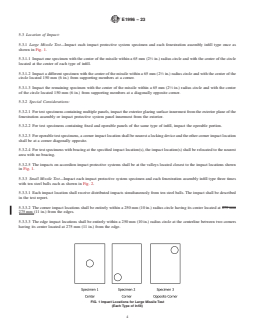
5.3.1 Large Missile Test—Impact each impact protective system specimen and each fenestration assembly infill type once as
shown in Fig. 1.
5.3.1.1 Impact one specimen with the center of the missile within a 65 mm (2 ⁄2 in.) radius circle and with the center of the circle
located at the center of each type of infill.
5.3.1.2 Impact a different specimen with the center of the missile within a 65 mm (2 ⁄2 in.) radius circle and with the center of the
circle located 150 mm (6 in.) from supporting members at a corner.
5.3.1.3 Impact the remaining specimen with the center of the missile within a 65 mm (2 ⁄2 in.) radius circle and with the center
of the circle located 150 mm (6 in.) from supporting members at a diagonally opposite corner.
5.3.2 Special Considerations:
5.3.2.1 For test specimens containing multiple panels, impact the exterior glazing surface innermost from the exterior plane of the
fenestration assembly or impact protective system panel innermost from the exterior.
5.3.2.2 For test specimens containing fixed and operable panels of the same type of infill, impact the operable portion.
5.3.2.3 For operable test specimens, a corner impact location shall be nearest a locking device and the other corner impact location
shall be at a corner diagonally opposite.
5.3.2.4 For test specimens with bracing at the specified impact location(s), the impact location(s) shall be relocated to the nearest
area with no bracing.
5.3.2.5 The impacts on accordion impact protective systems shall be at the valleys located closest to the impact locations shown
in Fig. 1.
5.3.3 Small Missile Test—Impact each impact protective system specimen and each fenestration assembly infill type three times
with ten steel balls each as shown in Fig. 2.
5.3.3.1 Each impact location shall receive distributed impacts simultaneously from ten steel balls. The impact shall be described
in the test report.
5.3.3.2 The corner impact locations shall be entirely within a 250 mm (10 in.) radius circle having its center located at 275 mm
275 mm (11 in.) from the edges.
5.3.3.3 The edge impact locations shall be entirely within a 250 mm (10 in.) radius circle at the centerline between two corners
having its center located at 275 mm (11 in.) from the edge.
FIG. 1 Impact Locations for Large Missile Test
(Each Type of Infill)
E1996 − 23
FIG. 2 Impact Locations for Small Missile Test
(Each Type of Infill)
5.3.3.4 The center impact location shall be entirely within a 250 mm (10 in.) radius circle having its center located at the horizontal
and vertical centerline of the infill.
NOTE 1—Impact locations for small missile test may overlap depending on the size of the specimen.
5.4 Air Pressure Cycling:
5.4.1 Air Pressure Differential:
5.4.1.1 The air pressure portion of the test shall use the test loading program in Table 1. Select P and P for the maximum
pos neg
inward (positive) and maximum outward (negative) air pressure differential for which qualification is sought.
5.4.1.2 The air pressure differential to be used for porous impact protective systems shall be F (the design wind force for other
structures as specified in ASCE/SEI 7) divided by the horizontally projected area of the entire assembly.
5.4.2 Porous impact protective systems whose aggregate open area exceeds 50 % of their projected surface area that pass the small
missile test and that are not subject to the large missile test need not be tested for the air pressure portion of the test described in
this section.
5.5 For impact protective system specimens that are tested independently of the fenestration assemblies they are intended to
protect, measure, and record both the maximum dynamic deflection and the residual deflection following the impact test and
measure and record the maximum positive deflection in combination with the residual deflection during the air pressure cycling
test. Measure all deflections to the nearest 2 mm (0.1 in.).2 mm (0.1 in.).
6. Missiles
6.1 The specifying authority shall select an applicable missile by defining a level of protection, a wind zone, and an assembly
elevation above the ground.
6.2 The applicable missile from Table 2 shall be chosen using Table 3 or Table 4, unless otherwise specified.
TABLE 1 Cyclic Static Air Pressure Loading
Loading Number of Air
Loading Direction Air Pressure Cycles
Sequence Pressure Cycles
1 Positive 0.2 to 0.5 P 3500
pos
2 Positive 0.0 to 0.6 P 300
pos
3 Positive 0.5 to 0.8 P 600
pos
4 Positive 0.3 to 1.0 P 100
pos
5 Negative 0.3 to 1.0 P 50
neg
6 Negative 0.5 to 0.8 P 1050
neg
7 Negative 0.0 to 0.6 P 50
neg
8 Negative 0.2 to 0.5 P 3350
neg
E1996 − 23
TABLE 2 Applicable Missiles
Impact Speed
Missile Level Missile
(m/s)
A 2 g (31 grains) ± 5 % steel ball 39.62 (130 f/s)
B 910 g ± 100 g (2.0 lb ± 0.25 lb) 2 × 4 in. 15.25 (50 f/s)
52.5 cm ± 100 mm (1 ft – 9 in. ± 4 in.) lumber
C 2050 g ± 100 g (4.5 lb ± 0.25 lb) 2 × 4 in. 12.19 (40 f/s)
1.2 m ± 100 mm (4 ft ± 4 in.) lumber
D 4100 g ± 100 g (9.0 lb ± 0.25 lb) 2 × 4 in. 15.25 (50 f/s)
2.4 m ± 100 mm (8 ft ± 4 in.) lumber
E 4100 g ± 100 g (9.0 lb ± 0.25 lb) 2 × 4 in. 24.38 (80 f/s)
2.4 m ± 100 mm (8 ft ± 4 in.) lumber
TABLE 3 Description Levels
NOTE 1—For Missiles B, C, D, and E, also use Missile A for porous
impact protective systems (see 8.5).
Level of Enhanced Protection
Basic Protection Unprotected
Protection (Essential Facilities)
Assembly Elevation #9.1 m >9.1 m #9.1 m >9.1 m #9.1 m >9.1 m
(30 ft) (30 ft) (30 ft) (30 ft) (30 ft) (30 ft)
Wind Zone 1 D D C A None None
Wind Zone 2 D D C A None None
Wind Zone 3 E D D A None None
TABLE 4 Description of Levels for Rooftop Skylights
in One- and Two-Family Dwellings
NOTE 1—The term “One- and Two-Family Dwellings” includes all
buildings included under the scope of the International Residential Code.
Level of Protection Basic Protection
Assembly Elevation #9.1 m (30 ft) >9.1 m (30 ft)
Wind Zone 1 A A
Wind Zone 2 B A
Wind Zone 3 C A
6.2.1 Unless otherwise specified, select the appropriate level of building protection from 6.2.1.1 – 6.2.1.3 and enter Table 3 or
Table 4 at the appropriate column.
6.2.1.1 Enhanced Protection (Essential Facilities)—Buildings and other structures designated as essential facilities, including, but
not limited to, hospitals; other health care facilities having emergency treatment facilities; jails and detention facilities; fire, rescue
and police stations, and emergency vehicle garages; designated emergency shelters; communications centers and other facilities
required for emergency response; power generating stations; other public utility facilities required in an emergency; and buildings
and other structures having critical national defense functions.
6.2.1.2 Basic Protection—All buildings and structures except those listed in 6.2.1.1 and 6.2.1.3.
E1996 − 23
6.2.1.3 Unprotected—Buildings and other structures that represent a low hazard to human life in a windstorm including, but not
limited to: agricultural facilities, production greenhouses, certain temporary facilities, and storage facilities.
6.2.2 Unless otherwise specified, select the wind zone based on the basic wind speed as specified in 6.2.2.1 – 6.2.2.3. For Basic
Protection buildings, use the ASCE/SEI 7 V map for risk category II. For Enhanced Protection buildings, use the ASCE/SEI
ULT
7 V map for risk category IV.
ULT
6.2.2.1 Wind Zone 1—130 mph (58 m/s) ≤ basic wind speed <140 mph (63 m/s), and Hawaii.
6.2.2.2 Wind Zone 2—140 mph (63 m/s) ≤ basic wind speed <150 mph (67 m/s) at greater than 1.6 km (one mile) from the
coastline. The coastline shall be measured from the mean high water mark.
6.2.2.3 Wind Zone 3—Basic wind speed ≥150 mph (67 m/s) or ≥140 mph (63 m/s) and within 1.6 km (1 mile) of the coastline.
The coastline shall be measured from the mean high water mark.
6.2.2.4 A specifying authority who wishes to specify additional protection from hurricane damage may use the information in
Appendix X4, Additional Protection.
7. Pass/Fail Criteria
7.1 In Wind Zones 1, 2, and 3, the specifying authority shall select an applicable pass/fail criterion based on 7.1.1 and 7.1.2.
7.1.1 Fenestration Assemblies and Non-Porous Impact Protective Systems:
7.1.1.1 The test specimen shall resist the large or small missile impacts, or both, with no tear formed longer than 130 mm (5 in.)
and wider than 1 mm ( ⁄16 in.) through which air can pass, or with no opening formed through which a 76 mm (3 in.) diameter
solid sphere can freely pass when evaluated upon completion of missile impacts and test loading program.
7.1.1.2 All test specimens meeting the enhanced protection impact levels shall resist the large or small missile impacts, or both,
without penetration of the inner plane of the infill or impact protective system, and resist the cyclic pressure loading specified in
Table 1 with no tear formed longer than 130 mm (5 in.) and wider than 1 mm ( ⁄16 in.) through which air can pass.
7.1.2 Porous Impact Protective Systems Tested Independently of the Fenestration Assemblies They are Protecting:
7.1.2.1 There shall be no penetration of the innermost plane of the test specimen by the applicable missile(s) during the impact
test(s).
7.1.2.2 Upon completion of the missile impact(s) and test loading program, there shall be no horizontally projected opening
formed through which a 76 mm (3 in.) diameter solid sphere can pass.
8. Product Qualification
8.1 When all test specimens submitted have met the requirements of this specification based on the pass/fail criteria described in
Section 7, except in the case of 8.2, the set of test specimens shall be accepted according to the designated building classification,
wind speed, and assembly elevation.
8.2 If any test specimen fails to meet the requirements of this specification based on the pass/fail criteria described in Section 7,
it shall be rejected and one additional identical test shall be performed on the additional specimen specified in 4.1.1.3 or 4.1.2.3.
Any additional failures shall constitute failure of the entire set of test specimens and it shall be rejected.
8.3 Impact protective system offset requirements:
8.3.1 Porous impact protective systems that are tested independently of the fenestration assembly shall be accepted for
installations in which they are offset from the fenestration assemblies by the greater of the following:
8.3.1.1 The maximum dynamic deflection, as measured in 5.5 plus 25 %; or
E1996 − 23
8.3.1.2 The sum of the maximum positive deflection and the residual deflection, as measured in 5.5 plus 25 %.
8.3.2 Non-porous impact protective systems in essential facilities in all wind zones that are tested independently of the fenestration
assembly shall be accepted for installations in which they are offset from the fenestration assemblies by the greater of the
following:
8.3.2.1 The maximum dynamic deflection, as measured in 5.5 mm + 2 mm (0.1 in.); or
8.3.2.2 The sum of the maximum positive deflection and the residual deflection, as measured in 5.5 mm + 2 mm (0.1 in.).
8.4 Fenestration and non-porous impact protective systems that have passed the large missile impact test are not required to pass
the small missile test.
8.5 Substitutions:
8.5.1 Substitutions within fenestration assemblies with successful tests shall be in accordance with Annex A1.
8.5.2 Substitutions within impact protection systems with successful tests shall be in accordance with Annex A2.
8.6 Manufactured assemblies successfully tested shall not be combined unless the structural supports and connections between
assemblies have been designed for the wind loads.
8.7 Qualification at any load level automatically includes qualification for all lower load levels.
9. Compliance Statement
9.1 Report the following information:
9.1.1 Detailed description of test specimen(s) and test results in accordance with the report section of Test Method E1886.
9.1.2 Missile type and cyclic loading pressure(s) for which the test specimen qualified.
9.2 Attach a copy of the test report from Test Method E1886, to the compliance statement for this specification.
10. Keywords
10.1 building envelope; curtain walls; cyclic pressure loading; doors; fenestration; hurricanes; impact protective systems; missile
impact; windborne debris; windows; windstorms
ANNEXES
(Mandatory Information)
A1. FENESTRATION SUBSTITUTIONS
A1.1 Introduction
A1.1.1 Substitution allowances are presented in the following text. There are three types of substitutions for fenestration
assemblies qualified under this standard: (1) substitutions of infill elements, (2) substitutions of anchorage, and (3) substitutions
of all other elements.
E1996 − 23
A1.1.2 The substitution criteria in Annex A1 are related to impact and cycling performance only as found in this specification and
in Test Method E1886 and doesdo not qualify systems for other performance attributes.
A1.1.3 The substitution language applies to the following fenestration types (representative diagrams of these fenestration types
are located in Fig. A1.1):
Sliding windows
Sliding doors
Storefront framing
Fixed windows
Mullions
Projected or hinged windows
Dual action windows and doors
Hinged doors
Curtain wall
Skylights and roof windows
A1.1.3.1 Specialty windows and greenhouse windows are not covered in these substitution allowances.
A1.2 Substitution Categories
A1.2.1 Automatic—No additional testing or analysis necessary.
A1.2.2 Engineering Analysis—Demonstrated or documented performance through a review of materials that predicates a
minimum of equivalent performance.
FIG. A1.1 Visual Grouping of Window Types in This Specification
E1996 − 23
A1.2.3 Single Specimen—One specimen, identical to the original specimens qualified with the only difference being the elements
to be substituted.
A1.2.4 Not Allowed—Not qualified by testing of a single specimen. Three identical specimens out of four are required to qualify
the substitution, as for a new product.
A1.3 General Premises for Substitution
A1.3.1 Substitutions are only allowed to assemblies that have initially qualified by having three initial specimens that are identical
in every way, excluding anchorage and mounting, pass all the prescribed performance requirements of Section 8.
A1.3.2 For fenestration assemblies other than curtain wall and storefront, any substitution of an assembly of the same type as the
three initial specimens shall be allowed automatically, provided the substitution is (1) equal to or smaller in overall area, (2)
contains the same or a fewer number of equal dimension or smaller dimension sash, panels, or lites, and (3) is rated at equal or
lower design pressures. Assemblies are allowed automatically to be stretched in one dimension only, provided (1) the overall area
of the originally tested specimens is not exceeded, (2) the span of any intermediate member is not exceeded, and (3) the rating of
the originally tested specimens is not exceeded. Engineering analysis or testing of additional specimen sizes can be conducted to
override these limitations.
A1.3.2.1 For curtain wall and storefront, any substitution of an assembly of the same type as the three initial specimens shall be
allowed automatically, provided:provided (1) the infill elements are equal to or smaller in overall area, and (2) the rating is at equal
or lower design pressures. Assemblies are allowed automatically to be stretched in one dimension only, provided (1) the overall
area of the originally tested specimens is not exceeded, (2) the deflection and stress limits of any structural member or component
is not exceeded, and (3) the rating of the originally tested specimens is not exceeded. Testing of additional specimen sizes can be
conducted to override these limitations.
A1.3.3 For products qualified under 5.3.3, Small Missile Test, substitutions of all elements that are not infill elements or anchorage
shall be allowed automatically.
A1.3.4 For products qualified under 5.3.1, Large Missile Test, substitutions of all elements that are not infill elements or anchorage
shall be allowed according to the criteria below:
A1.3.4.1 Any substitution testing shall be qualified at a pressure equal to or greater than the design pressure at which the three
initial specimens were qualified. However, the originally achieved qualified design pressure shall be maintained.
A1.3.4.2 Any substitution of an element shall not be allowed if a failure occurs for any reason during a single specimen test of
that substitution.
A1.3.4.3 Automatically substituted elements shall be allowed to be combined into a system.
A1.3.4.4 Multiple substituted elements that are individually qualified by a single specimen test shall be allowed to be combined
into a system when supported by engineering analysis.
E1996 − 23
A1.3.5 Anchorage:
A1.3.5.1 Each method of anchoring shall be qualified by testing a single specimen in the condition that produces the greatest load
on the anchoring method, or qualified by engineering analysis.
A1.3.5.2 Any substitution of the fastener within an anchoring method, supported by engineering analysis to be equal to or stronger
than the initial qualified fastener, shall be allowed automatically provided the original spacing is not exceeded.
A1.3.6 Insect Screens—If the initial specimens were tested without screens the addition of screens shall be allowed automatically.
If the initial specimens were tested with insect screens, substitution or elimination of the insect screen shall require single specimen
testing.
PREMISES FOR SUBSTITUTION—GLAZED PRODUCTS
A1.4 General
A1.4.1 When substituting an element on the basis of a single specimen test refer to Fig. A1.21 and select the worst case for impact
locations for(for large missile impact in Wind Zones 1-3), Fig. X4.1 large missile or small missile. Order of impact is(for large
missile impact in Wind Zone 4), or Fig. 2immaterial. (for small missile impact). Select the worst case for impact locations.
A1.5 Glazing Sealants, Adhesives, and Backbedding
A1.5.1 Substitution of glazing sealants, insulating glass primary or secondary sealants, adhesives, or backbedding color shall
require the testing of a single specimen, or when supported by engineering analysis provided the only change from the initial three
qualified specimens is a change in the sealant color and documentation is provided that the nominal specific gravity of the
substituted material is 60.06 from that used in the initial three specimens or historic data/documentation is provided showing that
different colors perform to the same performance properties that are either within or outside the allowable specific gravity range.
A1.5.2 Any substitution within the fenestration glazing sealant, insulating glass primary or secondary sealants, adhesives or
backbedding demonstrated to be equal to or stronger in ultimate tensile strength as shown in Test Method C1135 than the initial
three qualified specimens shall require a single specimen test. Substitution of a sealant, adhesive or backbedding material with a
lower movement capability as shown in Test Method C719 shall not be allowed.
A1.6 Glazing Tapes
A1.6.1 Substitution of glazing tape color shall require a single specimen test, or shall be supported by engineering analysis
provided the only change from the initial three qualified specimens is a change in the tape color, as follows:
A1.6.1.1 For preformed tapes, documentation is provided that the nominal specific gravity of the substituted material is 60.06
E1996 − 23
from that used in the initial three specimens or historic data/documentation is provided showing that different colors perform to
the same performance properties that are either within or outside the allowable specific gravity range.
A1.6.1.2 For foam tapes, documentation is provided that the specific gravity, as determined by Test Methods D3575 does not differ
by more than 620 % from that used in the initial three specimens.
A1.6.2 Any substitution within the fenestration glazing tapes demonstrated by an applicable reference standard to be equal to or
stronger than the initial three qualified specimens shall require a single specimen test.
A1.7 Glass Plies
A1.7.1 Glass color change shall be allowed automatically.
A1.7.2 Substitution or adding of glass coating (reflective, coated, low-e, frit, and so forth) shall be allowed when supported by
engineering analysis of the durability and compatibility of the treatment with glazing infill, interlayer, and sealant, adhesives or
back-bedding materials.
A1.7.3 For any non-sacrificial lite, individual glass ply thickness increase shall require the testing of a single specimen. A
substitution with a decrease in glass ply thickness shall not be allowed.
A1.7.4 For any non-sacrificial lite, any of the following glass type changes shall require a single specimen test:test (see A1.8.1.4,
A1.8.2.2, A1.8.2.3, and A1.8.2.4 for sacrificial lites).lites):
A1.7.4.1 Annealed to heat-strengthened.
A1.7.4.2 Annealed to chemically-strengthened.
A1.7.4.3 Annealed to fully tempered.
A1.7.4.4 Heat-strengthened to fully tempered.
A1.7.4.5 Chemically-strengthened to fully tempered.
A1.7.5 Glass type change from heat-strengthened to annealed or heat-strengthened to chemically-strengthened shall not be
allowed.
A1.7.6 Glass type change from fully tempered to heat-strengthened, chemically-strengthened, or annealed shall not be allowed.
A1.7.7 Glass decorative surface (sandblasted, acid etched, and so forth) substitution shall require a single specimen test.
E1996 − 23
A1.8 Insulating Glass Units
A1.8.1 Preconditions for Insulating Glass Unit Substitutions:
A1.8.1.1 The impact resisting lite (monolithic or laminated) of an insulating glass unit shall be composed of the same glass type
and treatment with equal thickness or thicknesses of glass, and thicker or equal interlayer of the same manufacturer and type as
originally tested and approved.
A1.8.1.2 The glazing detail (glazing sealants, adhesives, stops, etc.) shall be unchanged other than to accommodate any variations
in overall glazing thickness.
A1.8.1.3 Substitutions for insulating glass shall only be made for systems with the impact resistant glazing structurally adhered
to the frame or sash glazing leg or bed in the same manner and position as originally tested and approved.
A1.8.1.4 In an insulating glass unit, typically one lite provides the impact resistance (usually a laminated lite) and the other lite
is considered to be “sacrificial.” This sacrificial lite can fracture without detriment to the impact resistant lite which is providing
the actual building envelope protection.
A1.8.1.5 Glazing systems typically have a stationary glazing stop that is a permanent part of the frame or sash, or a removable
glazing stop (also referred to as a glazing bead), or both. If a removable stop is used, a system can be tested with this stop removed,
if it considered to be non-structural and unnecessary to pass the required test.
A1.8.2 Systems Tested with a
...