


ASTM E2209-22
(Test Method)Standard Test Method for Analysis of High Manganese Steel by Spark Atomic Emission Spectrometry
Standard Test Method for Analysis of High Manganese Steel by Spark Atomic Emission Spectrometry
SIGNIFICANCE AND USE
5.1 The chemical composition of high manganese steel alloys must be determined accurately to ensure the desired metallurgical properties. This procedure is suitable for manufacturing control and inspection testing.
SCOPE
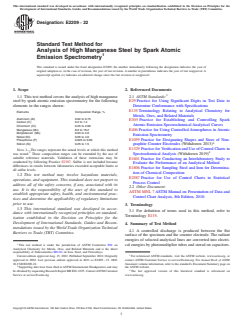
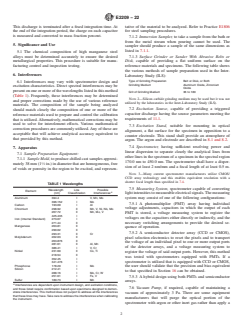
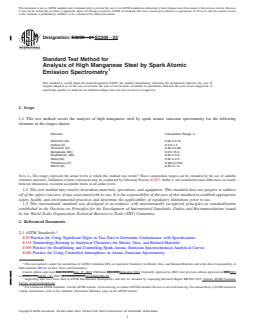
1.1 This test method covers the analysis of high manganese steel by spark atomic emission spectrometry for the following elements in the ranges shown:
Elements
Composition Range, %
Aluminum (Al)
0.02 to 0.15
Carbon (C)
0.3 to 1.4
Chromium (Cr)
0.25 to 2.00
Manganese (Mn)
8.0 to 16.2
Molybdenum (Mo)
0.03 to 2.0
Nickel (Ni)
0.05 to 4.0
Phosphorus (P)
0.025 to 0.06
Silicon (Si)
0.25 to 1.5
Note 1: The ranges represent the actual levels at which this method was tested.2 These composition ranges can be extended by the use of suitable reference materials. Validation of these extensions may be conducted by following Practice E2587. Sulfur is not included because differences in results between laboratories exceeded acceptable limits at all sulfur levels.
1.2 This test method may involve hazardous materials, operations, and equipment. This standard does not purport to address all of the safety concerns, if any, associated with its use. It is the responsibility of the user of this standard to establish appropriate safety, health, and environmental practices and determine the applicability of regulatory limitations prior to use.
1.3 This international standard was developed in accordance with internationally recognized principles on standardization established in the Decision on Principles for the Development of International Standards, Guides and Recommendations issued by the World Trade Organization Technical Barriers to Trade (TBT) Committee.
General Information
- Status
- Published
- Publication Date
- 14-Aug-2022
- Technical Committee
- E01 - Analytical Chemistry for Metals, Ores, and Related Materials
- Drafting Committee
- E01.01 - Iron, Steel, and Ferroalloys
Relations
- Effective Date
- 01-Jan-2020
- Effective Date
- 01-Nov-2019
- Refers
ASTM E406-19 - Standard Practice for Using Controlled Atmospheres in Atomic Emission Spectrometry - Effective Date
- 01-Oct-2019
- Effective Date
- 15-May-2019
- Effective Date
- 15-May-2016
- Effective Date
- 01-Jul-2015
- Effective Date
- 15-May-2015
- Effective Date
- 01-Apr-2015
- Effective Date
- 01-Oct-2014
- Effective Date
- 01-Oct-2014
- Effective Date
- 15-Aug-2014
- Effective Date
- 01-Apr-2014
- Effective Date
- 15-Feb-2014
- Effective Date
- 01-Dec-2013
- Effective Date
- 15-Dec-2012
Overview
ASTM E2209-22: Standard Test Method for Analysis of High Manganese Steel by Spark Atomic Emission Spectrometry, published by ASTM International, provides a validated procedure for the accurate determination of chemical composition in high manganese steel alloys. This method is integral for manufacturing control and inspection testing to ensure high manganese steels achieve the desired metallurgical and mechanical properties.
This test method details the analysis of key alloying elements including aluminum, carbon, chromium, manganese, molybdenum, nickel, phosphorus, and silicon, using spark atomic emission spectrometry (SAES). The procedure is optimized for metallurgical laboratories and industrial settings requiring rapid, precise, and reliable chemical analysis of steel.
Key Topics
Test Scope: The method applies to high manganese steel, covering the following compositional ranges (%):
- Manganese: 8.0 to 16.2
- Carbon: 0.3 to 1.4
- Chromium: 0.25 to 2.00
- Nickel: 0.05 to 4.0
- Molybdenum: 0.03 to 2.0
- Aluminum: 0.02 to 0.15
- Phosphorus: 0.025 to 0.06
- Silicon: 0.25 to 1.5
Suitability: The technique is specifically valuable for routine control in steel production and for compliance verification during product inspection.
Analytical Process:
- Employs spark atomic emission spectrometry for rapid multi-element analysis.
- Utilizes reference materials for calibration and drift correction.
- Prepares test samples by controlled grinding to assure representative and defect-free surfaces.
Accuracy and Precision: The method includes procedures for repeatability and reproducibility checks, providing statistical confidence in results.
Safety & Compliance: Users must adhere to all relevant safety protocols when handling potentially hazardous materials and high-energy equipment integral to the SAES method.
Applications
- Manufacturing Control: Supports steel plants and foundries in maintaining consistent alloy quality through on-line or off-line chemical analysis.
- Quality Assurance: Provides a quick and standardized process for inspection laboratories to verify alloy compositions against product specifications.
- Research & Development: Useful in alloy design and process optimization where precise composition tuning can significantly impact material performance.
- Regulatory Compliance: Ensures steel products meet international material and safety standards, enhancing marketability and cross-border acceptance.
- Failure Analysis: Enables detailed compositional analysis for investigating the cause of material failures or deviations in product performance.
Related Standards
- ASTM E29: Practice for Using Significant Digits in Test Data to Determine Conformance with Specifications.
- ASTM E305: Practice for Establishing and Controlling Spark Atomic Emission Spectrochemical Analytical Curves.
- ASTM E406: Practice for Using Controlled Atmospheres in Atomic Emission Spectrometry.
- ASTM E1806: Practice for Sampling Steel and Iron for Determination of Chemical Composition.
- ASTM E2587: Practice for Use of Control Charts in Statistical Process Control.
- ASTM E135: Terminology Relating to Analytical Chemistry for Metals, Ores, and Related Materials.
Spark atomic emission spectrometry is widely recognized for its speed, accuracy, and minimal sample preparation requirements, making ASTM E2209-22 a practical solution for high-volume steel laboratories seeking reliable, standardized chemical analysis methods for high manganese steels.
For up-to-date procedures and calibration guidance, the official ASTM E2209-22 standard text should always be referenced, ensuring full compliance with current international best practices.
Buy Documents
ASTM E2209-22 - Standard Test Method for Analysis of High Manganese Steel by Spark Atomic Emission Spectrometry
REDLINE ASTM E2209-22 - Standard Test Method for Analysis of High Manganese Steel by Spark Atomic Emission Spectrometry
Get Certified
Connect with accredited certification bodies for this standard

Element Materials Technology
Materials testing and product certification.

Inštitut za kovinske materiale in tehnologije
Institute of Metals and Technology. Materials testing, metallurgical analysis, NDT.
Sponsored listings
Frequently Asked Questions
ASTM E2209-22 is a standard published by ASTM International. Its full title is "Standard Test Method for Analysis of High Manganese Steel by Spark Atomic Emission Spectrometry". This standard covers: SIGNIFICANCE AND USE 5.1 The chemical composition of high manganese steel alloys must be determined accurately to ensure the desired metallurgical properties. This procedure is suitable for manufacturing control and inspection testing. SCOPE 1.1 This test method covers the analysis of high manganese steel by spark atomic emission spectrometry for the following elements in the ranges shown: Elements Composition Range, % Aluminum (Al) 0.02 to 0.15 Carbon (C) 0.3 to 1.4 Chromium (Cr) 0.25 to 2.00 Manganese (Mn) 8.0 to 16.2 Molybdenum (Mo) 0.03 to 2.0 Nickel (Ni) 0.05 to 4.0 Phosphorus (P) 0.025 to 0.06 Silicon (Si) 0.25 to 1.5 Note 1: The ranges represent the actual levels at which this method was tested.2 These composition ranges can be extended by the use of suitable reference materials. Validation of these extensions may be conducted by following Practice E2587. Sulfur is not included because differences in results between laboratories exceeded acceptable limits at all sulfur levels. 1.2 This test method may involve hazardous materials, operations, and equipment. This standard does not purport to address all of the safety concerns, if any, associated with its use. It is the responsibility of the user of this standard to establish appropriate safety, health, and environmental practices and determine the applicability of regulatory limitations prior to use. 1.3 This international standard was developed in accordance with internationally recognized principles on standardization established in the Decision on Principles for the Development of International Standards, Guides and Recommendations issued by the World Trade Organization Technical Barriers to Trade (TBT) Committee.
SIGNIFICANCE AND USE 5.1 The chemical composition of high manganese steel alloys must be determined accurately to ensure the desired metallurgical properties. This procedure is suitable for manufacturing control and inspection testing. SCOPE 1.1 This test method covers the analysis of high manganese steel by spark atomic emission spectrometry for the following elements in the ranges shown: Elements Composition Range, % Aluminum (Al) 0.02 to 0.15 Carbon (C) 0.3 to 1.4 Chromium (Cr) 0.25 to 2.00 Manganese (Mn) 8.0 to 16.2 Molybdenum (Mo) 0.03 to 2.0 Nickel (Ni) 0.05 to 4.0 Phosphorus (P) 0.025 to 0.06 Silicon (Si) 0.25 to 1.5 Note 1: The ranges represent the actual levels at which this method was tested.2 These composition ranges can be extended by the use of suitable reference materials. Validation of these extensions may be conducted by following Practice E2587. Sulfur is not included because differences in results between laboratories exceeded acceptable limits at all sulfur levels. 1.2 This test method may involve hazardous materials, operations, and equipment. This standard does not purport to address all of the safety concerns, if any, associated with its use. It is the responsibility of the user of this standard to establish appropriate safety, health, and environmental practices and determine the applicability of regulatory limitations prior to use. 1.3 This international standard was developed in accordance with internationally recognized principles on standardization established in the Decision on Principles for the Development of International Standards, Guides and Recommendations issued by the World Trade Organization Technical Barriers to Trade (TBT) Committee.
ASTM E2209-22 is classified under the following ICS (International Classification for Standards) categories: 77.040.30 - Chemical analysis of metals. The ICS classification helps identify the subject area and facilitates finding related standards.
ASTM E2209-22 has the following relationships with other standards: It is inter standard links to ASTM E135-20, ASTM E1601-19, ASTM E406-19, ASTM E135-19, ASTM E135-16, ASTM E135-15a, ASTM E135-15, ASTM E2587-15, ASTM E2587-14, ASTM E2587-14e1, ASTM E135-14b, ASTM E135-14a, ASTM E135-14, ASTM E135-13a, ASTM E1601-12. Understanding these relationships helps ensure you are using the most current and applicable version of the standard.
ASTM E2209-22 is available in PDF format for immediate download after purchase. The document can be added to your cart and obtained through the secure checkout process. Digital delivery ensures instant access to the complete standard document.
Standards Content (Sample)
This international standard was developed in accordance with internationally recognized principles on standardization established in the Decision on Principles for the
Development of International Standards, Guides and Recommendations issued by the World Trade Organization Technical Barriers to Trade (TBT) Committee.
Designation: E2209 − 22
Standard Test Method for
Analysis of High Manganese Steel by Spark Atomic
Emission Spectrometry
This standard is issued under the fixed designation E2209; the number immediately following the designation indicates the year of
original adoption or, in the case of revision, the year of last revision. A number in parentheses indicates the year of last reapproval. A
superscript epsilon (´) indicates an editorial change since the last revision or reapproval.
1. Scope 2. Referenced Documents
1.1 This test method covers the analysis of high manganese 2.1 ASTM Standards:
steel by spark atomic emission spectrometry for the following E29 Practice for Using Significant Digits in Test Data to
elements in the ranges shown: Determine Conformance with Specifications
E135 Terminology Relating to Analytical Chemistry for
Elements Composition Range, %
Metals, Ores, and Related Materials
Aluminum (Al) 0.02 to 0.15
E305 Practice for Establishing and Controlling Spark
Carbon (C) 0.3 to 1.4
Atomic Emission Spectrochemical Analytical Curves
Chromium (Cr) 0.25 to 2.00
Manganese (Mn) 8.0 to 16.2
E406 Practice for Using Controlled Atmospheres in Atomic
Molybdenum (Mo) 0.03 to 2.0
Emission Spectrometry
Nickel (Ni) 0.05 to 4.0
E1059 Practice for Designating Shapes and Sizes of Non-
Phosphorus (P) 0.025 to 0.06
Silicon (Si) 0.25 to 1.5
graphite Counter Electrodes (Withdrawn 2013)
E1329 Practice for Verification and Use of Control Charts in
NOTE 1—The ranges represent the actual levels at which this method
was tested. These composition ranges can be extended by the use of Spectrochemical Analysis (Withdrawn 2019)
suitable reference materials. Validation of these extensions may be
E1601 Practice for Conducting an Interlaboratory Study to
conducted by following Practice E2587. Sulfur is not included because
Evaluate the Performance of an Analytical Method
differences in results between laboratories exceeded acceptable limits at
E1806 Practice for Sampling Steel and Iron for Determina-
all sulfur levels.
tion of Chemical Composition
1.2 This test method may involve hazardous materials,
E2587 Practice for Use of Control Charts in Statistical
operations, and equipment. This standard does not purport to
Process Control
address all of the safety concerns, if any, associated with its
2.2 Other Document:
use. It is the responsibility of the user of this standard to
ASTM MNL 7 ASTM Manual on Presentation of Data and
establish appropriate safety, health, and environmental prac-
Control Chart Analysis, 8th Edition, 2010.
tices and determine the applicability of regulatory limitations
prior to use.
3. Terminology
1.3 This international standard was developed in accor-
3.1 For definition of terms used in this method, refer to
dance with internationally recognized principles on standard-
Terminology E135.
ization established in the Decision on Principles for the
Development of International Standards, Guides and Recom-
4. Summary of Test Method
mendations issued by the World Trade Organization Technical
4.1 A controlled discharge is produced between the flat
Barriers to Trade (TBT) Committee.
surface of the specimen and the counter electrode. The radiant
energies of selected analytical lines are converted into electri-
This test method is under the jurisdiction of ASTM Committee E01 on cal energies by photomultiplier tubes and stored on capacitors.
Analytical Chemistry for Metals, Ores, and Related Materials and is the direct
responsibility of Subcommittee E01.01 on Iron, Steel, and Ferroalloys.
Current edition approved Aug. 15, 2022. Published September 2022. Originally For referenced ASTM standards, visit the ASTM website, www.astm.org, or
approved in 2002. Last previous edition approved in 2021 as E2209 – 21. DOI: contact ASTM Customer Service at service@astm.org. For Annual Book of ASTM
10.1520/E2209-22. Standards volume information, refer to the standard’s Document Summary page on
Supporting data have been filed at ASTM International Headquarters and may the ASTM website.
be obtained by requesting Research Report RR:E01-1035. ContactASTM Customer The last approved version of this historical standard is referenced on
Service at service@astm.org www.astm.org.
Copyright © ASTM International, 100 Barr Harbor Drive, PO Box C700, West Conshohocken, PA 19428-2959. United States
E2209 − 22
This discharge is terminated after a fixed integration time. At tative of the material to be analyzed. Refer to Practice E1806
the end of the integration period, the charge on each capacitor for steel sampling procedures.
is measured and converted to mass fraction percent.
7.1.2 Immersion Sampler, to take a sample from the bath or
from the metal stream when pouring cannot be used. The
5. Significance and Use
sampler should produce a sample of the same dimensions as
listed in 7.1.1.
5.1 The chemical composition of high manganese steel
alloys must be determined accurately to ensure the desired 7.1.3 Surface Grinder or Sander With Abrasive Belts or
metallurgical properties. This procedure is suitable for manu-
Disk, capable of providing a flat uniform surface on the
facturing control and inspection testing. reference materials and specimens. The following table shows
the various methods of sample preparation used in the Inter-
6. Interferences
Laboratory Study (ILS):
6.1 Interferences may vary with spectrometer design and Type of Grinding Preparation Belt or Disk, or Both
Grinding Medium Aluminum Oxide, Zirconium
excitation characteristics. Direct spectral interferences may be
Oxide
presentononeormoreofthewavelengthslistedinthismethod
Grit of Grinding Medium 36 to 180
(Table 1). Frequently, these interferences may be determined
NOTE 2—Silicon carbide grinding medium may be used but it was not
and proper corrections made by the use of various reference
utilized by the laboratories in the Inter-Laboratory Study (ILS).
materials. The composition of the sample being analyzed
7.2 Excitation Source, capable of providing a triggered
should match closely the composition of one or more of the
capacitor discharge having the source parameters meeting the
reference materials used to prepare and control the calibration
requirements of 11.1.
that is utilized.Alternatively, mathematical corrections may be
used to solve for interelement effects. Various mathematical
7.3 Excitation Stand, suitable for mounting in optical
correction procedures are commonly utilized.Any of these are
alignment, a flat surface for the specimen in opposition to a
acceptable that will achieve analytical accuracy equivalent to
counter electrode. This stand shall provide an atmosphere of
that provided by this method.
argon. The argon and electrode are described in 8.1 and 8.2.
7.4 Spectrometer, having sufficient resolving power and
7. Apparatus
linear dispersion to separate clearly the analytical lines from
7.1 Sample Preparation Equipment:
other lines in the spectrum of a specimen in the spectral region
7.1.1 Sample Mold,toproducechilledcastsamplesapproxi-
170.0 nm to 450.0 nm. The spectrometer shall have a disper-
mately 38 mm (1 ⁄2 in.) in diameter that are homogeneous, free
sion of at least 2 nm/mm and a focal length of at least 0.5 m.
of voids or porosity in the region to be excited, and represen-
NOTE 3—Many current spectrometer manufacturers utilize CMOS/
CCD array technology and this enables equivalent resolution with a
shorter focal length than specified in 7.4.
TABLE 1 Wavelengths
7.5 Measuring System, spectrometer capable of converting
Wavelength Line Possible
Element
A
(nm) Classification Interferences lightintensitiestomeasurableelectricalsignals.Themeasuring
Aluminum 394.4 I V, Mn, Mo
system may consist of one of the following configurations:
396.152 I Mo
7.5.1 A photomultiplier (PMT) array having individual
Carbon 193.09 I Al
voltage adjustments, capacitors in which the output of each
Chromium 298.92 II Mn, V, Ni, Nb, Mo
267.72 II Mn, Mo, V
PMT is stored, a voltage measuring system to register the
425.435 I
voltages on the capacitors either directly or indirectly, and the
Iron (Internal Standard) 273.07 I
271.44 II necessary switching arrangements to provide the desired se-
Manganese 263.81 II
quence of operation.
290.02 II
7.5.2 A semiconductor detector array (CCD or CMOS),
293.31 II Cr
Molybdenum 202.03 II
pixel selection electronics to reset the pixels and to transport
263.876 II
the voltage of an individual pixel to one or more output ports
281.61 II Al, Mn
of the detector arrays, and a voltage measuring system to
386.41 I V, Cr
Nickel 231.60 II Co, Ti
register the voltage of said output ports. However, this method
218.54 II
was tested with spectrometers equipped with PMTs. If a
352.45 I
spectrometer is utilized that is equipped with CCD or CMOS,
341.476 I
Phosphorus 178.29 I Mo
the user should validate that the precision and bias equivalent
Silicon 212.41 I
to that specified in Section 16 can be obtained.
288.16 I Mo, Cr, W
251.61 I Fe, V
7.5.3 A hybrid design using both PMTs and semiconductor
Sulfur 180.73 I Mn
arrays.
A
Interferences are dependent upon instrument design, and excitation conditions,
and those listed require confirmation based upon specimens designed to demon- 7.6 Vacuum Pump, if required, capable of maintaining a
strate interferences.This method does not purport to address all the interferences
vacuum of approximately 3 Pa. There are some equipment
thattheselinesmayhave.Takecaretoaddresstheinterferenceswhencalibrating
manufacturers that will purge the optical portion of the
the instrument.
spectrometer with argon or other inert gas rather than apply a
E2209 − 22
vacuum on the optics. Either vacuum optics or purged optics 11.2 Spectrometer Configurations:
are required to determine carbon and phosphorus in this
Spectrometer Parameters
Focal Length 0.5 m to 1.2 m
method.
Dispersion 0.5 nm/mm to 2.16 nm/mm
7.7 Gas System, consisting of an argon supply, a pressure
Vacuum 1 Pa to 25 Pa
regulator, and a gas flow meter.Automatic sequencing shall be
11.3 Excitation Conditions:
provided to actuate the flow of argon at a given flow rate for a
Flush Time 2 s to 5 s
given time interval and to start the excitation at the end of the
Preburn 10 s to 30 s
required flush period. The gas system shall be in accordance Integration 5sto20s
with Practice E406.
11.4 Initiation Circuit—The initiator circuit parameters
shall be adequate to uniformly trigger the capacitor discharge.
8. Reagents and Materials
The values for these parameters will vary with the instrument.
8.1 Argon (supplied from gas cylinders or liquid tanks),
Values found to be adequate are as follows:
must be of sufficient purity to permit proper excitation of the
Capacitance (d-c charged) µF 1.2
analytical lines of interest. Argon of 99.998 % purity has been
Inductance, µH residual
found satisfactory. Refer to Practice E406.
Resistance,Ω residual
Potential, V 425
8.2 Counter Electrode—A tungsten rod ground to a 15°,
11.4.1 Other Electrical Parameters—Excitation units, on
30°, 45° or 90° angle conical tip, which conforms to Practice
which the precise parameters given in 11.1 and 11.4 are not
E1059, was found satisfactory. The instrument manufacturer
available, may be used, provided that it can be shown experi-
will define the material and geometry. Other material may be
mentally that equivalent precision and accuracy are obtained.
used, provided it can be shown experimentally that equivalent
precision and bias are obtained. 11.5 Electrode System—Insert the counter electrode in the
lower electrode position. Adjust the analytical gap to 3 mm, 4
9. Reference Materials
mm, 5 mm, or 7 mm depending on the manufacturer’s
9.1 Certified Reference Materials, for high manganese steel
recommendations for that particular instrument.
are commercially available.
11.6 Discharge Source—Most capacitor discharge sources
9.2 Calibration Reference Materials (RMs) shall be certified
in current spectrometers are of either two types: directional
reference materials from recognized certifica
...
This document is not an ASTM standard and is intended only to provide the user of an ASTM standard an indication of what changes have been made to the previous version. Because
it may not be technically possible to adequately depict all changes accurately, ASTM recommends that users consult prior editions as appropriate. In all cases only the current version
of the standard as published by ASTM is to be considered the official document.
Designation: E2209 − 21 E2209 − 22
Standard Test Method for
Analysis of High Manganese Steel by Spark Atomic
Emission Spectrometry
This standard is issued under the fixed designation E2209; the number immediately following the designation indicates the year of
original adoption or, in the case of revision, the year of last revision. A number in parentheses indicates the year of last reapproval. A
superscript epsilon (´) indicates an editorial change since the last revision or reapproval.
1. Scope
1.1 This test method covers the analysis of high manganese steel by spark atomic emission spectrometry for the following
elements in the ranges shown:
Elements Composition Range, %
Aluminum (Al) 0.02 to 0.15
Carbon (C) 0.3 to 1.4
Chromium (Cr) 0.25 to 2.00
Manganese (Mn) 8.0 to 16.2
Molybdenum (Mo) 0.03 to 2.0
Nickel (Ni) 0.05 to 4.0
Phosphorus (P) 0.025 to 0.06
Silicon (Si) 0.25 to 1.5
NOTE 1—The ranges represent the actual levels at which this method was tested. These composition ranges can be extended by the use of suitable
reference materials. Validation of these extensions may be conducted by following Practice E2587. Sulfur is not included because differences in results
between laboratories exceeded acceptable limits at all sulfur levels.
1.2 This test method may involve hazardous materials, operations, and equipment. This standard does not purport to address
all of the safety concerns, if any, associated with its use. It is the responsibility of the user of this standard to establish appropriate
safety, health, and environmental practices and determine the applicability of regulatory limitations prior to use.
1.3 This international standard was developed in accordance with internationally recognized principles on standardization
established in the Decision on Principles for the Development of International Standards, Guides and Recommendations issued
by the World Trade Organization Technical Barriers to Trade (TBT) Committee.
2. Referenced Documents
2.1 ASTM Standards:
E29 Practice for Using Significant Digits in Test Data to Determine Conformance with Specifications
E135 Terminology Relating to Analytical Chemistry for Metals, Ores, and Related Materials
E305 Practice for Establishing and Controlling Spark Atomic Emission Spectrochemical Analytical Curves
E406 Practice for Using Controlled Atmospheres in Atomic Emission Spectrometry
This test method is under the jurisdiction of ASTM Committee E01 on Analytical Chemistry for Metals, Ores, and Related Materials and is the direct responsibility of
Subcommittee E01.01 on Iron, Steel, and Ferroalloys.
Current edition approved June 15, 2021Aug. 15, 2022. Published July 2021September 2022. Originally approved in 2002. Last previous edition approved in 20132021
as E2209 – 13.E2209 – 21. DOI: 10.1520/E2209-21.10.1520/E2209-22.
Supporting data have been filed at ASTM International Headquarters and may be obtained by requesting Research Report RR:E01-1035. Contact ASTM Customer
Service at service@astm.org
For referenced ASTM standards, visit the ASTM website, www.astm.org, or contact ASTM Customer Service at service@astm.org. For Annual Book of ASTM Standards
volume information, refer to the standard’s Document Summary page on the ASTM website.
Copyright © ASTM International, 100 Barr Harbor Drive, PO Box C700, West Conshohocken, PA 19428-2959. United States
E2209 − 22
E1059 Practice for Designating Shapes and Sizes of Nongraphite Counter Electrodes (Withdrawn 2013)
E1329 Practice for Verification and Use of Control Charts in Spectrochemical Analysis (Withdrawn 2019)
E1601 Practice for Conducting an Interlaboratory Study to Evaluate the Performance of an Analytical Method
E1806 Practice for Sampling Steel and Iron for Determination of Chemical Composition
E2587 Practice for Use of Control Charts in Statistical Process Control
2.2 Other Document:
ASTM MNL 7 ASTM Manual on Presentation of Data and Control Chart Analysis, 8th Edition, 2010.
3. Terminology
3.1 For definition of terms used in this method, refer to Terminology E135.
4. Summary of Test Method
4.1 A controlled discharge is produced between the flat surface of the specimen and the counter electrode. The radiant energies
of selected analytical lines are converted into electrical energies by photomultiplier tubes and stored on capacitors. This discharge
is terminated after a fixed integration time. At the end of the integration period, the charge on each capacitor is measured and
converted to mass fraction percent.
5. Significance and Use
5.1 The chemical composition of high manganese steel alloys must be determined accurately to ensure the desired metallurgical
properties. This procedure is suitable for manufacturing control and inspection testing.
6. Interferences
6.1 Interferences may vary with spectrometer design and excitation characteristics. Direct spectral interferences may be present
on one or more of the wavelengths listed in this method (Table 1). Frequently, these interferences may be determined and proper
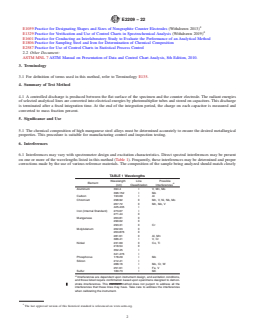
corrections made by the use of various reference materials. The composition of the sample being analyzed should match closely
TABLE 1 Wavelengths
Wavelength Line Possible
Element
A
(nm) Classification Interferences
Aluminum 394.4 I V, Mn, Mo
396.152 I Mo
Carbon 193.09 I Al
Chromium 298.92 II Mn, V, Ni, Nb, Mo
267.72 II Mn, Mo, V
425.435 I
Iron (Internal Standard) 273.07 I
271.44 II
Manganese 263.81 II
290.02 II
293.31 II Cr
Molybdenum 202.03 II
263.876 II
281.61 II Al, Mn
386.41 I V, Cr
Nickel 231.60 II Co, Ti
218.54 II
352.45 I
341.476 I
Phosphorus 178.29 I Mo
Silicon 212.41 I
288.16 I Mo, Cr, W
251.61 I Fe, V
Sulfur 180.73 I Mn
A
Interferences are dependent upon instrument design, and excitation conditions,
and those listed require confirmation based upon specimens designed to demon-
strate interferences. This standard method does not purport to address all the
interferences that these lines may have. Take care to address the interferences
when calibrating the instrument.
The last approved version of this historical standard is referenced on www.astm.org.
E2209 − 22
the composition of one or more of the reference materials used to prepare and control the calibration curve that is utilized.
Alternatively, mathematical corrections may be used to solve for interelement effects. Various mathematical correction procedures
are commonly utilized. Any of these are acceptable that will achieve analytical accuracy equivalent to that provided by this method.
7. Apparatus
7.1 Sample Preparation Equipment:
7.1.1 Sample Mold, to produce chilled cast samples approximately 38 mm (1 ⁄2 in.) in diameter that are homogeneous, free of
voids or porosity in the region to be excited, and representative of the material to be analyzed. Refer to Practice E1806 for steel
sampling procedures.
7.1.2 Immersion Sampler, to take a sample from the bath or from the metal stream when pouring cannot be used. The sampler
should produce a sample of the same dimensions as listed in 7.1.1.
7.1.3 Surface Grinder or Sander With Abrasive Belts or Disk, capable of providing a flat uniform surface on the reference
materials and specimens. The following table shows the various methods of sample preparation used in the Inter-Laboratory Study
(ILS):
Type of Grinding Preparation Belt or Disk, or Both
Grinding Medium Aluminum Oxide, Zirconium
Oxide
Grit of Grinding Medium 36 to 180
NOTE 2—Silicon carbide grinding medium may be used but it was not utilized by the laboratories in the Inter-Laboratory Study (ILS).
7.2 Excitation Source, capable of providing a triggered capacitor discharge having the source parameters meeting the requirements
of 11.1.
7.3 Excitation Stand, suitable for mounting in optical alignment, a flat surface for the specimen in opposition to a counter
electrode. This stand shall provide an atmosphere of argon. The argon and electrode are described in 8.1 and 8.2.
7.4 Spectrometer, having sufficient resolving power and linear dispersion to separate clearly the analytical lines from other lines
in the spectrum of a specimen in the spectral region 170.0 nm to 450.0 nm. The spectrometer shall have a dispersion of at least
2 nm/mm and a focal length of at least 0.5 m. Gas purged spectrometers are an alternative to vacuum systems.
NOTE 3—Many current spectrometer manufacturers utilize CMOS/CCD array technology and this enables equivalent resolution with a shorter focal length
than specified in 7.4.
7.5 Measuring System, spectrometer capable of converting light intensities to measurable electrical signals. The measuring system
may consist of one of the following configurations:
7.5.1 A photomultiplier (PMT) array having individual voltage adjustments, capacitors in which the output of each PMT is stored,
a voltage measuring system to register the voltages on the capacitors either directly or indirectly, and the necessary switching
arrangements to provide the desired sequence of operation.
7.5.2 A semiconductor detector array (CCD or CMOS), pixel selection electronics to reset the pixels and to transport the voltage
of an individual pixel to one or more output ports of the detector arrays, and a voltage measuring system to register the voltage
of said output ports. However, this method was tested with spectrometers equipped with PMTs. If a spectrometer is utilized that
is equipped with CCD or CMOS, the user should validate that the precision and bias equivalent to that specified in Section 16 can
be obtained.
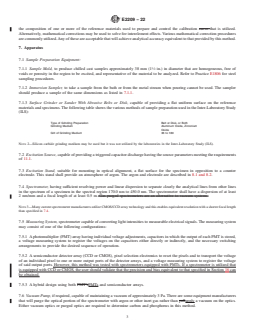
7.5.3 A hybrid design using both PMT’sPMTs and semiconductor arrays.
7.6 Vacuum Pump, if required, capable of maintaining a vacuum of approximately 3 Pa. There are some equipment manufacturers
that will purge the optical portion of the spectrometer with argon or other inert gas rather than pullapply a vacuum on the optics.
Either vacuum optics or purged optics are required to determine carbon and phosphorus in this method.
E2209 − 22
7.7 Gas System, consisting of an argon supply, a pressure regulator, and a gas flow meter. Automatic sequencing shall be provided
to actuate the flow of argon at a given flow rate for a given time interval and to start the excitation at the end of the required flush
period. The gas system shall be in accordance with Practice E406.
8. Reagents and Materials
8.1 Argon (supplied from gas cylinders or liquid tanks),must be of sufficient purity to permit proper excitation of the analytical
lines of interest. Argon of 99.998 % purity has been found satisfactory. Refer to Practice E406.
8.2 Counter Electrode—A tungsten rod ground to a 15°, 30°, 45° or 90° angle conical tip, which conforms to Practice E1059, was
found satisfactory. The instrument manufacturer will define the material and geometry. Other material may be used, provided it
can be shown experimentally that equivalent precision and bias are obtained.
9. Reference Materials
9.1 Certified Reference Materials, for high manganese steel are commercially available.
9.2 Calibration Reference Materials (RMs) shall be certified reference materials from recognized certification agencies. They shall
cover the composition mass fraction ranges of the elements to be determined and shall include all of the specific types of alloys
being analyzed. They shall be homogeneous and free of voids and porosity. Their metallurgical history should be similar to that
of the specimens being analyzed.
9.2.1 When selecting calibration RMs, use caution with compositions that are unusual. One element may influence the radiant
energy of another element. Tests should be made to determine if interrelations exist between elements in the calibration RMs.
10. Preparation of Calibration RMs and Specimens
10.1 Rough grind, either wet or dry, with a coarse grinding belt or disk. Dry the specimens, if wet, for proper excitation in the
argon atmosphere. Ensure that the specimens are homogeneous and free from voids and pits in the region to be excited. Refer to
7.1.1 and 7.1.2. Prepare the surface of the specimens and reference materials in a similar manner.
11. Excitation and Instrument Parameters
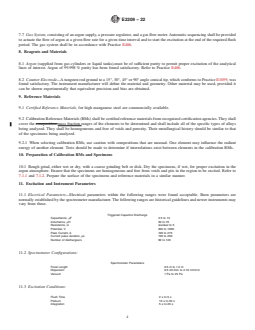
11.1 Electrical Parameters—Electrical parameters wit
...
Questions, Comments and Discussion
Ask us and Technical Secretary will try to provide an answer. You can facilitate discussion about the standard in here.
Loading comments...