

ASTM C1697-21
(Specification)Standard Specification for Blended Supplementary Cementitious Materials
General Information
- Abstract
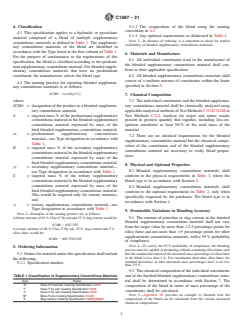
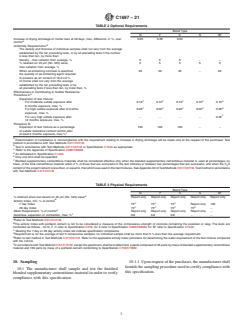
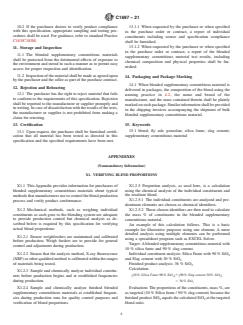
SCOPE
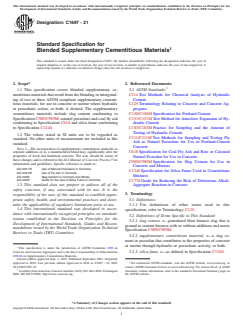
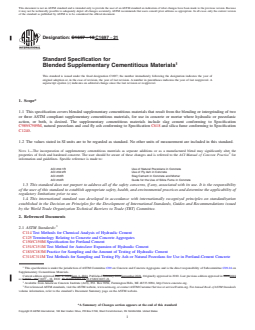
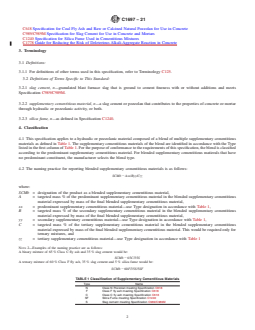
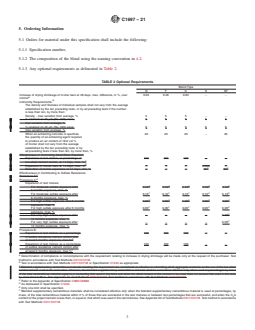
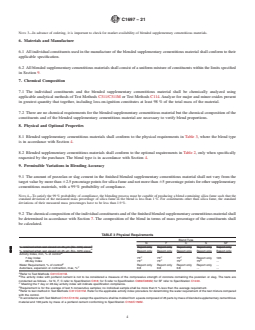
1.1 This specification covers blended supplementary cementitious materials that result from the blending or intergrinding of two or three ASTM compliant supplementary cementitious materials, for use in concrete or mortar where hydraulic or pozzolanic action, or both, is desired. The supplementary cementitious materials include slag cement conforming to Specification C989/C989M, natural pozzolans and coal fly ash conforming to Specification C618 and silica fume conforming to Specification C1240.
1.2 The values stated in SI units are to be regarded as standard. No other units of measurement are included in this standard.
Note 1: The incorporation of supplementary cementitious materials as separate additions or as a manufactured blend may significantly alter the properties of fresh and hardened concrete. The user should be aware of these changes and is referred to the ACI Manual of Concrete Practice2 for information and guidelines. Specific reference is made to:
ACI 232.1R
Use of Natural Pozzolans in Concrete
ACI 232.2R
Use of Fly Ash in Concrete
ACI 233R
Slag Cement in Concrete and Mortar
ACI 234R
Guide for the Use of Silica Fume in Concrete
1.3 This standard does not purport to address all of the safety concerns, if any, associated with its use. It is the responsibility of the user of this standard to establish appropriate safety, health, and environmental practices and determine the applicability of regulatory limitations prior to use.
1.4 This international standard was developed in accordance with internationally recognized principles on standardization established in the Decision on Principles for the Development of International Standards, Guides and Recommendations issued by the World Trade Organization Technical Barriers to Trade (TBT) Committee.
- Status
- Published
- Publication Date
- 31-Aug-2021
- Technical Committee
- C09 - Concrete and Concrete Aggregates
- Drafting Committee
- C09.24 - Supplementary Cementitious Materials
Buy Documents
ASTM C1697-21 - Standard Specification for Blended Supplementary Cementitious Materials
REDLINE ASTM C1697-21 - Standard Specification for Blended Supplementary Cementitious Materials
Overview
ASTM C1697-21: Standard Specification for Blended Supplementary Cementitious Materials establishes requirements for blended supplementary cementitious materials (SCMs) produced by blending or intergrinding two or three SCMs. These materials are used in concrete and mortar mixes to achieve hydraulic or pozzolanic action, or both, improving performance and durability. Covered SCMs include slag cement (per ASTM C989/C989M), natural pozzolans and fly ash (per ASTM C618), and silica fume (per ASTM C1240). The standard applies globally as per World Trade Organization (WTO) principles and specifies that only SI units are to be used.
Key Topics
- Blend Composition and Classification
- Blends may include combinations of Class N pozzolan, Class F and C fly ash, slag cement, and silica fume.
- Classification of blended SCMs is determined by the predominant constituent, using a standardized naming convention (e.g., SCMb 2 65C/35S for 65% Class C fly ash and 35% slag cement).
- Physical and Chemical Requirements
- The standard outlines testing and reporting methods for chemical composition, ensuring key constituents meet their respective ASTM standards.
- Blended SCMs must be uniform and accurate in blend proportions, with specific permissible variations outlined for manufacturing control.
- Optional and Additional Requirements
- Purchasers may specify optional criteria, including drying shrinkage, alkali-silica reaction (ASR) control, sulfate resistance, and uniformity.
- Methods for verification of blend proportions and quality control are detailed, including mechanical and chemical analysis.
- Ordering, Packaging, and Certification
- Orders must specify blend composition. Packaging and shipment must clearly indicate blend details and manufacturer information.
- Certification and test reports for both individual constituents and the blend may be requested by purchasers.
Applications
Blended supplementary cementitious materials are increasingly vital in modern construction practices due to their contribution to sustainable and high-performance concrete. Key practical applications include:
- Concrete and Mortar Production
Use in a variety of concrete and mortar mixes where hydraulic and pozzolanic reactions are desired for enhanced durability and performance. - Mitigation of Alkali-Silica Reaction (ASR) When properly proportioned, blended SCMs can reduce the risk of ASR, a common cause of concrete degradation. ASTM C1778 provides guidance on this application.
- Improvement of Sulfate Resistance Blended SCMs can enhance the sulfate resistance of concrete, a critical property for structures exposed to sulfate-rich environments.
- Lower Environmental Impact By substituting a portion of portland cement with SCMs, blends reduce clinker content, lowering CO₂ emissions in concrete production.
- Quality and Uniformity in Blended Materials Blended SCMs provide a consistent, factory-controlled product ensuring reliable performance across uses.
Related Standards
The following standards are frequently referenced with ASTM C1697-21, supporting the use and specification of blended supplementary cementitious materials:
- ASTM C618 - Specification for Coal Fly Ash and Raw or Calcined Natural Pozzolan for Use in Concrete
- ASTM C989/C989M - Specification for Slag Cement for Use in Concrete and Mortars
- ASTM C1240 - Specification for Silica Fume Used in Cementitious Mixtures
- ASTM C311/C311M - Test Methods for Sampling and Testing Fly Ash or Natural Pozzolans
- ASTM C114 - Test Methods for Chemical Analysis of Hydraulic Cement
- ASTM C183/C183M - Practice for Sampling Hydraulic Cement
- ASTM C125 - Terminology Relating to Concrete and Concrete Aggregates
- ASTM C150/C150M - Specification for Portland Cement
- ASTM C1778 - Guide for Reducing the Risk of Deleterious Alkali-Aggregate Reaction in Concrete
For additional application guidelines, users are referred to the ACI Manual of Concrete Practice, including:
- ACI 232 series (natural pozzolans and fly ash)
- ACI 233 (slag cement)
- ACI 234 (silica fume)
Keywords: blended supplementary cementitious materials, ASTM C1697-21, concrete, fly ash, slag cement, pozzolan, silica fume, ASR mitigation, sulfate resistance, construction materials standard.
Relations
- Effective Date
- 01-Feb-2024
- Effective Date
- 01-Jan-2024
- Effective Date
- 01-Dec-2023
- Effective Date
- 01-Dec-2023
- Effective Date
- 01-Oct-2023
- Effective Date
- 15-Dec-2019
- Effective Date
- 01-Dec-2019
- Effective Date
- 15-Jun-2019
- Effective Date
- 01-Jun-2019
- Effective Date
- 01-Apr-2019
- Effective Date
- 01-Jan-2019
- Effective Date
- 01-Oct-2018
- Effective Date
- 01-Jul-2018
- Effective Date
- 01-Apr-2018
- Effective Date
- 01-Jan-2018
Buy Documents
ASTM C1697-21 - Standard Specification for Blended Supplementary Cementitious Materials
REDLINE ASTM C1697-21 - Standard Specification for Blended Supplementary Cementitious Materials
Get Certified
Connect with accredited certification bodies for this standard

DIBt (Deutsches Institut für Bautechnik)
German Institute for Building Technology.
DIN CERTCO
DIN Group product certification.

Aboma Certification B.V.
Specialized in construction, metal, and transport sectors.
Sponsored listings
Frequently Asked Questions
ASTM C1697-21 is a technical specification published by ASTM International. Its full title is "Standard Specification for Blended Supplementary Cementitious Materials". This standard covers: SCOPE 1.1 This specification covers blended supplementary cementitious materials that result from the blending or intergrinding of two or three ASTM compliant supplementary cementitious materials, for use in concrete or mortar where hydraulic or pozzolanic action, or both, is desired. The supplementary cementitious materials include slag cement conforming to Specification C989/C989M, natural pozzolans and coal fly ash conforming to Specification C618 and silica fume conforming to Specification C1240. 1.2 The values stated in SI units are to be regarded as standard. No other units of measurement are included in this standard. Note 1: The incorporation of supplementary cementitious materials as separate additions or as a manufactured blend may significantly alter the properties of fresh and hardened concrete. The user should be aware of these changes and is referred to the ACI Manual of Concrete Practice2 for information and guidelines. Specific reference is made to: ACI 232.1R Use of Natural Pozzolans in Concrete ACI 232.2R Use of Fly Ash in Concrete ACI 233R Slag Cement in Concrete and Mortar ACI 234R Guide for the Use of Silica Fume in Concrete 1.3 This standard does not purport to address all of the safety concerns, if any, associated with its use. It is the responsibility of the user of this standard to establish appropriate safety, health, and environmental practices and determine the applicability of regulatory limitations prior to use. 1.4 This international standard was developed in accordance with internationally recognized principles on standardization established in the Decision on Principles for the Development of International Standards, Guides and Recommendations issued by the World Trade Organization Technical Barriers to Trade (TBT) Committee.
SCOPE 1.1 This specification covers blended supplementary cementitious materials that result from the blending or intergrinding of two or three ASTM compliant supplementary cementitious materials, for use in concrete or mortar where hydraulic or pozzolanic action, or both, is desired. The supplementary cementitious materials include slag cement conforming to Specification C989/C989M, natural pozzolans and coal fly ash conforming to Specification C618 and silica fume conforming to Specification C1240. 1.2 The values stated in SI units are to be regarded as standard. No other units of measurement are included in this standard. Note 1: The incorporation of supplementary cementitious materials as separate additions or as a manufactured blend may significantly alter the properties of fresh and hardened concrete. The user should be aware of these changes and is referred to the ACI Manual of Concrete Practice2 for information and guidelines. Specific reference is made to: ACI 232.1R Use of Natural Pozzolans in Concrete ACI 232.2R Use of Fly Ash in Concrete ACI 233R Slag Cement in Concrete and Mortar ACI 234R Guide for the Use of Silica Fume in Concrete 1.3 This standard does not purport to address all of the safety concerns, if any, associated with its use. It is the responsibility of the user of this standard to establish appropriate safety, health, and environmental practices and determine the applicability of regulatory limitations prior to use. 1.4 This international standard was developed in accordance with internationally recognized principles on standardization established in the Decision on Principles for the Development of International Standards, Guides and Recommendations issued by the World Trade Organization Technical Barriers to Trade (TBT) Committee.
ASTM C1697-21 is classified under the following ICS (International Classification for Standards) categories: 91.100.10 - Cement. Gypsum. Lime. Mortar. The ICS classification helps identify the subject area and facilitates finding related standards.
ASTM C1697-21 has the following relationships with other standards: It is inter standard links to ASTM C989/C989M-24, ASTM C311/C311M-24, ASTM C151/C151M-23, ASTM C1778-23, ASTM C114-23, ASTM C125-19a, ASTM C1778-19b, ASTM C1778-19a, ASTM C1778-19, ASTM C150/C150M-19, ASTM C125-19, ASTM C125-18b, ASTM C125-18a, ASTM C151/C151M-18, ASTM C125-18. Understanding these relationships helps ensure you are using the most current and applicable version of the standard.
ASTM C1697-21 is available in PDF format for immediate download after purchase. The document can be added to your cart and obtained through the secure checkout process. Digital delivery ensures instant access to the complete standard document.
Standards Content (Sample)
This international standard was developed in accordance with internationally recognized principles on standardization established in the Decision on Principles for the
Development of International Standards, Guides and Recommendations issued by the World Trade Organization Technical Barriers to Trade (TBT) Committee.
Designation:C1697 −21
Standard Specification for
Blended Supplementary Cementitious Materials
This standard is issued under the fixed designation C1697; the number immediately following the designation indicates the year of
original adoption or, in the case of revision, the year of last revision. A number in parentheses indicates the year of last reapproval. A
superscript epsilon (´) indicates an editorial change since the last revision or reapproval.
1. Scope* 2. Referenced Documents
1.1 This specification covers blended supplementary ce- 2.1 ASTM Standards:
mentitiousmaterialsthatresultfromtheblendingorintergrind- C114 Test Methods for Chemical Analysis of Hydraulic
ing of two or three ASTM compliant supplementary cementi- Cement
tious materials, for use in concrete or mortar where hydraulic C125 Terminology Relating to Concrete and Concrete Ag-
or pozzolanic action, or both, is desired. The supplementary gregates
cementitious materials include slag cement conforming to C150/C150M Specification for Portland Cement
Specification C989/C989M, natural pozzolans and coal fly ash C151/C151M Test Method for Autoclave Expansion of Hy-
conforming to Specification C618 and silica fume conforming draulic Cement
to Specification C1240. C183/C183M Practice for Sampling and the Amount of
Testing of Hydraulic Cement
1.2 The values stated in SI units are to be regarded as
C311/C311M Test Methods for Sampling and Testing Fly
standard. No other units of measurement are included in this
Ash or Natural Pozzolans for Use in Portland-Cement
standard.
Concrete
NOTE 1—The incorporation of supplementary cementitious materials as
C618 Specification for Coal Fly Ash and Raw or Calcined
separate additions or as a manufactured blend may significantly alter the
properties of fresh and hardened concrete. The user should be aware of
Natural Pozzolan for Use in Concrete
these changes and is referred to the ACI Manual of Concrete Practice for
C989/C989M Specification for Slag Cement for Use in
information and guidelines. Specific reference is made to:
Concrete and Mortars
ACI 232.1R Use of Natural Pozzolans in Concrete
C1240 Specification for Silica Fume Used in Cementitious
ACI 232.2R Use of Fly Ash in Concrete
Mixtures
ACI 233R Slag Cement in Concrete and Mortar
ACI 234R Guide for the Use of Silica Fume in Concrete
C1778 Guide for Reducing the Risk of Deleterious Alkali-
1.3 This standard does not purport to address all of the Aggregate Reaction in Concrete
safety concerns, if any, associated with its use. It is the
3. Terminology
responsibility of the user of this standard to establish appro-
priate safety, health, and environmental practices and deter-
3.1 Definitions:
mine the applicability of regulatory limitations prior to use. 3.1.1 For definitions of other terms used in this
1.4 This international standard was developed in accor-
specification, refer to Terminology C125.
dance with internationally recognized principles on standard-
3.2 Definitions of Terms Specific to This Standard:
ization established in the Decision on Principles for the
3.2.1 slag cement, n—granulated blast furnace slag that is
Development of International Standards, Guides and Recom-
ground to cement fineness with or without additions and meets
mendations issued by the World Trade Organization Technical
Specification C989/C989M.
Barriers to Trade (TBT) Committee.
3.2.2 supplementary cementitious material, n—a slag ce-
ment or pozzolan that contributes to the properties of concrete
or mortar through hydraulic or pozzolanic activity, or both.
This specification is under the jurisdiction of ASTM Committee C09 on
Concrete and ConcreteAggregates and is the direct responsibility of Subcommittee 3.2.3 silica fume, n—as defined in Specification C1240.
C09.24 on Supplementary Cementitious Materials.
Current edition approved Sept. 1, 2021. Published September 2021. Originally
approved in 2010. Last previous edition approved in 2018 as C1697 – 18. DOI: For referenced ASTM standards, visit the ASTM website, www.astm.org, or
10.1520/C1697-21. contact ASTM Customer Service at service@astm.org. For Annual Book of ASTM
Available fromAmerican Concrete Institute (ACI), P.O. Box 9094, Farmington Standards volume information, refer to the standard’s Document Summary page on
Hills, MI 48333-9094, http://www.concrete.org. the ASTM website.
*A Summary of Changes section appears at the end of this standard
Copyright © ASTM International, 100 Barr Harbor Drive, PO Box C700, West Conshohocken, PA 19428-2959. United States
C1697−21
4. Classification 5.1.2 The composition of the blend using the naming
convention in 4.2.
4.1 This specification applies to a hydraulic or pozzolanic
5.1.3 Any optional requirements as delineated in Table 2.
material composed of a blend of multiple supplementary
NOTE 3—In advance of ordering, it is important to check for market
cementitious materials as defined in Table 1. The supplemen-
availability of blended supplementary cementitious materials.
tary cementitious materials of the blend are identified in
accordance with the Type listed in the first column of Table 1.
6. Materials and Manufacture
For the purpose of conformance to the requirements of this
6.1 All individual constituents used in the manufacture of
specification, the blend is classified according to the predomi-
the blended supplementary cementitious material shall con-
nant supplementary cementitious material. For blended supple-
form to their applicable specification.
mentary cementitious matierals that have no predominant
constituent, the manufacturer selects the blend type. 6.2 All blended supplementary cementitious materials shall
consist of a uniform mixture of constituents within the limits
4.2 The naming practice for reporting blended supplemen-
specified in Section 9.
tary cementitious materials is as follows:
SCMb 2 Axx/Byy/Czz
7. Chemical Composition
where:
7.1 The individual constituents and the blended supplemen-
tary cementitious material shall be chemically analyzed using
SCMb = designation of the product as a blended supplemen-
tary cementitious material, applicableanalyticalmethodsofTestMethodsC311/C311Mor
A = targeted mass % of the predominant supplementary Test Methods C114. Analyze for major and minor oxides
cementitious material in the blended supplementary
present in greatest quantity that together, including loss-on-
cementitious material expressed by mass of the ignition constitutes at least 98 % of the total mass of the
final blended supplementary cementitious material,
material.
xx = predominant supplementary cementitious
7.2 There are no chemical requirements for the blended
material—use Type designation in accordance with
supplementary cementitious material but the chemical compo-
Table 1,
sition of the constituents and of the blended supplementary
B = targeted mass % of the secondary supplementary
cementitious material are necessary to verify blend propor-
cementitious material in the blended supplementary
tions.
cementitious material expressed by mass of the
final blended supplementary cementitious material,
8. Physical and Optional Properties
yy = secondary supplementary cementitious material—
8.1 Blended supplementary cementitious materials shall
use Type designation in accordance with Table 1,
C = targeted mass % of the tertiary supplementary conform to the physical requirements in Table 3, where the
blend type is in accordance with Section 4.
cementitious material in the blended supplementary
cementitious material expressed by mass of the
8.2 Blended supplementary cementitious materials shall
final blended supplementary cementitious material.
conform to the optional requirements in Table 2, only when
This would be required only for ternary mixtures,
specifically requested by the purchaser. The blend type is in
and
accordance with Section 4.
zz = tertiary supplementary cementitious material—use
Type designation in accordance with Table 1
9. Permissible Variations in Blending Accuracy
NOTE 2—Examples of the naming practice are as follows:
9.1 The amount of pozzolan or slag cement in the finished
Abinary mixture of 65 % Class C fly ash and 35 % slag cement would be:
blended supplementary cementitious material shall not vary
SCMb 2 65C/35S
from the target value by more than 62.5 percentage points for
A ternary mixture of 60 % Class F fly ash, 35 % slag cement and 5 %
silica fume and not more than 65 percentage points for other
silica fume would be:
supplementary cementitious materials, with a 99 % probability
SCMb 2 60F/35S/5SF
of compliance.
NOTE 4—To satisfy the 99 % probability of compliance, the blending
5. Ordering Information
process must be capable of producing a blend containing silica fume such
5.1 Orders for material under this specification shall include thatthestandarddeviationofthemeasuredmasspercentageofsilicafume
in the blend is less than 1 %. For constituents other than silica fume, the
the following:
standard deviations of their measured mass percentages have to be less
5.1.1 Specification number,
than 1.9 %.
9.2 The chemical composition of the individual constituents
TABLE 1 Classification of Supplementary Cementitious Materials and of the finished blended supplementary cementitious mate-
rial shall be determined in accordance with Section 7. The
Type Name
N Class N Pozzolan meeting Specification C618
composition of the blend in terms of mass percentage of the
F Class F fly ash meeting Specification C618
constituents shall be calculated.
C Class C fly ash meeting Specification C618
NOTE 5—Appendix X1 provides an example to illustrate how the
SF Silica Fume meeting Specification C1240
S Slag cement meeting Specification C989/C989M composition of the blend can be calculated from the various measured
chemical compositions.
C1697−21
TABLE 2 Optional Requirements
Blend Type
NF C S SF
Increase of drying shrinkage of mortar bars at 28 days, max, difference, in %, over 0.03 0.03 0.03 . .
A
control
B
Uniformity Requirements:
The density and fineness of individual samples shall not vary from the average
established by the ten preceding tests, or by all preceding tests if the number
is less than ten, by more than:
Density - max variation from average, % 5 5 5 . .
% retained on 45 µm (No. 325) sieve, 55 5 5 5
max variation from average, %
When air-entraining concrete is specified, 20 20 20 . 20
the quantity of air-entraining agent required
to produce an air content of 18.0 vol %
of mortar shall not vary from the average
established by the ten preceding tests or by
all preceding tests if less than ten, by more than, %
Effectiveness in Contributing to Sulfate Resistance:
E
Procedure A:
Expansion of test mixture:
F F F C D
For moderate sulfate exposure after 0.10 0.10 0.10 0.10 0.10
6 months exposure, max, %
F F F C D
For high sulfate exposure after 6 months 0.05 0.05 0.05 0.05 0.05
exposur
...
This document is not an ASTM standard and is intended only to provide the user of an ASTM standard an indication of what changes have been made to the previous version. Because
it may not be technically possible to adequately depict all changes accurately, ASTM recommends that users consult prior editions as appropriate. In all cases only the current version
of the standard as published by ASTM is to be considered the official document.
Designation: C1697 − 18 C1697 − 21
Standard Specification for
Blended Supplementary Cementitious Materials
This standard is issued under the fixed designation C1697; the number immediately following the designation indicates the year of
original adoption or, in the case of revision, the year of last revision. A number in parentheses indicates the year of last reapproval. A
superscript epsilon (´) indicates an editorial change since the last revision or reapproval.
1. Scope*
1.1 This specification covers blended supplementary cementitious materials that result from the blending or intergrinding of two
or three ASTM compliant supplementary cementitious materials, for use in concrete or mortar where hydraulic or pozzolanic
action, or both, is desired. The supplementary cementitious materials include slag cement conforming to Specification
C989/C989M, natural pozzolans and coal fly ash conforming to Specification C618 and silica fume conforming to Specification
C1240.
1.2 The values stated in SI units are to be regarded as standard. No other units of measurement are included in this standard.
NOTE 1—The incorporation of supplementary cementitious materials as separate additions or as a manufactured blend may significantly alter the
properties of fresh and hardened concrete. The user should be aware of these changes and is referred to the ACI Manual of Concrete Practice for
information and guidelines. Specific reference is made to:
ACI 232.1R Use of Natural Pozzolans in Concrete
ACI 232.2R Use of Fly Ash in Concrete
ACI 233R Slag Cement in Concrete and Mortar
ACI 234R Guide for the Use of Silica Fume in Concrete
1.3 This standard does not purport to address all of the safety concerns, if any, associated with its use. It is the responsibility
of the user of this standard to establish appropriate safety, health, and environmental practices and determine the applicability of
regulatory limitations prior to use.
1.4 This international standard was developed in accordance with internationally recognized principles on standardization
established in the Decision on Principles for the Development of International Standards, Guides and Recommendations issued
by the World Trade Organization Technical Barriers to Trade (TBT) Committee.
2. Referenced Documents
2.1 ASTM Standards:
C114 Test Methods for Chemical Analysis of Hydraulic Cement
C125 Terminology Relating to Concrete and Concrete Aggregates
C150/C150M Specification for Portland Cement
C151/C151M Test Method for Autoclave Expansion of Hydraulic Cement
C183/C183M Practice for Sampling and the Amount of Testing of Hydraulic Cement
C311/C311M Test Methods for Sampling and Testing Fly Ash or Natural Pozzolans for Use in Portland-Cement Concrete
This specification is under the jurisdiction of ASTM Committee C09 on Concrete and Concrete Aggregates and is the direct responsibility of Subcommittee C09.24 on
Supplementary Cementitious Materials.
Current edition approved Dec. 1, 2018Sept. 1, 2021. Published February 2019September 2021. Originally approved in 2010. Last previous edition approved in 20162018
as C1697 – 16.C1697 – 18. DOI: 10.1520/C1697-18.10.1520/C1697-21.
Available from American Concrete Institute (ACI), P.O. Box 9094, Farmington Hills, MI 48333-9094, http://www.concrete.org.
For referenced ASTM standards, visit the ASTM website, www.astm.org, or contact ASTM Customer Service at service@astm.org. For Annual Book of ASTM Standards
volume information, refer to the standard’s Document Summary page on the ASTM website.
*A Summary of Changes section appears at the end of this standard
Copyright © ASTM International, 100 Barr Harbor Drive, PO Box C700, West Conshohocken, PA 19428-2959. United States
C1697 − 21
C618 Specification for Coal Fly Ash and Raw or Calcined Natural Pozzolan for Use in Concrete
C989/C989M Specification for Slag Cement for Use in Concrete and Mortars
C1240 Specification for Silica Fume Used in Cementitious Mixtures
C1778 Guide for Reducing the Risk of Deleterious Alkali-Aggregate Reaction in Concrete
3. Terminology
3.1 Definitions:
3.1.1 For definitions of other terms used in this specification, refer to Terminology C125.
3.2 Definitions of Terms Specific to This Standard:
3.2.1 slag cement, n—granulated blast furnace slag that is ground to cement fineness with or without additions and meets
Specification C989/C989M.
3.2.2 supplementary cementitious material, n—a slag cement or pozzolan that contributes to the properties of concrete or mortar
through hydraulic or pozzolanic activity, or both.
3.2.3 silica fume, n—as defined in Specification C1240.
4. Classification
4.1 This specification applies to a hydraulic or pozzolanic material composed of a blend of multiple supplementary cementitious
materials as defined in Table 1. The supplementary cementitious materials of the blend are identified in accordance with the Type
listed in the first column of Table 1. For the purpose of conformance to the requirements of this specification, the blend is classified
according to the predominant supplementary cementitious material. For blended supplementary cementitious matierals that have
no predominant constituent, the manufacturer selects the blend type.
4.2 The naming practice for reporting blended supplementary cementitious materials is as follows:
SCMb 2 Axx/Byy/Czz
where:
SCMb = designation of the product as a blended supplementary cementitious material,
A = targeted mass % of the predominant supplementary cementitious material in the blended supplementary cementitious
material expressed by mass of the final blended supplementary cementitious material,
xx = predominant supplementary cementitious material—use Type designation in accordance with Table 1,
B = targeted mass % of the secondary supplementary cementitious material in the blended supplementary cementitious
material expressed by mass of the final blended supplementary cementitious material,
yy = secondary supplementary cementitious material—use Type designation in accordance with Table 1,
C = targeted mass % of the tertiary supplementary cementitious material in the blended supplementary cementitious
material expressed by mass of the final blended supplementary cementitious material. This would be required only for
ternary mixtures, and
zz = tertiary supplementary cementitious material—use Type designation in accordance with Table 1
NOTE 2—Examples of the naming practice are as follows:
A binary mixture of 65 % Class C fly ash and 35 % slag cement would be:
SCMb 2 65C/35S
A ternary mixture of 60 % Class F fly ash, 35 % slag cement and 5 % silica fume would be:
SCMb 2 60F/35S/5SF
TABLE 1 Classification of Supplementary Cementitious Materials
Type Name
N Class N Pozzolan meeting Specification C618
F Class F fly ash meeting Specification C618
C Class C fly ash meeting Specification C618
SF Silica Fume meeting Specification C1240
S Slag cement meeting Specification C989/C989M
C1697 − 21
5. Ordering Information
5.1 Orders for material under this specification shall include the following:
5.1.1 Specification number,
5.1.2 The composition of the blend using the naming convention in 4.2.
5.1.3 Any optional requirements as delineated in Table 2.
TABLE 2 Optional Requirements
Blend Type
N F C S SF
Increase of drying shrinkage of mortar bars at 28 days, max, difference, in %, over 0.03 0.03 0.03 . .
A
control
B
Uniformity Requirements:
The density and fineness of individual samples shall not vary from the average
established by the ten preceding tests, or by all preceding tests if the number
is less than ten, by more than:
Density - max variation from average, % 5 5 5 . .
% retained on 45-μm (No. 325) sieve, 5 5 5 5 5
max variation from average, %
% retained on 45 μm (No. 325) sieve, 5 5 5 5 5
max variation from average, %
When air-entraining concrete is specified, 20 20 20 . 20
the quantity of air-entraining agent required
to produce an air content of 18.0 vol %
of mortar shall not vary from the average
established by the ten preceding tests or by
all preceding tests if less than ten, by more than, %
Effectiveness in Controlling Alkali-Silica Reaction:
Expansion of test mixture as percentage of 100 100 100 . .
C
low-alkali cement control, at 14 days, max, %
D
Expansion of mortar bars at 14 days, max, % . . . 0.020 .
D E
Reduction of mortar expansion at 14 days, min, % . . . 75 80
Effectiveness in Contributing to Sulfate Resistance:
F
Procedure A:
E
Procedure A:
Expansion of test mixture:
G G G D E
For moderate sulfate exposure after 0.10 0.10 0.10 0.10 0.10
6 months exposure, max, %
F F F C D
For moderate sulfate exposure after 0.10 0.10 0.10 0.10 0.10
6 months exposure, max, %
G G G D E
For high sulfate exposure after 6 months 0.05 0.05 0.05 0.05 0.05
exposure, max, %
F F F C D
For high sulfate exposure after 6 months 0.05 0.05 0.05 0.05 0.05
exposure, max, %
D
For very high sulfate exposure after . . . . 0.05
12 months exposure, max, %
C
For very high sulfate exposure after . . . . 0.05
12 months exposure, max, %
Procedure B:
Expansion of test mixture as a percentage 100 100 100 . .
of sulfate resistance cement control after
G
at least 6 months exposure, max,%
Expansion of test mixture as a percentage 100 100 100 . .
of sulfate resistance cement control after
F
at least 6 months exposure, max,%
A
Determination of compliance or noncompliance with the requirement relating to increase in drying shrinkage will be made only at the request of the purchaser. Test
method in accordance with Test Methods C311/C311M.
B
Test in accordance with Test Methods C311/C311M or Specification C1240 as appropriate.
C
Blended supplementary cementitious materials meeting this requirement are considered as effective in controlling alkali aggregate reactions as the use of the low-alkali
control cement used in the evaluation. However, the blended supplementary cementitious material shall be considered effective only when used at percentages by mass
of the total cementitious material equal to or exceeding that used in the tests and when the alkali content of the cement to be used does not exceed that used in the tests
by more than 0.05 %. See Appendix XI, Test Methods C311/C311M. Test method in accordance with Test Methods C311/C311M.
C
Refer to the Appendix of Specification C989/C989M.
D
As delineated in Specification C1240.
E
Only one limit shall be specified.
F
Blended supplementary cementitious materials shall be considered effective only when the blended supplementary cementitious material is used at percentages, by
mass, of the total cementitious material within 2 % of those that are successful in the test mixtures or between two percentages that are successful, and when the C A
content of the project cement is less than, or equal to, that which was used in the test mixtures. See Appendix X2 of Test Methods C311/C311M. Test method in accordance
with Test Methods C311/C311M.
C1697 − 21
NOTE 3—In advance of ordering, it is important to check for market availability of blended supplementary cementitious materials.
6. Materials and Manufacture
6.1 All individual constituents used in the manufacture of the blended supplementary cementitious material shall conform to their
applicable specification.
6.2 All blended supplementary cementitious materials shall consist of a uniform mixture of constituents within the limits specified
in Section 9.
7. Chemical Composition
7.1 The individual constituents and the blended supplementary cementitious material shall be chemically analyzed using
applicable analytical methods of Test Methods C311/C311M or Test Methods C114. Analyze for major and minor oxides present
in greatest quantity that together, including loss-on-ignition constitutes at least 98 % of the total mass of the material.
7.2 There are no chemical r
...