

ASTM C114-23
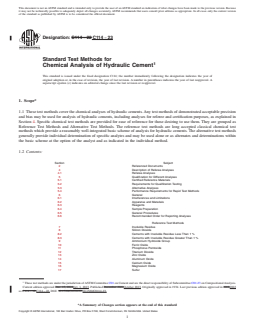
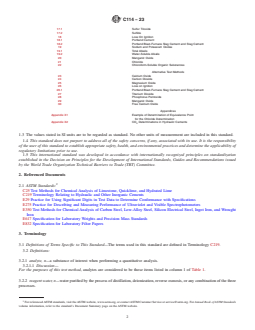
(Test Method)Standard Test Methods for Chemical Analysis of Hydraulic Cement
General Information
- Abstract
ABSTRACT
These test methods cover the chemical analyses of hydraulic cements. Specific chemical test methods are grouped as reference test methods and alternative test methods. The reference test methods are long accepted classical chemical test methods which provide a reasonably well-integrated basic scheme of analysis for hydraulic cements and are also required for referee analysis in those cases where conformance to chemical specification requirements are questioned. Apparatus and materials for the test method include balance, weights, glassware and laboratory containers, desiccators, filter paper, crucibles, and muffle furnace. Standard reagents for the test method shall be used within the limits of the specification. These reagents shall include purity agents, water, repackaged reagents, concentrated acids and ammonium hydroxide, nonstandardized solutions, and indicator solutions. Sample preparation and general test procedures shall be followed according to the specification. General procedures include sample weighing, taring of crucibles, weighing of ignited residues, volatilization of platinum, chemical analyses, and calculation. Reporting of analyses shall be of the following order: major components, minor components, and separate determinations. Reference test methods and procedures include determination of insoluble residue, silicon dioxide, ammonium hydroxide group, ferric oxide, phosphorus pentoxide, titanium dioxide, zinc oxide, aluminum oxide, calcium oxide, magnesium oxide, sulfur, loss on ignition, sodium and potassium oxides, manganic oxide, chloride, chloroform-soluble organic substances. Alternative test methods and procedures include determination of calcium oxide, calcium dioxide, magnesium oxide, loss on ignition, titanium dioxide, phosphorus pentoxide, manganic oxide, and free calcium oxide. The standardization used for qualification and for analysis of each constituent shall be determined by valid curve-fitting procedures.
SCOPE
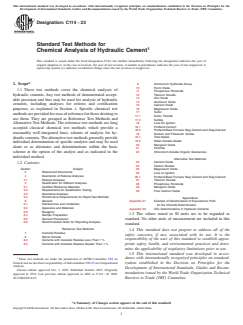
1.1 These test methods cover the chemical analyses of hydraulic cements. Any test methods of demonstrated acceptable precision and bias may be used for analysis of hydraulic cements, including analyses for referee and certification purposes, as explained in Section 4. Specific chemical test methods are provided for ease of reference for those desiring to use them. They are grouped as Reference Test Methods and Alternative Test Methods. The reference test methods are long accepted classical chemical test methods which provide a reasonably well-integrated basic scheme of analysis for hydraulic cements. The alternative test methods generally provide individual determination of specific analytes and may be used alone or as alternates and determinations within the basic scheme at the option of the analyst and as indicated in the individual method.
1.2 Contents:
Section
Subject
2
Referenced Documents
4
Description of Referee Analyses
4.1
Referee Analyses
5
Qualification for Different Analyses
5.1
Certified Reference Materials
5.2
Requirements for Qualification Testing
5.3
Alternative Analyses
5.4
Performance Requirements for Rapid Test Methods
6
General
6.1
Interferences and Limitations
6.2
Apparatus and Materials
6.3
Reagents
6.4
Sample Preparation
6.5
General Procedures
6.6
Recommended Order for Reporting Analyses
Reference Test Methods
7
Insoluble Residue
8
Silicon Dioxide
8.2
Cements with Insoluble Residue Less Than 1 %
8.3
Cements with Insoluble Residue Greater Than 1 %
9
Ammonium Hydroxide Group
10
Ferric Oxide
11
Phosphorus Pentoxide
12
Titanium Dioxide
13
Zinc Oxide
14
Aluminum Oxide
15
Calcium Oxide
16
Magnesium Oxide
17
Sulfur
17.1
Sulfur Trioxide
17.2
Sulfide
18
Loss On Ignition
18.1
Portland Cement
...
- Status
- Published
- Publication Date
- 30-Sep-2023
- Technical Committee
- C01 - Cement
- Drafting Committee
- C01.23 - Compositional Analysis
Overview
ASTM C114-23: Standard Test Methods for Chemical Analysis of Hydraulic Cement provides comprehensive procedures for determining chemical composition in hydraulic cements, including portland cement. This standard, developed by ASTM International, is widely recognized for quality control and verification within cement manufacturing and testing laboratories. ASTM C114-23 defines both traditional reference test methods and alternative test methods for chemical analysis, ensuring accuracy, repeatability, and regulatory compliance in cement quality assurance.
Key Topics
- Reference and Alternative Test Methods: Covers classic, well-integrated chemical analysis techniques (reference methods), and shorter or specialized procedures (alternative methods) for specific analytes.
- Certified Reference Materials (CRMs): Emphasizes the use of traceable reference cements for method qualification and analyst proficiency.
- Sample Preparation and General Procedures:
- Sieve and homogenize samples before testing
- Use precision balances, calibrated weights, specialized glassware, desiccators, and filter papers
- Detailed procedures for weighing, taring, ignition, and residue handling
- Analyte Determination: Methods cover major and minor constituents, such as silicon dioxide, ferric oxide, aluminum oxide, calcium and magnesium oxides, sulfur, sodium and potassium oxides, titanium dioxide, zinc oxide, phosphorus pentoxide, chloride, and more.
- Performance Requirements:
- Precision and bias limits for each analyte
- Requirements for duplicate testing, especially in referee analyses
- Qualification of Methods and Analysts:
- Periodic demonstration of analyst competence and method accuracy by using CRMs
- Requirements for method requalification under certain conditions, such as major equipment changes or suspect results
Applications
ASTM C114-23 is essential for:
- Cement Manufacturing Quality Control: Routine chemical analysis to ensure product meets specification requirements.
- Materials Testing Laboratories: Accurate determination and reporting of hydraulic cement composition, including conformance and certification testing.
- Dispute Resolution: Used as a referee method when there is a question about compliance with chemical specifications.
- Regulatory Compliance: Helps manufacturers and laboratories meet international and local construction material standards.
- Research and Development: Supports new formulations and performance verification for hydraulic cement products.
Common users include:
- Cement producers and suppliers
- Third-party laboratories
- Construction material evaluators
- Regulatory agencies
Related Standards
- ASTM C25: Test Methods for Chemical Analysis of Limestone, Quicklime, and Hydrated Lime
- ASTM C219: Terminology Relating to Hydraulic and Other Inorganic Cements
- ASTM E29: Practice for Using Significant Digits in Test Data
- ASTM E617: Specification for Laboratory Weights and Precision Mass Standards
- ASTM E832: Specification for Laboratory Filter Papers
- ASTM E350: Test Methods for Chemical Analysis of Carbon Steel and Iron
Practical Value
By following ASTM C114-23, organizations can ensure their hydraulic cement products are accurately analyzed for composition and purity. The standard’s robust requirements for calibration, sample preparation, analyst qualification, and reporting order enable greater consistency and comparability of results across the industry. This helps safeguard the reliability and safety of cement used in construction projects, ensures regulatory compliance, and builds confidence among stakeholders throughout the supply chain.
Keywords: ASTM C114-23, chemical analysis of cement, hydraulic cement, reference test methods, alternative test methods, cement quality control, chemical composition testing, laboratory standards, reference materials, cement testing standard.
Relations
- Effective Date
- 01-Oct-2023
- Effective Date
- 01-Apr-2024
- Effective Date
- 15-Nov-2023
- Effective Date
- 15-Aug-2023
- Effective Date
- 01-May-2019
- Refers
ASTM C25-19 - Standard Test Methods for Chemical Analysis of Limestone, Quicklime, and Hydrated Lime - Effective Date
- 01-May-2019
- Effective Date
- 01-Oct-2018
- Effective Date
- 15-Mar-2018
- Effective Date
- 01-Oct-2023
- Effective Date
- 01-Oct-2023
- Referred By
ASTM D5298-16 - Standard Test Method for Measurement of Soil Potential (Suction) Using Filter Paper - Effective Date
- 01-Oct-2023
- Effective Date
- 01-Oct-2023
- Effective Date
- 01-Oct-2023
- Effective Date
- 01-Oct-2023
- Effective Date
- 01-Oct-2023
Get Certified
Connect with accredited certification bodies for this standard

DIBt (Deutsches Institut für Bautechnik)
German Institute for Building Technology.
DIN CERTCO
DIN Group product certification.

Aboma Certification B.V.
Specialized in construction, metal, and transport sectors.
Sponsored listings
Frequently Asked Questions
ASTM C114-23 is a standard published by ASTM International. Its full title is "Standard Test Methods for Chemical Analysis of Hydraulic Cement". This standard covers: ABSTRACT These test methods cover the chemical analyses of hydraulic cements. Specific chemical test methods are grouped as reference test methods and alternative test methods. The reference test methods are long accepted classical chemical test methods which provide a reasonably well-integrated basic scheme of analysis for hydraulic cements and are also required for referee analysis in those cases where conformance to chemical specification requirements are questioned. Apparatus and materials for the test method include balance, weights, glassware and laboratory containers, desiccators, filter paper, crucibles, and muffle furnace. Standard reagents for the test method shall be used within the limits of the specification. These reagents shall include purity agents, water, repackaged reagents, concentrated acids and ammonium hydroxide, nonstandardized solutions, and indicator solutions. Sample preparation and general test procedures shall be followed according to the specification. General procedures include sample weighing, taring of crucibles, weighing of ignited residues, volatilization of platinum, chemical analyses, and calculation. Reporting of analyses shall be of the following order: major components, minor components, and separate determinations. Reference test methods and procedures include determination of insoluble residue, silicon dioxide, ammonium hydroxide group, ferric oxide, phosphorus pentoxide, titanium dioxide, zinc oxide, aluminum oxide, calcium oxide, magnesium oxide, sulfur, loss on ignition, sodium and potassium oxides, manganic oxide, chloride, chloroform-soluble organic substances. Alternative test methods and procedures include determination of calcium oxide, calcium dioxide, magnesium oxide, loss on ignition, titanium dioxide, phosphorus pentoxide, manganic oxide, and free calcium oxide. The standardization used for qualification and for analysis of each constituent shall be determined by valid curve-fitting procedures. SCOPE 1.1 These test methods cover the chemical analyses of hydraulic cements. Any test methods of demonstrated acceptable precision and bias may be used for analysis of hydraulic cements, including analyses for referee and certification purposes, as explained in Section 4. Specific chemical test methods are provided for ease of reference for those desiring to use them. They are grouped as Reference Test Methods and Alternative Test Methods. The reference test methods are long accepted classical chemical test methods which provide a reasonably well-integrated basic scheme of analysis for hydraulic cements. The alternative test methods generally provide individual determination of specific analytes and may be used alone or as alternates and determinations within the basic scheme at the option of the analyst and as indicated in the individual method. 1.2 Contents: Section Subject 2 Referenced Documents 4 Description of Referee Analyses 4.1 Referee Analyses 5 Qualification for Different Analyses 5.1 Certified Reference Materials 5.2 Requirements for Qualification Testing 5.3 Alternative Analyses 5.4 Performance Requirements for Rapid Test Methods 6 General 6.1 Interferences and Limitations 6.2 Apparatus and Materials 6.3 Reagents 6.4 Sample Preparation 6.5 General Procedures 6.6 Recommended Order for Reporting Analyses Reference Test Methods 7 Insoluble Residue 8 Silicon Dioxide 8.2 Cements with Insoluble Residue Less Than 1 % 8.3 Cements with Insoluble Residue Greater Than 1 % 9 Ammonium Hydroxide Group 10 Ferric Oxide 11 Phosphorus Pentoxide 12 Titanium Dioxide 13 Zinc Oxide 14 Aluminum Oxide 15 Calcium Oxide 16 Magnesium Oxide 17 Sulfur 17.1 Sulfur Trioxide 17.2 Sulfide 18 Loss On Ignition 18.1 Portland Cement ...
ABSTRACT These test methods cover the chemical analyses of hydraulic cements. Specific chemical test methods are grouped as reference test methods and alternative test methods. The reference test methods are long accepted classical chemical test methods which provide a reasonably well-integrated basic scheme of analysis for hydraulic cements and are also required for referee analysis in those cases where conformance to chemical specification requirements are questioned. Apparatus and materials for the test method include balance, weights, glassware and laboratory containers, desiccators, filter paper, crucibles, and muffle furnace. Standard reagents for the test method shall be used within the limits of the specification. These reagents shall include purity agents, water, repackaged reagents, concentrated acids and ammonium hydroxide, nonstandardized solutions, and indicator solutions. Sample preparation and general test procedures shall be followed according to the specification. General procedures include sample weighing, taring of crucibles, weighing of ignited residues, volatilization of platinum, chemical analyses, and calculation. Reporting of analyses shall be of the following order: major components, minor components, and separate determinations. Reference test methods and procedures include determination of insoluble residue, silicon dioxide, ammonium hydroxide group, ferric oxide, phosphorus pentoxide, titanium dioxide, zinc oxide, aluminum oxide, calcium oxide, magnesium oxide, sulfur, loss on ignition, sodium and potassium oxides, manganic oxide, chloride, chloroform-soluble organic substances. Alternative test methods and procedures include determination of calcium oxide, calcium dioxide, magnesium oxide, loss on ignition, titanium dioxide, phosphorus pentoxide, manganic oxide, and free calcium oxide. The standardization used for qualification and for analysis of each constituent shall be determined by valid curve-fitting procedures. SCOPE 1.1 These test methods cover the chemical analyses of hydraulic cements. Any test methods of demonstrated acceptable precision and bias may be used for analysis of hydraulic cements, including analyses for referee and certification purposes, as explained in Section 4. Specific chemical test methods are provided for ease of reference for those desiring to use them. They are grouped as Reference Test Methods and Alternative Test Methods. The reference test methods are long accepted classical chemical test methods which provide a reasonably well-integrated basic scheme of analysis for hydraulic cements. The alternative test methods generally provide individual determination of specific analytes and may be used alone or as alternates and determinations within the basic scheme at the option of the analyst and as indicated in the individual method. 1.2 Contents: Section Subject 2 Referenced Documents 4 Description of Referee Analyses 4.1 Referee Analyses 5 Qualification for Different Analyses 5.1 Certified Reference Materials 5.2 Requirements for Qualification Testing 5.3 Alternative Analyses 5.4 Performance Requirements for Rapid Test Methods 6 General 6.1 Interferences and Limitations 6.2 Apparatus and Materials 6.3 Reagents 6.4 Sample Preparation 6.5 General Procedures 6.6 Recommended Order for Reporting Analyses Reference Test Methods 7 Insoluble Residue 8 Silicon Dioxide 8.2 Cements with Insoluble Residue Less Than 1 % 8.3 Cements with Insoluble Residue Greater Than 1 % 9 Ammonium Hydroxide Group 10 Ferric Oxide 11 Phosphorus Pentoxide 12 Titanium Dioxide 13 Zinc Oxide 14 Aluminum Oxide 15 Calcium Oxide 16 Magnesium Oxide 17 Sulfur 17.1 Sulfur Trioxide 17.2 Sulfide 18 Loss On Ignition 18.1 Portland Cement ...
ASTM C114-23 is classified under the following ICS (International Classification for Standards) categories: 91.100.10 - Cement. Gypsum. Lime. Mortar. The ICS classification helps identify the subject area and facilitates finding related standards.
ASTM C114-23 has the following relationships with other standards: It is inter standard links to ASTM C114-22, ASTM C219-24, ASTM E350-23, ASTM E617-23, ASTM C25-19e1, ASTM C25-19, ASTM E617-18, ASTM E350-18, ASTM C1157/C1157M-23, ASTM C1084-19, ASTM D5298-16, ASTM C1005-20, ASTM E2060-22, ASTM C1038/C1038M-19, ASTM C1240-20. Understanding these relationships helps ensure you are using the most current and applicable version of the standard.
ASTM C114-23 is available in PDF format for immediate download after purchase. The document can be added to your cart and obtained through the secure checkout process. Digital delivery ensures instant access to the complete standard document.
Standards Content (Sample)
This international standard was developed in accordance with internationally recognized principles on standardization established in the Decision on Principles for the
Development of International Standards, Guides and Recommendations issued by the World Trade Organization Technical Barriers to Trade (TBT) Committee.
Designation: C114 − 23
Standard Test Methods for
Chemical Analysis of Hydraulic Cement
This standard is issued under the fixed designation C114; the number immediately following the designation indicates the year of
original adoption or, in the case of revision, the year of last revision. A number in parentheses indicates the year of last reapproval. A
superscript epsilon (´) indicates an editorial change since the last revision or reapproval.
1. Scope*
9 Ammonium Hydroxide Group
10 Ferric Oxide
1.1 These test methods cover the chemical analyses of
11 Phosphorus Pentoxide
hydraulic cements. Any test methods of demonstrated accept- 12 Titanium Dioxide
13 Zinc Oxide
able precision and bias may be used for analysis of hydraulic
14 Aluminum Oxide
cements, including analyses for referee and certification
15 Calcium Oxide
purposes, as explained in Section 4. Specific chemical test 16 Magnesium Oxide
17 Sulfur
methods are provided for ease of reference for those desiring to
17.1 Sulfur Trioxide
use them. They are grouped as Reference Test Methods and
17.2 Sulfide
18 Loss On Ignition
Alternative Test Methods. The reference test methods are long
18.1 Portland Cement
accepted classical chemical test methods which provide a
18.2 Portland Blast-Furnace Slag Cement and Slag Cement
reasonably well-integrated basic scheme of analysis for hy-
19 Sodium and Potassium Oxides
19.1 Total Alkalis
draulic cements. The alternative test methods generally provide
19.2 Water-Soluble Alkalis
individual determination of specific analytes and may be used
20 Manganic Oxide
alone or as alternates and determinations within the basic
21 Chloride
22 Chloroform-Soluble Organic Substances
scheme at the option of the analyst and as indicated in the
individual method.
Alternative Test Methods
23 Calcium Oxide
1.2 Contents:
24 Carbon Dioxide
Section Subject
25 Magnesium Oxide
2 Referenced Documents
26 Loss on Ignition
4 Description of Referee Analyses
26.1 Portland Blast-Furnace Slag Cement and Slag Cement
4.1 Referee Analyses
27 Titanium Dioxide
5 Qualification for Different Analyses
28 Phosphorus Pentoxide
5.1 Certified Reference Materials
29 Manganic Oxide
5.2 Requirements for Qualification Testing
30 Free Calcium Oxide
5.3 Alternative Analyses
5.4 Performance Requirements for Rapid Test Methods
Appendices
6 General
Appendix X1 Example of Determination of Equivalence Point
6.1 Interferences and Limitations
for the Chloride Determination
6.2 Apparatus and Materials
Appendix X2 CO Determinations in Hydraulic Cements
6.3 Reagents
1.3 The values stated in SI units are to be regarded as
6.4 Sample Preparation
6.5 General Procedures
standard. No other units of measurement are included in this
6.6 Recommended Order for Reporting Analyses
standard.
Reference Test Methods
1.4 This standard does not purport to address all of the
7 Insoluble Residue
safety concerns, if any, associated with its use. It is the
8 Silicon Dioxide
responsibility of the user of this standard to establish appro-
8.2 Cements with Insoluble Residue Less Than 1 %
8.3 Cements with Insoluble Residue Greater Than 1 %
priate safety, health, and environmental practices and deter-
mine the applicability of regulatory limitations prior to use.
1.5 This international standard was developed in accor-
dance with internationally recognized principles on standard-
These test methods are under the jurisdiction of ASTM Committee C01 on
Cement and are the direct responsibility of Subcommittee C01.23 on Compositional
ization established in the Decision on Principles for the
Analysis.
Development of International Standards, Guides and Recom-
Current edition approved Oct. 1, 2023. Published October 2023. Originally
mendations issued by the World Trade Organization Technical
approved in 1934. Last previous edition approved in 2022 as C114 – 22. DOI:
10.1520/C0114-23. Barriers to Trade (TBT) Committee.
*A Summary of Changes section appears at the end of this standard
Copyright © ASTM International, 100 Barr Harbor Drive, PO Box C700, West Conshohocken, PA 19428-2959. United States
C114 − 23
A
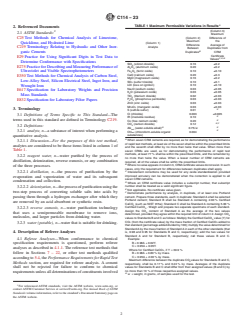
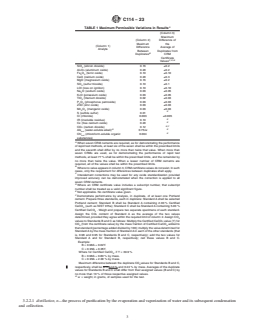
TABLE 1 Maximum Permissible Variations in Results
2. Referenced Documents
(Column 3)
2.1 ASTM Standards:
Maximum
C25 Test Methods for Chemical Analysis of Limestone, (Column 2) Difference of
Maximum the
Quicklime, and Hydrated Lime
(Column 1)
Difference Average of
Analyte
C219 Terminology Relating to Hydraulic and Other Inor-
Between Duplicates from
B
Duplicates CRM
ganic Cements
Certificate
E29 Practice for Using Significant Digits in Test Data to
C,D,B
Values
Determine Conformance with Specifications
SiO (silicon dioxide) 0.16 ±0.2
E275 Practice for Describing and Measuring Performance of
Al O (aluminum oxide) 0.20 ±0.2
2 3
Fe O (ferric oxide) 0.10 ±0.10
Ultraviolet and Visible Spectrophotometers 2 3
CaO (calcium oxide) 0.20 ±0.3
E350 Test Methods for Chemical Analysis of Carbon Steel,
MgO (magnesium oxide) 0.16 ±0.2
Low-Alloy Steel, Silicon Electrical Steel, Ingot Iron, and
SO (sulfur trioxide) 0.10 ±0.1
LOI (loss on ignition) 0.10 ±0.10
Wrought Iron
Na O (sodium oxide) 0.03 ±0.05
E617 Specification for Laboratory Weights and Precision
K O (potassium oxide) 0.03 ±0.05
Mass Standards
TiO (titanium dioxide) 0.02 ±0.03
P O (phosphorus pentoxide) 0.03 ±0.03
E832 Specification for Laboratory Filter Papers
2 5
ZnO (zinc oxide) 0.03 ±0.03
Mn O (manganic oxide) 0.03 ±0.03
2 3
3. Terminology E
S (sulfide sulfur) 0.01
Cl (chloride) 0.003 ±0.005
3.1 Definitions of Terms Specific to This Standard—The
E
IR (insoluble residue) 0.10
E
terms used in this standard are defined in Terminology C219.
Cx (free calcium oxide) 0.20
E,F
CO (carbon dioxide) 0.12
3.2 Definitions:
G E
Alk (water-soluble alkali) 0.75/w
sol
E
3.2.1 analyte, n—a substance of interest when performing a Chl (chloroform-soluble organic 0.004
sol
substances)
quantitative analysis.
A
When seven CRM cements are required, as for demonstrating the performance
3.2.1.1 Discussion—For the purposes of this test method,
of rapid test methods, at least six of the seven shall be within the prescribed limits
analytes are considered to be those items listed in column 1 of
and the seventh shall differ by no more than twice that value. When more than
Table 1.
seven CRMs are used, as for demonstrating the performance of rapid test
methods, at least 77 % shall be within the prescribed limits, and the remainder by
3.2.2 reagent water, n—water purified by the process of
no more than twice the value. When a lesser number of CRM cements are
distillation, deionization, reverse osmosis, or any combination
required, all of the values shall be within the prescribed limits.
B
Where no value appears in column 3, CRM certificate values do not exist. In such
of the three processes.
cases, only the requirement for differences between duplicates shall apply.
C
3.2.2.1 distillation, n—the process of purification by the
Interelement corrections may be used for any oxide standardization provided
improved accuracy can be demonstrated when the correction is applied to all
evaporation and vaporization of water and its subsequent
seven CRM cements.
condensation and collection.
D
Where an CRM certificate value includes a subscript number, that subscript
number shall be treated as a valid significant figure.
3.2.2.2 deionization, n—the process of purification using the
E
Not applicable. No certificate value given.
two-step process of converting soluble salts into acids by F
Demonstrate performance by analysis, in duplicate, of at least one Portland
cement. Prepare three standards, each in duplicate: Standard A shall be selected
passing them through a hydrogen exchanger after which they
Portland cement; Standard B shall be Standard A containing 2.00 % Certified
are removed by an acid absorbent or synthetic resin.
CaCO (such as NIST 915a); Standard C shall be Standard A containing 5.00 %
Certified CaCO . Weigh and prepare two separate specimens of each standard.
3.2.2.3 reverse osmosis, n—water purification technology 3
Assign the CO content of Standard A as the average of the two values
that uses a semipermeable membrane to remove ions,
determined, provided they agree within the required limit of column 2. Assign CO
molecules, and larger particles from drinking water.
values to Standards B and C as follows: Multiply the Certified CaCO value (Y) for
CO (from the certificate value) by the mass fraction of Certified CaCO added to
2 3
3.2.3 water (potable), n—water that is suitable for drinking.
that standard (percentage added divided by 100); multiply the value determined for
Standard A by the mass fraction of Standard A in each of the other standards (that
4. Description of Referee Analyses is, 0.98 and 0.95 for Standards B and C, respectively); add the two values for
Standard A and for Standard B, respectively; call these values B and C.
4.1 Referee Analyses—When conformance to chemical
Example:
B = 0.98A + 0.02Y.
specification requirements is questioned, perform referee
C = 0.95A + 0.05Y.
analyses as described in 4.1.1. The reference test methods that
Where for Certified CaCO , if Y = 39.9 %
follow in Sections 7 – 22, or other test methods qualified
B = 0.98A + 0.80 % by mass.
C = 0.95A + 2.00 % by mass.
according to 5.4, the Performance Requirements for Rapid Test
Maximum difference between the duplicate CO values for Standards B and C,
Methods section, are required for referee analysis. A cement
respectively, shall be 0.17 % and 0.24 % by mass. Averages of the duplicate
shall not be rejected for failure to conform to chemical values for Standards B and C shall differ from their assigned values (B and C) by
no more than 10 % of those respective assigned values.
requirements unless all determinations of constituents involved
G
w = weight, in grams, of samples used for the test.
For referenced ASTM standards, visit the ASTM website, www.astm.org, or
contact ASTM Customer Service at service@astm.org. For Annual Book of ASTM
Standards volume information, refer to the standard’s Document Summary page on
the ASTM website.
C114 − 23
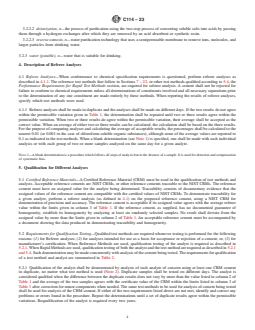
and all necessary separations prior to the determination of any The requirements for qualification of a test method and analyst
one constituent are made entirely by these methods. When are summarized in Table 2.
reporting the results of referee analyses, specify which test 5.2.1 Qualification of the analyst shall be demonstrated by
methods were used. analysis of each analyte of concern using at least one CRM
cement in duplicate, no matter what test method is used (Note
4.1.1 Referee analyses shall be made in duplicate and the
2). Duplicate samples shall be tested on different days. The
analyses shall be made on different days. If the two results do
analyst is considered qualified when the difference between the
not agree within the permissible variation given in Table 1, the
duplicate results does not vary by more than the value listed in
determination shall be repeated until two or three results agree
column 2 of Table 1 and the average of the two samples agrees
within the permissible variation. When two or three results do
with the certificate value of the CRM within the limits listed in
agree within the permissible variation, their average shall be
column 3 of Table 1 after correction for minor components
accepted as the correct value. When an average of either two or
when needed. The same test methods to be used for analysis of
three results can be calculated, the calculation shall be based on
cement being tested shall be used for analysis of the CRM
the three results. For the purpose of comparing analyses and
cement. If either of the two requirements listed above are not
calculating the average of acceptable results, the percentages
met, identify and correct any problems or errors found in the
shall be calculated to the nearest 0.01 (or 0.001 in the case of
procedure. Repeat the determinations until a set of duplicate
chloroform-soluble organic substances), although some of the
results agree within the permissible variations. Requalification
average values are reported to 0.1 as indicated in the test
of the analyst is required every two years.
methods. When a blank determination (see Note 1) is specified,
one shall be made with each individual analysis or with each
NOTE 2—When qualifying a Rapid Method with seven CRMs in
accordance with 5.4.2, the analyst performing the qualification of the test
group of two or more samples analyzed on the same day for a
method may simultaneously qualify for the requirement of 5.2.1.
given analyte.
5.2.2 Qualification data demonstrating that the same opera-
NOTE 1—A blank determination is a procedure which follows all steps
tor or analyst making the acceptance determination obtained
of analysis but in the absence of a sample. It is used for detection and
precise and accurate results with CRM cements in accordance
compensation of systematic bias.
with 5.2.1 shall be made available on request to all parties
concerned when there is a question of acceptance of a cement.
5. Qualification for Different Analyses
If the CRM used is not a NIST cement, the traceability
5.1 Certified Reference Materials—A Certified Reference
documentation of the CRM used shall also be made available
Material (CRM) must be used in the qualification of test
on request.
methods and analysts. Acceptable reference cements are NIST
5.3 Alternative Analyses—The alternative test methods
CRMs, or other reference cements traceable to the NIST
provide, in some cases, procedures that are shorter or more
CRMs. The reference cement must have an assigned value for
convenient to use for routine determination of certain constitu-
the analyte being determined. Traceability consists of docu-
ents than are the reference test methods (Note 3). Longer, more
mentary evidence that the assigned values of the reference
complex procedures, in some instances, have been retained as
cement are compatible with the certified values of NIST
alternative test methods to permit comparison of results by
CRMs. To demonstrate traceability for a given analyte, per-
different procedures or for use when unusual materials are
form a referee analysis (as defined in 4.1) on the proposed
being examined, where unusual interferences may be
reference cement, using a NIST CRM for demonstration of
suspected, or when unusual preparation for analysis is required.
precision and accuracy. The reference cement is acceptable if
Test results from alternative test methods may be used as a
its assigned value agrees with the average referee value within
basis for acceptance or rejection when it is clear that a cement
the limits given in column 3 of Table 1. If the reference cement,
does or does not meet the specification requirement. Any
as supplied, has no documented guarantee of homogeneity,
change in test method procedures from those procedures listed
establish its homogeneity by analyzing at least six randomly
selected samples. No result shall deviate from the assigned
value by more than the limits given in column 2 of Table 1. An
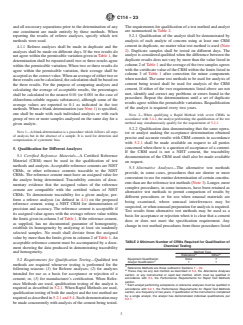
TABLE 2 Minimum Number of CRMs Required for Qualification of
acceptable reference cement must be accompanied by a docu-
Chemical Testing
ment showing the data produced in demonstrating traceability
Method Type
and homogeneity.
A B
Reference Other
Equipment Qualification None 7
5.2 Requirements for Qualification Testing—Qualified test
C
Analyst Qualification 1 1
methods are required whenever testing is performed for the
A
Reference Methods are those outlined in Sections 7 – 22.
following reasons: (1) for Referee analyses; (2) for analyses
B
These may be any test method as described in 5.3, the Alternative Analyses
intended for use as a basis for acceptance or rejection of a
section, or any instrumental or rapid test method, which must be qualified in
accordance with 5.4, the Performance Requirements for Rapid Test Methods
cement; or, (3) for manufacturer’s certification. When Refer-
section.
ence Methods are used, qualification testing of the analyst is
C
Each analyst performing acceptance or reference analyses must be qualified in
required as described in 5.2.1. When Rapid Methods are used, accordance with 5.2.1, the Performance Requirements for Rapid Test Methods
section, at a frequency of two years. If qualification of the instrument is completed
qualification testing of both the analyst and the test method are
by a single analyst, the analyst has demonstrated individual qualifications per
required as described in 5.2.1 and 5.4. Such demonstration may
5.2.1.
be made concurrently with analysis of the cement being tested.
C114 − 23
in Sections 7 – 30 requires method qualification in accordance 5.4.2.3 For each analyte and each CRM, the average ob-
with 5.4, the Performance Requirements for Rapid Test Meth- tained shall be compared to the certified concentrations. Where
ods section. a certificate value includes a subscript number, that subscript
shall be assumed to be a significant number. When seven
NOTE 3—It is not intended that the use of reference test methods be
CRMs are used in the qualification procedure, at least six of the
confined to referee analysis. A reference test method may be used in
seven averages for each analyte shall not differ from the
preference to an alternative test method when so desired. A reference test
method must be used where an alternative test method is not provided.
certified concentrations by more than the value shown in
column 3 of Table 1, and the remaining average by more than
5.3.1 Duplicate analyses and blank determinations are not
twice that value. When more than seven CRMs are used in the
required when using the alternative test methods. If, however,
qualification procedure, at least 77 % of the averages for each
a blank determination is desired for an alternative test method,
analyte shall not differ from the certified concentrations by
one may be used and it need not have been obtained concur-
more than the value shown in column 3 of Table 1, and the
rently with the analysis. The final results, when corrected for
remaining average(s) by more than twice that value.
blank values, should, in either case, be so designated.
3,4 5.4.2.4 The standardization, if needed, used for qualification
5.4 Performance Requirements for Rapid Test Methods:
and for analysis of each constituent shall be determined by
5.4.1 Definition and Scope—Where analytical data obtained
valid curve-fitting procedures. A point-to-point, saw-tooth
in accordance with this test method are required, any test
curve that is artificially made to fit a set of data points does not
method may be used that meets the requirements of 5.4.2, the
constitute a valid curve-fitting procedure. A complex polyno-
Qualification of a Test Method section. A test method is
mial drawn through the points is similarly not valid. For the
considered to consist of the specific procedures, reagents,
same reason, empirical inter-element corrections may be used,
supplies, equipment, instrument, and so forth, selected and
only if ≤ (N – 3) ⁄ 2 are employed, where N is the number of
used in a consistent manner by a specific laboratory. See Note
different standards used. The qualification testing shall be
4 for examples of procedures.
conducted with specimens newly prepared from scratch, in-
NOTE 4—Examples of test methods used successfully by their authors
cluding all the preparation stages applicable for analysis of an
for analysis of hydraulic cement are given in the list of references.
unknown sample, and employing the reagents currently in use
Included are test methods using atomic absorption X-ray spectrometry and
for unknown analyses.
spectrophotometry-EDTA.
5.4.3 Partial Results—Test Methods that provide acceptable
5.4.1.1 If more than one instrument, even though substan-
results for some analytes but not for others may be used only
tially identical, is used in a specific laboratory for the same
for those analytes for which acceptable results are obtained.
analyses, use of each instrument shall constitute a separate test
5.4.4 Report of Results—When performing chemical analy-
method and each must be qualified separately.
sis and reporting results for Manufacturer’s Certification, the
5.4.2 Qualification of a Test Method—Prior to use for
type of method (Reference or Rapid) and the test method used
analysis of hydraulic cement, each test method (see 5.4.1) must
along with any supporting qualification testing shall be avail-
be qualified individually for such analysis. Qualification data,
able on request.
or if applicable, requalification data, shall be made available
5.4.5 Rejection of Material—See 4.1, the Referee Analyses
pursuant to the Manufacturer’s Certification section of the
section, and 5.3, the Alternative Analyses section.
appropriate hydraulic cement specification.
5.4.6 Requalification of a Test Method:
5.4.2.1 Using the test method chosen, make single determi-
nations for each analyte under consideration on at least seven 5.4.6.1 Requalification of a test method shall be required
CRM samples. Requirements for a CRM are listed in 5.1, the
upon receipt of substantial evidence that the test method may
Certified Reference Material section. Complete two rounds of not be providing data in accordance with Table 1 for one or
tests on different days repeating all steps of sample prepara-
more constituents. Such requalification may be limited to those
tions. Calculate the differences between values and averages of constituents indicated to be in error and shall be carried out
the values from the two rounds of tests.
prior to further use of the method for analysis of those
5.4.2.2 When seven CRMs are used in the qualification constituents.
procedure, at least six of the seven differences between
5.4.6.2 Substantial evidence that a test method may not be
duplicates obtained of any single analyte shall not exceed the
providing data in accordance with Table 1 shall be considered
limits shown in column 2 of Table 1 and the remaining
to have been received when a laboratory is informed that
differences by no more than twice that value. When more than
analysis of the same material by Reference Test Methods run in
seven CRMs are used, the values for at least 77 % of the
accordance with 4.1.1, the final average of a CCRL sample, a
samples shall be within the prescribed limits, while the values
certificate value of an NIST CRM, the assigned value of an
for the remainder shall differ by no more than twice that value.
alternate CRM, or an accepted value of a known secondary
standard differs from the value obtained by the test method in
3 question by more than twice the value shown in column 2 of
Gebhardt, R. F., “Rapid Methods for Chemical Analysis of Hydraulic Cement,”
Table 1 for one or more constituents. When indirect test
ASTM STP 985, 1988.
Barger, G. S., “A Fusion Method for the X-Ray Fluorescence Analysis of
methods are involved, as when a value is obtained by
Portland Cements, Clinker and Raw Materials Utilizing Cerium (IV) Oxide in
difference, corrections shall be made for minor constituents in
Lithium Borate Fluxes,” Proceedings of the Thirty Fourth Annual Conference on
order to put analyses on a comparable basis prior to determin-
Applications of X-Ray Analysis, Denver Conference, Volume 29 pp. 581–585,
August 5, 1985. ing the differences. For any constituents affected, a test method
C114 − 23
also shall be requalified after any substantial repair or replace- 6.2.1.1 The balance shall be capable of reproducing results
ment of one or more critical components of an instrument within 0.0002 g with an accuracy of 60.0002 g. Direct-reading
essential to the test method. balances shall have a sensitivity not exceeding 0.0001 g (Note
5.4.6.3 If an instrument or piece of equipment is replaced, 6). Conventional two-pan balances shall have a maximum
even if by one of identical make or model, or is significantly
sensibility reciprocal of 0.0003 g. Any rapid weighing device
modified, a previously qualified test method using such new or that may be provided, such as a chain, damped motion, or
modified instrument or equipment shall be considered a new
heavy riders, shall not increase the basic inaccuracy by more
method and must be qualified in accordance with 5.4.2. than 0.0001 g at any reading and with any load within the rated
5.4.7 Precision and Bias—Different analytical test methods
capacity of the balance.
are subject to individual limits of precision and bias. It is the
NOTE 6—The sensitivity of a direct-reading balance is the weight
responsibility of the user to demonstrate that the test methods
required to change the reading one graduation. The sensibility reciprocal
used at least meet the limits of precision and bias shown in
for a conventional balance is defined as the change in weight required on
Table 1.
either pan to change the position of equilibrium one division on the pointer
scale at capacity or at any lesser load.
6. General
6.2.2 Weights—Weights used for analysis shall conform to
6.1 Interferences and Limitations:
Types I or II, Grades S or O, Classes 1, 2, or 3 as described in
6.1.1 These test methods were developed primarily for the
Specification E617. They shall be checked at least once a year,
analysis of portland cements. However, except for limitations
or when questioned, and adjusted at least to within allowable
noted in the procedure for specific constituents, the reference
tolerances for Class 3 weights (Note 7). For this purpose each
test methods provide for accurate analyses of other hydraulic
laboratory shall also maintain, or have available for use, a
cements that are completely decomposed by hydrochloric acid,
reference set of standard weights from 50 g to 10 mg, which
or where a preliminary sodium carbonate fusion is made to
shall conform at least to Class 3 requirements and be calibrated
ensure complete solubility. Some of the alternative test meth-
at intervals not exceeding five years by the National Institute of
ods may not always provide accurate results because of
Standards and Technology (NIST). After initial calibration,
interferences from elements which are not removed during the
recalibration by the NIST may be waived provided it can be
procedure.
shown by documented data obtained within the time interval
NOTE 5—Instrumental analyses can usually detect only the element
specified that a weight comparison between summations of
sought. Therefore, to avoid controversy, the actual procedure used for the
smaller weights and a single larger weight nominally equal to
elemental analyses should be noted when actual differences with reference
that summation, establishes that the allowable tolerances have
procedures can exist. For example, P O and TiO are included with
2 5 2
Al O in the usual wet test method and sulfide sulfur is included in most not been exceeded. All new sets of weights purchased shall
2 3
instrumental procedures with SO .
3 have the weights of 1 g and larger made of stainless steel or
other corrosion-resisting alloy not requiring protective coating,
6.1.2 When using a test method that determines total sulfur,
and shall meet the density requirements for Grades S or O.
such as most instrumental test methods, sulfide sulfur will be
determined with sulfate and included as such. In most hydrau-
NOTE 7—The scientific supply houses do not presently list weights as
lic cements, the difference resulting from such inclusion will be
meeting Specification E617. They list weights as meeting NIST or OIML
insignificant, less than 0.05 weight %. In some cases, notably
standards. The situation with regard to weights is in a state of flux because
slags and slag-containing cements but sometimes other ce-
of the trend toward internationalization. Hopefully this will soon be
resolved.
ments as well, significant levels of sulfide may be present. In
NIST Classes S and S-1 and OIML Class F weights meet the
such cases, especially if there is a question of meeting or not
requirements of this standard.
meeting a specification limit or when the most accurate results
are desired, analytical test methods shall be chosen so that 6.2.3 Glassware and Laboratory Containers—Standard
sulfate and sulfide can be reported separately. volumetric flasks, burets, and pipets should be of precision
6.1.2.1 Where desired, when using instrumental test meth- grade or better. Standard-taper, interchangeable, ground-glass
joints are recommended for all volumetric glassware and
ods for sulfate determination, if sulfide has been determined
separately, correct the total sulfur results (expressed as an distilling apparatus, when available. Wherever applicable, the
use of special types of glassware, such as colored glass for the
oxide) in accordance with the following calculation:
protection of solutions against light, alkali-resistant glass, and
SO 5 S 2 ~2.5·S ! (1)
3 total
high-silica glass having exceptional resistance to thermal shock
where:
is recommended. Polyethylene containers are recommended
SO = sulfur trioxide excluding sufide sulfur, for all aqueous solutions of alkalies and for standard solutions
S = total sulfur in the sample, expressed as the oxide,
where the presence of dissolved silica or alkali from the glass
total
from instrumental results, would be objectionable. Such containers shall be made of
–
2.5 = molecular ratio of SO ⁄ S to express sulfur as SO ,
high-density polyethylene having a wall thickness of at least
3 3
and
1 mm.
–
S = sulfide sulfur present.
6.2.4 Desiccators—Desiccators shall be provided with a
6.2 Apparatus and Materials: good desiccant, such as magnesium perchlorate, activated
6.2.1 Balance—The analytical balance used in the chemical alumina, or sulfuric acid. Anhydrous calcium sulfate may also
determinations shall conform to the following requirements: be used provided it has been treated with a color-change
C114 − 23
indicator to show when it has lost its effectiveness. Calcium 6.3.3.3 The desired specific gravities or concentrations of all
chloride is not a satisfactory desiccant for this type of analysis. other concentrated acids shall be stated whenever they are
6.2.5 Filter Paper—Filter paper shall conform to the re- specified.
quirements of Specification E832, Type II, Quantitative. When 6.3.4 Diluted Acids and Ammonium Hydroxide—
coarse-textured paper is required, Class E paper shall be used, Concentrations of diluted acids and ammonium hydroxide,
when medium-textured paper is required, Class F paper shall except when standardized, are specified as a ratio stating the
be used, and when retentive paper is required, Class G shall be number of volumes of the concentrated reagent to be added to
used. a given number of volumes of water, for example: HCl (1+99)
6.2.6 Crucibles: means 1 volume of concentrated HCl (sp gr 1.19) added to 99
6.2.6.1 Platinum Crucibles for ordinary chemical analysis volumes of water.
should preferably be made of pure unalloyed platinum and be 6.3.5 Standard Solutions—Concentrations of standard solu-
of 15 mL to 30 mL capacity. Where alloyed platinum is used tions shall be expressed as normalities (N) or as equivalents in
for greater stiffness or to obviate sticking of crucible and lid, grams per millilitre of the analyte to be determined, for
the alloyed platinum should not decrease in weight by more example: 0.1 N Na S O solution or K Cr O (1 mL = 0.004 g
2 2 3 2 2 7
than 0.2 mg when heated at 1200 °C for 1 h. Fe O ). The average of at least three determinations shall be
2 3
6.2.6.2 Porcelain Crucibles, glazed inside and out, except used for all standardizations. When a material is used as a
outside bottom and rim of 5 mL to 10 mL capacity. primary standard, reference has generally been made to the
6.2.7 Muffle Furnace—The muffle furnace shall be capable standard furnished by NIST. However, when primary standard
of operation at the temperatures required and shall have an grade materials are otherwise available they may be used or the
indicating pyrometer accurate within 625 °C, as corrected, if purity of a salt may be determined by suitable tests.
necessary, by calibration. More than one furnace may be used 6.3.6 Nonstandardized Solutions—Concentrations of non-
provided each is used within its proper operating temperature standardized solutions prepared by dissolving a given weight
range. of the solid reagent in a solvent shall be specified in grams of
the reagent per litre of solution, and it shall be understood that
6.3 Reagents:
water is the solvent unless otherwise specified, for example:
6.3.1 Purity of Reagents—Reagent grade chemicals shall be
NaOH solution (10 g/L) means 10 g of NaOH dissolved in
used in all tests. Unless otherwise indicated, it is intended that
water and diluted with water to 1 L. Other nonstandardized
all reagents shall conform to the specifications of the Commit-
solutions may be specified by name only, and the concentration
tee on Analytical Reagents of the American Chemical Society,
of such solutions will be governed by the instructions for their
where such specifications are available. Other grades may be
preparation.
used, provided it is first ascertained that the reagent is of
6.3.7 Indicator Solutions:
sufficiently high purity to permit its use without lessening the
6.3.7.1 Methyl Red—Prepare the solution on the basis of 2 g
accuracy of the determination.
of methyl red/L of 95 % ethyl alcohol.
6.3.2 Use reagent water as defined in 3.2.2 for all tests.
6.3.7.2 Phenolphthalein—Prepare the solution on the basis
6.3.3 Concentration of Reagents:
of 1 g of phenolphthalein/L of 95 % ethyl alcohol.
6.3.3.1 Prepackaged Reagents—Commercial prepackaged
standard solutions or diluted prepackaged concentrations of a 6.4 Sample Preparation:
reagent may be used whenever that reagent is called for in the 6.4.1 Before testing, pass representative portions of each
procedures provided that the purity and concentrations are as sample through a No. 20 (850 μm) sieve, or any other sieve
specified. Verify purity and concentration of such reagents by
suitable tests.
6.3.3.2 Concentrated Acids and Ammonium Hydroxide— TABLE 3 Rounding of Reported Results
When acids and ammonium hydroxide are specified by name
Analyte Decimal Places
SiO (silicon dioxide) 1
or chemical formula, it shall be understood that concentrated 2
Al O (aluminum oxide) 1
2 3
reagents of the following approximate specific gravities or
Fe O (ferric oxide) 2
2 3
concentrations by weight are intended:
CaO (calcium oxide) 1
MgO (magnesium oxide) 1
Acetic acid (HC H O ) 99.5 %
2 3 2
SO (sulfur trioxide) 2
Hydrochloric acid (HCl) sp gr 1.19
LoI (loss on ignition) 1
Hydrofluoric acid (HF) 48 %
Na O (sodium oxide) 2
Nitric acid (HNO ) sp gr 1.42
K O (potassium oxide) 2
Phosphoric acid (H PO ) 85 %
3 4
SrO (strontium oxide) 2
Sulfuric acid (H SO ) sp gr 1.84
2 4
TiO (titanium dioxide) 2
Ammonium hydroxide (NH OH) sp gr 0.90
P O (phosphorous pentoxide) 2
2 5
ZnO (zinc oxide) 2
Mn O (manganic oxide) 3
2 3
S (sulfide sulfur) 2
Cl (chloride) 3
ACS Reagent Chemicals, Specifications and Procedures for Reagents and
IR (insoluble residue 2
Standard-Grade Reference Materials, American Chemical Society, Washington,
FL (free calcium oxide) 1
DC. For suggestions on the testing of reagents not listed by the American Chemical
CO (carbon dioxide) 1
Society, see Analar Standards for Laboratory Chemicals, BDH Ltd., Poole, Dorset,
Water-soluble Alkali 2
U.K., and the United States Pharmacopeia and National Formulary, U.S. Pharma- Chloroform-soluble Organic Substances 3
copeial Convention, Inc. (USPC), Rockville, MD.
C114 − 23
having approximately 20 openings/1 in., in order to mix the lators or computers for calculations, perform no rounding,
sample, break up lumps, and remove foreign materials. Discard except in the final reported value.
the foreign materials and hardened lumps that do not break up 6.5.6 Rounding Figures—Rounding of figures to the number
on sieving or brushing. of significant places required in the report should be done after
calculations are completed, in order to keep the final results
6.4.2 By means of a sample splitter or by quartering, the
substantially free of calculation errors. The rounding procedure
representative sample shall be reduced to a laboratory sample
should follow the principle outlined in Practice E29. In
of at least 50 g. Where larger quantities are required for
assessing analyst- and method-qualification in accordance with
additional determinations such as water-soluble alkali,
Section 4, the individual duplicate results, the difference
chloride, duplicate testing, and so forth, prepare a sample of at
between them, the average of duplicates on CRMs, and the
least 100 g.
difference of this average from the certificate value shall be left
6.4.3 Pass the laboratory sample through a U.S. No. 100
un-rounded for comparison with the required limits. Round
sieve (sieve opening of 150 μm). Further grind the sieve
results for reporting as shown in Table 3.
residue so that it also passes the No. 100 sieve. Homogenize
the entire sample by again passing it through the sieve.
NOTE 8—The rounding procedure referred to in 6.5.6, in effect, drops
all digits beyond the number of places to be retained if the next figure is
6.4.4 Transfer the sample to a clean, dry, glass container
less than 5. If it is more than 5, or equal to 5 and subsequent places contain
with an airtight lid and further mix the sample thoroughly.
a digit other than 0, then the last retained digit is increased by one. When
6.4.5 Expedite the above procedure so that the sample is
the next digit is equal to 5 and all other subsequent digits are 0, the last
exposed to the atmosphere for a minimum time. digit to be retained is unchanged when it is even and increased by one
when it is odd. For example 3.96 (50) remains 3.96 but 3.95 (50) becomes
6.5 General Procedures:
3.96.
6.5.1 Weighing—The calculations included in the individual
6.6 Recommended Order for Reporting Analyses—The fol-
test methods assume that the exact weight specified has been
lowing order is recommended for reporting the results of
used. Accurately weighed samples, that are approximately but
chemical analysis of hydraulic cement:
not exactly equal to the weight specified, may be used provided
appropriate corrections are made in the calculations. Unless
otherwise stated, weights of all samples and residues should be
SiO (silicon dioxide)
recorded to the nearest 0.0001 g.
Al O (aluminum oxide)
2 3
Fe O (ferric oxide)
2 3
6.5.2 Tared or Weighed Crucibles—The tare weight of
CaO (calcium oxide)
crucibles shall be determined by preheating the empty crucible
MgO (magnesium oxide)
to constant weight at the same temperature and under the same SO (sulfur trioxide)
Loss on ignition
conditions as shall be used for the final ignition of a residue and
Na O (sodium oxide)
cooling in a desiccator for the same period of time used for the
K O (potassium oxide)
crucible containing the residue. TiO (titanium dioxide)
P O (phosphorus pentoxide)
2 5
6.5.3 Constancy of Weight of Ignited Residues—To defi-
ZnO (zinc oxide)
nitely establish the constancy of weight of an ignited residue Mn O (manganic oxide)
2 3
Sulfide sulfur
for referee purposes, the residue shall be ignited at the specified
Insoluble residue
temperature and for the specified time, cooled to room tem-
Free calcium oxide
perature in a desiccator, and weighed. The residue shall then be
CO (Carbon Dioxide)
Water-soluble alkali
reheated for at least 30 min, cooled to room temperature in a
Chloroform—soluble organic substances
desiccator, and reweighed. If the two weights do not differ by
more than 0.2 mg, constant weight is considered to have been
attained. If the difference in weights is greater than 0.2 mg,
additional ignition periods are required until two consecutive
REFERENCE TEST METHODS
weights agree within the specified limits. For ignition loss,
7. Insoluble Residue (Reference Test Method)
each reheating period shall be 5 min.
6.5.4 Volatilization of Platinum—The possibility of volatil-
7.1 Summary of Test Method:
ization of platinum or alloying constituents from the crucibles
7.1.1 In this test method, insoluble residue of a cement is
must be considered. On reheating, if the crucible and residue
determined by digestion of the sample in hydrochloric acid
lose the same weight (within 0.2 mg) as the crucible containing
followed, after filtration, by further digestion in sodium hy-
the blank, constant weight can be assumed. Crucibles of the
droxide. The resulting residue is ignited and weighed (Note 9).
same size, composition, and history shall be used for both the
NOTE 9—This test method, or any other test method designed for the
sample and the blank.
estimation of an acid-insoluble substance in any type of cement, is
6.5.5 Calculation—In all operations on a set of observed empirical because the amount obtained depends on the reagents and the
time and temperature of digestion. If the amount is large, there may be a
values such as manual multiplication or division, retain the
little variation in duplicate determinations. The procedure should be
equivalent of at least two more places of figures than in the
single observed values. For example, if observed values are
read or determined to the nearest 0.1 mg, carry numbers to the
See also the ASTM Manual on Presentation of Data and Control Chart
nearest 0.001 mg in calculation. When using electronic calcu- Analysis, STP 15D, 1976.
C114 − 23
followed closely in order to reduce the variation to a minimum.
8. Silicon Dioxide (Reference Test Method)
7.1.2 When this test method is used on blended cement, the
8.1 Selection of Test Method—For cements other than port-
decomposition in acid is considered to be complete when the
land and for which the insoluble residue is unknown, determine
portland-cement clinker is decomposed completely. An ammo-
the insoluble residue in accordance with Section 7 of these test
nium nitrate solution is used in the final washing to prevent
methods. For portland cements and other cements having an
finely-ground insoluble material from passing through the filter
insoluble residue less than 1 %, proceed in accordance with
paper.
8.2. For cements having an insoluble residue greater than 1 %
proceed in accordance with 8.3.
7.2 Reagents:
7.2.1 Ammonium Nitrate Solution (20 g NH NO /L).
8.2 Silicon Dioxide in Portland Cements and Cements with
4 3
7.2.2 Sodium Hydroxide Solution (10 g NaOH/L). Low Insoluble Residue:
8.2.1 Summary of Test Method—In this test method silicon
7.3 Procedure:
dioxide (SiO ) is determined gravimetrically. Ammonium
7.3.1 To 1 g of the sample (Note 10) add 25 mL of cold
chloride is added and the solution is not evaporated to dryness.
water. Disperse the cement in the water and while swirling the
This test method was developed primarily for hydraulic ce-
mixture, quickly add 5 mL of HCl. If necessary, warm the
ments that are almost completely decomposed by hydrochloric
solution gently, and grind the material with the flattened end of
acid and should not be used for hydraulic cements that contain
a glass rod for a few minutes until it is evident that decompo-
large amounts of acid-insoluble material and require a prelimi-
sition of the cement is complete (Note 11). Next, dilute the
nary sodium carbonate fusion. For such cements, or if pre-
solution to 50 mL with hot water (nearly boiling) and heat the
scribed in the standard specification for the cement being
covered mixture rapidly to near boiling by means of a
analyzed, the more lengthy procedure in 8.3 shall be used.
high-temperature hot plate. Then, using the hot plate, digest the
8.2.2 Reagent—Ammonium chloride (NH Cl).
covered mixture for 15 min at a temperature just below boiling.
8.2.3 Procedure:
Filter the solution through a medium-textured paper into a
8.2.3.1 Mix thoroughly 0.5 g of the sample and about 0.5 g
400 mL beaker and wash the beaker, paper, and residue
of NH Cl in a 50 mL beaker, cover the beaker with a watch
thoroughly with hot water. If desired, reserve the filtrate for the
glass, and add cautiously 5 mL of HCl, allowing the acid to run
sulfur trioxide determination (Note 12). Transfer the filter
down the lip of the covered beaker. After the chemical action
paper and contents to the original beaker, safely add up to
has subsided, lift the cover, add 1 or 2 drops of HNO , stir the
100 mL of hot (near boiling) NaOH solution (10 g/L)
...
This document is not an ASTM standard and is intended only to provide the user of an ASTM standard an indication of what changes have been made to the previous version. Because
it may not be technically possible to adequately depict all changes accurately, ASTM recommends that users consult prior editions as appropriate. In all cases only the current version
of the standard as published by ASTM is to be considered the official document.
Designation: C114 − 22 C114 − 23
Standard Test Methods for
Chemical Analysis of Hydraulic Cement
This standard is issued under the fixed designation C114; the number immediately following the designation indicates the year of
original adoption or, in the case of revision, the year of last revision. A number in parentheses indicates the year of last reapproval. A
superscript epsilon (´) indicates an editorial change since the last revision or reapproval.
1. Scope*
1.1 These test methods cover the chemical analyses of hydraulic cements. Any test methods of demonstrated acceptable precision
and bias may be used for analysis of hydraulic cements, including analyses for referee and certification purposes, as explained in
Section 4. Specific chemical test methods are provided for ease of reference for those desiring to use them. They are grouped as
Reference Test Methods and Alternative Test Methods. The reference test methods are long accepted classical chemical test
methods which provide a reasonably well-integrated basic scheme of analysis for hydraulic cements. The alternative test methods
generally provide individual determination of specific analytes and may be used alone or as alternates and determinations within
the basic scheme at the option of the analyst and as indicated in the individual method.
1.2 Contents:
Section Subject
2 Referenced Documents
4 Description of Referee Analyses
4.1 Referee Analyses
5 Qualification for Different Analyses
5.1 Certified Reference Materials
5.2 Requirements for Qualification Testing
5.3 Alternative Analyses
5.4 Performance Requirements for Rapid Test Methods
6 General
6.1 Interferences and Limitations
6.2 Apparatus and Materials
6.3 Reagents
6.4 Sample Preparation
6.5 General Procedures
6.6 Recommended Order for Reporting Analyses
Reference Test Methods
7 Insoluble Residue
8 Silicon Dioxide
8.2 Cements with Insoluble Residue Less Than 1 %
8.3 Cements with Insoluble Residue Greater Than 1 %
9 Ammonium Hydroxide Group
10 Ferric Oxide
11 Phosphorus Pentoxide
12 Titanium Dioxide
13 Zinc Oxide
14 Aluminum Oxide
15 Calcium Oxide
16 Magnesium Oxide
17 Sulfur
These test methods are under the jurisdiction of ASTM Committee C01 on Cement and are the direct responsibility of Subcommittee C01.23 on Compositional Analysis.
Current edition approved Dec. 15, 2022Oct. 1, 2023. Published December 2022October 2023. Originally approved in 1934. Last previous edition approved in 20182022
as C114 – 18.C114 – 22. DOI: 10.1520/C0114-22.10.1520/C0114-23.
*A Summary of Changes section appears at the end of this standard
Copyright © ASTM International, 100 Barr Harbor Drive, PO Box C700, West Conshohocken, PA 19428-2959. United States
C114 − 23
17.1 Sulfur Trioxide
17.2 Sulfide
18 Loss On Ignition
18.1 Portland Cement
18.2 Portland Blast-Furnace Slag Cement and Slag Cement
19 Sodium and Potassium Oxides
19.1 Total Alkalis
19.2 Water-Soluble Alkalis
20 Manganic Oxide
21 Chloride
22 Chloroform-Soluble Organic Substances
Alternative Test Methods
23 Calcium Oxide
24 Carbon Dioxide
25 Magnesium Oxide
26 Loss on Ignition
26.1 Portland Blast-Furnace Slag Cement and Slag Cement
27 Titanium Dioxide
28 Phosphorus Pentoxide
29 Manganic Oxide
30 Free Calcium Oxide
Appendices
Appendix X1 Example of Determination of Equivalence Point
for the Chloride Determination
Appendix X2 CO Determinations in Hydraulic Cements
1.3 The values stated in SI units are to be regarded as standard. No other units of measurement are included in this standard.
1.4 This standard does not purport to address all of the safety concerns, if any, associated with its use. It is the responsibility
of the user of this standard to establish appropriate safety, health, and environmental practices and determine the applicability of
regulatory limitations prior to use.
1.5 This international standard was developed in accordance with internationally recognized principles on standardization
established in the Decision on Principles for the Development of International Standards, Guides and Recommendations issued
by the World Trade Organization Technical Barriers to Trade (TBT) Committee.
2. Referenced Documents
2.1 ASTM Standards:
C25 Test Methods for Chemical Analysis of Limestone, Quicklime, and Hydrated Lime
C219 Terminology Relating to Hydraulic and Other Inorganic Cements
E29 Practice for Using Significant Digits in Test Data to Determine Conformance with Specifications
E275 Practice for Describing and Measuring Performance of Ultraviolet and Visible Spectrophotometers
E350 Test Methods for Chemical Analysis of Carbon Steel, Low-Alloy Steel, Silicon Electrical Steel, Ingot Iron, and Wrought
Iron
E617 Specification for Laboratory Weights and Precision Mass Standards
E832 Specification for Laboratory Filter Papers
3. Terminology
3.1 Definitions of Terms Specific to This Standard—The terms used in this standard are defined in Terminology C219.
3.2 Definitions:
3.2.1 analyte, n—a substance of interest when performing a quantitative analysis.
3.2.1.1 Discussion—
For the purposes of this test method, analytes are considered to be those items listed in column 1 of Table 1.
3.2.2 reagent water, n—water purified by the process of distillation, deionization, reverse osmosis, or any combination of the three
processes.
For referenced ASTM standards, visit the ASTM website, www.astm.org, or contact ASTM Customer Service at service@astm.org. For Annual Book of ASTM Standards
volume information, refer to the standard’s Document Summary page on the ASTM website.
C114 − 23
A
TABLE 1 Maximum Permissible Variations in Results
(Column 3)
Maximum
(Column 2) Difference of
Maximum the
(Column 1)
Difference Average of
Analyte
Between Duplicates from
B
Duplicates CRM
Certificate
C,D,B
Values
SiO (silicon dioxide) 0.16 ±0.2
Al O (aluminum oxide) 0.20 ±0.2
2 3
Fe O (ferric oxide) 0.10 ±0.10
2 3
CaO (calcium oxide) 0.20 ±0.3
MgO (magnesium oxide) 0.16 ±0.2
SO (sulfur trioxide) 0.10 ±0.1
LOI (loss on ignition) 0.10 ±0.10
Na O (sodium oxide) 0.03 ±0.05
K O (potassium oxide) 0.03 ±0.05
TiO (titanium dioxide) 0.02 ±0.03
P O (phosphorus pentoxide) 0.03 ±0.03
2 5
ZnO (zinc oxide) 0.03 ±0.03
Mn O (manganic oxide) 0.03 ±0.03
2 3
E
S (sulfide sulfur) 0.01
Cl (chloride) 0.003 ±0.005
E
IR (insoluble residue) 0.10
E
Cx (free calcium oxide) 0.20
E,F
CO (carbon dioxide) 0.12
G E
Alk (water-soluble alkali) 0.75/w
sol
E
Chl (chloroform-soluble organic 0.004
sol
substances)
A
When seven CRM cements are required, as for demonstrating the performance
of rapid test methods, at least six of the seven shall be within the prescribed limits
and the seventh shall differ by no more than twice that value. When more than
seven CRMs are used, as for demonstrating the performance of rapid test
methods, at least 77 % shall be within the prescribed limits, and the remainder by
no more than twice the value. When a lesser number of CRM cements are
required, all of the values shall be within the prescribed limits.
B
Where no value appears in column 3, CRM certificate values do not exist. In such
cases, only the requirement for differences between duplicates shall apply.
C
Interelement corrections may be used for any oxide standardization provided
improved accuracy can be demonstrated when the correction is applied to all
seven CRM cements.
D
Where an CRM certificate value includes a subscript number, that subscript
number shall be treated as a valid significant figure.
E
Not applicable. No certificate value given.
F
Demonstrate performance by analysis, in duplicate, of at least one Portland
cement. Prepare three standards, each in duplicate: Standard A shall be selected
Portland cement; Standard B shall be Standard A containing 2.00 % Certified
CaCO (such as NIST 915a); Standard C shall be Standard A containing 5.00 %
Certified CaCO . Weigh and prepare two separate specimens of each standard.
Assign the CO content of Standard A as the average of the two values
determined, provided they agree within the required limit of column 2. Assign CO
values to Standards B and C as follows: Multiply the Certified CaCO value (Y) for
CO (from the certificate value) by the mass fraction of Certified CaCO added to
2 3
that standard (percentage added divided by 100); multiply the value determined for
Standard A by the mass fraction of Standard A in each of the other standards (that
is, 0.98 and 0.95 for Standards B and C, respectively); add the two values for
Standard A and for Standard B, respectively; call these values B and C.
Example:
B = 0.98A + 0.02Y.
C = 0.95A + 0.05Y.
Where for Certified CaCO , if Y = 39.9 %
B = 0.98A + 0.80 % by mass.
C = 0.95A + 2.00 % by mass.
Maximum difference between the duplicate CO values for Standards B and C,
respectively, shall be 0.170.17 % and 0.24 % by mass. Averages of the duplicate
values for Standards B and C shall differ from their assigned values (B and C) by
no more than 10 % of those respective assigned values.
G
w = weight, in grams, of samples used for the test.
3.2.2.1 distillation, n—the process of purification by the evaporation and vaporization of water and its subsequent condensation
and collection.
C114 − 23
3.2.2.2 deionization, n—the process of purification using the two-step process of converting soluble salts into acids by passing
them through a hydrogen exchanger after which they are removed by an acid absorbent or synthetic resin.
3.2.2.3 reverse osmosis, n—water purification technology that uses a semipermeable membrane to remove ions, molecules, and
larger particles from drinking water.
3.2.3 water (potable), n—water that is suitable for drinking.
4. Description of Referee Analyses
4.1 Referee Analyses—When conformance to chemical specification requirements is questioned, perform referee analyses as
described in 4.1.1. The reference test methods that follow in Sections 7 – 22, or other test methods qualified according to 5.4, the
Performance Requirements for Rapid Test Methods section, are required for referee analysis. A cement shall not be rejected for
failure to conform to chemical requirements unless all determinations of constituents involved and all necessary separations prior
to the determination of any one constituent are made entirely by these methods. When reporting the results of referee analyses,
specify which test methods were used.
4.1.1 Referee analyses shall be made in duplicate and the analyses shall be made on different days. If the two results do not agree
within the permissible variation given in Table 1, the determination shall be repeated until two or three results agree within the
permissible variation. When two or three results do agree within the permissible variation, their average shall be accepted as the
correct value. When an average of either two or three results can be calculated, the calculation shall be based on the three results.
For the purpose of comparing analyses and calculating the average of acceptable results, the percentages shall be calculated to the
nearest 0.01 (or 0.001 in the case of chloroform-soluble organic substances), although some of the average values are reported to
0.1 as indicated in the test methods. When a blank determination (see Note 1) is specified, one shall be made with each individual
analysis or with each group of two or more samples analyzed on the same day for a given analyte.
NOTE 1—A blank determination is a procedure which follows all steps of analysis but in the absence of a sample. It is used for detection and compensation
of systematic bias.
5. Qualification for Different Analyses
5.1 Certified Reference Materials—A Certified Reference Material (CRM) must be used in the qualification of test methods and
analysts. Acceptable reference cements are NIST CRMs, or other reference cements traceable to the NIST CRMs. The reference
cement must have an assigned value for the analyte being determined. Traceability consists of documentary evidence that the
assigned values of the reference cement are compatible with the certified values of NIST CRMs. To demonstrate traceability for
a given analyte, perform a referee analysis (as defined in 4.1) on the proposed reference cement, using a NIST CRM for
demonstration of precision and accuracy. The reference cement is acceptable if its assigned value agrees with the average referee
value within the limits given in column 3 of Table 1. If the reference cement, as supplied, has no documented guarantee of
homogeneity, establish its homogeneity by analyzing at least six randomly selected samples. No result shall deviate from the
assigned value by more than the limits given in column 2 of Table 1. An acceptable reference cement must be accompanied by
a document showing the data produced in demonstrating traceability and homogeneity.
5.2 Requirements for Qualification Testing—Qualified test methods are required whenever testing is performed for the following
reasons: (1) for Referee analyses; (2) for analyses intended for use as a basis for acceptance or rejection of a cement; or, (3) for
manufacturer’s certification. When Reference Methods are used, qualification testing of the analyst is required as described in
5.2.1. When Rapid Methods are used, qualification testing of both the analyst and the test method are required as described in 5.2.1
and 5.4. Such demonstration may be made concurrently with analysis of the cement being tested. The requirements for qualification
of a test method and analyst are summarized in Table 2.
5.2.1 Qualification of the analyst shall be demonstrated by analysis of each analyte of concern using at least one CRM cement
in duplicate, no matter what test method is used (Note 2). Duplicate samples shall be tested on different days. The analyst is
considered qualified when the difference between the duplicate results does not vary by more than the value listed in column 2 of
Table 1 and the average of the two samples agrees with the certificate value of the CRM within the limits listed in column 3 of
Table 1 after correction for minor components when needed. The same test methods to be used for analysis of cement being tested
shall be used for analysis of the CRM cement. If either of the two requirements listed above are not met, identify and correct any
problems or errors found in the procedure. Repeat the determinations until a set of duplicate results agree within the permissible
variations. Requalification of the analyst is required every two years.
C114 − 23
TABLE 2 Minimum Number of CRMs Required for Qualification of
Chemical Testing
Method Type
A B
Reference Other
Equipment Qualification None 7
C
Analyst Qualification 1 1
A
Reference Methods are those outlined in Sections 7 – 22.
B
These may be any test method as described in 5.3, the Alternative Analyses
section, or any instrumental or rapid test method, which must be qualified in
accordance with 5.4, the Performance Requirements for Rapid Test Methods
section.
C
Each analyst performing acceptance or reference analyses must be qualified in
accordance with 5.2.1, the Performance Requirements for Rapid Test Methods
section, at a frequency of two years. If qualification of the instrument is completed
by a single analyst, the analyst has demonstrated individual qualifications per
5.2.1.
NOTE 2—When qualifying a Rapid Method with seven CRMs in accordance with 5.4.2, the analyst performing the qualification of the test method may
simultaneously qualify for the requirement of 5.2.1.
5.2.2 Qualification data demonstrating that the same operator or analyst making the acceptance determination obtained precise and
accurate results with CRM cements in accordance with 5.2.1 shall be made available on request to all parties concerned when there
is a question of acceptance of a cement. If the CRM used is not a NIST cement, the traceability documentation of the CRM used
shall also be made available on request.
5.3 Alternative Analyses—The alternative test methods provide, in some cases, procedures that are shorter or more convenient to
use for routine determination of certain constituents than are the reference test methods (Note 3). Longer, more complex
procedures, in some instances, have been retained as alternative test methods to permit comparison of results by different
procedures or for use when unusual materials are being examined, where unusual interferences may be suspected, or when unusual
preparation for analysis is required. Test results from alternative test methods may be used as a basis for acceptance or rejection
when it is clear that a cement does or does not meet the specification requirement. Any change in test method procedures from
those procedures listed in Sections 7 – 30 requires method qualification in accordance with 5.4, the Performance Requirements for
Rapid Test Methods section.
NOTE 3—It is not intended that the use of reference test methods be confined to referee analysis. A reference test method may be used in preference to
an alternative test method when so desired. A reference test method must be used where an alternative test method is not provided.
5.3.1 Duplicate analyses and blank determinations are not required when using the alternative test methods. If, however, a blank
determination is desired for an alternative test method, one may be used and it need not have been obtained concurrently with the
analysis. The final results, when corrected for blank values, should, in either case, be so designated.
3,4
5.4 Performance Requirements for Rapid Test Methods:
5.4.1 Definition and Scope—Where analytical data obtained in accordance with this test method are required, any test method may
be used that meets the requirements of 5.4.2, the Qualification of a Test Method section. A test method is considered to consist of
the specific procedures, reagents, supplies, equipment, instrument, and so forth, selected and used in a consistent manner by a
specific laboratory. See Note 4 for examples of procedures.
NOTE 4—Examples of test methods used successfully by their authors for analysis of hydraulic cement are given in the list of references. Included are
test methods using atomic absorption X-ray spectrometry and spectrophotometry-EDTA.
5.4.1.1 If more than one instrument, even though substantially identical, is used in a specific laboratory for the same analyses, use
of each instrument shall constitute a separate test method and each must be qualified separately.
Gebhardt, R. F., “Rapid Methods for Chemical Analysis of Hydraulic Cement,” ASTM STP 985, 1988.
Barger, G. S., “A Fusion Method for the X-Ray Fluorescence Analysis of Portland Cements, Clinker and Raw Materials Utilizing Cerium (IV) Oxide in Lithium Borate
Fluxes,” Proceedings of the Thirty Fourth Annual Conference on Applications of X-Ray Analysis, Denver Conference, Volume 29 pp. 581–585, August 5, 1985.
C114 − 23
5.4.2 Qualification of a Test Method—Prior to use for analysis of hydraulic cement, each test method (see 5.4.1) must be qualified
individually for such analysis. Qualification data, or if applicable, requalification data, shall be made available pursuant to the
Manufacturer’s Certification section of the appropriate hydraulic cement specification.
5.4.2.1 Using the test method chosen, make single determinations for each analyte under consideration on at least seven CRM
samples. Requirements for a CRM are listed in 5.1, the Certified Reference Material section. Complete two rounds of tests on
different days repeating all steps of sample preparations. Calculate the differences between values and averages of the values from
the two rounds of tests.
5.4.2.2 When seven CRMs are used in the qualification procedure, at least six of the seven differences between duplicates obtained
of any single analyte shall not exceed the limits shown in column 2 of Table 1 and the remaining differences by no more than twice
that value. When more than seven CRMs are used, the values for at least 77 % of the samples shall be within the prescribed limits,
while the values for the remainder shall differ by no more than twice that value.
5.4.2.3 For each analyte and each CRM, the average obtained shall be compared to the certified concentrations. Where a certificate
value includes a subscript number, that subscript shall be assumed to be a significant number. When seven CRMs are used in the
qualification procedure, at least six of the seven averages for each analyte shall not differ from the certified concentrations by more
than the value shown in column 3 of Table 1, and the remaining average by more than twice that value. When more than seven
CRMs are used in the qualification procedure, at least 77 % of the averages for each analyte shall not differ from the certified
concentrations by more than the value shown in column 3 of Table 1, and the remaining average(s) by more than twice that value.
5.4.2.4 The standardization, if needed, used for qualification and for analysis of each constituent shall be determined by valid
curve-fitting procedures. A point-to-point, saw-tooth curve that is artificially made to fit a set of data points does not constitute a
valid curve-fitting procedure. A complex polynomial drawn through the points is similarly not valid. For the same reason, empirical
inter-element corrections may be used, only if ≤ (N – 3)(N – 3) ⁄2⁄ 2 are employed, where N is the number of different standards
used. The qualification testing shall be conducted with specimens newly prepared from scratch, including all the preparation stages
applicable for analysis of an unknown sample, and employing the reagents currently in use for unknown analyses.
5.4.3 Partial Results—Test Methods that provide acceptable results for some analytes but not for others may be used only for those
analytes for which acceptable results are obtained.
5.4.4 Report of Results—When performing chemical analysis and reporting results for Manufacturer’s Certification, the type of
method (Reference or Rapid) and the test method used along with any supporting qualification testing shall be available on request.
5.4.5 Rejection of Material—See 4.1, the Referee Analyses section, and 5.3, the Alternative Analyses section.
5.4.6 Requalification of a Test Method:
5.4.6.1 Requalification of a test method shall be required upon receipt of substantial evidence that the test method may not be
providing data in accordance with Table 1 for one or more constituents. Such requalification may be limited to those constituents
indicated to be in error and shall be carried out prior to further use of the method for analysis of those constituents.
5.4.6.2 Substantial evidence that a test method may not be providing data in accordance with Table 1 shall be considered to have
been received when a laboratory is informed that analysis of the same material by Reference Test Methods run in accordance with
4.1.1, the final average of a CCRL sample, a certificate value of an NIST CRM, the assigned value of an alternate CRM, or an
accepted value of a known secondary standard differs from the value obtained by the test method in question by more than twice
the value shown in column 2 of Table 1 for one or more constituents. When indirect test methods are involved, as when a value
is obtained by difference, corrections shall be made for minor constituents in order to put analyses on a comparable basis prior to
determining the differences. For any constituents affected, a test method also shall be requalified after any substantial repair or
replacement of one or more critical components of an instrument essential to the test method.
5.4.6.3 If an instrument or piece of equipment is replaced, even if by one of identical make or model, or is significantly modified,
a previously qualified test method using such new or modified instrument or equipment shall be considered a new method and must
be qualified in accordance with 5.4.2.
C114 − 23
5.4.7 Precision and Bias—Different analytical test methods are subject to individual limits of precision and bias. It is the
responsibility of the user to demonstrate that the test methods used at least meet the limits of precision and bias shown in Table
1.
6. General
6.1 Interferences and Limitations:
6.1.1 These test methods were developed primarily for the analysis of portland cements. However, except for limitations noted
in the procedure for specific constituents, the reference test methods provide for accurate analyses of other hydraulic cements that
are completely decomposed by hydrochloric acid, or where a preliminary sodium carbonate fusion is made to ensure complete
solubility. Some of the alternative test methods may not always provide accurate results because of interferences from elements
which are not removed during the procedure.
NOTE 5—Instrumental analyses can usually detect only the element sought. Therefore, to avoid controversy, the actual procedure used for the elemental
analyses should be noted when actual differences with reference procedures can exist. For example, P O and TiO are included with Al O in the usual
2 5 2 2 3
wet test method and sulfide sulfur is included in most instrumental procedures with SO .
6.1.2 When using a test method that determines total sulfur, such as most instrumental test methods, sulfide sulfur will be
determined with sulfate and included as such. In most hydraulic cements, the difference resulting from such inclusion will be
insignificant, less than 0.05 weight %. In some cases, notably slags and slag-containing cements but sometimes other cements as
well, significant levels of sulfide may be present. In such cases, especially if there is a question of meeting or not meeting a
specification limit or when the most accurate results are desired, analytical test methods shall be chosen so that sulfate and sulfide
can be reported separately.
6.1.2.1 Where desired, when using instrumental test methods for sulfate determination, if sulfide has been determined separately,
correct the total sulfur results (expressed as an oxide) in accordance with the following calculation:
SO 5 S 2 ~2.5·S ! (1)
3 total
where:
SO = sulfur trioxide excluding sufide sulfur,
S = total sulfur in the sample, expressed as the oxide, from instrumental results,
total
–
2.5 = molecular ratio of SO ⁄S to express sulfur as SO , and
3 3
–
2.5 = molecular ratio of SO ⁄ S to express sulfur as SO , and
3 3
–
S = sulfide sulfur present.
6.2 Apparatus and Materials:
6.2.1 Balance—The analytical balance used in the chemical determinations shall conform to the following requirements:
6.2.1.1 The balance shall be capable of reproducing results within 0.0002 g with an accuracy of 60.0002 g. Direct-reading
balances shall have a sensitivity not exceeding 0.0001 g (Note 6). Conventional two-pan balances shall have a maximum sensibility
reciprocal of 0.0003 g. Any rapid weighing device that may be provided, such as a chain, damped motion, or heavy riders, shall
not increase the basic inaccuracy by more than 0.0001 g at any reading and with any load within the rated capacity of the balance.
NOTE 6—The sensitivity of a direct-reading balance is the weight required to change the reading one graduation. The sensibility reciprocal for a
conventional balance is defined as the change in weight required on either pan to change the position of equilibrium one division on the pointer scale
at capacity or at any lesser load.
6.2.2 Weights—Weights used for analysis shall conform to Types I or II, Grades S or O, Classes 1, 2, or 3 as described in
Specification E617. They shall be checked at least once a year, or when questioned, and adjusted at least to within allowable
tolerances for Class 3 weights (Note 7). For this purpose each laboratory shall also maintain, or have available for use, a reference
set of standard weights from 50 g to 10 mg, which shall conform at least to Class 3 requirements and be calibrated at intervals
not exceeding five years by the National Institute of Standards and Technology (NIST). After initial calibration, recalibration by
the NIST may be waived provided it can be shown by documented data obtained within the time interval specified that a weight
comparison between summations of smaller weights and a single larger weight nominally equal to that summation, establishes that
C114 − 23
the allowable tolerances have not been exceeded. All new sets of weights purchased shall have the weights of 1 g and larger made
of stainless steel or other corrosion-resisting alloy not requiring protective coating, and shall meet the density requirements for
Grades S or O.
NOTE 7—The scientific supply houses do not presently list weights as meeting Specification E617. They list weights as meeting NIST or OIML standards.
The situation with regard to weights is in a state of flux because of the trend toward internationalization. Hopefully this will soon be resolved.
NIST Classes S and S-1 and OIML Class F weights meet the requirements of this standard.
6.2.3 Glassware and Laboratory Containers—Standard volumetric flasks, burets, and pipets should be of precision grade or better.
Standard-taper, interchangeable, ground-glass joints are recommended for all volumetric glassware and distilling apparatus, when
available. Wherever applicable, the use of special types of glassware, such as colored glass for the protection of solutions against
light, alkali-resistant glass, and high-silica glass having exceptional resistance to thermal shock is recommended. Polyethylene
containers are recommended for all aqueous solutions of alkalies and for standard solutions where the presence of dissolved silica
or alkali from the glass would be objectionable. Such containers shall be made of high-density polyethylene having a wall thickness
of at least 1 mm.
6.2.4 Desiccators—Desiccators shall be provided with a good desiccant, such as magnesium perchlorate, activated alumina, or
sulfuric acid. Anhydrous calcium sulfate may also be used provided it has been treated with a color-change indicator to show when
it has lost its effectiveness. Calcium chloride is not a satisfactory desiccant for this type of analysis.
6.2.5 Filter Paper—Filter paper shall conform to the requirements of Specification E832, Type II, Quantitative. When
coarse-textured paper is required, Class E paper shall be used, when medium-textured paper is required, Class F paper shall be
used, and when retentive paper is required, Class G shall be used.
6.2.6 Crucibles:
6.2.6.1 Platinum Crucibles for ordinary chemical analysis should preferably be made of pure unalloyed platinum and be of 15 mL
to 30 mL capacity. Where alloyed platinum is used for greater stiffness or to obviate sticking of crucible and lid, the alloyed
platinum should not decrease in weight by more than 0.2 mg when heated at 1200 °C for 1 h.
6.2.6.2 Porcelain Crucibles, glazed inside and out, except outside bottom and rim of 5 mL to 10 mL capacity.
6.2.7 Muffle Furnace—The muffle furnace shall be capable of operation at the temperatures required and shall have an indicating
pyrometer accurate within 625 °C, as corrected, if necessary, by calibration. More than one furnace may be used provided each
is used within its proper operating temperature range.
6.3 Reagents:
6.3.1 Purity of Reagents—Reagent grade chemicals shall be used in all tests. Unless otherwise indicated, it is intended that all
reagents shall conform to the specifications of the Committee on Analytical Reagents of the American Chemical Society, where
such specifications are available. Other grades may be used, provided it is first ascertained that the reagent is of sufficiently high
purity to permit its use without lessening the accuracy of the determination.
6.3.2 Use reagent water as defined in 3.2.2 for all tests.
6.3.3 Concentration of Reagents:
6.3.3.1 Prepackaged Reagents—Commercial prepackaged standard solutions or diluted prepackaged concentrations of a reagent
may be used whenever that reagent is called for in the procedures provided that the purity and concentrations are as specified.
Verify purity and concentration of such reagents by suitable tests.
6.3.3.2 Concentrated Acids and Ammonium Hydroxide—When acids and ammonium hydroxide are specified by name or chemical
Reagent Chemicals, American Chemical Society Specifications, American Chemical Society, Washington, DC. For suggestions on the testing of reagents not listed by
the American Chemical Society, see Analar Standards for Laboratory Chemicals, BDH Ltd., Poole, Dorset, U.K., and the United States Pharmacopeia and National
Formulary, U.S. Pharmacopeia Convention, Inc. (USPC), Rockville, MD.ACS Reagent Chemicals, Specifications and Procedures for Reagents and Standard-Grade Reference
Materials, American Chemical Society, Washington, DC. For suggestions on the testing of reagents not listed by the American Chemical Society, see Analar Standards for
Laboratory Chemicals, BDH Ltd., Poole, Dorset, U.K., and the United States Pharmacopeia and National Formulary, U.S. Pharmacopeial Convention, Inc. (USPC),
Rockville, MD.
C114 − 23
formula, it shall be understood that concentrated reagents of the following approximate specific gravities or concentrations by
weight are intended:
Acetic acid (HC H O ) 99.5 %
2 3 2
Hydrochloric acid (HCl) sp gr 1.19
Hydrofluoric acid (HF) 48 %
Nitric acid (HNO ) sp gr 1.42
Phosphoric acid (H PO ) 85 %
3 4
Sulfuric acid (H SO ) sp gr 1.84
2 4
Ammonium hydroxide (NH OH) sp gr 0.90
6.3.3.3 The desired specific gravities or concentrations of all other concentrated acids shall be stated whenever they are specified.
6.3.4 Diluted Acids and Ammonium Hydroxide—Concentrations of diluted acids and ammonium hydroxide, except when
standardized, are specified as a ratio stating the number of volumes of the concentrated reagent to be added to a given number of
volumes of water, for example: HCl (1+99) means 1 volume of concentrated HCl (sp gr 1.19) added to 99 volumes of water.
6.3.5 Standard Solutions—Concentrations of standard solutions shall be expressed as normalities (N) or as equivalents in grams
per millilitre of the analyte to be determined, for example: 0.1 N Na S O solution or K Cr O (1 mL = 0.004 g Fe O ). The
2 2 3 2 2 7 2 3
average of at least three determinations shall be used for all standardizations. When a material is used as a primary standard,
reference has generally been made to the standard furnished by NIST. However, when primary standard grade materials are
otherwise available they may be used or the purity of a salt may be determined by suitable tests.
6.3.6 Nonstandardized Solutions—Concentrations of nonstandardized solutions prepared by dissolving a given weight of the solid
reagent in a solvent shall be specified in grams of the reagent per litre of solution, and it shall be understood that water is the solvent
unless otherwise specified, for example: NaOH solution (10 g/L) means 10 g of NaOH dissolved in water and diluted with water
to 1 L. Other nonstandardized solutions may be specified by name only, and the concentration of such solutions will be governed
by the instructions for their preparation.
6.3.7 Indicator Solutions:
6.3.7.1 Methyl Red—Prepare the solution on the basis of 2 g of methyl red/L of 95 % ethyl alcohol.
6.3.7.2 Phenolphthalein—Prepare the solution on the basis of 1 g of phenolphthalein/L of 95 % ethyl alcohol.
6.4 Sample Preparation:
TABLE 3 Rounding of Reported Results
Analyte Decimal Places
SiO (silicon dioxide) 1
Al O (aluminum oxide) 1
2 3
Fe O (ferric oxide) 2
2 3
CaO (calcium oxide) 1
MgO (magnesium oxide) 1
SO (sulfur trioxide) 2
LoI (loss on ignition) 1
Na O (sodium oxide) 2
K O (potassium oxide) 2
SrO (strontium oxide) 2
TiO (titanium dioxide) 2
P O (phosphorous pentoxide) 2
2 5
ZnO (zinc oxide) 2
Mn O (manganic oxide) 3
2 3
S (sulfide sulfur) 2
Cl (chloride) 3
IR (insoluble residue 2
FL (free calcium oxide) 1
CO (carbon dioxide) 1
Water-soluble Alkali 2
Chloroform-soluble Organic Substances 3
C114 − 23
6.4.1 Before testing, pass representative portions of each sample through a No. 20 (850 μm) sieve, or any other sieve having
approximately 20 openings/1 in., in order to mix the sample, break up lumps, and remove foreign materials. Discard the foreign
materials and hardened lumps that do not break up on sieving or brushing.
6.4.2 By means of a sample splitter or by quartering, the representative sample shall be reduced to a laboratory sample of at least
50 g. Where larger quantities are required for additional determinations such as water-soluble alkali, chloride, duplicate testing,
and so forth, prepare a sample of at least 100 g.
6.4.3 Pass the laboratory sample through a U.S. No. 100 sieve (sieve opening of 150 μm). Further grind the sieve residue so that
it also passes the No. 100 sieve. Homogenize the entire sample by again passing it through the sieve.
6.4.4 Transfer the sample to a clean, dry, glass container with an airtight lid and further mix the sample thoroughly.
6.4.5 Expedite the above procedure so that the sample is exposed to the atmosphere for a minimum time.
6.5 General Procedures:
6.5.1 Weighing—The calculations included in the individual test methods assume that the exact weight specified has been used.
Accurately weighed samples, that are approximately but not exactly equal to the weight specified, may be used provided
appropriate corrections are made in the calculations. Unless otherwise stated, weights of all samples and residues should be
recorded to the nearest 0.0001 g.
6.5.2 Tared or Weighed Crucibles—The tare weight of crucibles shall be determined by preheating the empty crucible to constant
weight at the same temperature and under the same conditions as shall be used for the final ignition of a residue and cooling in
a desiccator for the same period of time used for the crucible containing the residue.
6.5.3 Constancy of Weight of Ignited Residues—To definitely establish the constancy of weight of an ignited residue for referee
purposes, the residue shall be ignited at the specified temperature and for the specified time, cooled to room temperature in a
desiccator, and weighed. The residue shall then be reheated for at least 30 min, cooled to room temperature in a desiccator, and
reweighed. If the two weights do not differ by more than 0.2 mg, constant weight is considered to have been attained. If the
difference in weights is greater than 0.2 mg, additional ignition periods are required until two consecutive weights agree within
the specified limits. For ignition loss, each reheating period shall be 5 min.
6.5.4 Volatilization of Platinum—The possibility of volatilization of platinum or alloying constituents from the crucibles must be
considered. On reheating, if the crucible and residue lose the same weight (within 0.2 mg) as the crucible containing the blank,
constant weight can be assumed. Crucibles of the same size, composition, and history shall be used for both the sample and the
blank.
6.5.5 Calculation—In all operations on a set of observed values such as manual multiplication or division, retain the equivalent
of at least two more places of figures than in the single observed values. For example, if observed values are read or determined
to the nearest 0.1 mg, carry numbers to the nearest 0.001 mg in calculation. When using electronic calculators or computers for
calculations, perform no rounding, except in the final reported value.
6.5.6 Rounding Figures—Rounding of figures to the number of significant places required in the report should be done after
calculations are completed, in order to keep the final results substantially free of calculation errors. The rounding procedure should
follow the principle outlined in Practice E29. In assessing analyst- and method-qualification in accordance with Section 4, the
individual duplicate results, the difference between them, the average of duplicates on CRMs, and the difference of this average
from the certificate value shall be left un-rounded for comparison with the required limits. Round results for reporting as shown
in Table 3.
NOTE 8—The rounding procedure referred to in 6.5.6, in effect, drops all digits beyond the number of places to be retained if the next figure is less than
5. If it is more than 5, or equal to 5 and subsequent places contain a digit other than 0, then the last retained digit is increased by one. When the next
digit is equal to 5 and all other subsequent digits are 0, the last digit to be retained is unchanged when it is even and increased by one when it is odd.
For example 3.96 (50) remains 3.96 but 3.95 (50) becomes 3.96.
See also the ASTM Manual on Presentation of Data and Control Chart Analysis, STP 15D, 1976.
C114 − 23
6.6 Recommended Order for Reporting Analyses—The following order is recommended for reporting the results of chemical
analysis of hydraulic cement:
SiO (silicon dioxide)
Al O (aluminum oxide)
2 3
Fe O (ferric oxide)
2 3
CaO (calcium oxide)
MgO (magnesium oxide)
SO (sulfur trioxide)
Loss on ignition
Na O (sodium oxide)
K O (potassium oxide)
TiO (titanium dioxide)
P O (phosphorus pentoxide)
2 5
ZnO (zinc oxide)
Mn O (manganic oxide)
2 3
Sulfide sulfur
Insoluble residue
Free calcium oxide
CO (Carbon Dioxide)
Water-soluble alkali
Chloroform—soluble organic substances
REFERENCE TEST METHODS
7. Insoluble Residue (Reference Test Method)
7.1 Summary of Test Method:
7.1.1 In this test method, insoluble residue of a cement is determined by digestion of the sample in hydrochloric acid followed,
after filtration, by further digestion in sodium hydroxide. The resulting residue is ignited and weighed (Note 9).
NOTE 9—This test method, or any other test method designed for the estimation of an acid-insoluble substance in any type of cement, is empirical because
the amount obtained depends on the reagents and the time and temperature of digestion. If the amount is large, there may be a little variation in duplicate
determinations. The procedure should be followed closely in order to reduce the variation to a minimum.
7.1.2 When this test method is used on blended cement, the decomposition in acid is considered to be complete when the
portland-cement clinker is decomposed completely. An ammonium nitrate solution is used in the final washing to prevent
finely-ground insoluble material from passing through the filter paper.
7.2 Reagents:
7.2.1 Ammonium Nitrate Solution (20 g NH NO /L).
4 3
7.2.2 Sodium Hydroxide Solution (10 g NaOH/L).
7.3 Procedure:
7.3.1 To 1 g of the sample (Note 10) add 25 mL of cold water. Disperse the cement in the water and while swirling the mixture,
quickly add 5 mL of HCl. If necessary, warm the solution gently, and grind the material with the flattened end of a glass rod for
a few minutes until it is evident that decomposition of the cement is complete (Note 11). Dilute Next, dilute the solution to 50 mL
with hot water (nearly boiling) and heat the covered mixture rapidly to near boiling by means of a high-temperature hot plate. Then
Then, using the hot plate, digest the covered mixture for 15 min at a temperature just below boiling (boiling. Note 12). Filter the
solution through a medium-textured paper into a 400 mL beaker, beaker and wash the beaker, paper, and residue thoroughly with
hot water, and water. If desired, reserve the filtrate for the sulfur trioxide determination, if desired determination (Note 1312).
Transfer the filter paper and contents to the original beaker, safely add up to 100 mL 100 mL of hot (near boiling) NaOH solution
C114 − 23
(10 g/L), and macerate the filter paper using a glass rod. After maceration, add any remaining NaOH solution to total 100 mL and
proceed to digest covered mixture at a temperature just below boiling for 15 min. During the digestion, occasionally stir the
mixture. Acidify the solution with HCl using methyl red or bromocresol purple as the indicator and add an excess of 4 or 5 drops
of HCl. Filter through medium-textured paper and wash the residue at least 14 times with hot NH NO solution (20 g/L) making
4 3
certain to wash the entire filter paper and contents d
...