


ASTM F3614-22
(Practice)Standard Practice for Recording the Exoskeleton User Information
Standard Practice for Recording the Exoskeleton User Information
SIGNIFICANCE AND USE
5.1 The significance of the information to be recorded in a test report allows for exoskeleton safety and performance to be contextualized with the exoskeleton user. Exoskeleton test results can be compared across users to determine exoskeleton usefulness, exoskeleton capability for particular users or groups of users, and standardized reporting of user information allows organizations to better replicate tests.
5.2 Limitations of the practice are that not all exoskeletons can or have the same fit to all users and therefore may change the exoskeleton capabilities. For example, as users vary in size, shape, gender, etc., an exoskeleton that fits one user may allow an increase or decrease in torque applied to the arms, legs, etc. as compared to another user, especially users at the upper and lower limits of manufacturer-suggested exoskeleton sizing. Another example is that prior surgeries or pain may affect measured exoskeleton performance as the user may, for example, favor use of one limb to another or may move different when tested with the exoskeleton versus without the exoskeleton.
5.3 Additional user measurement information may be found in the following references:
Note 1: The measurements in these references may not consider measurements of the user when dressed in appropriate clothing (for example, shoes – see 6.3.12 – 6.3.14) that will be worn when using an exoskeleton.
5.3.1 2012 Anthropometric Survey (ANSUR II6) of U.S. Army Personnel: Methods and Summary Statistics,
5.3.2 United States Air Force Research Laboratory Civilian American and European Surface Anthropometry Resource (CAESAR7) Final Report,
5.3.3 Tables D6240/D6240M,
5.3.4 Tables D8077/D8077M,
5.3.5 Tables D7878/D7878M,
5.3.6 Tables D6960/D6960M,
5.3.7 Terminology D5219,
5.3.8 Tables D8241/D8241M,
5.3.9 Practice E3003,
5.3.10 Practice F1731, and
5.3.11 ISO 7250-1.
SCOPE
1.1 This practice describes a means to record the exoskeleton user information when testing. The practice provides a method for recording exoskeleton user: general information, measurements, activity level, experience with exoskeletons, prior injuries, and other pertinent information that may impact exoskeleton testing.
1.2 This practice is intended to be used with other exoskeleton test methods and practices to provide a clear representation of the exoskeleton user being tested; provides a basis for comparison of the test circumstances across different exoskeletons, users, tests, or all three; and allows a test to be recreated.
1.3 The values stated in SI units are to be regarded as the standard. The values given in parentheses are not precise mathematical conversions to imperial units. They are close approximate equivalents for the purpose of specifying exoskeleton characteristics while maintaining repeatability and reproducibility of the test method results. These values given in parentheses are provided for information only and are not considered standard.
1.4 This standard does not purport to address all of the safety concerns, if any, associated with its use. It is the responsibility of the user of this standard to establish appropriate safety, health, and environmental practices and determine the applicability of regulatory limitations prior to use.
1.5 This international standard was developed in accordance with internationally recognized principles on standardization established in the Decision on Principles for the Development of International Standards, Guides and Recommendations issued by the World Trade Organization Technical Barriers to Trade (TBT) Committee.
General Information
- Status
- Published
- Publication Date
- 14-Nov-2022
- Technical Committee
- F48 - Exoskeletons and Exosuits
- Drafting Committee
- F48.03 - Task Performance and Environmental Considerations
Relations
- Effective Date
- 01-Aug-2020
- Effective Date
- 01-Oct-2019
- Effective Date
- 01-Apr-2019
- Effective Date
- 01-Sep-2018
- Effective Date
- 01-Dec-2015
- Effective Date
- 15-Feb-2015
- Effective Date
- 01-Feb-2012
- Effective Date
- 15-Jan-2009
- Effective Date
- 15-Jan-2009
- Effective Date
- 15-Jun-2008
- Effective Date
- 15-Jul-2007
- Effective Date
- 01-Mar-2007
- Effective Date
- 10-Sep-2002
- Effective Date
- 10-Aug-1996
- Effective Date
- 10-Aug-1996
Overview
ASTM F3614-22 is the internationally recognized standard practice for recording exoskeleton user information during testing. Developed by ASTM Committee F48 on Exoskeletons and Exosuits, this standard provides a consistent, reproducible method for collecting, reporting, and documenting user characteristics that may impact exoskeleton safety, performance, and test outcomes. By standardizing exoskeleton user information, organizations can effectively compare test results across a diverse range of participants, enhance data reproducibility, and support improved product evaluation.
This standard is essential in ensuring that exoskeleton testing protocols account for the variability in user characteristics such as anthropometric measurements, prior injuries, activity levels, and experience with exoskeleton devices. Accurate user data enables more meaningful interpretation of exoskeleton test results, supports risk mitigation, and helps facilitate test replication for research and regulatory purposes.
Key Topics
- User Information Recording: The standard defines a process for capturing essential user data, including photographs, demographic information, and specific body measurements relevant for exoskeleton fit and function.
- Impact of User Variability: It highlights how differences in size, shape, gender, and prior conditions (like surgeries or injuries) can affect exoskeleton performance and test results.
- Standardization for Comparability: By using standardized reporting, test administrators can compare results across different exoskeleton models, users, and test scenarios.
- Reporting Protocol: The practice outlines the systematic capture of user details such as age, occupation, activities, handedness, and physical characteristics (e.g., height, weight, limb measurements in appropriate clothing).
- Contextualization of Results: Proper documentation enables linking user characteristics to outcomes, supporting more accurate safety and effectiveness assessments.
Applications
ASTM F3614-22 is critically important for:
- Product Development and Evaluation: Exoskeleton manufacturers and researchers use this standard to ensure user trials are documented in a manner that supports fair product comparisons and iterative design improvements.
- Regulatory and Certification Testing: Bodies conducting certification or validation of exoskeletons employ this practice to standardize user data, supporting device approval and compliance.
- Clinical and Rehabilitation Settings: Clinicians and rehabilitation specialists apply this standard when assessing exoskeletons for medical or assistive use, ensuring user-specific factors are considered for safety and efficacy.
- Workforce and Industrial Assessments: Safety professionals in industrial and occupational settings use this documentation to evaluate how exoskeletons perform for workers of different body types or with various physical backgrounds.
The standardized process also facilitates international collaboration and supports adherence to World Trade Organization (WTO) Technical Barriers to Trade (TBT) principles.
Related Standards
Several other standards complement and support the application of ASTM F3614-22, providing deeper reference frameworks for user measurement and exoskeleton fit:
- ASTM F3613: Practice for Recording the Exoskeleton Fit to the User
- ASTM F3323: Terminology for Exoskeletons and Exosuits
- ASTM E3003: Practice for Body Armor Wearer Measurement and Fitting of Armor
- ASTM F1731: Practice for Body Measurements and Sizing of Fire and Rescue Services Uniforms
- ASTM D6240/D6240M, D8077/D8077M, D7878/D7878M, D6960/D6960M, D8241/D8241M: Various tables of anthropometric body measurements
- ASTM D5219: Terminology Relating to Body Dimensions for Apparel Sizing
- ISO 7250-1: Basic Human Body Measurements for Technological Design
- ISO 15537: Principles for Selecting and Using Test Persons for Testing Anthropometric Aspects of Industrial Products
Summary
Standardizing exoskeleton user information through ASTM F3614-22 enhances the robustness and reproducibility of exoskeleton testing. By enabling direct comparison of results, supporting regulatory compliance, and accounting for individual user variability, this standard practice is vital for the safety, effectiveness, and adoption of exoskeleton technology across multiple industries.
Keywords: exoskeleton testing, user information recording, anthropometric measurements, standard practice, exosuit, exoskeleton performance, ASTM F3614-22, test comparability, user variability, industrial exoskeletons, rehabilitation standards.
Get Certified
Connect with accredited certification bodies for this standard

BSI Group
BSI (British Standards Institution) is the business standards company that helps organizations make excellence a habit.

TÜV Rheinland
TÜV Rheinland is a leading international provider of technical services.

TÜV SÜD
TÜV SÜD is a trusted partner of choice for safety, security and sustainability solutions.
Sponsored listings
Frequently Asked Questions
ASTM F3614-22 is a standard published by ASTM International. Its full title is "Standard Practice for Recording the Exoskeleton User Information". This standard covers: SIGNIFICANCE AND USE 5.1 The significance of the information to be recorded in a test report allows for exoskeleton safety and performance to be contextualized with the exoskeleton user. Exoskeleton test results can be compared across users to determine exoskeleton usefulness, exoskeleton capability for particular users or groups of users, and standardized reporting of user information allows organizations to better replicate tests. 5.2 Limitations of the practice are that not all exoskeletons can or have the same fit to all users and therefore may change the exoskeleton capabilities. For example, as users vary in size, shape, gender, etc., an exoskeleton that fits one user may allow an increase or decrease in torque applied to the arms, legs, etc. as compared to another user, especially users at the upper and lower limits of manufacturer-suggested exoskeleton sizing. Another example is that prior surgeries or pain may affect measured exoskeleton performance as the user may, for example, favor use of one limb to another or may move different when tested with the exoskeleton versus without the exoskeleton. 5.3 Additional user measurement information may be found in the following references: Note 1: The measurements in these references may not consider measurements of the user when dressed in appropriate clothing (for example, shoes – see 6.3.12 – 6.3.14) that will be worn when using an exoskeleton. 5.3.1 2012 Anthropometric Survey (ANSUR II6) of U.S. Army Personnel: Methods and Summary Statistics, 5.3.2 United States Air Force Research Laboratory Civilian American and European Surface Anthropometry Resource (CAESAR7) Final Report, 5.3.3 Tables D6240/D6240M, 5.3.4 Tables D8077/D8077M, 5.3.5 Tables D7878/D7878M, 5.3.6 Tables D6960/D6960M, 5.3.7 Terminology D5219, 5.3.8 Tables D8241/D8241M, 5.3.9 Practice E3003, 5.3.10 Practice F1731, and 5.3.11 ISO 7250-1. SCOPE 1.1 This practice describes a means to record the exoskeleton user information when testing. The practice provides a method for recording exoskeleton user: general information, measurements, activity level, experience with exoskeletons, prior injuries, and other pertinent information that may impact exoskeleton testing. 1.2 This practice is intended to be used with other exoskeleton test methods and practices to provide a clear representation of the exoskeleton user being tested; provides a basis for comparison of the test circumstances across different exoskeletons, users, tests, or all three; and allows a test to be recreated. 1.3 The values stated in SI units are to be regarded as the standard. The values given in parentheses are not precise mathematical conversions to imperial units. They are close approximate equivalents for the purpose of specifying exoskeleton characteristics while maintaining repeatability and reproducibility of the test method results. These values given in parentheses are provided for information only and are not considered standard. 1.4 This standard does not purport to address all of the safety concerns, if any, associated with its use. It is the responsibility of the user of this standard to establish appropriate safety, health, and environmental practices and determine the applicability of regulatory limitations prior to use. 1.5 This international standard was developed in accordance with internationally recognized principles on standardization established in the Decision on Principles for the Development of International Standards, Guides and Recommendations issued by the World Trade Organization Technical Barriers to Trade (TBT) Committee.
SIGNIFICANCE AND USE 5.1 The significance of the information to be recorded in a test report allows for exoskeleton safety and performance to be contextualized with the exoskeleton user. Exoskeleton test results can be compared across users to determine exoskeleton usefulness, exoskeleton capability for particular users or groups of users, and standardized reporting of user information allows organizations to better replicate tests. 5.2 Limitations of the practice are that not all exoskeletons can or have the same fit to all users and therefore may change the exoskeleton capabilities. For example, as users vary in size, shape, gender, etc., an exoskeleton that fits one user may allow an increase or decrease in torque applied to the arms, legs, etc. as compared to another user, especially users at the upper and lower limits of manufacturer-suggested exoskeleton sizing. Another example is that prior surgeries or pain may affect measured exoskeleton performance as the user may, for example, favor use of one limb to another or may move different when tested with the exoskeleton versus without the exoskeleton. 5.3 Additional user measurement information may be found in the following references: Note 1: The measurements in these references may not consider measurements of the user when dressed in appropriate clothing (for example, shoes – see 6.3.12 – 6.3.14) that will be worn when using an exoskeleton. 5.3.1 2012 Anthropometric Survey (ANSUR II6) of U.S. Army Personnel: Methods and Summary Statistics, 5.3.2 United States Air Force Research Laboratory Civilian American and European Surface Anthropometry Resource (CAESAR7) Final Report, 5.3.3 Tables D6240/D6240M, 5.3.4 Tables D8077/D8077M, 5.3.5 Tables D7878/D7878M, 5.3.6 Tables D6960/D6960M, 5.3.7 Terminology D5219, 5.3.8 Tables D8241/D8241M, 5.3.9 Practice E3003, 5.3.10 Practice F1731, and 5.3.11 ISO 7250-1. SCOPE 1.1 This practice describes a means to record the exoskeleton user information when testing. The practice provides a method for recording exoskeleton user: general information, measurements, activity level, experience with exoskeletons, prior injuries, and other pertinent information that may impact exoskeleton testing. 1.2 This practice is intended to be used with other exoskeleton test methods and practices to provide a clear representation of the exoskeleton user being tested; provides a basis for comparison of the test circumstances across different exoskeletons, users, tests, or all three; and allows a test to be recreated. 1.3 The values stated in SI units are to be regarded as the standard. The values given in parentheses are not precise mathematical conversions to imperial units. They are close approximate equivalents for the purpose of specifying exoskeleton characteristics while maintaining repeatability and reproducibility of the test method results. These values given in parentheses are provided for information only and are not considered standard. 1.4 This standard does not purport to address all of the safety concerns, if any, associated with its use. It is the responsibility of the user of this standard to establish appropriate safety, health, and environmental practices and determine the applicability of regulatory limitations prior to use. 1.5 This international standard was developed in accordance with internationally recognized principles on standardization established in the Decision on Principles for the Development of International Standards, Guides and Recommendations issued by the World Trade Organization Technical Barriers to Trade (TBT) Committee.
ASTM F3614-22 is classified under the following ICS (International Classification for Standards) categories: 11.180.10 - Aids and adaptation for moving; 25.040.30 - Industrial robots. Manipulators. The ICS classification helps identify the subject area and facilitates finding related standards.
ASTM F3614-22 has the following relationships with other standards: It is inter standard links to ASTM E3003-20, ASTM F3323-19a, ASTM F3323-19, ASTM F3323-18, ASTM E3003-15, ASTM D5219-15, ASTM D6240/D6240M-12, ASTM D5219-09e1, ASTM D5219-09, ASTM F1731-96(2008), ASTM D5219-07a, ASTM D5219-07, ASTM D5219-02, ASTM F1731-96(2002), ASTM F1731-96. Understanding these relationships helps ensure you are using the most current and applicable version of the standard.
ASTM F3614-22 is available in PDF format for immediate download after purchase. The document can be added to your cart and obtained through the secure checkout process. Digital delivery ensures instant access to the complete standard document.
Standards Content (Sample)
This international standard was developed in accordance with internationally recognized principles on standardization established in the Decision on Principles for the
Development of International Standards, Guides and Recommendations issued by the World Trade Organization Technical Barriers to Trade (TBT) Committee.
Designation: F3614 − 22
Standard Practice for
Recording the Exoskeleton User Information
This standard is issued under the fixed designation F3614; the number immediately following the designation indicates the year of
original adoption or, in the case of revision, the year of last revision. A number in parentheses indicates the year of last reapproval. A
superscript epsilon (´) indicates an editorial change since the last revision or reapproval.
1. Scope 2. Referenced Documents
2.1 ASTM Standards:
1.1 This practice describes a means to record the exoskel-
eton user information when testing. The practice provides a D5219 Terminology Relating to Body Dimensions for Ap-
parel Sizing
method for recording exoskeleton user: general information,
measurements, activity level, experience with exoskeletons, D6240/D6240M Tables of Body Measurements for Mature
Men, ages 35 and older, Sizes Thirty-Four to Fifty-Two
prior injuries, and other pertinent information that may impact
exoskeleton testing. (34 to 52) Short, Regular, and Tall
D6960/D6960M Tables for Body Measurements for Plus
1.2 This practice is intended to be used with other exoskel-
Women’s Figure Type, Size Range 14W – 40W
eton test methods and practices to provide a clear representa-
D7878/D7878M Tables for Body Measurements for Adult
tion of the exoskeleton user being tested; provides a basis for
Female Misses Petite Figure Type, Size Range 00P – 20P
comparison of the test circumstances across different
(Withdrawn 2022)
exoskeletons, users, tests, or all three; and allows a test to be
D8077/D8077M Tables for Body Measurements for Mature
recreated.
Big Men Type, Size Range 46–64
1.3 The values stated in SI units are to be regarded as the
D8241/D8241M Tables of Body Measurements for Young
standard. The values given in parentheses are not precise
Men Type, Size Range 32 – 48
mathematical conversions to imperial units. They are close
E3003 Practice for Body Armor Wearer Measurement and
approximate equivalents for the purpose of specifying exoskel-
Fitting of Armor
eton characteristics while maintaining repeatability and repro-
F1731 Practice for Body Measurements and Sizing of Fire
ducibility of the test method results. These values given in
and Rescue Services Uniforms and OtherThermal Hazard
parentheses are provided for information only and are not
Protective Clothing
considered standard.
F3323 Terminology for Exoskeletons and Exosuits
F3613 Practice for Recording the Exoskeleton Fit to the
1.4 This standard does not purport to address all of the
User
safety concerns, if any, associated with its use. It is the
2.2 ISO Standards:
responsibility of the user of this standard to establish appro-
ISO 7250-1 Basic human body measurements for techno-
priate safety, health, and environmental practices and deter-
logical design–Part 1: Body measurement definitions and
mine the applicability of regulatory limitations prior to use.
landmarks
1.5 This international standard was developed in accor-
ISO 15537 Principles for selecting and using test persons for
dance with internationally recognized principles on standard-
testing anthropometric aspects of industrial products and
ization established in the Decision on Principles for the
designs
Development of International Standards, Guides and Recom-
mendations issued by the World Trade Organization Technical
Barriers to Trade (TBT) Committee. 2
For referenced ASTM standards, visit the ASTM website, www.astm.org, or
contact ASTM Customer Service at service@astm.org. For Annual Book of ASTM
Standards volume information, refer to the standard’s Document Summary page on
the ASTM website.
1 3
This practice is under the jurisdiction of ASTM Committee F48 on Exoskel- The last approved version of this historical standard is referenced on
etons and Exosuits and is the direct responsibility of Subcommittee F48.03 on Task www.astm.org.
Performance and Environmental Considerations. Available from International Organization for Standardization (ISO), ISO
Current edition approved Nov. 15, 2022. Published December 2022. DOI: Central Secretariat, Chemin de Blandonnet 8, CP 401, 1214 Vernier, Geneva,
10.1520/F3614-22. Switzerland, https://www.iso.org.
Copyright © ASTM International, 100 Barr Harbor Drive, PO Box C700, West Conshohocken, PA 19428-2959. United States
F3614 − 22
3. Terminology 5. Significance and Use
3.1 Terms used within this practice refer to Terminology 5.1 The significance of the information to be recorded in a
F3323 and Terminology D5219. test report allows for exoskeleton safety and performance to be
contextualized with the exoskeleton user. Exoskeleton test
4. Summary of Practice
results can be compared across users to determine exoskeleton
usefulness, exoskeleton capability for particular users or
4.1 This practice describes a method for recording the
groups of users, and standardized reporting of user information
exoskeleton user information when performing tests described
allows organizations to better replicate tests.
in exoskeleton test methods. Considering the variability of
users, fitting users to exoskeletons and performing exoskeleton
5.2 Limitations of the practice are that not all exoskeletons
tests requires knowledge of the user, including many param-
can or have the same fit to all users and therefore may change
eters. For example: gender; size; shape; head, limb and trunk
theexoskeletoncapabilities.Forexample,asusersvaryinsize,
sizes; user activities; exoskeleton and task experience; prior
shape, gender, etc., an exoskeleton that fits one user may allow
surgeries and pains. User variability can therefore cause
an increase or decrease in torque applied to the arms, legs, etc.
varying exoskeleton performance, for example:
as compared to another user, especially users at the upper and
4.1.1 Users at the upper or lower size limits of the exoskel-
lower limits of manufacturer-suggested exoskeleton sizing.
eton manufacturer specification may have different perfor-
Another example is that prior surgeries or pain may affect
mance than users more centered on the specification; or
measured exoskeleton performance as the user may, for
4.1.2 Arectangular-shaped user may have different exoskel-
example, favor use of one limb to another or may move
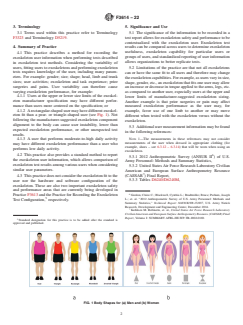
eton fit than a pear- or triangle-shaped user (see Fig. 1). Not
different when tested with the exoskeleton versus without the
following the manufacturer-suggested exoskeleton component
exoskeleton.
alignment to the body can cause user instability, lower than
5.3 Additional user measurement information may be found
expected exoskeleton performance, or other unexpected test
in the following references:
results.
NOTE 1—The measurements in these references may not consider
4.1.3 A user that performs moderate-to-high daily activity
measurements of the user when dressed in appropriate clothing (for
may have different exoskeleton performance than a user who
example, shoes – see 6.3.12 – 6.3.14) that will be worn when using an
performs low daily activity.
exoskeleton.
4.2 This practice also provides a standard method to report
5.3.1 2012 Anthropometric Survey (ANSUR II ) of U.S.
the exoskeleton user information, which allows comparison of
Army Personnel: Methods and Summary Statistics,
exoskeleton test results among various users when considering
5.3.2 United StatesAir Force Research Laboratory Civilian
similar user parameters.
American and European Surface Anthropometry Resource
4.3 This practice does not consider the exoskeleton fit to the (CAESAR ) Final Report,
5.3.3 Tables D6240/D6240M,
user nor the hardware and software configuration of the
exoskeleton. These are also two important exoskeleton safety
and performance areas that are currently being developed in
Practice F3613 and the Practice for Recording the Exoskeleton
Gordon, Claire C.; Blackwell, Cynthia L.; Bradtmiller, Bruce; Parham, Joseph
L.; et. al. “2012 Anthropometric Survey of U.S. Army Personnel: Methods and
Test Configuration, respectively.
Summary Statistics,” Technical Report NATICK/TR-15/007, U.S. Army Natick
Research, Development and Engineering Center, December 2014.
Kathleen M. Robinette, et. al., United States Air Force Research Laboratory
CivilianAmericanandEuropeanSurfaceAnthropometryResource(CAESAR)Final
Report, Volume I: SUMMARY AFRL-HE-WP-TR-2002-0169.
Standard designation for this practice is to be added after the standard is
approved and published.
FIG. 1 Body Shapes for (a) Men and (b) Women
F3614 − 22
5.3.4 Tables D8077/D8077M,
5.3.5 Tables D7878/D7878M,
5.3.6 Tables D6960/D6960M,
5.3.7 Terminology D5219,
5.3.8 Tables D8241/D8241M,
5.3.9 Practice E3003,
5.3.10 Practice F1731, and
5.3.11 ISO 7250-1.
6. Exoskeleton User Information
6.1 Photos of User—Provide clear photographs of the user
not wearing the exoskeleton from the front, left side, right side,
and back, and any other distinguishing features that may affect
the exoskeleton test. The user should not wear loose clothing
for the photos.
6.2 General Information:
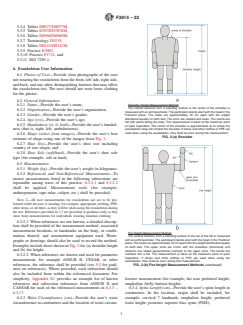
Shoulder Height Measurement Method
6.2.1 Name—Provide the user’s name,
The vertical distance from a standing surface to the center of the shoulder is
6.2.2 Organization—Provide the user’s organization,
measuredwithananthropometer.Theparticipantstandserectwiththeheadinthe
6.2.3 Gender—Provide the user’s gender, Frankfurt plane. The heels are approximately 10 cm apart with the weight
distributed equally on both feet. The arms are relaxed and down. The hands are
6.2.4 Age (yrs)—Provide the user’s age,
flat with palms facing the body. The measurement is taken at the maximum point
6.2.5 Handedness (rt, lt, both)—Provide the user’s handed-
of quiet respiration. The center of the shoulder is approximated as to where the
ness (that is, right, left, ambidextrous), exoskeleton strap will contact the shoulder. If shoes and other clothes or PPE are
used when using the exoskeleton, they shall be worn during this measurement.
6.2.6 Shape (select from images)—Provide the user’s best
FIG. 2 (a) Shoulder
estimate of shape using one of the images from Fig. 1,
6.2.7 Shoe Size—Provide the user’s shoe size including
country of size origin, and
6.2.8 Shoe Sole (soft/hard)—Provide the user’s shoe sole
type (for example, soft or hard).
6.3 Measurements:
6.3.1 Weight (kg)—Provide the user’s weight in kilograms;
6.3.2 Referenced and Non-Referenced Measurements—To
ensure measurements listed in the following subsections are
repeatable among users of this practice, 6.3.2.1 and 6.3.2.2
shall be applied. Measurement tools (for example,
anthropometer, tape ruler, caliper, etc.) shall be provided;
NOTE 2—All user measurements for exoskeleton use are to be per-
formed while the user is wearing, for example, appropriate clothing, PPE,
otheritems,orallthree,astheywillbewhenusingtheexoskeletonduring
the test. References provided in 5.3 are provided as guidance only as they
show body measurements for individuals wearing minimal clothing.
6.3.2.1 When references are not known, a detailed descrip-
tion shall be provided of the measurement method, associated
measurement locations, or landma
...
Questions, Comments and Discussion
Ask us and Technical Secretary will try to provide an answer. You can facilitate discussion about the standard in here.
Loading comments...