


ASTM D2805-11(2018)
(Test Method)Standard Test Method for Hiding Power of Paints by Reflectometry
Standard Test Method for Hiding Power of Paints by Reflectometry
SIGNIFICANCE AND USE
5.1 This is a precise instrumental method giving results having an absolute physical significance without reference to a comparison paint. It should be used when maximum precision and minimum subjectivity are required, as in testing specification coatings or evaluating the hiding efficiency of pigments.
5.2 Hiding power Test Method D344 is visual instead of instrumental, and gives results that are relative to a material standard instead of absolute. It is less precise than Test Method D2805 but more closely aligned with practical painting procedures.
SCOPE
1.1 This test method covers the determination, without reference to a material paint standard, of the hiding power of air dry coatings with Y tristimulus values greater than 15 %. With appropriate modification, it can also be used to test baking finishes.
1.2 The values stated in SI units are to be regarded as standard. No other units of measurement are included in this standard.
1.3 This standard does not purport to address all of the safety concerns, if any, associated with its use. It is the responsibility of the user of this standard to establish appropriate safety, health, and environmental practices and determine the applicability of regulatory limitations prior to use.
1.4 This international standard was developed in accordance with internationally recognized principles on standardization established in the Decision on Principles for the Development of International Standards, Guides and Recommendations issued by the World Trade Organization Technical Barriers to Trade (TBT) Committee.
General Information
Buy Standard
Standards Content (Sample)
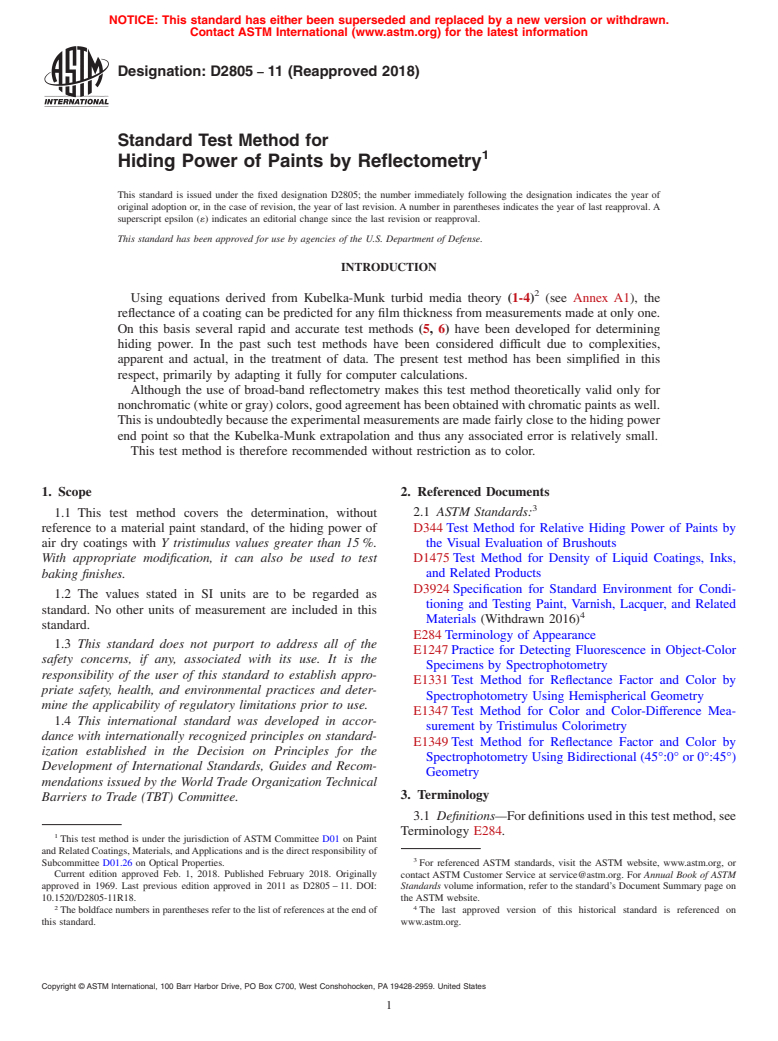
NOTICE: This standard has either been superseded and replaced by a new version or withdrawn.
Contact ASTM International (www.astm.org) for the latest information
Designation: D2805 − 11 (Reapproved 2018)
Standard Test Method for
Hiding Power of Paints by Reflectometry
This standard is issued under the fixed designation D2805; the number immediately following the designation indicates the year of
original adoption or, in the case of revision, the year of last revision. A number in parentheses indicates the year of last reapproval. A
superscript epsilon (´) indicates an editorial change since the last revision or reapproval.
This standard has been approved for use by agencies of the U.S. Department of Defense.
INTRODUCTION
Using equations derived from Kubelka-Munk turbid media theory (1-4) (see Annex A1), the
reflectance of a coating can be predicted for any film thickness from measurements made at only one.
On this basis several rapid and accurate test methods (5, 6) have been developed for determining
hiding power. In the past such test methods have been considered difficult due to complexities,
apparent and actual, in the treatment of data. The present test method has been simplified in this
respect, primarily by adapting it fully for computer calculations.
Although the use of broad-band reflectometry makes this test method theoretically valid only for
nonchromatic (white or gray) colors, good agreement has been obtained with chromatic paints as well.
This is undoubtedly because the experimental measurements are made fairly close to the hiding power
end point so that the Kubelka-Munk extrapolation and thus any associated error is relatively small.
This test method is therefore recommended without restriction as to color.
1. Scope 2. Referenced Documents
1.1 This test method covers the determination, without 2.1 ASTM Standards:
reference to a material paint standard, of the hiding power of D344 Test Method for Relative Hiding Power of Paints by
air dry coatings with Y tristimulus values greater than 15 %. the Visual Evaluation of Brushouts
With appropriate modification, it can also be used to test D1475 Test Method for Density of Liquid Coatings, Inks,
baking finishes. and Related Products
D3924 Specification for Standard Environment for Condi-
1.2 The values stated in SI units are to be regarded as
tioning and Testing Paint, Varnish, Lacquer, and Related
standard. No other units of measurement are included in this
Materials (Withdrawn 2016)
standard.
E284 Terminology of Appearance
1.3 This standard does not purport to address all of the
E1247 Practice for Detecting Fluorescence in Object-Color
safety concerns, if any, associated with its use. It is the
Specimens by Spectrophotometry
responsibility of the user of this standard to establish appro-
E1331 Test Method for Reflectance Factor and Color by
priate safety, health, and environmental practices and deter-
Spectrophotometry Using Hemispherical Geometry
mine the applicability of regulatory limitations prior to use.
E1347 Test Method for Color and Color-Difference Mea-
1.4 This international standard was developed in accor-
surement by Tristimulus Colorimetry
dance with internationally recognized principles on standard-
E1349 Test Method for Reflectance Factor and Color by
ization established in the Decision on Principles for the
Spectrophotometry Using Bidirectional (45°:0° or 0°:45°)
Development of International Standards, Guides and Recom-
Geometry
mendations issued by the World Trade Organization Technical
3. Terminology
Barriers to Trade (TBT) Committee.
3.1 Definitions—For definitions used in this test method, see
Terminology E284.
This test method is under the jurisdiction of ASTM Committee D01 on Paint
and Related Coatings, Materials, and Applications and is the direct responsibility of
Subcommittee D01.26 on Optical Properties. For referenced ASTM standards, visit the ASTM website, www.astm.org, or
Current edition approved Feb. 1, 2018. Published February 2018. Originally contact ASTM Customer Service at service@astm.org. For Annual Book of ASTM
approved in 1969. Last previous edition approved in 2011 as D2805 – 11. DOI: Standards volume information, refer to the standard’s Document Summary page on
10.1520/D2805-11R18. the ASTM website.
2 4
The boldface numbers in parentheses refer to the list of references at the end of The last approved version of this historical standard is referenced on
this standard. www.astm.org.
Copyright © ASTM International, 100 Barr Harbor Drive, PO Box C700, West Conshohocken, PA 19428-2959. United States
D2805 − 11 (2018)
3.2 Definitions of Terms Specific to This Standard: 4.4 As an optional procedure the contrast ratio C at a
specified spreading rate H is calculated from R and S.
3.2.1 contrast ratio, n—the ratio of the reflectance of a film
C ∞
on a black substrate to that of an identical film on a white
5. Significance and Use
substrate.
5.1 This is a precise instrumental method giving results
3.2.1.1 C , n—the contrast ratio with a white substrate of
W
having an absolute physical significance without reference to a
reflectance W.
comparison paint. It should be used when maximum precision
Thus:C 5 R /R
W 0 W
and minimum subjectivity are required, as in testing specifica-
3.2.1.2 C, n—the contrast ratio with a white substrate for
tion coatings or evaluating the hiding efficiency of pigments.
which W = 0.80.
5.2 Hiding power Test Method D344 is visual instead of
Thus:C 5 R /R
0 0.80 instrumental, and gives results that are relative to a material
standard instead of absolute. It is less precise than Test Method
3.2.2 reflectance, n—the daylight luminous diffuse reflec-
D2805 but more closely aligned with practical painting proce-
tance factor (specular reflection excluded). Also referred to in
dures.
this test method as the Y-tristimulus value. This value may be
expressed as a percent or a decimal fraction, the latter being
6. Apparatus and Materials
preferred and usually required for mathematical calculations.
6.1 Substrates:
3.2.2.1 reflectivity, R , n—the reflectance of film thick
∞
6.1.1 Black Glass Panels, minimum size 200 by 200 mm,
enough to have the same reflectance over both a black and a
and approximately 6-mm thick.
white substrate.
6.1.2 Black and White Paper Charts—The surface shall be
3.2.2.2 R , n—the reflectance of a film on a black surface
smooth and level, and impervious to paint liquids. The black
with a reflectance of 1 % or less, which is effectively zero for
area shall have a maximum reflectance of 1 % and the white
the purpose of this test.
area a minimum reflectance of 78 %. The white area shall be
3.2.2.3 W, n—the reflectance of a white substrate.
non-fluorescent, as observed visually under ultra-violet
illumination, or determined in accordance with Practice E1247.
3.2.2.4 R , n—the reflectance of a film applied on a white
W
substrate of reflectance W.
6.2 Balance, accurate to 0.1 mg.
3.2.2.5 R , n—the reflectance of a film applied on a
6.3 Glass Slides—Round or square plates of thickness
0.80
substrate having a reflectance of 80 %, which is the standard
similar to that used for microscope specimen slides, with a
white-substrate reflectance in paint technology.
minimum area of 40 cm .
3.2.3 scattering coeffıcient, S, n—the ability of a material to
6.4 Reflectance-Measuring Instrument —One that allows
internally scatter and thereby reflect light; expressed in this test
only diffusely reflected, radiant flux to be incident upon the
method in the same units as spreading rate.
measuring element. It shall employ a photometric system,
including source, filters, and receptor, that provides a response
3.2.4 spreading rate, H, n—film area per unit volume of
closely similar to the product of the spectral luminous effi-
coating, in this test method expressed in square metres per litre
2 ciency function of the CIE standard observer and source C. It
(m /L).
shall provide readings to at least the third decimal place and
3.2.4.1 spreading rate, H , n—an experimentally deter-
X
permit estimation to the fourth.
mined value of H.
6 2
6.5 Template, with a film area approximately 100 cm
3.2.4.2 spreading rate, H , n—value of H at a specified
C
determined to the nearest tenth. Record the exact value on Line
contrast ratio C.
C of the worksheet shown in Fig. 1.
3.2.4.3 hiding power, H , n—the spreading rate at the
0.98
6.6 Doctor Blade Film Applicators, width 150 mm, clear-
contrast ratio C = 0.98.
ances 50, 75, 100, 125, 150, 175, and 200 µm.
NOTE 1—It should be emphasized that a contrast ratio of 0.98 does not
6.7 Computer and Software, for solving the relevant
represent visually complete hiding, nor does it indicate that the same
Kubelka-Munk equations.
contrast ratio holds at every wavelength.
7. Procedure
4. Summary of Test Method
7.1 General Instructions:
4.1 The reflectivity R of the coating is determined from
∞
reflectance measurements on black and white hiding power
charts.
Conforming with Test Methods E1331, E1347, or E1349. Other methods for
measuring the CIE-Y tristimulus value (specular reflection excluded) are permis-
4.2 The scattering coefficient S of the coating is determined
sible.
from R , and the reflectance R and spreading rate H of a film
∞ 0 X
The sole source of supply of the template known to the committee at this time
applied on black glass.
is Paul Gardner Co., 316 N. E. First St., Pompano Beach, FL 33061. If you are aware
of alternative suppliers, please provide this information to ASTM International
4.3 The hiding power, H of the coating is calculated
0.98
Headquarters. Your comments will receive careful consideration at a meeting of the
from the reflectivity R and the scattering coefficient S. responsible technical committee, which you may attend.
∞
D2805 − 11 (2018)
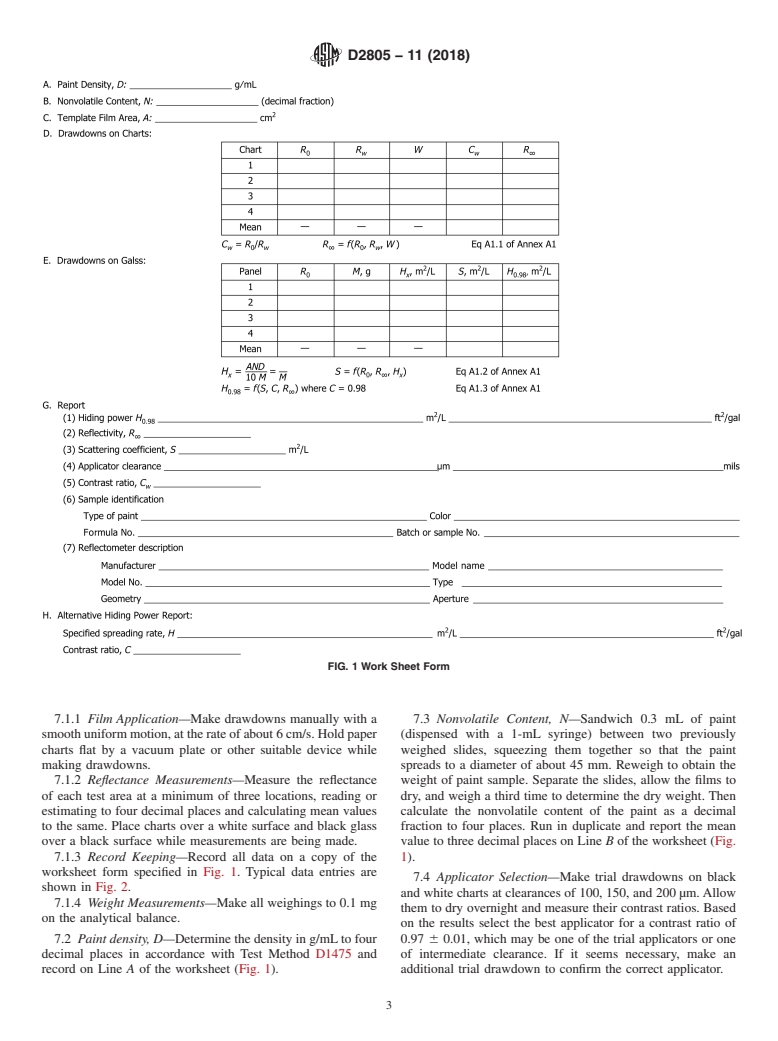
FIG. 1 Work Sheet Form
7.1.1 Film Application—Make drawdowns manually with a 7.3 Nonvolatile Content, N—Sandwich 0.3 mL of paint
smooth uniform motion, at the rate of about 6 cm/s. Hold paper (dispensed with a 1-mL syringe) between two previously
charts flat by a vacuum plate or other suitable device while weighed slides, squeezing them together so that the paint
making drawdowns. spreads to a diameter of about 45 mm. Reweigh to obtain the
7.1.2 Reflectance Measurements—Measure the reflectance weight of paint sample. Separate the slides, allow the films to
of each test area at a m
...
This document is not an ASTM standard and is intended only to provide the user of an ASTM standard an indication of what changes have been made to the previous version. Because
it may not be technically possible to adequately depict all changes accurately, ASTM recommends that users consult prior editions as appropriate. In all cases only the current version
of the standard as published by ASTM is to be considered the official document.
Designation: D2805 − 11 D2805 − 11 (Reapproved 2018)
Standard Test Method for
Hiding Power of Paints by Reflectometry
This standard is issued under the fixed designation D2805; the number immediately following the designation indicates the year of
original adoption or, in the case of revision, the year of last revision. A number in parentheses indicates the year of last reapproval. A
superscript epsilon (´) indicates an editorial change since the last revision or reapproval.
This standard has been approved for use by agencies of the U.S. Department of Defense.
INTRODUCTION
Using equations derived from Kubelka-Munk turbid media theory (1-4) (see Annex A1), the
reflectance of a coating can be predicted for any film thickness from measurements made at only one.
On this basis several rapid and accurate test methods (5, 6) have been developed for determining
hiding power. In the past such test methods have been considered difficult due to complexities,
apparent and actual, in the treatment of data. The present test method has been simplified in this
respect, primarily by adapting it fully for computer calculations.
Although the use of broad-band reflectometry makes this test method theoretically valid only for
nonchromatic (white or gray) colors, good agreement has been obtained with chromatic paints as well.
This is undoubtedly because the experimental measurements are made fairly close to the hiding power
end point so that the Kubelka-Munk extrapolation and thus any associated error is relatively small.
This test method is therefore recommended without restriction as to color.
1. Scope
1.1 This test method covers the determination, without reference to a material paint standard, of the hiding power of air dry
coatings with Y tristimulus values greater than 15 %. With appropriate modification, it can also be used to test baking finishes.
1.2 The values stated in SI units are to be regarded as standard. No other units of measurement are included in this standard.
1.3 This standard does not purport to address all of the safety concerns, if any, associated with its use. It is the responsibility
of the user of this standard to establish appropriate safety safety, health, and healthenvironmental practices and determine the
applicability of regulatory limitations prior to use.
1.4 This international standard was developed in accordance with internationally recognized principles on standardization
established in the Decision on Principles for the Development of International Standards, Guides and Recommendations issued
by the World Trade Organization Technical Barriers to Trade (TBT) Committee.
2. Referenced Documents
2.1 ASTM Standards:
D344 Test Method for Relative Hiding Power of Paints by the Visual Evaluation of Brushouts
D1475 Test Method for Density of Liquid Coatings, Inks, and Related Products
D3924 Specification for Standard Environment for Conditioning and Testing Paint, Varnish, Lacquer, and Related Materials
(Withdrawn 2016)
E284 Terminology of Appearance
E1247 Practice for Detecting Fluorescence in Object-Color Specimens by Spectrophotometry
E1331 Test Method for Reflectance Factor and Color by Spectrophotometry Using Hemispherical Geometry
E1347 Test Method for Color and Color-Difference Measurement by Tristimulus Colorimetry
This test method is under the jurisdiction of ASTM Committee D01 on Paint and Related Coatings, Materials, and Applications and is the direct responsibility of
Subcommittee D01.26 on Optical Properties.
Current edition approved June 1, 2011Feb. 1, 2018. Published June 2011February 2018. Originally approved in 1969. Last previous edition approved in 20032011 as
D2805 – 96a (2003).D2805 – 11. DOI: 10.1520/D2805-11.10.1520/D2805-11R18.
The boldface numbers in parentheses refer to the list of references at the end of this standard.
For referenced ASTM standards, visit the ASTM website, www.astm.org, or contact ASTM Customer Service at service@astm.org. For Annual Book of ASTM Standards
volume information, refer to the standard’s Document Summary page on the ASTM website.
The last approved version of this historical standard is referenced on www.astm.org.
Copyright © ASTM International, 100 Barr Harbor Drive, PO Box C700, West Conshohocken, PA 19428-2959. United States
D2805 − 11 (2018)
E1349 Test Method for Reflectance Factor and Color by Spectrophotometry Using Bidirectional (45°:0° or 0°:45°) Geometry
3. Terminology
3.1 Definitions—For definitions used in this test method, see Terminology E284.
3.2 Definitions of Terms Specific to This Standard:
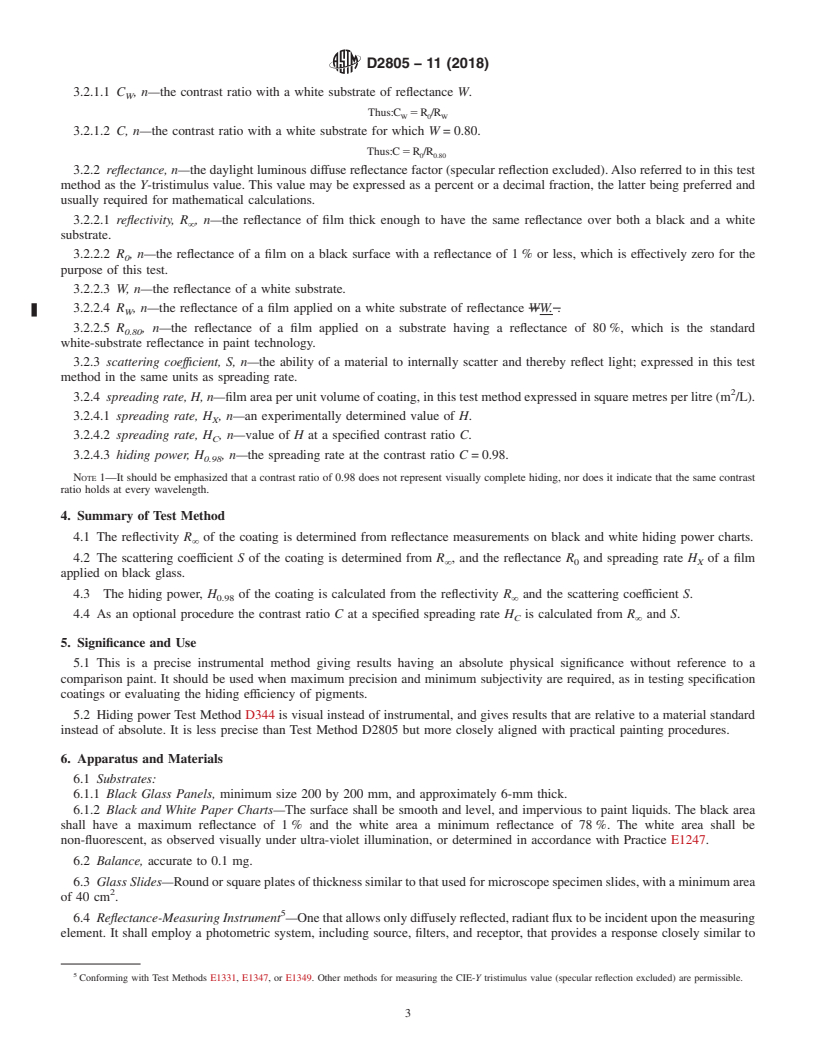
3.2.1 contrast ratio, n—the ratio of the reflectance of a film on a black substrate to that of an identical film on a white substrate.
D2805 − 11 (2018)
3.2.1.1 C , n—the contrast ratio with a white substrate of reflectance W.
W
Thus:C 5 R /R
W 0 W
3.2.1.2 C, n—the contrast ratio with a white substrate for which W = 0.80.
Thus:C5 R /R
0 0.80
3.2.2 reflectance, n—the daylight luminous diffuse reflectance factor (specular reflection excluded). Also referred to in this test
method as the Y-tristimulus value. This value may be expressed as a percent or a decimal fraction, the latter being preferred and
usually required for mathematical calculations.
3.2.2.1 reflectivity, R , n—the reflectance of film thick enough to have the same reflectance over both a black and a white
∞
substrate.
3.2.2.2 R , n—the reflectance of a film on a black surface with a reflectance of 1 % or less, which is effectively zero for the
purpose of this test.
3.2.2.3 W, n—the reflectance of a white substrate.
3.2.2.4 R , n—the reflectance of a film applied on a white substrate of reflectance WW. .
W
3.2.2.5 R , n—the reflectance of a film applied on a substrate having a reflectance of 80 %, which is the standard
0.80
white-substrate reflectance in paint technology.
3.2.3 scattering coeffıcient, S, n—the ability of a material to internally scatter and thereby reflect light; expressed in this test
method in the same units as spreading rate.
3.2.4 spreading rate, H, n—film area per unit volume of coating, in this test method expressed in square metres per litre (m /L).
3.2.4.1 spreading rate, H , n—an experimentally determined value of H.
X
3.2.4.2 spreading rate, H , n—value of H at a specified contrast ratio C.
C
3.2.4.3 hiding power, H , n—the spreading rate at the contrast ratio C = 0.98.
0.98
NOTE 1—It should be emphasized that a contrast ratio of 0.98 does not represent visually complete hiding, nor does it indicate that the same contrast
ratio holds at every wavelength.
4. Summary of Test Method
4.1 The reflectivity R of the coating is determined from reflectance measurements on black and white hiding power charts.
∞
4.2 The scattering coefficient S of the coating is determined from R , and the reflectance R and spreading rate H of a film
∞ 0 X
applied on black glass.
4.3 The hiding power, H of the coating is calculated from the reflectivity R and the scattering coefficient S.
0.98 ∞
4.4 As an optional procedure the contrast ratio C at a specified spreading rate H is calculated from R and S.
C ∞
5. Significance and Use
5.1 This is a precise instrumental method giving results having an absolute physical significance without reference to a
comparison paint. It should be used when maximum precision and minimum subjectivity are required, as in testing specification
coatings or evaluating the hiding efficiency of pigments.
5.2 Hiding power Test Method D344 is visual instead of instrumental, and gives results that are relative to a material standard
instead of absolute. It is less precise than Test Method D2805 but more closely aligned with practical painting procedures.
6. Apparatus and Materials
6.1 Substrates:
6.1.1 Black Glass Panels, minimum size 200 by 200 mm, and approximately 6-mm thick.
6.1.2 Black and White Paper Charts—The surface shall be smooth and level, and impervious to paint liquids. The black area
shall have a maximum reflectance of 1 % and the white area a minimum reflectance of 78 %. The white area shall be
non-fluorescent, as observed visually under ultra-violet illumination, or determined in accordance with Practice E1247.
6.2 Balance, accurate to 0.1 mg.
6.3 Glass Slides—Round or square plates of thickness similar to that used for microscope specimen slides, with a minimum area
of 40 cm .
6.4 Reflectance-Measuring Instrument —One that allows only diffusely reflected, radiant flux to be incident upon the measuring
element. It shall employ a photometric system, including source, filters, and receptor, that provides a response closely similar to
Conforming with Test Methods E1331, E1347, or E1349. Other methods for measuring the CIE-Y tristimulus value (specular reflection excluded) are permissible.
D2805 − 11 (2018)
the product of the spectral luminous efficiency function of the CIE standard observer and source C. It shall provide readings to
at least the third decimal place and permit estimation to the fourth.
6 2
6.5 Template, with a film area approximately 100 cm determined to the nearest tenth. Record the exact value on Line C of the
worksheet shown in Fig. 1.
6.6 Doctor Blade Film Applicators, width 150 mm, clearances 50, 75, 100, 125, 150, 175, and 200 μm.
6.7 Computer and Software, for solving the relevant Kubelka-Munk equations.
7. Procedure
7.1 General Instructions:
7.1.1 Film Application—Make drawdowns manually with a smooth uniform motion, at the rate of about 6 cm/s. Hold paper
charts flat by a vacuum plate or other suitable device while making drawdowns.
FIG. 1 Work Sheet Form
The sole source of supply of the template known to the committee at this time is Paul Gardner Co., 316 N. E. First St., Pompano Beach, FL 33061. If you are aware
of alternative suppliers, please provide this information to ASTM International Headquarters. Your comments will receive careful consideration at a meeting of the responsible
technical committee, which you may attend.
D2805 − 11 (2018)
7.1.2 Reflectance Measurements—Measure the reflectance of each test area at a minimum of three locations, reading
...
Questions, Comments and Discussion
Ask us and Technical Secretary will try to provide an answer. You can facilitate discussion about the standard in here.