

ASTM D217-21a
(Test Method)Standard Test Methods for Cone Penetration of Lubricating Grease
General Information
- Abstract
SIGNIFICANCE AND USE
5.1 These cone penetration tests not only evaluate the consistency of lubricating greases over the full range of NLGI numbers from 000 to 6, but also evaluate the consistency of stiff greases having penetration numbers less than 85. In contrast, Test Method D937 is aimed at petrolatums and Test Method D1403 uses less precise 1/4 and 1/2-scale equipment intended for use when the sample quantity is limited.
5.2 Cone penetration test results provide one measure of the consistency of a grease. Worked penetration results are required to determine to which NLGI consistency grade a grease belongs. Undisturbed penetration results provide a means of evaluating the effect of storage conditions on grease consistency.
5.3 Although no correlation has been developed between cone penetration results and field service, the cone penetrations obtained by the four procedures are widely used for specification purposes, such as in users' material specifications and suppliers' manufacturing specifications.
SCOPE
1.1 These test methods cover four procedures for measuring the consistency of lubricating greases by the penetration of a cone of specified dimensions, mass, and finish. The penetration is measured in tenths of a millimetre.
Note 1: The National Lubricating Grease Institute (NLGI)3 classified greases according to their consistency as measured by the worked penetration. The classification system is as follows:
NLGI
Consistency Number
Worked Penetration Range,
25 °C (77 °F)
000
445 to 475
00
400 to 430
0
355 to 385
1
310 to 340
2
265 to 295
3
220 to 250
4
175 to 205
5
130 to 160
6
85 to 115
1.1.1 The procedures for unworked, worked, and prolonged worked penetration are applicable to greases having penetrations between 85 and 475, that is, to greases with consistency numbers between NLGI 6 and NLGI 000. An undisturbed penetration test, described in Appendix X1, is similar to the unworked penetration test.
1.1.2 The block penetration procedure is applicable to greases that are sufficiently hard to hold their shape. Such greases usually have penetrations below eighty-five tenths of a millimetre.
1.1.3 Unworked penetrations do not generally represent the consistency of greases in use as effectively as do worked penetrations. The latter are usually preferred for inspecting lubricating greases.
1.2 None of the four procedures is considered suitable for the measurement of the consistency of petrolatums by penetration. Test Method D937 should be used for such products.
1.3 The dimensions of the equipment described in these test methods are given in SI units as the primary unit of measure with equivalent imperial units as accetpable alternatives where applicable. In cases where equivalent SI conversions are not known, notes are added for clarification. Temperatures and other dimensions are given in the preferred SI units; the values shown in parentheses are provided for information.
1.4 This standard does not purport to address all of the safety concerns, if any, associated with its use. It is the responsibility of the user of this standard to establish appropriate safety, health, and environmental practices and determine the applicability of regulatory limitations prior to use.
1.5 This international standard was developed in accordance with internationally recognized principles on standardization established in the Decision on Principles for the Development of International Standards, Guides and Recommendations issued by the World Trade Organization Technical Barriers to Trade (TBT) Committee.
- Status
- Published
- Publication Date
- 30-Nov-2021
- Technical Committee
- D02 - Petroleum Products, Liquid Fuels, and Lubricants
- Drafting Committee
- D02.G0.02 - Consistency and Related Rheological Tests
Overview
ASTM D217-21a: Standard Test Methods for Cone Penetration of Lubricating Grease specifies procedures to evaluate the consistency of lubricating greases using cone penetration tests. Developed by ASTM International, this standard covers four primary procedures-unworked, worked, prolonged worked, and block penetration-allowing measurement of grease consistency across the full range of National Lubricating Grease Institute (NLGI) numbers from 000 to 6. Results are instrumental in manufacturing quality control, product specification, and material classification for industrial and automotive lubricants.
Key Topics
- Cone Penetration Testing: The depth a cone of specified dimensions and mass penetrates into a grease sample at 25 °C (77 °F) is measured. This value, in tenths of a millimeter, defines the grease’s consistency.
- Test Procedures:
- Unworked Penetration: Measures consistency with minimal sample disturbance.
- Worked Penetration: Sample is mechanically worked (standardized strokes), simulating actual use, and is the preferred method for consistency grading.
- Prolonged Worked Penetration: Assesses consistency after extensive mechanical shearing.
- Block Penetration: Designed for very stiff greases (penetration less than 85), requiring the sample to hold its shape.
- NLGI Consistency Numbers: Greases are classified by NLGI based on worked penetration, with grades from 000 (softest) to 6 (hardest).
- Equipment:
- Penetrometer and cone (standardized dimensions and finish)
- Grease worker (manual or motorized)
- Temperature control apparatus for precise conditioning at 25 °C
- Additional tools for sample preparation (spatulas, cutters)
- Special Tests: Includes undisturbed penetration for assessing storage effects and block penetration for very firm greases.
Applications
- Product Specification and Quality Control: Manufacturers use these test methods to certify lubricating greases against NLGI grades, ensuring products meet specific consistency requirements for industrial and automotive applications.
- Material Selection: Engineers and maintenance professionals rely on cone penetration results to select greases suited for varying temperature, load, and speed conditions in machinery.
- Research and Development: Allows formulators to compare and optimize grease performance based on measurable, repeatable penetration values.
- Effects of Working and Storage: Worked penetration simulates operational shear, providing insight into how grease performance changes during use. Undisturbed penetration can indicate potential storage issues or changes caused by manufacturing.
- Regulatory and International Trade Compliance: This standard aligns with internationally recognized principles, supporting cross-border quality assurance and regulatory requirements.
Related Standards
- ASTM D937: Test Method for Cone Penetration of Petrolatum-applies to petrolatums rather than lubricating greases.
- ASTM D1403: Test Methods for Cone Penetration of Lubricating Grease Using One-Quarter and One-Half Scale Equipment-used when sample size is limited; less precise than D217.
- ASTM D4175: Terminology Relating to Petroleum Products, Liquid Fuels, and Lubricants-provides definitions for terms used in these methods.
- NLGI Classification System: Directly referenced for consistency grading based on worked penetration results.
Keywords: lubricating grease, cone penetration, ASTM D217, NLGI consistency number, grease test methods, worked penetration, unworked penetration, block penetration, grease quality control, lubricant testing.
Implementing ASTM D217-21a ensures reliable, standardized measurement of lubricating grease consistency, supporting product development, quality assurance, and informed selection for industrial lubrication solutions.
Relations
- Refers
ASTM D4175-23a - Standard Terminology Relating to Petroleum Products, Liquid Fuels, and Lubricants - Effective Date
- 15-Dec-2023
- Refers
ASTM D4175-23e1 - Standard Terminology Relating to Petroleum Products, Liquid Fuels, and Lubricants - Effective Date
- 01-Jul-2023
- Effective Date
- 01-Jun-2020
- Effective Date
- 01-Apr-2020
- Effective Date
- 01-Feb-2020
- Effective Date
- 01-May-2019
- Effective Date
- 01-Aug-2018
- Effective Date
- 01-Nov-2012
- Effective Date
- 01-May-2010
- Effective Date
- 01-Nov-2007
- Effective Date
- 01-Nov-2007
- Effective Date
- 01-Nov-2004
- Effective Date
- 10-Dec-2002
- Effective Date
- 10-Nov-1997
- Effective Date
- 10-Nov-1997
Get Certified
Connect with accredited certification bodies for this standard

Element Materials Technology
Materials testing and product certification.

ABS Group Brazil
ABS Group certification services in Brazil.

ABS Quality Evaluations Inc.
American Bureau of Shipping quality certification.
Sponsored listings
Frequently Asked Questions
ASTM D217-21a is a standard published by ASTM International. Its full title is "Standard Test Methods for Cone Penetration of Lubricating Grease". This standard covers: SIGNIFICANCE AND USE 5.1 These cone penetration tests not only evaluate the consistency of lubricating greases over the full range of NLGI numbers from 000 to 6, but also evaluate the consistency of stiff greases having penetration numbers less than 85. In contrast, Test Method D937 is aimed at petrolatums and Test Method D1403 uses less precise 1/4 and 1/2-scale equipment intended for use when the sample quantity is limited. 5.2 Cone penetration test results provide one measure of the consistency of a grease. Worked penetration results are required to determine to which NLGI consistency grade a grease belongs. Undisturbed penetration results provide a means of evaluating the effect of storage conditions on grease consistency. 5.3 Although no correlation has been developed between cone penetration results and field service, the cone penetrations obtained by the four procedures are widely used for specification purposes, such as in users' material specifications and suppliers' manufacturing specifications. SCOPE 1.1 These test methods cover four procedures for measuring the consistency of lubricating greases by the penetration of a cone of specified dimensions, mass, and finish. The penetration is measured in tenths of a millimetre. Note 1: The National Lubricating Grease Institute (NLGI)3 classified greases according to their consistency as measured by the worked penetration. The classification system is as follows: NLGI Consistency Number Worked Penetration Range, 25 °C (77 °F) 000 445 to 475 00 400 to 430 0 355 to 385 1 310 to 340 2 265 to 295 3 220 to 250 4 175 to 205 5 130 to 160 6 85 to 115 1.1.1 The procedures for unworked, worked, and prolonged worked penetration are applicable to greases having penetrations between 85 and 475, that is, to greases with consistency numbers between NLGI 6 and NLGI 000. An undisturbed penetration test, described in Appendix X1, is similar to the unworked penetration test. 1.1.2 The block penetration procedure is applicable to greases that are sufficiently hard to hold their shape. Such greases usually have penetrations below eighty-five tenths of a millimetre. 1.1.3 Unworked penetrations do not generally represent the consistency of greases in use as effectively as do worked penetrations. The latter are usually preferred for inspecting lubricating greases. 1.2 None of the four procedures is considered suitable for the measurement of the consistency of petrolatums by penetration. Test Method D937 should be used for such products. 1.3 The dimensions of the equipment described in these test methods are given in SI units as the primary unit of measure with equivalent imperial units as accetpable alternatives where applicable. In cases where equivalent SI conversions are not known, notes are added for clarification. Temperatures and other dimensions are given in the preferred SI units; the values shown in parentheses are provided for information. 1.4 This standard does not purport to address all of the safety concerns, if any, associated with its use. It is the responsibility of the user of this standard to establish appropriate safety, health, and environmental practices and determine the applicability of regulatory limitations prior to use. 1.5 This international standard was developed in accordance with internationally recognized principles on standardization established in the Decision on Principles for the Development of International Standards, Guides and Recommendations issued by the World Trade Organization Technical Barriers to Trade (TBT) Committee.
SIGNIFICANCE AND USE 5.1 These cone penetration tests not only evaluate the consistency of lubricating greases over the full range of NLGI numbers from 000 to 6, but also evaluate the consistency of stiff greases having penetration numbers less than 85. In contrast, Test Method D937 is aimed at petrolatums and Test Method D1403 uses less precise 1/4 and 1/2-scale equipment intended for use when the sample quantity is limited. 5.2 Cone penetration test results provide one measure of the consistency of a grease. Worked penetration results are required to determine to which NLGI consistency grade a grease belongs. Undisturbed penetration results provide a means of evaluating the effect of storage conditions on grease consistency. 5.3 Although no correlation has been developed between cone penetration results and field service, the cone penetrations obtained by the four procedures are widely used for specification purposes, such as in users' material specifications and suppliers' manufacturing specifications. SCOPE 1.1 These test methods cover four procedures for measuring the consistency of lubricating greases by the penetration of a cone of specified dimensions, mass, and finish. The penetration is measured in tenths of a millimetre. Note 1: The National Lubricating Grease Institute (NLGI)3 classified greases according to their consistency as measured by the worked penetration. The classification system is as follows: NLGI Consistency Number Worked Penetration Range, 25 °C (77 °F) 000 445 to 475 00 400 to 430 0 355 to 385 1 310 to 340 2 265 to 295 3 220 to 250 4 175 to 205 5 130 to 160 6 85 to 115 1.1.1 The procedures for unworked, worked, and prolonged worked penetration are applicable to greases having penetrations between 85 and 475, that is, to greases with consistency numbers between NLGI 6 and NLGI 000. An undisturbed penetration test, described in Appendix X1, is similar to the unworked penetration test. 1.1.2 The block penetration procedure is applicable to greases that are sufficiently hard to hold their shape. Such greases usually have penetrations below eighty-five tenths of a millimetre. 1.1.3 Unworked penetrations do not generally represent the consistency of greases in use as effectively as do worked penetrations. The latter are usually preferred for inspecting lubricating greases. 1.2 None of the four procedures is considered suitable for the measurement of the consistency of petrolatums by penetration. Test Method D937 should be used for such products. 1.3 The dimensions of the equipment described in these test methods are given in SI units as the primary unit of measure with equivalent imperial units as accetpable alternatives where applicable. In cases where equivalent SI conversions are not known, notes are added for clarification. Temperatures and other dimensions are given in the preferred SI units; the values shown in parentheses are provided for information. 1.4 This standard does not purport to address all of the safety concerns, if any, associated with its use. It is the responsibility of the user of this standard to establish appropriate safety, health, and environmental practices and determine the applicability of regulatory limitations prior to use. 1.5 This international standard was developed in accordance with internationally recognized principles on standardization established in the Decision on Principles for the Development of International Standards, Guides and Recommendations issued by the World Trade Organization Technical Barriers to Trade (TBT) Committee.
ASTM D217-21a is classified under the following ICS (International Classification for Standards) categories: 75.100 - Lubricants, industrial oils and related products. The ICS classification helps identify the subject area and facilitates finding related standards.
ASTM D217-21a has the following relationships with other standards: It is inter standard links to ASTM D4175-23a, ASTM D4175-23e1, ASTM D1403-20b, ASTM D1403-20a, ASTM D1403-20, ASTM D1403-19, ASTM D1403-18, ASTM D937-07(2012), ASTM D1403-10, ASTM D937-07, ASTM D1403-02(2007), ASTM D937-04, ASTM D1403-02, ASTM D937-97(2002), ASTM D1403-97. Understanding these relationships helps ensure you are using the most current and applicable version of the standard.
ASTM D217-21a is available in PDF format for immediate download after purchase. The document can be added to your cart and obtained through the secure checkout process. Digital delivery ensures instant access to the complete standard document.
Standards Content (Sample)
This international standard was developed in accordance with internationally recognized principles on standardization established in the Decision on Principles for the
Development of International Standards, Guides and Recommendations issued by the World Trade Organization Technical Barriers to Trade (TBT) Committee.
Designation: D217 − 21a
Designation: 50/17
Standard Test Methods for
1,2
Cone Penetration of Lubricating Grease
This standard is issued under the fixed designation D217; the number immediately following the designation indicates the year of
original adoption or, in the case of revision, the year of last revision.Anumber in parentheses indicates the year of last reapproval.A
superscript epsilon (´) indicates an editorial change since the last revision or reapproval.
This standard has been approved for use by agencies of the U.S. Department of Defense.
1. Scope* 1.1.3 Unworked penetrations do not generally represent the
consistency of greases in use as effectively as do worked
1.1 Thesetestmethodscoverfourproceduresformeasuring
penetrations. The latter are usually preferred for inspecting
the consistency of lubricating greases by the penetration of a
lubricating greases.
coneofspecifieddimensions,mass,andfinish.Thepenetration
is measured in tenths of a millimetre. 1.2 None of the four procedures is considered suitable for
the measurement of the consistency of petrolatums by penetra-
NOTE 1—The National Lubricating Grease Institute (NLGI) classified
tion. Test Method D937 should be used for such products.
greases according to their consistency as measured by the worked
penetration. The classification system is as follows:
1.3 Thedimensionsoftheequipmentdescribedinthesetest
NLGI Worked Penetration Range,
methods are given in SI units as the primary unit of measure
Consistency Number 25 °C (77 °F)
with equivalent imperial units as accetpable alternatives where
000 445 to 475
00 400 to 430 applicable. In cases where equivalent SI conversions are not
0 355 to 385
known, notes are added for clarification. Temperatures and
1 310 to 340
other dimensions are given in the preferred SI units; the values
2 265 to 295
3 220 to 250 shown in parentheses are provided for information.
4 175 to 205
1.4 This standard does not purport to address all of the
5 130 to 160
6 85to115
safety concerns, if any, associated with its use. It is the
responsibility of the user of this standard to establish appro-
1.1.1 The procedures for unworked, worked, and prolonged
priate safety, health, and environmental practices and deter-
worked penetration are applicable to greases having penetra-
mine the applicability of regulatory limitations prior to use.
tions between 85 and 475, that is, to greases with consistency
numbers between NLGI 6 and NLGI 000. An undisturbed 1.5 This international standard was developed in accor-
dance with internationally recognized principles on standard-
penetration test, described in Appendix X1, is similar to the
unworked penetration test. ization established in the Decision on Principles for the
Development of International Standards, Guides and Recom-
1.1.2 The block penetration procedure is applicable to
greases that are sufficiently hard to hold their shape. Such mendations issued by the World Trade Organization Technical
Barriers to Trade (TBT) Committee.
greases usually have penetrations below eighty-five tenths of a
millimetre.
2. Referenced Documents
2.1 ASTM Standards:
ThesetestmethodsarethejurisdictionofASTMCommitteeD02onPetroleum
D937Test Method for Cone Penetration of Petrolatum
Products, Liquid Fuels, and Lubricants and are the direct responsibility of ASTM
D1403Test Methods for Cone Penetration of Lubricating
Subcommittee D02.G0.02 on Consistency and Related Rheological Tests. The
Grease Using One-Quarter and One-Half Scale Cone
technically equivalent standard as referenced is under the jurisdiction of the Energy
Institute Subcommittee SC-C-6. These test methods were adopted as a joint
Equipment
ASTM-IP standard in 1969.
D4175Terminology Relating to Petroleum Products, Liquid
Current edition approved Dec. 1, 2021. Published December 2021. Originally
Fuels, and Lubricants
approved in 1925. Last previous edition approved in 2021 as D217 – 21. DOI:
10.1520/D0217-21A.
This test method has been developed through the cooperative effort between
ASTMandtheEnergyInstitute,London.ASTMandIPstandardswereapprovedby
ASTMandEItechnicalcommitteesasbeingtechnicallyequivalentbutthatdoesnot For referenced ASTM standards, visit the ASTM website, www.astm.org, or
imply both standards are identical. contact ASTM Customer Service at service@astm.org. For Annual Book of ASTM
National Lubricating Grease Institute, 4635 Wyandotte St., Kansas City, MO Standards volume information, refer to the standard’s Document Summary page on
64112-1596. the ASTM website.
*A Summary of Changes section appears at the end of this standard
Copyright © ASTM International, 100 Barr Harbor Drive, PO Box C700, West Conshohocken, PA 19428-2959. United States
D217 − 21a
3. Terminology
3.1 Definitions:
3.1.1 For definitions of terms used in this test method, refer
to Terminology D4175.
3.1.2 consistency, n—of lubricating grease, the degree of
resistance to movement under stress.
3.1.2.1 Discussion—Thetermconsistencyisusedsomewhat
synonymously with penetration. Generally, consistency refers
to the worked penetration of a grease.
3.1.3 lubricant, n—any material interposed between two
surfacesthatreducesthefrictionorwearbetweenthem. D4175
3.1.4 lubricating grease, n—a semi-fluid to solid product of
a dispersion of a thickener in a liquid lubricant.
3.1.4.1 Discussion—Thedispersionofthethickenerformsa
two-phase system and immobilizes the liquid lubricant by
surfacetensionandotherphysicalforces.Otheringredientsare
commonly included to impart special properties.
3.1.5 penetration, n—of lubricating grease, the depth that
thestandardconeentersthesamplewhenreleasedtofallunder
its own weight for 5s.
3.1.6 penetrometer, n—an instrument that measures the
consistencyorhardnessofsemiliquidtosemisolidmaterialsby
measuring the depth to which a specified cone or needle under
a given force falls into the material.
3.1.7 prolonged worked penetration, n—of lubricating
grease, the penetration of a sample after it has been worked
more than 60 double strokes in a standard grease worker at a
FIG. 1 Penetrometer
temperature of 15°C to 30°C (59°F to 86°F).
3.1.7.1 Discussion—After the prescribed number of double
strokes, the worker and contents are brought to 25°C (77°F),
workedanadditional60doublestrokes,andpenetratedwithout
3.1.12 working, n—of lubricating grease,thesubjectionofa
delay.
sample to the shearing action of the standard grease worker.
3.1.8 semi-solid, n—aseeminglysolidmaterialthatdeforms
3.2 Definitions of Terms Specific to This Standard:
under a force equal to or greater than the force of gravity and
3.2.1 block penetration, n—of lubricating grease, the pen-
that can be made to flow by the application of such a force so
etration at 25°C (77°F) determined on the freshly prepared
long as it exceeds the yield stress of the material.
faceofacubecutfromasamplethatissufficientlyhardtohold
3.1.8.1 Discussion—In the petroleum industry, lubricating
its shape.
grease, petrolatum, slack wax, and bitumen are recognized as
3.2.2 penetrometer, n—an instrument (see Fig. 1) designed
semi-solids. (Synonyms—semi-liquid and semi-fluid.)
to measure the depth to which the standard cone falls into the
3.1.9 thickener, n—in lubricating grease, a substance com-
grease.
posed of finely divided particles dispersed in a liquid lubricant
to form the product’s structure.
3.2.2.1 Discussion—In this test method, either a standard
3.1.9.1 Discussion—The thickener can be fibers (such as
penetrometer(6.2)oranoptionalpenetrometercone(A1.3)can
various metallic soaps) or plates or spheres (such as certain
be used to determine the consistency of lubricating greases.
non-soapthickeners)whichareinsolubleor,atmost,onlyvery
The penetration force is determined by the mass of the cone
slightly soluble in the liquid lubricant. The general require-
and the shaft.
mentsarethatthesolidparticlesbeextremelysmall,uniformly
dispersed, and capable of forming a relatively stable, gel-like
4. Summary of Test Method
structure with the liquid lubricant.
4.1 For unworked penetration, the sample is brought to
3.1.10 unworked penetration, n—of lubricating grease, the
25°C 6 0.5°C (77°F 6 1°F) using a temperature bath. The
penetration at 25°C (77°F) of a sample that has received only
sample is then transferred with as little manipulation as
minimum disturbance in transferring to a grease worker cup or
possible into a worker cup (or other suitable container), if not
dimensionally equivalent rigid container.
placedtherebeforethetemperaturestabilizationstep.Thecone
3.1.11 worked penetration, n—of lubricating grease, the assembly of the penetrometer is released and allowed to drop
penetration at 25°C (77°F), without delay, of a sample after freely into the grease for 5s 6 0.1s. Three determinations are
60 double strokes in a standard grease worker. made and averaged to give the reported result.
D217 − 21a
4.2 For worked penetration, the sample is brought to 25°C 6.3 Grease Worker, comprising a grease cup, cover, and
6 0.5°C (77°F 6 1°F) and placed in the worker cup. The plunger assembly, in accordance with A1.4, constructed for
sample is subjected to 60 double strokes in the grease worker. either manual or mechanical operation.
The penetration is determined immediately by releasing the 6.3.1 Grease Worker Drive, Manual, in accordance with
A1.5,whichallowsforworkingthegreaseatarateof60 610
coneassemblyfromthepenetrometerandallowingtheconeto
drop freely into the grease for 5s 6 0.1s. Three determina- double strokes per minute.
6.3.2 Grease Worker Drive, Motorized, in accordance with
tions are made and averaged to give the reported result.
A1.6,whichallowsforworkingthegreaseatarateof60 610
4.3 For prolonged worked penetration, the sample is placed
double strokes per minute. This apparatus is essential for the
in the worker cup and subjected to a predetermined number of
working step of the prolonged worked penetration procedure.
double strokes in the grease worker. Following completion of
6.4 Grease Cutter, in accordance with A1.7, is used for
the prolonged working, the grease and worker assembly are
preparation of samples for block penetration.
brought to 25°C 6 0.5°C (77°F 6 1°F) and the grease is
worked an additional 60 double strokes in the grease worker.
6.5 Temperature Bath, capable of controlling the bath tem-
The penetration is determined immediately by releasing the perature at 25°C 6 0.5°C (77°F 6 1°F) and designed to
coneassemblyfromthepenetrometerandallowingtheconeto
bring the assembled grease worker to test temperature conve-
dropfreelyintothegreasefor5s 60.1s.Threedeterminations niently.Examplesofsuitabletemperaturebathsincludeawater
are made and averaged to give the reported result.
bath, air bath, constant temperature test room, or a
temperature-controlled metal block. If a water bath is to be
4.4 For block penetration, a cube of the grease is prepared
used for samples for unworked penetration, means should be
by slicing off a thin layer using the grease cutter. The cube of
provided for protecting the grease surface from water and for
grease is brought to 25°C 6 0.5°C (77°F 6 1°F) and placed
maintainingtheairabovethesampleattesttemperature.Anair
on the penetrometer table with the prepared face upward. The
bathispreferredforbringingblockgreasestotesttemperature,
penetration is determined by releasing the cone assembly from
butatightlysealedcontainerplacedinawaterbathwillsuffice.
the penetrometer and allowing the cone to drop freely into the
6.6 Spatula, corrosion-resistant, having a stiff blade nomi-
grease for 5s 6 0.1s. Three determinations are made and
nally 32mm (1.25in.) wide and at least 150mm (6in.) long.
averaged to give the reported result.
6.7 Temperature-Measuring Device, with a sheath length of
5. Significance and Use
approximately 200mm (8in.) and a sheath diameter of ap-
proximately 3.7mm (0.145in.) (small enough to fit through
5.1 These cone penetration tests not only evaluate the
the vent cock). The temperature range of the device should be
consistency of lubricating greases over the full range of NLGI
wide enough to allow it to be immersed in grease at approxi-
numbers from 000 to 6, but also evaluate the consistency of
mately 38°C (100°F) without damage. The scale should have
stiff greases having penetration numbers less than 85. In
small enough divisions (or digital resolution) to allow the user
contrast, Test Method D937 is aimed at petrolatums and Test
to read 60.5°C (61°F).Aspacer can be applied to the upper
1 1
Method D1403 uses less precise ⁄4 and ⁄2-scale equipment
portion of the sheath to hold the tip just above the perforated
intended for use when the sample quantity is limited.
plate of the grease worker and in the bulk of the sample (see
5.2 Conepenetrationtestresultsprovideonemeasureofthe
A1.3).
consistency of a grease. Worked penetration results are re-
6.8 Overflow Ring (optional), in accordance with A1.8,isa
quired to determine to which NLGI consistency grade a grease
useful device for catching grease scraped from the sample
belongs. Undisturbed penetration results provide a means of
surface as well as any grease forced by the penetrometer cone
evaluating the effect of storage conditions on grease consis-
to overflow from the cup. This grease can be returned to the
tency.
worker cup for subsequent testing.
5.3 Although no correlation has been developed between
7. Reagents and Materials
conepenetrationresultsandfieldservice,theconepenetrations
7.1 Appropriate Volatile Gum-free Solvent, for example,
obtained by the four procedures are widely used for specifica-
light petroleum naphtha.
tion purposes, such as in users’ material specifications and
suppliers’ manufacturing specifications.
7.2 Cloth or Paper Wiper, for wiping grease from the
penetrometer cone. The wiper should be soft, so as not to
6. Apparatus
scratch the cone.
6.1 Penetrometer, in accordance with A1.1. The instrument
8. Sampling
shallbecapableofindicatingdepthintenthsofamillimetre.A
8.1 Sample Size—Sufficient sample (at least 0.45 kg
sketch of a generic penetrometer is shown in Fig. 1.
(1.1lb)) to overfill the cup of the standard grease worker is
6.2 Standard Penetrometer Cone, in accordance with A1.2, required. If the sample size is insufficient and penetration
is suitable for all penetrations.An optional penetrometer cone, ranges from NLGI 0 to 4, use Test Method D1403.
in accordance with A1.3, is suitable only for penetrations less 8.1.1 For block penetration, obtain a sufficient size sample
than 400.The optional cone should not be used to measure the of the grease, which must be hard enough to hold its shape, to
penetration of 00 and 000 grade greases. permit cutting from it a 50mm (2in.) cube as a test specimen.
D217 − 21a
than 265 are not significantly affected if the diameter of the
container exceeds that of the worker cup.
8.2.2 Worked Penetration—Prior to performing the test, the
grease sample (if necessary, in a suitable container or in the
worker cup) and the test equipment (worker cup, plunger and
cone) must all be at a standard temperature of 25°C 6 0.5°C
(77°F 6 1°F). This can be achieved by the use of a
temperature bath (6.5) or a combination of different tempera-
ture baths. Additional time will be required to achieve a
consistent temperature of 25°C 6 0.5°C (77°F 6 1°F) if the
sample is larger than 0.45kg (1.1lb), or if the initial sample
temperature differs from 25°C by more than about 8°C
(15°F). If the grease sample and equipment are already at the
correcttemperaturebeforethesampleisplacedintotheworker
cup, there is no need to further stabilize the sample once it has
been placed in the cup. Transfer sufficient specimen to the cup
FIG. 2 Preparing Sample for Penetration Measurement
of the clean grease worker to fill it heaping full (mound up
about 13mm (0.5in.) at the center), avoiding the inclusion of
air by packing with the spatula. Jar the cup from time to time
asitisbeingpackedtoremoveanyairinadvertentlyentrapped.
8.2 Sample Preparation—Samples are prepared for the
Assembletheworkerand,withtheventcockopen,depressthe
various cone penetration test methods as follows:
plunger to the bottom.
8.2.1 Unworked Penetration—Prior to performing the test,
If an air bath or water bath is used to bring grease and
thegreasesample(ifnecessary,inasuitablecontainerorinthe
equipment to 25°C 6 0.5°C (77°F 6 1°F) after assembly,
worker cup) and the test equipment (worker cup and cone)
then insert a thermometer through the vent cock so that its tip
must all be at a standard temperature of 25°C 6 0.5°C (77°F
isinthecenterofthegrease.Placetheassembledworkerinthe
6 1°F).This can be achieved by the use of a temperature bath
temperature bath maintained at 25°C 6 0.5°C (77°F 6 1°F)
(6.5) or a combination of different temperature baths, It is
(Note 2) until the temperature of the worker and its contents is
important to allow sufficient time for the grease and test
25°C 6 0.5°C as indicated by the thermometer. If the initial
equipment to reach 25°C 6 0.5°C (77°F 6 1°F).Additional
sample temperature differs from 25°C by more than about
time will be required to achieve a consistent temperature of
8°C(15°F),orifanalternativemethodofbringingthesample
25°C 6 0.5°C (77°F 6 1°F) if the sample is larger than
to 25°C is used, allow sufficient additional time to ensure that
0.45kg (1.1lb), or if the initial sample temperature differs
the specimen is at 25°C 6 0.5°C before proceeding. Testing
from 25°C by more than about 8°C (15°F). If the grease
mayproceedwhenthespecimenisatauniformtemperatureof
sample and equipment are already at the correct temperature
25°C 6 0.5°C. Remove the worker from the bath. If a water
before the sample is placed into the worker cup, there is no
bath was used, wipe any excess water from the outer surfaces
need to further stabilize the sample once it has been placed in
of the worker. Remove the thermometer and close the vent
the cup. Testing may proceed if the specimen is at a uniform
cock.
temperature of 25°C 6 0.5°C. Transfer the specimen, prefer-
8.2.2.1 Working—Subject the grease to 60 full (63mm to
ably in one lump, to overfill the cup of the grease worker or
7 13
71.5mm (2 ⁄16in. to 2 ⁄16in.)) double strokes of the plunger,
other container. Make this transfer in such a manner that the
completed in about 60s, and return the plunger to its top
grease will be worked as little as possible.
position. Open the vent cock, remove the cover and plunger,
8.2.1.1 Preparing Sample for Measurement—Jar the cup to
and return to the cup as much of the grease clinging to the
drive out trapped air and pack the grease with the spatula, with
plunger as can readily be removed.
aslittlemanipulationaspossible,toobtainacupfulwithoutair
NOTE 2—If it is desired to immerse the worker into a water bath, above
pockets. Scrape off the excess grease extending over the rim,
the joint between the cup and cover, take care that the joint is watertight
creatingaflatsurface,bymovingthebladeofthespatula,held
in order to prevent the entrance of water to the worker.
inclined toward the direction of motion at an angle of approxi-
8.2.2.2 Preparing Sample for Measurement—Jar the cup
mately 45°, across the rim of the cup (Fig. 2). This excess
sharply on the bench or floor and pack the grease down with a
grease will be retained to repair the surface for the second and
spatula to fill the holes left by the plunger and to remove any
third determinations. Do not perform any further leveling or
air pockets (Note 3). Scrape off the excess grease extending
smoothing of the surface throughout the determination of
overtherim,creatingaflatsurface,bymovingthebladeofthe
unworked penetration and determine the measurement imme-
spatula, held inclined toward the direction of motion at an
diately.
angle of approximately 45°, across the rim of the cup (Fig. 2),
8.2.1.2 The penetrations of soft greases are dependent upon
retaining the portion removed (Note 4).
the diameter of the container. Therefore, greases having un-
worked penetrations greater than 265 should be tested in
NOTE 3—The jarring should be only as vigorous as required to remove
containershavingthesamediameterlimitationsasthoseofthe
the entrapped air without splashing the specimen from the cup. In
worker cup. The results on greases having penetrations less performing these operations, a minimum of manipulation should be used,
D217 − 21a
FIG. 3 Preparing Block Sample for Penetration Measurement
as any agitation of the grease may have the effect of increasing the
single corner, which can be truncated for identification (Fig.
working beyond the specified 60 strokes.
3(c) and Note 6). Take care not
...
This document is not an ASTM standard and is intended only to provide the user of an ASTM standard an indication of what changes have been made to the previous version. Because
it may not be technically possible to adequately depict all changes accurately, ASTM recommends that users consult prior editions as appropriate. In all cases only the current version
of the standard as published by ASTM is to be considered the official document.
Designation: D217 − 21 D217 − 21a
Designation: 50/17
Standard Test Methods for
1,2
Cone Penetration of Lubricating Grease
This standard is issued under the fixed designation D217; the number immediately following the designation indicates the year of
original adoption or, in the case of revision, the year of last revision. A number in parentheses indicates the year of last reapproval. A
superscript epsilon (´) indicates an editorial change since the last revision or reapproval.
This standard has been approved for use by agencies of the U.S. Department of Defense.
1. Scope*
1.1 These test methods cover four procedures for measuring the consistency of lubricating greases by the penetration of a cone
of specified dimensions, mass, and finish. The penetration is measured in tenths of a millimetre.
NOTE 1—The National Lubricating Grease Institute (NLGI) classified greases according to their consistency as measured by the worked penetration. The
classification system is as follows:
NLGI Worked Penetration Range,
Consistency Number 25 °C (77 °F)
000 445 to 475
00 400 to 430
0 355 to 385
1 310 to 340
2 265 to 295
3 220 to 250
4 175 to 205
5 130 to 160
6 85 to 115
1.1.1 The procedures for unworked, worked, and prolonged worked penetration are applicable to greases having penetrations
between 85 and 475, that is, to greases with consistency numbers between NLGI 6 and NLGI 000. An undisturbed penetration test,
described in Appendix X1, is similar to the unworked penetration test.
1.1.2 The block penetration procedure is applicable to greases that are sufficiently hard to hold their shape. Such greases usually
have penetrations below eighty-five tenths of a millimetre.
1.1.3 Unworked penetrations do not generally represent the consistency of greases in use as effectively as do worked penetrations.
The latter are usually preferred for inspecting lubricating greases.
These test methods are the jurisdiction of ASTM Committee D02 on Petroleum Products, Liquid Fuels, and Lubricants and are the direct responsibility of ASTM
Subcommittee D02.G0.02 on Consistency and Related Rheological Tests. In the IP, these test methods areThe technically equivalent standard as referenced is under the
jurisdiction of the Standardization Committee. Energy Institute Subcommittee SC-C-6. These test methods were adopted as a joint ASTM-IP standard in 1969.
Current edition approved July 1, 2021Dec. 1, 2021. Published July 2021December 2021. Originally approved in 1925. Last previous edition approved in 20192021 as D217
– 19b.21. DOI: 10.1520/D0217-21.10.1520/D0217-21A.
This test method has been developed through the cooperative effort between ASTM and the Energy Institute, London. ASTM and IP standards were approved by ASTM
and EI technical committees as being technically equivalent but that does not imply both standards are identical.
National Lubricating Grease Institute, 4635 Wyandotte St., Kansas City, MO 64112-1596.
*A Summary of Changes section appears at the end of this standard
Copyright © ASTM International, 100 Barr Harbor Drive, PO Box C700, West Conshohocken, PA 19428-2959. United States
D217 − 21a
1.2 None of the four procedures is considered suitable for the measurement of the consistency of petrolatums by penetration. Test
Method D937 should be used for such products.
1.3 The dimensions of the equipment described in these test methods are given in SI units as the primary unit of measure with
equivalent imperial units as accetpable alternatives where applicable. In cases where equivalent SI conversions are not known,
notes are added for clarification. Temperatures and other dimensions are given in the preferred SI units; the values shown in
parentheses are provided for information.
1.4 This standard does not purport to address all of the safety concerns, if any, associated with its use. It is the responsibility
of the user of this standard to establish appropriate safety, health, and environmental practices and determine the applicability of
regulatory limitations prior to use.
1.5 This international standard was developed in accordance with internationally recognized principles on standardization
established in the Decision on Principles for the Development of International Standards, Guides and Recommendations issued
by the World Trade Organization Technical Barriers to Trade (TBT) Committee.
2. Referenced Documents
2.1 ASTM Standards:
D937 Test Method for Cone Penetration of Petrolatum
D1403 Test Methods for Cone Penetration of Lubricating Grease Using One-Quarter and One-Half Scale Cone Equipment
D4175 Terminology Relating to Petroleum Products, Liquid Fuels, and Lubricants
3. Terminology
3.1 Definitions:
3.1.1 For definitions of terms used in this test method, refer to Terminology D4175.
3.1.2 consistency, n—of lubricating grease, the degree of resistance to movement under stress.
3.1.2.1 Discussion—
The term consistency is used somewhat synonymously with penetration. Generally, consistency refers to the worked penetration
of a grease.
3.1.3 lubricant, n—any material interposed between two surfaces that reduces the friction or wear between them. D4175
3.1.4 lubricating grease, n—a semi-fluid to solid product of a dispersion of a thickener in a liquid lubricant.
3.1.4.1 Discussion—
The dispersion of the thickener forms a two-phase system and immobilizes the liquid lubricant by surface tension and other
physical forces. Other ingredients are commonly included to impart special properties.
3.1.5 penetration, n—of lubricating grease, the depth that the standard cone enters the sample when released to fall under its own
weight for 5 s.
3.1.6 penetrometer, n—an instrument that measures the consistency or hardness of semiliquid to semisolid materials by measuring
the depth to which a specified cone or needle under a given force falls into the material.
3.1.7 prolonged worked penetration, n—of lubricating grease, the penetration of a sample after it has been worked more than 60
double strokes in a standard grease worker at a temperature of 15 °C to 30 °C (59 °F to 86 °F).
3.1.7.1 Discussion—
After the prescribed number of double strokes, the worker and contents are brought to 25 °C (77 °F), worked an additional 60
double strokes, and penetrated without delay.
3.1.8 semi-solid, n—a seemingly solid material that deforms under a force equal to or greater than the force of gravity and that
can be made to flow by the application of such a force so long as it exceeds the yield stress of the material.
For referenced ASTM standards, visit the ASTM website, www.astm.org, or contact ASTM Customer Service at service@astm.org. For Annual Book of ASTM Standards
volume information, refer to the standard’s Document Summary page on the ASTM website.
D217 − 21a
FIG. 1 Penetrometer
3.1.8.1 Discussion—
In the petroleum industry, lubricating grease, petrolatum, slack wax, and bitumen are recognized as semi-solids. (Synonyms—
semi-liquid and semi-fluid.)
3.1.9 thickener, n—in lubricating grease, a substance composed of finely divided particles dispersed in a liquid lubricant to form
the product’s structure.
3.1.9.1 Discussion—
The thickener can be fibers (such as various metallic soaps) or plates or spheres (such as certain non-soap thickeners) which are
insoluble or, at most, only very slightly soluble in the liquid lubricant. The general requirements are that the solid particles be
extremely small, uniformly dispersed, and capable of forming a relatively stable, gel-like structure with the liquid lubricant.
3.1.10 unworked penetration, n—of lubricating grease, the penetration at 25 °C (77 °F) of a sample that has received only
minimum disturbance in transferring to a grease worker cup or dimensionally equivalent rigid container.
3.1.11 worked penetration, n—of lubricating grease, the penetration at 25 °C (77 °F), without delay, of a sample after 60 double
strokes in a standard grease worker.
3.1.12 working, n—of lubricating grease, the subjection of a sample to the shearing action of the standard grease worker.
3.2 Definitions of Terms Specific to This Standard:
3.2.1 block penetration, n—of lubricating grease, the penetration at 25 °C (77 °F) determined on the freshly prepared face of a
cube cut from a sample that is sufficiently hard to hold its shape.
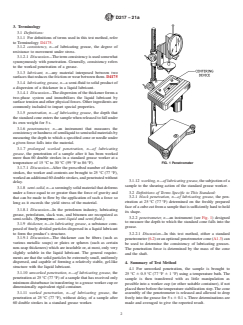
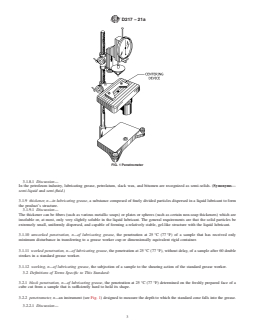
3.2.2 penetrometer, n—an instrument (see Fig. 1) designed to measure the depth to which the standard cone falls into the grease.
3.2.2.1 Discussion—
D217 − 21a
In this test method, either a standard penetrometer (6.2) or an optional penetrometer cone (A1.3) can be used to determine the
consistency of lubricating greases. The penetration force is determined by the mass of the cone and the shaft.
4. Summary of Test Method
4.1 For unworked penetration, the sample is brought to 25 °C 6 0.5 °C (77 °F 6 1 °F) using a temperature bath. The sample is
then transferred with as little manipulation as possible into a worker cup (or other suitable container), if not placed there before
the temperature stabilization step. The cone assembly of the penetrometer is released and allowed to drop freely into the grease
for 5 s 6 0.1 s. Three determinations are made and averaged to give the reported result.
4.2 For worked penetration, the sample is brought to 25 °C 6 0.5 °C (77 °F 6 1 °F) and placed in the worker cup. The sample
is subjected to 60 double strokes in the grease worker. The penetration is determined immediately by releasing the cone assembly
from the penetrometer and allowing the cone to drop freely into the grease for 5 s 6 0.1 s. Three determinations are made and
averaged to give the reported result.
4.3 For prolonged worked penetration, the sample is placed in the worker cup and subjected to a predetermined number of double
strokes in the grease worker. Following completion of the prolonged working, the grease and worker assembly are brought to 25 °C
6 0.5 °C (77 °F 6 1 °F) and the grease is worked an additional 60 double strokes in the grease worker. The penetration is
determined immediately by releasing the cone assembly from the penetrometer and allowing the cone to drop freely into the grease
for 5 s 6 0.1 s. Three determinations are made and averaged to give the reported result.
4.4 For block penetration, a cube of the grease is prepared by slicing off a thin layer using the grease cutter. The cube of grease
is brought to 25 °C 6 0.5 °C (77 °F 6 1 °F) and placed on the penetrometer table with the prepared face upward. The penetration
is determined by releasing the cone assembly from the penetrometer and allowing the cone to drop freely into the grease for 5 s
6 0.1 s. Three determinations are made and averaged to give the reported result.
5. Significance and Use
5.1 These cone penetration tests not only evaluate the consistency of lubricating greases over the full range of NLGI numbers from
000 to 6, but also evaluate the consistency of stiff greases having penetration numbers less than 85. In contrast, Test Method D937
1 1
is aimed at petrolatums and Test Method D1403 uses less precise ⁄4 and ⁄2-scale equipment intended for use when the sample
quantity is limited.
5.2 Cone penetration test results provide one measure of the consistency of a grease. Worked penetration results are required to
determine to which NLGI consistency grade a grease belongs. Undisturbed penetration results provide a means of evaluating the
effect of storage conditions on grease consistency.
5.3 Although no correlation has been developed between cone penetration results and field service, the cone penetrations obtained
by the four procedures are widely used for specification purposes, such as in users’ material specifications and suppliers’
manufacturing specifications.
6. Apparatus
6.1 Penetrometer, in accordance with A1.1. The instrument shall be capable of indicating depth in tenths of a millimetre. A sketch
of a generic penetrometer is shown in Fig. 1.
6.2 Standard Penetrometer Cone, in accordance with A1.2, is suitable for all penetrations. An optional penetrometer cone, in
accordance with A1.3, is suitable only for penetrations less than 400. The optional cone should not be used to measure the
penetration of 00 and 000 grade greases.
6.3 Grease Worker, comprising a grease cup, cover, and plunger assembly, in accordance with A1.4, constructed for either manual
or mechanical operation.
6.3.1 Grease Worker Drive, Manual, in accordance with A1.5, which allows for working the grease at a rate of 60 6 10 double
strokes per minute.
D217 − 21a
6.3.2 Grease Worker Drive, Motorized, in accordance with A1.6, which allows for working the grease at a rate of 60 6 10 double
strokes per minute. This apparatus is essential for the working step of the prolonged worked penetration procedure.
6.4 Grease Cutter, in accordance with A1.7, is used for preparation of samples for block penetration.
6.5 Temperature Bath, capable of controlling the bath temperature at 25 °C 6 0.5 °C (77 °F 6 1 °F) and designed to bring the
assembled grease worker to test temperature conveniently. Examples of suitable temperature baths include a water bath, air bath,
constant temperature test room, or a temperature-controlled metal block. If a water bath is to be used for samples for unworked
penetration, means should be provided for protecting the grease surface from water and for maintaining the air above the sample
at test temperature. An air bath is preferred for bringing block greases to test temperature, but a tightly sealed container placed in
a water bath will suffice.
6.6 Spatula, corrosion-resistant, having a stiff blade nominally 32 mm (1.25 in.) wide and at least 150 mm (6 in.) long.
6.7 Temperature-Measuring Device, with a sheath length of approximately 200 mm (8 in.) and a sheath diameter of approximately
3.7 mm (0.145 in.) (small enough to fit through the vent cock). The temperature range of the device should be wide enough to allow
it to be immersed in grease at approximately 38 °C (100 °F) without damage. The scale should have small enough divisions (or
digital resolution) to allow the user to read 60.5 °C (61 °F). A spacer can be applied to the upper portion of the sheath to hold
the tip just above the perforated plate of the grease worker and in the bulk of the sample (see A1.3).
6.8 Overflow Ring (optional), in accordance with A1.8, is a useful device for catching grease scraped from the sample surface as
well as any grease forced by the penetrometer cone to overflow from the cup. This grease can be returned to the worker cup for
subsequent testing.
7. Reagents and Materials
7.1 Appropriate Volatile Gum-free Solvent, for example, light petroleum naphtha.
7.2 Cloth or Paper Wiper, for wiping grease from the penetrometer cone. The wiper should be soft, so as not to scratch the cone.
8. Sampling
8.1 Sample Size—Sufficient sample (at least 0.45 kg (1.1 lb)) to overfill the cup of the standard grease worker is required. If the
sample size is insufficient and penetration ranges from NLGI 0 to 4, use Test Method D1403.
8.1.1 For block penetration, obtain a sufficient size sample of the grease, which must be hard enough to hold its shape, to permit
cutting from it a 50 mm (2 in.) cube as a test specimen.
8.2 Sample Preparation—Samples are prepared for the various cone penetration test methods as follows:
8.2.1 Unworked Penetration—Prior to performing the test, the grease sample (if necessary, in a suitable container or in the worker
cup) and the test equipment (worker cup and cone) must all be at a standard temperature of 25 °C 6 0.5 °C (77 °F 6 1 °F). This
can be achieved by the use of a temperature bath (6.5) or a combination of different temperature baths, It is important to allow
sufficient time for the grease and test equipment to reach 25 °C 6 0.5 °C (77 °F 6 1 °F). Additional time will be required to
achieve a consistent temperature of 25 °C 6 0.5 °C (77 °F 6 1 °F) if the sample is larger than 0.45 kg (1.1 lb), or if the initial
sample temperature differs from 25 °C by more than about 8 °C (15 °F). If the grease sample and equipment are already at the
correct temperature before the sample is placed into the worker cup, there is no need to further stabilize the sample once it has
been placed in the cup. Testing may proceed if the specimen is at a uniform temperature of 25 °C 6 0.5 °C. Transfer the specimen,
preferably in one lump, to overfill the cup of the grease worker or other container. Make this transfer in such a manner that the
grease will be worked as little as possible.
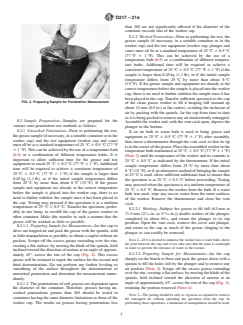
8.2.1.1 Preparing Sample for Measurement—Jar the cup to drive out trapped air and pack the grease with the spatula, with as little
manipulation as possible, to obtain a cupful without air pockets. Scrape off the excess grease extending over the rim, creating a
flat surface, by moving the blade of the spatula, held inclined toward the direction of motion at an angle of approximately 45°,
D217 − 21a
FIG. 2 Preparing Sample for Penetration Measurement
across the rim of the cup (Fig. 2). This excess grease will be retained to repair the surface for the second and third determinations.
Do not perform any further leveling or smoothing of the surface throughout the determination of unworked penetration and
determine the measurement immediately.
8.2.1.2 The penetrations of soft greases are dependent upon the diameter of the container. Therefore, greases having unworked
penetrations greater than 265 should be tested in containers having the same diameter limitations as those of the worker cup. The
results on greases having penetrations less than 265 are not significantly affected if the diameter of the container exceeds that of
the worker cup.
8.2.2 Worked Penetration—Prior to performing the test, the grease sample (if necessary, in a suitable container or in the worker
cup) and the test equipment (worker cup, plunger and cone) must all be at a standard temperature of 25 °C 6 0.5 °C (77 °F 6 1 °F).
This can be achieved by the use of a temperature bath (6.5) or a combination of different temperature baths. Additional time will
be required to achieve a consistent temperature of 25 °C 6 0.5 °C (77 °F 6 1 °F) if the sample is larger than 0.45 kg (1.1 lb), or
if the initial sample temperature differs from 25 °C by more than about 8 °C (15 °F). If the grease sample and equipment are
already at the correct temperature before the sample is placed into the worker cup, there is no need to further stabilize the sample
once it has been placed in the cup. Transfer sufficient specimen to the cup of the clean grease worker to fill it heaping full (mound
up about 13 mm (0.5 in.) at the center), avoiding the inclusion of air by packing with the spatula. Jar the cup from time to time
as it is being packed to remove any air inadvertently entrapped. Assemble the worker and, with the vent cock open, depress the
plunger to the bottom.
If an air bath or water bath is used to bring grease and equipment to 25 °C 6 0.5 °C (77 °F 6 1 °F) after assembly, then insert
a thermometer through the vent cock so that its tip is in the center of the grease. Place the assembled worker in the temperature
bath maintained at 25 °C 6 0.5 °C (77 °F 6 1 °F) (Note 2) until the temperature of the worker and its contents is 25 °C 6 0.5 °C
as indicated by the thermometer. If the initial sample temperature differs from 25 °C by more than about 8 °C (15 °F), or if an
alternative method of bringing the sample to 25 °C is used, allow sufficient additional time to ensure that the specimen is at 25 °C
6 0.5 °C before proceeding. Testing may proceed when the specimen is at a uniform temperature of 25 °C 6 0.5 °C. Remove the
worker from the bath. If a water bath was used, wipe any excess water from the outer surfaces of the worker. Remove the
thermometer and close the vent cock.
7 13
8.2.2.1 Working—Subject the grease to 60 full (63 mm to 71.5 mm (2 ⁄16 in. to 2 ⁄16 in.)) double strokes of the plunger, completed
in about 60 s, and return the plunger to its top position. Open the vent cock, remove the cover and plunger, and return to the cup
as much of the grease clinging to the plunger as can readily be removed.
NOTE 2—If it is desired to immerse the worker into a water bath, above the joint between the cup and cover, take care that the joint is watertight in order
to prevent the entrance of water to the worker.
8.2.2.2 Preparing Sample for Measurement—Jar the cup sharply on the bench or floor and pack the grease down with a spatula
to fill the holes left by the plunger and to remove any air pockets (Note 3). Scrape off the excess grease extending over th
...