

ASTM B37-18
(Specification)Standard Specification for Aluminum for Use in Iron and Steel Manufacture
General Information
- Abstract
ABSTRACT
This specification covers the standard for ingot, bar, rod, cone, nugget or shot aluminum and aluminum alloys proposed for use in manufacturing iron and steel. Each sample shall conform to the chemical composition limits enlisted herein. Test samples can be taken at the time the ingots, bars, rods, cones, nuggets or shots are produced or from the finished product.
SCOPE
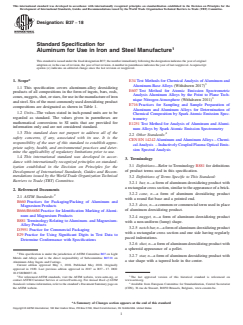
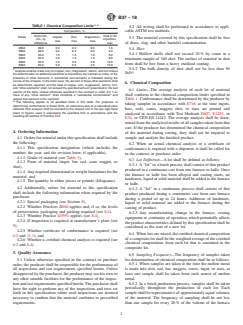
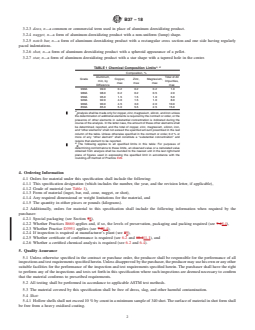
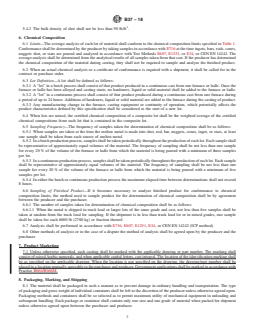
1.1 This specification covers aluminum-alloy deoxidizing products of all compositions in the form of ingots, bars, rods, cones, nuggets, shot, or stars, for use in the manufacture of iron and steel. Six of the most commonly used deoxidizing product compositions are designated as shown in Table 1. (A) Analysis shall be made only for copper, zinc, magnesium, silicon, and iron unless the determination of additional elements is required by the contract or order, or the presence of other elements in substantial concentration is indicated during the course of the analysis. In the latter case, the amount of these other elements shall be determined, reported, and the total of copper, zinc, magnesium, silicon, iron, and “other elements” shall not exceed the specified amount prescribed in the last column of the table. Unless otherwise specified in the contract or order, 0.2 % or more of any “other element” shall constitute a “substantial concentration” and require that element to be reported.(B) The following applies to all specified limits in this table: For purposes of determining conformance to these limits, an observed value or a calculated value obtained from analysis shall be rounded to the nearest unit in the last right-hand place of figures used in expressing the specified limit in accordance with the rounding-off method of Practice E29.
1.2 Units—The values stated in inch-pound units are to be regarded as standard. The values given in parentheses are mathematical conversions to SI units that are provided for information only and are not considered standard.
1.3 This standard does not purport to address all of the safety concerns, if any, associated with its use. It is the responsibility of the user of this standard to establish appropriate safety, health, and environmental practices and determine the applicability of regulatory limitations prior to use.
1.4 This international standard was developed in accordance with internationally recognized principles on standardization established in the Decision on Principles for the Development of International Standards, Guides and Recommendations issued by the World Trade Organization Technical Barriers to Trade (TBT) Committee.
- Status
- Published
- Publication Date
- 30-Apr-2018
- Technical Committee
- B07 - Light Metals and Alloys
- Drafting Committee
- B07.01 - Aluminum Alloy Ingots and Castings
Buy Documents

ASTM B37-18 - Standard Specification for Aluminum for Use in Iron and Steel Manufacture
REDLINE ASTM B37-18 - Standard Specification for Aluminum for Use in Iron and Steel Manufacture
Overview
ASTM B37-18 is the internationally recognized standard specification for aluminum products used in the manufacture of iron and steel. Developed by ASTM International, this standard specifies the requirements for aluminum-alloy deoxidizing products supplied in various forms-including ingot, bar, rod, cone, nugget, shot, and star. Used primarily as a deoxidizer in steel and ironmaking processes, these aluminum products play a crucial role in enhancing material quality and final product performance.
ASTM B37-18 sets forth criteria for chemical composition, quality assurance, marking, packaging, and sampling. This specification is vital for steelmakers, materials suppliers, and anyone involved in the procurement, processing, or verification of deoxidizing aluminum and aluminum alloys for iron and steel production.
Key Topics
Aluminum Forms and Compositions
- Covers aluminum and aluminum-alloy products in multiple shapes: ingots, bars, rods, cones, nuggets, shot, and stars.
- Specifies six commonly used grades based on chemical composition limits for elements such as copper, zinc, magnesium, silicon, and iron.
- Outlines impurity limits and stipulates analysis and reporting requirements for additional elements if present in substantial concentration.
Chemical Composition and Analysis
- Average analysis for each lot must conform to prescribed limits.
- Sampling during production follows strict guidelines for both batch and continuous processes.
- Analytical methods include spark atomic emission spectrometry and other recognized test procedures.
- Methods of determining conformance to specified limits reference ASTM Practice E29 for significant digits and rounding.
Quality Assurance and Inspection
- Producers are responsible for compliance with all testing and inspection requirements unless otherwise specified.
- Defines "lot" for sampling purposes and details appropriate procedures for verifying compliance.
- Purchasers may inspect products at the manufacturer’s facility and have rights for arbitration in case of dissatisfaction.
Marking, Packaging, and Shipping
- Requires clear identification marking of each casting or shipment.
- Packaging standards ensure protection from damage and facilitate handling and transportation.
- Special requirements or marking for government and specific contractual needs are accommodated.
Applications
ASTM B37-18 is widely used in sectors where aluminum deoxidizers are essential for quality iron and steel manufacturing:
- Steelmaking: Aluminum deoxidizing products are added during steel production to remove oxygen and prevent defects such as porosity.
- Iron manufacture: Similar application as in steel, enhancing cleanliness and overall material properties.
- Supply chain: Aluminum producers, metallurgical suppliers, and quality control laboratories use this standard as a benchmark for product specification, quality assurance, and validation.
- Procurement: Enables accurate ordering, certification, and acceptance of deoxidizing aluminum materials by specifying grade, form, and necessary documentation.
Compliance with this standard helps to ensure the performance, traceability, and consistency of aluminum deoxidizers, meeting both regulatory and industry demands.
Related Standards
Organizations and professionals applying ASTM B37-18 may also reference several related standards, including:
- ASTM B660: Practices for Packaging/Packing of Aluminum and Magnesium Products
- ASTM B666/B666M: Practice for Identification Marking of Aluminum and Magnesium Products
- ASTM B881: Terminology Relating to Aluminum- and Magnesium-Alloy Products
- ASTM D3951: Practice for Commercial Packaging
- ASTM E29: Practice for Using Significant Digits in Test Data to Determine Conformance with Specifications
- ASTM E716: Practices for Sampling and Sample Preparation of Aluminum and Aluminum Alloys
- ASTM E1251: Test Method for Analysis of Aluminum and Aluminum Alloys by Spark Atomic Emission Spectrometry
- CEN EN 14242: Chemical Analysis of Aluminum and Aluminum Alloys – Inductively Coupled Plasma Optical Emission Spectral Analysis
Keywords: ASTM B37, aluminum deoxidizing products, steel manufacture, iron manufacture, alloy specification, chemical composition, sampling, quality assurance, aluminum alloy testing, industrial metals standards.
Relations
- Effective Date
- 01-May-2018
- Effective Date
- 01-Nov-2023
- Effective Date
- 01-Oct-2023
- Effective Date
- 01-May-2018
- Effective Date
- 01-Nov-2017
- Effective Date
- 01-Oct-2017
- Effective Date
- 15-Sep-2017
- Effective Date
- 01-Dec-2015
- Refers
ASTM E34-11 - Standard Test Methods for Chemical Analysis of Aluminum and Aluminum-Base Alloys - Effective Date
- 01-Jul-2011
- Effective Date
- 15-Mar-2011
- Effective Date
- 01-Sep-2010
- Effective Date
- 15-Aug-2010
- Effective Date
- 01-Jun-2009
- Effective Date
- 15-Oct-2008
- Effective Date
- 01-Oct-2008
Buy Documents
ASTM B37-18 - Standard Specification for Aluminum for Use in Iron and Steel Manufacture
REDLINE ASTM B37-18 - Standard Specification for Aluminum for Use in Iron and Steel Manufacture
Get Certified
Connect with accredited certification bodies for this standard

Element Materials Technology
Materials testing and product certification.

Inštitut za kovinske materiale in tehnologije
Institute of Metals and Technology. Materials testing, metallurgical analysis, NDT.
Sponsored listings
Frequently Asked Questions
ASTM B37-18 is a technical specification published by ASTM International. Its full title is "Standard Specification for Aluminum for Use in Iron and Steel Manufacture". This standard covers: ABSTRACT This specification covers the standard for ingot, bar, rod, cone, nugget or shot aluminum and aluminum alloys proposed for use in manufacturing iron and steel. Each sample shall conform to the chemical composition limits enlisted herein. Test samples can be taken at the time the ingots, bars, rods, cones, nuggets or shots are produced or from the finished product. SCOPE 1.1 This specification covers aluminum-alloy deoxidizing products of all compositions in the form of ingots, bars, rods, cones, nuggets, shot, or stars, for use in the manufacture of iron and steel. Six of the most commonly used deoxidizing product compositions are designated as shown in Table 1. (A) Analysis shall be made only for copper, zinc, magnesium, silicon, and iron unless the determination of additional elements is required by the contract or order, or the presence of other elements in substantial concentration is indicated during the course of the analysis. In the latter case, the amount of these other elements shall be determined, reported, and the total of copper, zinc, magnesium, silicon, iron, and “other elements” shall not exceed the specified amount prescribed in the last column of the table. Unless otherwise specified in the contract or order, 0.2 % or more of any “other element” shall constitute a “substantial concentration” and require that element to be reported.(B) The following applies to all specified limits in this table: For purposes of determining conformance to these limits, an observed value or a calculated value obtained from analysis shall be rounded to the nearest unit in the last right-hand place of figures used in expressing the specified limit in accordance with the rounding-off method of Practice E29. 1.2 Units—The values stated in inch-pound units are to be regarded as standard. The values given in parentheses are mathematical conversions to SI units that are provided for information only and are not considered standard. 1.3 This standard does not purport to address all of the safety concerns, if any, associated with its use. It is the responsibility of the user of this standard to establish appropriate safety, health, and environmental practices and determine the applicability of regulatory limitations prior to use. 1.4 This international standard was developed in accordance with internationally recognized principles on standardization established in the Decision on Principles for the Development of International Standards, Guides and Recommendations issued by the World Trade Organization Technical Barriers to Trade (TBT) Committee.
ABSTRACT This specification covers the standard for ingot, bar, rod, cone, nugget or shot aluminum and aluminum alloys proposed for use in manufacturing iron and steel. Each sample shall conform to the chemical composition limits enlisted herein. Test samples can be taken at the time the ingots, bars, rods, cones, nuggets or shots are produced or from the finished product. SCOPE 1.1 This specification covers aluminum-alloy deoxidizing products of all compositions in the form of ingots, bars, rods, cones, nuggets, shot, or stars, for use in the manufacture of iron and steel. Six of the most commonly used deoxidizing product compositions are designated as shown in Table 1. (A) Analysis shall be made only for copper, zinc, magnesium, silicon, and iron unless the determination of additional elements is required by the contract or order, or the presence of other elements in substantial concentration is indicated during the course of the analysis. In the latter case, the amount of these other elements shall be determined, reported, and the total of copper, zinc, magnesium, silicon, iron, and “other elements” shall not exceed the specified amount prescribed in the last column of the table. Unless otherwise specified in the contract or order, 0.2 % or more of any “other element” shall constitute a “substantial concentration” and require that element to be reported.(B) The following applies to all specified limits in this table: For purposes of determining conformance to these limits, an observed value or a calculated value obtained from analysis shall be rounded to the nearest unit in the last right-hand place of figures used in expressing the specified limit in accordance with the rounding-off method of Practice E29. 1.2 Units—The values stated in inch-pound units are to be regarded as standard. The values given in parentheses are mathematical conversions to SI units that are provided for information only and are not considered standard. 1.3 This standard does not purport to address all of the safety concerns, if any, associated with its use. It is the responsibility of the user of this standard to establish appropriate safety, health, and environmental practices and determine the applicability of regulatory limitations prior to use. 1.4 This international standard was developed in accordance with internationally recognized principles on standardization established in the Decision on Principles for the Development of International Standards, Guides and Recommendations issued by the World Trade Organization Technical Barriers to Trade (TBT) Committee.
ASTM B37-18 is classified under the following ICS (International Classification for Standards) categories: 77.120.10 - Aluminium and aluminium alloys. The ICS classification helps identify the subject area and facilitates finding related standards.
ASTM B37-18 has the following relationships with other standards: It is inter standard links to ASTM B37-17, ASTM B660-23, ASTM D3951-18(2023), ASTM D3951-18, ASTM B881-17, ASTM E1251-17a, ASTM E1251-17, ASTM D3951-15, ASTM E34-11, ASTM E1251-11, ASTM E716-10, ASTM D3951-10, ASTM B881-09, ASTM B660-08, ASTM E29-08. Understanding these relationships helps ensure you are using the most current and applicable version of the standard.
ASTM B37-18 is available in PDF format for immediate download after purchase. The document can be added to your cart and obtained through the secure checkout process. Digital delivery ensures instant access to the complete standard document.
Standards Content (Sample)
This international standard was developed in accordance with internationally recognized principles on standardization established in the Decision on Principles for the
Development of International Standards, Guides and Recommendations issued by the World Trade Organization Technical Barriers to Trade (TBT) Committee.
Designation:B37 −18
Standard Specification for
Aluminum for Use in Iron and Steel Manufacture
This standard is issued under the fixed designation B37; the number immediately following the designation indicates the year of original
adoption or, in the case of revision, the year of last revision.Anumber in parentheses indicates the year of last reapproval.Asuperscript
epsilon (´) indicates an editorial change since the last revision or reapproval.
1. Scope* E34 Test Methods for Chemical Analysis of Aluminum and
Aluminum-Base Alloys (Withdrawn 2017)
1.1 This specification covers aluminum-alloy deoxidizing
E607 Test Method for Atomic Emission Spectrometric
products of all compositions in the form of ingots, bars, rods,
Analysis Aluminum Alloys by the Point to Plane Tech-
cones,nuggets,shot,orstars,foruseinthemanufactureofiron
nique Nitrogen Atmosphere (Withdrawn 2011)
and steel. Six of the most commonly used deoxidizing product
E716 Practices for Sampling and Sample Preparation of
compositions are designated as shown in Table 1.
Aluminum and Aluminum Alloys for Determination of
1.2 Units—The values stated in inch-pound units are to be
Chemical Composition by Spark Atomic Emission Spec-
regarded as standard. The values given in parentheses are
trometry
mathematical conversions to SI units that are provided for
E1251 Test Method for Analysis of Aluminum and Alumi-
information only and are not considered standard.
num Alloys by Spark Atomic Emission Spectrometry
1.3 This standard does not purport to address all of the 4
2.2 Other Standards:
safety concerns, if any, associated with its use. It is the
CEN EN 14242 Aluminum and Aluminum Alloys – Chemi-
responsibility of the user of this standard to establish appro-
calAnalysis – Inductively Coupled Plasma Optical Emis-
priate safety, health, and environmental practices and deter-
sion Spectral Analysis
mine the applicability of regulatory limitations prior to use.
1.4 This international standard was developed in accor-
3. Terminology
dance with internationally recognized principles on standard-
3.1 Definitions—Refer to Terminology B881 for definitions
ization established in the Decision on Principles for the
of product terms used in this specification.
Development of International Standards, Guides and Recom-
mendations issued by the World Trade Organization Technical
3.2 Definitions of Terms Specific to This Standard:
Barriers to Trade (TBT) Committee.
3.2.1 bar, n—a form of aluminum deoxidizing product with
arectangularcrosssection,similartotheappearanceofabrick.
2. Referenced Documents
3.2.2 cone, n—a form of aluminum deoxidizing product
2.1 ASTM Standards:
with a round flat base and a pointed end.
B660 Practices for Packaging/Packing of Aluminum and
3.2.3 deox, n—a common or commercial term used in place
Magnesium Products
of aluminum deoxidizing product.
B666/B666M Practice for Identification Marking of Alumi-
num and Magnesium Products
3.2.4 nugget, n—a form of aluminum deoxidizing product
B881 Terminology Relating toAluminum- and Magnesium-
with a non-uniform (lump) shape.
Alloy Products
3.2.5 notch bar, n—aformofaluminumdeoxidizingproduct
D3951 Practice for Commercial Packaging
with a rectangular cross section and one side having regularly
E29 Practice for Using Significant Digits in Test Data to
paced indentations.
Determine Conformance with Specifications
3.2.6 shot, n—aformofaluminumdeoxidizingproductwith
a spheroid appearance of a pellet.
This specification is under the jurisdiction of ASTM Committee B07 on Light
3.2.7 star, n—a form of aluminum deoxidizing product with
Metals and Alloys and is the direct responsibility of Subcommittee B07.01 on
a star shape with a tapered hole in the center.
Aluminum Alloy Ingots and Castings.
Current edition approved May 1, 2018. Published May 2018. Originally
approved in 1920. Last previous edition approved in 2017 as B37 – 17. DOI:
10.1520/B0037-18.
2 3
For referenced ASTM standards, visit the ASTM website, www.astm.org, or The last approved version of this historical standard is referenced on
contact ASTM Customer Service at service@astm.org. For Annual Book of ASTM www.astm.org.
Standards volume information, refer to the standard’s Document Summary page on Available from European Committee for Standardization, Central Secretariat
the ASTM website. (CEN), 36 rue de Stassart, B1050 Brussels, Belgium., www.cenorm.be.
*A Summary of Changes section appears at the end of this standard
Copyright © ASTM International, 100 Barr Harbor Drive, PO Box C700, West Conshohocken, PA 19428-2959. United States
B37−18
A, B
TABLE 1 Chemical Composition Limits
5.2 All testing shall be performed in accordance to appli-
Composition, %
cable ASTM test methods.
Aluminum, Total of All
Grade
Copper, Zinc, Magnesium,
5.3 The material covered by this specification shall be free
min, by Impurities,
max max max
Difference max of dross, slag, and other harmful contamination.
990A 99.0 0.2 0.2 0.2 1.0
5.4 Shot:
980A 98.0 0.2 0.2 0.5 2.0
5.4.1 Hollow shells shall not exceed 10 % by count in a
950A 95.0 1.5 1.5 1.0 5.0
920A 92.0 4.0 1.5 1.0 8.0
minimum sample of 340 shot. The surface of material in shot
900A 90.0 4.5 3.0 2.0 10.0
form shall be free from a heavy oxidized coating.
850A 85.0 5.0 5.5 2.5 15.0
5.4.2 The bulk density of shot shall not be less than 90
A
Analysis shall be made only for copper, zinc, magnesium, silicon, and iron unless
lb/ft .
the determination of additional elements is required by the contract or order, or the
presence of other elements in substantial concentration is indicated during the
course of the analysis. In the latter case, the amount of these other elements shall
6. Chemical Composition
be determined, reported, and the total of copper, zinc, magnesium, silicon, iron,
and “other elements” shall not exceed the specified amount prescribed in the last
6.1 Limits—The average analysis of each lot of material
column of the table. Unless otherwise specified in the contract or order, 0.2 % or
shall conform to the chemical composition limits specified in
more of any “other element” shall constitute a “substantial concentration” and
require that element to be reported.
Table 1. Conformance shall be determined by the producer by
B
The following applies to all specified limits in this table: For purposes of
taking samples in accordance with E716 at the time ingots,
determining conformance to these limits, an observed value or a calculated value
bars, rods, cones, nuggets shot, or stars are poured and
obtained from analysis shall be rounded to the nearest unit in the last right-hand
place of figures used in expressing the specified limit in accordance with the
analyzed in accordance with Test Methods E607, E1251,or
rounding-off method of Practice E29.
E34, or CEN EN 14242. The average analysis shall be deter-
mined from the analytical results of all samples taken from that
cast. If the producer has determined the chemical composition
4. Ordering Information
of the material during casting, they shall not be required to
sample and analyze the finished product.
4.1 Orders for material under this specification shall include
the following:
6.2 When an actual chemical analysis or a certificate of
4.1.1 This specification designation (which includes the
conformance is required with a shipment, it shall be called for
number, the year, and the revision letter, if applicable),
in the contract or purchase order.
4.1.2 Grade of material (see Table 1),
6.3 Lot Definition—A lot shall be defined as follows:
4.1.3 Form of material (ingot, bar, rod, cone, nugget, or
6.3.1 A“lot” in a batch process shall consist of that product
shot),
produced in a continuous cast from one furnace or ladle. Once
4.1.4 Anyrequireddimensionalorweightlimitationsforthe
the furnace or ladle has been alloyed and casting starts, no
material, and
hardeners, liquid or solid material shall be added to the furnace
4.1.5 The quantity in either pieces or pounds (kilograms).
or ladle.
4.2 Additionally, orders for material to this specification
6.3.2 A “lot” in a continuous process shall consist of that
shall include the following information when required by the
product produced during a continuous cast from one furnace
purchaser:
during a period of up to 24 hours. Additions of hardeners,
4.2.1 Special packaging (see Section 8),
liquid or solid material are added to the furnace during the
4.2.2 Whether Practices B660 applies and, if so, the levels
casting of product.
of preservation, packaging and packing required (see 8.4),
6.3.3 Any manufacturing change in the furnace, casting
4.2.3 Whether Practice D3951 applies (see 8.4),
equipment or continuity of operation, which potentially affects
4.2.4 If inspection is required at manufacturer’s plant (see
the product
...
This document is not an ASTM standard and is intended only to provide the user of an ASTM standard an indication of what changes have been made to the previous version. Because
it may not be technically possible to adequately depict all changes accurately, ASTM recommends that users consult prior editions as appropriate. In all cases only the current version
of the standard as published by ASTM is to be considered the official document.
Designation: B37 − 17 B37 − 18
Standard Specification for
Aluminum for Use in Iron and Steel Manufacture
This standard is issued under the fixed designation B37; the number immediately following the designation indicates the year of original
adoption or, in the case of revision, the year of last revision. A number in parentheses indicates the year of last reapproval. A superscript
epsilon (´) indicates an editorial change since the last revision or reapproval.
1. Scope*
1.1 This specification covers aluminum-alloy deoxidizing products of all compositions in the form of ingots, bars, rods, cones,
nuggets, shot, or stars, for use in the manufacture of iron and steel. Six of the most commonly used deoxidizing product
compositions are designated as shown in Table 1.
1.2 Units—The values stated in inch-pound units are to be regarded as standard. The values given in parentheses are
mathematical conversions to SI units that are provided for information only and are not considered standard.
1.3 This standard does not purport to address all of the safety concerns, if any, associated with its use. It is the responsibility
of the user of this standard to establish appropriate safety, health, and environmental practices and determine the applicability of
regulatory limitations prior to use.
1.4 This international standard was developed in accordance with internationally recognized principles on standardization
established in the Decision on Principles for the Development of International Standards, Guides and Recommendations issued
by the World Trade Organization Technical Barriers to Trade (TBT) Committee.
2. Referenced Documents
2.1 ASTM Standards:
B660 Practices for Packaging/Packing of Aluminum and Magnesium Products
B666/B666M Practice for Identification Marking of Aluminum and Magnesium Products
B881 Terminology Relating to Aluminum- and Magnesium-Alloy Products
D3951 Practice for Commercial Packaging
E29 Practice for Using Significant Digits in Test Data to Determine Conformance with Specifications
E34 Test Methods for Chemical Analysis of Aluminum and Aluminum-Base Alloys (Withdrawn 2017)
E607 Test Method for Atomic Emission Spectrometric Analysis Aluminum Alloys by the Point to Plane Technique Nitrogen
Atmosphere (Withdrawn 2011)
E716 Practices for Sampling and Sample Preparation of Aluminum and Aluminum Alloys for Determination of Chemical
Composition by Spark Atomic Emission Spectrometry
E1251 Test Method for Analysis of Aluminum and Aluminum Alloys by Spark Atomic Emission Spectrometry
2.2 Other Standards:
CEN EN 14242 Aluminum and Aluminum Alloys – Chemical Analysis – Inductively Coupled Plasma Optical Emission
Spectral Analysis
3. Terminology
3.1 Definitions—Refer to Terminology B881 for definitions of product terms used in this specification.
3.2 Definitions of Terms Specific to This Standard:
3.2.1 bar, n—a form of aluminum deoxidizing product with a rectangular cross section, similar to the appearance of a brick.
3.2.2 cone, n—a form of aluminum deoxidizing product with a round flat base and a pointed end.
This specification is under the jurisdiction of ASTM Committee B07 on Light Metals and Alloys and is the direct responsibility of Subcommittee B07.01 on Aluminum
Alloy Ingots and Castings.
Current edition approved Oct. 1, 2017May 1, 2018. Published October 2017May 2018. Originally approved in 1920. Last previous edition approved in 20132017 as
B37 – 08 (2013).B37 – 17. DOI: 10.1520/B0037-17.10.1520/B0037-18.
For referenced ASTM standards, visit the ASTM website, www.astm.org, or contact ASTM Customer Service at service@astm.org. For Annual Book of ASTM Standards
volume information, refer to the standard’s Document Summary page on the ASTM website.
The last approved version of this historical standard is referenced on www.astm.org.
Available from European Committee for Standardization, Central Secretariat (CEN), 36 rue de Stassart, B1050 Brussels, Belgium., www.cenorm.be.
*A Summary of Changes section appears at the end of this standard
Copyright © ASTM International, 100 Barr Harbor Drive, PO Box C700, West Conshohocken, PA 19428-2959. United States
B37 − 18
3.2.3 deox, n—a common or commercial term used in place of aluminum deoxidizing product.
3.2.4 nugget, n—a form of aluminum deoxidizing product with a non-uniform (lump) shape.
3.2.5 notch bar, n—a form of aluminum deoxidizing product with a rectangular cross section and one side having regularly
paced indentations.
3.2.6 shot, n—a form of aluminum deoxidizing product with a spheroid appearance of a pellet.
3.2.7 star, n—a form of aluminum deoxidizing product with a star shape with a tapered hole in the center.
A, B
TABLE 1 Chemical Composition Limits
Composition, %
Aluminum, Total of All
Grade
Copper, Zinc, Magnesium,
min, by Impurities,
max max max
Difference max
990A 99.0 0.2 0.2 0.2 1.0
980A 98.0 0.2 0.2 0.5 2.0
950A 95.0 1.5 1.5 1.0 5.0
920A 92.0 4.0 1.5 1.0 8.0
900A 90.0 4.5 3.0 2.0 10.0
850A 85.0 5.0 5.5 2.5 15.0
A
Analysis shall be made only for copper, zinc, magnesium, silicon, and iron unless
the determination of additional elements is required by the contract or order, or the
presence of other elements in substantial concentration is indicated during the
course of the analysis. In the latter case, the amount of these other elements shall
be determined, reported, and the total of copper, zinc, magnesium, silicon, iron,
and “other elements” shall not exceed the specified amount prescribed in the last
column of the table. Unless otherwise specified in the contract or order, 0.2 % or
more of any “other element” shall constitute a “substantial concentration” and
require that element to be reported.
B
The following applies to all specified limits in this table: For purposes of
determining conformance to these limits, an observed value or a calculated value
obtained from analysis shall be rounded to the nearest unit in the last right-hand
place of figures used in expressing the specified limit in accordance with the
rounding-off method of Practice E29.
4. Ordering Information
4.1 Orders for material under this specification shall include the following:
4.1.1 This specification designation (which includes the number, the year, and the revision letter, if applicable),
4.1.2 Grade of material (see Table 1),
4.1.3 Form of material (ingot, bar, rod, cone, nugget, or shot),
4.1.4 Any required dimensional or weight limitations for the material, and
4.1.5 The quantity in either pieces or pounds (kilograms).
4.2 Additionally, orders for material to this specification shall include the following information when required by the
purchaser:
4.2.1 Special packaging (see Section 78),
4.2.2 Whether Practices B660 applies and, if so, the levels of preservation, packaging and packing required (see 7.48.4),
4.2.3 Whether Practice D3951 applies (see 7.48.4),
4.2.4 If inspection is required at manufacturer’s plant (see 89),
4.2.5 Whether certificate of conformance is required (see 6.2 and 10.111.1), and
4.2.6 Whether a certified chemical analysis is required (see 6.2 and 6.4).
5. Quality Assurance
5.1 Unless otherwise specified in the contract or purchase order, the producer shall be responsible for the performance of all
inspections and test requirements specified herein. Unless disapproved by the purchaser, the producer may use his own or any other
suitable facilities for the performance of the inspection and test requirements specified herein. The purchaser shall have the right
to perform any of the inspections and tests set forth in this specification where such inspections are deemed necessary to confirm
that the material conforms to prescribed requirements.
5.2 All testing shall be performed in accordance to applicable ASTM test methods.
5.3 The material covered by this specification shall be free of dross, slag, and other harmful contamination.
5.4 Shot:
5.4.1 Hollow shells shall not exceed 10 % by count in a minimum sample of 340 shot. The surface of material in shot form shall
be free from a heavy oxidized coating.
B37 − 18
5.4.2 The bulk density of shot shall not be less than 90 lb/ft .
6. Chemical Composition
6.1 Limits—The average analysis of each lot of material shall conform to the chemical composition limits specified in Table 1.
Conformance shall be determined by the producer by taking samples in accordance with E716 at the time ingots, bars, rods, cones,
nuggets shot, or stars are poured and analyzed in accordance with Test Methods E607, E1251, or E34, or CEN EN 14242. The
average analysis shall be determined from the analytical results of all samples taken from that cast. If the producer has determined
the chemical composition of the material during casting, they shall not be required to sample and analyze the finished p
...