

ASTM D1177-22
(Test Method)Standard Test Method for Freezing Point of Aqueous Engine Coolants
General Information
- Abstract
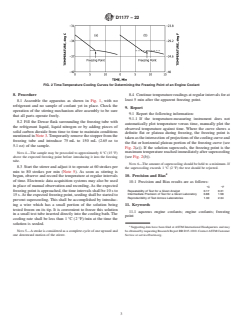
SIGNIFICANCE AND USE
5.1 The freezing point of an engine coolant indicates the coolant freeze protection.
5.2 The freezing point of an engine coolant may be used to determine the approximate glycol or glycerin content, provided the glycol type is known.
SCOPE
1.1 This test method covers the determination of the freezing point of an aqueous engine coolant solution in the laboratory.
Note 1: Where solutions of specific concentrations are to be tested, they shall be prepared from representative samples as directed in Practice D1176. Secondary phases separating on dilution need not be separated.
Note 2: These products may also be marketed in a ready-to-use form (prediluted).
1.2 The values stated in SI units are to be regarded as standard. The values given in parentheses after SI units are provided for information only and are not considered standard.
1.3 This standard does not purport to address all of the safety concerns, if any, associated with its use. It is the responsibility of the user of this standard to establish appropriate safety, health, and environmental practices and determine the applicability of regulatory limitations prior to use.
1.4 This international standard was developed in accordance with internationally recognized principles on standardization established in the Decision on Principles for the Development of International Standards, Guides and Recommendations issued by the World Trade Organization Technical Barriers to Trade (TBT) Committee.
- Status
- Published
- Publication Date
- 31-Aug-2022
- Technical Committee
- D15 - Engine Coolants and Related Fluids
- Drafting Committee
- D15.03 - Physical Properties

Overview
ASTM D1177-22: Standard Test Method for Freezing Point of Aqueous Engine Coolants is a widely recognized specification from ASTM International. This standard details laboratory procedures for determining the freezing point of aqueous engine coolant solutions, which is essential for assessing their freeze protection performance. The freezing point measurement is also a valuable indicator of the glycol or glycerin content in engine coolants when the specific glycol type is known.
Accurate determination of the coolant freezing point is critical for ensuring effective operation of engines in low-temperature environments. Adherence to ASTM D1177-22 enables manufacturers, laboratories, and regulatory agencies to ensure the quality, performance, and safety of engine coolants in automotive and industrial applications.
Key Topics
- Test Methodology: The standard outlines procedures for preparing samples, setting up measurement apparatus, and recording temperature changes during controlled cooling. The precise determination of the coolant’s freezing point is based on analyzing the time-temperature curve and identifying the point of crystallization.
- Significance: The freezing point is a primary indicator of the antifreeze protection provided by the coolant. It informs decisions about suitable coolant concentrations for varying climate conditions.
- Sample Preparation: Guidance is given on preparing representative samples according to standardized sampling practices, such as those described in ASTM D1176.
- Apparatus Requirements: Specifies the use of Dewar flasks, resistance thermometers, and calibrated measuring instruments capable of high accuracy.
- Safety and Compliance: Users are responsible for implementing appropriate safety, health, and environmental practices, as the test may involve hazardous chemicals and cryogenic liquids.
Applications
The ASTM D1177-22 test method is integral across various sectors where engine coolants are utilized or manufactured, including:
- Automotive Industry: Ensures consistent low-temperature protection for vehicles operating in cold climates. Helps automotive OEMs and service providers evaluate the freeze protection level of coolant formulations and in-service fluids.
- Industrial Equipment: Assists in maintaining optimal performance and longevity of engines in heavy machinery, marine, and stationary power generation applications.
- Quality Control Laboratories: Provides a scientifically validated approach for coolant manufacturers and third-party labs to certify the performance of new batches and monitor product compliance.
- Glycol Content Assessment: By comparing the freezing point to established reference data, operators can estimate the concentration of antifreeze agents, supporting both maintenance and product development.
Related Standards
To ensure comprehensive coolant evaluation and testing, the following related ASTM standards are referenced or used in conjunction with ASTM D1177-22:
- ASTM D1176: Practice for Sampling and Preparing Aqueous Solutions of Engine Coolants or Antirusts for Testing Purposes. Provides guidance on preparing accurate and representative coolant samples necessary for valid freezing point measurements.
- ASTM E1: Specification for ASTM Liquid-in-Glass Thermometers. Defines requirements for thermometers used in freezing point determination and helps ensure measurement accuracy and repeatability.
Practical Value
Using ASTM D1177-22 delivers multiple benefits:
- Reliability: Adherence to a standardized test method enhances the reliability and comparability of freezing point data across the coolant industry.
- Safety: Ensures that coolants meet minimum safety standards for freeze protection, preventing engine block damage and associated failures.
- Regulatory Compliance: Assists manufacturers in meeting regulatory requirements and industry certifications for both domestic and international markets.
Key terms: engine coolant freezing point, ASTM D1177-22, antifreeze protection, glycol content, laboratory testing, quality control, automotive standards, coolant analysis.
Relations
- Effective Date
- 01-Oct-2019
- Effective Date
- 01-Apr-2014
- Effective Date
- 01-May-2013
- Effective Date
- 01-Apr-2008
- Effective Date
- 01-Nov-2007
- Effective Date
- 01-Nov-2005
- Effective Date
- 01-Nov-2003
- Effective Date
- 10-May-2003
- Effective Date
- 10-Oct-2001
- Effective Date
- 10-Oct-2001
- Effective Date
- 10-Oct-2001
- Effective Date
- 10-Apr-1998
- Effective Date
- 10-Apr-1998
Get Certified
Connect with accredited certification bodies for this standard

ECOCERT
Organic and sustainability certification.

Eurofins Food Testing Global
Global leader in food, environment, and pharmaceutical product testing.

Intertek Bangladesh
Intertek certification and testing services in Bangladesh.
Sponsored listings
Frequently Asked Questions
ASTM D1177-22 is a standard published by ASTM International. Its full title is "Standard Test Method for Freezing Point of Aqueous Engine Coolants". This standard covers: SIGNIFICANCE AND USE 5.1 The freezing point of an engine coolant indicates the coolant freeze protection. 5.2 The freezing point of an engine coolant may be used to determine the approximate glycol or glycerin content, provided the glycol type is known. SCOPE 1.1 This test method covers the determination of the freezing point of an aqueous engine coolant solution in the laboratory. Note 1: Where solutions of specific concentrations are to be tested, they shall be prepared from representative samples as directed in Practice D1176. Secondary phases separating on dilution need not be separated. Note 2: These products may also be marketed in a ready-to-use form (prediluted). 1.2 The values stated in SI units are to be regarded as standard. The values given in parentheses after SI units are provided for information only and are not considered standard. 1.3 This standard does not purport to address all of the safety concerns, if any, associated with its use. It is the responsibility of the user of this standard to establish appropriate safety, health, and environmental practices and determine the applicability of regulatory limitations prior to use. 1.4 This international standard was developed in accordance with internationally recognized principles on standardization established in the Decision on Principles for the Development of International Standards, Guides and Recommendations issued by the World Trade Organization Technical Barriers to Trade (TBT) Committee.
SIGNIFICANCE AND USE 5.1 The freezing point of an engine coolant indicates the coolant freeze protection. 5.2 The freezing point of an engine coolant may be used to determine the approximate glycol or glycerin content, provided the glycol type is known. SCOPE 1.1 This test method covers the determination of the freezing point of an aqueous engine coolant solution in the laboratory. Note 1: Where solutions of specific concentrations are to be tested, they shall be prepared from representative samples as directed in Practice D1176. Secondary phases separating on dilution need not be separated. Note 2: These products may also be marketed in a ready-to-use form (prediluted). 1.2 The values stated in SI units are to be regarded as standard. The values given in parentheses after SI units are provided for information only and are not considered standard. 1.3 This standard does not purport to address all of the safety concerns, if any, associated with its use. It is the responsibility of the user of this standard to establish appropriate safety, health, and environmental practices and determine the applicability of regulatory limitations prior to use. 1.4 This international standard was developed in accordance with internationally recognized principles on standardization established in the Decision on Principles for the Development of International Standards, Guides and Recommendations issued by the World Trade Organization Technical Barriers to Trade (TBT) Committee.
ASTM D1177-22 is classified under the following ICS (International Classification for Standards) categories: 71.100.45 - Refrigerants and antifreezes. The ICS classification helps identify the subject area and facilitates finding related standards.
ASTM D1177-22 has the following relationships with other standards: It is inter standard links to ASTM D1176-14(2019), ASTM D1176-14, ASTM E1-13, ASTM D1176-98(2008), ASTM E1-07, ASTM E1-05, ASTM E1-03a, ASTM E1-03, ASTM E1-01, ASTM E1-98e1, ASTM E1-98, ASTM D1176-98(2002), ASTM D1176-98. Understanding these relationships helps ensure you are using the most current and applicable version of the standard.
ASTM D1177-22 is available in PDF format for immediate download after purchase. The document can be added to your cart and obtained through the secure checkout process. Digital delivery ensures instant access to the complete standard document.
Standards Content (Sample)
This international standard was developed in accordance with internationally recognized principles on standardization established in the Decision on Principles for the
Development of International Standards, Guides and Recommendations issued by the World Trade Organization Technical Barriers to Trade (TBT) Committee.
Designation: D1177 − 22
Standard Test Method for
Freezing Point of Aqueous Engine Coolants
This standard is issued under the fixed designation D1177; the number immediately following the designation indicates the year of
original adoption or, in the case of revision, the year of last revision.Anumber in parentheses indicates the year of last reapproval.A
superscript epsilon (´) indicates an editorial change since the last revision or reapproval.
This standard has been approved for use by agencies of the U.S. Department of Defense.
1. Scope* 3.1.1 freezing point—the temperature at which crystalliza-
tion begins in the absence of supercooling, or the maximum
1.1 This test method covers the determination of the freez-
temperature reached immediately after initial crystal formation
ing point of an aqueous engine coolant solution in the
in the case of supercooling, or the temperature at which solid
laboratory.
crystals,formedoncooling,disappearwhenthetemperatureof
NOTE 1—Where solutions of specific concentrations are to be tested,
the specimen is allowed to rise.
they shall be prepared from representative samples as directed in Practice
D1176. Secondary phases separating on dilution need not be separated.
4. Summary of Test Method
NOTE 2—These products may also be marketed in a ready-to-use form
(prediluted).
4.1 This test method involves the determination of the
1.2 The values stated in SI units are to be regarded as time-temperature curve prior to freezing and the determination
of the horizontal or flattened portion of the freezing curve.The
standard. The values given in parentheses after SI units are
provided for information only and are not considered standard. freezing point is taken as the intersection of projections of the
cooling curve and the freezing curve. If the solution
1.3 This standard does not purport to address all of the
supercools, the freezing point is the maximum temperature
safety concerns, if any, associated with its use. It is the
reached after supercooling.
responsibility of the user of this standard to establish appro-
priate safety, health, and environmental practices and deter-
5. Significance and Use
mine the applicability of regulatory limitations prior to use.
1.4 This international standard was developed in accor- 5.1 The freezing point of an engine coolant indicates the
dance with internationally recognized principles on standard- coolant freeze protection.
ization established in the Decision on Principles for the
5.2 The freezing point of an engine coolant may be used to
Development of International Standards, Guides and Recom-
determinetheapproximateglycolorglycerincontent,provided
mendations issued by the World Trade Organization Technical
the glycol type is known.
Barriers to Trade (TBT) Committee.
6. Apparatus
2. Referenced Documents
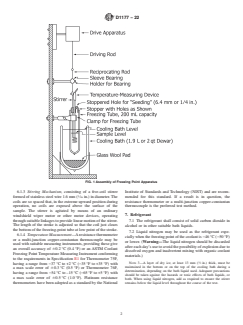
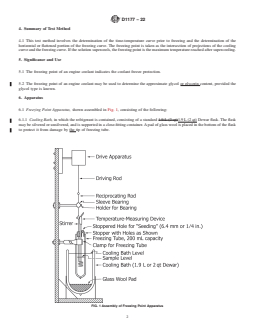
6.1 Freezing Point Apparatus, shown assembled in Fig. 1,
2.1 ASTM Standards:
consisting of the following:
D1176Practice for Sampling and Preparing Aqueous Solu-
6.1.1 Cooling Bath, in which the refrigerant is contained,
tionsofEngineCoolantsorAntirustsforTestingPurposes
consistingofastandard1.9L(2qt)Dewarflask.Theflaskmay
E1Specification for ASTM Liquid-in-Glass Thermometers
be silvered or unsilvered, and is supported in a close-fitting
container. A pad of glass wool is placed in the bottom of the
3. Terminology
flask to protect it from damage by the tip of freezing tube.
3.1 Definitions:
6.1.2 Freezing Tube consisting of a 200 mL (6.8 oz)
unevacuated, unsilvered Dewar flask. The tube is closed by a
cork having a central hole for the thermocouple or resistance
This test method is under the jurisdiction ofASTM Committee D15 on Engine
thermometer, a second hole placed to one side for passage of
Coolants and Related Fluids and is the direct responsibility of Subcommittee
the stirring rod, and a third hole for introducing wire for
D15.03 on Physical Properties.
Current edition approved Sept. 1, 2022. Published September 2022. Originally seeding at appropriate time.
approved in 1951. Last previous edition approved in 2017 as D1177-17. DOI:
10.1520/D1177-22.
For referenced ASTM standards, visit the ASTM website, www.astm.org, or
contact ASTM Customer Service at service@astm.org. For Annual Book of ASTM For routine work, a tube with a seeding tip as described in the paper by
Standards volume information, refer to the standard’s Document Summary page on Mallonee,R.E.,andHoward,F.L.,“TheDeterminationofFreezingPointofEngine
the ASTM website. Antifreeze,” in the February 1951 issue of the ASTM Bulletin may be used.
*A Summary of Changes section appears at the end of this standard
Copyright © ASTM International, 100 Barr Harbor Drive, PO Box C700, West Conshohocken, PA 19428-2959. United States
D1177 − 22
FIG. 1 Assembly of Freezing Point Apparatus
6.1.3 Stirring Mechanism, consisting of a five-coil stirrer Institute of Standards and Technology (NIST) and are recom-
formedofstainlesssteelwire1.6mm( ⁄16in.)indiameter.The mended for this standard. If a result is in question, the
coils are so spaced that, in the extreme upward position during resistance thermometer or a multi-junction copper-constantan
operation, no coils are exposed above the surface of the thermocouple is the preferred test method.
sample. The stirrer is agitated by means of an ordinary
7. Refrigerant
windshield wiper motor or other motor devices, operating
throughsuitablelinkagestoprovidelinearmotionofthestirrer.
7.1 The refrigerant shall consist of solid carbon dioxide in
The length of the stroke is adjusted so that the coil just clears
alcohol or in other suitable bath liquids.
thebottomofthefreezing-pointtubeatlowpointofthestroke.
7.2 Liquid nitrogen may be used as the refrigerant espe-
6.1.4 Temperature Measurement—Aresistancethermometer
ciallywhenthefreezingpointofthecoolantis−46°C(−50°F)
or a multi-junction copper-constantan thermocouple may be
or lower. (Warning—T
...
This document is not an ASTM standard and is intended only to provide the user of an ASTM standard an indication of what changes have been made to the previous version. Because
it may not be technically possible to adequately depict all changes accurately, ASTM recommends that users consult prior editions as appropriate. In all cases only the current version
of the standard as published by ASTM is to be considered the official document.
Designation: D1177 − 17 D1177 − 22
Standard Test Method for
Freezing Point of Aqueous Engine Coolants
This standard is issued under the fixed designation D1177; the number immediately following the designation indicates the year of
original adoption or, in the case of revision, the year of last revision. A number in parentheses indicates the year of last reapproval. A
superscript epsilon (´) indicates an editorial change since the last revision or reapproval.
This standard has been approved for use by agencies of the U.S. Department of Defense.
1. Scope*
1.1 This test method covers the determination of the freezing point of an aqueous engine coolant solution in the laboratory.
NOTE 1—Where solutions of specific concentrations are to be tested, they shall be prepared from representative samples as directed in Practice D1176.
Secondary phases separating on dilution need not be separated.
NOTE 2—These products may also be marketed in a ready-to-use form (prediluted).
1.2 The values stated in SI units are to be regarded as the standard. The values given in parentheses are for information only.after
SI units are provided for information only and are not considered standard.
1.3 This standard does not purport to address all of the safety concerns, if any, associated with its use. It is the responsibility
of the user of this standard to establish appropriate safety safety, health, and healthenvironmental practices and determine the
applicability of regulatory limitations prior to use.
1.4 This international standard was developed in accordance with internationally recognized principles on standardization
established in the Decision on Principles for the Development of International Standards, Guides and Recommendations issued
by the World Trade Organization Technical Barriers to Trade (TBT) Committee.
2. Referenced Documents
2.1 ASTM Standards:
D1176 Practice for Sampling and Preparing Aqueous Solutions of Engine Coolants or Antirusts for Testing Purposes
E1 Specification for ASTM Liquid-in-Glass Thermometers
3. Terminology
3.1 Definitions:
3.1.1 freezing point—the temperature at which crystallization begins in the absence of supercooling, or the maximum temperature
reached immediately after initial crystal formation in the case of supercooling, or the temperature at which solid crystals, formed
on cooling, disappear when the temperature of the specimen is allowed to rise.
This test method is under the jurisdiction of ASTM Committee D15 on Engine Coolants and Related Fluids and is the direct responsibility of Subcommittee D15.03 on
Physical Properties.
Current edition approved April 1, 2017Sept. 1, 2022. Published April 2017September 2022. Originally approved in 1951. Last previous edition approved in 20162017 as
D1177-16.-17. DOI: 10.1520/D1177-17.10.1520/D1177-22.
For referenced ASTM standards, visit the ASTM website, www.astm.org, or contact ASTM Customer Service at service@astm.org. For Annual Book of ASTM Standards
volume information, refer to the standard’s Document Summary page on the ASTM website.
*A Summary of Changes section appears at the end of this standard
Copyright © ASTM International, 100 Barr Harbor Drive, PO Box C700, West Conshohocken, PA 19428-2959. United States
D1177 − 22
4. Summary of Test Method
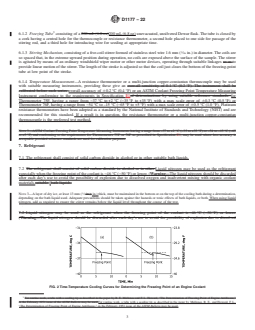
4.1 This test method involves the determination of the time-temperature curve prior to freezing and the determination of the
horizontal or flattened portion of the freezing curve. The freezing point is taken as the intersection of projections of the cooling
curve and the freezing curve. If the solution supercools, the freezing point is the maximum temperature reached after supercooling.
5. Significance and Use
5.1 The freezing point of an engine coolant indicates the coolant freeze protection.
5.2 The freezing point of an engine coolant may be used to determine the approximate glycol or glycerin content, provided the
glycol type is known.
6. Apparatus
6.1 Freezing Point Apparatus, shown assembled in Fig. 1, consisting of the following:
6.1.1 Cooling Bath, in which the refrigerant is contained, consisting of a standard 1.9-L (2-qt)1.9 L (2 qt) Dewar flask. The flask
may be silvered or unsilvered, and is supported in a close-fitting container. A pad of glass wool is placed in the bottom of the flask
to protect it from damage by the tip of freezing tube.
FIG. 1 Assembly of Freezing Point Apparatus
D1177 − 22
6.1.2 Freezing Tube consisting of a 200-mL (6.8-oz)200 mL (6.8 oz) unevacuated, unsilvered Dewar flask. The tube is closed by
a cork having a central hole for the thermocouple or resistance thermometer, a second hole placed to one side for passage of the
stirring rod, and a third hole for introducing wire for seeding at appropriate time.
6.1.3 Stirring Mechanism, consisting of a five-coil stirrer formed of stainless steel wire 1.6 mm ( ⁄16 in.) in diameter. The coils are
so spaced that, in the extreme upward position during operation, no coils are exposed above the surface of the sample. The stirrer
is agitated by means of an ordinary windshield wiper motor or other motor devices, operating through suitable linkages so as to
provide linear motion of the stirrer. The length of the stroke is adjusted so that the coil just clears the bottom of the freezing-point
tube at low point of the stroke.
6.1.4 Temperature Measurement—A resistance thermometer or a multi-junction copper-constantan thermocouple may be used
with suitable measuring instruments, providing these give an over-all sensitivity of 0.1 °C (0.2 °F). The instrument shall be
calibrated before each series overall accuracy of 60.2 °C (0.4 °F) or an ASTM Coolant Freezing Point Temperature Measuring
Instrument conforming to the requirements in Specification E1of determinations by using suitable reference standards. for
Thermometer 75F, having a range from −37 °C to +2 °C (−35 °F to +35 °F) with a max scale error of 60.3 °C (0.5 °F) or
Thermometer 76F, having a range from −54 °C to –15 °C (−65 °F to +5 °F) with a max scale error of 60.5 °C (1.0 °F). Platinum
resistance thermometers have been adopted as a standard by the National Institute of Standards and Technology (NIST) and are
recommended for this standard. If a result is in question, the resistance thermometer or a multi-junction copper-constantan
thermocouple is the preferred test method.
NOTE 3—ASTM Coolant Freezing Point Temperature Measuring Instruments having a range from −37 to +2 °C (−35 to +35 °F) or −54 to −15 °C (−65
to +5 °F) and conforming to the requirements for Thermometers 75F or 76F as prescribed in Specification E1, may be used where less accuracy is
acceptable provided reference standards are used for calibration purposes.
7. Refrigerant
7.1 The refrigerant shall consist of solid carbon dioxide in alc
...