

ASTM D1092-20
(Test Method)Standard Test Method for Measuring Apparent Viscosity of Lubricating Greases
General Information
- Abstract
SIGNIFICANCE AND USE
5.1 Apparent viscosity versus shear rate information can be useful in predicting pressure drops in grease distribution systems under steady-state flow conditions at constant temperature.
SCOPE
1.1 This test method covers measurement, in poises, of the apparent viscosity of lubricating greases in the temperature range from −54 °C to 38 °C (−65 °F to 100 °F). Measurements are limited to the range from 25 P to 100 000 P at 0.1 s−1 and 1 P to 100 P at 15 000 s−1.
Note 1: At very low temperatures the shear rate range may be reduced because of the great force required to force grease through the smaller capillaries. Precision has not been established below 10 s−1.
1.2 This standard uses inch-pound units as well as SI (acceptable metric) units. The values stated first are to be regarded as standard. The values given in parentheses are for information only. The capillary dimensions in SI units in Fig. A1.1 and Fig. A1.2 are standard.
1.3 This test method uses mercury thermometers. WARNING—Mercury has been designated by many regulatory agencies as a hazardous substance that can cause serious medical issues. Mercury, or its vapor, has been demonstrated to be hazardous to health and corrosive to materials. Use caution when handling mercury and mercury-containing products. See the applicable product Safety Data Sheet (SDS) for additional information. The potential exists that selling mercury or mercury-containing products, or both, is prohibited by local or national law. Users must determine legality of sales in their location. The responsible subcommittee, D02.G0, continues to explore alternatives to eventually replace the mercury thermometers.
1.3.1 In addition, temperature measuring devices such as liquid-in-glass thermometers (Specifications E1 and E2251), thermocouples, thermistors, or platinum resistance thermometers that provide equivalent or better accuracy and precision, that cover the temperature range for ASTM thermometer 49C, may be used.
1.4 This standard does not purport to address all of the safety concerns, if any, associated with its use. It is the responsibility of the user of this standard to establish appropriate safety, health, and environmental practices and determine the applicability of regulatory limitations prior to use.
1.5 This international standard was developed in accordance with internationally recognized principles on standardization established in the Decision on Principles for the Development of International Standards, Guides and Recommendations issued by the World Trade Organization Technical Barriers to Trade (TBT) Committee.
- Status
- Published
- Publication Date
- 31-May-2020
- Technical Committee
- D02 - Petroleum Products, Liquid Fuels, and Lubricants
- Drafting Committee
- D02.G0.02 - Consistency and Related Rheological Tests
Overview
ASTM D1092-20: Standard Test Method for Measuring Apparent Viscosity of Lubricating Greases establishes a reliable method to determine the apparent viscosity of lubricating greases. This test method is crucial for industries that depend on precise lubrication, as it measures viscosity across a broad temperature range −54°C to 38°C (−65°F to 100°F). The standard gives valuable insight into how grease will perform under operating conditions, supporting optimal design, maintenance, and specification for grease distribution systems.
By characterizing apparent viscosity versus shear rate, ASTM D1092-20 helps predict pressure drops in grease distribution under steady-state flow conditions at constant temperature. Measurements are reported in poises, with specific ranges according to the applied shear rate.
Key Topics
- Measurement Range: Covers apparent viscosity of lubricating greases from 25 P to 100,000 P at 0.1 s⁻¹ and 1 P to 100 P at 15,000 s⁻¹.
- Shear Rate Analysis: The relationship between apparent viscosity and shear rate is critical for understanding grease flow behavior.
- Temperature Considerations: The method is applicable across temperatures from −54°C to 38°C, covering extreme low- and high-temperature applications.
- Precision and Repeatability: The standard outlines guidelines for repeatability and reproducibility to ensure reliable results.
- Unit System: Utilizes both SI (metric) and inch-pound units to ensure global applicability.
- Instrument Options: While traditional mercury thermometers are referenced, the standard allows for alternative devices such as thermocouples, thermistors, or platinum resistance thermometers, provided they meet accuracy requirements.
Applications
ASTM D1092-20 is a key standard for:
- Grease Manufacturers: Ensures batches of lubricating grease meet specific performance criteria.
- Automotive and Industrial Maintenance: Predicts how lubricating greases will behave in centralized lubricating systems, leading to better machine reliability and reduced maintenance costs.
- System Designers and Engineers: Supports accurate modeling of pressure drop and flow characteristics in grease distribution systems and pipelines.
- Quality Control Laboratories: Offers a standardized test protocol for routine quality assurance and compliance with customer or regulatory requirements.
The ability to reliably measure viscosity supports data-driven decisions for product selection and system design, especially where equipment operates under varying shear rates and temperatures.
Related Standards
For a comprehensive approach to lubricating grease testing and characterization, consider these related ASTM standards:
- ASTM D88: Standard Test Method for Saybolt Viscosity
- ASTM D217: Test Methods for Cone Penetration of Lubricating Grease (assesses work consistency and preparation)
- ASTM D3244: Practice for Utilization of Test Data to Determine Conformance with Specifications
- ASTM E1 / E2251: Specifications for Temperature Measurement Devices
These standards complement ASTM D1092-20 by addressing other critical grease properties, testing conditions, and instrumentation specifications.
Keywords: ASTM D1092-20, apparent viscosity, lubricating greases, shear rate, viscosity test, grease distribution, temperature range, SI units, hydraulic systems, pressure drop, quality control, grease manufacturing standards.
Relations
- Replaces
ASTM D1092-19 - Standard Test Method for Measuring Apparent Viscosity of Lubricating Greases - Effective Date
- 01-Jun-2020
- Effective Date
- 01-Jul-2019
- Effective Date
- 01-May-2019
- Effective Date
- 01-Oct-2016
- Effective Date
- 01-May-2013
- Effective Date
- 01-May-2013
- Effective Date
- 01-May-2011
- Effective Date
- 01-Nov-2010
- Effective Date
- 01-May-2010
- Effective Date
- 01-Nov-2007
- Effective Date
- 01-Nov-2007
- Effective Date
- 01-Nov-2007
- Effective Date
- 01-Nov-2007
- Effective Date
- 01-Nov-2007
- Effective Date
- 01-Jul-2007
Get Certified
Connect with accredited certification bodies for this standard

Element Materials Technology
Materials testing and product certification.

ABS Group Brazil
ABS Group certification services in Brazil.

ABS Quality Evaluations Inc.
American Bureau of Shipping quality certification.
Sponsored listings
Frequently Asked Questions
ASTM D1092-20 is a standard published by ASTM International. Its full title is "Standard Test Method for Measuring Apparent Viscosity of Lubricating Greases". This standard covers: SIGNIFICANCE AND USE 5.1 Apparent viscosity versus shear rate information can be useful in predicting pressure drops in grease distribution systems under steady-state flow conditions at constant temperature. SCOPE 1.1 This test method covers measurement, in poises, of the apparent viscosity of lubricating greases in the temperature range from −54 °C to 38 °C (−65 °F to 100 °F). Measurements are limited to the range from 25 P to 100 000 P at 0.1 s−1 and 1 P to 100 P at 15 000 s−1. Note 1: At very low temperatures the shear rate range may be reduced because of the great force required to force grease through the smaller capillaries. Precision has not been established below 10 s−1. 1.2 This standard uses inch-pound units as well as SI (acceptable metric) units. The values stated first are to be regarded as standard. The values given in parentheses are for information only. The capillary dimensions in SI units in Fig. A1.1 and Fig. A1.2 are standard. 1.3 This test method uses mercury thermometers. WARNING—Mercury has been designated by many regulatory agencies as a hazardous substance that can cause serious medical issues. Mercury, or its vapor, has been demonstrated to be hazardous to health and corrosive to materials. Use caution when handling mercury and mercury-containing products. See the applicable product Safety Data Sheet (SDS) for additional information. The potential exists that selling mercury or mercury-containing products, or both, is prohibited by local or national law. Users must determine legality of sales in their location. The responsible subcommittee, D02.G0, continues to explore alternatives to eventually replace the mercury thermometers. 1.3.1 In addition, temperature measuring devices such as liquid-in-glass thermometers (Specifications E1 and E2251), thermocouples, thermistors, or platinum resistance thermometers that provide equivalent or better accuracy and precision, that cover the temperature range for ASTM thermometer 49C, may be used. 1.4 This standard does not purport to address all of the safety concerns, if any, associated with its use. It is the responsibility of the user of this standard to establish appropriate safety, health, and environmental practices and determine the applicability of regulatory limitations prior to use. 1.5 This international standard was developed in accordance with internationally recognized principles on standardization established in the Decision on Principles for the Development of International Standards, Guides and Recommendations issued by the World Trade Organization Technical Barriers to Trade (TBT) Committee.
SIGNIFICANCE AND USE 5.1 Apparent viscosity versus shear rate information can be useful in predicting pressure drops in grease distribution systems under steady-state flow conditions at constant temperature. SCOPE 1.1 This test method covers measurement, in poises, of the apparent viscosity of lubricating greases in the temperature range from −54 °C to 38 °C (−65 °F to 100 °F). Measurements are limited to the range from 25 P to 100 000 P at 0.1 s−1 and 1 P to 100 P at 15 000 s−1. Note 1: At very low temperatures the shear rate range may be reduced because of the great force required to force grease through the smaller capillaries. Precision has not been established below 10 s−1. 1.2 This standard uses inch-pound units as well as SI (acceptable metric) units. The values stated first are to be regarded as standard. The values given in parentheses are for information only. The capillary dimensions in SI units in Fig. A1.1 and Fig. A1.2 are standard. 1.3 This test method uses mercury thermometers. WARNING—Mercury has been designated by many regulatory agencies as a hazardous substance that can cause serious medical issues. Mercury, or its vapor, has been demonstrated to be hazardous to health and corrosive to materials. Use caution when handling mercury and mercury-containing products. See the applicable product Safety Data Sheet (SDS) for additional information. The potential exists that selling mercury or mercury-containing products, or both, is prohibited by local or national law. Users must determine legality of sales in their location. The responsible subcommittee, D02.G0, continues to explore alternatives to eventually replace the mercury thermometers. 1.3.1 In addition, temperature measuring devices such as liquid-in-glass thermometers (Specifications E1 and E2251), thermocouples, thermistors, or platinum resistance thermometers that provide equivalent or better accuracy and precision, that cover the temperature range for ASTM thermometer 49C, may be used. 1.4 This standard does not purport to address all of the safety concerns, if any, associated with its use. It is the responsibility of the user of this standard to establish appropriate safety, health, and environmental practices and determine the applicability of regulatory limitations prior to use. 1.5 This international standard was developed in accordance with internationally recognized principles on standardization established in the Decision on Principles for the Development of International Standards, Guides and Recommendations issued by the World Trade Organization Technical Barriers to Trade (TBT) Committee.
ASTM D1092-20 is classified under the following ICS (International Classification for Standards) categories: 75.100 - Lubricants, industrial oils and related products. The ICS classification helps identify the subject area and facilitates finding related standards.
ASTM D1092-20 has the following relationships with other standards: It is inter standard links to ASTM D1092-19, ASTM D217-19a, ASTM D217-19, ASTM D217-16, ASTM E1-13, ASTM D88-07(2013), ASTM E2251-11, ASTM E2251-10, ASTM D217-10, ASTM D217-02(2007), ASTM D88-07, ASTM E1-07, ASTM E2251-07, ASTM D3244-07a, ASTM D3244-07. Understanding these relationships helps ensure you are using the most current and applicable version of the standard.
ASTM D1092-20 is available in PDF format for immediate download after purchase. The document can be added to your cart and obtained through the secure checkout process. Digital delivery ensures instant access to the complete standard document.
Standards Content (Sample)
This international standard was developed in accordance with internationally recognized principles on standardization established in the Decision on Principles for the
Development of International Standards, Guides and Recommendations issued by the World Trade Organization Technical Barriers to Trade (TBT) Committee.
Designation: D1092 − 20
Standard Test Method for
Measuring Apparent Viscosity of Lubricating Greases
This standard is issued under the fixed designation D1092; the number immediately following the designation indicates the year of
original adoption or, in the case of revision, the year of last revision.Anumber in parentheses indicates the year of last reapproval.A
superscript epsilon (´) indicates an editorial change since the last revision or reapproval.
This standard has been approved for use by agencies of the U.S. Department of Defense.
1. Scope* responsibility of the user of this standard to establish appro-
priate safety, health, and environmental practices and deter-
1.1 This test method covers measurement, in poises, of the
mine the applicability of regulatory limitations prior to use.
apparent viscosity of lubricating greases in the temperature
1.5 This international standard was developed in accor-
rangefrom−54°Cto38°C(−65°Fto100°F).Measurements
−1 dance with internationally recognized principles on standard-
are limited to the range from 25P to 100000P at 0.1s and
−1 ization established in the Decision on Principles for the
1P to 100P at 15000s .
Development of International Standards, Guides and Recom-
NOTE1—Atverylowtemperaturestheshearraterangemaybereduced
mendations issued by the World Trade Organization Technical
because of the great force required to force grease through the smaller
Barriers to Trade (TBT) Committee.
−1
capillaries. Precision has not been established below 10s .
1.2 This standard uses inch-pound units as well as SI
2. Referenced Documents
(acceptable metric) units. The values stated first are to be
2.1 ASTM Standards:
regarded as standard. The values given in parentheses are for
D88Test Method for Saybolt Viscosity
information only. The capillary dimensions in SI units in Fig.
D217Test Methods for Cone Penetration of Lubricating
A1.1 and Fig. A1.2 are standard.
Grease
1.3 This test method uses mercury thermometers.
D3244Practice for Utilization of Test Data to Determine
WARNING—Mercury has been designated by many regula-
Conformance with Specifications
tory agencies as a hazardous substance that can cause serious
E1Specification for ASTM Liquid-in-Glass Thermometers
medicalissues.Mercury,oritsvapor,hasbeendemonstratedto
E2251Specification for Liquid-in-Glass ASTM Thermom-
be hazardous to health and corrosive to materials. Use caution
eters with Low-Hazard Precision Liquids
when handling mercury and mercury-containing products. See
3. Terminology
the applicable product Safety Data Sheet (SDS) for additional
information. The potential exists that selling mercury or
3.1 Definitions:
mercury-containing products, or both, is prohibited by local or
3.1.1 apparent viscosity, n—of a lubricating grease is the
national law. Users must determine legality of sales in their
ratio of shear stress to shear rate calculated from Poiseuille’s
location. The responsible subcommittee, D02.G0, continues to
equation, and is measured in poises (see 10.1).
explore alternatives to eventually replace the mercury ther-
3.1.2 capillary, n—For the purpose of this test method, a
mometers.
capillary is any right cylindrical tube having a length to
1.3.1 In addition, temperature measuring devices such as
diameter ratio of 40 to 1.
liquid-in-glass thermometers (Specifications E1 and E2251),
3.1.3 shear rate, n—the rate at which a series of adjacent
thermocouples, thermistors, or platinum resistance thermom-
layers of grease move with respect to each other; proportional
eters that provide equivalent or better accuracy and precision,
to the linear velocity of flow divided by the capillary radius,
that cover the temperature range forASTM thermometer 49C,
and is thus expressed as reciprocal seconds.
may be used.
1.4 This standard does not purport to address all of the
4. Summary of Test Method
safety concerns, if any, associated with its use. It is the
4.1 The sample is forced through a capillary by means of a
floating piston actuated by the hydraulic system. From the
This test method is under the jurisdiction of ASTM Committee D02 on
Petroleum Products, Liquid Fuels, and Lubricants and is the direct responsibility of
Subcommittee D02.G0.02 on Consistency and Related Rheological Tests. For referenced ASTM standards, visit the ASTM website, www.astm.org, or
Current edition approved June 1, 2020. Published September 2020. Originally contact ASTM Customer Service at service@astm.org. For Annual Book of ASTM
approved in 1950. Last previous edition approved in 2019 as D1092–19. DOI: Standards volume information, refer to the standard’s Document Summary page on
10.1520/D1092-20. the ASTM website.
*A Summary of Changes section appears at the end of this standard
Copyright © ASTM International, 100 Barr Harbor Drive, PO Box C700, West Conshohocken, PA 19428-2959. United States
D1092 − 20
predeterminedflowrateandtheforcedevelopedinthesystem,
the apparent viscosity is calculated by means of Poiseuille’s
equation.Aseriesofeightcapillariesandtwopumpspeedsare
used to determine the apparent viscosity at sixteen shear rates.
Theresultsareexpressedasalog-logplotofapparentviscosity
versus shear rate.
5. Significance and Use
5.1 Apparent viscosity versus shear rate information can be
useful in predicting pressure drops in grease distribution
systems under steady-state flow conditions at constant tem-
perature.
6. Apparatus
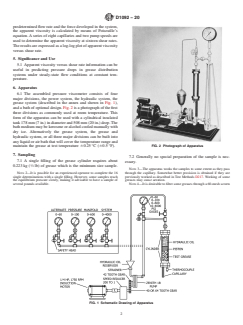
6.1 The assembled pressure viscometer consists of four
major divisions, the power system, the hydraulic system, the
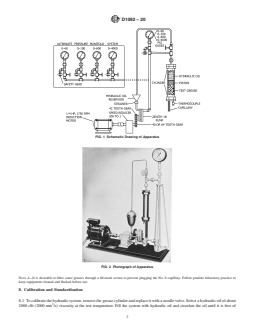
grease system (described in the annex and shown in Fig. 1),
andabathofoptionaldesign.Fig.2isaphotographofthefirst
three divisions as commonly used at room temperature. This
form of the apparatus can be used with a cylindrical insulated
tank178mm(7in.)indiameterand508mm(20in.)deep.The
bathmediummaybekeroseneoralcoholcooledmanuallywith
dry ice. Alternatively the grease system, the grease and
hydraulic system, or all three major divisions can be built into
anyliquidorairbaththatwillcoverthetemperaturerangeand
FIG. 2 Photograph of Apparatus
maintain the grease at test temperature 60.25°C (60.5°F).
7. Sampling
7.2 Generally no special preparation of the sample is nec-
7.1 A single filling of the grease cylinder requires about
essary.
0.223kg ( ⁄2lb) of grease which is the minimum size sample.
NOTE 3—The apparatus works the samples to some extent as they pass
NOTE 2—It is possible for an experienced operator to complete the 16 through the capillary. Somewhat better precision is obtained if they are
single determinations with a single filling. However, some samples reach previously worked as described in Test Methods D217. Working of some
the equilibrium pressure slowly, making it advisable to have a sample of greases may cause aeration.
NOTE4—Itisdesirabletofiltersomegreasesthrougha60-meshscreen
several pounds available.
FIG. 1 Schematic Drawing of Apparatus
D1092 − 20
topreventpluggingtheNo.8capillary.Followprudentlaboratorypractice
oil flows from the gage connection on the viscometer before
to keep equipment cleaned and flushed before use.
reconnecting the gage. With the entire viscometer assembled,
circulate hydraulic oil with the return valve open until all trace
8. Calibration and Standardization
of air is eliminated.
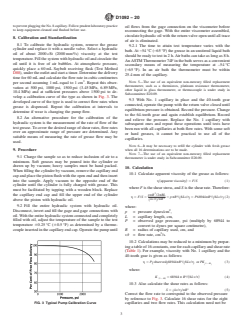
8.1 To calibrate the hydraulic system, remove the grease
9.2.1 The time to attain test temperature varies with the
cylinder and replace it with a needle valve. Select a hydraulic
bath.At −54°C (−65°F) the grease in an unstirred liquid bath
oil of about 2000cSt (2000mm /s) viscosity at the test
shouldbereadytotestin2h.Airbathscantakeaslongas8h.
temperature.Fillthesystemwithhydraulicoilandcirculatethe
AnASTMThermometer74Finthebathservesasaconvenient
oil until it is free of air bubbles. At atmospheric pressure,
secondary means of measuring the temperature at –54°C
quickly place a 60mL Saybolt receiving flask (Test Method
(−65°F). In an air bath the thermometer must be within
D88),undertheoutletandstartatimer.Determinethedelivery
25.4mm of the capillary.
timefor60mLandcalculatetheflowrateincubiccentimetres
NOTE 5—The use of an equivalent non-mercury filled replacement
per second assuming 1mL equal to 1cm . Repeat this obser-
thermometer, such as a thermistors, platinum resistance thermometer,
vation at 500psi, 1000psi, 1500psi (3.45MPa, 6.89MPa,
other liquid in glass thermometer, or thermocouple is under study in
10.4MPa) and at sufficient pressures above 1500psi to de-
Subcommittee E20.09.
velop a calibration curve of the type as shown in Fig. 3. The
9.3 With No. 1 capillary in place and the 40-tooth gear
developed curve of the type is used to correct flow rates when
connected, operate the pump with the return valve closed until
grease is dispensed. Repeat the calibration at intervals to
equilibrium pressure is obtained. Record the pressure. Change
determine if wear is changing the pump flow.
to the 64-tooth gear and again establish equilibrium. Record
8.2 An alternative procedure for the calibration of the
and relieve the pressure. Replace the No. 1 capillary with
hydraulic system is the measurement of the rate of flow of the
subsequent ones and repeat these operations until tests have
testgrease.Tocoverthedesiredrangeofshearrates,flowrates
been run with all capillaries at both flow rates. With some soft
over an approximate range of pressure are determined. Any
or hard greases, it cannot be practical to use all of the
suitable means of measuring the rate of grease flow may be
capillaries.
used.
NOTE 6—It may be necessary to refill the cylinder with fresh grease
9. Procedure when all 16 determinations are to be made.
NOTE 7—The use of an equivalent non-mercury filled replacement
9.1 Charge the sample so as to reduce inclusion of air to a
thermometer is under study in Subcommittee E20.09.
minimum. Soft greases may be poured into the cylinder or
drawn up by vacuum; heavy samples must be hand packed.
10. Calculation
Whenfillingthecylinderbyvacuum,removethecapillaryend
10.1 Calculate apparent viscosity of the grease as follows:
capandplacethepistonflushwiththeopenendandtheninsert
into the sample. Apply vacuum to the opposite end of the
η~apparentviscosity! 5 F/S (1)
cylinder until the cylinder is fully charged with grease. This
where Fistheshearstress,and Sistheshearrate.Therefore:
must be facilitated by tapping with a wooden block. Replace
pπR /2πRL
the capillary end cap and fill the upper end of the cylinder
4 4
η 5 F/S 5 5 pπR /~8Lv/t! 5 P68944πR /~8Lv/t! (2)
above the piston with hydraulic oil. ~4v/t!/πR
9.2 Fill the entire hydraulic system with hydraulic oil.
where:
Disconnect, invert and fill the gage and gage connections with
p = pressure dynes/cm ,
oil.Withtheentirehydraulicsystemconnectedandcompletely
L = capillary length, cm,
filled with oil, adjust the temperature of the sample to the test
P = observed gage pressure, psi (multiply by 68944 to
temperature 60.25°C (60.5°F) as determined by a thermo-
convert to dynes per square centimetre),
coupleinsertedinthecapillaryendcap.Operatethepumpuntil
R = radius of capillary used, cm, and
v/t = flow rate, cm /s.
10.2 Calculations may be reduced to a minimum by prepar-
ingatableof16constants,oneforeachcapillaryandshearrate
(Table 1). For example, viscosity with No. 1 capillary and the
40-tooth gear is given as follows:
η 5 P observed 68944πR / 8Lv/t or PK (3)
~ ! ~ !
~ !
where:
K 568944π R /~8Lv/t! (4)
~1240!
10.3 Also calculate the shear rates as follows:
S 5 4v/t /πR (5)
~ !
Correct the flow rate to correspond to the observed pressure
by reference to Fig. 3. Calculate 16 shear rates for the eight
FIG. 3 Typical Pump Calibration Curve capillaries and two flow rates. This calculation need not be
D1092 − 20
TABLE 1 Suggested Data Sheet for Recording Test Results (With Illustrative Test Values)
Sample . . No. 2 Grease Temperature . . 25°C
..
Date. . Nov. 1, 1948 Operator. . R.S.
A B A C
12 3 4 5 6 7
Apparent
Observed Shear Rate, Shear Stress,
K = 68944 Viscosity,
−1
Capillary Gear Pressure, S ,s = dynes per sq
πR /(8Lv/t) n poises,
P, psi (4v/t)/πR cm = n × S
= P×K
1 40 25.5 28.10 716 15 10 740
2 40 38.3 6.83 267 61 16 300
3 40 48.8 3.61 176 120 21 100
4 40 63.5 1.90 120 230 27 800
5 40 96.5 0.89 86 480 41 300
6 40 125 0.58 72.6 755 54 800
7 40 286 0.139 39.8 3 140 125 000
8 40 546 0.0464 25.3 9 320 235 500
1 64 29.5 17.60 520 24 12 470
2 64 45.8 4.27 195 98 19 100
3 64 60 2.26 135.5 195 26 400
4 64 82.3 1.19 97.9 370 36 250
5 64 130 0.556 72.4 770 55 800
6 64 165 0.363 59.9 1 220 73 200
7 64 384 0.087 33.4 5 020 167 500
8 64 720 0.029 20.9 14 900 311 000
A
Values in this column are predetermined.
B
Column 3 times Column 4.
C
Column 5 times Column 6.
repeated for each run since it will remain constant until reca- viscosities by their corresponding shear rates. Fo
...
This document is not an ASTM standard and is intended only to provide the user of an ASTM standard an indication of what changes have been made to the previous version. Because
it may not be technically possible to adequately depict all changes accurately, ASTM recommends that users consult prior editions as appropriate. In all cases only the current version
of the standard as published by ASTM is to be considered the official document.
Designation: D1092 − 19 D1092 − 20
Standard Test Method for
Measuring Apparent Viscosity of Lubricating Greases
This standard is issued under the fixed designation D1092; the number immediately following the designation indicates the year of
original adoption or, in the case of revision, the year of last revision. A number in parentheses indicates the year of last reapproval. A
superscript epsilon (´) indicates an editorial change since the last revision or reapproval.
This standard has been approved for use by agencies of the U.S. Department of Defense.
1. Scope*
1.1 This test method covers measurement, in poises, of the apparent viscosity of lubricating greases in the temperature range from
−1
−54 °C to 38 °C (−65 °F to 100 °F). Measurements are limited to the range from 25 P to 100 000 P at 0.1 s and 1 P to 100 P at
−1
15 000 s .
NOTE 1—At very low temperatures the shear rate range may be reduced because of the great force required to force grease through the smaller capillaries.
−1
Precision has not been established below 10 s .
1.2 This standard uses inch-pound units as well as SI (acceptable metric) units. The values stated first are to be regarded as
standard. The values given in parentheses are for information only. The capillary dimensions in SI units in Fig. A1.1 and Fig. A1.2
are standard.
1.3 This test method uses mercury thermometers. WARNING—Mercury has been designated by many regulatory agencies as a
hazardous substance that can cause serious medical issues. Mercury, or its vapor, has been demonstrated to be hazardous to health
and corrosive to materials. Use caution when handling mercury and mercury-containing products. See the applicable product
Safety Data Sheet (SDS) for additional information. The potential exists that selling mercury or mercury-containing products, or
both, is prohibited by local or national law. Users must determine legality of sales in their location. The responsible subcommittee,
D02.G0, continues to explore alternatives to eventually replace the mercury thermometers.
1.3.1 In addition, temperature measuring devices such as liquid-in-glass thermometers (Specification(Specifications E1 and
E2251), thermocouples, thermistors, or platinum resistance thermometers that provide equivalent or better accuracy and precision,
that cover the temperature range for ASTM thermometer 49C, may be used.
1.4 This standard does not purport to address all of the safety concerns, if any, associated with its use. It is the responsibility
of the user of this standard to establish appropriate safety, health, and environmental practices and determine the applicability of
regulatory limitations prior to use.
1.5 This international standard was developed in accordance with internationally recognized principles on standardization
established in the Decision on Principles for the Development of International Standards, Guides and Recommendations issued
by the World Trade Organization Technical Barriers to Trade (TBT) Committee.
This test method is under the jurisdiction of ASTM Committee D02 on Petroleum Products, Liquid Fuels, and Lubricants and is the direct responsibility of Subcommittee
D02.G0.02 on Consistency and Related Rheological Tests.
Current edition approved Nov. 1, 2019June 1, 2020. Published November 2019September 2020. Originally approved in 1950. Last previous edition approved in 20182019
as D1092 – 18.D1092 – 19. DOI: 10.1520/D1092-19.10.1520/D1092-20.
*A Summary of Changes section appears at the end of this standard
Copyright © ASTM International, 100 Barr Harbor Drive, PO Box C700, West Conshohocken, PA 19428-2959. United States
D1092 − 20
2. Referenced Documents
2.1 ASTM Standards:
D88 Test Method for Saybolt Viscosity
D217 Test Methods for Cone Penetration of Lubricating Grease
D3244 Practice for Utilization of Test Data to Determine Conformance with Specifications
E1 Specification for ASTM Liquid-in-Glass Thermometers
E2251 Specification for Liquid-in-Glass ASTM Thermometers with Low-Hazard Precision Liquids
3. Terminology
3.1 Definitions:
3.1.1 apparent viscosity, n—of a lubricating grease is the ratio of shear stress to shear rate calculated from Poiseuille’s equation,
and is measured in poises (see 10.1).
3.1.2 capillary, n—For the purpose of this test method, a capillary is any right cylindrical tube having a length to diameter ratio
of 40 to 1.
3.1.3 shear rate, n—the rate at which a series of adjacent layers of grease move with respect to each other; proportional to the
linear velocity of flow divided by the capillary radius, and is thus expressed as reciprocal seconds.
4. Summary of Test Method
4.1 The sample is forced through a capillary by means of a floating piston actuated by the hydraulic system. From the
predetermined flow rate and the force developed in the system, the apparent viscosity is calculated by means of Poiseuille’s
equation. A series of eight capillaries and two pump speeds are used to determine the apparent viscosity at sixteen shear rates. The
results are expressed as a log-log plot of apparent viscosity versus shear rate.
5. Significance and Use
5.1 Apparent viscosity versus shear rate information can be useful in predicting pressure drops in grease distribution systems under
steady-state flow conditions at constant temperature.
6. Apparatus
6.1 The assembled pressure viscometer consists of four major divisions, the power system, the hydraulic system, the grease system
(described in the annex and shown in Fig. 1), and a bath of optional design. Fig. 2 is a photograph of the first three divisions as
commonly used at room temperature. This form of the apparatus can be used with a cylindrical insulated tank 178 mm (7 in.) in
diameter and 508 mm (20 in.) deep. The bath medium may be kerosene or alcohol cooled manually with dry ice. Alternatively the
grease system, the grease and hydraulic system, or all three major divisions can be built into any liquid or air bath that will cover
the temperature range and maintain the grease at test temperature 60.25 °C (60.5 °F).
7. Sampling
7.1 A single filling of the grease cylinder requires about 0.223 kg ( ⁄2 lb) of grease which is the minimum size sample.
NOTE 2—It is possible for an experienced operator to complete the 16 single determinations with a single filling. However, some samples reach the
equilibrium pressure slowly, making it advisable to have a sample of several pounds available.
7.2 Generally no special preparation of the sample is necessary.
NOTE 3—The apparatus works the samples to some extent as they pass through the capillary. Somewhat better precision is obtained if they are previously
worked as described in Test Methods D217. Working of some greases may cause aeration.
For referenced ASTM standards, visit the ASTM website, www.astm.org, or contact ASTM Customer Service at service@astm.org. For Annual Book of ASTM Standards
volume information, refer to the standard’s Document Summary page on the ASTM website.
D1092 − 20
FIG. 1 Schematic Drawing of Apparatus
FIG. 2 Photograph of Apparatus
NOTE 4—It is desirable to filter some greases through a 60-mesh screen to prevent plugging the No. 8 capillary. Follow prudent laboratory practice to
keep equipment cleaned and flushed before use.
8. Calibration and Standardization
8.1 To calibrate the hydraulic system, remove the grease cylinder and replace it with a needle valve. Select a hydraulic oil of about
2000 cSt (2000 mm /s) viscosity at the test temperature. Fill the system with hydraulic oil and circulate the oil until it is free of
D1092 − 20
air bubbles. At atmospheric pressure, quickly place a 60 mL Saybolt receiving flask (Test Method D88), under the outlet and start
a timer. Determine the delivery time for 60 mL and calculate the flow rate in cubic centimetres per second assuming 1 mL equal
to 1 cm . Repeat this observation at 500 psi, 1000 psi, 1500 psi (3.45 MPa, 6.89 MPa, 10.4 MPa) and at sufficient pressures above
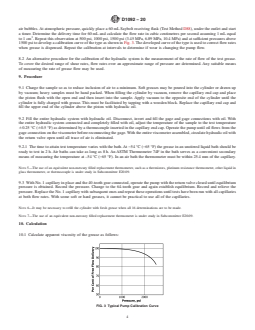
1500 psi to develop a calibration curve of the type as shown in Fig. 3. The developed curve of the type is used to correct flow rates
when grease is dispensed. Repeat the calibration at intervals to determine if wear is changing the pump flow.
8.2 An alternative procedure for the calibration of the hydraulic system is the measurement of the rate of flow of the test grease.
To cover the desired range of shear rates, flow rates over an approximate range of pressure are determined. Any suitable means
of measuring the rate of grease flow may be used.
9. Procedure
9.1 Charge the sample so as to reduce inclusion of air to a minimum. Soft greases may be poured into the cylinder or drawn up
by vacuum; heavy samples must be hand packed. When filling the cylinder by vacuum, remove the capillary end cap and place
the piston flush with the open end and then insert into the sample. Apply vacuum to the opposite end of the cylinder until the
cylinder is fully charged with grease. This must be facilitated by tapping with a wooden block. Replace the capillary end cap and
fill the upper end of the cylinder above the piston with hydraulic oil.
9.2 Fill the entire hydraulic system with hydraulic oil. Disconnect, invert and fill the gage and gage connections with oil. With
the entire hydraulic system connected and completely filled with oil, adjust the temperature of the sample to the test temperature
60.25 °C (60.5 °F) as determined by a thermocouple inserted in the capillary end cap. Operate the pump until oil flows from the
gage connection on the viscometer before reconnecting the gage. With the entire viscometer assembled, circulate hydraulic oil with
the return valve open until all trace of air is eliminated.
9.2.1 The time to attain test temperature varies with the bath. At −54 °C (−65 °F) the grease in an unstirred liquid bath should be
ready to test in 2 h. Air baths can take as long as 8 h. An ASTM Thermometer 74F in the bath serves as a convenient secondary
means of measuring the temperature at –54 °C (−65 °F). In an air bath the thermometer must be within 25.4 mm of the capillary.
NOTE 5—The use of an equivalent non-mercury filled replacement thermometer, such as a thermistors, platinum resistance thermometer, other liquid in
glass thermometer, or thermocouple is under study in Subcommittee E20.09.
9.3 With No. 1 capillary in place and the 40-tooth gear connected, operate the pump with the return valve closed until equilibrium
pressure is obtained. Record the pressure. Change to the 64-tooth gear and again establish equilibrium. Record and relieve the
pressure. Replace the No. 1 capillary with subsequent ones and repeat these operations until tests have been run with all capillaries
at both flow rates. With some soft or hard greases, it cannot be practical to use all of the capillaries.
NOTE 6—It may be necessary to refill the cylinder with fresh grease when all 16 determinations are to be made.
NOTE 7—The use of an equivalent non-mercury filled replacement thermometer is under study in Subcommittee E20.09.
10. Calculation
10.1 Calculate apparent viscosity of the grease as follows:
FIG. 3 Typical Pump Calibration Curve
D1092 − 20
η apparent viscosity 5 F/S (1)
~ !
where F is the shear stress, and S is the shear rate. Therefore:
pπR /2πRL
4 4
η5 F/S 5 5 pπR / 8Lv/t 5 P68944πR / 8Lv/t (2)
~ ! ~ !
4v/t /πR
~ !
where:
p = pressure dynes/cm ,
L = capillary length, cm,
P = observed gage pressure, psi (multiply by 68944 to convert to dynes per square centimetre),
R = radius of capillary used, cm, and
v/t = flow rate, cm /s.
10.2 Calculations may be reduced to a minimum by preparing a table of 16 constants, one for each capillary and shear rate (Table
1). For example, viscosity with No. 1 capillary and the 40-tooth gear is given as follows:
η5 P observed 68944πR / 8Lv/t or PK (3)
~ ! ~ !
~ !
where:
K 5 68944 π R / 8Lv/t (4)
~ !
~ !
10.3 Also calculate the shear rates as follows:
S 5 4v/t /πR (5)
~ !
Correct the flow rate to correspond to the observed pressure by reference to Fig. 3. Calculate 16 shear rates for the eight cap-
illaries and two flow rates. This calculation need not be repeated for each run since it will remain constant until recalibration
of the pump indicates a revision.
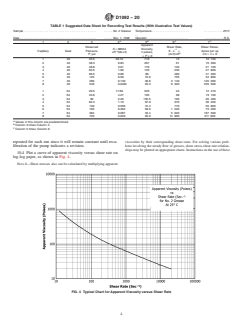
10.4 Plot a curve of apparent viscosity versus shear rate on log-log paper, as shown in Fig. 4.
NOTE 8—Shear stresses also can be calculated by multiplying apparent viscosities by their corresponding shear rates. For solving various problems
TABLE 1 Suggested Data Sheet for Recording Test Results (With Illustrative Test Values)
Sample . . . . . . . . . . . . . . . . . . . . . . . . . . . . . . . . . . . . . . . . . . . . . . No. 2 Grease Temperature . . . . . . . . . . . . . . . . . . . . . . . . . . . . . . . 25°C
. .
Date . . . . . . . . . . . . . . . . . . . . . . . . . . . . . . . . . . . . . . . . . . . . . . . . Nov. 1, 1948 Operator . . . . . . . . . . . . . . . . . . . . . . . . . . . . . . . . . R.S.
A B A C
1 2 3 4 5 6 7
Apparent
Observed Shear Rate, Shear Stress,
K = 68944 Viscosity,
−1
Capillary Gear Pressure, S , s = dynes per sq
πR /(8Lv/t) n poises,
P, psi (4v/t)/πR cm = n × S
= P × K
1 40 25.5 28.10 716 15 10 740
2 40 38.3 6.83 267 61 16 300
3 40 48.8 3.61 176 120 21 100
4 40 63.5 1.90 120 230 27 800
5 40 96.5 0.89 86 480 41 300
6 40 125 0.58 72.6 755 54 800
...