


ASTM D7816-12(2016)
(Test Method)Standard Test Method for Enumeration of Halophilic and Proteolytic Bacteria in Raceway Brine, Brine-Cured Hides and Skins
Standard Test Method for Enumeration of Halophilic and Proteolytic Bacteria in Raceway Brine, Brine-Cured Hides and Skins
SIGNIFICANCE AND USE
4.1 This test method enumerates salt tolerant (halophilic) bacteria, and proteolytic bacteria that are also salt tolerant. Under the conditions of this test method those bacteria are equated as halophilic organisms. Salt tolerant proteolytic bacteria have been known to cause damage to hides and skins in raceway brine.
SCOPE
1.1 This test method covers the enumeration of bacteria that can tolerate high salt concentrations or can hydrolyze protein/collagen, or both. This test method is applicable to raceway brine, brine-cured hides and skins, and pre-charge raceway liquor.
1.2 The values stated in SI units are to be regarded as standard. No other units of measurement are included in this standard.
1.3 This standard does not purport to address all of the safety concerns, if any, associated with its use. It is the responsibility of the user of this standard to establish appropriate safety and health practices and determine the applicability of regulatory limitations prior to use.
General Information
Buy Standard
Standards Content (Sample)
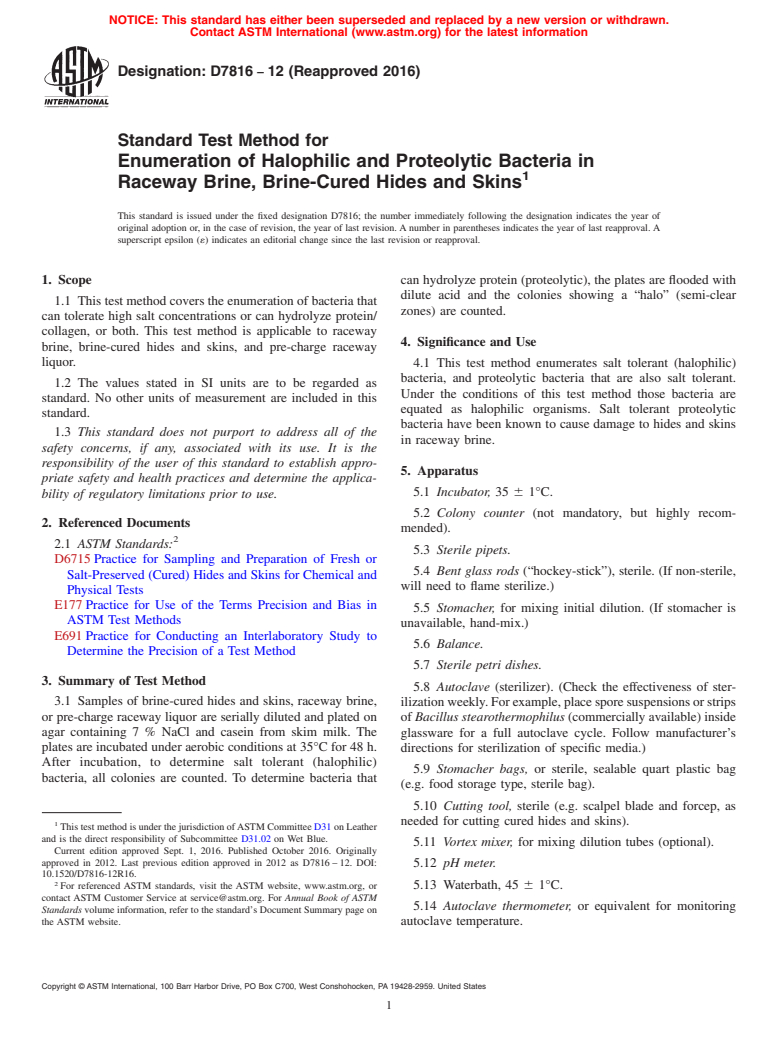
NOTICE: This standard has either been superseded and replaced by a new version or withdrawn.
Contact ASTM International (www.astm.org) for the latest information
Designation: D7816 − 12 (Reapproved 2016)
Standard Test Method for
Enumeration of Halophilic and Proteolytic Bacteria in
Raceway Brine, Brine-Cured Hides and Skins
This standard is issued under the fixed designation D7816; the number immediately following the designation indicates the year of
original adoption or, in the case of revision, the year of last revision.Anumber in parentheses indicates the year of last reapproval.A
superscript epsilon (´) indicates an editorial change since the last revision or reapproval.
1. Scope can hydrolyze protein (proteolytic), the plates are flooded with
dilute acid and the colonies showing a “halo” (semi-clear
1.1 Thistestmethodcoverstheenumerationofbacteriathat
zones) are counted.
can tolerate high salt concentrations or can hydrolyze protein/
collagen, or both. This test method is applicable to raceway
4. Significance and Use
brine, brine-cured hides and skins, and pre-charge raceway
liquor.
4.1 This test method enumerates salt tolerant (halophilic)
bacteria, and proteolytic bacteria that are also salt tolerant.
1.2 The values stated in SI units are to be regarded as
Under the conditions of this test method those bacteria are
standard. No other units of measurement are included in this
equated as halophilic organisms. Salt tolerant proteolytic
standard.
bacteria have been known to cause damage to hides and skins
1.3 This standard does not purport to address all of the
in raceway brine.
safety concerns, if any, associated with its use. It is the
responsibility of the user of this standard to establish appro-
5. Apparatus
priate safety and health practices and determine the applica-
5.1 Incubator, 35 6 1°C.
bility of regulatory limitations prior to use.
5.2 Colony counter (not mandatory, but highly recom-
2. Referenced Documents
mended).
2.1 ASTM Standards:
5.3 Sterile pipets.
D6715Practice for Sampling and Preparation of Fresh or
5.4 Bent glass rods (“hockey-stick”), sterile. (If non-sterile,
Salt-Preserved (Cured) Hides and Skins for Chemical and
will need to flame sterilize.)
Physical Tests
E177Practice for Use of the Terms Precision and Bias in
5.5 Stomacher, for mixing initial dilution. (If stomacher is
ASTM Test Methods
unavailable, hand-mix.)
E691Practice for Conducting an Interlaboratory Study to
5.6 Balance.
Determine the Precision of a Test Method
5.7 Sterile petri dishes.
3. Summary of Test Method
5.8 Autoclave (sterilizer). (Check the effectiveness of ster-
3.1 Samples of brine-cured hides and skins, raceway brine,
ilizationweekly.Forexample,placesporesuspensionsorstrips
or pre-charge raceway liquor are serially diluted and plated on of Bacillus stearothermophilus(commerciallyavailable)inside
agar containing 7 % NaCl and casein from skim milk. The glassware for a full autoclave cycle. Follow manufacturer’s
plates are incubated under aerobic conditions at 35°C for 48 h. directions for sterilization of specific media.)
After incubation, to determine salt tolerant (halophilic)
5.9 Stomacher bags, or sterile, sealable quart plastic bag
bacteria, all colonies are counted. To determine bacteria that
(e.g. food storage type, sterile bag).
5.10 Cutting tool, sterile (e.g. scalpel blade and forcep, as
needed for cutting cured hides and skins).
ThistestmethodisunderthejurisdictionofASTMCommitteeD31onLeather
and is the direct responsibility of Subcommittee D31.02 on Wet Blue.
5.11 Vortex mixer, for mixing dilution tubes (optional).
Current edition approved Sept. 1, 2016. Published October 2016. Originally
approved in 2012. Last previous edition approved in 2012 as D7816–12. DOI:
5.12 pH meter.
10.1520/D7816-12R16.
For referenced ASTM standards, visit the ASTM website, www.astm.org, or 5.13 Waterbath, 45 6 1°C.
contact ASTM Customer Service at service@astm.org. For Annual Book of ASTM
5.14 Autoclave thermometer, or equivalent for monitoring
Standards volume information, refer to the standard’s Document Summary page on
the ASTM website. autoclave temperature.
Copyright © ASTM International, 100 Barr Harbor Drive, PO Box C700, West Conshohocken, PA 19428-2959. United States
D7816 − 12 (2016)
NOTE 3—Do not allow agar to solidify prior to pouring (9.5).
6. Reagents and Materials
9.5 Pour the sterile agar into petri dishes. Replace the cover
6.1 5 % acetic acid.
and swirl to evenly distribute the agar. Allow to solidify at
6.2 1N – 6N NaOH.
roomtemperatureonaflatsurface.Whensolid,invertthepetri
6.3 Standard plate count agar containing 100 mL of 10 %
dishes, with the cover on the bottom, leaving a slight opening
powdered skim milk solution and 77 g of salt per litre of agar.
to allow the plates to dry for ⁄2 h.
6.4 Ready-To-Use Plate, (optional) : Plate CountAgar + 10
10. Procedure
% skim milk + 7.7 % NaCl.
10.1 Using a sterile scalpel, aseptically weigh a 20 6 0.1g
6.5 Butterfield’s Phosphate Stock Solution—Dissolve 34 g
specimen in a sterile bag. For brine-cured hides and skins,
KH PO (Potassium Phosphate monobasic) in 500 mL DI
2 4
include both flesh and hair side.
water.Adjust the pH to 7.2 6 0.1 with 1N – 6N NaOH. Bring
10.2 Add 180 g of BPD w/salt (6.6) diluent into the same
volume to 1 L with DI water. Sterilize for 15 min at 121°C.
sterile bag (10.1). Stomach or hand-massage for 1 min. This
NOTE 1—Typical autoclave setting is 120–124°C at 15 psi. (See 5.8.)
provides a 1:10 dilution.
6.6 Butterfield’s Phosphate Diluent with salt (BPD w/salt)—
Take 1.25 mL of Butterfield’s Phosphate Stock solution (6.5)
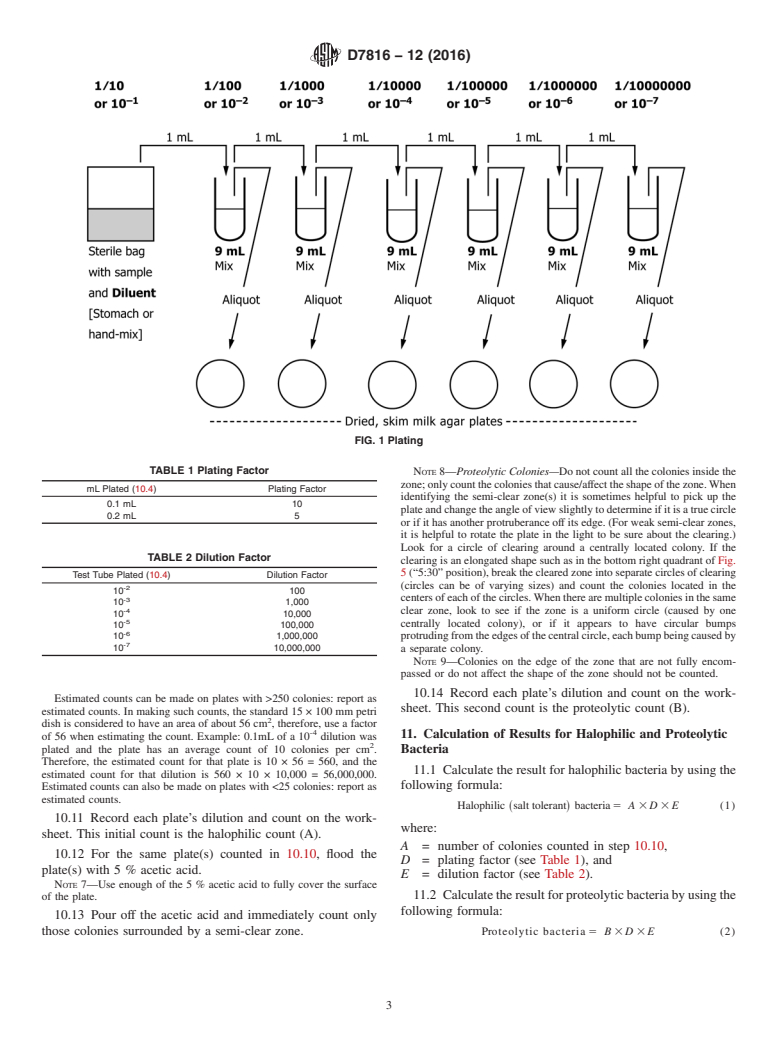
10.3 Prepare the following sample dilutions using 9-mL
-2 -3 -4 -5 -6 -7
andbringto1LwithDIwater,thenadd77gofsalt(NaCl)per
dilutiontubes(BPDw/salt):10 ,10 ,10 ,10 ,10 ,and10
litre prior to autoclaving. Dispense into 1 L bottles and 9 mL
(see Fig. 1).
dilution tubes. Sterilize for 15 min at 121°C. (See Note 1.)
10.3.1 Control Blank—In 10.9, incubate one of the petri
dishes prepared in 9.5 as-is, with the sample plates.
6.7 Alcohol (for flame sterilizing), e.g. 70 % Isopropyl
-2 -1
Example:Toobtaina10 dilution,mixthe10 dilutionand
alcohol.
-1
pipet 1 mL of that 10 dilution into a 9-mL dilution tube.
6.8 Powdered skim milk.
NOTE 4—When transferring the aliquots between the tubes, the analyst
must use a different pipet or pipet tip for each transfer.
6.9 Distilled or deionized water.
10.4 Pipetanappropriateportion(0.1mLor0.2mL),ofthe
6.10 Salt (NaCl), Sodium chloride – reagent grade.
-2
10 dilutionandplacetheliquidinthemiddleofadried,skim
6.11 Bacillus stearothermophilus spore suspensions or
milk agar plate. (If you expect a high bacteria load use 0.1 mL
strips (commercially available), or equivalent.
aliquot, otherwise use 0.2 mLaliquot. If approximate range of
bacteria load is unknown then use both 0.1 and 0.2 aliquots.
7. Hazards
Refer to Table 1 for Plating Factor.)
7.1 Allreagentsandchemicalsshouldbehandledwithcare.
10.5 Flame sterilize a bent glass rod, or obtain a sterile,
Before using any chemical, read and follow all safety precau-
autoclaved bent glass rod.
tions and instructions on the manufacturer’s label or MSDS
10.6 Using the glass rod, spread the liquid evenly on the
(Material Safety Data Sheet).
agar surface.
8. Sampling
10.7 Replace the cover and allow the plate to dry at room
8.1 The specimen shall be sampled in accordance with
temperature.
Practice D6715, and placed in sterile containers.
10.8 Repeat steps 10.4 – 10.7 for each dilution.
9. Preparation of Standard Plate Count Agar 10.9 Invert all plates and incubate at 35 6 1°C for 48 6 3
NOTE 2—Omit steps 9.1 – 9.5 if using Reagent 6.4. h.
9.1 Prepare the standard plate count agar per manufacturer
10.10 Following incubation, count only those plates that
label directions.
have 25–250 colonies.
NOTE5—Ifaplateshows confluent growth(i.e.bacterialgrowthcovers
9.2 Add 77 g of salt per litre of agar and autoclave for 15
the entire plate, making it impossible to determine the existence of
min at 121°C.
discretecolonies),recordthatplate’scountasTNTC–“TooNumerousTo
Count”). See Fig. 2 and Fig. 3 for diagrams of a countable plate and a
9.3 Prepare a 10 % powdered skim milk mixture by adding
TNTC plate, respectively.
10gpowderedskimmilkto100mLDIwater,thenstirringthe
NOTE 6—Halophilic Colonies—Count all the distinct colonies on the
mixture to dissolve it. Autoclave the mixture for 15 min at
plate. If there are similar-appearing colonies growing in close proximity
121°C.
but not touching, count them as individual colonies, provided the distance
between them is at least equal to the diameter of the smallest colony.
9.4 Cooltheagar(9.2)to45 61°C,thenadd100mLofthe
Colonies that are impinging, and that differ in appearance, such as
sterile10%powderedskimmilkmixture(9.3)perlitreofagar.
morphologyorcolor,arecountedasindividualcolonies.Coloniesthatare
Rotate bottle gently to mix.
a cluster, and are similar in appearance, such as morphology or color, are
counted as one colony (see arrow Fig. 4 – “7:00” position). There may
also be “spreaders”: a chain of colonies not distinctly separated. Count as
onecolonyifachainofcoloniesappearstobecausedbydisintegrationof
The sole source of supply of the reagent known to the committee at this time
a bacterial clump as agar and sample were mixed. Count as one colony if
is Edge Biologicals, Inc., Memphis, TN, Cat.# 4P-468. If you are aware of
a spreader developed as a film of growth between the agar and bottom of
alternative suppliers, please provide this information to ASTM International
...
This document is not an ASTM standard and is intended only to provide the user of an ASTM standard an indication of what changes have been made to the previous version. Because
it may not be technically possible to adequately depict all changes accurately, ASTM recommends that users consult prior editions as appropriate. In all cases only the current version
of the standard as published by ASTM is to be considered the official document.
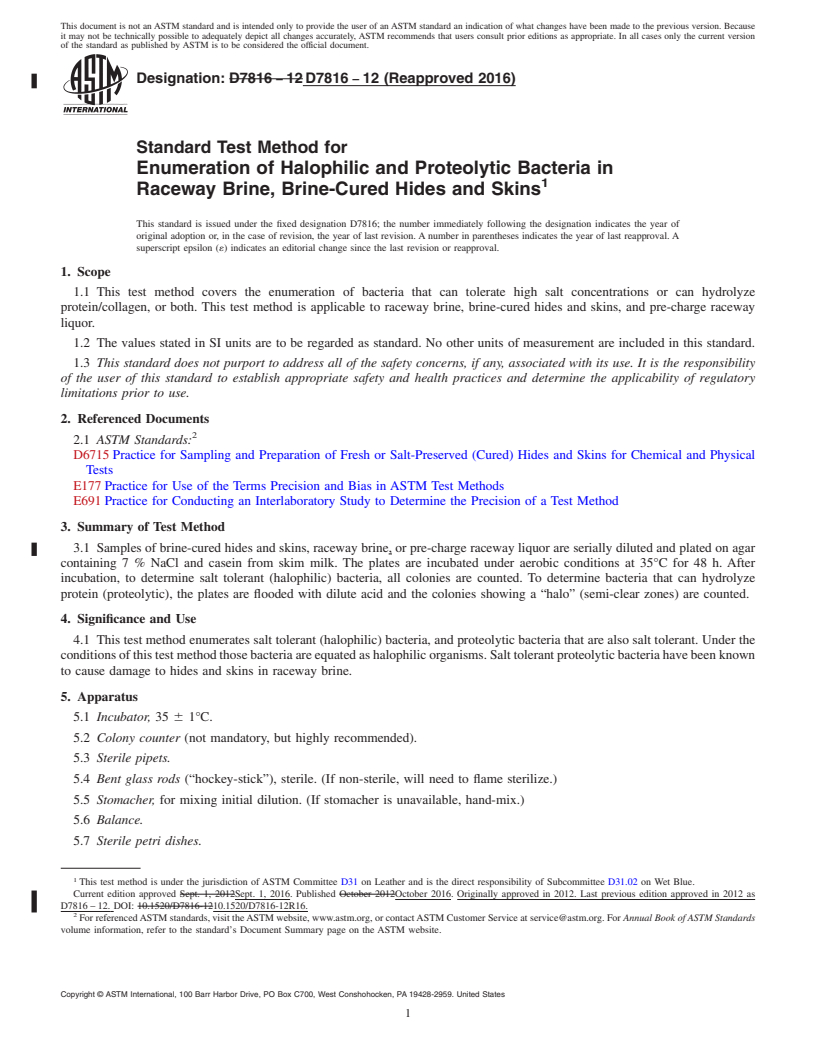
Designation: D7816 − 12 D7816 − 12 (Reapproved 2016)
Standard Test Method for
Enumeration of Halophilic and Proteolytic Bacteria in
Raceway Brine, Brine-Cured Hides and Skins
This standard is issued under the fixed designation D7816; the number immediately following the designation indicates the year of
original adoption or, in the case of revision, the year of last revision. A number in parentheses indicates the year of last reapproval. A
superscript epsilon (´) indicates an editorial change since the last revision or reapproval.
1. Scope
1.1 This test method covers the enumeration of bacteria that can tolerate high salt concentrations or can hydrolyze
protein/collagen, or both. This test method is applicable to raceway brine, brine-cured hides and skins, and pre-charge raceway
liquor.
1.2 The values stated in SI units are to be regarded as standard. No other units of measurement are included in this standard.
1.3 This standard does not purport to address all of the safety concerns, if any, associated with its use. It is the responsibility
of the user of this standard to establish appropriate safety and health practices and determine the applicability of regulatory
limitations prior to use.
2. Referenced Documents
2.1 ASTM Standards:
D6715 Practice for Sampling and Preparation of Fresh or Salt-Preserved (Cured) Hides and Skins for Chemical and Physical
Tests
E177 Practice for Use of the Terms Precision and Bias in ASTM Test Methods
E691 Practice for Conducting an Interlaboratory Study to Determine the Precision of a Test Method
3. Summary of Test Method
3.1 Samples of brine-cured hides and skins, raceway brine, or pre-charge raceway liquor are serially diluted and plated on agar
containing 7 % NaCl and casein from skim milk. The plates are incubated under aerobic conditions at 35°C for 48 h. After
incubation, to determine salt tolerant (halophilic) bacteria, all colonies are counted. To determine bacteria that can hydrolyze
protein (proteolytic), the plates are flooded with dilute acid and the colonies showing a “halo” (semi-clear zones) are counted.
4. Significance and Use
4.1 This test method enumerates salt tolerant (halophilic) bacteria, and proteolytic bacteria that are also salt tolerant. Under the
conditions of this test method those bacteria are equated as halophilic organisms. Salt tolerant proteolytic bacteria have been known
to cause damage to hides and skins in raceway brine.
5. Apparatus
5.1 Incubator, 35 6 1°C.
5.2 Colony counter (not mandatory, but highly recommended).
5.3 Sterile pipets.
5.4 Bent glass rods (“hockey-stick”), sterile. (If non-sterile, will need to flame sterilize.)
5.5 Stomacher, for mixing initial dilution. (If stomacher is unavailable, hand-mix.)
5.6 Balance.
5.7 Sterile petri dishes.
This test method is under the jurisdiction of ASTM Committee D31 on Leather and is the direct responsibility of Subcommittee D31.02 on Wet Blue.
Current edition approved Sept. 1, 2012Sept. 1, 2016. Published October 2012October 2016. Originally approved in 2012. Last previous edition approved in 2012 as
D7816 – 12. DOI: 10.1520/D7816-1210.1520/D7816-12R16.
For referenced ASTM standards, visit the ASTM website, www.astm.org, or contact ASTM Customer Service at service@astm.org. For Annual Book of ASTM Standards
volume information, refer to the standard’s Document Summary page on the ASTM website.
Copyright © ASTM International, 100 Barr Harbor Drive, PO Box C700, West Conshohocken, PA 19428-2959. United States
D7816 − 12 (2016)
5.8 Autoclave (sterilizer). (Check the effectiveness of sterilization weekly. For example, place spore suspensions or strips of
Bacillus stearothermophilus (commercially available) inside glassware for a full autoclave cycle. Follow manufacturer’s directions
for sterilization of specific media.)
5.9 Stomacher bags, or sterile, sealable quart plastic bag (e.g. food storage type, sterile bag).
5.10 Cutting tool, sterile (e.g. scalpel blade and forcep, as needed for cutting cured hides and skins).
5.11 Vortex mixer, for mixing dilution tubes (optional).
5.12 pH meter.
5.13 Waterbath, 45 6 1°C.
5.14 Autoclave thermometer, or equivalent for monitoring autoclave temperature.
6. Reagents and Materials
6.1 5 % acetic acid.
6.2 1N – 6N NaOH.
6.3 Standard plate count agar containing 100 mL of 10 % powdered skim milk solution and 77 g of salt per litre of agar.
6.4 Ready-To-Use Plate, (optional) : Plate Count Agar + 10 % skim milk + 7.7 % NaCl.
6.5 Butterfield’s Phosphate Stock Solution—Dissolve 34 g KH PO (Potassium Phosphate monobasic) in 500 mL DI water.
2 4
Adjust the pH to 7.2 6 0.1 with 1N – 6N NaOH. Bring volume to 1 L with DI water. Sterilize for 15 min at 121°C.
NOTE 1—Typical autoclave setting is 120–124°C at 15 psi. (See 5.8.)
6.6 Butterfield’s Phosphate Diluent with salt (BPD w/salt)—Take 1.25 mL of Butterfield’s Phosphate Stock solution (6.5) and
bring to 1 L with DI water, then add 77 g of salt (NaCl) per litre prior to autoclaving. Dispense into 1 L bottles and 9 mL dilution
tubes. Sterilize for 15 min at 121°C. (See Note 1.)
6.7 Alcohol (for flame sterilizing), e.g. 70 % Isopropyl alcohol.
6.8 Powdered skim milk.
6.9 Distilled or deionized water.
6.10 Salt (NaCl), Sodium chloride – reagent grade.
6.11 Bacillus stearothermophilus spore suspensions or strips (commercially available), or equivalent.
7. Hazards
7.1 All reagents and chemicals should be handled with care. Before using any chemical, read and follow all safety precautions
and instructions on the manufacturer’s label or MSDS (Material Safety Data Sheet).
8. Sampling
8.1 The specimen shall be sampled in accordance with Practice D6715, and placed in sterile containers.
9. Preparation of Standard Plate Count Agar
NOTE 2—Omit steps 9.1 – 9.5 if using Reagent 6.4.
9.1 Prepare the standard plate count agar per manufacturer label directions.
9.2 Add 77 g of salt per litre of agar and autoclave for 15 min at 121°C.
9.3 Prepare a 10 % powdered skim milk mixture by adding 10 g powdered skim milk to 100 mL DI water, then stirring the
mixture to dissolve it. Autoclave the mixture for 15 min at 121°C.
9.4 Cool the agar (9.2) to 45 6 1°C, then add 100 mL of the sterile 10 % powdered skim milk mixture (9.3) per litre of agar.
Rotate bottle gently to mix.
NOTE 3—Do not allow agar to solidify prior to pouring (9.5).
9.5 Pour the sterile agar into petri dishes. Replace the cover and swirl to evenly distribute the agar. Allow to solidify at room
temperature on a flat surface. When solid, invert the petri dishes, with the cover on the bottom, leaving a slight opening to allow
the plates to dry for ⁄2 h.
The sole source of supply of the reagent known to the committee at this time is Edge Biologicals, Inc., Memphis, TN, Cat.# 4P-468. If you are aware of alternative
suppliers, please provide this information to ASTM International Headquarters. Your comments will receive careful consideration at a meeting of the responsible technical
committee, which you may attend.
D7816 − 12 (2016)
10. Procedure
10.1 Using a sterile scalpel, aseptically weigh a 20 6 0.1g specimen in a sterile bag. For brine-cured hides and skins, include
both flesh and hair side.
10.2 Add 180 g of BPD w/salt (6.6) diluent into the same sterile bag (10.1). Stomach or hand-massage for 1 min. This provides
a 1:10 dilution.
-2 -3 -4 -5 -6 -7
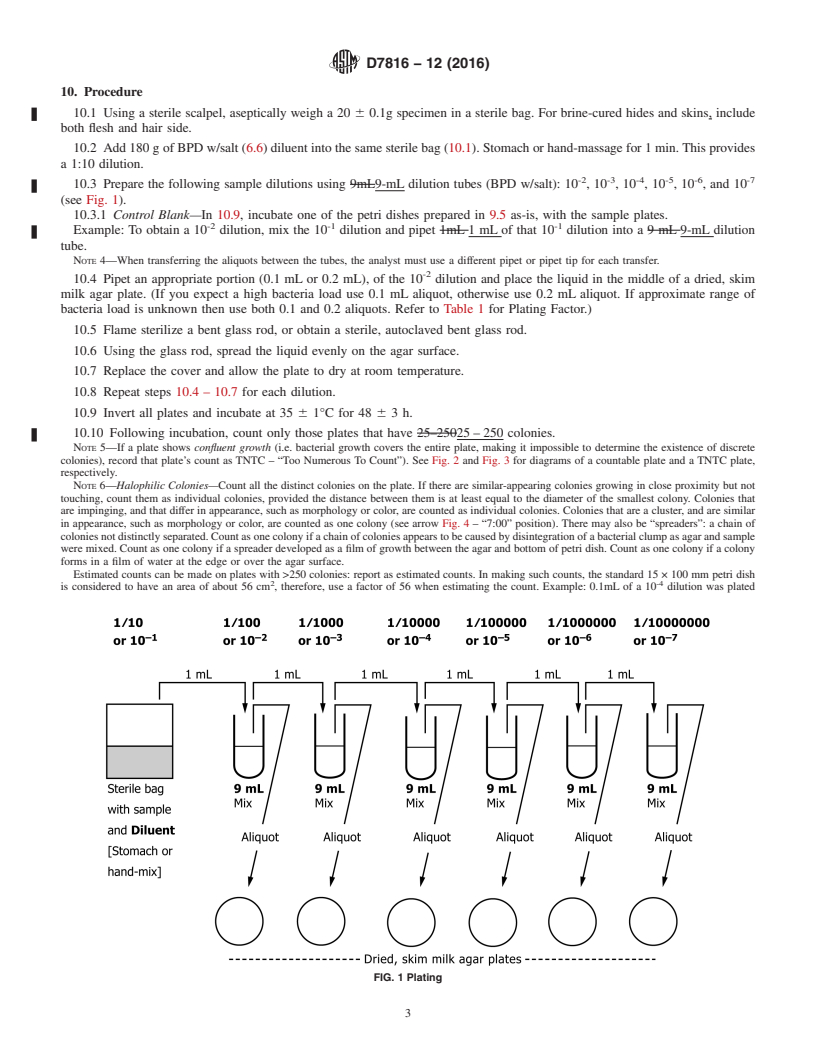
10.3 Prepare the following sample dilutions using 9mL9-mL dilution tubes (BPD w/salt): 10 , 10 , 10 , 10 , 10 , and 10
(see Fig. 1).
10.3.1 Control Blank—In 10.9, incubate one of the petri dishes prepared in 9.5 as-is, with the sample plates.
-2 -1 -1
Example: To obtain a 10 dilution, mix the 10 dilution and pipet 1mL 1 mL of that 10 dilution into a 9 mL 9-mL dilution
tube.
NOTE 4—When transferring the aliquots between the tubes, the analyst must use a different pipet or pipet tip for each transfer.
-2
10.4 Pipet an appropriate portion (0.1 mL or 0.2 mL), of the 10 dilution and place the liquid in the middle of a dried, skim
milk agar plate. (If you expect a high bacteria load use 0.1 mL aliquot, otherwise use 0.2 mL aliquot. If approximate range of
bacteria load is unknown then use both 0.1 and 0.2 aliquots. Refer to Table 1 for Plating Factor.)
10.5 Flame sterilize a bent glass rod, or obtain a sterile, autoclaved bent glass rod.
10.6 Using the glass rod, spread the liquid evenly on the agar surface.
10.7 Replace the cover and allow the plate to dry at room temperature.
10.8 Repeat steps 10.4 – 10.7 for each dilution.
10.9 Invert all plates and incubate at 35 6 1°C for 48 6 3 h.
10.10 Following incubation, count only those plates that have 25–25025 – 250 colonies.
NOTE 5—If a plate shows confluent growth (i.e. bacterial growth covers the entire plate, making it impossible to determine the existence of discrete
colonies), record that plate’s count as TNTC – “Too Numerous To Count”). See Fig. 2 and Fig. 3 for diagrams of a countable plate and a TNTC plate,
respectively.
NOTE 6—Halophilic Colonies—Count all the distinct colonies on the plate. If there are similar-appearing colonies growing in close proximity but not
touching, count them as individual colonies, provided the distance between them is at least equal to the diameter of the smallest colony. Colonies that
are impinging, and that differ in appearance, such as morphology or color, are counted as individual colonies. Colonies that are a cluster, and are similar
in appearance, such as morphology or color,
...
Questions, Comments and Discussion
Ask us and Technical Secretary will try to provide an answer. You can facilitate discussion about the standard in here.