

ASTM F3004-13(2020)
(Test Method)Standard Test Method for Evaluation of Seal Quality and Integrity Using Airborne Ultrasound
General Information
- Abstract
SIGNIFICANCE AND USE
5.1 This method allows for the evaluation of seal quality by passing an ultrasound signal through the sealed area of a package or item. Poorly sealed areas will not transmit as much ultrasonic energy as properly sealed areas.
5.2 This method relies on quantitative analysis of ultrasound signal strength, providing a non-subjective approach to assessing package seal quality and detecting defects.
5.3 This technique has been used for inspecting a variety of materials including flexible pouch seals, rigid tray seals and other packaging components such as affixed valves. The precision and bias for any specific package and seal configuration needs to be individually determined and validated.
5.4 The C-Scan approach is useful for laboratory applications or off-line seal inspection. The L-Scan approach can be used for on-line, real time inspection of seal quality. The sensitivity of either approach to detect a given defect size and level of severity needs to be individually determined.
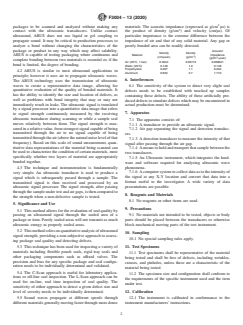
5.5 Sound waves propagate at different speeds through different materials generally moving faster through more dense materials. The acoustic impedance (expressed as g/cm2·μs) is the product of density (g/cm3) and velocity (cm/μs). Of particular importance is the extreme difference between the impedance of air and that of any solid material. Any gap or poorly bonded area can be readily detected.
Material
Velocity
(cm/μsec)
Density
(g/cm3)
Acoustic
Impedance
(g/cm2-μsec)
Air (20°C, 1 bar)
0.0344
0.00119
0.000041
Water (20°C)
0.148
1.0
0.148
Polyethylene
0.267
1.1
0.294
Aluminum
0.632
2.7
1.710
SCOPE
1.1 This standard method describes the technology and testing procedures that can be used to detect seal defects in the size range of 1 mm and characterize seal quality in a variety of packaging styles using airborne ultrasound technology.
1.2 This test method does not purport to be the only method for measurement of seal quality.
1.3 Heat seals and other package components can be tested in flexible, semi-rigid and rigid packages. Only the precision and bias for flexible package seals were evaluated in a recent ILS included in the method. The precision and bias for any specific package needs to be individually determined.
1.4 On-line, real time inspection of seals can be considered particularly in the L-Scan mode.
1.5 This method provides a non-destructive, quantitative, non-subjective approach to flexible package seal inspection.
1.6 The values stated in SI units are to be regarded as standard. No other units of measurement are included in this standard.
1.7 This standard does not purport to address all of the safety concerns, if any, associated with its use. It is the responsibility of the user of this standard to establish appropriate safety, health, and environmental practices and determine the applicability of regulatory limitations prior to use.
1.8 This international standard was developed in accordance with internationally recognized principles on standardization established in the Decision on Principles for the Development of International Standards, Guides and Recommendations issued by the World Trade Organization Technical Barriers to Trade (TBT) Committee.
- Status
- Published
- Publication Date
- 14-Nov-2020
- Technical Committee
- F02 - Primary Barrier Packaging
- Drafting Committee
- F02.40 - Package Integrity
Overview
ASTM F3004-13(2020), Standard Test Method for Evaluation of Seal Quality and Integrity Using Airborne Ultrasound, provides procedures for the non-destructive, quantitative assessment of seal quality in packaging using airborne ultrasound technology. This international standard enables precise detection of package seal defects as small as 1 mm, supporting quality assurance in flexible, semi-rigid, and rigid packaging across various industries. By utilizing airborne ultrasound, this method supports the detection of poorly bonded areas, ensuring compliance and supporting product safety during packaging processes.
Key Topics
- Airborne Ultrasound Testing: Employs non-contact ultrasound techniques to pass an ultrasonic signal through product seals, measuring the transmission strength to assess seal quality and integrity.
- Quantitative Analysis: Provides objective, non-subjective data by analyzing variations in ultrasonic signal strength, eliminating the variability typical of visual or manual inspection.
- C-Scan and L-Scan Approaches:
- C-Scan: Suitable for laboratory or offline inspection, offering detailed area mapping of seal integrity.
- L-Scan: Designed for real-time, on-line production inspection, enabling continuous monitoring of seal quality.
- Defect Detection: Sensitive to gaps, poor bonding, and other seal defects due to differences in acoustic impedance between air and packaging materials.
- Material Compatibility: Designed for diverse packaging styles and materials such as flexible pouches, rigid trays, and packages with affixed valves.
- Non-Destructive Evaluation: Does not alter or damage the sample, supporting ongoing inspection without product loss.
Applications
- Flexible and Rigid Packaging Inspection: Applicable to heat seals and other package components in flexible, semi-rigid, and rigid packaging formats, enabling verification of seal integrity for pharmaceuticals, food products, medical devices, and industrial goods.
- Process Control in Manufacturing: Supports on-line, real-time inspection to immediately identify seal defects and prevent faulty packages from reaching the market.
- Quality Assurance and Compliance: Facilitates data-driven quality assessments, supporting compliance with regulatory, safety, and performance standards for primary barrier packaging.
- Defect Characterization: Capable of detecting and characterizing defect types such as channel leaks, wrinkles, material inclusions, and incomplete sealing, which may compromise package sterility or containment.
- Research and Development: Useful in laboratory settings for evaluating new packaging designs and materials for seal integrity under various conditions.
- Non-Subjective Reporting: Generates numerical, graphical, and image-based data to support detailed reporting and traceable quality documentation.
Related Standards
- ASTM E177 - Practice for Use of the Terms Precision and Bias in ASTM Test Methods
(Referenced for establishing repeatability and reproducibility criteria) - ASTM E691 - Practice for Conducting an Interlaboratory Study to Determine the Precision of a Test Method
(Referenced for evaluating the method’s precision and statistical validity) - Other Packaging Integrity Standards:
- ASTM F88 - Standard Test Method for Seal Strength of Flexible Barrier Materials
- ASTM F1929 - Standard Test Method for Detecting Seal Leaks in Porous Medical Packaging
- International Principles: Developed in accordance with WTO TBT Committee guidelines for the development of international standards.
Keywords: ASTM F3004, airborne ultrasound, package seal inspection, packaging integrity, non-destructive testing, seal defect detection, C-scan, L-scan, quality assurance, flexible packaging, seal quality evaluation.
Relations
- Effective Date
- 01-May-2014
- Effective Date
- 01-May-2013
- Effective Date
- 01-May-2013
- Effective Date
- 01-Nov-2011
- Effective Date
- 01-Oct-2010
- Effective Date
- 01-Oct-2008
- Effective Date
- 01-Oct-2008
- Refers
ASTM E177-06b - Standard Practice for Use of the Terms Precision and Bias in ASTM Test Methods - Effective Date
- 15-Nov-2006
- Refers
ASTM E177-06a - Standard Practice for Use of the Terms Precision and Bias in ASTM Test Methods - Effective Date
- 01-Nov-2006
- Effective Date
- 01-Nov-2005
- Refers
ASTM E177-04e1 - Standard Practice for Use of the Terms Precision and Bias in ASTM Test Methods - Effective Date
- 01-Nov-2004
- Effective Date
- 01-Nov-2004
- Effective Date
- 01-Nov-2004
- Refers
ASTM E177-90a(2002) - Standard Practice for Use of the Terms Precision and Bias in ASTM Test Methods - Effective Date
- 10-Jan-2002
- Effective Date
- 10-May-1999
Get Certified
Connect with accredited certification bodies for this standard

BRCGS (Brand Reputation Compliance Global Standards)
Global food safety and quality standards owner.
Sponsored listings
Frequently Asked Questions
ASTM F3004-13(2020) is a standard published by ASTM International. Its full title is "Standard Test Method for Evaluation of Seal Quality and Integrity Using Airborne Ultrasound". This standard covers: SIGNIFICANCE AND USE 5.1 This method allows for the evaluation of seal quality by passing an ultrasound signal through the sealed area of a package or item. Poorly sealed areas will not transmit as much ultrasonic energy as properly sealed areas. 5.2 This method relies on quantitative analysis of ultrasound signal strength, providing a non-subjective approach to assessing package seal quality and detecting defects. 5.3 This technique has been used for inspecting a variety of materials including flexible pouch seals, rigid tray seals and other packaging components such as affixed valves. The precision and bias for any specific package and seal configuration needs to be individually determined and validated. 5.4 The C-Scan approach is useful for laboratory applications or off-line seal inspection. The L-Scan approach can be used for on-line, real time inspection of seal quality. The sensitivity of either approach to detect a given defect size and level of severity needs to be individually determined. 5.5 Sound waves propagate at different speeds through different materials generally moving faster through more dense materials. The acoustic impedance (expressed as g/cm2·μs) is the product of density (g/cm3) and velocity (cm/μs). Of particular importance is the extreme difference between the impedance of air and that of any solid material. Any gap or poorly bonded area can be readily detected. Material Velocity (cm/μsec) Density (g/cm3) Acoustic Impedance (g/cm2-μsec) Air (20°C, 1 bar) 0.0344 0.00119 0.000041 Water (20°C) 0.148 1.0 0.148 Polyethylene 0.267 1.1 0.294 Aluminum 0.632 2.7 1.710 SCOPE 1.1 This standard method describes the technology and testing procedures that can be used to detect seal defects in the size range of 1 mm and characterize seal quality in a variety of packaging styles using airborne ultrasound technology. 1.2 This test method does not purport to be the only method for measurement of seal quality. 1.3 Heat seals and other package components can be tested in flexible, semi-rigid and rigid packages. Only the precision and bias for flexible package seals were evaluated in a recent ILS included in the method. The precision and bias for any specific package needs to be individually determined. 1.4 On-line, real time inspection of seals can be considered particularly in the L-Scan mode. 1.5 This method provides a non-destructive, quantitative, non-subjective approach to flexible package seal inspection. 1.6 The values stated in SI units are to be regarded as standard. No other units of measurement are included in this standard. 1.7 This standard does not purport to address all of the safety concerns, if any, associated with its use. It is the responsibility of the user of this standard to establish appropriate safety, health, and environmental practices and determine the applicability of regulatory limitations prior to use. 1.8 This international standard was developed in accordance with internationally recognized principles on standardization established in the Decision on Principles for the Development of International Standards, Guides and Recommendations issued by the World Trade Organization Technical Barriers to Trade (TBT) Committee.
SIGNIFICANCE AND USE 5.1 This method allows for the evaluation of seal quality by passing an ultrasound signal through the sealed area of a package or item. Poorly sealed areas will not transmit as much ultrasonic energy as properly sealed areas. 5.2 This method relies on quantitative analysis of ultrasound signal strength, providing a non-subjective approach to assessing package seal quality and detecting defects. 5.3 This technique has been used for inspecting a variety of materials including flexible pouch seals, rigid tray seals and other packaging components such as affixed valves. The precision and bias for any specific package and seal configuration needs to be individually determined and validated. 5.4 The C-Scan approach is useful for laboratory applications or off-line seal inspection. The L-Scan approach can be used for on-line, real time inspection of seal quality. The sensitivity of either approach to detect a given defect size and level of severity needs to be individually determined. 5.5 Sound waves propagate at different speeds through different materials generally moving faster through more dense materials. The acoustic impedance (expressed as g/cm2·μs) is the product of density (g/cm3) and velocity (cm/μs). Of particular importance is the extreme difference between the impedance of air and that of any solid material. Any gap or poorly bonded area can be readily detected. Material Velocity (cm/μsec) Density (g/cm3) Acoustic Impedance (g/cm2-μsec) Air (20°C, 1 bar) 0.0344 0.00119 0.000041 Water (20°C) 0.148 1.0 0.148 Polyethylene 0.267 1.1 0.294 Aluminum 0.632 2.7 1.710 SCOPE 1.1 This standard method describes the technology and testing procedures that can be used to detect seal defects in the size range of 1 mm and characterize seal quality in a variety of packaging styles using airborne ultrasound technology. 1.2 This test method does not purport to be the only method for measurement of seal quality. 1.3 Heat seals and other package components can be tested in flexible, semi-rigid and rigid packages. Only the precision and bias for flexible package seals were evaluated in a recent ILS included in the method. The precision and bias for any specific package needs to be individually determined. 1.4 On-line, real time inspection of seals can be considered particularly in the L-Scan mode. 1.5 This method provides a non-destructive, quantitative, non-subjective approach to flexible package seal inspection. 1.6 The values stated in SI units are to be regarded as standard. No other units of measurement are included in this standard. 1.7 This standard does not purport to address all of the safety concerns, if any, associated with its use. It is the responsibility of the user of this standard to establish appropriate safety, health, and environmental practices and determine the applicability of regulatory limitations prior to use. 1.8 This international standard was developed in accordance with internationally recognized principles on standardization established in the Decision on Principles for the Development of International Standards, Guides and Recommendations issued by the World Trade Organization Technical Barriers to Trade (TBT) Committee.
ASTM F3004-13(2020) is classified under the following ICS (International Classification for Standards) categories: 55.040 - Packaging materials and accessories. The ICS classification helps identify the subject area and facilitates finding related standards.
ASTM F3004-13(2020) has the following relationships with other standards: It is inter standard links to ASTM E177-14, ASTM E691-13, ASTM E177-13, ASTM E691-11, ASTM E177-10, ASTM E691-08, ASTM E177-08, ASTM E177-06b, ASTM E177-06a, ASTM E691-05, ASTM E177-04e1, ASTM E177-04, ASTM E177-06, ASTM E177-90a(2002), ASTM E691-99. Understanding these relationships helps ensure you are using the most current and applicable version of the standard.
ASTM F3004-13(2020) is available in PDF format for immediate download after purchase. The document can be added to your cart and obtained through the secure checkout process. Digital delivery ensures instant access to the complete standard document.
Standards Content (Sample)
This international standard was developed in accordance with internationally recognized principles on standardization established in the Decision on Principles for the
Development of International Standards, Guides and Recommendations issued by the World Trade Organization Technical Barriers to Trade (TBT) Committee.
Designation: F3004 − 13 (Reapproved 2020)
Standard Test Method for
Evaluation of Seal Quality and Integrity Using Airborne
Ultrasound
This standard is issued under the fixed designation F3004; the number immediately following the designation indicates the year of
original adoption or, in the case of revision, the year of last revision.Anumber in parentheses indicates the year of last reapproval.A
superscript epsilon (´) indicates an editorial change since the last revision or reapproval.
1. Scope 2. Referenced Documents
1.1 This standard method describes the technology and 2.1 ASTM Standards:
testing procedures that can be used to detect seal defects in the E177Practice for Use of the Terms Precision and Bias in
size range of 1 mm and characterize seal quality in a variety of ASTM Test Methods
packaging styles using airborne ultrasound technology. E691Practice for Conducting an Interlaboratory Study to
Determine the Precision of a Test Method
1.2 Thistestmethoddoesnotpurporttobetheonlymethod
for measurement of seal quality.
3. Terminology
1.3 Heat seals and other package components can be tested
3.1 Definitions:
in flexible, semi-rigid and rigid packages. Only the precision
3.1.1 acoustic impedance, n—the product of a material’s
and bias for flexible package seals were evaluated in a recent
density and its acoustic velocity.
ILS included in the method. The precision and bias for any
3.1.2 airborne ultrasound, n—non-contact, non-destructive
specific package needs to be individually determined.
ultrasound technology that allows materials to be scanned and
1.4 On-line, real time inspection of seals can be considered
analyzed without physical contact with the transducers. No
particularly in the L-Scan mode.
coupling is used other than air.
1.5 This method provides a non-destructive, quantitative,
3.1.3 ultrasonic attenuation, n—the decay rate of the wave
non-subjective approach to flexible package seal inspection.
as it propagates through a material. It is the combined effect of
scattering and absorption.
1.6 The values stated in SI units are to be regarded as
standard. No other units of measurement are included in this
3.1.4 ultrasound, n—sound with frequencies greater than
standard.
the upper limit of human hearing which is approximately 20
kHz. Typical industrial applications use much higher frequen-
1.7 This standard does not purport to address all of the
cies in the 1–100 MHz range.
safety concerns, if any, associated with its use. It is the
responsibility of the user of this standard to establish appro-
3.1.5 ultrasound C-Scan, n—multiple L-Scans which accu-
priate safety, health, and environmental practices and deter-
mulates data to describe an area of interest in both X and Y
mine the applicability of regulatory limitations prior to use.
dimensions.
1.8 This international standard was developed in accor-
3.1.6 ultrasound L-Scan, n—a single linear scan across one
dance with internationally recognized principles on standard-
direction over the area of interest.
ization established in the Decision on Principles for the
Development of International Standards, Guides and Recom- 4. Summary of Test Method
mendations issued by the World Trade Organization Technical
4.1 Ultrasound has been used for inspecting a wide variety
Barriers to Trade (TBT) Committee.
of materials as well as human health issues, based on sending
and receiving ultrasonic sound waves. Airborne Ultrasound
(ABUS) is a non-contact ultrasound technology that allows
ThistestmethodisunderthejurisdictionofASTMCommitteeF02onPrimary
Barrier Packaging and is the direct responsibility of Subcommittee F02.40 on
Package Integrity. For referenced ASTM standards, visit the ASTM website, www.astm.org, or
Current edition approved Nov. 15, 2020. Published December 2020. Originally contact ASTM Customer Service at service@astm.org. For Annual Book of ASTM
ɛ1
approved in 2013. Last previous edition approved in 2013 as F3004 – 13 . DOI: Standards volume information, refer to the standard’s Document Summary page on
10.1520/F3004-13R20. the ASTM website.
Copyright © ASTM International, 100 Barr Harbor Drive, PO Box C700, West Conshohocken, PA 19428-2959. United States
F3004 − 13 (2020)
packages to be scanned and analyzed without making any materials. The acoustic impedance (expressed as g/cm ·µs) is
contact with the ultrasonic transducers. Unlike contact the product of density (g/cm ) and velocity (cm/µs). Of
ultrasound, ABUS does not use liquid or gel coupling to particular importance is the extreme difference between the
propagate sound. It may be critical to production processes to impedance of air and that of any solid material. Any gap or
analyze a bond without changing the characteristics of the poorly bonded area can be readily detected.
package or product in any way which may affect salability.
Acoustic
Velocity Density
Material Impedance
ABUS is capable of testing packaging where continuous and
(cm/µsec) (g/cm )
(g/cm -µsec)
complete bonding between two materials is essential or, if the
Air (20°C, 1 bar) 0.0344 0.00119 0.000041
bond is limited, the degree of bonding.
Water (20°C) 0.148 1.0 0.148
Polyethylene 0.267 1.1 0.294
4.2 ABUS is similar to most ultrasound applications in
Aluminum 0.632 2.7 1.710
principle; however it uses air to propagate ultrasonic waves.
6. Interferences
The ABUS technology uses the transmission of ultrasonic
waves to create a representative data image, allowing for
6.1 The sensitivity of the system to detect very slight seal
quantitative evaluation of the quality of bonded materials. It
defects needs to be established with mocked up samples
has the ability to identify the size and location of defects, as
containing these defects. The ability of these artificially pro-
well as problems with bond integrity that may or may not
duceddefectstosimulatedefectswhichmaybeencounteredin
immediately result in leaks. The ultrasonic signal is translated
actual production must be determined.
by a signal processor into a quantitative data image that refers
7. Apparatus
to signal strength continuously measured by the receiving
ultrasonic transducer during scanning or while a sample seal
7.1 The apparatus consists of:
moves relatively between them. The signal strength is mea-
7.1.1 A transducer to provide an ultrasonic signal.
suredinarelativevalue,fromstrongestsignalcapableofbeing
7.1.2 Air gap separating the signal and detection transduc-
transmitted through the air to no signal capable of being
ers.
transmittedthroughtheair(abovethenaturalnoiselevelofthat
7.1.3 Adetection transducer to measure the intensity of that
frequency). Based on this scale of sound measurement, quan-
signal after passing through the air gap.
titative data representations of the material being scanned can
7.1.4 Ameanstoholdandtransportthatsamplebetweenthe
be used to characterize the condition of certain materials, most
two transducers.
specifically whether two layers of material are appropriately
7.1.5 An Ultrasonic instrument, which integrates the hard-
bonded together.
ware and software required for analyzing ultrasonic wave
phenomena.
4.3 The technique and instrumentation is fundamentally
7.1.6 Acomputersystemtocollectdataastotheintensityof
very simple. An ultrasonic transducer is used to produce a
the signal at any X-Y location and convert that data into a
signal which is subsequently passed through a sample. The
format useful to the investigator. A wide variety of data
transmitted signal is then received and processed by an
presentations are possible.
ultrasonic signal processor. The signal strength, after passing
throughthesampleundertestandairgaps,isthencomparedto
8. Reagents and Materials
the strength when a non-defective sample is tested.
8.1 No reagents or other items are used.
5. Significance and Use
9. Precautions
5.1 This method allows for the evaluation of seal quality by
passing an ultrasound signal through the sealed area of a 9.1 No materials not intended to be tested, objects or body
package or item. Poorly sealed areas will not transmit as much parts should be placed between the transducers or otherwise
ultrasonic energy as properly sealed areas. block mechanical moving parts of the test instrument.
5.2 Thismethodreliesonquantitativeanalysisofultrasound
10. Sampling
signal strength, providing a non-subjective approach to assess-
10.1 No special sampling rules apply.
ing package seal quality and detecting defects.
5.3 This technique has been used for inspecting a variety of 11. Test Specimens
materials including flexible pouch seals, rigid tray seals and
11.1 Test specimens shall be representative of the material
other packaging components such as affixed valves. The
being tested and shall be free of defects, including wrinkles,
precision and bias for any specific package and seal configu-
creases, and pinholes, unless these are a characteristic of the
ration needs to be individually determined and validated.
material being tested.
5.4 The C-Scan approach is useful for laboratory applica-
11.2 The specimen size and configuration shall conform to
tions or off-line seal inspection. The L-Scan approach can be
the requirements of the specific instrument used and the item
used for on-line, real time inspection of seal quality. The
under test.
sensitivity of either approach to detect a given defect size and
level of severity needs to be individually determined. 12. Calibration
5.5 Sound waves propagate at different speeds through 12.1 The instrument is calibrated in conformance to the
differentmaterialsgenerallymovingfasterthroughmoredense instrument manufacturers’ instructions.
F3004 − 13 (2020)
13. Conditioning 17. Precision and Bias
17.1 The precision of this test method is based on an
13.1 Typically, no sample conditioning is required.
interlaboratory study conducted in 2012 (see RR:F02-1033 ).
Four laboratories participated in the study, testing three differ-
14. Procedure
ent types of packaging, modified with six different intentional
14.1 Each specific instrument will be operated in accor-
defects (also one non-defective). SealScan 525 systems fitted
dance with the instrum
...