

ASTM D3402/D3402M-23
(Test Method)Standard Test Method for Tumbler Test for Coke
General Information
- Abstract
SIGNIFICANCE AND USE
4.1 Coke undergoes various degrees of degradation during removal from coke ovens, transportation, and its decent within a blast furnace to the combustion zone. These processes subject the coke to impact and abrasion. This test method is a relative measure of the resistance of coke to breakage when subjected to these degradation processes.
SCOPE
1.1 This test method describes a procedure for obtaining a relative measure of the resistance to degradation of coke by impact and abrasion.
1.2 Standard Procedure—This procedure uses a coke sample that is sized to 75 mm by 50 mm [ 3.0 in. by 2 in.].
1.3 Alternative Procedure—This procedure uses a composite coke sample that is comprised of coke sized 50 % of 63 mm by 50 mm [2.5 in. by 2 in.] and 50 % of 50 mm by 37.5 mm [2 in. by 1.50 in.].
1.4 The values stated in either SI units or inch-pound units are to be regarded separately as standard. The values stated in each system may not be exact equivalents; therefore, to ensure conformance with the standard, each system shall be used independently of the other, and values from the two systems shall not be combined.
1.5 This standard does not purport to address all of the safety concerns, if any, associated with its use. It is the responsibility of the user of this standard to establish appropriate safety, health, and environmental practices and determine the applicability of regulatory limitations prior to use.
1.6 This international standard was developed in accordance with internationally recognized principles on standardization established in the Decision on Principles for the Development of International Standards, Guides and Recommendations issued by the World Trade Organization Technical Barriers to Trade (TBT) Committee.
- Status
- Published
- Publication Date
- 31-Aug-2023
- Technical Committee
- D05 - Coal and Coke
- Drafting Committee
- D05.15 - Metallurgical Properties of Coal and Coke
Overview
ASTM D3402/D3402M-23, Standard Test Method for Tumbler Test for Coke, is an internationally recognized procedure developed by ASTM International to assess the resistance of coke to degradation. This test method evaluates how coke, a key material used in metallurgical processes, withstands impact and abrasion during handling, transportation, and its descent into the combustion zone of a blast furnace. The method offers a relative measure of the physical strength of coke, which is vital for maintaining efficient blast furnace operations and ensuring high-quality end products.
Key Topics
- Coke Degradation: The standard quantifies the extent to which coke breaks down due to mechanical stresses, such as impact and abrasion, encountered during industrial handling.
- Test Procedures:
- Standard Procedure: Involves tumbling a coke sample sized between 75 mm by 50 mm (3.0 in. by 2 in.).
- Alternative Procedure: Uses a composite sample with 50% sized 63 mm by 50 mm (2.5 in. by 2 in.) and 50% sized 50 mm by 37.5 mm (2 in. by 1.50 in.).
- Strength Indexes: The method measures two key indexes:
- Stability Factor: Indicates the percentage of coke retained on a specified sieve after tumbling.
- Hardness Factor: Represents the cumulative percentage of coke remaining on a finer sieve following the test.
- Sample Preparation and Testing: Proper sample sizing and moisture control are integral parts of the method to ensure reproducibility and accuracy.
- Precision and Bias: The standard outlines limits for repeatability and reproducibility to guarantee consistent results across testing laboratories.
Applications
The ASTM D3402/D3402M-23 tumbler test plays a crucial role in the metallurgical and coke-making industries. Its primary applications include:
- Quality Control: Ensuring the produced coke meets the physical strength requirements for blast furnace operations, reducing fines generation and operational issues.
- Supplier and Buyer Specifications: Providing a standardized method for coke producers and steelmakers to communicate quality, supporting contract requirements and dispute resolution.
- Research and Development: Facilitating product improvement and process optimization by enabling comparison of different coke blends, oven practices, or raw materials.
- Transportation and Handling: Evaluating the likely breakdown of coke during shipping and storage, leading to improvements in logistics and handling protocols.
By adopting ASTM D3402/D3402M-23, organizations benefit from reliable and repeatable methods to gauge the physical properties of coke, foundational for process stability and product performance in ironmaking.
Related Standards
Several other ASTM standards and international references complement or are referenced by ASTM D3402/D3402M-23, including:
- ASTM D346/D346M: Practice for Collection and Preparation of Coke Samples for Laboratory Analysis
- ASTM E11: Specification for Woven Wire Test Sieve Cloth and Test Sieves
- ASTM D294: (superseded) Method of Test for Tumbler Test for Coke
- ISO 5725-6: Accuracy of measurement methods and results – Use in practice of accuracy values
Summary
The ASTM D3402/D3402M-23 Tumbler Test for Coke is an essential standard ensuring consistent, reliable assessment of coke's resistance to physical degradation. Its use helps maintain blast furnace efficiency, optimal logistics, and high product quality, serving as a benchmark throughout the coke supply chain. Industrial users, laboratories, and quality professionals benefit from integrating this method within their quality assurance frameworks for coke assessment and specification compliance.
Relations
- Effective Date
- 01-Sep-2023
- Effective Date
- 01-Sep-2023
Get Certified
Connect with accredited certification bodies for this standard

Element Materials Technology
Materials testing and product certification.

ABS Group Brazil
ABS Group certification services in Brazil.

ABS Quality Evaluations Inc.
American Bureau of Shipping quality certification.
Sponsored listings
Frequently Asked Questions
ASTM D3402/D3402M-23 is a standard published by ASTM International. Its full title is "Standard Test Method for Tumbler Test for Coke". This standard covers: SIGNIFICANCE AND USE 4.1 Coke undergoes various degrees of degradation during removal from coke ovens, transportation, and its decent within a blast furnace to the combustion zone. These processes subject the coke to impact and abrasion. This test method is a relative measure of the resistance of coke to breakage when subjected to these degradation processes. SCOPE 1.1 This test method describes a procedure for obtaining a relative measure of the resistance to degradation of coke by impact and abrasion. 1.2 Standard Procedure—This procedure uses a coke sample that is sized to 75 mm by 50 mm [ 3.0 in. by 2 in.]. 1.3 Alternative Procedure—This procedure uses a composite coke sample that is comprised of coke sized 50 % of 63 mm by 50 mm [2.5 in. by 2 in.] and 50 % of 50 mm by 37.5 mm [2 in. by 1.50 in.]. 1.4 The values stated in either SI units or inch-pound units are to be regarded separately as standard. The values stated in each system may not be exact equivalents; therefore, to ensure conformance with the standard, each system shall be used independently of the other, and values from the two systems shall not be combined. 1.5 This standard does not purport to address all of the safety concerns, if any, associated with its use. It is the responsibility of the user of this standard to establish appropriate safety, health, and environmental practices and determine the applicability of regulatory limitations prior to use. 1.6 This international standard was developed in accordance with internationally recognized principles on standardization established in the Decision on Principles for the Development of International Standards, Guides and Recommendations issued by the World Trade Organization Technical Barriers to Trade (TBT) Committee.
SIGNIFICANCE AND USE 4.1 Coke undergoes various degrees of degradation during removal from coke ovens, transportation, and its decent within a blast furnace to the combustion zone. These processes subject the coke to impact and abrasion. This test method is a relative measure of the resistance of coke to breakage when subjected to these degradation processes. SCOPE 1.1 This test method describes a procedure for obtaining a relative measure of the resistance to degradation of coke by impact and abrasion. 1.2 Standard Procedure—This procedure uses a coke sample that is sized to 75 mm by 50 mm [ 3.0 in. by 2 in.]. 1.3 Alternative Procedure—This procedure uses a composite coke sample that is comprised of coke sized 50 % of 63 mm by 50 mm [2.5 in. by 2 in.] and 50 % of 50 mm by 37.5 mm [2 in. by 1.50 in.]. 1.4 The values stated in either SI units or inch-pound units are to be regarded separately as standard. The values stated in each system may not be exact equivalents; therefore, to ensure conformance with the standard, each system shall be used independently of the other, and values from the two systems shall not be combined. 1.5 This standard does not purport to address all of the safety concerns, if any, associated with its use. It is the responsibility of the user of this standard to establish appropriate safety, health, and environmental practices and determine the applicability of regulatory limitations prior to use. 1.6 This international standard was developed in accordance with internationally recognized principles on standardization established in the Decision on Principles for the Development of International Standards, Guides and Recommendations issued by the World Trade Organization Technical Barriers to Trade (TBT) Committee.
ASTM D3402/D3402M-23 is classified under the following ICS (International Classification for Standards) categories: 75.160.10 - Solid fuels. The ICS classification helps identify the subject area and facilitates finding related standards.
ASTM D3402/D3402M-23 has the following relationships with other standards: It is inter standard links to ASTM D3402/D3402M-16, ASTM D346/D346M-11(2019)e1. Understanding these relationships helps ensure you are using the most current and applicable version of the standard.
ASTM D3402/D3402M-23 is available in PDF format for immediate download after purchase. The document can be added to your cart and obtained through the secure checkout process. Digital delivery ensures instant access to the complete standard document.
Standards Content (Sample)
This international standard was developed in accordance with internationally recognized principles on standardization established in the Decision on Principles for the
Development of International Standards, Guides and Recommendations issued by the World Trade Organization Technical Barriers to Trade (TBT) Committee.
Designation: D3402/D3402M − 23
Standard Test Method for
Tumbler Test for Coke
This standard is issued under the fixed designation D3402/D3402M; the number immediately following the designation indicates the
year of original adoption or, in the case of revision, the year of last revision. A number in parentheses indicates the year of last
reapproval. A superscript epsilon (´) indicates an editorial change since the last revision or reapproval.
1. Scope by D 3402 (Withdrawn 1975)
D346/D346M Practice for Collection and Preparation of
1.1 This test method describes a procedure for obtaining a
Coke Samples for Laboratory Analysis
relative measure of the resistance to degradation of coke by
E11 Specification for Woven Wire Test Sieve Cloth and Test
impact and abrasion.
Sieves
1.2 Standard Procedure—This procedure uses a coke
3. Summary of Test Method
sample that is sized to 75 mm by 50 mm [ 3.0 in. by 2 in.].
3.1 A sample of dry coke of designated size is tumbled in a
1.3 Alternative Procedure—This procedure uses a compos-
rotating drum at a specified turning rate for a specified number
ite coke sample that is comprised of coke sized 50 % of 63 mm
of revolutions. Two indexes of its strength, the stability factor
by 50 mm [2.5 in. by 2 in.] and 50 % of 50 mm by 37.5 mm
and the hardness factor, are determined by sieve analysis of the
[2 in. by 1.50 in.].
coke after treatment. Studies have indicated that there is no real
1.4 The values stated in either SI units or inch-pound units
difference in the stability factor as determined by the standard
are to be regarded separately as standard. The values stated in
and alternative procedures. The alternative procedure produces
each system may not be exact equivalents; therefore, to ensure
hardness factor results averaging slightly higher than the
conformance with the standard, each system shall be used
standard procedure.
independently of the other, and values from the two systems
4. Significance and Use
shall not be combined.
4.1 Coke undergoes various degrees of degradation during
1.5 This standard does not purport to address all of the
removal from coke ovens, transportation, and its decent within
safety concerns, if any, associated with its use. It is the
a blast furnace to the combustion zone. These processes subject
responsibility of the user of this standard to establish appro-
the coke to impact and abrasion. This test method is a relative
priate safety, health, and environmental practices and deter-
measure of the resistance of coke to breakage when subjected
mine the applicability of regulatory limitations prior to use.
to these degradation processes.
1.6 This international standard was developed in accor-
dance with internationally recognized principles on standard-
5. Apparatus
ization established in the Decision on Principles for the
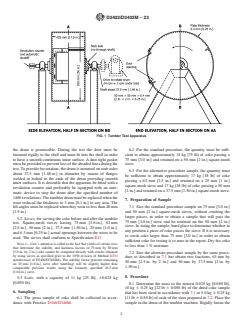
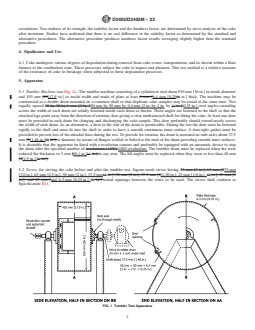
5.1 Tumbler Machine (see Fig. 1)—The tumbler machine
Development of International Standards, Guides and Recom-
consisting of a cylindrical steel drum 910 mm [36 in.] in inside
mendations issued by the World Trade Organization Technical
diameter and 455 mm [17.9 in.] in inside width and made of
Barriers to Trade (TBT) Committee.
plate at least 6.4 mm [0.25 in.] thick. The machine may be
constructed as a double drum mounted on a common shaft so
2. Referenced Documents
that duplicate coke samples may be tested at the same time.
2.1 ASTM Standards:
Two equally spaced 50 mm by 50 mm by 6.4 mm [2 in. by 2 in.
D294 Method of Test for Tumbler Test for Coke; Replaced
by 0.25 in.] steel angles extending across the width of each
drum are solidly fastened inside each drum as shown. These
angles are fastened to the shell so that the attached legs point
away from the direction of rotation, thus giving a clear
This test method is under the jurisdiction of ASTM Committee D05 on Coal
and Coke and is the direct responsibility of Subcommittee D05.15 on Metallurgical
unobstructed shelf for lifting the coke. At least one door must
Properties of Coal and Coke.
be provided in each drum for charging and discharging the
Current edition approved Sept. 1, 2023. Published October 2023. Originally
coke sample. This door preferably should extend nearly across
approved in 1975. Last previous edition approved in 2016 as D3402/D3402M – 16.
DOI: 10.1520/D3402_D3402M-23. the width of each drum. As an alternative, a door in the side of
For referenced ASTM standards, visit the ASTM website, www.astm.org, or
contact ASTM Customer Service at service@astm.org. For Annual Book of ASTM
Standards volume information, refer to the standard’s Document Summary page on The last approved version of this historical standard is referenced on
the ASTM website. www.astm.org.
Copyright © ASTM International, 100 Barr Harbor Drive, PO Box C700, West Conshohocken, PA 19428-2959. United States
D3402/D3402M − 23
FIG. 1 Tumbler Test Apparatus
the drum is permissible. During the test the door must be 6.2 For the standard procedure, the quantity must be suffi-
fastened rigidly to the shell and must fit into the shell in order cient to obtain approximately 34 kg [75 lb] of coke passing a
to have a smooth continuous inner surface. A dust-tight gasket 75 mm [3.0 in.] and retained on a 50 mm [2 in.] square-mesh
must be provided to prevent loss of the abraded fines during the sieve.
test. To provide for rotation, the drum is mounted on stub axles
6.3 For the alternative procedure sample, the quantity must
about 37.5 mm [1.48 in.] in diameter by means of flanges
be sufficient to obtain approximately 17 kg [38 lb] of coke
welded or bolted to the ends of the drum providing smooth
passing a 63 mm [2.5 in.] and retained on a 25 mm [1 in.]
inner surfaces. It is desirable that the apparatus be fitted with a
square-mesh sieve and 17 kg [38 lb] of coke passing a 50 mm
revolution counter and preferably be equipped with an auto-
[2 in.] and retained on a 37.5 mm [1.50 in.] square-mesh sieve.
matic device to stop the drum after the specified number of
1400 revolutions. The tumbler drum must be replaced when the
7. Preparation of Sample
wear reduced the thickness to 3 mm [0.1 in.] in any area. The
lift angles must be replaced when they wear to less than 48 mm 7.1 Size the standard procedure sample on 75 mm [3.0 in.]
[1.9 in.]. and 50 mm [2 in.] square-mesh sieves, without crushing the
larger pieces, in order to obtain a sample that will pass the
5.2 Sieves, for sieving the coke before and after the tumbler
75 mm [3.0 in.] sieve and be retained on the 50 mm [2 in.]
test. Square-mesh sieves having 75 mm [3.0 in.], 63 mm
sieve. In sizing the sample, hand place to determine whether in
[2.5 in.], 50 mm [2 in.], 37.5 mm [1.50 in.], 25 mm [1.0 in.],
any position a piece of coke passes the sieve. If it is necessary
and 6.3 mm [0.25 in.] actual openings between the wires to be
to crush coke larger than 75 mm [3.0 in.] in order to obtain
used. The sieves shall conform to Specification E11.
sufficient coke for testing it so note in the report. Dry the coke
NOTE 1—User’s attention is called to the fact that yields of certain sizes
to less than 1 % moisture.
that determine the stability and hardness factors of 75 mm by 50 mm
[3.0 in. by 2 in.] coke cannot be compared directly with results obtained 7.2 Size the alternate procedure sample by the same proce-
by using sieves as specified prior to the 1950 revision of Method D294
dure as described in 7.1 but obtain two fractions, 63 mm by
(predecessor of D3402/D3402M). The stability factor (percent remaining
50 mm [2.5 in. by 2 in.] and 50 mm by 37.5 mm [2 in. by
on 25 mm [1.0 in.] sieve after tumbling) will be slightly higher than
1.50 in.].
comparable previous results using the formerly specified 26.5 mm
[1.04 in.] sieve.
8. Procedure
5.3 Scale, with a capacity of 11 kg [25 lb], 60.025 kg
[0.050 lb].
8.1 Determine the mass to the nearest 0.025 kg [0.050 lb],
10 kg 6 0.25 kg [22 lb 6 0.050 lb] of the dried coke sample
6. Sampling
that has been sized in accordance with 7.1 or 5.0 kg 6 0.25 kg
6.1 The gross sample of coke shall be collected in accor- [11 lb 6 0.50 lb] of each of the sizes prepared in 7.2. Place the
dance with Practice D346/D346M. sample in the drum of the tumbler machine. Rigidly fasten the
D3402/D3402M − 23
cover and rotate the drum at 24 rpm 6 1 rpm under load for a 1
W = cumulative mass of coke retained on 6.3 mm [ ⁄4 in.]
total of 1400 revolutions.
sieve after tumbling as described in 8.2.
100 = conversion factor to convert dimensionless fraction to
8.2 Remove all of the coke from the drum and sieve it using
a percent, %.
a 25 mm [1.0 in.] square-mesh sieve
...
This document is not an ASTM standard and is intended only to provide the user of an ASTM standard an indication of what changes have been made to the previous version. Because
it may not be technically possible to adequately depict all changes accurately, ASTM recommends that users consult prior editions as appropriate. In all cases only the current version
of the standard as published by ASTM is to be considered the official document.
Designation: D3402/D3402M − 16 D3402/D3402M − 23
Standard Test Method for
Tumbler Test for Coke
This standard is issued under the fixed designation D3402/D3402M; the number immediately following the designation indicates the
year of original adoption or, in the case of revision, the year of last revision. A number in parentheses indicates the year of last
reapproval. A superscript epsilon (´) indicates an editorial change since the last revision or reapproval.
1. Scope
1.1 This test method describes a procedure for obtaining a relative measure of the resistance to degradation of coke by impact and
abrasion.
1.2 Standard Procedure—This procedure uses a coke sample sized to −75 mm [−3 in.] and + 50 mm [ + 2 that is sized to 75 mm
by 50 mm [ 3.0 in. by 2 in.].
1.3 Alternative Procedure—This procedure using coke uses a composite coke sample that is comprised of coke sized 50 % of 63
1 1
by 50 mm [263 mm by 50 mm [2.5 in. ⁄2by 2 in.] 2 in.] and 50 % of 5050 mm by 37.5 mm [2 by 1[2 in. by 1.50 ⁄2 in.].
1.4 The values stated in either SI units or inch-pound units are to be regarded separately as standard. The values stated in each
system may not be exact equivalents; therefore, to ensure conformance with the standard, each system shall be used independently
of the other. Combiningother, and values from the two systems may result in non-conformance with the standard.shall not be
combined.
1.5 This standard does not purport to address all of the safety problems,concerns, if any, associated with its use. It is the
responsibility of the user of this standard to establish appropriate safety and healthsafety, health, and environmental practices and
determine the applicability of regulatory limitations prior to use.
1.6 This international standard was developed in accordance with internationally recognized principles on standardization
established in the Decision on Principles for the Development of International Standards, Guides and Recommendations issued
by the World Trade Organization Technical Barriers to Trade (TBT) Committee.
2. Referenced Documents
2.1 ASTM Standards:
D294 Method of Test for Tumbler Test for Coke; Replaced by D 3402 (Withdrawn 1975)
D346/D346M Practice for Collection and Preparation of Coke Samples for Laboratory Analysis
E11 Specification for Woven Wire Test Sieve Cloth and Test Sieves
3. Summary of Test Method
3.1 A sample of dry coke of designated size is tumbled in a rotating drum at a specified turning rate for a specified number of
This test method is under the jurisdiction of ASTM Committee D05 on Coal and Coke and is the direct responsibility of Subcommittee D05.15 on Metallurgical Properties
of Coal and Coke.
Current edition approved April 1, 2016Sept. 1, 2023. Published April 2016October 2023. Originally approved in 1975. Last previous edition approved in 20082016 as
D3402/D3402M – 93D3402/D3402M – 16.(2008). DOI: 10.1520/D3402_D3402M-16.10.1520/D3402_D3402M-23.
For referenced ASTM standards, visit the ASTM website, www.astm.org, or contact ASTM Customer Service at service@astm.org. For Annual Book of ASTM Standards
volume information, refer to the standard’s Document Summary page on the ASTM website.
The last approved version of this historical standard is referenced on www.astm.org.
Copyright © ASTM International, 100 Barr Harbor Drive, PO Box C700, West Conshohocken, PA 19428-2959. United States
D3402/D3402M − 23
revolutions. Two indexes of its strength, the stability factor and the hardness factor, are determined by sieve analysis of the coke
after treatment. Studies have indicated that there is no real difference in the stability factor as determined by the standard and
alternative procedures. The alternative procedure produces hardness factor results averaging slightly higher than the standard
procedure.
4. Significance and Use
4.1 Coke undergoes various degrees of degradation during removal from coke ovens, transportation, and its decent within a blast
furnace to the combustion zone. These processes subject the coke to impact and abrasion. This test method is a relative measure
of the resistance of coke to breakage when subjected to these degradation processes.
5. Apparatus
5.1 Tumbler Machine (see Fig. 1)—The tumbler machine consisting of a cylindrical steel drum 910 mm [36 in.] in inside diameter
and 455 mm [18[17.9 in.] in inside width and made of plate at least 6 mm [6.4 mm [0.25 ⁄4 in.] thick. The machine may be
constructed as a double drum mounted on a common shaft so that duplicate coke samples may be tested at the same time. Two
equally spaced 50 by 50 by 6 mm [2 by 250 mm by 50 mm by 6.4 mm [2 in. by 2 in. by ⁄4 in.] 0.25 in.] steel angles extending
across the width of each drum are solidly fastened inside each drum as shown. These angles are fastened to the shell so that the
attached legs point away from the direction of rotation, thus giving a clear unobstructed shelf for lifting the coke. At least one door
must be provided in each drum for charging and discharging the coke sample. This door preferably should extend nearly across
the width of each drum. As an alternative, a door in the side of the drum is permissible. During the test the door must be fastened
rigidly to the shell and must fit into the shell in order to have a smooth continuous inner surface. A dust-tight gasket must be
provided to prevent loss of the abraded fines during the test. To provide for rotation, the drum is mounted on stub axles about 37.5
mm [1[1.48 in.] ⁄2 in.] in diameter by means of flanges welded or bolted to the ends of the drum providing smooth inner surfaces.
It is desirable that the apparatus be fitted with a revolution counter and preferably be equipped with an automatic device to stop
the drum after the specified number of revolutions (1400).1400 revolutions. The tumbler drum must be replaced when the wear
reduced the thickness to 3 mm [[0.1 in.] ⁄8 in.] in any area. The lift angles must be replaced when they wear to less than 48 mm
[1[1.9 in.]. ⁄8 in.].
5.2 Sieves, for sieving the coke before and after the tumbler test. Square-mesh sieves having 75 mm [3 in.], 63 mm [275 mm
1 1
[3.0 in.], 63 mm [2.5 in.], 50 mm [2 in.], 37.5 mm ⁄2 in.], 50 mm [2 in.], 37.5 mm [1[1.50 in.], 25 mm [1.0 in.], ⁄2 in.], 25 mm [1
in.], and 63 mm [and 6.3 mm [0.25 in.] ⁄4 in.] actual openings between the wires to be used. The sieves shall conform to
Specification E11.
FIG. 1 Tumbler Test Apparatus
D3402/D3402M − 23
NOTE 1—User’s attention is called to the fact that yields of certain sizes that determine the stability and hardness factors of 75 by 50 mm [3 by 2 in.]
75 mm by 50 mm [3.0 in. by 2 in.] coke cannot be compared directly with results obtained by using sieves as specified prior to the 1950 revision of
Method D294 (predecessor of D3402/D3402M). The stability factor (percent remaining on 25 mm [1 in.] 25 mm [1.0 in.] sieve after tumbling) will be
slightly higher than comparable previous results using the formerly specified 26.5 mm [1.06 in.] 26.5 mm [1.04 in.] sieve.
5.3 Weighing Scale, capable of weighing with a capacity of 11 kg [25 lb], sensitive to 0.025 kg [0.0560.025 kg [0.050 lb].
6. Sampling
6.1 The gross sample of coke shall be collected in accordance with Practice D346/D346M.
6.2 For the standard procedure, the quantity must be sufficient to obtain approximately 34 kg [75 lb] of coke passing a 75 mm
[3[3.0 in.] and retained on a 50 mm [2 in.] square-mesh sieve.
6.3 For the alternative procedure sample, the quantity must be sufficient to obtain approximately 17 kg [38 lb] of coke passing
a 63 mm [2[2.5 ⁄2 in.] and retained on a 25 mm [1 in.] square-mesh sieve and 17 kg [38 lb] of coke passing a 50 mm [2 in.] and
retained on a 37.5 mm [1[1.50 ⁄2 in.] square-mesh sieve.
7. Preparation of Sample
7.1 Size the standard procedure sample on 75 mm [3[3.0 in.] and 50 mm [2 in.] square-mesh sieves, without crushing the larger
pieces, in order to obtain a sample that will pass the 75 mm [3 in.] 75 mm [3.0 in.] sieve and be retained on the 50 mm [2 in.]
sieve. In sizing the sample, hand place to determine whether in any position a piece of coke passes the sieve. If it is necessary to
crush large coke ( +75 mm or [+3 in.])coke larger than 75 mm [3.0 in.] in order to obtain sufficient coke for testing it so note in
the report. Dry the coke to less than 1 % moisture.
7.2 Size the alternate procedure sample by the same procedure as described in 7.1 but obtain two fractions, 63 by 50 mm [263 mm
1 1
by 50 mm [2.5 in. ⁄2by 2 in.] and 50 by 37.5 mm [2 by 150 mm by 37.5 mm [2 in. by 1.50 in.]. ⁄2 in.].
8. Procedure
8.1 Accurately weigh Determine the mass to the nearest 0.025 kg [0.05 lb], 10[0.050 lb], 10 kg 6 0.25 kg [22 6 0.5[22 lb 6 0.050
lb] of the dried coke sample that has been sized in accordance with 7.1 or 55.0 kg 6 0.25 kg [11 6 0.5[11 lb 6 0.50 lb] of each
of the sizes prepared in 7.2. Place the weighed sample in the drum of the tumbler machine. Rigidly fasten the cover and rotate the
drum at 2424 rpm 6 1 rpm under load for a total of 1400 revolutions.
8.2 Remove all of the coke from the drum and sieve it using a 25 mm [1[1.0 in.] square-mesh sieve and a 6.3 mm [[0.25 ⁄4 in.]
square-mesh sieve. Shake the coke vigorously on the sieve in order to up-end the pieces until practically no more coke will pass
through the openings (Note 2). Weigh the Determine the mass of coke remaining on each of
...