

ASTM D346/D346M-11(2019)e1
(Practice)Standard Practice for Collection and Preparation of Coke Samples for Laboratory Analysis
General Information
- Abstract
SIGNIFICANCE AND USE
3.1 This practice may be used to provide a representative sample of the coke from which it is collected. Due to the variability of coke and the wide variety of sampling equipment, caution must be exercised in all stages of sampling, from system specifications and equipment procurement to equipment acceptance testing and actually taking the final sample.
3.2 This practice also provides an analysis sample of coke from the gross or divided sample. The analysis samples can be used to determine the value of the coke represented, its ability to meet specifications, as well as for other purposes.
SCOPE
1.1 This practice covers procedures for the collection and reduction of samples of coke to be used for physical tests, chemical analyses, and the determination of total moisture.
1.2 The values stated in either SI units or inch-pound units are to be regarded separately as standard. The values stated in each system are not necessarily exact equivalents; therefore, to ensure conformance with the standard, each system shall be used independently of the other, and values from the two systems shall not be combined.
1.2.1 Values in SI units [or inch-pound units] shall be obtained by measurement in SI units [or inch-pound units] or by appropriate conversion, using the Rules for Conversion and Rounding given in IEEE/ASTM SI 10, of measurements made in SI units [or other units]. Values are stated in SI units when inch-pound units are not used in practice.
1.3 This standard does not purport to address all of the safety concerns, if any, associated with its use. It is the responsibility of the user of this standard to establish appropriate safety, health, and environmental practices and determine the applicability of regulatory limitations prior to use.
1.4 This international standard was developed in accordance with internationally recognized principles on standardization established in the Decision on Principles for the Development of International Standards, Guides and Recommendations issued by the World Trade Organization Technical Barriers to Trade (TBT) Committee.
- Status
- Published
- Publication Date
- 31-Jul-2019
- Technical Committee
- D05 - Coal and Coke
- Drafting Committee
- D05.23 - Sampling
Overview
ASTM D346/D346M-11(2019)e1 – Standard Practice for Collection and Preparation of Coke Samples for Laboratory Analysis establishes protocols for systematically collecting and preparing representative coke samples. Developed by ASTM Committee D05 on Coal and Coke, this international standard supports accurate laboratory testing by providing best practices for sample acquisition and reduction. The document is critical for organizations needing reliable data on coke quality, whether for routine production, compliance, or trade.
Coke, due to its heterogeneity, requires careful sampling to ensure test results accurately reflect the bulk material. This standard remains aligned with global principles of standardization and is referenced worldwide for control and quality assurance in coke sampling and testing.
Key Topics
Scope of Application
- Procedures for collecting and reducing samples of coke for physical and chemical analysis, including total moisture determination
- Guidance on using both SI and inch-pound units (with explicit separation of unit systems)
- Emphasizes the need for planning and care at every stage - from sample system design to final analysis preparation
Sampling Practices
- Representative sampling is essential for accurate results
- Recommends collecting gross samples during loading/unloading processes (from railroad cars, ships, trucks, conveyors, bins, etc.) to minimize segregation
- Specifies increment collection methods: stopped-belt cuts, full/part-stream cuts, and stationary sampling
Sample Reduction and Preparation
- Mandates minimum sample quantities for various tests (e.g., sieve analysis, drop shatter, tumbler test, moisture, and chemical analysis)
- Procedures for crushing, mixing, and dividing samples, using manual or mechanical riffles to ensure homogeneity and representativeness
- Detailed hand division procedures (alternate-shovel method) for field conditions where mechanical division is impractical
Reporting Requirements
- Analytical reports should document the sampling method, locations, sizes, and further preparation steps to ensure traceability and reproducibility
Safety and Compliance
- Advises all users to establish appropriate health, safety, and environmental practices
- Ensures compliance with regulatory limitations and international standardization principles
Applications
Adherence to ASTM D346/D346M is crucial wherever coke sampling forms the basis for:
- Laboratory Analysis: Ensuring physical and chemical tests (such as size consist, moisture, drop shatter, tumbler tests, and chemical composition) are valid and representative.
- Quality Assurance: Verifying batch or shipment quality for acceptance, rejection, or grading, particularly during trade and procurement.
- Production Control: Monitoring process stability in coke and steel manufacturing by routine sampling and analysis.
- Regulatory Compliance: Documenting and demonstrating conformity to national and international standards.
- Research and Development: Generating reliable data sets for material investigations and performance correlations.
The standard is widely used by coke producers, steel manufacturers, inspection agencies, laboratories, and regulatory authorities worldwide.
Related Standards
The practice references and is often used in conjunction with several other ASTM International standards, including:
- ASTM D167: Apparent and True Specific Gravity and Porosity of Lump Coke
- ASTM D293/D293M: Sieve Analysis of Coke
- ASTM D2013/D2013M: Preparing Coal Samples for Analysis
- ASTM D2234/D2234M: Collection of a Gross Sample of Coal
- ASTM D3038: Drop Shatter Test for Coke
- ASTM D3302/D3302M: Total Moisture in Coal
- ASTM D3402/D3402M: Tumbler Test for Coke
- IEEE/ASTM SI 10: Metric Practice (Rules for Conversion and Rounding)
Working in compliance with ASTM D346/D346M ensures standardized, fair, and scientifically valid approaches for coke sampling and preparation, supporting consistent results across laboratories and geographies. For more information, reference the ASTM International website or relevant annual standards volume.
Relations
- Effective Date
- 01-Sep-2023
- Effective Date
- 01-Dec-2019
- Effective Date
- 01-Sep-2018
- Effective Date
- 01-Jun-2018
- Effective Date
- 15-Oct-2017
- Effective Date
- 01-Apr-2016
- Effective Date
- 01-Mar-2016
- Effective Date
- 15-May-2012
- Effective Date
- 01-Apr-2012
- Refers
ASTM D167-12 - Standard Test Method for Apparent and True Specific Gravity and Porosity of Lump Coke - Effective Date
- 01-Feb-2012
- Effective Date
- 01-May-2010
- Effective Date
- 01-Jan-2010
- Effective Date
- 01-Oct-2009
- Effective Date
- 01-Oct-2008
- Effective Date
- 01-May-2007
Get Certified
Connect with accredited certification bodies for this standard

Element Materials Technology
Materials testing and product certification.

ABS Group Brazil
ABS Group certification services in Brazil.

ABS Quality Evaluations Inc.
American Bureau of Shipping quality certification.
Sponsored listings
Frequently Asked Questions
ASTM D346/D346M-11(2019)e1 is a standard published by ASTM International. Its full title is "Standard Practice for Collection and Preparation of Coke Samples for Laboratory Analysis". This standard covers: SIGNIFICANCE AND USE 3.1 This practice may be used to provide a representative sample of the coke from which it is collected. Due to the variability of coke and the wide variety of sampling equipment, caution must be exercised in all stages of sampling, from system specifications and equipment procurement to equipment acceptance testing and actually taking the final sample. 3.2 This practice also provides an analysis sample of coke from the gross or divided sample. The analysis samples can be used to determine the value of the coke represented, its ability to meet specifications, as well as for other purposes. SCOPE 1.1 This practice covers procedures for the collection and reduction of samples of coke to be used for physical tests, chemical analyses, and the determination of total moisture. 1.2 The values stated in either SI units or inch-pound units are to be regarded separately as standard. The values stated in each system are not necessarily exact equivalents; therefore, to ensure conformance with the standard, each system shall be used independently of the other, and values from the two systems shall not be combined. 1.2.1 Values in SI units [or inch-pound units] shall be obtained by measurement in SI units [or inch-pound units] or by appropriate conversion, using the Rules for Conversion and Rounding given in IEEE/ASTM SI 10, of measurements made in SI units [or other units]. Values are stated in SI units when inch-pound units are not used in practice. 1.3 This standard does not purport to address all of the safety concerns, if any, associated with its use. It is the responsibility of the user of this standard to establish appropriate safety, health, and environmental practices and determine the applicability of regulatory limitations prior to use. 1.4 This international standard was developed in accordance with internationally recognized principles on standardization established in the Decision on Principles for the Development of International Standards, Guides and Recommendations issued by the World Trade Organization Technical Barriers to Trade (TBT) Committee.
SIGNIFICANCE AND USE 3.1 This practice may be used to provide a representative sample of the coke from which it is collected. Due to the variability of coke and the wide variety of sampling equipment, caution must be exercised in all stages of sampling, from system specifications and equipment procurement to equipment acceptance testing and actually taking the final sample. 3.2 This practice also provides an analysis sample of coke from the gross or divided sample. The analysis samples can be used to determine the value of the coke represented, its ability to meet specifications, as well as for other purposes. SCOPE 1.1 This practice covers procedures for the collection and reduction of samples of coke to be used for physical tests, chemical analyses, and the determination of total moisture. 1.2 The values stated in either SI units or inch-pound units are to be regarded separately as standard. The values stated in each system are not necessarily exact equivalents; therefore, to ensure conformance with the standard, each system shall be used independently of the other, and values from the two systems shall not be combined. 1.2.1 Values in SI units [or inch-pound units] shall be obtained by measurement in SI units [or inch-pound units] or by appropriate conversion, using the Rules for Conversion and Rounding given in IEEE/ASTM SI 10, of measurements made in SI units [or other units]. Values are stated in SI units when inch-pound units are not used in practice. 1.3 This standard does not purport to address all of the safety concerns, if any, associated with its use. It is the responsibility of the user of this standard to establish appropriate safety, health, and environmental practices and determine the applicability of regulatory limitations prior to use. 1.4 This international standard was developed in accordance with internationally recognized principles on standardization established in the Decision on Principles for the Development of International Standards, Guides and Recommendations issued by the World Trade Organization Technical Barriers to Trade (TBT) Committee.
ASTM D346/D346M-11(2019)e1 is classified under the following ICS (International Classification for Standards) categories: 75.160.10 - Solid fuels. The ICS classification helps identify the subject area and facilitates finding related standards.
ASTM D346/D346M-11(2019)e1 has the following relationships with other standards: It is inter standard links to ASTM D3402/D3402M-23, ASTM D2234/D2234M-19, ASTM D293/D293M-18, ASTM D3038-93(2018), ASTM D2234/D2234M-17, ASTM D3402/D3402M-16, ASTM D2234/D2234M-16, ASTM D167-12a, ASTM D3302/D3302M-12, ASTM D167-12, ASTM D3038-93(2010), ASTM D2234/D2234M-10, ASTM D2234/D2234M-09a, ASTM D3402/D3402M-93(2008), ASTM D2234/D2234M-07. Understanding these relationships helps ensure you are using the most current and applicable version of the standard.
ASTM D346/D346M-11(2019)e1 is available in PDF format for immediate download after purchase. The document can be added to your cart and obtained through the secure checkout process. Digital delivery ensures instant access to the complete standard document.
Standards Content (Sample)
This international standard was developed in accordance with internationally recognized principles on standardization established in the Decision on Principles for the
Development of International Standards, Guides and Recommendations issued by the World Trade Organization Technical Barriers to Trade (TBT) Committee.
´1
Designation: D346/D346M − 11 (Reapproved 2019)
Standard Practice for
Collection and Preparation of Coke Samples for Laboratory
Analysis
This standard is issued under the fixed designation D346/D346M; the number immediately following the designation indicates the year
of original adoption or, in the case of revision, the year of last revision. A number in parentheses indicates the year of last reapproval.
A superscript epsilon (´) indicates an editorial change since the last revision or reapproval.
ε NOTE—Editorial changes were made throughout in October 2019.
INTRODUCTION
Coke, especially run of oven coke or foundry coke, or both, is a difficult material to sample. It is
imperative that every sample be collected and handled carefully and conscientiously and in strict
accordance with the standard procedure described herein.
Gross samples of not less than the quantities designated in this practice must be taken, whether the
coke to be sampled consists of a few tons or several hundred tons.
1. Scope 2. Referenced Documents
1.1 This practice covers procedures for the collection and
2.1 ASTM Standards:
reduction of samples of coke to be used for physical tests,
D167 Test Method for Apparent and True Specific Gravity
chemical analyses, and the determination of total moisture.
and Porosity of Lump Coke
D293/D293M Test Method for the Sieve Analysis of Coke
1.2 The values stated in either SI units or inch-pound units
D2013/D2013M Practice for Preparing Coal Samples for
are to be regarded separately as standard. The values stated in
Analysis
each system are not necessarily exact equivalents; therefore, to
D2234/D2234M Practice for Collection of a Gross Sample
ensure conformance with the standard, each system shall be
of Coal
used independently of the other, and values from the two
D3038 Test Method for Drop Shatter Test for Coke
systems shall not be combined.
D3302/D3302M Test Method for Total Moisture in Coal
1.2.1 Values in SI units [or inch-pound units] shall be
D3402/D3402M Test Method for Tumbler Test for Coke
obtained by measurement in SI units [or inch-pound units] or
IEEE/ASTM SI 10 American National Standard for Metric
by appropriate conversion, using the Rules for Conversion and
Practice
Rounding given in IEEE/ASTM SI 10, of measurements made
in SI units [or other units]. Values are stated in SI units when
inch-pound units are not used in practice. 3. Significance and Use
1.3 This standard does not purport to address all of the
3.1 This practice may be used to provide a representative
safety concerns, if any, associated with its use. It is the
sample of the coke from which it is collected. Due to the
responsibility of the user of this standard to establish appro-
variabilityofcokeandthewidevarietyofsamplingequipment,
priate safety, health, and environmental practices and deter-
caution must be exercised in all stages of sampling, from
mine the applicability of regulatory limitations prior to use.
system specifications and equipment procurement to equip-
1.4 This international standard was developed in accor-
ment acceptance testing and actually taking the final sample.
dance with internationally recognized principles on standard-
3.2 This practice also provides an analysis sample of coke
ization established in the Decision on Principles for the
from the gross or divided sample. The analysis samples can be
Development of International Standards, Guides and Recom-
used to determine the value of the coke represented, its ability
mendations issued by the World Trade Organization Technical
to meet specifications, as well as for other purposes.
Barriers to Trade (TBT) Committee.
This practice is under the jurisdiction of ASTM Committee D05 on Coal and
Coke and is the direct responsibility of Subcommittee D05.23 on Sampling. For referenced ASTM standards, visit the ASTM website, www.astm.org, or
Current edition approved Aug. 1, 2019. Published October 2019. Originally contact ASTM Customer Service at service@astm.org. For Annual Book of ASTM
approved in 1932. Last previous edition approved in 2011 as D346/D346M – 11. Standards volume information, refer to the standard’s Document Summary page on
DOI: 10.1520/D0346_D0346M-11R19E01. the ASTM website.
Copyright © ASTM International, 100 Barr Harbor Drive, PO Box C700, West Conshohocken, PA 19428-2959. United States
´1
D346/D346M − 11 (2019)
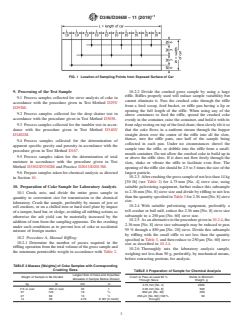
ships, or barges are, in general, unreliable because of size segregation and
4. Place of Sampling
should not be used for determining conformance to specifications unless
4.1 Sample coke while it is being loaded into or unloaded
the purchaser and the seller so agree. If necessary to collect a sample of
from railroad cars, ships, barges, or trucks, or when discharged
coke from the surface of a loaded railroad car, take nine equal increments
about 305 mm [1 ft] below the surface. Locate the nine points as shown
from supply bins, grab buckets, belt conveyers, or other coke
in Fig. 1. The diameter of the hole must be at least 3 times that of the
conveying equipment. Sample close to the point of interest.
largest piece in the shipment.
5. Collection of Gross Sample
6. Condition of Increment Collection
5.1 Collect increments regularly, systematically, and with
6.1 Four conditions of increment collection are recognized:
such frequency, so that the entire quantity of coke sampled will
6.1.1 Condition A (Stopped-Belt Cut), in which a loaded
be represented proportionately in the gross sample, and a gross
conveyor belt is stopped and a full cross-section cut with
sample of the required amount will be collected. The standard
parallel sides is removed from the coke stream. The distance
grosssampleshallequalorexceedthequantitiesgiveninTable
between the parallel faces shall not be less than three times the
1.
length of the largest piece.
5.1.1 The quantity of sample to be taken will depend on the
6.1.2 Condition B (Full-Stream Cut), in which a full cross
type and size of the coke being sampled and the amount of
section is removed from a moving stream of coke.
information to be obtained from the sample.
6.1.3 Condition C (Part-Stream Cut), in which a portion,
5.1.1.1 The size of the sieve analysis sample is governed by
not a full cross section, is removed from a moving stream of
the homogeneity of the coke being sampled. The quantities
coke.
given in Table 1 represent the minimum quantity to be
6.1.4 ConditionD(StationarySampling),inwhichaportion
collected.The sieve analysis sample will supply sufficient coke
of coke is collected from a pile, a railroad car, a barge, or a
for any subsequent physical tests and laboratory analysis.Total
shiphold.
moisture of the coke should not be determined on the sieve
NOTE 2—See Section 6 of Practice D2234/D2234M.
analysis sample.
5.1.1.2 For the drop shatter test, a minimum of 75 kg
7. Size of Increments
[165 lb] of coke retained on 50 mm [2 in.] square mesh sieve if
7.1 Tocollectincrements,useashovelorspeciallydesigned
furnace coke is being processed, or 140 kg [300 lb] of coke
tool or mechanical means for taking equal increments. When
retained on 75 mm [3 in.] square mesh sieve if foundry coke is
increments are collected from the surface of a loaded rail car or
being processed, is required. The quantities given in Table 1
truck shipment, the gross sample shall consist of nine incre-
represent the minimum amounts required of sized coke.
ments of approximately equal quantity. When increments are
5.1.1.3 The tumbler test requires a minimum of 35 kg
taken from piles, conveyor belts, barges, and so forth, the gross
[75 lb]ofcokethatwillpassa75 mm[3 in.]squaremeshsieve
sample shall consist of not less than 25, nor more than 50
and can be retained on a 50 mm [2 in.] square mesh sieve, or
increments, of approximately equal quantity.
that which will pass a 64 mm [2 ⁄2 in.] square mesh sieve and
can be retained on a 38 mm [1 ⁄2 in.] square mesh sieve. The NOTE 3—When large-size coke, such as foundry coke, is being
sampled, it is likely that quantities larger than those given in Table 1 will
quantities given in Table 1 represent the minimum amount of
be collected. However, the minimum number of increments collected
the required sized coke.
should not be decreased unless such is agreed upon between the purchaser
5.1.1.4 The apparent specific gravity test requires a mini-
and the seller.
mum of 23 kg [50 lb] of representative coke pieces. The
NOTE 4—If the sample for chemical analysis is obtained from the sieve
quantities given in Table 1 represent the minimum amounts of analysis sample, a sample not smaller than that shown in Table 1 should
be reconstituted from the size fractions obtained when the sieve analysis
the required coke pieces.
sample was processed.
5.1.1.5 The determination of total moisture of the coke
requires approximately 45 kg [100 lb] of coke. The quantities
8. Quantities Represented
given in Table 1 represent the minimum amount to be col-
8.1 Take a gross sample for each 454 Mg [500 tons] or
lected.
fraction thereof, or in case of larger tonnages, for such
5.1.1.6 The quantities given for samples for chemical analy-
quantities as may be agreed upon. Sample separately each lot
sis represent the minimum amounts to be collected.
of coke arising from a different source or known to be of
NOTE1—Samplesc
...