

ASTM C557-03(2017)
(Specification)Standard Specification for Adhesives for Fastening Gypsum Wallboard to Wood Framing
General Information
- Abstract
ABSTRACT
This specification covers the minimum performance standards for and properties of adhesives intended to bond the back surface paper of gypsum wallboard to wood framing members. Test requirements and test methods for the adhesive used for the application of all thicknesses of gypsum wallboard are also covered. The specification provides a basis for ensuring the quality of adhesives. Compression shear test, tensile test, gap filling or bridging characteristics test, freeze-thaw stability test, and accelerated adhesive aging shall be performed on the adhesive. The tests are suitable for products performance certification and quality control programs and can be useful the general public, adhesive manufacturers, distributors, specifiers, architects, contractors, testing laboratories and other businesses and professionals.
SCOPE
1.1 This specification includes properties and covers minimum performance standards for adhesives intended to bond the back surface paper of gypsum wallboard to wood framing members.
1.2 This specification also covers test requirements and test methods for the adhesive used for the application of all thicknesses of gypsum wallboard.
1.3 The values stated in inch-pound units are to be regarded as standard. The values given in parentheses are mathematical conversions to SI units that are provided for information only and are not considered standard.
1.4 This standard does not purport to address all of the safety concerns, if any, associated with its use. It is the responsibility of the user of this standard to establish appropriate safety and health practices and determine the applicability of regulatory limitations prior to use.
1.5 This international standard was developed in accordance with internationally recognized principles on standardization established in the Decision on Principles for the Development of International Standards, Guides and Recommendations issued by the World Trade Organization Technical Barriers to Trade (TBT) Committee.
- Status
- Published
- Publication Date
- 31-Mar-2017
- Technical Committee
- D14 - Adhesives
- Drafting Committee
- D14.70 - Construction Adhesives
Overview
ASTM C557-03(2017), Standard Specification for Adhesives for Fastening Gypsum Wallboard to Wood Framing, establishes minimum performance standards, properties, and test methods for adhesives used in bonding the back surface paper of gypsum wallboard to wood framing. This ASTM International standard provides quality benchmarks for the adhesives employed in drywall installations, ensuring both safety and effectiveness for a wide range of practitioners, from manufacturers to construction professionals.
Key Topics
- Adhesive Performance Requirements: The standard outlines the necessary physical properties-such as workability, open time, and storage life-that adhesives must meet to be deemed suitable for fastening gypsum wallboard to wood framing.
- Testing Methods: ASTM C557-03(2017) specifies procedures such as compression shear tests, tensile strength tests, gap-filling or bridging characteristics, freeze-thaw stability, and accelerated adhesive aging. These tests are used for product certification and ongoing quality control.
- Applicability Across Wallboard Thicknesses: Adhesives must be suitable for use with all standard thicknesses of gypsum wallboard.
- Role of Mechanical Fasteners: While adhesives must provide sufficient bond strength, they are not intended to replace mechanical fasteners, which remain necessary for the structural integrity of assemblies.
- Safety and Health: The standard mandates that users evaluate associated safety practices and comply with regulatory requirements related to the use of adhesives.
Applications
ASTM C557-03(2017) is applicable in diverse contexts throughout the construction and building materials industries:
- Product Certification: Adhesive manufacturers, specifiers, and distributors use these performance criteria to certify products before they reach the market.
- Construction and Contracting: Architects and contractors rely on compliant adhesives to ensure reliable and durable gypsum wallboard installations onto wood framing in both residential and commercial buildings.
- Quality Control and Testing: Laboratories and quality assurance professionals utilize the prescribed testing methods to ensure that adhesives meet the required shear and tensile strengths, maintain stability under temperature changes, and provide proper gap-filling and wetting properties.
- Material Selection: Specifiers can reference this standard for developing project requirements or selecting adhesives that fulfill stringent industry benchmarks, particularly for installations where adhesive performance directly impacts finished wall quality.
Related Standards
Several standards are referenced within ASTM C557-03(2017), providing further guidance on testing methods and material definitions:
- ASTM C1396/C1396M: Specification for Gypsum Board, referencing the properties of the wallboard substrates.
- ASTM D905: Test Method for Strength Properties of Adhesive Bonds in Shear by Compression Loading, a foundational procedure for determining shear performance.
- ASTM D907: Terminology of Adhesives, for definitions and vocabulary used in this sector.
- ASTM E4: Practices for Force Verification of Testing Machines, ensuring accuracy in mechanical testing.
- ASTM E177: Practice for Use of the Terms Precision and Bias in ASTM Test Methods, relating to the repeatability and reliability of test results.
By describing the minimum quality standards, defining rigorous testing protocols, and referencing related documents, ASTM C557-03(2017) ensures that adhesives for fastening gypsum wallboard to wood framing meet consistent and dependable performance criteria, supporting safer and more efficient construction practices.
Keywords: ASTM C557, adhesives, gypsum wallboard, wood framing, adhesive performance, shear strength, tensile strength, construction adhesives, drywall installation, building materials standards.
Relations
- Effective Date
- 01-Apr-2017
- Effective Date
- 01-Oct-2014
- Effective Date
- 01-Jun-2014
- Effective Date
- 01-May-2014
- Effective Date
- 01-Feb-2014
- Effective Date
- 01-May-2013
- Effective Date
- 01-Jan-2013
- Effective Date
- 01-Jul-2012
- Effective Date
- 01-May-2012
- Effective Date
- 01-Dec-2011
- Effective Date
- 15-May-2011
- Effective Date
- 01-Jan-2011
- Effective Date
- 01-Oct-2010
- Effective Date
- 01-Jun-2010
- Effective Date
- 15-Nov-2009
Get Certified
Connect with accredited certification bodies for this standard

DIBt (Deutsches Institut für Bautechnik)
German Institute for Building Technology.
DIN CERTCO
DIN Group product certification.

Aboma Certification B.V.
Specialized in construction, metal, and transport sectors.
Sponsored listings
Frequently Asked Questions
ASTM C557-03(2017) is a technical specification published by ASTM International. Its full title is "Standard Specification for Adhesives for Fastening Gypsum Wallboard to Wood Framing". This standard covers: ABSTRACT This specification covers the minimum performance standards for and properties of adhesives intended to bond the back surface paper of gypsum wallboard to wood framing members. Test requirements and test methods for the adhesive used for the application of all thicknesses of gypsum wallboard are also covered. The specification provides a basis for ensuring the quality of adhesives. Compression shear test, tensile test, gap filling or bridging characteristics test, freeze-thaw stability test, and accelerated adhesive aging shall be performed on the adhesive. The tests are suitable for products performance certification and quality control programs and can be useful the general public, adhesive manufacturers, distributors, specifiers, architects, contractors, testing laboratories and other businesses and professionals. SCOPE 1.1 This specification includes properties and covers minimum performance standards for adhesives intended to bond the back surface paper of gypsum wallboard to wood framing members. 1.2 This specification also covers test requirements and test methods for the adhesive used for the application of all thicknesses of gypsum wallboard. 1.3 The values stated in inch-pound units are to be regarded as standard. The values given in parentheses are mathematical conversions to SI units that are provided for information only and are not considered standard. 1.4 This standard does not purport to address all of the safety concerns, if any, associated with its use. It is the responsibility of the user of this standard to establish appropriate safety and health practices and determine the applicability of regulatory limitations prior to use. 1.5 This international standard was developed in accordance with internationally recognized principles on standardization established in the Decision on Principles for the Development of International Standards, Guides and Recommendations issued by the World Trade Organization Technical Barriers to Trade (TBT) Committee.
ABSTRACT This specification covers the minimum performance standards for and properties of adhesives intended to bond the back surface paper of gypsum wallboard to wood framing members. Test requirements and test methods for the adhesive used for the application of all thicknesses of gypsum wallboard are also covered. The specification provides a basis for ensuring the quality of adhesives. Compression shear test, tensile test, gap filling or bridging characteristics test, freeze-thaw stability test, and accelerated adhesive aging shall be performed on the adhesive. The tests are suitable for products performance certification and quality control programs and can be useful the general public, adhesive manufacturers, distributors, specifiers, architects, contractors, testing laboratories and other businesses and professionals. SCOPE 1.1 This specification includes properties and covers minimum performance standards for adhesives intended to bond the back surface paper of gypsum wallboard to wood framing members. 1.2 This specification also covers test requirements and test methods for the adhesive used for the application of all thicknesses of gypsum wallboard. 1.3 The values stated in inch-pound units are to be regarded as standard. The values given in parentheses are mathematical conversions to SI units that are provided for information only and are not considered standard. 1.4 This standard does not purport to address all of the safety concerns, if any, associated with its use. It is the responsibility of the user of this standard to establish appropriate safety and health practices and determine the applicability of regulatory limitations prior to use. 1.5 This international standard was developed in accordance with internationally recognized principles on standardization established in the Decision on Principles for the Development of International Standards, Guides and Recommendations issued by the World Trade Organization Technical Barriers to Trade (TBT) Committee.
ASTM C557-03(2017) is classified under the following ICS (International Classification for Standards) categories: 91.100.10 - Cement. Gypsum. Lime. Mortar. The ICS classification helps identify the subject area and facilitates finding related standards.
ASTM C557-03(2017) has the following relationships with other standards: It is inter standard links to ASTM C557-03(2009)e1, ASTM C1396/C1396M-14a, ASTM E4-14, ASTM E177-14, ASTM C1396/C1396M-14, ASTM E177-13, ASTM C1396/C1396M-13, ASTM D907-12a, ASTM D907-12, ASTM D907-11a, ASTM C1396/C1396M-11, ASTM D907-11, ASTM E177-10, ASTM E4-10, ASTM C1396/C1396M-09a. Understanding these relationships helps ensure you are using the most current and applicable version of the standard.
ASTM C557-03(2017) is available in PDF format for immediate download after purchase. The document can be added to your cart and obtained through the secure checkout process. Digital delivery ensures instant access to the complete standard document.
Standards Content (Sample)
This international standard was developed in accordance with internationally recognized principles on standardization established in the Decision on Principles for the
Development of International Standards, Guides and Recommendations issued by the World Trade Organization Technical Barriers to Trade (TBT) Committee.
Designation:C557 −03 (Reapproved 2017)
Standard Specification for
Adhesives for Fastening Gypsum Wallboard to Wood
Framing
This standard is issued under the fixed designation C557; the number immediately following the designation indicates the year of
original adoption or, in the case of revision, the year of last revision.Anumber in parentheses indicates the year of last reapproval.A
superscript epsilon (´) indicates an editorial change since the last revision or reapproval.
This standard has been approved for use by agencies of the U.S. Department of Defense.
1. Scope E4Practices for Force Verification of Testing Machines
E177Practice for Use of the Terms Precision and Bias in
1.1 This specification includes properties and covers mini-
ASTM Test Methods
mumperformancestandardsforadhesivesintendedtobondthe
back surface paper of gypsum wallboard to wood framing
3. Terminology
members.
3.1 Definitions—Many terms in this specification are de-
1.2 This specification also covers test requirements and test
fined in Terminology D907.
methods for the adhesive used for the application of all
thicknesses of gypsum wallboard.
4. Significance and Use
1.3 Thevaluesstatedininch-poundunitsaretoberegarded
4.1 The specification applies to adhesives for bonding the
as standard. The values given in parentheses are mathematical
back surface paper of gypsum wallboard of any thickness to
conversions to SI units that are provided for information only
wood-framing members.
and are not considered standard.
4.2 This specification provides a basis for ensuring the
1.4 This standard does not purport to address all of the
quality of the adhesives.
safety concerns, if any, associated with its use. It is the
responsibility of the user of this standard to establish appro-
4.3 Although the bonds rendered by these adhesives shall
priate safety and health practices and determine the applica-
have enough strength by themselves to maintain the bond
bility of regulatory limitations prior to use.
betweenadherends,theyarenotintendedasasubstituteforthe
1.5 This international standard was developed in accor-
common practice of using mechanical fasteners to maximize
dance with internationally recognized principles on standard-
integrity of drywall-wood-framing structures.
ization established in the Decision on Principles for the
4.4 The tests are suitable for products performance certifi-
Development of International Standards, Guides and Recom-
cation and quality control programs and can be useful to the
mendations issued by the World Trade Organization Technical
generalpublic,adhesivemanufacturers,distributors,specifiers,
Barriers to Trade (TBT) Committee.
architects,contractors,testinglaboratoriesandotherbusinesses
and professionals
2. Referenced Documents
2 4.5 Theresultsdonotincludeallpossibleconditions,which
2.1 ASTM Standards:
may occur during final assembly, but indicate a set of perfor-
C1396/C1396MSpecification for Gypsum Board
mance characteristics for laboratory controlled bonding vari-
D905Test Method for Strength Properties of Adhesive
ables.
Bonds in Shear by Compression Loading
D907Terminology of Adhesives
5. Adhesive Physical Property Requirements
5.1 Adhesives—The adhesives shall be uniform, homoge-
This specification is under the jurisdiction of ASTM Committee D14 on
neous mixtures of elastomeric polymers or viscoelastic resins,
Adhesives and is the direct responsibility of Subcommittee D14.70 on Construction
or both, free of lumps or foreign matter.
Adhesives.
5.1.1 Workability—When applied to the framing member
Current edition approved April 1, 2017. Published May 2017. Originally
ε1
with a caulking gun or notched trowel, or both, in accordance
approved in 1965. Last previous edition approved in 2009 as C557–03 (2009) .
DOI: 10.1520/C0557-03R17.
with the manufacturer’s instructions, the adhesive shall exhibit
For referenced ASTM standards, visit the ASTM website, www.astm.org, or
a consistency capable of ensuring non-sagging properties.
contact ASTM Customer Service at service@astm.org. For Annual Book of ASTM
5.1.2 Open Time—The adhesive shall have an open assem-
Standards volume information, refer to the standard’s Document Summary page on
the ASTM website. bly time of between 10 to 20 min to give the user sufficient
*A Summary of Changes section appears at the end of this standard
Copyright © ASTM International, 100 Barr Harbor Drive, PO Box C700, West Conshohocken, PA 19428-2959. United States
C557−03 (2017)
time to apply and, if necessary, reposition the gypsum wall- 8.4 Polyvinyl Acetate Adhesive—Any commercially avail-
board at ambient temperatures, ranging from 40 to 100°F (4 to able product.
38°C).
8.5 Spacers—No. 20 gauge (American Standard or B&S)
5.1.3 Storage Life—The adhesive shall remain serviceable 1
bronze or brass wire ⁄32-in. (0.8-mm) diameter.
and meet all the requirements of this specification for not less
8.6 Trowels—Plastic or metal with ⁄16-in. (4.76-mm) deep
than six months after delivery, when stored in original un-
V-notches.
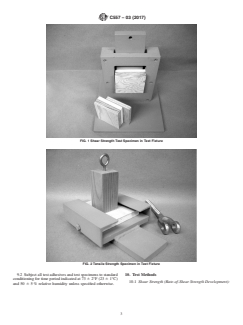
opened containers at temperatures ranging from 40 to 85°F (4
8.7 Compression Shear Test Fixture—A compression-shear
to 30°C).
apparatusthatissimilarto,butofalargerscalethanthefixture
6. Adhesive Performance Property Requirements
recommendedinTestMethodD905.Asimilarfixtureisshown
in Fig. 1.
6.1 The adhesives shall conform to the requirements sum-
marized in Table 1. 8.8 Tensile Test Fixture—An assembly of one 5 by 5 by
1 1
⁄2-in. (127 by 127 by 12.7-mm) thick steel plate and two 1 ⁄2
7. Sampling 1 1
by 1 ⁄2-in. by ⁄4-in. thick by 6-in. long (38.1 by 38.1 by
6.4-mmthickby152-mmlong)steelanglesections.SeeFig.2.
7.1 The test adhesive sample size of 1 qt (approximately 1
L) is a minimum amount to complete one full series of testing.
8.9 Scaffold Nails—6d, common, double-head, smooth
The sample is to be handled and stored according to the
shaft, 0.113-in. (2.87-mm) diameter, 2 in. (51 mm) long.
manufacturers recommendations. For qualification testing, the
8.10 Testing Machine—Any suitable testing machine that is
sample is to be representative of the final product for which
capable of operation at a constant rate of motion of the
recognition is sought.
moveableheadandhasaforcemeasurementaccuracyof 61%
when calibrated in accordance with Practices E4.
8. Materials and Apparatus for Conducting Tests
8.11 Wood Screw with Eyelet—#6 by 1 ⁄2-in. (38.1-mm)
8.1 Gypsum Wallboard— ⁄2-in. (12.7-mm) thick, complying
long, with a ⁄8-in. (9.5-mm) inside diameter eyelet.
with Specification C1396/C1396M; the dimensions are speci-
5 19
8.12 Plywood Shim— ⁄8-in. (15.9-mm) or ⁄32-in. (15.1-
fied in each test.
mm) thick plywood with dimensions of 4 by 3 ⁄2 in. (101.6 by
5 19
8.2 Plywood— ⁄8-in. (15.9-mm) or ⁄32-in (15.1-mm) U.S.
88.9-mm) for shear test specimens and 4 by 4 in. (101.6 by
Product Standard PS-1-95 grade marked stamped commercial
101.6-mm) for tensile test specimens.
plywood, Group 1 Species, exterior glue, or sanded exterior
grade plywood, underlayment type, with A grade face ply for
9. Conditioning of Materials and Specimens (Standard
the adhesion surface.
Conditions)
8.3 Douglas-fir Dimension Lumber—Nominal 2 by 4, 1 ⁄2 9.1 Condition the gypsum wallboard, plywood, and
1 1
by 1 ⁄2 by 3 ⁄2-in. (38.0 by 38.0 by 89.0 mm); No. 1, Douglas-fir, lumber to a constant weight at 73 6 2°F (23 6
straight-grained, and knot-free; the dimensions are specified in 1°C) and 50 6 5% relative humidity, unless specified other-
each test. wise.
TABLE 1 Adhesive Properties and Performance Requirements
Reference
Test Method Property Condition Requirements
Number
Rate of shear strength development 10.1.4 shear strength 24 h at Std. Cond. 10 psi (69 kPa) min
10.1.5 shear strength 14 days at Std. Cond. 40 psi (276 kPa) min
10.1.6 shear strength 14 days at Std. Cond., + cyclic 32 psi (220 kPa) min
lab exposure, + 2 days at
Std. Cond.
10.1.7 shear strength (a) 178 N (40 lbf) for 24 h at no bond separation
Std. Cond.
(b) 89 N (20 lbf) for 24 h at no bond separation
100°F
Rate of tensile strength development 10.2.3 tensile strength 24 h at Std. Cond. 15 psi (103 kPa) min
10.2.4 tensile strength 14 days at Std. Cond. 25 psi (172 kPa) min
Adhesive open-time determination 10.3 open-time 24 h at Std. Cond. 75 % paper transfer, min
Substrate wet-out by adhesive
1. Plywood 10.4.1 wet-out spatula applied good wetting property
2. Wallboard 10.4.2 wet-out spatula applied good wetting property
Bridging 10.5 gap filling 48 h at Std. Cond. adhesive bond line is maintained -
report paper failure %
Accelerated adhesive aging 10.6 accelerated aging 500 h at 70°C (158°F) no fracture into separate pieces
Freeze-thaw stability 10.7 low-temperature storage 3 cycles of: no change in workability; 10 psi
24 h at -17°C (0°F) + 24 h at (69 kPa) shear strength, min
Std. Cond.
Suitability as a laminating adhesive for vinyl- 10.8.1 compatibility 24 h at 38°C (100°F) no blistering, vinyl-film discoloration,
covered wallboard or bond failure
10.8.2 staining 1 h at Std. Cond. no swelling or discoloration
C557−03 (2017)
FIG. 1Shear Strength Test Specimen in Text Fixture
FIG. 2Tensile Strength Specimen in Text Fixture
9.2 Subjectalltestadhesivesandtestspecimenstostandard 10. Test Methods
conditioning for time period indicated at 73 6 2°F (23 6 1°C)
10.1 Shear Strength (Rate-of-Shear Strength Development):
and 50 6 5% relative humidity unless specified otherwise.
C557−03 (2017)
10.1.1 Preparation of Gypsum Wallboard-Plywood 10.1.2.5 Immediately following assembly, compress each
Laminates—Eachlaminateisconstructedbybondingapieceof test specimen under a uniformly distributed load of 15 lb (67
1 1 1
4by3 ⁄2 by ⁄2-in. thick (102 by 89 by 12.7-mm) gypsum N) for a period of 3 to 3- ⁄2 min.
5 1
wallboard front paper surface paper to a ⁄8-in. (15.9 mm) or 10.1.2.6 After the 3 to 3- ⁄2 min period, remove the load,
⁄32-in.(15.1-mm)plywoodshimofthesamedimensionswith withdraw the spacers, wipe the excess adhesive from the
a commercially available PVA adhesive. The plywood rein- bonded edges with a square-edged spatula taking care not to
forces the gypsum wallboard to prevent fracture before the disturb the alignment of the bonded pieces.
ultimate shear load can be achieved. The grain of the gypsum 10.1.3 ShearStrengthDetermination—Aftercompletingthe
wallboard back surface paper is parallel with the 3 ⁄2-in. appropriate conditioning, test the specimen in shear using a
(89-mm) direction. compression-shear test fixture as shown in Fig. 1. The bottom
10.1.2 Preparation of Shear Strength Test Specimens— edge of the wallboard-plywood laminate rests on self-aligning
Prepare the number of test specimens indicated in 10.1.4 – seat as the test loading is simultaneously applied to the top
10.1.7 by bondinga4by3 ⁄2 in. (102 by 89-mm) piece edge of the single plywood. The stress applied is parallel and
plywood to the previously prepared wallboard-plywood lami- uniformly distributed to the bond line shear plane and requires
nate as follows: careful orientation using shims and self-aligning apparatus as
10.1.2.1 Spread the test adhesive onto the plywood bonding necessary.Determinetheshearstrengthatacrossheadspeedof
surface with a trowel having ⁄16-in. (4.8-mm) deep V-notches 0.50-in/min (12.7-mm/min). Observations are made during
so that the adhesive ridges are parallel to the grain of wood. stress application to ensure the test assembly maintains proper
Duringapplicationholdthetrowelatanapproximate90°angle alignment and the fixture operates without binding or friction
to the receiving surface. throughout the test. Record the maximum shear strength and
10.1.2.2 Insert six wire spacers No. 20 gauge at least 2-in. theaverageshearstrengthforthe24h,14–day,cycleexposure,
(51.0-mm) long in the joint 1-in. 6 ⁄16-in. (25.4 6 1.6-mm). and static load test conditions.
Position the spacers so that one is on the centerline of the 10.1.4 Shear Strength After 24 h:
bonded area (perpendicular to the ridges), and the others are 10.1.4.1 Prepare five test assemblies using the procedure in
1-in.(25.4-mm)awayfromthecenterspacersandparalleltoit. 10.1.1 and 10.1.2.
10.1.2.3 Allow an open time of 30 s 6 5 s upon completion 10.1.4.2 After aging the assemblies 24 h 6 1 h at standard
of spreading. condition (9.1), determine the shear strength in accordance
10.1.2.4 Squarely position the gypsum wallboard-plywood with 10.1.3.
laminate back surface paper onto the adhesive coated plywood 10.1.5 Shear Strength After 14 Days:
1 1
with the overlapping 2 ⁄2 6 ⁄16-in. (63.5 6 1.6-mm), thus 10.1.5.1 Preparefivetestassembliessusingtheprocedurein
2 2
forming the 10-in. (64.5-cm ) bonded area. See Fig. 3. 10.1.1 to 10.1.2.
FIG. 3Shear Strength Test Specimen Assembly
C557−03 (201
...