

ASTM D831/D831M-12(2020)
(Test Method)Standard Test Method for Gas Content of Cable and Capacitor Oils
General Information
- Abstract
SIGNIFICANCE AND USE
4.1 The gas content of cable and capacitor oils is considered to be important, since the evolution of gas in the form of bubbles can have an adverse effect on the insulating properties of these fluids. It is customary to degas these oils prior to use, and this test method provides a means of determining the gas content before and after degassing.
SCOPE
1.1 This test method covers the determination of the gas content of electrical insulating oils of low and medium viscosities in the general range up to 190 mm2/s at 104°F [40°C], such as are used in capacitors and paper-insulated electric cables and cable systems of the oil-filled type. The determination of gas content is desirable for any insulating oil having these properties and intended for use in a degassed state.
Note 1: For testing insulating oils with viscosities of 19 mm2/s or below at 40°C, see Test Method D2945.
1.2 The values stated in either SI units or inch-pound units are to be regarded separately as standard. The values stated in each system are not necessarily exact equivalents; therefore, to ensure conformance with the standard, each system shall be used independently of the other, and values from the two systems shall not be combined.
1.3 This standard does not purport to address all of the safety concerns, if any, associated with its use. It is the responsibility of the user of this standard to establish appropriate safety, health, and environmental practices and determine the applicability of regulatory limitations prior to use.
1.4 This international standard was developed in accordance with internationally recognized principles on standardization established in the Decision on Principles for the Development of International Standards, Guides and Recommendations issued by the World Trade Organization Technical Barriers to Trade (TBT) Committee.
- Status
- Published
- Publication Date
- 30-Nov-2020
- Technical Committee
- D27 - Electrical Insulating Liquids and Gases
- Drafting Committee
- D27.03 - Analytical Tests

Overview
ASTM D831/D831M-12(2020) is the internationally recognized standard test method developed by ASTM International for evaluating the gas content in cable and capacitor oils. This standard is essential for assessing electrical insulating oils of low and medium viscosities (up to 190 mm²/s at 40°C), as used in oil-filled capacitors and paper-insulated electric cables. The procedure defines a reliable method for determining gas content both before and after degassing, which is vital because evolved gas in the form of bubbles can adversely affect the dielectric and insulating properties of the oil.
Key Topics
- Purpose: To quantify the gas content in electrical insulating oils to ensure high performance and reliability of power systems.
- Importance of Degassing: Gas bubbles reduce the insulating properties of oils, making degassing a common industry practice before application in equipment.
- Sampling and Measurement: The method utilizes specialized apparatus, including a degassing chamber, vacuum system, and pressure measurements, to accurately determine the volume of gas released from the oil.
- Applicability: Suitable for oils used in oil-filled cables, capacitors, and cable systems, particularly when these oils are to be used in a degassed state.
- Calculation: The gas content is calculated as the percentage of gas (at standard conditions) by volume of oil, considering apparatus calibration, oil and chamber temperatures, and pressure differences.
- Precision: The standard provides guidance on sampling and procedural accuracy, helping minimize errors and ensure reproducibility.
Applications
The ASTM D831/D831M-12(2020) test method is widely applied across the electrical power industry and related sectors where reliable insulation and equipment longevity are paramount. Practical applications include:
- Quality Assurance: Used by manufacturers to ensure that cable and capacitor oils meet stringent gas content requirements before being installed in critical infrastructure.
- Maintenance: Power utilities and service providers utilize this standard for routine diagnostics and preventive maintenance by testing in-service oils and identifying risks associated with gas accumulation.
- Research and Development: Laboratories and R&D departments reference this method when developing new types of insulating oils or improving existing formulations.
- Compliance and Safety: Following this standard ensures alignment with regulatory expectations and international best practices, minimizing the risk of equipment failures caused by insufficiently degassed oils.
Related Standards
For comprehensive quality management and testing in electrical insulating oils, the following related standards may also be applicable:
- ASTM D2945: Standard Test Method for Gas Content of Insulating Oils (for oils with viscosity 19 mm²/s or below at 40°C).
- IEC Standards: Refer to International Electrotechnical Commission documents for additional methods and requirements concerning electrical insulating liquids.
- Other ASTM Standards: For sampling, safety considerations, and general test methodologies, refer to ASTM's catalog for updated and relevant standards.
Keywords: cable oil, capacitor oil, electrical insulating oil, gas content, oil-filled cable, ASTM D831, oil degassing, dielectric oil testing
Adherence to ASTM D831/D831M-12(2020) supports optimal performance, safety, and reliability for critical electrical insulation systems by ensuring accurate detection and control of gas content in insulating oils.
Relations
- Refers
ASTM D2945-90(2003)e2 - Standard Test Method for Gas Content of Insulating Oils (Withdrawn 2012) - Effective Date
- 23-Feb-1990
- Effective Date
- 23-Feb-1990
- Effective Date
- 23-Feb-1990
Get Certified
Connect with accredited certification bodies for this standard

IMQ S.p.A. (Certification)
Italian electrical product certification.

SLG Prüf- und Zertifizierungs GmbH
German testing and certification body.

UL Solutions
Global safety science company with testing, inspection and certification.
Sponsored listings
Frequently Asked Questions
ASTM D831/D831M-12(2020) is a standard published by ASTM International. Its full title is "Standard Test Method for Gas Content of Cable and Capacitor Oils". This standard covers: SIGNIFICANCE AND USE 4.1 The gas content of cable and capacitor oils is considered to be important, since the evolution of gas in the form of bubbles can have an adverse effect on the insulating properties of these fluids. It is customary to degas these oils prior to use, and this test method provides a means of determining the gas content before and after degassing. SCOPE 1.1 This test method covers the determination of the gas content of electrical insulating oils of low and medium viscosities in the general range up to 190 mm2/s at 104°F [40°C], such as are used in capacitors and paper-insulated electric cables and cable systems of the oil-filled type. The determination of gas content is desirable for any insulating oil having these properties and intended for use in a degassed state. Note 1: For testing insulating oils with viscosities of 19 mm2/s or below at 40°C, see Test Method D2945. 1.2 The values stated in either SI units or inch-pound units are to be regarded separately as standard. The values stated in each system are not necessarily exact equivalents; therefore, to ensure conformance with the standard, each system shall be used independently of the other, and values from the two systems shall not be combined. 1.3 This standard does not purport to address all of the safety concerns, if any, associated with its use. It is the responsibility of the user of this standard to establish appropriate safety, health, and environmental practices and determine the applicability of regulatory limitations prior to use. 1.4 This international standard was developed in accordance with internationally recognized principles on standardization established in the Decision on Principles for the Development of International Standards, Guides and Recommendations issued by the World Trade Organization Technical Barriers to Trade (TBT) Committee.
SIGNIFICANCE AND USE 4.1 The gas content of cable and capacitor oils is considered to be important, since the evolution of gas in the form of bubbles can have an adverse effect on the insulating properties of these fluids. It is customary to degas these oils prior to use, and this test method provides a means of determining the gas content before and after degassing. SCOPE 1.1 This test method covers the determination of the gas content of electrical insulating oils of low and medium viscosities in the general range up to 190 mm2/s at 104°F [40°C], such as are used in capacitors and paper-insulated electric cables and cable systems of the oil-filled type. The determination of gas content is desirable for any insulating oil having these properties and intended for use in a degassed state. Note 1: For testing insulating oils with viscosities of 19 mm2/s or below at 40°C, see Test Method D2945. 1.2 The values stated in either SI units or inch-pound units are to be regarded separately as standard. The values stated in each system are not necessarily exact equivalents; therefore, to ensure conformance with the standard, each system shall be used independently of the other, and values from the two systems shall not be combined. 1.3 This standard does not purport to address all of the safety concerns, if any, associated with its use. It is the responsibility of the user of this standard to establish appropriate safety, health, and environmental practices and determine the applicability of regulatory limitations prior to use. 1.4 This international standard was developed in accordance with internationally recognized principles on standardization established in the Decision on Principles for the Development of International Standards, Guides and Recommendations issued by the World Trade Organization Technical Barriers to Trade (TBT) Committee.
ASTM D831/D831M-12(2020) is classified under the following ICS (International Classification for Standards) categories: 29.040.10 - Insulating oils. The ICS classification helps identify the subject area and facilitates finding related standards.
ASTM D831/D831M-12(2020) has the following relationships with other standards: It is inter standard links to ASTM D2945-90(2003)e2, ASTM D2945-90(2003), ASTM D2945-90(2003)e1. Understanding these relationships helps ensure you are using the most current and applicable version of the standard.
ASTM D831/D831M-12(2020) is available in PDF format for immediate download after purchase. The document can be added to your cart and obtained through the secure checkout process. Digital delivery ensures instant access to the complete standard document.
Standards Content (Sample)
This international standard was developed in accordance with internationally recognized principles on standardization established in the Decision on Principles for the
Development of International Standards, Guides and Recommendations issued by the World Trade Organization Technical Barriers to Trade (TBT) Committee.
Designation: D831/D831M − 12 (Reapproved 2020)
Standard Test Method for
Gas Content of Cable and Capacitor Oils
This standard is issued under the fixed designation D831/D831M; the number immediately following the designation indicates the year
of original adoption or, in the case of revision, the year of last revision.Anumber in parentheses indicates the year of last reapproval.
A superscript epsilon (´) indicates an editorial change since the last revision or reapproval.
1. Scope D2945Test Method for Gas Content of Insulating Oils
(Withdrawn 2012)
1.1 This test method covers the determination of the gas
content of electrical insulating oils of low and medium
3. Summary of Test Method
viscosities in the general range up to 190 mm /s at 104°F
3.1 This test method consists essentially of feeding the oil
[40°C], such as are used in capacitors and paper-insulated
into an evacuated chamber in such a manner that the oil is
electric cables and cable systems of the oil-filled type. The
thoroughlyexposedtothevacuum,allowingfreeescapeofany
determination of gas content is desirable for any insulating oil
dissolvedgas.Fromthevolumeofoiladmittedtothechamber,
having these properties and intended for use in a degassed
the temperature, the pressure produced, and volume occupied
state.
by the released gas, the gas volume under standard conditions
NOTE 1—For testing insulating oils with viscosities of 19 mm /s or
of pressure and temperature may be calculated as a percentage
below at 40°C, see Test Method D2945.
by volume of oil.
1.2 The values stated in either SI units or inch-pound units
4. Significance and Use
are to be regarded separately as standard. The values stated in
each system are not necessarily exact equivalents; therefore, to 4.1 Thegascontentofcableandcapacitoroilsisconsidered
ensure conformance with the standard, each system shall be to be important, since the evolution of gas in the form of
bubbles can have an adverse effect on the insulating properties
used independently of the other, and values from the two
systems shall not be combined. of these fluids. It is customary to degas these oils prior to use,
and this test method provides a means of determining the gas
1.3 This standard does not purport to address all of the
content before and after degassing.
safety concerns, if any, associated with its use. It is the
responsibility of the user of this standard to establish appro-
5. Apparatus (see Fig. 1)
priate safety, health, and environmental practices and deter-
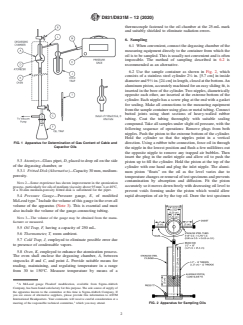
5.1 Degassing Chamber—Degassing chamber, A, made of
mine the applicability of regulatory limitations prior to use.
heat-resistantglass (withcalibratedoilwellatbottom),having
1.4 This international standard was developed in accor-
afixedtotalspacevolumeofabout175to300mL.Theoilwell
dance with internationally recognized principles on standard-
shall have a maximum capacity of 50 mL and shall be
ization established in the Decision on Principles for the
calibrated in 0.2-mL divisions.
Development of International Standards, Guides and Recom-
5.2 Stopcocks—Glass stopcocks, B and C, which shall have
mendations issued by the World Trade Organization Technical
large-diameter barrels and a mirror finish to ensure against
Barriers to Trade (TBT) Committee.
leakage. Use stopcock grease on all stopcocks and ground-
glass joints.
2. Referenced Documents
2.1 ASTM Standards: 2
For referenced ASTM standards, visit the ASTM website, www.astm.org, or
contact ASTM Customer Service at service@astm.org. For Annual Book of ASTM
Standards volume information, refer to the standard’s Document Summary page on
the ASTM website.
1 2
This test method is under the jurisdiction of ASTM Committee D27 on The last approved version of this historical standard is referenced on
Electrical Insulating Liquids and Gases and is the direct responsibility of Subcom- www.astm.org.
mittee D27.03 on Analytical Tests. Borosilicate glass has been found to be satisfactory for this purpose.
Current edition approved Dec. 1, 2020. Published December 2020. Originally AstopcockgreaseequivalenttoNo.15521.Areadilyavailablevacuumsealing
approved in 1945. Last previous edition approved in 2012 as D831–12. DOI: compound. Dow Corning grease #1597418, has been found to be satisfactory for
10.1520/D0831_D0831M-12R20. this use.
Copyright © ASTM International, 100 Barr Harbor Drive, PO Box C700, West Conshohocken, PA 19428-2959. United States
D831/D831M − 12 (2020)
thermocouple fastened to the oil chamber at the 25-mL mark
and suitably shielded to eliminate radiation errors.
6. Sampling
6.1 Whenconvenient,connectthedegassingchamberofthe
measuring equipment directly to the container from which the
oilistobesampled.Thisisusuallynotconvenientandisoften
impossible. The method of sampling described in 6.2 is
recommended as an alternative.
6.2 Use the sample container as shown in Fig. 2, which
consists of a stainless steel cylinder 2 ⁄4 in. [5.7 cm] in inside
diameterand9 ⁄2in.[24cm]inlength,closedatthebottom.An
aluminumpiston,accuratelymachinedforaneasyslidingfit,is
inserted in the bore of the cylinder. Two nipples, diametrically
opposite each other, are inserted at the extreme bottom of the
cylinder. Each nipple has a screw plug at the end with a gasket
for sealing. Make all connections to the measuring equipment
fromthesamplecontainerusingglassormetaltubing.Connect
butted joints using short sections of heavy-walled rubber
tubing. Coat the tubing thoroughly with suitable sealing
compound.Take all samples under slight oil pressure, with the
following sequence of operations: Remove plugs from both
nipples. Push the piston to the extreme bottom of the cylinder.
Hold the cylinder so that the nipples point in a vertical
FIG. 1 Apparatus for Determination of Gas Content of Cable and direction. Using a rubber tube connection, force oil in through
Capacitor Oils
the nipple in the lowest position and flush a few millilitres out
the opposite nipple to remove any trapped air bubbles. Then
insert the plug in the outlet nipple and allow oil to push the
5.3 Atomizer—Glass pipet, D, placed to drop oil on the side
piston up to fill the cylinder. Hold the piston at the top of the
of the degassing chamber, or
cylinder with one hand and plug the inlet nipple. The alumi-
5.3.1 FrittedDisk(Alternative)—Capacity30mm,medium-
num piston “floats” on the oil as the level varies due to
porosity.
temperaturechangesorremovaloftestspecimensandprevents
contamination by absorption and diffusion. Fit the piston
NOTE 2—Some experience has shown improvement in the atomization
accurately so it moves down freely with decreasing oil level to
process,particularlyforoilsofmediumviscosityabove95mm /sat40°C,
if a 30-mm medium-porosity fritted disk is substituted for the pipet.
prevent voids forming under the piston which would allow
rapid absorption of air by the top oil. Draw the test specimen
5.4 Pressure Gauge—Pressure gauge, E, of modified
McLeodtype. Includethevolumeofthisgaugeintheover-all
volume of the apparatus (Note 3). This is essential and must
also include the volume of the gauge-connecting tubing.
NOTE 3—The volume of the gauge may be obtained from the manu-
facturer or measured.
5.5 Oil Trap, F, having a capacity of 250 mL.
5.6 Thermometer, T, room ambient.
5.7 Cold Trap, J, employed to eliminate possible error due
to presence of condensable vapors.
5.8 Oven, K, employed to enhance the atomization process.
The oven shall enclose the degassing chamber, A, between
stopcocks B and C, and point L. Provide suitable means for
reading, maintaining, and regulating temperature in a range
from 30 to 150°C. Measure temperature by means of a
A McLeod gauge Flosdorf modification, available from Sigma-Aldrich
Company,hasbeenfoundsatisfactoryforthispurpose.Thesolesourceofsupplyof
the apparatus known to the committee at this time is Sigma-Aldrich Company. If
you are aware of alternative suppliers, please provide this information to ASTM
International Headquarters. Your comments will receive careful consideration at a
meeting of the responsible technical committee, which you may attend. FIG. 2 Apparatus for Sampling Oils
D831/D831M − 12 (2020)
continuously from the cylinder, weight the piston to ensure sources of leakage. (Let the vacuum pump run continuously to
maintenance of contact with the oil. Wide variations in the enhance the seal of stopco
...