


ASTM D6316-17
(Test Method)Standard Test Method for Determination of Total, Combustible and Carbonate Carbon in Solid Residues from Coal and Coke
Standard Test Method for Determination of Total, Combustible and Carbonate Carbon in Solid Residues from Coal and Coke
SIGNIFICANCE AND USE
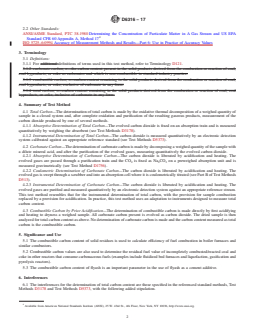
5.1 The combustible carbon content of solid residues is used to calculate efficiency of fuel combustion in boiler furnaces and similar combustors.
5.2 Combustible carbon values are also used to determine the residual fuel value of incompletely combusted/reacted coal and coke in other reactors that consume carbonaceous fuels (examples include fluidized bed furnaces and liquefaction, gasification and pyrolysis reactors).
5.3 The combustible carbon content of flyash is an important parameter in the use of flyash as a cement additive.
SCOPE
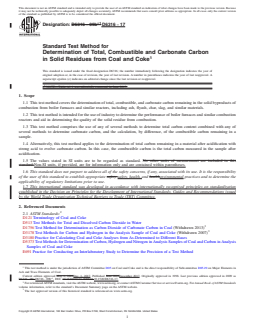
1.1 This test method covers the determination of total, combustible, and carbonate carbon remaining in the solid byproducts of combustion from boiler furnaces and similar reactors, including ash, flyash, char, slag, and similar materials.
1.2 This test method is intended for the use of industry to determine the performance of boiler furnaces and similar combustion reactors and aid in determining the quality of the solid residue from combustion.
1.3 This test method comprises the use of any of several methods to determine total carbon content combined with any of several methods to determine carbonate carbon, and the calculation, by difference, of the combustible carbon remaining in a sample.
1.4 Alternatively, this test method applies to the determination of total carbon remaining in a material after acidification with strong acid to evolve carbonate carbon. In this case, the combustible carbon is the total carbon measured in the sample after acidification.
1.5 The values stated in SI units are to be regarded as standard. Non-SI units, if provided, are for information only and are contained within parentheses.
1.6 This standard does not purport to address all of the safety concerns, if any, associated with its use. It is the responsibility of the user of this standard to establish appropriate safety, health, and environmental practices and to determine the applicability of regulatory limitations prior to use.
1.7 This international standard was developed in accordance with internationally recognized principles on standardization established in the Decision on Principles for the Development of International Standards, Guides and Recommendations issued by the World Trade Organization Technical Barriers to Trade (TBT) Committee.
General Information
- Status
- Published
- Publication Date
- 30-Nov-2017
- Technical Committee
- D05 - Coal and Coke
- Drafting Committee
- D05.29 - Major Elements in Ash and Trace Elements of Coal
Relations
- Effective Date
- 01-Dec-2017
- Effective Date
- 01-Mar-2024
- Effective Date
- 01-Dec-2023
- Effective Date
- 01-Sep-2015
- Effective Date
- 01-Jan-2015
- Effective Date
- 01-Mar-2014
- Effective Date
- 01-Mar-2014
- Effective Date
- 15-Oct-2013
- Effective Date
- 01-May-2013
- Effective Date
- 01-Apr-2012
- Effective Date
- 06-Feb-2012
- Effective Date
- 01-Nov-2011
- Effective Date
- 01-Oct-2009
- Effective Date
- 01-Feb-2009
- Effective Date
- 01-Oct-2008
Overview
ASTM D6316-17 is the standard test method established by ASTM International for the determination of total, combustible, and carbonate carbon in solid residues from coal and coke. This test method is widely used in the energy and materials industries for analyzing the carbon content of byproducts such as ash, flyash, char, and slag resulting from the combustion of coal and coke in boiler furnaces and other reactors. Determining accurate levels of each carbon type is essential for assessing fuel combustion efficiency, evaluating the quality of solid residues, and understanding the potential uses and residual value of combustion byproducts.
Key Topics
- Total Carbon Determination: Measures all forms of carbon present in a sample, including both combustible and carbonate carbon.
- Combustible Carbon: Represents the carbon fraction in solid residues capable of further oxidation and is key to assessing combustion efficiency and potential residual fuel value.
- Carbonate Carbon: The non-combustible carbon fraction in carbonate compounds, relevant for detailed residue analysis.
- Analytical Methods:
- Thermal decomposition followed by measurement of CO₂.
- Absorptive, coulometric, and instrumental quantification.
- Acidification approaches to evolve and measure carbonate carbon.
- Sample Preparation: Careful collection and preparation are required for representative analysis, including predrying, pulverizing, and dividing samples according to standard practice.
- Precision and Repeatability: The method provides guidelines for repeatability and reproducibility, supporting interlaboratory consistency.
Applications
- Boiler and Combustion System Performance: Used to determine fuel combustion efficiency in boiler furnaces, fluidized bed reactors, and similar combustion equipment. Higher combustible carbon residues may indicate incomplete combustion.
- Assessment of Residual Fuel Value: Essential in evaluating unburned carbon in residues from various carbon conversion systems such as gasification, liquefaction, and pyrolysis reactors.
- Flyash Characterization: In the construction sector, specifically in cement production, the combustible carbon content of flyash influences its suitability as a cement additive and affects product quality.
- Environmental Compliance: Supports monitoring and reporting requirements for plant emissions and waste characterization.
- Quality Control in Coal and Coke Processing: Assists producers and consumers in verifying the completeness of fuel utilization and in optimizing process parameters.
Related Standards
Several key standards and references complement and provide context to ASTM D6316-17:
- ASTM D121: Terminology of Coal and Coke - definitions relevant to coal and coke analysis.
- ASTM D5373: Test Methods for Determination of Carbon, Hydrogen, and Nitrogen in Coal and Coke.
- ASTM D3180: Practice for Calculating Coal and Coke Analyses from As-Determined to Different Bases.
- ANSI/ASME PTC 38-1980: Procedures for particulate sampling in combustion systems.
- US EPA CFR 60 Appendix A, Method 17: Methods for determining the concentration of particulate matter in emissions.
- ISO 5725-6: Guidelines for precision in analytical measurement methods and interlaboratory studies.
Practical Value
Implementing ASTM D6316-17 ensures reliable, repeatable, and industry-accepted assessment of carbon forms in solid residues from coal and coke combustion. This test method aids operational efficiency, regulatory compliance, resource optimization, and product quality-supporting both environmental stewardship and economic performance in the power, manufacturing, and construction sectors. By following standardized sample handling and analysis procedures, laboratories and plants can generate data essential for technical decision-making and continuous process improvement.
Keywords: ASTM D6316-17, total carbon, combustible carbon, carbonate carbon, ash analysis, flyash, boiler efficiency, coal residue, coke residue, combustion performance, carbon determination, standard test method.
Buy Documents
ASTM D6316-17 - Standard Test Method for Determination of Total, Combustible and Carbonate Carbon in Solid Residues from Coal and Coke
REDLINE ASTM D6316-17 - Standard Test Method for Determination of Total, Combustible and Carbonate Carbon in Solid Residues from Coal and Coke
Get Certified
Connect with accredited certification bodies for this standard

ABS Quality Evaluations Inc.
American Bureau of Shipping quality certification.

Element Materials Technology
Materials testing and product certification.

ABS Group Brazil
ABS Group certification services in Brazil.
Sponsored listings
Frequently Asked Questions
ASTM D6316-17 is a standard published by ASTM International. Its full title is "Standard Test Method for Determination of Total, Combustible and Carbonate Carbon in Solid Residues from Coal and Coke". This standard covers: SIGNIFICANCE AND USE 5.1 The combustible carbon content of solid residues is used to calculate efficiency of fuel combustion in boiler furnaces and similar combustors. 5.2 Combustible carbon values are also used to determine the residual fuel value of incompletely combusted/reacted coal and coke in other reactors that consume carbonaceous fuels (examples include fluidized bed furnaces and liquefaction, gasification and pyrolysis reactors). 5.3 The combustible carbon content of flyash is an important parameter in the use of flyash as a cement additive. SCOPE 1.1 This test method covers the determination of total, combustible, and carbonate carbon remaining in the solid byproducts of combustion from boiler furnaces and similar reactors, including ash, flyash, char, slag, and similar materials. 1.2 This test method is intended for the use of industry to determine the performance of boiler furnaces and similar combustion reactors and aid in determining the quality of the solid residue from combustion. 1.3 This test method comprises the use of any of several methods to determine total carbon content combined with any of several methods to determine carbonate carbon, and the calculation, by difference, of the combustible carbon remaining in a sample. 1.4 Alternatively, this test method applies to the determination of total carbon remaining in a material after acidification with strong acid to evolve carbonate carbon. In this case, the combustible carbon is the total carbon measured in the sample after acidification. 1.5 The values stated in SI units are to be regarded as standard. Non-SI units, if provided, are for information only and are contained within parentheses. 1.6 This standard does not purport to address all of the safety concerns, if any, associated with its use. It is the responsibility of the user of this standard to establish appropriate safety, health, and environmental practices and to determine the applicability of regulatory limitations prior to use. 1.7 This international standard was developed in accordance with internationally recognized principles on standardization established in the Decision on Principles for the Development of International Standards, Guides and Recommendations issued by the World Trade Organization Technical Barriers to Trade (TBT) Committee.
SIGNIFICANCE AND USE 5.1 The combustible carbon content of solid residues is used to calculate efficiency of fuel combustion in boiler furnaces and similar combustors. 5.2 Combustible carbon values are also used to determine the residual fuel value of incompletely combusted/reacted coal and coke in other reactors that consume carbonaceous fuels (examples include fluidized bed furnaces and liquefaction, gasification and pyrolysis reactors). 5.3 The combustible carbon content of flyash is an important parameter in the use of flyash as a cement additive. SCOPE 1.1 This test method covers the determination of total, combustible, and carbonate carbon remaining in the solid byproducts of combustion from boiler furnaces and similar reactors, including ash, flyash, char, slag, and similar materials. 1.2 This test method is intended for the use of industry to determine the performance of boiler furnaces and similar combustion reactors and aid in determining the quality of the solid residue from combustion. 1.3 This test method comprises the use of any of several methods to determine total carbon content combined with any of several methods to determine carbonate carbon, and the calculation, by difference, of the combustible carbon remaining in a sample. 1.4 Alternatively, this test method applies to the determination of total carbon remaining in a material after acidification with strong acid to evolve carbonate carbon. In this case, the combustible carbon is the total carbon measured in the sample after acidification. 1.5 The values stated in SI units are to be regarded as standard. Non-SI units, if provided, are for information only and are contained within parentheses. 1.6 This standard does not purport to address all of the safety concerns, if any, associated with its use. It is the responsibility of the user of this standard to establish appropriate safety, health, and environmental practices and to determine the applicability of regulatory limitations prior to use. 1.7 This international standard was developed in accordance with internationally recognized principles on standardization established in the Decision on Principles for the Development of International Standards, Guides and Recommendations issued by the World Trade Organization Technical Barriers to Trade (TBT) Committee.
ASTM D6316-17 is classified under the following ICS (International Classification for Standards) categories: 75.160.10 - Solid fuels. The ICS classification helps identify the subject area and facilitates finding related standards.
ASTM D6316-17 has the following relationships with other standards: It is inter standard links to ASTM D6316-09be1, ASTM D121-15(2024), ASTM D3180-15(2023), ASTM D121-15, ASTM D3180-15, ASTM D5373-14e1, ASTM D5373-14, ASTM D5373-13, ASTM E691-13, ASTM D3180-12, ASTM D513-11e1, ASTM E691-11, ASTM D121-09a, ASTM D121-09, ASTM E691-08. Understanding these relationships helps ensure you are using the most current and applicable version of the standard.
ASTM D6316-17 is available in PDF format for immediate download after purchase. The document can be added to your cart and obtained through the secure checkout process. Digital delivery ensures instant access to the complete standard document.
Standards Content (Sample)
This international standard was developed in accordance with internationally recognized principles on standardization established in the Decision on Principles for the
Development of International Standards, Guides and Recommendations issued by the World Trade Organization Technical Barriers to Trade (TBT) Committee.
Designation: D6316 − 17
Standard Test Method for
Determination of Total, Combustible and Carbonate Carbon
in Solid Residues from Coal and Coke
This standard is issued under the fixed designation D6316; the number immediately following the designation indicates the year of
original adoption or, in the case of revision, the year of last revision. A number in parentheses indicates the year of last reapproval. A
superscript epsilon (´) indicates an editorial change since the last revision or reapproval.
1. Scope 2. Referenced Documents
1.1 This test method covers the determination of total, 2.1 ASTM Standards:
combustible, and carbonate carbon remaining in the solid D121 Terminology of Coal and Coke
byproducts of combustion from boiler furnaces and similar D513 Test Methods for Total and Dissolved Carbon Dioxide
reactors,includingash,flyash,char,slag,andsimilarmaterials. in Water
D1756 Test Method for Determination as Carbon Dioxide of
1.2 This test method is intended for the use of industry to
Carbonate Carbon in Coal (Withdrawn 2013)
determine the performance of boiler furnaces and similar
D3178 Test Methods for Carbon and Hydrogen in the
combustion reactors and aid in determining the quality of the
Analysis Sample of Coal and Coke (Withdrawn 2007)
solid residue from combustion.
D3180 Practice for Calculating Coal and Coke Analyses
1.3 This test method comprises the use of any of several
from As-Determined to Different Bases
methods to determine total carbon content combined with any
D5373 Test Methods for Determination of Carbon, Hydro-
of several methods to determine carbonate carbon, and the
genandNitrogeninAnalysisSamplesofCoalandCarbon
calculation,bydifference,ofthecombustiblecarbonremaining
in Analysis Samples of Coal and Coke
in a sample.
E691 Practice for Conducting an Interlaboratory Study to
Determine the Precision of a Test Method
1.4 Alternatively, this test method applies to the determina-
tion of total carbon remaining in a material after acidification 2.2 Other Standards:
ANSI/ASME Standard, PTC 38-1980 Determining the Con-
with strong acid to evolve carbonate carbon. In this case, the
combustible carbon is the total carbon measured in the sample centration of Particulate Matter in A Gas Stream and US
EPA Standard CFR 60 Appendix A, Method 17
after acidification.
ISO 5725–6:0994 Accuracy of Measurement Methods and
1.5 The values stated in SI units are to be regarded as
Results—Part 6: Use in Practice of Accuracy Values
standard. Non-SI units, if provided, are for information only
and are contained within parentheses.
3. Terminology
1.6 This standard does not purport to address all of the
3.1 Definitions:
safety concerns, if any, associated with its use. It is the
3.1.1 For definitions of terms used in this test method, refer
responsibility of the user of this standard to establish appro-
to Terminology D121.
priate safety, health, and environmental practices and to
determine the applicability of regulatory limitations prior to 4. Summary of Test Method
use.
4.1 Total Carbon—The determination of total carbon is
1.7 This international standard was developed in accor-
made by the oxidative thermal decomposition of a weighed
dance with internationally recognized principles on standard-
quantity of sample in a closed system and, after complete
ization established in the Decision on Principles for the
oxidation and purification of the resulting gaseous products,
Development of International Standards, Guides and Recom-
measurement of the carbon dioxide produced by one of several
mendations issued by the World Trade Organization Technical
methods.
Barriers to Trade (TBT) Committee.
For referenced ASTM standards, visit the ASTM website, www.astm.org, or
contact ASTM Customer Service at service@astm.org. For Annual Book of ASTM
This test method is under the jurisdiction of ASTM Committee D05 on Coal Standards volume information, refer to the standard’s Document Summary page on
and Coke and is the direct responsibility of Subcommittee D05.29 on Major the ASTM website.
Elements in Ash and Trace Elements of Coal. The last approved version of this historical standard is referenced on
Current edition approved Dec. 1, 2017. Published December 2017. Originally www.astm.org.
ε1
approved in 1998. Last previous edition approved in 2009 as D6316 - 09b . DOI: Available fromAmerican National Standards Institute (ANSI), 25 W. 43rd St.,
10.1520/D6316-17. 4th Floor, New York, NY 10036, http://www.ansi.org.
Copyright © ASTM International, 100 Barr Harbor Drive, PO Box C700, West Conshohocken, PA 19428-2959. United States
D6316 − 17
4.1.1 Absorptive Determination of Total Carbon—The 6.1.1 The temperature and conditions of combustion that
evolved carbon dioxide is fixed on an absorption train and is ensure complete conversion of a residue sample’s total carbon
measured quantitatively by weighing the absorbent (see Test content to carbon dioxide may be different than those required
Methods D3178). for conversion in coal samples. It is absolutely imperative that
4.1.2 Instrumental Determination of Total Carbon—The the instrumental conditions used will ensure complete conver-
carbon dioxide is measured quantitatively by an electronic sion of mineral carbonate in any amount or form.
detection system calibrated against an appropriate reference
6.2 The interferences for the determination of carbonate
standard (see Test Methods D5373).
carbon are those specified in the referenced methods, Test
4.2 Carbonate Carbon—The determination of carbonate
Method D1756 and Part B of Test Methods D513 with the
carbon is made by decomposing a weighed quantity of the
following stipulation
sample with a dilute mineral acid, and after the purification of
6.2.1 Some coal combustion residues contain significant
theevolvedgases,measuringquantitativelytheevolvedcarbon
amounts of reactive elements such as CaO which will absorb
dioxide.
carbon dioxide on exposure to open air and form mineral
4.2.1 Absorptive Determination of Carbonate Carbon—The
carbonates. This absorption will influence the calculated
carbon dioxide is liberated by acidification and heating. The
amount of combustible carbon in the sample only if there was
evolved gases are passed through a purification train and the
carbon dioxide chemisorption from the air between the time of
CO is fixed as Na CO on a preweighed absorption unit and
2 2 3 thecarbonatedeterminationandthetotalcarbondetermination.
is measured gravimetrically (see Test Method D1756).
Therefore, it is necessary that the sample be protected from air
4.2.2 Coulometric Determination of Carbonate Carbon—
exposure.
The carbon dioxide is liberated by acidification and heating.
6.3 The mineral acid and temperature required for prior
The evolved gas is swept through a scrubber and into an
acidification of the analytical sample shall not interfere with
absorption cell where it is coulometrically titrated (see Part B
the amount of combustible carbon present in the sample or the
of Test Methods D513).
analytical determination of carbon. The use of oxidizing acids
4.2.3 Instrumental Determination of Carbonate Carbon—
such as concentrated nitric acid may oxidize a portion of the
The carbon dioxide is liberated by acidification and heating.
combustiblecarbon.Otheracidssuchashydrochloricacidmay
The evolved gases are purified and measured quantitatively by
be incompatible with the reagents used to purify the gas stream
an electronic detection system against an appropriate reference
in the instrumental determination of carbon. Sulfuric acid has
stream. This test method resembles that for the instrumental
a relatively high boiling point and is difficult to remove from
determination of total carbon, with the provision for sample
the sample by drying. A solution of 10 % nitric acid is
combustion replaced by a provision for acidification. In
suggested for use in this procedure.
practice, this test method uses an adaptation to instruments
designed to measure total carbon content.
7. Apparatus
4.3 Combustible Carbon by Prior Acidification—The deter-
7.1 The apparatus used is specified in the respective refer-
mination of combustible carbon is made directly by first
enced method.
acidifying and heating to dryness a weighed sample. All
carbonate carbon present is evolved as carbon dioxide. The
7.2 Total Carbon Content:
driedsampleisthenanalyzedfortotalcarboncontentasabove.
7.2.1 Absorptive Determination of Total Carbon—The ap-
No determination of carbonate carbon is made and the carbon
paratus consists of an oxygen-purifying train, combustion unit,
content measured as total carbon is the combustible carbon.
and absorption train of the type and configuration specified in
Test Methods D3178.
5. Significance and Use
7.2.2 Instrumental Determination of Total Carbon—
5.1 Thecombustiblecarboncontentofsolidresiduesisused
Because a variety of instrumental components and configura-
tocalculateefficiencyoffuelcombustioninboilerfurnacesand
tions can be used satisfactorily for these test methods, no
similar combustors.
specifications are presented here with respect to overall system
design. However, the apparatus shall be capable of completely
5.2 Combustible carbon values are also used to determine
converting the carbon content to carbon dioxide, and the
the residual fuel value of incompletely combusted/reacted coal
detection system shall determine the carbon dioxide individu-
and coke in other reactors that consume carbonaceous fuels
ally and without interference.
(examples include fluidized bed furnaces and liquefaction,
gasification and pyrolysis reactors).
7.3 Carbonate Carbon Content:
5.3 The combustible carbon content of flyash is an impor-
7.3.1 Absorptive Determination of Carbonate Carbon—The
tant parameter in the use of flyash as a cement additive.
apparatus shall consist of an air purifying train, reaction unit,
and absorption unit of the type and configuration specified in
6. Interferences
Test Method D1756.
6.1 The interferences for the determination of total carbon 7.3.2 Coulometric Determination of Carbonate Carbon—
content are those specified in the referenced standard methods, The apparatus shall consist of an evolution unit, a carbon
Test Methods D3178 and Test Methods D5373, with the dioxide coulometer, scrubber, and pH meter of the type and
following added stipulation. configuration specified in Part B of Test Methods D513.
D6316 − 17
7.3.3 Instrumental Determination of Carbonate Carbon— able for the intended purpose. In the case of combustion
The apparatus shall consist of a heated acidification unit that is boilers, it may be necessary to collect bottom ash, fly ash, and
installed by bypassing the combustion system in a device slag samples for analysis. The type and location of sample
designed for the determination of total carbon content. The collectionthereforedependsontheultimateuseofthedataand
gas-purifying system of such instrument shall be capable of the current industry practice. In the special case of calculating
completely removing the water content and acid gases pro- combustor efficiency, the standard industry sampling practice
duced as byproducts of the carbon dioxide evolution. The is prescribed in ANSI ASME PTC 38-1980 or EPA CRF 60
detection system shall measure the evolved carbon dioxide as Appendix A, Method 17, or both.
an individual species and without interference.
10.2 If moist or wet, the combustion residue sample will be
7.4 Combustible Carbon by Prior Acidification—The cru- predried at 107 °C 6 3 °C. Drying time should be the
cibles used for this method must be free of carbonate, inert to minimum required to ensure complete dryness of the sample to
the mineral acid used, and compatible with the instrument used minimize absorption of carbon dioxide from the air (see 6.2.1).
for measuring total carbon. The acidified sample is heated to
10.3 Prepare the analysis sample in accordance with Prac-
dryness using a laboratory hotplate capable of maintaining the
tice D2013, taking note of any additional preparation require-
fine temperature control requi
...
This document is not an ASTM standard and is intended only to provide the user of an ASTM standard an indication of what changes have been made to the previous version. Because
it may not be technically possible to adequately depict all changes accurately, ASTM recommends that users consult prior editions as appropriate. In all cases only the current version
of the standard as published by ASTM is to be considered the official document.
´1
Designation: D6316 − 09b D6316 − 17
Standard Test Method for
Determination of Total, Combustible and Carbonate Carbon
in Solid Residues from Coal and Coke
This standard is issued under the fixed designation D6316; the number immediately following the designation indicates the year of
original adoption or, in the case of revision, the year of last revision. A number in parentheses indicates the year of last reapproval. A
superscript epsilon (´) indicates an editorial change since the last revision or reapproval.
ε NOTE—Table A1.1 was editorially corrected in June 2013.
1. Scope
1.1 This test method covers the determination of total, combustible, and carbonate carbon remaining in the solid byproducts of
combustion from boiler furnaces and similar reactors, including ash, flyash, char, slag, and similar materials.
1.2 This test method is intended for the use of industry to determine the performance of boiler furnaces and similar combustion
reactors and aid in determining the quality of the solid residue from combustion.
1.3 This test method comprises the use of any of several methods to determine total carbon content combined with any of
several methods to determine carbonate carbon, and the calculation, by difference, of the combustible carbon remaining in a
sample.
1.4 Alternatively, this test method applies to the determination of total carbon remaining in a material after acidification with
strong acid to evolve carbonate carbon. In this case, the combustible carbon is the total carbon measured in the sample after
acidification.
1.5 The values stated in SI units are to be regarded as standard. No other units of measurement are included in this
standard.Non-SI units, if provided, are for information only and are contained within parentheses.
1.6 This standard does not purport to address all of the safety concerns, if any, associated with its use. It is the responsibility
of the user of this standard to establish appropriate safety safety, health, and healthenvironmental practices and to determine the
applicability of regulatory limitations prior to use.
1.7 This international standard was developed in accordance with internationally recognized principles on standardization
established in the Decision on Principles for the Development of International Standards, Guides and Recommendations issued
by the World Trade Organization Technical Barriers to Trade (TBT) Committee.
2. Referenced Documents
2.1 ASTM Standards:
D121 Terminology of Coal and Coke
D513 Test Methods for Total and Dissolved Carbon Dioxide in Water
D1756 Test Method for Determination as Carbon Dioxide of Carbonate Carbon in Coal (Withdrawn 2013)
D3178 Test Methods for Carbon and Hydrogen in the Analysis Sample of Coal and Coke (Withdrawn 2007)
D3180 Practice for Calculating Coal and Coke Analyses from As-Determined to Different Bases
D5373 Test Methods for Determination of Carbon, Hydrogen and Nitrogen in Analysis Samples of Coal and Carbon in Analysis
Samples of Coal and Coke
E691 Practice for Conducting an Interlaboratory Study to Determine the Precision of a Test Method
This test method is under the jurisdiction of ASTM Committee D05 on Coal and Coke and is the direct responsibility of Subcommittee D05.29 on Major Elements in
Ash and Trace Elements of Coal.
Current edition approved May 1, 2009Dec. 1, 2017. Published June 2009December 2017. Originally approved in 1998. Last previous edition approved in 2009 as
ε1
D6316 - 09a.D6316 - 09b . DOI: 10.1520/D6316-09BE01.10.1520/D6316-17.
For referenced ASTM standards, visit the ASTM website, www.astm.org, or contact ASTM Customer Service at service@astm.org. For Annual Book of ASTM Standards
volume information, refer to the standard’s Document Summary page on the ASTM website.
The last approved version of this historical standard is referenced on www.astm.org.
Copyright © ASTM International, 100 Barr Harbor Drive, PO Box C700, West Conshohocken, PA 19428-2959. United States
D6316 − 17
2.2 Other Standards:
ANSI/ASME Standard, PTC 38-1980 Determining the Concentration of Particulate Matter in A Gas Stream and US EPA
Standard CFR 60 Appendix A, Method 17
ISO 5725–6:0994 Accuracy of Measurement Methods and Results—Part 6: Use in Practice of Accuracy Values
3. Terminology
3.1 Definitions:
3.1.1 For additional definitions of terms used in this test method, refer to Terminology D121.
3.1.2 carbonate carbon, n—the carbon content present in the solid products derived from the combustion or reaction of coal,
coal byproducts, or coke as carbonates and which is non-combustible in standard industry practice.
3.1.3 combustible carbon, n—carbon content remaining in the solid products derived from the combustion or reaction of coal,
coal byproducts, or coke, exclusive of carbonate in any form.
3.1.4 total carbon, n—carbon content remaining in the solid products derived from the combustion or reaction of coal, coal
byproducts, or coke, inclusive of carbonate in any form.
4. Summary of Test Method
4.1 Total Carbon—The determination of total carbon is made by the oxidative thermal decomposition of a weighed quantity of
sample in a closed system and, after complete oxidation and purification of the resulting gaseous products, measurement of the
carbon dioxide produced by one of several methods.
4.1.1 Absorptive Determination of Total Carbon—The evolved carbon dioxide is fixed on an absorption train and is measured
quantitatively by weighing the absorbent (see Test Methods D3178).
4.1.2 Instrumental Determination of Total Carbon—The carbon dioxide is measured quantitatively by an electronic detection
system calibrated against an appropriate reference standard (see Test Methods D5373).
4.2 Carbonate Carbon—The determination of carbonate carbon is made by decomposing a weighed quantity of the sample with
a dilute mineral acid, and after the purification of the evolved gases, measuring quantitatively the evolved carbon dioxide.
4.2.1 Absorptive Determination of Carbonate Carbon—The carbon dioxide is liberated by acidification and heating. The
evolved gases are passed through a purification train and the CO is fixed as Na CO on a preweighed absorption unit and is
2 2 3
measured gravimetrically (see Test Method D1756).
4.2.2 Coulometric Determination of Carbonate Carbon—The carbon dioxide is liberated by acidification and heating. The
evolved gas is swept through a scrubber and into an absorption cell where it is coulometrically titrated (see Part B of Test Methods
D513).
4.2.3 Instrumental Determination of Carbonate Carbon—The carbon dioxide is liberated by acidification and heating. The
evolved gases are purified and measured quantitatively by an electronic detection system against an appropriate reference stream.
This test method resembles that for the instrumental determination of total carbon, with the provision for sample combustion
replaced by a provision for acidification. In practice, this test method uses an adaptation to instruments designed to measure total
carbon content.
4.3 Combustible Carbon by Prior Acidification—The determination of combustible carbon is made directly by first acidifying
and heating to dryness a weighed sample. All carbonate carbon present is evolved as carbon dioxide. The dried sample is then
analyzed for total carbon content as above. No determination of carbonate carbon is made and the carbon content measured as total
carbon is the combustible carbon.
5. Significance and Use
5.1 The combustible carbon content of solid residues is used to calculate efficiency of fuel combustion in boiler furnaces and
similar combustors.
5.2 Combustible carbon values are also used to determine the residual fuel value of incompletely combusted/reacted coal and
coke in other reactors that consume carbonaceous fuels (examples include fluidized bed furnaces and liquefaction, gasification and
pyrolysis reactors).
5.3 The combustible carbon content of flyash is an important parameter in the use of flyash as a cement additive.
6. Interferences
6.1 The interferences for the determination of total carbon content are those specified in the referenced standard methods, Test
Methods D3178 and Test Methods D5373, with the following added stipulation.
Available from American National Standards Institute (ANSI), 25 W. 43rd St., 4th Floor, New York, NY 10036, http://www.ansi.org.
D6316 − 17
6.1.1 The temperature and conditions of combustion that ensure complete conversion of a residue sample’s total carbon content
to carbon dioxide may be different than those required for conversion in coal samples. It is absolutely imperative that the
instrumental conditions used will ensure complete conversion of mineral carbonate in any amount or form.
6.2 The interferences for the determination of carbonate carbon are those specified in the referenced methods, Test Method
D1756 and Part B of Test Methods D513 with the following stipulation
6.2.1 Some coal combustion residues contain significant amounts of reactive elements such as CaO which will absorb carbon
dioxide on exposure to open air and form mineral carbonates. This absorption will influence the calculated amount of combustible
carbon in the sample only if there was carbon dioxide chemisorption from the air between the time of the carbonate determination
and the total carbon determination. Therefore, it is necessary that the sample be protected from air exposure.
6.3 The mineral acid and temperature required for prior acidification of the analytical sample shall not interfere with the amount
of combustible carbon present in the sample or the analytical determination of carbon. The use of oxidizing acids such as
concentrated nitric acid may oxidize a portion of the combustible carbon. Other acids such as hydrochloric acid may be
incompatible with the reagents used to purify the gas stream in the instrumental determination of carbon. Sulfuric acid has a
relatively high boiling point and is difficult to remove from the sample by drying. A solution of 10 % nitric acid is suggested for
use in this procedure.
7. Apparatus
7.1 The apparatus used is specified in the respective referenced method.
7.2 Total Carbon Content:
7.2.1 Absorptive Determination of Total Carbon—The apparatus consists of an oxygen-purifying train, combustion unit, and
absorption train of the type and configuration specified in Test Methods D3178.
7.2.2 Instrumental Determination of Total Carbon—Because a variety of instrumental components and configurations can be
used satisfactorily for these test methods, no specifications are presented here with respect to overall system design. However, the
apparatus shall be capable of completely converting the carbon content to carbon dioxide, and the detection system shall determine
the carbon dioxide individually and without interference.
7.3 Carbonate Carbon Content:
7.3.1 Absorptive Determination of Carbonate Carbon—The apparatus shall consist of an air purifying train, reaction unit, and
absorption unit of the type and configuration specified in Test Method D1756.
7.3.2 Coulometric Determination of Carbonate Carbon—The apparatus shall consist of an evolution unit, a carbon dioxide
coulometer, scrubber, and pH meter of the type and configuration specified in Part B of Test Methods D513.
7.3.3 Instrumental Determination of Carbonate Carbon—The apparatus shall consist of a heated acidification unit that is
installed by bypassing the combustion system in a device designed for the determination of total carbon content. The gas-purifying
system of such instrument shall be capable of completely removing the water content and acid gases produced as byproducts of
the carbon dioxide evolution. The detection system shall measure the evolved carbon dioxide as an individual species and without
interference.
7.4 Combustible Carbon by Prior Acidification—The crucibles used for this method must be free of carbonate, inert to the
mineral acid used, and compatible with the instrument used for measuring total carbon. The acidified sample is heated to dryness
using a laboratory hotplate capable of maintaining the fine temperature control required to dry the sample without material loss
of sample as a result of spattering or boilover. The instrument used shall meet the requirements of Test Methods D5373 and be
capable of removing the additional acid gases that result from the mineral acid used for evolving the carbon dioxide before
determining carbon content.
8. Reagents
8.1 Purity of Reagents—Reagent grade chemicals shall be used in all tests. Unless otherwise indicated, it is intended that all
reagents shall conform to the specifications of the Committee on Analytical Reagents of the American Chemical Society, where
such specifications are available. Other grades may be used, provided it is first ascertained that the reagent is of sufficiently high
purity to permit its use without lessening the accuracy of the determination.
9. Standards
9.1 There are currently no standard reference materials of coal or coke residues that are certified for combustible carbon or
carbonate carbon content. However, other types of standard materials can be used for both method validation and instrument
calibration. These include:
9.1.1 Buffalo River Sediment (NIST 2704)—Total RM 8704)—Total carbon = 3.3483.351 6 0.016 %.0.017 %.
Reagent Chemicals, American Chemical Society Specifications , American Chemical Society, Washington, DC. For suggestions on the testing of reagents not listed by
the American Chemical Society, see Analar Standards for Laboratory Chemicals, BDH Ltd., Pool, Dorset, U.K., and
...
Questions, Comments and Discussion
Ask us and Technical Secretary will try to provide an answer. You can facilitate discussion about the standard in here.
Loading comments...