

ASTM D5767-18(2023)
(Test Method)Standard Test Method for Instrumental Measurement of Distinctness-of-Image (DOI) Gloss of Coated Surfaces
General Information
- Abstract
SIGNIFICANCE AND USE
4.1 An important aspect of the appearance of glossy coating surfaces is the distinctness (clarity) of images reflected by them. The values obtained in this measuring procedure correlate well with visual ratings for DOI (image clarity).
4.2 Although Test Methods D523 and D4039 are useful in characterizing some aspects of glossy appearance, they do not provide satisfactory ratings for DOI (image clarity).
4.3 The measurement conditions given conform to the conditions specified in Test Methods E430.
4.4 The measurement conditions given in this test method conform to the conditions specified in ISO 10216.
4.5 The scale values obtained with the measuring procedures of this test method range from 0 to 100 with a value of 100 representing perfect DOI (image clarity).
4.6 The DOI (image clarity) scale value does not, of itself, indicate any specific cause for reduction in reflected image sharpness. Surface irregularities such as haze, orange peel, and wrinkle, when present, may be cited as causes for reduction of image sharpness.
SCOPE
1.1 These test methods describe the measurement of the distinctness-of-image (DOI) gloss of coating surfaces using electro-optical measuring techniques.
1.2 The coatings assessed shall be applied to planar rigid surfaces.
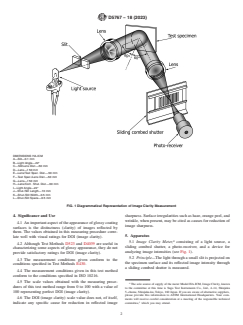
1.3 Test Method—The light through a small slit is projected on the specimen surface and its reflected image intensity is measured through a sliding combed shutter to provide a value of image clarity.
1.4 The values stated in SI units are to be regarded as standard. No other units of measurement are included in this standard.
1.5 This standard does not purport to address all of the safety concerns, if any, associated with its use. It is the responsibility of the user of this standard to establish appropriate safety, health, and environmental practices and determine the applicability of regulatory limitations prior to use.
1.6 This international standard was developed in accordance with internationally recognized principles on standardization established in the Decision on Principles for the Development of International Standards, Guides and Recommendations issued by the World Trade Organization Technical Barriers to Trade (TBT) Committee.
- Status
- Published
- Publication Date
- 31-Oct-2023
- Technical Committee
- E12 - Color and Appearance
- Drafting Committee
- E12.03 - Geometry
Overview
ASTM D5767-18(2023), Standard Test Method for Instrumental Measurement of Distinctness-of-Image (DOI) Gloss of Coated Surfaces, is a critical international standard published by ASTM International. It defines precise methods for measuring the distinctness-of-image (DOI) gloss on coated, planar rigid surfaces using electro-optical techniques. This standard is widely recognized for providing reliable evaluations of image clarity, a key component in the visual appearance and performance of glossy coatings. Accurate DOI gloss measurement has become essential in industries where coating surface quality directly affects product aesthetics and customer satisfaction.
Key Topics
- Distinctness-of-Image (DOI) Gloss: Focuses on the sharpness or clarity of images reflected from a coated surface, providing a scale from 0 to 100, where 100 represents perfect image clarity.
- Electro-Optical Measurement: Uses a light source, optical mask, sliding combed shutter, and photoreceiver to quantitatively assess DOI gloss, correlating well with human visual ratings.
- Measurement Conditions: Procedures align with internationally recognized methods, including ISO 10216 and ASTM E430, ensuring global compatibility and repeatability.
- Applicability and Limitations: Intended for coatings applied to flat, rigid substrates. While providing objective DOI values, the scale does not indicate the root causes of reduced image clarity, such as haze, orange peel, or surface wrinkles.
- Standardization and Calibration: Requires the use of calibrated standards (such as black glass or ceramic tile) to ensure measurement accuracy and consistency.
- Precision and Repeatability: Includes guidance for achieving consistent and precise results across different labs and instruments.
Applications
ASTM D5767 is utilized across various industries where surface quality is of paramount importance:
- Automotive and Transportation: Manufacturers use DOI gloss measurements to ensure high-quality, visually appealing painted finishes on vehicles and components.
- Industrial Coatings: Applied to machinery, appliances, and equipment, image clarity evaluations help ensure product surfaces meet specification and customer expectations.
- Consumer Goods: Electronics, home appliances, and furniture sectors rely on DOI gloss levels to enhance product appeal and perceived value.
- Quality Assurance and R&D: Testing facilities and research labs apply this standard to benchmark new coatings, compare surface treatments, and monitor consistency in production environments.
- Standards Compliance and International Trade: Alignment with international norms such as ISO 10216 and WTO TBT requirements supports market access and regulatory compliance.
Related Standards
- ASTM D523 – Test Method for Specular Gloss
Measures gloss but does not specifically assess image clarity or DOI. - ASTM D4039 – Test Method for Reflection Haze of High-Gloss Surfaces
Useful for evaluating haze but insufficient for full DOI analysis. - ASTM D2457 – Test Method for Specular Gloss of Plastic Films
Focuses on plastics, measuring gloss without DOI specificity. - ASTM E430 – Test Methods for Gloss of High-Gloss Surfaces by Abridged Goniophotometry
Provides conditions referenced in DOI measurement. - ASTM E284 – Terminology of Appearance
Offers definitions relevant to gloss and DOI. - ASTM E691 – Practice for Conducting Interlaboratory Studies
Underpins the precision and reproducibility data for this test method. - ISO 10216 – Anodizing of Aluminum and its Alloys-Instrumental Determination of Image Clarity
Mirrors measurement procedures for international harmonization. - ISO 17221 – Plastics-Determination of Image Clarity
Related to plastics testing for image clarity assessments.
Practical Value
The implementation of ASTM D5767-18(2023) enables manufacturers, quality control labs, and researchers to objectively quantify the visual clarity and overall quality of coated surfaces. By providing a robust, internationally recognized method, the standard enhances consistency in appearance evaluation, supports product differentiation, ensures compliance with global requirements, and ultimately contributes to improved customer satisfaction in high-gloss and decorative applications.
Keywords: distinctness-of-image, DOI gloss, image clarity, coated surfaces, ASTM D5767, reflectance, high-gloss, surface quality, electro-optical measurement, surface appearance.
Relations
- Effective Date
- 01-Nov-2023
- Referred By
ASTM D6486-23 - Standard Practice for Short Term Vehicle Service Exposure of Automotive Coatings - Effective Date
- 01-Nov-2023
- Effective Date
- 01-Nov-2023
- Effective Date
- 01-Nov-2023
- Referred By
ASTM D5382-02(2017) - Standard Guide to Evaluation of Optical Properties of Powder Coatings - Effective Date
- 01-Nov-2023
Get Certified
Connect with accredited certification bodies for this standard

DVS-ZERT GmbH
German welding certification society.
CARES (UK Certification Authority for Reinforcing Steels)
UK certification for reinforcing steels and construction.
EWF/IIW (European/International Welding Federation)
International welding personnel certification.
Sponsored listings
Frequently Asked Questions
ASTM D5767-18(2023) is a standard published by ASTM International. Its full title is "Standard Test Method for Instrumental Measurement of Distinctness-of-Image (DOI) Gloss of Coated Surfaces". This standard covers: SIGNIFICANCE AND USE 4.1 An important aspect of the appearance of glossy coating surfaces is the distinctness (clarity) of images reflected by them. The values obtained in this measuring procedure correlate well with visual ratings for DOI (image clarity). 4.2 Although Test Methods D523 and D4039 are useful in characterizing some aspects of glossy appearance, they do not provide satisfactory ratings for DOI (image clarity). 4.3 The measurement conditions given conform to the conditions specified in Test Methods E430. 4.4 The measurement conditions given in this test method conform to the conditions specified in ISO 10216. 4.5 The scale values obtained with the measuring procedures of this test method range from 0 to 100 with a value of 100 representing perfect DOI (image clarity). 4.6 The DOI (image clarity) scale value does not, of itself, indicate any specific cause for reduction in reflected image sharpness. Surface irregularities such as haze, orange peel, and wrinkle, when present, may be cited as causes for reduction of image sharpness. SCOPE 1.1 These test methods describe the measurement of the distinctness-of-image (DOI) gloss of coating surfaces using electro-optical measuring techniques. 1.2 The coatings assessed shall be applied to planar rigid surfaces. 1.3 Test Method—The light through a small slit is projected on the specimen surface and its reflected image intensity is measured through a sliding combed shutter to provide a value of image clarity. 1.4 The values stated in SI units are to be regarded as standard. No other units of measurement are included in this standard. 1.5 This standard does not purport to address all of the safety concerns, if any, associated with its use. It is the responsibility of the user of this standard to establish appropriate safety, health, and environmental practices and determine the applicability of regulatory limitations prior to use. 1.6 This international standard was developed in accordance with internationally recognized principles on standardization established in the Decision on Principles for the Development of International Standards, Guides and Recommendations issued by the World Trade Organization Technical Barriers to Trade (TBT) Committee.
SIGNIFICANCE AND USE 4.1 An important aspect of the appearance of glossy coating surfaces is the distinctness (clarity) of images reflected by them. The values obtained in this measuring procedure correlate well with visual ratings for DOI (image clarity). 4.2 Although Test Methods D523 and D4039 are useful in characterizing some aspects of glossy appearance, they do not provide satisfactory ratings for DOI (image clarity). 4.3 The measurement conditions given conform to the conditions specified in Test Methods E430. 4.4 The measurement conditions given in this test method conform to the conditions specified in ISO 10216. 4.5 The scale values obtained with the measuring procedures of this test method range from 0 to 100 with a value of 100 representing perfect DOI (image clarity). 4.6 The DOI (image clarity) scale value does not, of itself, indicate any specific cause for reduction in reflected image sharpness. Surface irregularities such as haze, orange peel, and wrinkle, when present, may be cited as causes for reduction of image sharpness. SCOPE 1.1 These test methods describe the measurement of the distinctness-of-image (DOI) gloss of coating surfaces using electro-optical measuring techniques. 1.2 The coatings assessed shall be applied to planar rigid surfaces. 1.3 Test Method—The light through a small slit is projected on the specimen surface and its reflected image intensity is measured through a sliding combed shutter to provide a value of image clarity. 1.4 The values stated in SI units are to be regarded as standard. No other units of measurement are included in this standard. 1.5 This standard does not purport to address all of the safety concerns, if any, associated with its use. It is the responsibility of the user of this standard to establish appropriate safety, health, and environmental practices and determine the applicability of regulatory limitations prior to use. 1.6 This international standard was developed in accordance with internationally recognized principles on standardization established in the Decision on Principles for the Development of International Standards, Guides and Recommendations issued by the World Trade Organization Technical Barriers to Trade (TBT) Committee.
ASTM D5767-18(2023) is classified under the following ICS (International Classification for Standards) categories: 25.220.01 - Surface treatment and coating in general. The ICS classification helps identify the subject area and facilitates finding related standards.
ASTM D5767-18(2023) has the following relationships with other standards: It is inter standard links to ASTM D5767-18, ASTM D6486-23, ASTM D3451-06(2017), ASTM D7270-07(2021), ASTM D5382-02(2017). Understanding these relationships helps ensure you are using the most current and applicable version of the standard.
ASTM D5767-18(2023) is available in PDF format for immediate download after purchase. The document can be added to your cart and obtained through the secure checkout process. Digital delivery ensures instant access to the complete standard document.
Standards Content (Sample)
This international standard was developed in accordance with internationally recognized principles on standardization established in the Decision on Principles for the
Development of International Standards, Guides and Recommendations issued by the World Trade Organization Technical Barriers to Trade (TBT) Committee.
Designation: D5767 − 18 (Reapproved 2023)
Standard Test Method for
Instrumental Measurement of Distinctness-of-Image (DOI)
Gloss of Coated Surfaces
This standard is issued under the fixed designation D5767; the number immediately following the designation indicates the year of
original adoption or, in the case of revision, the year of last revision. A number in parentheses indicates the year of last reapproval. A
superscript epsilon (´) indicates an editorial change since the last revision or reapproval.
1. Scope D3964 Practice for Selection of Coating Specimens for
Appearance Measurements
1.1 These test methods describe the measurement of the
D4039 Test Method for Reflection Haze of High-Gloss
distinctness-of-image (DOI) gloss of coating surfaces using
Surfaces
electro-optical measuring techniques.
E284 Terminology of Appearance
1.2 The coatings assessed shall be applied to planar rigid
E430 Test Methods for Measurement of Gloss of High-Gloss
surfaces.
Surfaces by Abridged Goniophotometry
E691 Practice for Conducting an Interlaboratory Study to
1.3 Test Method—The light through a small slit is projected
on the specimen surface and its reflected image intensity is Determine the Precision of a Test Method
measured through a sliding combed shutter to provide a value
2.2 ISO Standards:
of image clarity.
ISO 10216 Anodizing of Aluminum and its Alloys—
Instrumental Determination of Image Clarity of Anodic
1.4 The values stated in SI units are to be regarded as
standard. No other units of measurement are included in this Oxidation Coatings—Instrumental Method
ISO 17221 Plastics—Determination of Image Clarity (de-
standard.
gree of sharpness of reflected or transmitted image)
1.5 This standard does not purport to address all of the
ISO 11664–1 Colorimetry Part 1—CIE standard colorimet-
safety concerns, if any, associated with its use. It is the
ric observers
responsibility of the user of this standard to establish appro-
ISO 11664–2 Colorimetry Part 2—CIE standard illuminants
priate safety, health, and environmental practices and deter-
mine the applicability of regulatory limitations prior to use.
3. Terminology
1.6 This international standard was developed in accor-
dance with internationally recognized principles on standard-
3.1 Definitions—Terms and definitions in Terminology
ization established in the Decision on Principles for the
E284 are applicable to these methods.
Development of International Standards, Guides and Recom-
3.1.1 distinctness-of-image (DOI) gloss, n—aspect of gloss
mendations issued by the World Trade Organization Technical
characterized by the sharpness of images of objects produced
Barriers to Trade (TBT) Committee.
by reflection at a surface. E284
3.1.1.1 Discussion—This quality is sometimes called image
2. Referenced Documents
clarity.
2.1 ASTM Standards:
3.1.2 gloss reflectance factor, R , n—ratio of the specularly
s
D523 Test Method for Specular Gloss
reflected part of the (whole) flux reflected from the specimen to
D823 Practices for Producing Films of Uniform Thickness
the flux reflected from a specified gloss standard under the
of Paint, Coatings and Related Products on Test Panels
same geometric and spectral conditions of measurements.
D2457 Test Method for Specular Gloss of Plastic Films and
E284
Solid Plastics
3.1.2.1 Discussion—The gloss standard may be a black
glass or mirror and may be assigned one of a variety of scale
This test method is under the jurisdiction of ASTM Committee E12 on Color
values as specified.
and Appearance and is the direct responsibility of Subcommittee E12.03 on
Geometry.
3.1.3 specular angle, n—angle of reflection equal and op-
Current edition approved Nov. 1, 2023. Published November 2023. Originally
posite to the angle of incidence. E284
approved in 1995. Last previous edition approved in 2018 as D5767 – 18. DOI:
10.1520/D5767-18R23.
For referenced ASTM standards, visit the ASTM website, www.astm.org, or
contact ASTM Customer Service at service@astm.org. For Annual Book of ASTM
Standards volume information, refer to the standard’s Document Summary page on Available from American National Standards Institute (ANSI), 25 W. 43rd St.,
the ASTM website. 4th Floor, New York, NY 10036, http://www.ansi.org.
Copyright © ASTM International, 100 Barr Harbor Drive, PO Box C700, West Conshohocken, PA 19428-2959. United States
D5767 − 18 (2023)
DIMENSIONS HA-ICM
A—Slit—0.1 mm
B—Light Angle—22°
C—Slit/Lens Dist.—50 mm
D—Lens—f 50 mm
E—Lens/Test Spec. Dist.—50 mm
F—Test Spec./Lens Dist.—50 mm
G—Lens—f 50 mm
H—Lens/Com. Shut. Dist.—50 mm
I—Light Angle—22°
J—Shut./Slit Length—10 mm
K—Shut./Slit Width—0.5 mm
L—Shut./Slit Space—0.5 mm
FIG. 1 Diagrammatical Representation of Image Clarity Measurement
4. Significance and Use sharpness. Surface irregularities such as haze, orange peel, and
wrinkle, when present, may be cited as causes for reduction of
4.1 An important aspect of the appearance of glossy coating
image sharpness.
surfaces is the distinctness (clarity) of images reflected by
them. The values obtained in this measuring procedure corre-
5. Apparatus
late well with visual ratings for DOI (image clarity).
5.1 Image Clarity Meter, consisting of a light source, a
4.2 Although Test Methods D523 and D4039 are useful in
sliding combed shutter, a photo-receiver, and a device for
characterizing some aspects of glossy appearance, they do not
analyzing image intensities (see Fig. 1).
provide satisfactory ratings for DOI (image clarity).
5.2 Principle—The light through a small slit is projected on
4.3 The measurement conditions given conform to the
the specimen surface and its reflected image intensity through
conditions specified in Test Methods E430.
a sliding combed shutter is measured.
4.4 The measurement conditions given in this test method
conform to the conditions specified in ISO 10216.
4.5 The scale values obtained with the measuring proce-
The sole source of supply of the meter Model HA-ICM, Image Clarity, known
dures of this test method range from 0 to 100 with a value of
to the committee at this time is Suga Test Instruments Co., Ltd., 4–14, Shinjuku
100 representing perfect DOI (image clarity). 5–chome, Shinjuku-ku, Tokyo, 160 Japan. If you are aware of alternative suppliers,
please provide this information to ASTM International Headquarters. Your com-
4.6 The DOI (image clarity) scale value does not, of itself,
ments will receive careful consideration at a meeting of the responsible technical
indicate any specific cause for reduction in reflected image committee, which you may attend.
D5767 − 18 (2023)
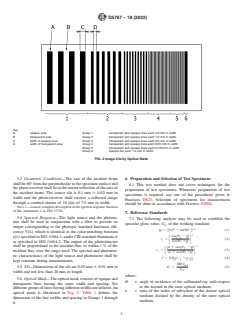
Key
A opaque area Group 1 transparent and opaque lines each 2.0 mm in width
B transparent area Group 2 transparent and opaque lines each 1.0 mm in width
C width of opaque area Group 3 transparent and opaque lines each 0.5 mm in width
D width of transparent area Group 4 transparent and opaque lines each 0.25 mm in width
Group 5 transparent and opaque lines each 0.125 mm in width
Group 6 opaque line each 1.0 mm in width
FIG. 2 Image Clarity Optical Mask
5.3 Geometric Conditions—The axis of the incident beam 6. Preparation and Selection of Test Specimens
shall be 60° from the perpendicular to the specimen surface and
6.1 This test method does not cover techniques for the
the photo-receiver shall be at the mirror reflection of the axis of
preparation of test specimens. Whenever preparation of test
the incident beam. The source slit is 0.1 mm 6 0.02 mm in
specimens is required, use one of the procedures given in
width and the photo-receiver shall receive a reflected image
Practices D823. Selection of specimens for measurement
through a combed shutter of 18 slits of 7.5 mm in width.
should be done in accordance with Practice D3964.
NOTE 1—A more complete description of the spectral response function
of this instrument is in ISO 17221.
7. Reference Standards
5.4 Spectral Response—The light source and the photom-
7.1 The following analysis may be used to establish the
eter shall be used in conjunction with a filter to provide an
specular gloss value, G , of the working standard:
s
output corresponding to the photopic standard luminous effi-
2 2 1⁄2
Q 5 @~n! 2 sin ~θ! # (1)
ciency V(λ), which is identical to the color-matching function
cos θ 2 Q
y(λ) specified in ISO 11664-1, under CIE standard illuminant A ~ !
r 5 (2)
F G
i
cos θ 1Q
as specified in ISO 11664-2. The output of the photodetector ~ !
shall be proportional to the incident flux, to within 1 % of the 2 2
~n ! cos~θ! 2 Q
r 5 (3)
F G
incident flux, over the range used. The spectral and photomet- '
n ! cos θ 1Q
~ ~ !
ric characteristics of the light source and photometer shall be
I 5 0.5 r 1 r (4)
@~ ! ~ !#
' i
kept constant during measurements.
100 I
WS
G 5 (5)
5.5 Slit—Dimensions of the slit are 0.03 mm 6 0.01 mm in
s
I
PS
width and not less than 20 mm in length.
where:
5.6 Optical Mask—The optical mask consists of opaque and
Θ = angle of incidence of the collimated ray with respect
transparent lines having the same width and spacing. Six
to the normal in the rarer optical medium,
different groups of lines having different widths are utilized. An
n = ratio of the index of refraction of the denser optical
optical mask is illustrated in Fig. 2. Table 1 defines the
medium divided by the density of the rarer optical
dimension of the line widths and spacing in Groups 1 through
medium,
6.
D5767 − 18 (2023)
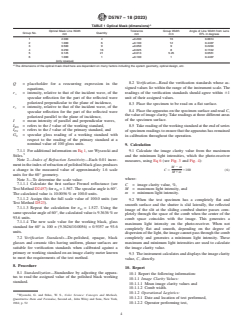
A
TABLE 1 Optical Mask (dimensions)
Optical Mask Line Width Tolerance Group Width Angle of Line Width from Lens
Group No. Quantity
mm mm mm EFL in degrees
1 2.000 4 ±0.200 16 0.8814
2 1.000 6 ±0.100 12 0.4407
3 0.500 9 ±0.050 9 0.2204
4 0.250 16 ±0.025 8 0.1102
5 0.125 21 ±0.013 5.25 0.0551
6 1.000 1 ±0.100 1 0.4407
(only opaque)
A
The dimensions of the optical mask cited here are dependent on many factors including the system geometry, optical design, etc.
8.2 Verification—Read the verification standards whose as-
Q = placeholder for a reocurring expression in the
signed values lie within the range of the instrument scale. The
equations,
readings of the verification standards should agree within 61
r = intensity, relative to that of the incident wave, of the
'
unit of their assigned values.
specular reflection for the part of the reflected wave
polarized perpendicular to the plane of incidence,
8.3 Place the specimen to be read on a flat surface.
r = intensity, relative to that of the incident wave, of the
??
8.4 Place the apparatus on the specimen surface and read C,
specular reflection for the part of the reflected wave
the value of image clarity. Take readings at three different areas
polarized parallel to the plane of incidence,
of the specimen surface.
I = mean intensity of parallel and perpendicular waves,
I = refers to the I value of the working standard,
8.5 Take reading of the working standard at the end of series
WS
I = refers to the I value of the primary standard, and
PS of specimen readings to ensure that the apparatus has remained
G = specular gloss reading of a working standard with
S
in calibration throughout the operation.
respect to the reading of the primary standard at a
nominal value of 100 gloss units.
9. Calculation
7.1.1 For additional information on Eq 1, see Wyszecki and
9.1 Calculate the image clarity value from the maximum
Stiles.
and the minimum light intensities, which the photo-receiver
Note 2—Index of Refraction Sensitivity—Each 0.01 incre-
measures, using Eq 6 (see Fig. 3 and Fig. 4):
ment in the index of refraction of polished black glass produces
M 2 m
C 5 × 100 (6)
a change in the measured value of approximately 1.6 scale
M1m
units for the 60° geometry.
where:
Note 3—To determine the scale value:
7.1.1.1 Calculate the first surface Fresnel reflectance (see
C = image clarity value, %,
Test Method D2457) for n = 1.567. The specular angle is 60°. M = maximum light intensity, and
D
m = minimum light intensity.
The calculated value is 10.0056 % or 100.0 units.
7.1.1.2 Assign this the full scale value of 100.0 units (see
9.2 When the test specimen has a completely flat and
Test Method D523).
smooth surface and the shutter is slid late
...