

ASTM D2099-14(2023)
(Test Method)Standard Test Method for Dynamic Water Resistance of Shoe Upper Leather by the Maeser Water Penetration Tester
General Information
- Abstract
SIGNIFICANCE AND USE
3.1 This test method is intended to estimate the water resistance of shoe upper leather. The flex imparted to the leather is similar to the flex given the vamp of the shoe in actual wear.
Note 1: There is an indication that this test method cannot be used interchangeably for specification purposes with Test Method D2098.
SCOPE
1.1 This test method covers the determination of the dynamic water resistance of shoe upper leather by the Maeser water penetration tester. It is applicable to all types of shoe upper leather. Certain waterproof processes can cause contamination of the stainless steel balls. When this happens, visual inspection is recommended. This test method does not apply to wet blue.
1.2 Initial water penetration and water absorption can be measured by this test method.
1.3 The values stated in inch-pound units are to be regarded as standard. The values given in parentheses are mathematical conversions to SI units that are provided for information only and are not considered standard.
1.4 This standard does not purport to address all of the safety concerns, if any, associated with its use. It is the responsibility of the user of this standard to establish appropriate safety, health, and environmental practices and determine the applicability of regulatory limitations prior to use.
1.5 This international standard was developed in accordance with internationally recognized principles on standardization established in the Decision on Principles for the Development of International Standards, Guides and Recommendations issued by the World Trade Organization Technical Barriers to Trade (TBT) Committee.
- Status
- Published
- Publication Date
- 31-Dec-2022
- Technical Committee
- D31 - Leather
- Drafting Committee
- D31.03 - Footwear

Overview
ASTM D2099-14(2023), titled Standard Test Method for Dynamic Water Resistance of Shoe Upper Leather by the Maeser Water Penetration Tester, is an internationally recognized standard developed by ASTM International. This test method provides a reliable procedure for measuring the dynamic water resistance of shoe upper leather using the Maeser water penetration tester. The testing simulates the repeated flexing that leather experiences in the vamp of a shoe during actual wear, making it valuable for estimating how well shoe upper leathers resist water ingress under real-world conditions.
The method applies to all types of shoe upper leather except "wet blue" and accommodates both visual and electronic detection methods for water penetration and absorption. This test is especially significant for manufacturers, quality controllers, and researchers focusing on footwear materials and performance.
Key Topics
Scope of Applicability
- Applicable to all shoe upper leather types except wet blue
- Measures both initial water penetration and water absorption
- Values are provided in inch-pound units as standard
Testing Methodology
- Utilizes the Maeser water penetration tester, which flexes the leather specimen in a manner comparable to actual shoe conditions
- Detects initial water penetration via electronic or visual means
- Calculates water absorption by comparing the specimen’s mass before and after testing
Significance and Use
- Simulates real-life flexing conditions to provide an accurate estimate of dynamic water resistance
- Enables ranking and selection of leathers based on water resistance for footwear manufacturing
- Supports research, product development, and quality control by providing actionable data on performance under dynamic conditions
Safety and Compliance
- Users must establish appropriate safety, health, and environmental practices relevant to their local regulations
- Developed in alignment with internationally accepted principles for standardization
Applications
ASTM D2099-14(2023) has broad applications in the leather and footwear industries, contributing to the development, quality assurance, and regulatory compliance of shoe materials. Common applications include:
Footwear Manufacturing
- Ensures shoe upper leathers meet water resistance requirements for consumer durability and comfort
- Supports product claims for water-resistant or waterproof shoes
Material Selection and R&D
- Helps in selecting suitable leathers for various footwear designs, especially for outdoor or sports shoes
- Assists in benchmarking and improving the water resistance of leather via new tanning or finishing processes
Quality Control
- Serves as a basis for establishing and maintaining product specifications
- Provides a pass/fail criterion and allows for comparative ranking of different leather lots or treatments
Regulatory and Contractual Compliance
- Aligns with procurement requirements and government agency specifications, including those of the U.S. Department of Defense
Related Standards
Several ASTM standards are referenced and related to the procedures in ASTM D2099-14(2023), including:
- ASTM D1610 - Practice for Conditioning Leather and Leather Products for Testing
- ASTM D2098 - Test Method for Dynamic Water Resistance of Shoe Upper Leather by the Dow Corning Leather Tester
- ASTM D2813 - Practice for Sampling Leather for Physical and Chemical Tests
These standards provide complementary guidance for specimen preparation, alternative test methods, and sampling procedures, aiding comprehensive material evaluation and ensuring consistency across tests.
By following ASTM D2099-14(2023), stakeholders can reliably assess the dynamic water resistance of shoe upper leather, enhance product quality, and meet industry expectations for performance and durability.
Relations
- Refers
ASTM D1610-01(2013) - Standard Practice for Conditioning Leather and Leather Products for Testing - Effective Date
- 01-May-2013
- Effective Date
- 01-Sep-2012
- Effective Date
- 01-Sep-2008
- Effective Date
- 01-Sep-2008
- Refers
ASTM D1610-01(2007) - Standard Practice for Conditioning Leather and Leather Products for Testing - Effective Date
- 01-Apr-2007
- Effective Date
- 01-Sep-2004
- Effective Date
- 01-Oct-2003
- Effective Date
- 10-May-2001
- Effective Date
- 10-May-2001
- Effective Date
- 10-Sep-2000
- Effective Date
- 10-Apr-1997
Frequently Asked Questions
ASTM D2099-14(2023) is a standard published by ASTM International. Its full title is "Standard Test Method for Dynamic Water Resistance of Shoe Upper Leather by the Maeser Water Penetration Tester". This standard covers: SIGNIFICANCE AND USE 3.1 This test method is intended to estimate the water resistance of shoe upper leather. The flex imparted to the leather is similar to the flex given the vamp of the shoe in actual wear. Note 1: There is an indication that this test method cannot be used interchangeably for specification purposes with Test Method D2098. SCOPE 1.1 This test method covers the determination of the dynamic water resistance of shoe upper leather by the Maeser water penetration tester. It is applicable to all types of shoe upper leather. Certain waterproof processes can cause contamination of the stainless steel balls. When this happens, visual inspection is recommended. This test method does not apply to wet blue. 1.2 Initial water penetration and water absorption can be measured by this test method. 1.3 The values stated in inch-pound units are to be regarded as standard. The values given in parentheses are mathematical conversions to SI units that are provided for information only and are not considered standard. 1.4 This standard does not purport to address all of the safety concerns, if any, associated with its use. It is the responsibility of the user of this standard to establish appropriate safety, health, and environmental practices and determine the applicability of regulatory limitations prior to use. 1.5 This international standard was developed in accordance with internationally recognized principles on standardization established in the Decision on Principles for the Development of International Standards, Guides and Recommendations issued by the World Trade Organization Technical Barriers to Trade (TBT) Committee.
SIGNIFICANCE AND USE 3.1 This test method is intended to estimate the water resistance of shoe upper leather. The flex imparted to the leather is similar to the flex given the vamp of the shoe in actual wear. Note 1: There is an indication that this test method cannot be used interchangeably for specification purposes with Test Method D2098. SCOPE 1.1 This test method covers the determination of the dynamic water resistance of shoe upper leather by the Maeser water penetration tester. It is applicable to all types of shoe upper leather. Certain waterproof processes can cause contamination of the stainless steel balls. When this happens, visual inspection is recommended. This test method does not apply to wet blue. 1.2 Initial water penetration and water absorption can be measured by this test method. 1.3 The values stated in inch-pound units are to be regarded as standard. The values given in parentheses are mathematical conversions to SI units that are provided for information only and are not considered standard. 1.4 This standard does not purport to address all of the safety concerns, if any, associated with its use. It is the responsibility of the user of this standard to establish appropriate safety, health, and environmental practices and determine the applicability of regulatory limitations prior to use. 1.5 This international standard was developed in accordance with internationally recognized principles on standardization established in the Decision on Principles for the Development of International Standards, Guides and Recommendations issued by the World Trade Organization Technical Barriers to Trade (TBT) Committee.
ASTM D2099-14(2023) is classified under the following ICS (International Classification for Standards) categories: 61.060 - Footwear. The ICS classification helps identify the subject area and facilitates finding related standards.
ASTM D2099-14(2023) has the following relationships with other standards: It is inter standard links to ASTM D1610-01(2013), ASTM D2098-04(2012), ASTM D2098-04(2008), ASTM D2813-03(2008), ASTM D1610-01(2007), ASTM D2098-04, ASTM D2813-03, ASTM D1610-01, ASTM D1610-00, ASTM D2098-00, ASTM D2813-97. Understanding these relationships helps ensure you are using the most current and applicable version of the standard.
ASTM D2099-14(2023) is available in PDF format for immediate download after purchase. The document can be added to your cart and obtained through the secure checkout process. Digital delivery ensures instant access to the complete standard document.
Standards Content (Sample)
This international standard was developed in accordance with internationally recognized principles on standardization established in the Decision on Principles for the
Development of International Standards, Guides and Recommendations issued by the World Trade Organization Technical Barriers to Trade (TBT) Committee.
Designation: D2099 − 14 (Reapproved 2023)
Standard Test Method for
Dynamic Water Resistance of Shoe Upper Leather by the
Maeser Water Penetration Tester
This standard is issued under the fixed designation D2099; the number immediately following the designation indicates the year of
original adoption or, in the case of revision, the year of last revision. A number in parentheses indicates the year of last reapproval. A
superscript epsilon (´) indicates an editorial change since the last revision or reapproval.
This standard has been approved for use by agencies of the U.S. Department of Defense.
1. Scope Upper Leather by the Dow Corning Leather Tester
D2813 Practice for Sampling Leather for Physical and
1.1 This test method covers the determination of the dy-
Chemical Tests
namic water resistance of shoe upper leather by the Maeser
water penetration tester. It is applicable to all types of shoe
3. Significance and Use
upper leather. Certain waterproof processes can cause contami-
3.1 This test method is intended to estimate the water
nation of the stainless steel balls. When this happens, visual
resistance of shoe upper leather. The flex imparted to the
inspection is recommended. This test method does not apply to
leather is similar to the flex given the vamp of the shoe in
wet blue.
actual wear.
1.2 Initial water penetration and water absorption can be
measured by this test method. NOTE 1—There is an indication that this test method cannot be used
interchangeably for specification purposes with Test Method D2098.
1.3 The values stated in inch-pound units are to be regarded
as standard. The values given in parentheses are mathematical
4. Apparatus
conversions to SI units that are provided for information only
4.1 Balance, sensitive to 0.01 g.
and are not considered standard.
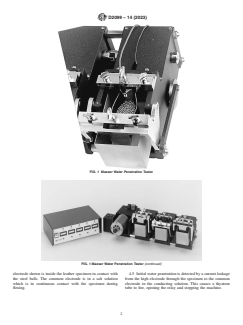
4.2 Maeser Water Penetration Tester, as shown in Fig. 1,or
1.4 This standard does not purport to address all of the
its equivalent. The essential features of the machine are:
safety concerns, if any, associated with its use. It is the
4.2.1 Specimen Holder, made of two V-shaped clamps with
responsibility of the user of this standard to establish appro-
wedges for holding the specimen. The clamps shall be 2.5 in.
priate safety, health, and environmental practices and deter-
6 0.1 in. (63.5 mm 6 2.5 mm) apart, inside measurement,
mine the applicability of regulatory limitations prior to use.
when their tops are in the same horizontal plane. One clamp
1.5 This international standard was developed in accor-
shall be in a fixed position.The other clamp shall be pivoted as
dance with internationally recognized principles on standard-
shown in Fig. 1 and attached, through a connecting link, to a
ization established in the Decision on Principles for the
motor-driven eccentric which turns at 90 r⁄min 6 5 r/min. In
Development of International Standards, Guides and Recom-
one rotation of the eccentric, the center of the top of the
mendations issued by the World Trade Organization Technical
movable clamp shall move a distance of 1 in. 6 0.05 in.
Barriers to Trade (TBT) Committee.
(25.4 mm 6 1.3 mm) below the horizontal and return.
4.2.2 Water Tank, made of copper, stainless steel, or other
2. Referenced Documents
noncorrosive material. It shall be of such a size that it can be
2.1 ASTM Standards:
placed around the clamps and of such a depth that, when in
D1610 Practice for Conditioning Leather and Leather Prod-
position for use, the top is 1.25 in. to 1.5 in. (31.7 mm to 38.1
ucts for Testing
mm) above the lowest point of the flexed clamp.
D2098 Test Method for Dynamic Water Resistance of Shoe
4.3 Base for the Water Tank, which is removable from
between the machine frame and the water tank.
This test method is under the jurisdiction ofASTM Committee D31 on Leather
4.4 Two systems can be used to determine the number of
and is the direct responsibility of Subcommittee D31.03 on Footwear.
cycles through which the specimen is flexed. One shall be a
Current edition approved Jan. 1, 2023. Published January 2023. Originally
mechanical reset counter connected to the movable clamp. The
approved in 1962. Last previous edition approved in 2014 as D2099–14. DOI:
10.1520/D2099-14R23.
other system shall be electrical and consist of a high and
For referenced ASTM standards, visit the ASTM website, www.astm.org, or
common electrode. The recommended resistance across the
contact ASTM Customer Service at service@astm.org. For Annual Book of ASTM
common electrodes is 50 000 Ω. When the resistance falls
Standards volume information, refer to the standard’s Document Summary page on
the ASTM website. below this value, the relay will be energized. The high
Copyright © ASTM International, 100 Barr Harbor Drive, PO Box C700, West Conshohocken, PA 19428-2959. United States
D2099 − 14 (2023)
FIG. 1 Maeser Water Penetration Tester
FIG. 1 Maeser Water Penetration Tester (continued)
electrode shown is inside the leather specimen in contact with 4.5 Initial water penetration is detected by a current leakage
the steel balls. The common electrode is in a salt solution from the high electrode through the specimen to the common
which is in continuous contact with the specimen during electrode in the conducting solution. This causes a thyatron
flexing. tube to fire, opening the relay and stopping the machine.
D2099 − 14 (2023)
5. Reagents and Materials 7. Procedure
5.1 Magnet, to facilitate removal of stainless steel balls. 7.1 Determine the initial water penetration and water ab-
sorption on the same specimen, as follows:
5.2 Magnetic Balls, stainless steel, ⁄8 in. (3 mm optional) in
7.1.1 Weigh the specimen to the nearest 0.01 g. Set the
diameter, 400 series. The steel balls shall be clean and free of
machine with the tops of the clamps in the same horizontal
grease, oil, silicone, or rust, and have a resistance less than
plane.Foldthespecimeninhalfalongthelongdimension,with
7500Ω before using. Steel balls need to be cleaned after each
thesurfacetobeexposedtothewaterontheoutside.Fastenthe
use.
specimen in the clamps by means of the V-shaped wedges, so
5.2.1 To clean, immer
...