

ASTM F2333-04(2017)
(Test Method)Standard Test Method for Traction Characteristics of the Athletic Shoe-Sports Surface Interface
General Information
- Abstract
SIGNIFICANCE AND USE
5.1 This test method will be used by athletic footwear manufacturers to characterize the traction of the athletic shoe-sports surface interface, and as a tool for development of athletic shoe outsoles.
5.2 This test method will be used by researchers to determine the effect of sport surface conditions (for example, moisture, grass species, turf density, soil texture, soil composition, and so forth) on traction characteristics of the athletic shoe-sports surface interface.
5.3 This test method will be used by sports surface manufacturers to characterize the traction of the athletic shoe-sports surface interface, and as a tool for development of sports surfaces.
5.4 Careful adherence to the requirements and recommendations of this test method will provide results that compare with results from different laboratory sources.
5.5 The method will be used to research relationships between traction at athletic shoe-sports surface interfaces and athletic performance or injury. This research may lead to recommendations for appropriate levels of traction.
SCOPE
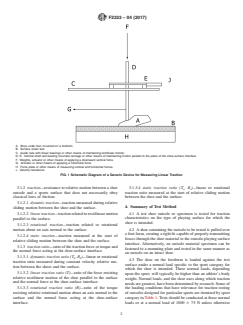
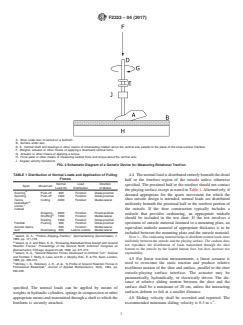
1.1 This test method covers specifications for the performance of sports shoe-surface traction measuring devices, but does not require a specific device or mechanism to be used. Figs. 1 and 2 show schematic diagrams of generic apparatus.
FIG. 1 Schematic Diagram of a Generic Device for Measuring Linear Traction
A. Shoe under test, mounted on a footform.
B. Surface under test.
C. Guide rails with linear bearings or other means of maintaining rectilinear motion.
D, E. Vertical shaft and bearing mounted carriage or other means of maintaining motion parallel to the plane of the shoe-surface interface.
F. Weights, actuator or other means of applying a downward vertical force.
G. Actuator or other means of applying a horizontal force.
H. Force plate or other means of measuring vertical and horizontal forces.
J. Velocity transducer.
FIG. 2 Schematic Diagram of a Generic Device for Measuring Rotational Traction
A. Shoe under test, mounted on a footform.
B. Surface under test.
D, E. Vertical shaft and bearings or other means of constraining rotation about the vertical axis parallel to the plane of the shoe-surface interface.
F. Weights, actuator or other means of applying a downward vertical force.
G. Actuator or other means of applying a torque.
H. Force plate or other means of measuring vertical force and torque about the vertical axis.
J. Angular velocity transducer.
1.2 This test method is appropriate for measuring the effects of athletic shoe outsole design and materials on traction at the shoe-surface interface.
1.3 This test method is appropriate for measuring the effects of sport surface design and materials on traction at the shoe-surface interface.
1.4 This test method specifies test procedures that are appropriate for both field and laboratory testing.
1.5 Traction characteristics measured by this test method encompass friction forces developed between shoe outsoles and playing surfaces.
1.6 Traction characteristics measured by this test method encompass traction achieved by penetration of cleats or studs into playing surfaces.
1.7 This test method specifies test procedures for the measurement of traction during linear translational motion and rotational motion, but not simultaneous combinations of linear and translational motion.
1.8 The loads and load rates specified in this test method are specific to sports activities. The test method is not intended for measurement of slip resistance or traction of pedestrian footwear.
1.9 Test results obtained by this method shall be qualified by the characteristics of the specimen.
1.9.1 Comparative tests of surfaces shall be qualified by the characteristics of the shoes used to test the surfaces, including the cushioning, outsole material, and sole design.
1.9.2 Comparative tests of shoes shall be qualified by the pertinent cha...
- Status
- Published
- Publication Date
- 31-Aug-2017
- Technical Committee
- F08 - Sports Equipment, Playing Surfaces, and Facilities
- Drafting Committee
- F08.54 - Athletic Footwear
Overview
ASTM F2333-04(2017) is an international standard developed by ASTM to ensure consistency in evaluating the traction characteristics of the interface between athletic shoes and sports surfaces. This standard prescribes methods for measuring both linear and rotational traction between sports footwear and playing surfaces, reflecting real-world sports conditions that involve various surface materials, moisture levels, turf characteristics, and athletic movements. The standard is widely used by athletic footwear manufacturers, sports surface designers, and researchers. By providing a framework for reliable and repeatable traction testing, ASTM F2333-04(2017) supports the safe and effective design of athletic shoes and sports surfaces.
Key Topics
- Traction Measurement: Specifies procedures for measuring traction in both linear (straight-line) and rotational (twisting) motions using generic devices and footforms.
- Test Apparatus Requirements: Outlines required equipment components, such as force plates, actuators, footforms, and means for applying normal and horizontal forces.
- Outsole and Surface Evaluation: Covers protocols for characterizing the effects of outsole designs, cleats, materials, and different playing surfaces (e.g., grass, artificial turf) on traction.
- Realistic Load Application: Emphasizes testing under loads and rates specific to different sports for accurate simulation (e.g., representative normal forces for sprinting, running, or stopping).
- Field and Laboratory Testing: Enables both laboratory-based and in-field testing to account for varying installation and environmental conditions.
- Data Collection and Analysis: Specifies minimum requirements for data sampling rates, filtering, and reporting of dynamic and static traction ratios, force histories, and movement velocities.
Applications
ASTM F2333-04(2017) is used in several important scenarios:
- Athletic Footwear Development: Shoe manufacturers use this method to design and refine outsoles for enhanced performance, durability, and athlete safety. Understanding the traction characteristics aids in optimizing tread patterns and material choices.
- Sports Surface Engineering: Producers of artificial turf, natural grass, and flooring materials apply this standard to measure and tailor the surface’s interaction with various shoe types, improving player performance and reducing injury risk.
- Sports Safety Research: Researchers utilize the standard to study how different shoe-surface combinations influence athletic performance and potential injury mechanisms, especially regarding resistance during rapid starts, stops, and pivots.
- Comparative Testing: Enables meaningful comparison of products from different manufacturers or locations by standardizing the test setup and reporting requirements.
- Regulatory Compliance: Facilities and organizations reference the standard to ensure equipment and surfaces meet baseline safety and quality requirements.
The test method explicitly excludes pedestrian slip resistance testing and is not intended for non-sport footwear.
Related Standards
The following standards and references are closely associated with or complement ASTM F2333-04(2017):
- SAE J211 - Instrumentation for Impact Tests: Provides protocols for force, velocity, and torque measurement instrumentation, supporting accurate data collection in traction tests.
- ASTM STP 649 & STP 1424: Address slip resistance measurement on walkway and playing surfaces.
- ASTM Committee F08 Standards: Related to sports equipment, playing surfaces, and facilities.
Keywords: sports shoe traction, athletic footwear, outsole performance, sports surface testing, linear and rotational traction, ASTM F2333, athletic injury prevention, laboratory and field traction measurement, footwear-surface interface analysis.
Relations
- Effective Date
- 01-Sep-2017
- Effective Date
- 01-Sep-2017
Frequently Asked Questions
ASTM F2333-04(2017) is a standard published by ASTM International. Its full title is "Standard Test Method for Traction Characteristics of the Athletic Shoe-Sports Surface Interface". This standard covers: SIGNIFICANCE AND USE 5.1 This test method will be used by athletic footwear manufacturers to characterize the traction of the athletic shoe-sports surface interface, and as a tool for development of athletic shoe outsoles. 5.2 This test method will be used by researchers to determine the effect of sport surface conditions (for example, moisture, grass species, turf density, soil texture, soil composition, and so forth) on traction characteristics of the athletic shoe-sports surface interface. 5.3 This test method will be used by sports surface manufacturers to characterize the traction of the athletic shoe-sports surface interface, and as a tool for development of sports surfaces. 5.4 Careful adherence to the requirements and recommendations of this test method will provide results that compare with results from different laboratory sources. 5.5 The method will be used to research relationships between traction at athletic shoe-sports surface interfaces and athletic performance or injury. This research may lead to recommendations for appropriate levels of traction. SCOPE 1.1 This test method covers specifications for the performance of sports shoe-surface traction measuring devices, but does not require a specific device or mechanism to be used. Figs. 1 and 2 show schematic diagrams of generic apparatus. FIG. 1 Schematic Diagram of a Generic Device for Measuring Linear Traction A. Shoe under test, mounted on a footform. B. Surface under test. C. Guide rails with linear bearings or other means of maintaining rectilinear motion. D, E. Vertical shaft and bearing mounted carriage or other means of maintaining motion parallel to the plane of the shoe-surface interface. F. Weights, actuator or other means of applying a downward vertical force. G. Actuator or other means of applying a horizontal force. H. Force plate or other means of measuring vertical and horizontal forces. J. Velocity transducer. FIG. 2 Schematic Diagram of a Generic Device for Measuring Rotational Traction A. Shoe under test, mounted on a footform. B. Surface under test. D, E. Vertical shaft and bearings or other means of constraining rotation about the vertical axis parallel to the plane of the shoe-surface interface. F. Weights, actuator or other means of applying a downward vertical force. G. Actuator or other means of applying a torque. H. Force plate or other means of measuring vertical force and torque about the vertical axis. J. Angular velocity transducer. 1.2 This test method is appropriate for measuring the effects of athletic shoe outsole design and materials on traction at the shoe-surface interface. 1.3 This test method is appropriate for measuring the effects of sport surface design and materials on traction at the shoe-surface interface. 1.4 This test method specifies test procedures that are appropriate for both field and laboratory testing. 1.5 Traction characteristics measured by this test method encompass friction forces developed between shoe outsoles and playing surfaces. 1.6 Traction characteristics measured by this test method encompass traction achieved by penetration of cleats or studs into playing surfaces. 1.7 This test method specifies test procedures for the measurement of traction during linear translational motion and rotational motion, but not simultaneous combinations of linear and translational motion. 1.8 The loads and load rates specified in this test method are specific to sports activities. The test method is not intended for measurement of slip resistance or traction of pedestrian footwear. 1.9 Test results obtained by this method shall be qualified by the characteristics of the specimen. 1.9.1 Comparative tests of surfaces shall be qualified by the characteristics of the shoes used to test the surfaces, including the cushioning, outsole material, and sole design. 1.9.2 Comparative tests of shoes shall be qualified by the pertinent cha...
SIGNIFICANCE AND USE 5.1 This test method will be used by athletic footwear manufacturers to characterize the traction of the athletic shoe-sports surface interface, and as a tool for development of athletic shoe outsoles. 5.2 This test method will be used by researchers to determine the effect of sport surface conditions (for example, moisture, grass species, turf density, soil texture, soil composition, and so forth) on traction characteristics of the athletic shoe-sports surface interface. 5.3 This test method will be used by sports surface manufacturers to characterize the traction of the athletic shoe-sports surface interface, and as a tool for development of sports surfaces. 5.4 Careful adherence to the requirements and recommendations of this test method will provide results that compare with results from different laboratory sources. 5.5 The method will be used to research relationships between traction at athletic shoe-sports surface interfaces and athletic performance or injury. This research may lead to recommendations for appropriate levels of traction. SCOPE 1.1 This test method covers specifications for the performance of sports shoe-surface traction measuring devices, but does not require a specific device or mechanism to be used. Figs. 1 and 2 show schematic diagrams of generic apparatus. FIG. 1 Schematic Diagram of a Generic Device for Measuring Linear Traction A. Shoe under test, mounted on a footform. B. Surface under test. C. Guide rails with linear bearings or other means of maintaining rectilinear motion. D, E. Vertical shaft and bearing mounted carriage or other means of maintaining motion parallel to the plane of the shoe-surface interface. F. Weights, actuator or other means of applying a downward vertical force. G. Actuator or other means of applying a horizontal force. H. Force plate or other means of measuring vertical and horizontal forces. J. Velocity transducer. FIG. 2 Schematic Diagram of a Generic Device for Measuring Rotational Traction A. Shoe under test, mounted on a footform. B. Surface under test. D, E. Vertical shaft and bearings or other means of constraining rotation about the vertical axis parallel to the plane of the shoe-surface interface. F. Weights, actuator or other means of applying a downward vertical force. G. Actuator or other means of applying a torque. H. Force plate or other means of measuring vertical force and torque about the vertical axis. J. Angular velocity transducer. 1.2 This test method is appropriate for measuring the effects of athletic shoe outsole design and materials on traction at the shoe-surface interface. 1.3 This test method is appropriate for measuring the effects of sport surface design and materials on traction at the shoe-surface interface. 1.4 This test method specifies test procedures that are appropriate for both field and laboratory testing. 1.5 Traction characteristics measured by this test method encompass friction forces developed between shoe outsoles and playing surfaces. 1.6 Traction characteristics measured by this test method encompass traction achieved by penetration of cleats or studs into playing surfaces. 1.7 This test method specifies test procedures for the measurement of traction during linear translational motion and rotational motion, but not simultaneous combinations of linear and translational motion. 1.8 The loads and load rates specified in this test method are specific to sports activities. The test method is not intended for measurement of slip resistance or traction of pedestrian footwear. 1.9 Test results obtained by this method shall be qualified by the characteristics of the specimen. 1.9.1 Comparative tests of surfaces shall be qualified by the characteristics of the shoes used to test the surfaces, including the cushioning, outsole material, and sole design. 1.9.2 Comparative tests of shoes shall be qualified by the pertinent cha...
ASTM F2333-04(2017) is classified under the following ICS (International Classification for Standards) categories: 61.060 - Footwear; 97.220.01 - Sports equipment and facilities in general. The ICS classification helps identify the subject area and facilitates finding related standards.
ASTM F2333-04(2017) has the following relationships with other standards: It is inter standard links to ASTM F2333-04(2011), ASTM F1551-09(2017). Understanding these relationships helps ensure you are using the most current and applicable version of the standard.
ASTM F2333-04(2017) is available in PDF format for immediate download after purchase. The document can be added to your cart and obtained through the secure checkout process. Digital delivery ensures instant access to the complete standard document.
Standards Content (Sample)
This international standard was developed in accordance with internationally recognized principles on standardization established in the Decision on Principles for the
Development of International Standards, Guides and Recommendations issued by the World Trade Organization Technical Barriers to Trade (TBT) Committee.
Designation: F2333 − 04 (Reapproved 2017) An American National Standard
Standard Test Method for
Traction Characteristics of the Athletic Shoe-Sports Surface
Interface
This standard is issued under the fixed designation F2333; the number immediately following the designation indicates the year of
original adoption or, in the case of revision, the year of last revision. A number in parentheses indicates the year of last reapproval. A
superscript epsilon (´) indicates an editorial change since the last revision or reapproval.
1. Scope 1.9.2 Comparative tests of shoes shall be qualified by the
pertinent characteristics of the surfaces on which shoes are
1.1 This test method covers specifications for the perfor-
tested, including the surface type, material, condition, and
mance of sports shoe-surface traction measuring devices, but
temperature.
does not require a specific device or mechanism to be used.
1.10 This test method does not establish performance or
Figs. 1 and 2 show schematic diagrams of generic apparatus.
safety criteria. The level of traction required between a sport
1.2 This test method is appropriate for measuring the effects
shoe and surface varies with the level of performance and from
of athletic shoe outsole design and materials on traction at the
individual to individual. The extent to which particular levels
shoe-surface interface.
of traction contribute to individual athletic performance and
1.3 This test method is appropriate for measuring the effects
risk of injury is not known.
of sport surface design and materials on traction at the
1.11 The values stated in SI units are to be regarded as the
shoe-surface interface.
standard.
1.4 This test method specifies test procedures that are
1.12 Thisstandardmayinvolvehazardousmaterials,opera-
appropriate for both field and laboratory testing.
tionsandequipment.Thisstandarddoesnotpurporttoaddress
1.5 Traction characteristics measured by this test method all of the safety concerns, if any, associated with its use. It is
the responsibility of the user of this standard to establish
encompass friction forces developed between shoe outsoles
and playing surfaces. appropriate safety, health, and environmental practices and
determine the applicability of regulatory limitations prior to
1.6 Traction characteristics measured by this test method
use.
encompass traction achieved by penetration of cleats or studs
1.13 This international standard was developed in accor-
into playing surfaces.
dance with internationally recognized principles on standard-
1.7 This test method specifies test procedures for the mea-
ization established in the Decision on Principles for the
surement of traction during linear translational motion and
Development of International Standards, Guides and Recom-
rotational motion, but not simultaneous combinations of linear
mendations issued by the World Trade Organization Technical
and translational motion.
Barriers to Trade (TBT) Committee.
1.8 Theloadsandloadratesspecifiedinthistestmethodare
2. Referenced Documents
specific to sports activities. The test method is not intended for
measurement of slip resistance or traction of pedestrian foot-
2.1 SAE Standard:
wear.
SAE J211 Recommended Practice for Instrumentation for
Impact Tests
1.9 Testresultsobtainedbythismethodshallbequalifiedby
the characteristics of the specimen.
3. Terminology
1.9.1 Comparative tests of surfaces shall be qualified by the
characteristics of the shoes used to test the surfaces, including
3.1 Definitions:
the cushioning, outsole material, and sole design.
3.1.1 footform—a rigid form approximating the shape of a
foot or shoe last to which the shoe under test may be tightly
fitted and through which the loads required by this test method
1 may be transmitted.
This test method is under the jurisdiction of ASTM Committee F08 on Sports
Equipment, Playing Surfaces, and Facilities and is the direct responsibility of
Subcommittee F08.54 on Athletic Footwear.
Current edition approved Sept. 1, 2017. Published December 2017. Originally
approved in 2004. Last previous edition approved in 2011 as F2333 – 04 (2011). Available from Society of Automotive Engineers (SAE), 400 Commonwealth
DOI: 10.1520/F2333-04R17. Dr., Warrendale, PA 15096-0001.
Copyright © ASTM International, 100 Barr Harbor Drive, PO Box C700, West Conshohocken, PA 19428-2959. United States
F2333 − 04 (2017)
A. Shoe under test, mounted on a footform.
B. Surface under test.
C. Guide rails with linear bearings or other means of maintaining rectilinear motion.
D, E. Vertical shaft and bearing mounted carriage or other means of maintaining motion parallel to the plane of the shoe-surface interface.
F. Weights, actuator or other means of applying a downward vertical force.
G. Actuator or other means of applying a horizontal force.
H. Force plate or other means of measuring vertical and horizontal forces.
J. Velocity transducer.
FIG. 1 Schematic Diagram of a Generic Device for Measuring Linear Traction
3.1.2 traction—resistance to relative motion between a shoe 3.1.3.4 static traction ratio (T,R )—linear or rotational
s s
outsole and a sports surface that does not necessarily obey traction ratio measured at the start of relative sliding motion
classical laws of friction. between the shoe and the surface.
3.1.2.1 dynamic traction—traction measured during relative
4. Summary of Test Method
sliding motion between the shoe and the surface.
4.1 A test shoe outsole or specimen is tested for traction
3.1.2.2 lineartraction—tractionrelatedtorectilinearmotion
characteristics on the type of playing surface for which the
parallel to the surface.
shoe is intended.
3.1.2.3 rotational traction—traction related to rotational
motion about an axis normal to the surface. 4.2 Ashoe containing the outsole to be tested is pulled over
a foot form, creating a tight fit capable of properly transmitting
3.1.2.4 static traction—traction measured at the start of
forces through the shoe material to the outsole-playing surface
relative sliding motion between the shoe and the surface.
interface. Alternatively, an outsole material specimen can be
3.1.3 traction ratio—ratio of the traction force or torque and
fastened to a mounting plate and tested in the same manner as
the normal force acting at the shoe-surface interface.
an outsole on an intact shoe.
3.1.3.1 dymamic traction ratio (T,R )—linear or rotational
k k
4.3 The shoe on the footform is loaded against the test
traction ratio measured during constant velocity relative mo-
surface under a normal load specific to the sport category for
tion between the shoes and the surface.
which the shoe is intended. These normal loads, depending
3.1.3.2 linear traction ratio (T)—ratio of the force resisting
upon the sport, will typically be higher than an athlete’s body
relative rectilinear motion of the shoe parallel to the surface
weight. Normal loads, and the shoe axes along which traction
and the normal force at the shoe-surface interface.
needs are greatest, have been determined by research. Some of
3.1.3.3 rotational traction ratio (R)—ratio of the torque the loading conditions that have relevance for traction testing
resisting relative rotational motion about an axis normal to the of outsoles designed for particular sports are itemized by sport
surface and the normal force acting at the shoe-surface category in Table 1. Tests should be conducted at these normal
interface. loads or at a normal load of 1000 6 75 N unless otherwise
F2333 − 04 (2017)
A. Shoe under test, mounted on a footform.
B. Surface under test.
D, E. Vertical shaft and bearings or other means of constraining rotation about the vertical axis parallel to the plane of the shoe-surface interface.
F. Weights, actuator or other means of applying a downward vertical force.
G. Actuator or other means of applying a torque.
H. Force plate or other means of measuring vertical force and torque about the vertical axis.
J. Angular velocity transducer.
FIG. 2 Schematic Diagram of a Generic Device for Measuring Rotational Traction
TABLE 1 Distribution of Normal Loads and Application of Pulling
4.4 Thenormalloadisdistributedentirelybeneaththedistal
Forces
half or the forefoot region of the outsole unless otherwise
Normal Load Direction
specified. The proximal half or the rearfoot should not contact
Sport Movement
Load (N) Distribution of Motion
the playing surface except as noted in Table 1.Alternatively, if
A
Running Push-off 800 Forefoot Distal-proximal
deemed appropriate for the sports movement for which the
Sprinting Push-off 1500 Forefoot Distal-proximal
shoe outsole design is intended, normal loads are distributed
Tennis, Cutting 2200 Forefoot Medial-lateral
B
basketball,
uniformly beneath the proximal half or the rearfoot portion of
C
soccer,
the outsole. If the shoe construction typically includes a
football
Stopping 3000 Forefoot Proximal-distal
midsole that provides cushioning, an appropriate midsole
D
Shuffling 1300 Forefoot Medial-lateral
should be included in the test shoe. If the test involves a
Starting 1500 Forefoot Distal-proximal
Football Pushing 900 Forefoot Distal-proximal specimen of outsole material fastened to a mounting plate, an
Aerobic dance 500 Forefoot Medial-lateral
equivalent midsole material of appropriate thickness is to be
Golf Downswing 600 Lateral outsole Medial-lateral
included between the mounting plate and the outsole material.
A
Valiant, G. A., “Friction–Slipping–Traction,” Sportverletzung Sportschaden,7,
NOTE1—Thecushioningmaterialhelpstodistributenormalloadsmore
1993, pp. 171-178.
uniformly between the outsole and the playing surface. The cushion does
B
Valiant, G. A. and Eden, K. B., “Evaluating Basketball Shoe Design with Ground
not reproduce the distribution of loads transmitted through the shoe
Reaction Forces,” Proceedings of the Second North American Congress on
bottom to the outsole by the loaded human foot, but does increase test
Biomechanics, Chicago, August 24-28, 1992, pp. 271-272.
C
repeatability.
Valiant, G. A., “Ground Reaction Forces Developed on Artificial Turf,” Science
and Football, T. Reilly, A. Lees, and W. J. Murphy, Eds., E. & F.N. Spon, London,
4.5 For linear traction measurements, a linear actuator is
1988, pp. 406-415.
D
used to overcome the static traction and produce relative
McClay, I. S., Robinson, J. R., et al., “A Profile of Ground Reaction Forces in
Professional Basketball,” Journal of Applied Biomechanics, 10(3), 1994, pp.
rectilinear motion of the shoe and surface, parallel to the shoe
222-236.
outsole-playing surface interface. The actuator may be
pneumatically, hydraulically, or electrically driven. The dis-
tance of relative sliding motion between the shoe and the
surface shall be a minimum of 20 cm, unless the interacting
specified. The normal loads can be applied by means of
surfaces deform or fail at a smaller distance.
weights or hydraulic cylinders, springs in compression or other
appropriate means and transmitted through a shaft to which the 4.6 Sliding velocity shall be recorded and reported. The
-1
footform is securely attached. recommended minimum sliding velocity is 0.3 m s .
F2333 − 04 (2017)
NOTE 2—Under some conditions, for example, cleated shoes on
zontal motion include linear actuators, hydraulic cylinders,
artificial turf, spiked shoes on running tracks, it may not be possible to
compressed air cylinders, and variable speed motors. It is
generate sliding at the recommended velocity. Under these circumstances,
recommended that the velocity of the actuator be controllable.
the force and velocity developed should be recorded and dynamic traction
Since traction ratios at the shoe-surface interface may exceed
coefficients should not be reported.
1.0, the motion generating device must be capable of applying
4.7 For rotational traction measurements, the loaded shoe
horizontal forces that are even higher than the applied normal
outsole is rotated about the vertical shaft transmitting the
forces.
normal loads. The rotary motion may be applied manually, or
NOTE 3—Under some circumstances (for example, tests with portable
by means of a rotary actuator. The minimum rotation applied
equipmentusedinthefield)itmaybenecessarytoproducerelativesliding
shall be 90° unless the interacting surfaces deform or fail at a
motion manually (for example, by means of manually drawn cables).
Manual induction of motion is not recommended because it may be more
lesser rotation. The minimum rate of rotation shall be 45°/s.
variable than controlled mechanical actuators.
Angular velocity shall be recorded and reported.
6.5 Guides, or a means of maintaining rectilinear motion
4.8 For linear traction tests, the measured variables are
parallel to the shoe-playing surface interface, such as low
normal forces, horizontal or traction forces, and sliding veloc-
friction bearings, are required.
ity. For rotational traction tests, measured variables are normal
forces, the moment (torque) resisting rotation about a vertical 6.6 A means of maintaining the outsole or sample perpen-
axis, and angular velocity during rotation. Traction ratios are dicular to the playing surface during rotation (for example, low
calculated from these measurements. friction rotary bearings) is required for measurement of rota-
tional traction ratios.
4.9 All variables are recorded as functions of time, from
before the application of horizontal or rotational motion until 6.7 Transducers, signal conditioners and other instrumenta-
after the cessation of motion. tion are required to measure normal force, horizontal force,
torque, velocity, and angular velocity. The performance of the
5. Significance and Use
measurement systems shall, as a minimum, conform to the
requirements of a CFC Class 100 Data Channel, as defined by
5.1 This test method will be used by athletic footwear
SAE J211. Anti-aliasing filters shall be used to filter data
manufacturers to characterize the traction of the athletic
channels at a -3dB cutoff frequency of 250 6 20 Hz before
shoe-sports surface interface, and as a tool for development of
they are digitized.
athletic shoe outsoles.
NOTE 4—For laboratory-based measurements, an appropriate means of
5.2 This test method will be used by researchers to deter-
measuring forces and torques is a multi-axis force plate to which the
mine the effect of sport surface conditions (for example,
surface being tested is securely attached (Figs. 1 and 2).
moisture, grass species, turf density, soil texture, soil
6.8 The apparatus should have the capability of differenti-
composition, and so forth) on traction characteristics of the
ating static traction forces from dynamic traction forces.
athletic shoe-sports surface interface.
Typically, the velocity or angular velocity measuring trans-
5.3 This test method will be used by sports surface manu- ducer will be used for this purpose.
facturers to characterize the traction of the athletic shoe-sports
6.9 The data acquisition system should sample and store
surface interface, and as a tool for development of sports
force, torque, velocity, and angular velocity signals at a
surfaces.
minimum sampling rate of 500 samples/s.
5.4 Careful adherence to the requirements and recommen-
6.10 The complete apparatus used to make the traction
dations of this test method will provide results that compare
measurements shall be anchored or have a large enough inertia
with results from different laboratory sources.
to prevent it from being moved by the application of linear or
5.5 The method will be used to research relationships rotary motion to the shoe-surface system under test.
between traction at athletic shoe-sports surface interfaces and
7. Procedure
athletic performance or injury. This research may lead to
recommendations for appropriate levels of traction.
7.1 Select a sample of the playing surface appropriate for
the outsole to be tested and prepare it in accordance with the
6. Apparatus
required conditions of the traction test.
6.1 A footform.
7.2 If the test is conducted in the field, locate the traction
6.2 A means of securely mounting surface samples to be testing device on an area of the playing surface that has the
tested and of controlling or constraining relative motion required conditions.
between the footform-mounted shoe and the surface.
7.3 Adjust the normal force to a magnitude appropriate to
6.3 Ameans of applying a minimum normal load of 1000 N the sport for which the outsole is intended. The normal force
through the footform is required. The normal load should be shall be either the appropriate value selected from Table 1
adjustable within 675 N. Typical means of load application (675 N) or 1000 6 75 N.
include weights, hydraulic cylinders, and compressed air
7.4 Clean all debris and foreign material, mould release
cylinders.
compounds, and so forth from the shoe outsole, unless the test
6.4 A means of producing relative sliding motion between method is being used to determine the effects of a specific
the shoe and the surface. Typical methods of applying hori- contaminant on traction.
F2333 − 04 (2017)
7.5 Attach a shoe with the outsole to be tested or a test time, orientation of the outsole relative to direction of friction
sample to the device component that transmits the high normal force, outsole compound, outsole pattern, surface type, surface
force. Orient the outsole along a desired axis of translation (see condition, and area of outsole loaded. For most tests outsole
Table 1). area associated with male shoe sizes is sufficient.
7.6 Lower the sample onto the playing surface. 9.2 Express T or T , static or dynamic ratios of horizontal
s k
friction force divided by normal loading force, within a range
7.7 For measurements of linear traction, immediately in-
definedbyminimummeasuredTtomaximummeasuredTwith
duce a horizontal motion to the outsole, parallel to the playing
a precision of 0.01.
surface in the desired direction of translation. For measure-
ments of rotational traction, immediately induce an angular
9.3 Alternatively, T or T may be expressed as a mean 0.01.
s k
motionaboutaverticalaxispassingthroughtheforefootregion
9.4 Express peak magnitude of moment about the vertical
of the footform. The applied torque or force used to induce
axis resisting rotation as a mean with a precision of 1 Nm.
motion shall be high enough to initiate and maintain motion of
9.5 Alternatively, peak magnitude of moment resisting ro-
the outsole relative to the surface at the required velocit
...