

ASTM D4232-23
(Specification)Standard Performance Specification for Woven Career Apparel Fabrics: Dress and Vocational
General Information
- Abstract
SIGNIFICANCE AND USE
5.1 Upon mutual agreement between the purchaser and the supplier, woven fabrics intended for this end use should meet all of the requirements listed in Table 1 of this performance specification.
5.2 It is recognized that where more critical requirements call for higher performance levels, for purposes of fashion or aesthetics the ultimate consumer of articles made from these fabrics may find acceptable fabrics that do not conform to all of the requirements in Table 1. One or more of the requirements may be modified by mutual agreement between the purchaser and the supplier.
5.2.1 In such cases, any references to the specification shall specify that: “This fabric meets ASTM Specification D4232 except for the following characteristic(s).”
5.3 Where no prepurchase agreement has been reached between the purchaser and the supplier, and in case of controversy, the requirements listed in Table 1 are intended to be used as a guide only. As noted in 5.2, ultimate consumer demands dictate varying performance parameters for any particular style of fabric.
5.4 The uses and significance of particular properties and test methods are discussed in the appropriate sections of the specified test methods.
SCOPE
1.1 This performance specification covers the performance requirements for woven fabrics for career apparel: dress and vocational.
1.2 This performance specification is not applicable to career apparel fabrics that do not patently fit the category of Career Dress Apparel. Performance specifications for such fabrics should be as agreed to between the purchaser and the seller. This performance specification is not applicable to overcoat or topcoat uniform fabrics.
1.3 These requirements apply to both the length and width directions for those properties where fabric direction is pertinent.
1.4 This standard does not purport to address all of the safety concerns, if any, associated with its use. It is the responsibility of the user of this standard to establish appropriate safety, health, and environmental practices and determine the applicability of regulatory limitations prior to use.
1.5 This international standard was developed in accordance with internationally recognized principles on standardization established in the Decision on Principles for the Development of International Standards, Guides and Recommendations issued by the World Trade Organization Technical Barriers to Trade (TBT) Committee.
- Status
- Published
- Publication Date
- 31-Dec-2022
- Technical Committee
- D13 - Textiles
- Drafting Committee
- D13.61 - Apparel
Buy Documents

ASTM D4232-23 - Standard Performance Specification for Woven Career Apparel Fabrics: Dress and Vocational
REDLINE ASTM D4232-23 - Standard Performance Specification for Woven Career Apparel Fabrics: Dress and Vocational
Overview
ASTM D4232-23 is the globally recognized standard performance specification for woven career apparel fabrics, including dress and vocational applications for both men’s and women’s garments. Developed by ASTM International, this standard details essential performance criteria for woven fabrics intended for career apparel, providing manufacturers, suppliers, and purchasers with a common framework to evaluate and specify fabric quality. The requirements encompass key attributes such as breaking strength, tear resistance, yarn slippage, dimensional stability, flammability, smoothness after laundering, and colorfastness, ensuring that career apparel meets the rigorous demands of professional settings.
Key Topics
- Performance Requirements: The standard sets out minimum requirements for properties such as breaking strength, tear strength, dimensional stability, and colorfastness, with distinctions for fabric weight classes (heavy, medium, light) tailored to different career apparel applications.
- Fabric Categories: Specifications are provided for:
- Career Dress Apparel (e.g., suits, dresses, shirts, blouses, pants)
- Career Vocational Apparel (e.g., jackets, lab coats, coveralls, aprons, smocks)
- Directionality: All performance requirements apply to both the length and width of fabrics, accounting for directionally dependent properties.
- Customization and Flexibility: Modifications to specific requirements can be made through mutual agreement between purchaser and supplier, supporting both functional needs and aesthetic preferences in career apparel.
- Testing Methods: The standard cross-references test procedures from ASTM and AATCC, ensuring reliability and repeatability in measuring performance criteria such as colorfastness, tear strength, and smoothness.
- Consumer and Regulatory Considerations: Emphasizes compliance with flammability regulations and the need for safety, health, and environmental practices when selecting and using fabrics.
Applications
Employing ASTM D4232-23 in the procurement and design of career apparel fabrics benefits a wide range of industries, including:
- Uniform Suppliers: Ensuring consistent quality for uniforms in hospitality, healthcare, security, service, and educational sectors.
- Apparel Manufacturers: Streamlining sourcing and production with clear, internationally recognized benchmarks for fabric performance.
- Purchasers and End-Users: Specifying or requesting fabrics tested to this standard helps guarantee durable, colorfast, and safe apparel for the workplace.
- Quality Assurance Teams: Standardized testing and performance criteria simplify quality checks and reduce disputes about fabric suitability.
- Customization: Stakeholders can modify requirements based on particular use cases while still referencing compliance with the main standard (e.g., “meets ASTM D4232 except for [specified characteristic]”).
Related Standards
Several nationally and internationally recognized standards are referenced and complement ASTM D4232-23:
- ASTM D5034 - Breaking Strength and Elongation of Textile Fabrics
- ASTM D1424, D2261 - Tearing Strength of Fabrics
- AATCC TM61, TM132, TM8, TM116 - Colorfastness to Laundering, Drycleaning, and Crocking
- AATCC TM124, TM135, TM158 - Fabric Smoothness and Dimensional Changes after Laundering or Drycleaning
- 16 CFR 1610 - Flammable Fabrics Act Regulations for safety compliance
- ANSI/ASQ Z1.4 - Sampling Procedures and Tables for Inspection by Attributes
Practical Value
By following ASTM D4232-23, organizations benefit from improved quality assurance, reduced procurement ambiguity, and enhanced safety and durability of career apparel. The standard supports international trade, confidence in fabric performance, and agile adaptation to evolving workplace requirements, making it a crucial reference for procurement and technical teams in apparel and textile industries.
Relations
- Effective Date
- 01-Jan-2024
- Effective Date
- 15-Jul-2017
- Effective Date
- 15-Jul-2017
- Effective Date
- 01-Mar-2017
- Effective Date
- 15-Sep-2015
- Effective Date
- 01-Sep-2015
- Effective Date
- 01-Apr-2015
- Effective Date
- 01-Oct-2013
- Effective Date
- 01-Oct-2013
- Effective Date
- 01-Jul-2013
- Effective Date
- 01-Jul-2013
- Effective Date
- 15-Jun-2013
- Effective Date
- 15-Jun-2013
- Effective Date
- 15-May-2013
- Effective Date
- 01-Jan-2013
Buy Documents
ASTM D4232-23 - Standard Performance Specification for Woven Career Apparel Fabrics: Dress and Vocational
REDLINE ASTM D4232-23 - Standard Performance Specification for Woven Career Apparel Fabrics: Dress and Vocational
Frequently Asked Questions
ASTM D4232-23 is a technical specification published by ASTM International. Its full title is "Standard Performance Specification for Woven Career Apparel Fabrics: Dress and Vocational". This standard covers: SIGNIFICANCE AND USE 5.1 Upon mutual agreement between the purchaser and the supplier, woven fabrics intended for this end use should meet all of the requirements listed in Table 1 of this performance specification. 5.2 It is recognized that where more critical requirements call for higher performance levels, for purposes of fashion or aesthetics the ultimate consumer of articles made from these fabrics may find acceptable fabrics that do not conform to all of the requirements in Table 1. One or more of the requirements may be modified by mutual agreement between the purchaser and the supplier. 5.2.1 In such cases, any references to the specification shall specify that: “This fabric meets ASTM Specification D4232 except for the following characteristic(s).” 5.3 Where no prepurchase agreement has been reached between the purchaser and the supplier, and in case of controversy, the requirements listed in Table 1 are intended to be used as a guide only. As noted in 5.2, ultimate consumer demands dictate varying performance parameters for any particular style of fabric. 5.4 The uses and significance of particular properties and test methods are discussed in the appropriate sections of the specified test methods. SCOPE 1.1 This performance specification covers the performance requirements for woven fabrics for career apparel: dress and vocational. 1.2 This performance specification is not applicable to career apparel fabrics that do not patently fit the category of Career Dress Apparel. Performance specifications for such fabrics should be as agreed to between the purchaser and the seller. This performance specification is not applicable to overcoat or topcoat uniform fabrics. 1.3 These requirements apply to both the length and width directions for those properties where fabric direction is pertinent. 1.4 This standard does not purport to address all of the safety concerns, if any, associated with its use. It is the responsibility of the user of this standard to establish appropriate safety, health, and environmental practices and determine the applicability of regulatory limitations prior to use. 1.5 This international standard was developed in accordance with internationally recognized principles on standardization established in the Decision on Principles for the Development of International Standards, Guides and Recommendations issued by the World Trade Organization Technical Barriers to Trade (TBT) Committee.
SIGNIFICANCE AND USE 5.1 Upon mutual agreement between the purchaser and the supplier, woven fabrics intended for this end use should meet all of the requirements listed in Table 1 of this performance specification. 5.2 It is recognized that where more critical requirements call for higher performance levels, for purposes of fashion or aesthetics the ultimate consumer of articles made from these fabrics may find acceptable fabrics that do not conform to all of the requirements in Table 1. One or more of the requirements may be modified by mutual agreement between the purchaser and the supplier. 5.2.1 In such cases, any references to the specification shall specify that: “This fabric meets ASTM Specification D4232 except for the following characteristic(s).” 5.3 Where no prepurchase agreement has been reached between the purchaser and the supplier, and in case of controversy, the requirements listed in Table 1 are intended to be used as a guide only. As noted in 5.2, ultimate consumer demands dictate varying performance parameters for any particular style of fabric. 5.4 The uses and significance of particular properties and test methods are discussed in the appropriate sections of the specified test methods. SCOPE 1.1 This performance specification covers the performance requirements for woven fabrics for career apparel: dress and vocational. 1.2 This performance specification is not applicable to career apparel fabrics that do not patently fit the category of Career Dress Apparel. Performance specifications for such fabrics should be as agreed to between the purchaser and the seller. This performance specification is not applicable to overcoat or topcoat uniform fabrics. 1.3 These requirements apply to both the length and width directions for those properties where fabric direction is pertinent. 1.4 This standard does not purport to address all of the safety concerns, if any, associated with its use. It is the responsibility of the user of this standard to establish appropriate safety, health, and environmental practices and determine the applicability of regulatory limitations prior to use. 1.5 This international standard was developed in accordance with internationally recognized principles on standardization established in the Decision on Principles for the Development of International Standards, Guides and Recommendations issued by the World Trade Organization Technical Barriers to Trade (TBT) Committee.
ASTM D4232-23 is classified under the following ICS (International Classification for Standards) categories: 61.020 - Clothes. The ICS classification helps identify the subject area and facilitates finding related standards.
ASTM D4232-23 has the following relationships with other standards: It is inter standard links to ASTM D2261-13(2024), ASTM D2261-13(2017)e1, ASTM D2261-13(2017), ASTM D123-17, ASTM D123-15b, ASTM D123-15a, ASTM D123-15, ASTM D7022-13, ASTM D7022-13e1, ASTM D1424-09(2013), ASTM D1424-09(2013)e1, ASTM D123-13ae1, ASTM D123-13a, ASTM D123-13, ASTM D2261-13. Understanding these relationships helps ensure you are using the most current and applicable version of the standard.
ASTM D4232-23 is available in PDF format for immediate download after purchase. The document can be added to your cart and obtained through the secure checkout process. Digital delivery ensures instant access to the complete standard document.
Standards Content (Sample)
This international standard was developed in accordance with internationally recognized principles on standardization established in the Decision on Principles for the
Development of International Standards, Guides and Recommendations issued by the World Trade Organization Technical Barriers to Trade (TBT) Committee.
Designation: D4232 − 23
Standard Performance Specification for
Woven Career Apparel Fabrics: Dress and Vocational
This standard is issued under the fixed designation D4232; the number immediately following the designation indicates the year of
original adoption or, in the case of revision, the year of last revision. A number in parentheses indicates the year of last reapproval. A
superscript epsilon (´) indicates an editorial change since the last revision or reapproval.
1. Scope D1424 Test Method for Tearing Strength of Fabrics by
Falling-Pendulum (Elmendorf-Type) Apparatus
1.1 This performance specification covers the performance
D2261 Test Method for Tearing Strength of Fabrics by the
requirements for woven fabrics for career apparel: dress and
Tongue (Single Rip) Procedure (Constant-Rate-of-
vocational.
Extension Tensile Testing Machine)
1.2 This performance specification is not applicable to
D2262 Test Method for Tearing Strength of Woven Fabrics
career apparel fabrics that do not patently fit the category of
by the Tongue (Single Rip) Method (Constant-Rate-of-
Career Dress Apparel. Performance specifications for such
Traverse Tensile Testing Machine) (Withdrawn 1995)
fabrics should be as agreed to between the purchaser and the
D5034 Test Method for Breaking Strength and Elongation of
seller. This performance specification is not applicable to
Textile Fabrics (Grab Test)
overcoat or topcoat uniform fabrics. 3
D7022 Terminology Relating to Apparel (Withdrawn 2022)
2.2 AATCC Test Methods:
1.3 These requirements apply to both the length and width
directions for those properties where fabric direction is perti- TM8 Colorfastness to Crocking: Crockmeter
TM15 Colorfastness to Perspiration
nent.
TM16.3 Colorfastness to Light: Xenon-Arc
1.4 This standard does not purport to address all of the
TM23 Colorfastness to Burnt Gas Fumes
safety concerns, if any, associated with its use. It is the
TM61 Colorfastness to Laundering: Accelerated
responsibility of the user of this standard to establish appro-
TM109 Colorfastness to Ozone in the Atmosphere under
priate safety, health, and environmental practices and deter-
Low Humidities
mine the applicability of regulatory limitations prior to use.
TM116 Colorfastness to Crocking: Rotary Vertical Crock-
1.5 This international standard was developed in accor-
meter Method
dance with internationally recognized principles on standard-
TM124 Smoothness Appearance of Fabrics After Repeated
ization established in the Decision on Principles for the
Home Laundering
Development of International Standards, Guides and Recom-
TM132 Colorfastness to Drycleaning
mendations issued by the World Trade Organization Technical
TM135 Dimensional Change of Fabrics after Home Laun-
Barriers to Trade (TBT) Committee.
dering
TM158 Dimensional Changes on Dry Cleaning in Perchlo-
2. Referenced Documents
roethylene: Machine Method
2.1 ASTM Standards:
TM172 Colorfastness to Powdered Non-chlorine Bleach in
D123 Terminology Relating to Textiles
Home Laundering
D434 Test Method for Resistance to Slippage of Yarns in
TM188 Colorfastness to Sodium Hypochlorite Bleach in
Woven Fabrics Using a Standard Seam (Withdrawn
Home Laundering
2003)
EP1 AATCC Gray Scale for Color Change
EP2 AATCC Gray Scale for Staining
EP8 AATCC 9-Step Chromatic Transference Scale
This performance specification is under the jurisdiction of ASTM Committee
M11 A Glossary of AATCC Standard Terminology
D13 on Textiles and is the direct responsibility of Subcommittee D13.61 on
2.3 Federal Standard:
Apparel.
Current edition approved Jan. 1, 2023. Published August 2023. Originally CFR 1610 Chapter II-Consumer Product Safety Commission
approved in 1983. Last previous edition approved in 2014 as D4232 –14. DOI:
Subchapter D-Flammable Fabrics Act Regulations
10.1520/D4232-23.
For referenced ASTM standards, visit the ASTM website, www.astm.org, or
contact ASTM Customer Service at service@astm.org. For Annual Book of ASTM AATCC Technical Manual, available from American Association of Textile
Standards volume information, refer to the standard’s Document Summary page on Chemists and Colorists (AATCC), P.O. Box 12215, Research Triangle Park, NC
the ASTM website. 27709, http://www.aatcc.org.
The last approved version of this historical standard is referenced on Available from Superintendent of Documents, Government Printing Office,
www.astm.org. Washington, DC 20402.
Copyright © ASTM International, 100 Barr Harbor Drive, PO Box C700, West Conshohocken, PA 19428-2959. United States
D4232 − 23
2.4 ANSI Standard: 3.1.1 The following terms are relevant to this standard:
ANSI/ASQ Z1.4 Sampling Procedures and Tables for In- career apparel.
spection by Attributes
3.2 For definitions of all other textile terms see Terminology
NOTE 1—Reference to test methods in this standard give only the D123.
permanent part of the designation of ASTM, AATCC, or other test
3.3 For terms relating to chemical or colorfastness testing,
methods. The current editions of each test method cited shall prevail.
refer to specific AATCC test methods, or the Glossary of
3. Terminology
AATCC Standard Terminology, or both.
3.1 For all terminology related to Apparel, see Terminology
4. Specification Requirements
D7022.
4.1 The properties of woven fabrics for men’s and women’s
career apparel shall conform to the specification requirements
Available from American National Standards Institute (ANSI), 25 W. 43rd St.,
in Table 1.
4th Floor, New York, NY 10036, http://www.ansi.org.
TABLE 1 Specification Requirements
NOTE 1—Grade in colorfastness is based on a numerical scale of 5 for negligible color change or color transfer rating, and to 1 for very severe color
change or color transfer, or durable press rating. A grade for fabric smoothness requirements is based on SA-5 for a very smooth, pressed, finished
appearance to a grade of SA-1 crumpled, creased and severely wrinkled appearance.
Career Dress Apparel Career Vocational Apparel
Characteristics Section
Fabric Requirements Fabric Requirements
Breaking strength (load) (CRE):
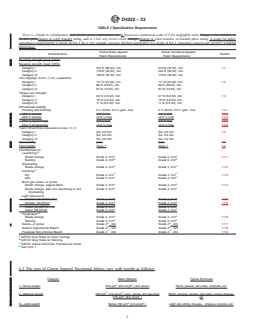
Category I 267 N (60 lbf), min 312 N (70 lbf), min 7.1
Category II 178 N (40 lbf), min 222 N (50 lbf), min
Category III 156 N (35 lbf), min 178 N (40 lbf), min
Yarn slippage, 6-mm, ( ⁄4-in.) separation:
Category I 111 N (25 lbf), min 111 N (25 lbf), min 7.2
Category II 89 N (20 lbf), min 89 N (20 lbf), min
Category III 67 N (15 lbf), min 67 N (15 lbf), min
Tongue tear strength:
Category I 20 N (4.5 lbf), min 27 N (6.0 lbf), min 7.3
Category II 16 N (3.5 lbf), min 18 N (4.0 lbf), min
Category III 11 N (2.5 lbf), min 11 N (2.5 lbf), min
Dimensional stability:
Pressing and finishing 2 % shrink, 0.5 % gain, max 2 % shrink, 0.5 % gain, max 7.4.1
After 5 washes ±2.5 % max ±2.5 % max 7.4.2
After 3 drycleanings ±2.5 % max ±2.5 % max 7.4.3
Fabric Smoothness Appearance (see 7.5.1):
Category I SA, 3.5 min SA, 3.0 min 7.5
Category II SA, 3.5 min SA, 3.0 min
Category III SA, 3.0 min SA, 3.0 min
Flammability Class 1 Class 1 7.6
Colorfastness to:
D
Laundering:
A A
Shade change Grade 4, min Grade 4, min 7.7.1
B B
Staining Grade 3, min Grade 3, min
Drycleaning
A A
Shade change Grade 4, min Grade 4, min 7.7.2
D
Crocking:
C C
Dry Grade 4, min Grade 4, min 7.7.3
C C
Wet Grade 3, min Grade 3, min
Burnt gas fumes—2 cycles
A A
Shade change, original fabric Grade 4, min Grade 4, min 7.7.4
A A
Shade change, after one laundering or one Grade 4, min Grade 4, min
drycleaning
Light (xenon-arc)
A A
Outdoor (40 AFUs) Grade 4, min Grade 4, min 7.7.5
A A
Indoor (20 AFUs) Grade 4, min Grade 4, min
D
Perspiration:
A A
Shade change Grade 4, min Grade 4, min 7.7.6
B B
Staining Grade 3, min Grade 3, min
A A
Ozone—2 cycles Grade 4 , min Grade 4 , min 7.7.7
A A
Sodium Hypochlorite Bleach Grade 4 , min Grade 4 , min 7.7.8
A A
Powdered Non-chlorine Bleach Grade 4 , min Grade 4 , min 7.7.9
A
AATCC Gray Scale for Color Change.
B
AATCC Gray Scale for Staining.
C
AATCC 9-Step Chromatic Transference Scale.
D
See Note 7.
D4232 − 23
4.2 The uses of Career Apparel Dress fabrics vary with 7. Test Methods (See Note 1)
weight as follows:
7.1 Breaking Force—Determine the dry breaking force as
Category Mass (Weight) Typical End-Uses
directed in Test Method D5034, using a constant rate of
extension (CRE) tensile testing machine with the speed of the
2 2
I—Heavy-weight 200 g/m (6.0 oz/yd ) Pants, suits, blazer,
and above waiter-type jackets, pulling clamp at 300 mm 6 10 mm (12 in. 6 0.5 in.)/min. (See
vests, coveralls, etc.
Note 2.)
2 2
II—Medium-weight 150 g/m (4.5 oz/yd ) Pants, jackets, dresses,
NOTE 2—If preferred, the use of a constant-rate-of-traverse (CRT)
and above, but less shirts and blouses,
testing machine is permitted. The crosshead speed should be as agreed
than 200 g/m (6.0 oz/ gowns, smocks, lab
between the purchaser and the supplier. There may be no overall
yd ) coats, etc.
correlation between the results obtained w
...
This document is not an ASTM standard and is intended only to provide the user of an ASTM standard an indication of what changes have been made to the previous version. Because
it may not be technically possible to adequately depict all changes accurately, ASTM recommends that users consult prior editions as appropriate. In all cases only the current version
of the standard as published by ASTM is to be considered the official document.
Designation: D4232 − 14 D4232 − 23
Standard Performance Specification for
Men’s and Women’s Woven Career Apparel Fabrics: Dress
and Vocational Career Apparel Fabrics
This standard is issued under the fixed designation D4232; the number immediately following the designation indicates the year of
original adoption or, in the case of revision, the year of last revision. A number in parentheses indicates the year of last reapproval. A
superscript epsilon (´) indicates an editorial change since the last revision or reapproval.
1. Scope
1.1 This performance specification covers the performance requirements for woven fabrics for men’s and women’s dress and
vocational career apparel. career apparel: dress and vocational.
1.2 This performance specification is not applicable to career apparel fabrics that do not patently fit the category of Career Dress
Apparel. Performance specifications for such fabrics should be as agreed to between the purchaser and the seller. This performance
specification is not applicable to overcoat or topcoat uniform fabrics.
1.3 These requirements apply to both the length and width directions for those properties where fabric direction is pertinent.
1.4 This standard does not purport to address all of the safety concerns, if any, associated with its use. It is the responsibility
of the user of this standard to establish appropriate safety and healthsafety, health, and environmental practices and determine
the applicability of regulatory limitations prior to use.
1.5 This international standard was developed in accordance with internationally recognized principles on standardization
established in the Decision on Principles for the Development of International Standards, Guides and Recommendations issued
by the World Trade Organization Technical Barriers to Trade (TBT) Committee.
2. Referenced Documents
2.1 ASTM Standards:
D123 Terminology Relating to Textiles
D434 Test Method for Resistance to Slippage of Yarns in Woven Fabrics Using a Standard Seam (Withdrawn 2003)
D1424 Test Method for Tearing Strength of Fabrics by Falling-Pendulum (Elmendorf-Type) Apparatus
D2261 Test Method for Tearing Strength of Fabrics by the Tongue (Single Rip) Procedure (Constant-Rate-of-Extension Tensile
Testing Machine)
D2262 Test Method for Tearing Strength of Woven Fabrics by the Tongue (Single Rip) Method (Constant-Rate-of-Traverse
Tensile Testing Machine) (Withdrawn 1995)
D2724 Test Method for Bond Strength of Bonded, Fused, and Laminated Apparel Fabrics
D5034 Test Method for Breaking Strength and Elongation of Textile Fabrics (Grab Test)
D7022 Terminology Relating to Apparel (Withdrawn 2022)
This performance specification is under the jurisdiction of ASTM Committee D13 on Textiles and is the direct responsibility of Subcommittee D13.61 on Apparel.
Current edition approved Feb. 1, 2014Jan. 1, 2023. Published March 2014August 2023. Originally approved in 1983. Last previous edition approved in 20082014 as
D4232 – 01D4232(2008). DOI: 10.1520/D4232-14. –14. DOI: 10.1520/D4232-23.
For referenced ASTM standards, visit the ASTM website, www.astm.org, or contact ASTM Customer Service at service@astm.org. For Annual Book of ASTM Standards
volume information, refer to the standard’s Document Summary page on the ASTM website.
The last approved version of this historical standard is referenced on www.astm.org.
Copyright © ASTM International, 100 Barr Harbor Drive, PO Box C700, West Conshohocken, PA 19428-2959. United States
D4232 − 23
2.2 AATCC Test Methods:
8TM8 Colorfastness to Crocking: Crockmeter Method
15TM15 Colorfastness to Perspiration
16.3TM16.3 Colorfastness to Light: Xenon-Arc
23TM23 Colorfastness to Burnt Gas Fumes
61TM61 Colorfastness to Laundering: Accelerated
TM109 Colorfastness to Ozone in the Atmosphere under Low Humidities
116TM116 Colorfastness to Crocking: Rotary Vertical Crockmeter Method
124TM124 Smoothness Appearance of Fabrics After Repeated Home Laundering
132TM132 Colorfastness to Drycleaning
135TM135 Dimensional Change of Fabrics after Home Laundering
TM158 Dimensional Changes on Dry Cleaning in Perchloroethylene: Machine Method
172TM172 Colorfastness to Powdered Non-chlorine Bleach in Home Laundering
188TM188 Colorfastness to Sodium Hypochlorite Bleach in Home Laundering
Evaluation Procedure 1EP1 AATCC Gray Scale for Color Change
Evaluation Procedure 2EP2 AATCC Gray Scale for Staining
Evaluation Procedure 8EP8 AATCC 9-Step Chromatic Transference Scale
M11 A Glossary of AATCC Standard Terminology
2.3 Federal Standard:
16CFR 1610 CFR, Chapter II-Consumer Product Safety Commission Subchapter D-Flammable Fabrics Act Regulations
2.4 MilitaryANSI Standard:
MIL-STD-105DANSI/ASQ Z1.4 Sampling Procedures and Tables for Inspection by Attributes
NOTE 1—Reference to test methods in this standard give only the permanent part of the designation of ASTM, AATCC, or other test methods. The current
editions of each test method cited shall prevail.
3. Terminology
3.1 For all terminology related to Apparel, see Terminology D7022.
3.1.1 The following terms are relevant to this standard: career apparel, career dress apparel, career vocational apparel.
3.2 For definitions of all other textile terms see Terminology D123.
3.3 For terms relating to chemical or colorfastness testing, refer to specific AATCC test methods, or the Glossary of AATCC
Standard Terminology, or both.
4. Specification Requirements
4.1 The properties of woven fabrics for men’s and women’s career apparel shall conform to the specification requirements in Table
1.
4.2 The uses of Career Apparel Dress fabrics vary with weight as follows:
Category Mass (Weight) Typical End-Uses
2 2
I—Heavy-weight 200 g/m (6.0 oz/yd ) and above Pants, suits, blazer, waiter-type jackets, vests,
coveralls, etc.
2 2
II—Medium-weight 150 g/m (4.5 oz/yd ) and above, but less than 200 Pants, jackets, dresses, shirts and blouses, gowns,
2 2
g/m (6.0 oz/yd ) smocks, lab coats, etc.
2 2
III—Light-weight Below 150 g/m (4.5 oz/yd ) Tops (shirts, blouses) and dresses
AATCC Technical Manual, available from American Association of Textile Chemists and Colorists (AATCC), P.O. Box 12215, Research Triangle Park, NC 27709,
http://www.aatcc.org.
Available from Superintendent of Documents, Government Printing Office, Washington, DC 20402.
Available from Standardization Documents Order Desk, Bldg. 4 Section D, 700 Robbins Ave., Philadelphia, PA 19111-5094, Attn: NPODS.American National Standards
Institute (ANSI), 25 W. 43rd St., 4th Floor, New York, NY 10036, http://www.ansi.org.
D4232 − 23
TABLE 1 Specification Requirements
NOTE 1—Grade in colorfastness and durable press requirements are is based on a numerical scale of 5 for negligible color change, color transfer, or
durable presschange or color transfer rating, and to 1 for very severe color change, change or color transfer, or durable press rating. A grade for fabric
smoothness requirements is based on SA-5 for a very smooth, pressed, finished appearance to a grade of SA-1 crumpled, creased and severely wrinkled
appearance.
Career Dress Apparel Career Vocational Apparel
Characteristics Section
Fabric Requirements Fabric Requirements
Breaking strength (load) (CRT):
Breaking strength (load) (CRE):
Category I 267 N (60 lbf), min 312 N (70 lbf), min 7.1
Category II 178 N (40 lbf), min 222 N (50 lbf), min
Category III 156 N (35 lbf), min 178 N (40 lbf), min
Yarn slippage, 6-mm, ( ⁄4-in.) separation:
Category I 111 N (25 lbf), min 111 N (25 lbf), min 7.2
Category II 89 N (20 lbf), min 89 N (20 lbf), min
Category III 67 N (15 lbf), min 67 N (15 lbf), min
Tongue tear strength:
Category I 20 N (4.5 lbf), min 27 N (6.0 lbf), min 7.3
Category II 16 N (3.5 lbf), min 18 N (4.0 lbf), min
Category III 11 N (2.5 lbf), min 11 N (2.5 lbf), min
Dimensional stability:
Pressing and finishing 2 % shrink, 0.5 % gain, max 2 % shrink, 0.5 % gain, max 7.4.1
After 5 washes 2.5 % max 2.5 % max 7.4.2
After 5 washes ±2.5 % max ±2.5 % max 7.4.2
After 3 drycleanings 2.5 % max 2.5 % max 7.4.3
After 3 drycleanings ±2.5 % max ±2.5 % max 7.4.3
Fabric Smoothness Appearance (see 7.5.1):
Category I SA, 3.5 min SA, 3.0 min 7.5
Category II SA, 3.5 min SA, 3.0 min
Category III SA, 3.0 min SA, 3.0 min
Flammability pass pass 7.6
Flammability Class 1 Class 1 7.6
Colorfastness to:
D
Laundering:
A A
Shade change Grade 4, min Grade 4, min 7.7.1
B B
Staining Grade 3, min Grade 3, min
Drycleaning
A A
Shade change Grade 4, min Grade 4, min 7.7.2
D
Crocking:
C C
Dry Grade 4, min Grade 4, min 7.7.3
C C
Wet Grade 3, min Grade 3, min
Burnt gas fumes—2 cycles
A A
Shade change, original fabric Grade 4, min Grade 4, min 7.7.4
A A
Shade change, after one laundering or one Grade 4, min Grade 4, min
drycleaning
Light (xenon-arc)
A A
Outdoor (40 AATCC FU) Grade 4, min Grade 4, min 7.7.5
A A
Outdoor (40 AFUs) Grade 4, min Grade 4, min 7.7.5
A A
Indoor (20 AATCC FU) Grade 4, min Grade 4, min
A A
Indoor (20 AFUs) Grade 4, min Grade 4, min
D
Perspiration:
A A
Shade change Grade 4, min Grade 4, min 7.7.6
B B
Staining Grade 3, min Grade 3, min
A A
Ozone—2 cycles Grade 4 , min Grade 4 , min 7.7.7
A A
Sodium Hypochlorite Bleach Grade 4 , min Grade 4 , min 7.7.8
A A
Powdered Non-chlorine Bleach Grade 4 , min Grade 4 , min 7.7.9
A
AATCC Gray Scale for Color Change.
B
AATCC Gray Scale for Staining.
C
AATCC 9-Step Chromatic Transference Scale.
D
See Note 7.
4.3 The uses of Career Apparel Vocational fabrics vary with weight as follows:
Category Mass (Weight) Typical End-Uses
2 2
I—Heavy-weight 270 g/m (8.0 oz/yd ) and above Pants, jackets, lab coats, coveralls, etc.
2 2
I
...