

ASTM D6321/D6321M-22
(Practice)Standard Practice for the Evaluation of Machine Washable T-Shirts
General Information
- Abstract
SIGNIFICANCE AND USE
4.1 This practice may be used to evaluate pertinent characteristics of washable T-shirts.
4.2 T-shirts may be subject to extra processes such as garment dyeing, garment washing, printing, application of embroidery or trims. An individual process or combination or processes may affect the performance of the final product.
4.3 This practice may be used by mutual agreement between the purchaser and the supplier to establish purchasing specifications.
SCOPE
1.1 This practice covers test methods and procedures used to evaluate important characteristics of machine washable T-shirts. T-shirts may be made of knitted fabric composed of any textile fiber(s) or blend of fibers and intended to be used as underwear or as an outer garment.
1.2 T-shirts' characteristics may be assessed either as a final product or at any intermediate processing stage.
1.3 This practice excludes T-shirts intended for hand washing or dry cleaning care.
1.4 The values stated in either SI units or inch-pound units are to be regarded separately as standard. The values stated in each system are not necessarily exact equivalents; therefore, to ensure conformance with the standard, each system shall be used independently of the other, and values from the two systems shall not be combined.
1.5 This standard does not purport to address all of the safety concerns, if any, associated with its use. It is the responsibility of the user of this standard to establish appropriate safety, health, and environmental practices and determine the applicability of regulatory limitations prior to use.
1.6 This international standard was developed in accordance with internationally recognized principles on standardization established in the Decision on Principles for the Development of International Standards, Guides and Recommendations issued by the World Trade Organization Technical Barriers to Trade (TBT) Committee.
- Status
- Published
- Publication Date
- 31-Oct-2022
- Technical Committee
- D13 - Textiles
- Drafting Committee
- D13.61 - Apparel


Overview
ASTM D6321/D6321M-22: Standard Practice for the Evaluation of Machine Washable T-Shirts is a vital international standard developed by ASTM International. This practice specifies key test methods and evaluation procedures for assessing the performance characteristics of machine washable T-shirts. It applies to T-shirts made from knitted fabrics using any textile fibers or fiber blends and covers garments intended for use as underwear or outerwear. The standard excludes T-shirts designed solely for hand washing or dry cleaning.
By referencing this standard, manufacturers, suppliers, and purchasers can establish mutual agreements on purchasing specifications, ensuring the quality, durability, and consistency of machine washable T-shirts in global markets.
Key Topics
- Performance Evaluation: The standard outlines comprehensive test methods for evaluating characteristics such as colorfastness, dimensional stability, bursting strength, seam performance, and the effect of various garment processes (e.g., dyeing, printing, application of trims).
- Assessment Stages: Evaluations can take place on the finished T-shirt or during any intermediate stage of processing.
- Sampling and Specimen Preparation: Detailed steps for sampling, laboratory specimen selection, and marking for measurements are included.
- Testing Conditions and Methods: The practice references established ASTM and AATCC methods for laboratory conditioning, washing, and drying for repeatable and consistent testing outcomes, including:
- Bursting strength (ASTM D3786, D3787)
- Seam performance (ASTM D3940)
- Color change and staining (AATCC Evaluation Procedures 1, 2, 7)
- Dimensional changes after laundering (AATCC TM150)
- Skewness change due to laundering (AATCC TM179)
- Colorfastness to water and bleach (AATCC TM107, TM172)
Applications
ASTM D6321/D6321M-22 delivers substantial practical value across the textile and apparel industry:
- Quality Control and Assurance: Enables apparel manufacturers and suppliers to maintain consistent quality standards for machine washable T-shirts by offering uniform testing protocols.
- Purchasing Agreements: Serves as a reference in contracts between buyers and suppliers, making it easier to specify and verify product requirements and performance.
- Product Development: Guides designers and engineers in evaluating how processes such as dyeing, washing, or adding embellishments may impact the final product's wash durability and integrity.
- Retail and Consumer Confidence: By ensuring T-shirts meet recognized standards for machine washability, brands can enhance customer satisfaction, reduce returns, and strengthen brand reputation.
- Regulatory and Trade Compliance: Aligns with internationally recognized standardization principles, supporting both local and international trade requirements.
Related Standards
To fully implement ASTM D6321/D6321M-22, familiarity with related ASTM and AATCC standards is essential:
- ASTM D123 - Terminology Relating to Textiles
- ASTM D1776 - Practice for Conditioning and Testing Textiles
- ASTM D3786/D3787 - Test Methods for Bursting Strength
- ASTM D3940 - Test Method for Bursting Strength and Elongation of Sewn Seams (withdrawn)
- ASTM D4154/D4156 - Performance Specifications for Knitted Sportswear and Beachwear Fabrics
- AATCC TM150 - Dimensional Changes of Garments after Home Laundering
- AATCC TM107/TM172/TM179 - Colorfastness and Skewness Test Methods
- AATCC Evaluation Procedures 1, 2, 7 - Color and Stain Assessment Methods
By adhering to ASTM D6321/D6321M-22 and its referenced methods, industry teams help ensure that machine washable T-shirts deliver reliable performance and meet evolving consumer demands for durable, high-quality garments.
Relations
- Effective Date
- 01-Jul-2020
- Effective Date
- 01-Mar-2017
- Effective Date
- 01-Jan-2016
- Effective Date
- 15-Sep-2015
- Effective Date
- 01-Sep-2015
- Effective Date
- 01-Jul-2015
- Effective Date
- 01-Apr-2015
- Effective Date
- 01-Oct-2013
- Effective Date
- 01-Oct-2013
- Effective Date
- 15-Jun-2013
- Effective Date
- 15-Jun-2013
- Effective Date
- 15-May-2013
- Effective Date
- 01-Feb-2012
- Effective Date
- 01-Feb-2012
- Effective Date
- 01-May-2011
Frequently Asked Questions
ASTM D6321/D6321M-22 is a standard published by ASTM International. Its full title is "Standard Practice for the Evaluation of Machine Washable T-Shirts". This standard covers: SIGNIFICANCE AND USE 4.1 This practice may be used to evaluate pertinent characteristics of washable T-shirts. 4.2 T-shirts may be subject to extra processes such as garment dyeing, garment washing, printing, application of embroidery or trims. An individual process or combination or processes may affect the performance of the final product. 4.3 This practice may be used by mutual agreement between the purchaser and the supplier to establish purchasing specifications. SCOPE 1.1 This practice covers test methods and procedures used to evaluate important characteristics of machine washable T-shirts. T-shirts may be made of knitted fabric composed of any textile fiber(s) or blend of fibers and intended to be used as underwear or as an outer garment. 1.2 T-shirts' characteristics may be assessed either as a final product or at any intermediate processing stage. 1.3 This practice excludes T-shirts intended for hand washing or dry cleaning care. 1.4 The values stated in either SI units or inch-pound units are to be regarded separately as standard. The values stated in each system are not necessarily exact equivalents; therefore, to ensure conformance with the standard, each system shall be used independently of the other, and values from the two systems shall not be combined. 1.5 This standard does not purport to address all of the safety concerns, if any, associated with its use. It is the responsibility of the user of this standard to establish appropriate safety, health, and environmental practices and determine the applicability of regulatory limitations prior to use. 1.6 This international standard was developed in accordance with internationally recognized principles on standardization established in the Decision on Principles for the Development of International Standards, Guides and Recommendations issued by the World Trade Organization Technical Barriers to Trade (TBT) Committee.
SIGNIFICANCE AND USE 4.1 This practice may be used to evaluate pertinent characteristics of washable T-shirts. 4.2 T-shirts may be subject to extra processes such as garment dyeing, garment washing, printing, application of embroidery or trims. An individual process or combination or processes may affect the performance of the final product. 4.3 This practice may be used by mutual agreement between the purchaser and the supplier to establish purchasing specifications. SCOPE 1.1 This practice covers test methods and procedures used to evaluate important characteristics of machine washable T-shirts. T-shirts may be made of knitted fabric composed of any textile fiber(s) or blend of fibers and intended to be used as underwear or as an outer garment. 1.2 T-shirts' characteristics may be assessed either as a final product or at any intermediate processing stage. 1.3 This practice excludes T-shirts intended for hand washing or dry cleaning care. 1.4 The values stated in either SI units or inch-pound units are to be regarded separately as standard. The values stated in each system are not necessarily exact equivalents; therefore, to ensure conformance with the standard, each system shall be used independently of the other, and values from the two systems shall not be combined. 1.5 This standard does not purport to address all of the safety concerns, if any, associated with its use. It is the responsibility of the user of this standard to establish appropriate safety, health, and environmental practices and determine the applicability of regulatory limitations prior to use. 1.6 This international standard was developed in accordance with internationally recognized principles on standardization established in the Decision on Principles for the Development of International Standards, Guides and Recommendations issued by the World Trade Organization Technical Barriers to Trade (TBT) Committee.
ASTM D6321/D6321M-22 is classified under the following ICS (International Classification for Standards) categories: 61.020 - Clothes. The ICS classification helps identify the subject area and facilitates finding related standards.
ASTM D6321/D6321M-22 has the following relationships with other standards: It is inter standard links to ASTM D3787-16(2020), ASTM D123-17, ASTM D3787-16, ASTM D123-15b, ASTM D123-15a, ASTM D3787-15, ASTM D123-15, ASTM D7022-13, ASTM D7022-13e1, ASTM D123-13a, ASTM D123-13ae1, ASTM D123-13, ASTM D123-12, ASTM D123-12e1, ASTM D3787-07(2011). Understanding these relationships helps ensure you are using the most current and applicable version of the standard.
ASTM D6321/D6321M-22 is available in PDF format for immediate download after purchase. The document can be added to your cart and obtained through the secure checkout process. Digital delivery ensures instant access to the complete standard document.
Standards Content (Sample)
This international standard was developed in accordance with internationally recognized principles on standardization established in the Decision on Principles for the
Development of International Standards, Guides and Recommendations issued by the World Trade Organization Technical Barriers to Trade (TBT) Committee.
Designation: D6321/D6321M − 22
Standard Practice for
the Evaluation of Machine Washable T-Shirts
This standard is issued under the fixed designation D6321/D6321M; the number immediately following the designation indicates the
year of original adoption or, in the case of revision, the year of last revision. A number in parentheses indicates the year of last
reapproval. A superscript epsilon (´) indicates an editorial change since the last revision or reapproval.
1. Scope D3787 Test Method for Bursting Strength of Textiles—
Constant-Rate-of-Traverse (CRT) Ball Burst Test
1.1 This practice covers test methods and procedures used
D3887 Specification for Tolerance for Knitted Fabrics
to evaluate important characteristics of machine washable
(Withdrawn 2017)
T-shirts. T-shirts may be made of knitted fabric composed of
D3940 Test Method for Bursting Strength (Load) and Elon-
any textile fiber(s) or blend of fibers and intended to be used as
gation of Sewn Seams of Knit or Woven Stretch Textile
underwear or as an outer garment.
Fabrics (Withdrawn 1995)
1.2 T-shirts’ characteristics may be assessed either as a final
D4154 Performance Specification for Men’s and Boys’Knit-
product or at any intermediate processing stage.
ted and Woven Beachwear and Sports Shirt Fabrics
D4156 Performance Specification for Women’s and Girls’
1.3 This practice excludes T-shirts intended for hand wash-
ing or dry cleaning care. Knitted Sportswear Fabrics
D7022 Terminology Relating to Apparel
1.4 The values stated in either SI units or inch-pound units
2.2 AATCC Test Methods:
are to be regarded separately as standard. The values stated in
EP1, Gray Scale for Color Change
each system are not necessarily exact equivalents; therefore, to
EP2, Gray Scale for Staining
ensure conformance with the standard, each system shall be
EP7, Instrumental Assessment of the Change in Color of a
used independently of the other, and values from the two
Textile Specimen
systems shall not be combined.
TM7, Colorfastness to Water
1.5 This standard does not purport to address all of the
TM150, Dimensional Changes of Garments after Home
safety concerns, if any, associated with its use. It is the
Laundering
responsibility of the user of this standard to establish appro-
TM172, Colorfastness to Powered Non-Chlorine Bleach in
priate safety, health, and environmental practices and deter-
Home Laundering
mine the applicability of regulatory limitations prior to use.
TM179, Skew Change in Fabrics After Home Laundering
1.6 This international standard was developed in accor-
2.3 Other AATCC Documents:
dance with internationally recognized principles on standard-
M11 Glossary of AATCC Standard Terminology
ization established in the Decision on Principles for the
LP1 Home Laundering: Machine Washing
Development of International Standards, Guides and Recom-
mendations issued by the World Trade Organization Technical
3. Terminology
Barriers to Trade (TBT) Committee.
3.1 For all terminology relating to D13.61,Apparel, refer to
2. Referenced Documents
Terminology D7022.
3.1.1 The following terms are relevant to this standard:
2.1 ASTM Standards:
T-shirt.
D123 Terminology Relating to Textiles
3.1.2 For definitions of other textile terms used in this
D1776 Practice for Conditioning and Testing Textiles
standard, refer to terminology in Terminology D123 and
D3786 Test Method for Bursting Strength of Textile
Glossary of AATCC Standard Terminology.
Fabrics—Diaphragm Bursting Strength Tester Method
4. Significance and Use
This practice is under the jurisdiction of ASTM Committee D13 on Textiles,
and is the direct responsibility of Subcommittee D13.61 on Apparel. 4.1 This practice may be used to evaluate pertinent charac-
Current edition approved Nov. 1, 2022. Published December 2022. Originally
teristics of washable T-shirts.
approved in 1998. Last previous edition approved in 2014 as D6321 – 14. DOI:
10.1520/D6321_D6321M-22.
For referenced ASTM standards, visit the ASTM website, www.astm.org, or
contact ASTM Customer Service at service@astm.org. For Annual Book of ASTM The last approved version of this historical standard is referenced on
Standards volume information, refer to the standard’s Document Summary page on www.astm.org.
the ASTM website. Available from AATCC, PO Box 12215, Research Triangle Park, NC 27709.
Copyright © ASTM International, 100 Barr Harbor Drive, PO Box C700, West Conshohocken, PA 19428-2959. United States
D6321/D6321M − 22
4.2 T-shirts may be subject to extra processes such as 7.2.3.1 For garment dimensional change, mark the locations
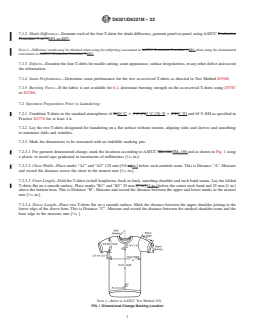
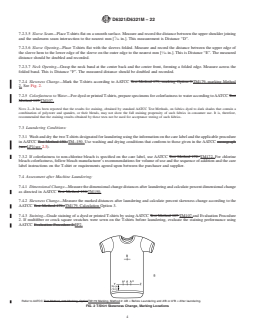
garment dyeing, garment washing, printing, application of according to AATCC TM–150 and as shown in Fig. 1 using a
embroidery or trims. An individual process or combination or plastic or metal tape graduated in increments of millimetres
processes may affect the performance of the final product. [ ⁄16 in.]:
7.2.3.2 Chest Width—Place marks “A1” and “A2” 125 mm
4.3 Thispracticemaybeusedbymutualagreementbetween
[5.0 in.] below each armhole seam. This is Distance “A”.
the purchaser and the supplier to establish purchasing specifi-
Measure and record the distance across the chest to the nearest
cations.
mm [ ⁄16 in.].
7.2.3.3 Front Length—Fold the T-shirts in half lengthwise,
5. Sampling, Selection, and Number of Specimens
back-to-back,matchingshoulderandneckbandseams.Laythe
5.1 Lot Sample—Take a lot sample as directed in an
folded T-shirts flat on a smooth surface. Place marks “B1” and
applicable material specification or as agreed between pur-
“B2” 25 mm [1 in.] below the center neck band and 25 mm [1
chaser and supplier, such as an agreement to take at random
in.] above the bottom hem. This is Distance “B”. Measure and
some fixed number of shipping containers or garments from
record the distance between the upper and lower marks to the
each lot.
nearest mm [ ⁄16 in.].
7.2.3.4 Sleeve Length—Place two T-shirts flat on a smooth
5.2 Laboratory Sample—From each lot sampling unit, take
surface. Mark the distance between the upper shoulder joining
five T-shirts to be used as the laboratory sample.
to the lower edge of the sleeve hem. This is Distance “C”.
5.3 Test Specimen—From each laboratory sample, two
Measure and record the distance between the marked shoulder
T-shirts are to be tested as-received and two T-shirts that are to
seam and the hem edge to the measure mm [ ⁄16 ].
be laundered. The fifth T-shirt is to be retained as a control
7.2.3.5 Sleeve Sea
...
This document is not an ASTM standard and is intended only to provide the user of an ASTM standard an indication of what changes have been made to the previous version. Because
it may not be technically possible to adequately depict all changes accurately, ASTM recommends that users consult prior editions as appropriate. In all cases only the current version
of the standard as published by ASTM is to be considered the official document.
Designation: D6321/D6321M − 14 D6321/D6321M − 22
Standard Practice for
the Evaluation of Machine Washable T-Shirts
This standard is issued under the fixed designation D6321/D6321M; the number immediately following the designation indicates the
year of original adoption or, in the case of revision, the year of last revision. A number in parentheses indicates the year of last
reapproval. A superscript epsilon (´) indicates an editorial change since the last revision or reapproval.
1. Scope
1.1 This practice covers test methods and procedures used to evaluate important characteristics of machine washable T-shirts.
T-shirts may be made of knitted fabric composed of any textile fiber(s) or blend of fibers and intended to be used as underwear
or as an outer garment.
1.2 T-shirts’ characteristics may be assessed either as a final product or at any intermediate processing stage.
1.3 This practice excludes T-shirts intended for hand washing or dry cleaning care.
1.4 The values stated in either SI units or inch-pound units are to be regarded separately as standard. The values stated in each
system are not necessarily exact equivalents; therefore, to ensure conformance with the standard, each system shall be used
independently of the other, and values from the two systems shall not be combined.
1.5 This standard does not purport to address all of the safety concerns, if any, associated with its use. It is the responsibility
of the user of this standardsstandard to establish appropriate safety safety, health, and healthenvironmental practices and
determine the applicability of regulatory limitations prior to use.
1.6 This international standard was developed in accordance with internationally recognized principles on standardization
established in the Decision on Principles for the Development of International Standards, Guides and Recommendations issued
by the World Trade Organization Technical Barriers to Trade (TBT) Committee.
2. Referenced Documents
2.1 ASTM Standards:
D123 Terminology Relating to Textiles
D1776 Practice for Conditioning and Testing Textiles
D3786 Test Method for Bursting Strength of Textile Fabrics—Diaphragm Bursting Strength Tester Method
D3787 Test Method for Bursting Strength of Textiles—Constant-Rate-of-Traverse (CRT) Ball Burst Test
D3887 Specification for Tolerance for Knitted Fabrics (Withdrawn 2017)
D3940 Test Method for Bursting Strength (Load) and Elongation of Sewn Seams of Knit or Woven Stretch Textile Fabrics
(Withdrawn 1995)
D4154 Performance Specification for Men’s and Boys’ Knitted and Woven Beachwear and Sports Shirt Fabrics
D4156 Performance Specification for Women’s and Girls’ Knitted Sportswear Fabrics
This practice is under the jurisdiction of ASTM Committee D13 on Textiles, and is the direct responsibility of Subcommittee D13.61 on Apparel.
Current edition approved Feb. 1, 2014Nov. 1, 2022. Published March 2014December 2022. Originally approved in 1998. Last previous edition approved in 20132014 as
D6321 – 13.D6321 – 14. DOI: 10.1520/D6321_D6321M-14.10.1520/D6321_D6321M-22.
For referenced ASTM standards, visit the ASTM website, www.astm.org, or contact ASTM Customer Service at service@astm.org. For Annual Book of ASTM Standards
volume information, refer to the standard’s Document Summary page on the ASTM website.
The last approved version of this historical standard is referenced on www.astm.org.
Copyright © ASTM International, 100 Barr Harbor Drive, PO Box C700, West Conshohocken, PA 19428-2959. United States
D6321/D6321M − 22
D7022 Terminology Relating to Apparel
2.2 AATCC Test Methods:
Evaluation Procedure 1,EP1, Gray Scale for Color Change
Evaluation Procedure 2,EP2, Gray Scale for Staining
Evaluation Procedure 7,EP7, Instrumental Assessment of the Change in Color of a Textile Specimen
Method 107,TM7, Colorfastness to Water
Method 150,TM150, Dimensional Changes of Garments after Home Laundering
Method 172,TM172, Colorfastness to Powered Non-Chlorine Bleach in Home Laundering
Method 179,TM179, Skewness Change in Fabric and Garment Twist Resulting from Automatic Skew Change in Fabrics After
Home Laundering
2.3 Other AATCC Documents:
A Glossary of AATCC Standard TerminologyM11 Glossary of AATCC Standard Terminology
Standardization of Home Laundry Test ConditionsLP1 Home Laundering: Machine Washing
3. Terminology
3.1 For all terminology relating to D13.61, Apparel, refer to Terminology D7022.
3.1.1 The following terms are relevant to this standard: T-shirt.
3.1.2 For definitions of other textile terms used in this standard, refer to terminology in Terminology D123 and Glossary of
AATCC Standard Terminology.
4. Significance and Use
4.1 This practice may be used to evaluate pertinent characteristics of washable T-shirts.
4.2 T-shirts may be subject to extra processes such as garment dyeing, garment washing, printing, application of embroidery or
trims. An individual process or combination or processes may affect the performance of the final product.
4.3 This practice may be used by mutual agreement between the purchaser and the supplier to establish purchasing specifications.
5. Sampling, Selection, and Number of Specimens
5.1 Lot Sample—Take a lot sample as directed in an applicable material specification or as agreed between purchaser and supplier,
such as an agreement to take at random some fixed number of shipping containers or garments from each lot.
5.2 Laboratory Sample—From each lot sampling unit, take five T-shirts to be used as the laboratory sample.
5.3 Test Specimen—From each laboratory sample, two T-shirts are to be tested as-received and two T-shirts that are to be
laundered. The fifth T-shirt is to be retained as a control specimen and not tested.
6. Fabric Performance Characteristics
6.1 Evaluate fabric designated for T-shirt manufacture using Specification D3887, D3787, Performance Specification D4154, or
Performance Specification D4156 as appropriate.
7. Garment Performance Characteristics
7.1 Assessments Prior to Machine Laundering (As-Received State):
7.1.1 Condition T-shirts in standard atmospheres for testing 2020 °C 6 3°C [703 °C [70 °F 6 2°F]2 °F] and 6565 % 6 2 % RH
according to Practice D1776 for 4 hrs.
Available from AATCC, PO Box 12215, Research Triangle Park, NC 27709.
D6321/D6321M − 22
7.1.2 Shade Difference—Examine each of the four T-shirts for shade difference, garment panel-to-panel, using AATCC Evaluation
Procedure 1 or 7.EP1 or EP7.
NOTE 1—Difference results may be obtained when using the subjecting assessment in AATCC Evaluation Procedure 1 EP1 when using the instrumental
assessment in AATCC Evaluation Procedure 7.EP7.
7.1.3 Defects—Examine the four T-shirts for needle cutting, seam appearance, surface irregularities, or any other defect and record
the information.
7.1.4 Seam Performance—Determine seam per
...