

ASTM E1142-23b
(Terminology)Standard Terminology Relating to Thermophysical Properties
General Information
- Abstract
SCOPE
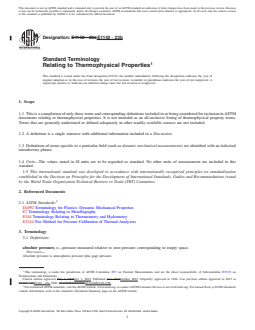
1.1 This is a compilation of only those terms and corresponding definitions included in or being considered for inclusion in ASTM documents relating to thermophysical properties. It is not intended as an all-inclusive listing of thermophysical property terms. Terms that are generally understood or defined adequately in other readily available sources are not included.
1.2 A definition is a single sentence with additional information included in a Discussion.
1.3 Definitions of terms specific to a particular field (such as dynamic mechanical measurements) are identified with an italicized introductory phrase.
1.4 Units—The values stated in SI units are to be regarded as standard. No other units of measurement are included in this standard.
1.5 This international standard was developed in accordance with internationally recognized principles on standardization established in the Decision on Principles for the Development of International Standards, Guides and Recommendations issued by the World Trade Organization Technical Barriers to Trade (TBT) Committee.
- Status
- Published
- Publication Date
- 30-Sep-2023
- Technical Committee
- E37 - Thermal Measurements
- Drafting Committee
- E37.03 - Nomenclature and Definitions
Overview
ASTM E1142-23b: Standard Terminology Relating to Thermophysical Properties is a critical international standard developed by ASTM International. This document compiles selected terms and definitions specifically used in ASTM standards related to thermophysical properties, supporting clear and consistent communication in scientific, engineering, and industrial contexts. The terminology is designed to foster understanding, accuracy, and alignment in documentation and research regarding thermal and physical behaviors of materials, supporting compliance with globally recognized standardization principles.
Key Topics
Specific Terminology: The standard provides clear, concise definitions for terms fundamental to thermophysical properties, such as thermal conductivity, thermal diffusivity, heat capacity, thermal expansion, viscosity, and phase diagrams. Only terms used or proposed for ASTM documents are included.
Field-Specific Definitions: Where relevant, the standard distinguishes field-specific meanings (e.g., as in dynamic mechanical measurements), supporting correct use in various scientific and industrial settings.
SI Units Compliance: All values, terms, and definitions refer exclusively to SI units, in accordance with international practice, eliminating ambiguities in measurement and reporting.
Clarity of Definitions: Each definition is a single sentence, with supplementary explanations provided as discussions to support clear interpretation and practical application.
Revision and Development: The standard is subject to regular review and revision by ASTM Committee E37, ensuring continued relevance in light of technical advances.
Applications
ASTM E1142-23b plays a foundational role across multiple sectors involving material science and thermophysics:
Materials Characterization: Researchers and engineers rely on standardized terminology to accurately describe the thermal properties (e.g., glass transition, thermal conductivity, specific heat) of metals, polymers, ceramics, and composites.
Product Development and Quality Control: Manufacturers use these definitions to develop testing protocols, document material properties, and ensure compliance with contract specifications and regulatory requirements.
Thermal Analysis Techniques: The standard provides indispensable language for describing and interpreting results from methods such as differential scanning calorimetry (DSC), thermomechanical analysis (TMA), dynamic mechanical analysis (DMA), and thermogravimetric analysis (TGA).
Data Reporting and International Collaboration: Consistent terminology enables unambiguous reporting in scientific publications, industry reports, safety data sheets, and technical datasheets, enhancing cross-border collaboration and trade.
Education and Training: Academic institutions employ this standardized vocabulary to support instruction in thermodynamics, materials science, and related engineering curricula.
Related Standards
ASTM E1142-23b is closely aligned with other ASTM terminology and test method standards, ensuring comprehensive coverage of relevant concepts, including:
- ASTM D4092: Terminology for Plastics: Dynamic Mechanical Properties
- ASTM E7: Terminology Relating to Metallography
- ASTM E344: Terminology Relating to Thermometry and Hydrometry
- ASTM E2744: Test Method for Pressure Calibration of Thermal Analyzers
These referenced standards deepen the scope of terminology, offering definitions tailored to plastics, metals, temperature measurement, and pressure calibration contexts.
Practical Value
By establishing a common language for thermophysical properties, ASTM E1142-23b helps ensure communication accuracy, reduces errors in specification interpretation, and underpins quality assurance activities in materials research, product development, and process engineering. Its adoption advances international harmonization, supporting innovation and efficiency in both research and industrial applications where thermophysical property data is essential.
Relations
- Effective Date
- 01-Oct-2023
- Effective Date
- 01-Dec-2023
- Effective Date
- 01-Nov-2020
- Effective Date
- 01-Oct-2023
- Effective Date
- 01-Oct-2023
- Effective Date
- 01-Oct-2023
- Effective Date
- 01-Oct-2023
- Effective Date
- 01-Oct-2023
- Effective Date
- 01-Oct-2023
- Referred By
ASTM E2403-23 - Standard Test Method for Sulfated Ash of Organic Materials by Thermogravimetry - Effective Date
- 01-Oct-2023
- Effective Date
- 01-Oct-2023
- Effective Date
- 01-Oct-2023
- Effective Date
- 01-Oct-2023
- Referred By
ASTM E3142-18a(2023) - Standard Test Method for Thermal Lag of Thermal Analysis Apparatus - Effective Date
- 01-Oct-2023
- Effective Date
- 01-Oct-2023
Get Certified
Connect with accredited certification bodies for this standard

BSMI (Bureau of Standards, Metrology and Inspection)
Taiwan's standards and inspection authority.
Sponsored listings
Frequently Asked Questions
ASTM E1142-23b is a standard published by ASTM International. Its full title is "Standard Terminology Relating to Thermophysical Properties". This standard covers: SCOPE 1.1 This is a compilation of only those terms and corresponding definitions included in or being considered for inclusion in ASTM documents relating to thermophysical properties. It is not intended as an all-inclusive listing of thermophysical property terms. Terms that are generally understood or defined adequately in other readily available sources are not included. 1.2 A definition is a single sentence with additional information included in a Discussion. 1.3 Definitions of terms specific to a particular field (such as dynamic mechanical measurements) are identified with an italicized introductory phrase. 1.4 Units—The values stated in SI units are to be regarded as standard. No other units of measurement are included in this standard. 1.5 This international standard was developed in accordance with internationally recognized principles on standardization established in the Decision on Principles for the Development of International Standards, Guides and Recommendations issued by the World Trade Organization Technical Barriers to Trade (TBT) Committee.
SCOPE 1.1 This is a compilation of only those terms and corresponding definitions included in or being considered for inclusion in ASTM documents relating to thermophysical properties. It is not intended as an all-inclusive listing of thermophysical property terms. Terms that are generally understood or defined adequately in other readily available sources are not included. 1.2 A definition is a single sentence with additional information included in a Discussion. 1.3 Definitions of terms specific to a particular field (such as dynamic mechanical measurements) are identified with an italicized introductory phrase. 1.4 Units—The values stated in SI units are to be regarded as standard. No other units of measurement are included in this standard. 1.5 This international standard was developed in accordance with internationally recognized principles on standardization established in the Decision on Principles for the Development of International Standards, Guides and Recommendations issued by the World Trade Organization Technical Barriers to Trade (TBT) Committee.
ASTM E1142-23b is classified under the following ICS (International Classification for Standards) categories: 01.040.17 - Metrology and measurement. Physical phenomena (Vocabularies); 17.200.10 - Heat. Calorimetry. The ICS classification helps identify the subject area and facilitates finding related standards.
ASTM E1142-23b has the following relationships with other standards: It is inter standard links to ASTM E1142-23a, ASTM E344-23, ASTM E344-20, ASTM E794-06(2018), ASTM E1868-10(2021), ASTM E1640-23, ASTM E2070-23, ASTM E2958-21, ASTM E2890-21, ASTM E2403-23, ASTM E2041-23, ASTM E1641-23, ASTM C1470-20, ASTM E3142-18a(2023), ASTM E2716-23. Understanding these relationships helps ensure you are using the most current and applicable version of the standard.
ASTM E1142-23b is available in PDF format for immediate download after purchase. The document can be added to your cart and obtained through the secure checkout process. Digital delivery ensures instant access to the complete standard document.
Standards Content (Sample)
This international standard was developed in accordance with internationally recognized principles on standardization established in the Decision on Principles for the
Development of International Standards, Guides and Recommendations issued by the World Trade Organization Technical Barriers to Trade (TBT) Committee.
Designation: E1142 − 23b
Standard Terminology
Relating to Thermophysical Properties
This standard is issued under the fixed designation E1142; the number immediately following the designation indicates the year of
original adoption or, in the case of revision, the year of last revision. A number in parentheses indicates the year of last reapproval. A
superscript epsilon (´) indicates an editorial change since the last revision or reapproval.
1. Scope 3. Terminology
1.1 This is a compilation of only those terms and corre- 3.1 Definitions:
sponding definitions included in or being considered for absolute pressure, n—pressure measured relative to zero
inclusion in ASTM documents relating to thermophysical
pressure corresponding to empty space.
properties. It is not intended as an all-inclusive listing of DISCUSSION—Absolute pressure is atmospheric pressure plus gage
pressure.
thermophysical property terms. Terms that are generally un-
derstood or defined adequately in other readily available
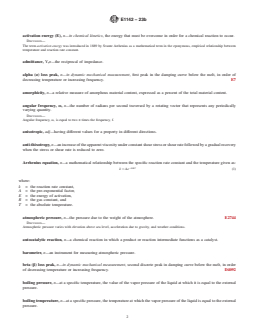
activation energy (E), n—in chemical kinetics, the energy that
sources are not included.
must be overcome in order for a chemical reaction to occur.
DISCUSSION—The term activation energy was introduced in 1889 by
1.2 A definition is a single sentence with additional infor-
Svante Arrhenius as a mathematical term in the eponymous, empirical
mation included in a Discussion.
relationship between temperature and reaction rate constant.
1.3 Definitions of terms specific to a particular field (such as
admittance, Y, n—the reciprocal of impedance.
dynamic mechanical measurements) are identified with an
italicized introductory phrase.
alpha (α) loss peak, n—in dynamic mechanical measurement,
1.4 Units—The values stated in SI units are to be regarded
first peak in the damping curve below the melt, in order of
as standard. No other units of measurement are included in this
decreasing temperature or increasing frequency. E7
standard.
amorphicity, n—a relative measure of amorphous material
1.5 This international standard was developed in accor-
content, expressed as a percent of the total material content.
dance with internationally recognized principles on standard-
angular frequency, ω, n—the number of radians per second
ization established in the Decision on Principles for the
traversed by a rotating vector that represents any periodically
Development of International Standards, Guides and Recom-
varying quantity.
mendations issued by the World Trade Organization Technical
DISCUSSION—Angular frequency, ω, is equal to two π times the
Barriers to Trade (TBT) Committee.
frequency, f.
2. Referenced Documents
anisotropic, adj—having different values for a property in
different directions.
2.1 ASTM Standards:
D4092 Terminology for Plastics: Dynamic Mechanical
anti-thixotropy, n—an increase of the apparent viscosity under
Properties
constant shear stress or shear rate followed by a gradual
E7 Terminology Relating to Metallography
recovery when the stress or shear rate is reduced to zero.
E344 Terminology Relating to Thermometry and Hydrom-
etry Arrhenius equation, n—a mathematical relationship between
E2744 Test Method for Pressure Calibration of Thermal
the specific reaction rate constant and the temperature given
Analyzers as:
2E/RT
k 5 Ae (1)
where:
This terminology is under the jurisdiction of ASTM Committee E37 on
Thermal Measurements and are the direct responsibility of Subcommittee E37.03 on k = the reaction rate constant,
Nomenclature and Definitions.
A = the pre-exponential factor,
Current edition approved Oct. 1, 2023. Published October 2023. Originally
E = the energy of activation,
approved in 1988. Last previous edition approved in 2023 as E1142 – 23a. DOI:
R = the gas constant, and
10.1520/E1142-23B.
2 T = the absolute temperature.
For referenced ASTM standards, visit the ASTM website, www.astm.org, or
contact ASTM Customer Service at service@astm.org. For Annual Book of ASTM
atmospheric pressure, n—the pressure due to the weight of
Standards volume information, refer to the standard’s Document Summary page on
the ASTM website. the atmosphere. E2744
Copyright © ASTM International, 100 Barr Harbor Drive, PO Box C700, West Conshohocken, PA 19428-2959. United States
E1142 − 23b
DISCUSSION—Atmospheric pressure varies with elevation above sea
where:
level, acceleration due to gravity, and weather conditions.
E* = complex modulus, measured in tension or flexure,
E' = storage modulus, measured in tension or flexure,
autocatalytic reaction, n—a chemical reaction in which a E" = loss modulus, measured in tension or flexure,
product or reaction intermediate functions as a catalyst.
G* = complex modulus, measured in shear,
G' = storage modulus, measured in shear,
barometer, n—an instrument for measuring atmospheric pres-
G" = loss modulus, measured in shear,
sure.
K* = complex modulus, measured in compression,
beta (β) loss peak, n—in dynamic mechanical measurement,
K' = storage modulus, measured in compression
K" = loss modulus, measured in compression, and
second discrete peak in damping curve below the melt, in
i 5 21 , measured in compression.
œ
order of decreasing temperature or increasing frequency.
D4092
The complex modulus may be measured in tension or
flexure, (E*), compression, (K*), or in shear, (G*). D4092
boiling pressure, n—at a specific temperature, the value of the
vapor pressure of the liquid at which it is equal to the
complex shear compliance, J*, n—reciprocal of complex
external pressure.
shear modulus, where J* = 1/G*. D4092
boiling temperature, n—at a specific pressure, the tempera-
complex tensile compliance, D*, n—reciprocal of complex
ture at which the vapor pressure of the liquid is equal to the
tensile modulus, where D* = 1 ⁄E*. D4092
external pressure.
complex viscosity, η*, n—the complex modulus divided by the
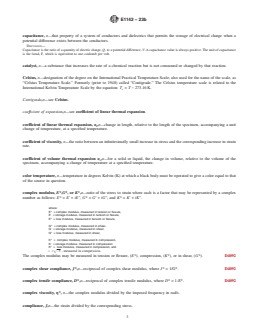
capacitance, n—that property of a system of conductors and
imposed frequency in rad/s.
dielectrics that permits the storage of electrical charge when
compliance, J, n—the strain divided by the corresponding
a potential difference exists between the conductors.
stress.
DISCUSSION—Capacitance is the ratio of a quantity of electric charge,
Q, to a potential difference, V. A capacitance value is always positive.
DISCUSSION—Compliance is the reciprocal of modulus.
The unit of capacitance is the farad, F, which is equivalent to one
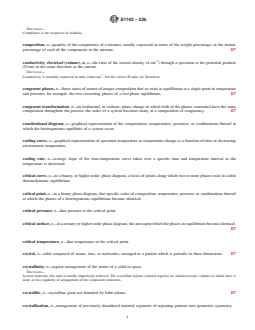
composition, n—quantity of the components of a mixture;
coulomb per volt.
usually expressed in terms of the weight percentage, or the
catalyst, n—a substance that increases the rate of a chemical
atomic percentage of each of the components in the mixture.
reaction but is not consumed or changed by that reaction.
E7
Celsius, n—designation of the degree on the International
conductivity, electrical (volume), σ, n—the ratio of the
Practical Temperature Scale; also used for the name of the -2
current density (A·cm ) through a specimen to the potential
scale, as “Celsius Temperature Scale.” Formerly (prior to
gradient (V/cm) in the same direction as the current.
1948) called “Centigrade.” The Celsius temperature scale is
DISCUSSION—Conductivity is normally expressed in units
related to the International Kelvin Temperature Scale by the -1
(ohm·cm) , but the correct SI units are Siemen·m.
equation: T = T − 273.16 K.
c
congruent phases, n—those states of matter of unique com-
Centigrade, n—see Celsius.
position that co-exist at equilibrium at a single point in
temperature and pressure; for example, the two coexisting
coeffıcient of expansion, n—see coefficient of linear thermal
phases of a two-phase equilibrium. E7
expansion.
congruent transformation, n—an isothermal, or isobaric,
coefficient of linear thermal expansion, α , n—change in
l
phase change in which both of the phases concerned have the
length, relative to the length of the specimen, accompanying
same composition throughout the process; the order of a
a unit change of temperature, at a specified temperature.
system becomes unary at a composition of congruency. E7
coefficient of viscosity, n—the ratio between an infinitesimally
constitutional diagram, n—graphical representation of the
small increase in stress and the corresponding increase in
compositions, temperatures, pressures, or combinations
strain rate.
thereof at which the heterogeneous equilibria of a system
coefficient of volume thermal expansion α , n—for a solid or
v
occur.
liquid, the change in volume, relative to the volume of the
cooling curve, n—graphical representation of specimen tem-
specimen, accompanying a change of temperature at a
perature or temperature change as a function of time or
specified temperature.
decreasing environment temperature.
color temperature, n—temperature in degrees Kelvin (K) at
which a black body must be operated to give a color equal to cooling rate, n—average slope of the time-temperature curve
taken over a specific time and temperature interval as the
that of the source in question.
temperature is decreased.
complex modulus, E*, G*, or K*, n—ratio of the stress to
strain where each is a factor that may be represented by a critical curve, n—in a binary, or higher order, phase diagram,
complex number as follows: E* = E' + iE", G* = G' + iG", a locus of points along which two or more phases exist in
and K* = K' + iK". stable thermodynamic equilibrium.
E1142 − 23b
critical point, n—in a binary phase diagram, that specific value between alternate junctions maintained at a reference tem-
of composition, temperature, pressure, or combinations perature and the measured temperature.
thereof at which the phases of a heterogeneous equilibrium
dilatancy, n—the increase in volume caused by shear.
become identical.
dilatometry, n—the technique to measure a dimensional
critical pressure, n—that pressure at the critical point.
change of a substance as a function of temperature or time at
critical surface, n—in a ternary or higher order phase diagram, no or negligible applied force.
the area upon which the phases in equilibrium become
dipole relaxation time, γ, n—the exponential decay time
identical. E7
required for the electric polarization of any point of a
critical temperature, n—that temperature at the critical point.
suitably charged dielectric to fall from its original value to
1/e of that value, due to the loss of dipole orientation.
crystal, n—solid composed of atoms, ions, or molecules,
DISCUSSION—Under conditions of an alternating applied field and in
arranged in a pattern which is periodic in three dimensions.
systems with a single dipole relaxation time, it is equal to 1/ω at the loss
E7
factor peak in cases where the peak is caused by a dipole mechanism.
crystallinity, n—regular arrangement of the atoms of a solid in
dissipation factor, n—see tangent delta.
space.
dissociation, n—as applied to heterogeneous equilibria, the
DISCUSSION—In most materials, this state is usually imperfectly
transformation of one phase into two or more new phases, all
achieved. The crystalline regions (ordered regions) are submicroscopic
volumes in which there is more or less regularity of arrangement of the
of different composition. E7
component molecules.
dynamic modulus, n—see complex modulus.
crystallite, n—crystalline grain not bounded by habit planes.
elasticity, n—that property of materials that causes them to
E7
return to their original form or condition after the applied
crystallization, n—arrangement of previously disordered ma-
force is removed. D4092
terial segments of repeating patterns into geometric symme-
elastic limit, n—the greatest stress that can be applied to a
try.
material without permanent deformation.
crystallization temperature, n—that temperature at which a
elastic modulus, n—the ratio of stress to corresponding strain
specimen undergoes crystallization upon cooling.
within the elastic limit of the stress-strain curve.
Curie point, n—see Curie temperature.
DISCUSSION—The elastic modulus may also be measured in tension
(E'), compression (K'), flexure (E'), or shear (G'). (See also complex
Curie temperature, n—temperature above which a ferromag-
modulus.)
netic or ferroelectric material becomes paramagnetic, or
enthalpy, n—a thermodynamic function defined by the equa-
paraelectric, respectively.
tion H = U + PV where H is the enthalpy, U is the internal
DISCUSSION—There may be more than one if there are multiple
materials.
energy, P is the pressure, and V the volume of the system.
DISCUSSION—At constant pressure the change in enthalpy measures
damping, n—loss in energy, dissipated as heat, that results
the quantity of heat exchanged by the system and its surrounding.
when a material or material system is subjected to an
equilibrium diagram, n—see constitutional diagram.
oscillatory load or displacement. D4092
eutectic point, n—see eutectic.
devitrification, n—crystallization of an amorphous substance.
E7
eutectic, adj—mixture of two or more substances which
solidifies as a whole when cooled from the liquid state,
dielectric constant, n—see permittivity, relative.
without change in composition.
dielectric dissipation factor, D, n—the ratio of the loss factor,
DISCUSSION—The temperature at which the eutectic mixture solidifies
ε", to the absolute permittivity, ε', or:
is called the eutectic point. This temperature is constant for a given
" '
composition, and represents the lowest melting point of the system.
D 5 ε /ε (2)
DISCUSSION—The dielectric dissipation factor is numerically equal to
expansivity, n—the change in dimension resulting from an
the tangent of the dielectric loss angle and may be referred to as the loss
infinitesimal change in an independent variable (such as
tangent, tan δ, or the cotangent of the phase angle, θ.
temperature or humidity).
dielectric loss angle, n—the angle whose tangent is the
failure, n—the point beyond which a material ceases to be
dissipation factor or arctan ε''/ε'.
functionally capable of its intended use.
DISCUSSION—It is also the difference between 90 degrees and the
phase angle.
failure criterion, n—specification of the chemical, physical,
mechanical, electrical, or other condition under which a
differential thermocouple, n—see differential thermopile.
material ceases to be functionally capable of its intended use.
differential thermopile, n—a number of temperature sensors
connected in series-opposing and arranged so that there is an failure temperature (T ), n—the temperature at which a
f
increase in output signal for a given temperature difference material fails.
E1142 − 23b
Fahrenheit, n—designation of a degree on the Fahrenheit impedance, Z, n—the ratio of the time dependent voltage, v(t),
temperature scale that is related to the International Practical across a circuit, a circuit element, or material to the time
Temperature Scale by means of the equation: dependent current, i(t), through it; that is:
T 5 1.8 T 132 (3) Z 5 v t /i t (4)
~ ! ~ !
F C
DISCUSSION—The impedance of a circuit, circuit element, or material
where:
is a measure of its ability to oppose the transmission of an alternating
T = the temperature in degree Fahrenheit, and
current. It is expressed in ohms. Its value depends on the angular
F
T = the temperature in degrees Celsius. frequency, ω, of the measurement.
C
freezing temperature, n—see crystallization temperature. invariant equilibrium, n—stable state among a number of
phases exceeding by two the number of components in the
frequency, f, n—the number of cycles per unit time of periodic
system and in which more of the external variables
process.
(pressure, temperatures, or concentrations) may be varied
DISCUSSION—The unit is Hertz (Hz) which is equal to 1 cycle per/s.
without causing a decrease in the number of phases present.
frequency profile, n—in dynamic mechanical measurement,
E7
plot of the dynamic properties of a material, at a constant
invariant point, n—point defined by the unique values of
temperature, as a function of test frequency. D4092
temperature, pressure, and concentrations in a system with
gage pressure, n—pressure measured relative to atmospheric
the maximum number of phases that can coexist in
pressure.
equilibrium. E7
DISCUSSION—Gage pressure is the difference between absolute pres-
sure and atmospheric pressure. isohume, n—constant relative humidity.
gamma (γ) loss peak, n—in dynamic mechanical
isotropic, adj—having the same magnitude of a property in all
measurement, third peak in the damping curve below the
directions.
melt, in the order of decreasing temperature or increasing
Kelvin, n—designation of the thermodynamic temperature
frequency. D4092
scale and the degree on this scale. E344
Gibbs Phase Rule, n—maximum number of phases (P) that
DISCUSSION—This Kelvin scale was defined by the 10th General
may coexist at equilibrium is equal to two, plus the number
Conference on Weights and Measure in 1954 by assigning the tem-
of components (C) in the mixture, minus the number of perature of 273.16 K to the triple point of water. Also, the degree on the
International Practical Kelvin Temperature Scale.
degrees of freedom (F): P + F = C + 2. E7
kinetics (chemical), n—the study of rates of chemical reac-
glass transition, n—reversible change in an amorphous mate-
tions.
rial or in amorphous regions of a partially crystalline
material, from (or to) a viscous or rubbery condition to (or
lifetime, n—the period of time during which an object,
from) a hard and relatively brittle one.
performance property, or process exists and functions in
DISCUSSION—The glass transition generally occurs over a relatively
accordance with stated requirements.
narrow temperature region and is similar to the solidification of a liquid
to a glassy state. Not only do hardness and brittleness undergo rapid
liquidus, n—locus of points in a phase diagram, re
...
This document is not an ASTM standard and is intended only to provide the user of an ASTM standard an indication of what changes have been made to the previous version. Because
it may not be technically possible to adequately depict all changes accurately, ASTM recommends that users consult prior editions as appropriate. In all cases only the current version
of the standard as published by ASTM is to be considered the official document.
Designation: E1142 − 23a E1142 − 23b
Standard Terminology
Relating to Thermophysical Properties
This standard is issued under the fixed designation E1142; the number immediately following the designation indicates the year of
original adoption or, in the case of revision, the year of last revision. A number in parentheses indicates the year of last reapproval. A
superscript epsilon (´) indicates an editorial change since the last revision or reapproval.
1. Scope
1.1 This is a compilation of only those terms and corresponding definitions included in or being considered for inclusion in ASTM
documents relating to thermophysical properties. It is not intended as an all-inclusive listing of thermophysical property terms.
Terms that are generally understood or defined adequately in other readily available sources are not included.
1.2 A definition is a single sentence with additional information included in a Discussion.
1.3 Definitions of terms specific to a particular field (such as dynamic mechanical measurements) are identified with an italicized
introductory phrase.
1.4 Units—The values stated in SI units are to be regarded as standard. No other units of measurement are included in this
standard.
1.5 This international standard was developed in accordance with internationally recognized principles on standardization
established in the Decision on Principles for the Development of International Standards, Guides and Recommendations issued
by the World Trade Organization Technical Barriers to Trade (TBT) Committee.
2. Referenced Documents
2.1 ASTM Standards:
D4092 Terminology for Plastics: Dynamic Mechanical Properties
E7 Terminology Relating to Metallography
E344 Terminology Relating to Thermometry and Hydrometry
E2744 Test Method for Pressure Calibration of Thermal Analyzers
3. Terminology
3.1 Definitions:
absolute pressure, n—pressure measured relative to zero pressure corresponding to empty space.
DISCUSSION—
Absolute pressure is atmospheric pressure plus gage pressure.
This terminology is under the jurisdiction of ASTM Committee E37 on Thermal Measurements and are the direct responsibility of Subcommittee E37.03 on
Nomenclature and Definitions.
Current edition approved May 1, 2023Oct. 1, 2023. Published June 2023October 2023. Originally approved in 1988. Last previous edition approved in 2023 as
E1142 – 23.E1142 – 23a. DOI: 10.1520/E1142-23A.10.1520/E1142-23B.
For referenced ASTM standards, visit the ASTM website, www.astm.org, or contact ASTM Customer Service at service@astm.org. For Annual Book of ASTM Standards
volume information, refer to the standard’s Document Summary page on the ASTM website.
Copyright © ASTM International, 100 Barr Harbor Drive, PO Box C700, West Conshohocken, PA 19428-2959. United States
E1142 − 23b
activation energy (E), n—in chemical kinetics, the energy that must be overcome in order for a chemical reaction to occur.
DISCUSSION—
The term activation energy was introduced in 1889 by Svante Arrhenius as a mathematical term in the eponymous, empirical relationship between
temperature and reaction rate constant.
admittance, Y,n—the reciprocal of impedance.
alpha (α) loss peak, n—in dynamic mechanical measurement, first peak in the damping curve below the melt, in order of
decreasing temperature or increasing frequency. E7
amorphicity, n—a relative measure of amorphous material content, expressed as a percent of the total material content.
angular frequency, ω, n—the number of radians per second traversed by a rotating vector that represents any periodically
varying quantity.
DISCUSSION—
Angular frequency, ω, is equal to two π times the frequency, f.
anisotropic, adj—having different values for a property in different directions.
anti-thixotropy, n—an increase of the apparent viscosity under constant shear stress or shear rate followed by a gradual recovery
when the stress or shear rate is reduced to zero.
Arrhenius equation, n—a mathematical relationship between the specific reaction rate constant and the temperature given as:
2E/RT
k 5 Ae (1)
where:
k = the reaction rate constant,
A = the pre-exponential factor,
E = the energy of activation,
R = the gas constant, and
T = the absolute temperature.
atmospheric pressure, n—the pressure due to the weight of the atmosphere. E2744
DISCUSSION—
Atmospheric pressure varies with elevation above sea level, acceleration due to gravity, and weather conditions.
autocatalytic reaction, n—a chemical reaction in which a product or reaction intermediate functions as a catalyst.
barometer, n—an instrument for measuring atmospheric pressure.
beta (β) loss peak, n—in dynamic mechanical measurement, second discrete peak in damping curve below the melt, in order
of decreasing temperature or increasing frequency. D4092
boiling pressure, n—at a specific temperature, the value of the vapor pressure of the liquid at which it is equal to the external
pressure.
boiling temperature, n—at a specific pressure, the temperature at which the vapor pressure of the liquid is equal to the external
pressure.
E1142 − 23b
capacitance, n—that property of a system of conductors and dielectrics that permits the storage of electrical charge when a
potential difference exists between the conductors.
DISCUSSION—
Capacitance is the ratio of a quantity of electric charge, Q, to a potential difference, V. A capacitance value is always positive. The unit of capacitance
is the farad, F, which is equivalent to one coulomb per volt.
catalyst, n—a substance that increases the rate of a chemical reaction but is not consumed or changed by that reaction.
Celsius, n—designation of the degree on the International Practical Temperature Scale; also used for the name of the scale, as
“Celsius Temperature Scale.” Formerly (prior to 1948) called “Centigrade.” The Celsius temperature scale is related to the
International Kelvin Temperature Scale by the equation: T = T − 273.16 K.
c
Centigrade,n—see Celsius.
coeffıcient of expansion,n—see coefficient of linear thermal expansion.
coefficient of linear thermal expansion, α ,n—change in length, relative to the length of the specimen, accompanying a unit
l
change of temperature, at a specified temperature.
coefficient of viscosity, n—the ratio between an infinitesimally small increase in stress and the corresponding increase in strain
rate.
coefficient of volume thermal expansion α ,n—for a solid or liquid, the change in volume, relative to the volume of the
v
specimen, accompanying a change of temperature at a specified temperature.
color temperature, n—temperature in degrees Kelvin (K) at which a black body must be operated to give a color equal to that
of the source in question.
complex modulus, E*,G*, or K*,n—ratio of the stress to strain where each is a factor that may be represented by a complex
number as follows: E* = E' + iE", G* = G' + iG", and K* = K' + iK".
where:
E* = complex modulus, measured in tension or flexure,
E' = storage modulus, measured in tension or flexure,
E" = loss modulus, measured in tension or flexure,
G* = complex modulus, measured in shear,
G' = storage modulus, measured in shear,
G" = loss modulus, measured in shear,
K* = complex modulus, measured in compression,
K' = storage modulus, measured in compression
K" = loss modulus, measured in compression, and
i 5 21 , measured in compression.
œ
The complex modulus may be measured in tension or flexure, (E*), compression, (K*), or in shear, (G*). D4092
complex shear compliance, J*,n—reciprocal of complex shear modulus, where J* = 1/G*. D4092
complex tensile compliance, D*,n—reciprocal of complex tensile modulus, where D* = 1 ⁄E*. D4092
complex viscosity, η*, n—the complex modulus divided by the imposed frequency in rad/s.
compliance, J,n—the strain divided by the corresponding stress.
E1142 − 23b
DISCUSSION—
Compliance is the reciprocal of modulus.
composition, n—quantity of the components of a mixture; usually expressed in terms of the weight percentage, or the atomic
percentage of each of the components in the mixture. E7
-2
conductivity, electrical (volume), σ, n—the ratio of the current density (A·cm ) through a specimen to the potential gradient
(V/cm) in the same direction as the current.
DISCUSSION—
-1
Conductivity is normally expressed in units (ohm·cm) , but the correct SI units are Siemen·m.
congruent phases, n—those states of matter of unique composition that co-exist at equilibrium at a single point in temperature
and pressure; for example, the two coexisting phases of a two-phase equilibrium. E7
congruent transformation, n—an isothermal, or isobaric, phase change in which both of the phases concerned have the same
composition throughout the process; the order of a system becomes unary at a composition of congruency. E7
constitutional diagram, n—graphical representation of the compositions, temperatures, pressures, or combinations thereof at
which the heterogeneous equilibria of a system occur.
cooling curve, n—graphical representation of specimen temperature or temperature change as a function of time or decreasing
environment temperature.
cooling rate, n—average slope of the time-temperature curve taken over a specific time and temperature interval as the
temperature is decreased.
critical curve, n—in a binary, or higher order, phase diagram, a locus of points along which two or more phases exist in stable
thermodynamic equilibrium.
critical point, n—in a binary phase diagram, that specific value of composition, temperature, pressure, or combinations thereof
at which the phases of a heterogeneous equilibrium become identical.
critical pressure, n—that pressure at the critical point.
critical surface, n—in a ternary or higher order phase diagram, the area upon which the phases in equilibrium become identical.
E7
critical temperature, n—that temperature at the critical point.
crystal, n—solid composed of atoms, ions, or molecules, arranged in a pattern which is periodic in three dimensions. E7
crystallinity, n—regular arrangement of the atoms of a solid in space.
DISCUSSION—
In most materials, this state is usually imperfectly achieved. The crystalline regions (ordered regions) are submicroscopic volumes in which there is
more or less regularity of arrangement of the component molecules.
crystallite, n—crystalline grain not bounded by habit planes. E7
crystallization, n—arrangement of previously disordered material segments of repeating patterns into geometric symmetry.
E1142 − 23b
crystallization temperature, n—that temperature at which a specimen undergoes crystallization upon cooling.
Curie point,n—see Curie temperature.
Curie temperature, n—temperature above which a ferromagnetic or ferroelectric material becomes paramagnetic, or
paraelectric, respectively.
DISCUSSION—
There may be more than one if there are multiple materials.
damping, n—loss in energy, dissipated as heat, that results when a material or material system is subjected to an oscillatory load
or displacement. D4092
devitrification, n—crystallization of an amorphous substance. E7
dielectric constant,n—see permittivity, relative.
dielectric dissipation factor, D,n—the ratio of the loss factor, ε", to the absolute permittivity, ε', or:
" '
D 5 ε /ε (2)
DISCUSSION—
The dielectric dissipation factor is numerically equal to the tangent of the dielectric loss angle and may be referred to as the loss tangent, tan δ, or the
cotangent of the phase angle, θ.
dielectric loss angle, n—the angle whose tangent is the dissipation factor or arctan ε''/ε'.
DISCUSSION—
It is also the difference between 90 degrees and the phase angle.
differential thermocouple,n—see differential thermopile.
differential thermopile, n—a number of temperature sensors connected in series-opposing and arranged so that there is an
increase in output signal for a given temperature difference between alternate junctions maintained at a reference temperature
and the measured temperature.
dilatancy, n—the increase in volume caused by shear.
dilatometry, n—the technique to measure a dimensional change of a substance as a function of temperature or time at no or
negligible applied force.
dipole relaxation time, γ, n—the exponential decay time required for the electric polarization of any point of a suitably charged
dielectric to fall from its original value to 1/e of that value, due to the loss of dipole orientation.
DISCUSSION—
Under conditions of an alternating applied field and in systems with a single dipole relaxation time, it is equal to 1/ω at the loss factor peak in cases
where the peak is caused by a dipole mechanism.
dissipation factor,n—see tangent delta.
dissociation, n—as applied to heterogeneous equilibria, the transformation of one phase into two or more new phases, all of
different composition. E7
dynamic modulus,n—see complex modulus.
E1142 − 23b
elasticity, n—that property of materials that causes them to return to their original form or condition after the applied force is
removed. D4092
elastic limit, n—the greatest stress that can be applied to a material without permanent deformation.
elastic modulus, n—the ratio of stress to corresponding strain within the elastic limit of the stress-strain curve.
DISCUSSION—
The elastic modulus may also be measured in tension (E'), compression (K'), flexure (E'), or shear (G'). (See also complex modulus.)
enthalpy, n—a thermodynamic function defined by the equation H = U + PV where H is the enthalpy, U is the internal energy,
P is the pressure, and V the volume of the system.
DISCUSSION—
At constant pressure the change in enthalpy measures the quantity of heat exchanged by the system and its surrounding.
equilibrium diagram,n—see constitutional diagram.
eutectic point,n—see eutectic.
eutectic, adj—mixture of two or more substances which solidifies as a whole when cooled from the liquid state, without change
in composition.
DISCUSSION—
The temperature at which the eutectic mixture solidifies is called the eutectic point. This temperature is constant for a given composition, and represents
the lowest melting point of the system.
expansivity, n—the change in dimension resulting from an infinitesimal change in an independent variable (such as temperature
or humidity).
failure, n—the point beyond which a material ceases to be functionally capable of its intended use.
failure criterion, n—specification of the chemical, physical, mechanical, electrical, or other condition under which a material
ceases to be functionally capable of its intended use.
failure temperature (T ), n—the temperature at which a material fails.
f
Fahrenheit, n—designation of a degree on the Fahrenheit temperature scale that is related to the International Practical
Temperature Scale by means of the equation:
T 5 1.8 T 132 (3)
F C
where:
T = the temperature in degree Fahrenheit, and
F
T = the temperature in degrees Celsius.
C
freezing temperature,n—see crystallization temperature.
frequency, f, n—the number of cycles per unit time of periodic process.
DISCUSSION—
The unit is Hertz (Hz) which is equal to 1 cycle per/s.
frequency profile, n—in dynamic mechanical measurement, plot of the dynamic properties of a material, at a constant
temperature, as a function of test frequency. D4092
E1142 − 23b
gage pressure, n—pressure measured relative to atmospheric pressure.
DISCUSSION—
Gage pressure is the difference between absolute pressure and atmospheric pressure.
gamma (γ) loss peak, n—in dynamic mechanical measurement, third peak in the damping curve below the melt, in the order
of decreasing temperature or increasing frequency. D4092
Gibbs Phase Rule, n—maximum number of phases (P) that may coexist at equilibrium is equal to two, plus the number of
components (C) in the mixture, minus the number of degrees of freedom (F): P + F = C + 2. E7
glass transition, n—reversible change in an amorphous material or in amorphous regions of a partially crystalline material, from
(or to) a viscous or rubbery condition to (or from) a hard and relatively brittle one.
DISCUSSION—
The glass transition generally occurs over a relatively narrow temperature region and is similar to the solidification of a liquid to a glassy state. Not
only do hardness and brittleness undergo rapid changes in this temperature region, but other properties, such as coefficient of thermal expansion and
specific heat capacity, also change rapidly. This phenomenon sometimes is referred to as a second order transition, rubber transition, or rubbery
transition. When more than one amorphous transition occurs in a material, the one associated with segmental motions of the backbone molecular chain,
or accompanied by the largest change in properties is usually considered to be the glass transition.
glass transition temperature, n—a temperature chosen to represent the temperature range over which the glass transition takes
place.
DISCUSSION—
The glass transition temperature can be determined readily by observing the temperature region at which a significant change takes place in some
specific electrical, mechanical, thermal, or other physical property. Moreover, the observed temperature can vary significantly depending on the
property chosen for observation and on details of the experimental technique (for example, heating rate, frequency of test). Therefore, the observed
Tg should be considered valid only for that particular technique and set of test conditions.
heat capacity, n—quantity of heat necessary to change the temperature of an entity, substance or system by one Kelvin of
temperature.
DISCUSSION—
The SI units of measurement are J/K.
impedance, Z, n—the ratio of the time dependent voltage, v(t), across a circuit, a circuit element, or material to the time
dependent current, i(t), through it; that is:
Z 5 v t /i t (4)
~ ! ~ !
DISCUSSION—
The impedanc
...