


ASTM D6348-12(2020)
(Test Method)Standard Test Method for Determination of Gaseous Compounds by Extractive Direct Interface Fourier Transform Infrared (FTIR) Spectroscopy
Standard Test Method for Determination of Gaseous Compounds by Extractive Direct Interface Fourier Transform Infrared (FTIR) Spectroscopy
SIGNIFICANCE AND USE
5.1 The FTIR measurements provide for multicomponent on-site analysis of source effluent.
5.2 This test method provides the volume concentration of detected analytes. Converting the volume concentration to a mass emission rate using a particular compound’s molecular weight, and the effluent volumetric flow rate, temperature and pressure is useful for determining the impact of that compound to the atmosphere.
5.3 Known concentrations of target analytes are spiked into the effluent to evaluate the sampling and analytical system’s effectiveness for transport and quantification of the target analytes, and to ensure that the data collected are meaningful.
5.4 The FTIR measurement data are used to evaluate process conditions, emissions control devices, and for determining compliance with emission standards or other applicable permits.
5.5 Data quality objectives for each specific testing program must be specified and outlined in a test plan (Annex A1).5
SCOPE
1.1 This field test method employs an extractive sampling system to direct stationary source effluent to an FTIR spectrometer for the identification and quantification of gaseous compounds. Concentration results are provided. This test method is potentially applicable for the determination of compounds that (1) have sufficient vapor pressure to be transported to the FTIR spectrometer and (2) absorb a sufficient amount of infrared radiation to be detected.
1.2 This field test method provides near real time analysis of extracted gas samples from stationary sources. Gas streams with high moisture content may require conditioning to minimize the excessive spectral absorption features imposed by water vapor.
1.3 This field test method requires the preparation of a source specific field test plan. The test plan must include the following: (1) the identification of the specific target analytes (2) the known analytical interferents specific to the test facility source effluent (3) the test data quality necessary to meet the specific test requirements and (4) the results obtained from the laboratory testing (see Annex A1 for test plan requirements).
1.4 The FTIR instrument range should be sufficient to measure from high ppm(v) to ppb(v) and may be extended to higher or lower concentrations using any or all of the following procedures:
1.4.1 The gas absorption cell path length may be either increased or decreased,
1.4.2 The sample conditioning system may be modified to reduce the water vapor, CO2, and other interfering compounds to levels that allow for quantification of the target compound(s), and
1.4.3 The analytical algorithm may be modified such that interfering absorbance bands are minimized or stronger/weaker absorbance bands are employed for the target analytes.
1.5 The practical minimum detectable concentration is instrument, compound, and interference specific (see Annex A2 for procedures to estimate the achievable minimum detectable concentrations (MDCs)). The actual sensitivity of the FTIR measurement system for the individual target analytes depends upon the following:
1.5.1 The specific infrared absorptivity (signal) and wavelength analysis region for each target analyte,
1.5.2 The amount of instrument noise (see Annex A6), and
1.5.3 The concentration of interfering compounds in the sample gas (in particular, percent moisture and CO2), and the amount of spectral overlap imparted by these compounds in the wavelength region(s) used for the quantification of the target analytes.
1.5.4 Any sampling system interferences such as adsorption or outgassing.
1.6 Practices E168 and E1252 are suggested for additional reading.
1.7 The values stated in SI units are to be regarded as standard. No other units of measurement are included in this standard.
1.8 This standard does not purport to address all of the safety concerns, if any, associated with its use. It is the responsibility of the user of thi...
General Information
Relations
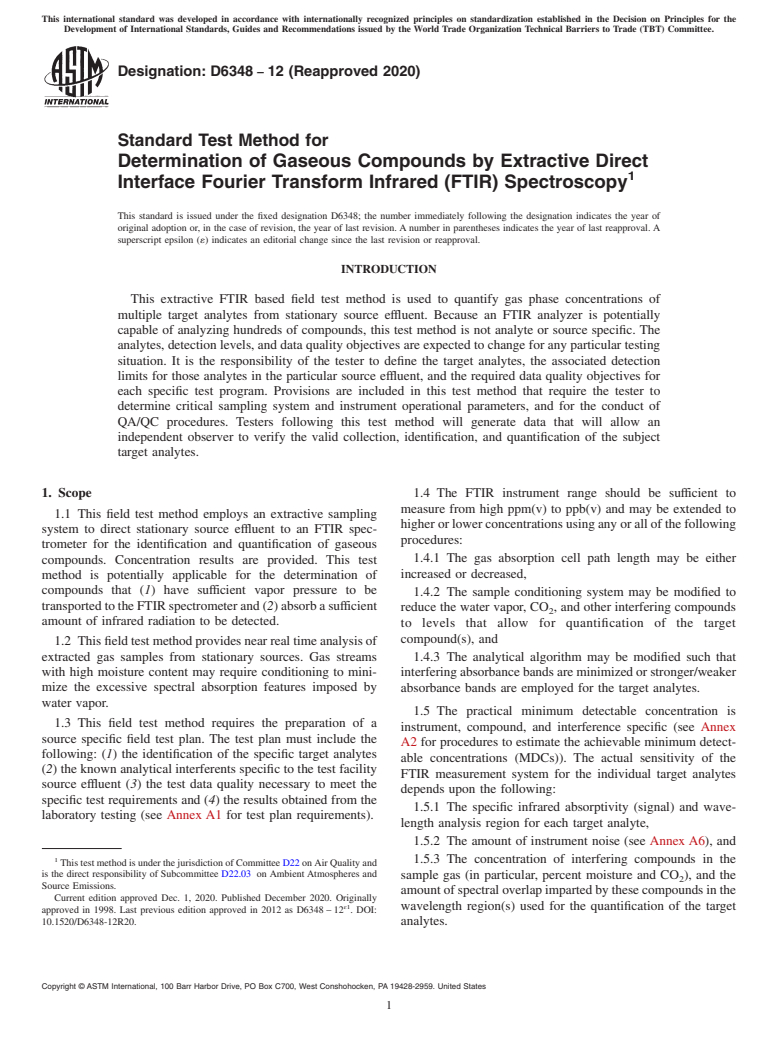
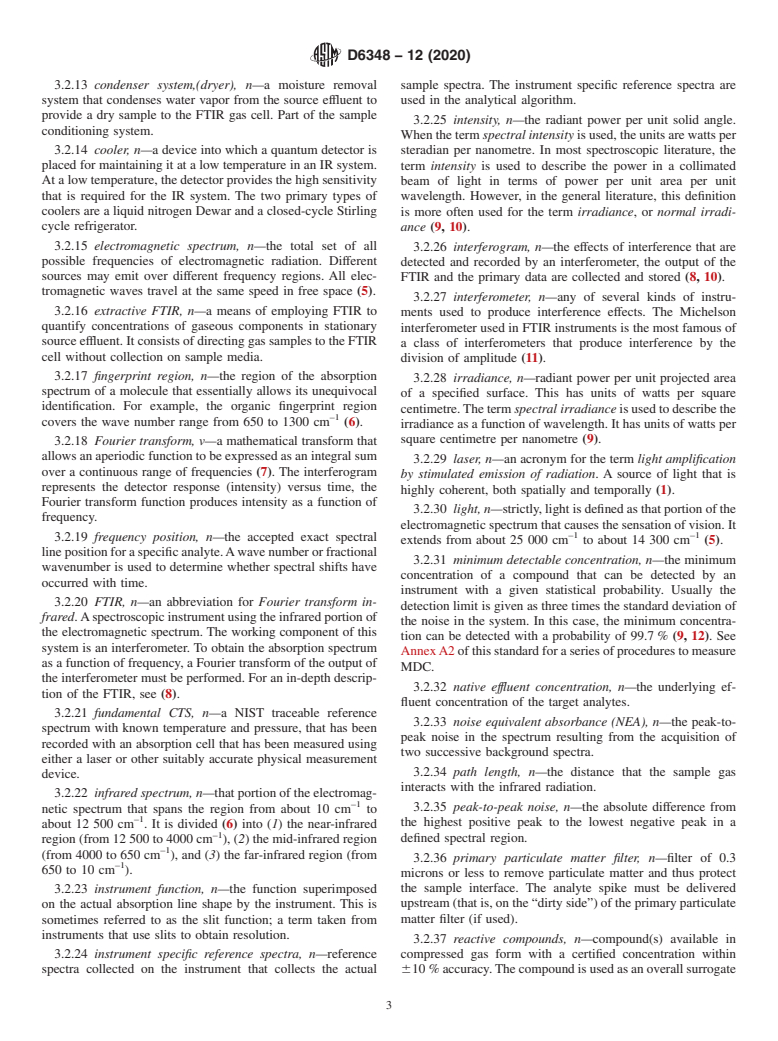
Standards Content (Sample)
This international standard was developed in accordance with internationally recognized principles on standardization established in the Decision on Principles for the
Development of International Standards, Guides and Recommendations issued by the World Trade Organization Technical Barriers to Trade (TBT) Committee.
Designation: D6348 − 12 (Reapproved 2020)
Standard Test Method for
Determination of Gaseous Compounds by Extractive Direct
1
Interface Fourier Transform Infrared (FTIR) Spectroscopy
This standard is issued under the fixed designation D6348; the number immediately following the designation indicates the year of
original adoption or, in the case of revision, the year of last revision.Anumber in parentheses indicates the year of last reapproval.A
superscript epsilon (´) indicates an editorial change since the last revision or reapproval.
INTRODUCTION
This extractive FTIR based field test method is used to quantify gas phase concentrations of
multiple target analytes from stationary source effluent. Because an FTIR analyzer is potentially
capable of analyzing hundreds of compounds, this test method is not analyte or source specific. The
analytes,detectionlevels,anddataqualityobjectivesareexpectedtochangeforanyparticulartesting
situation. It is the responsibility of the tester to define the target analytes, the associated detection
limits for those analytes in the particular source effluent, and the required data quality objectives for
each specific test program. Provisions are included in this test method that require the tester to
determine critical sampling system and instrument operational parameters, and for the conduct of
QA/QC procedures. Testers following this test method will generate data that will allow an
independent observer to verify the valid collection, identification, and quantification of the subject
target analytes.
1. Scope 1.4 The FTIR instrument range should be sufficient to
measure from high ppm(v) to ppb(v) and may be extended to
1.1 This field test method employs an extractive sampling
higherorlowerconcentrationsusinganyorallofthefollowing
system to direct stationary source effluent to an FTIR spec-
procedures:
trometer for the identification and quantification of gaseous
1.4.1 The gas absorption cell path length may be either
compounds. Concentration results are provided. This test
increased or decreased,
method is potentially applicable for the determination of
compounds that (1) have sufficient vapor pressure to be
1.4.2 The sample conditioning system may be modified to
transportedtotheFTIRspectrometerand(2)absorbasufficient
reduce the water vapor, CO , and other interfering compounds
2
amount of infrared radiation to be detected.
to levels that allow for quantification of the target
compound(s), and
1.2 Thisfieldtestmethodprovidesnearrealtimeanalysisof
extracted gas samples from stationary sources. Gas streams 1.4.3 The analytical algorithm may be modified such that
with high moisture content may require conditioning to mini- interferingabsorbancebandsareminimizedorstronger/weaker
mize the excessive spectral absorption features imposed by absorbance bands are employed for the target analytes.
water vapor.
1.5 The practical minimum detectable concentration is
1.3 This field test method requires the preparation of a
instrument, compound, and interference specific (see Annex
source specific field test plan. The test plan must include the
A2 for procedures to estimate the achievable minimum detect-
following: (1) the identification of the specific target analytes
able concentrations (MDCs)). The actual sensitivity of the
(2) the known analytical interferents specific to the test facility
FTIR measurement system for the individual target analytes
source effluent (3) the test data quality necessary to meet the
depends upon the following:
specific test requirements and (4) the results obtained from the
1.5.1 The specific infrared absorptivity (signal) and wave-
laboratory testing (see Annex A1 for test plan requirements).
length analysis region for each target analyte,
1.5.2 The amount of instrument noise (see AnnexA6), and
1
1.5.3 The concentration of interfering compounds in the
ThistestmethodisunderthejurisdictionofCommitteeD22onAirQualityand
is the direct responsibility of Subcommittee D22.03 on AmbientAtmospheres and
sample gas (in particular, percent moisture and CO ), and the
2
Source Emissions.
amountofspectraloverlapimpartedbythesecompoundsinthe
Current edition approved Dec. 1, 2020. Published December 2020. Originally
ɛ1
wavelength region(s) used for the quantification of the target
approved in 1998. Last previous edition approved in 2012 as D6348–12 . DOI:
10.1520/D6348-12R20. analytes.
Copyright © ASTM International, 100 Barr Harbor Drive, PO Box C700, West Conshohocken, PA 19428-2959. United States
1
---------------------- Page: 1 ----------------------
D6348 − 12 (2020)
1.5.4 Anysamplingsysteminterferencessuchasadsorption 3.2.1 absorbance, n—the negative logarithm of the
or outgassi
...
Questions, Comments and Discussion
Ask us and Technical Secretary will try to provide an answer. You can facilitate discussion about the standard in here.