

ASTM C120/C120M-19
(Test Method)Standard Test Methods for Flexure Testing of Structural and Roofing Slate
General Information
- Abstract
SIGNIFICANCE AND USE
5.1 These test methods are useful in indicating the differences in flexure (breaking load, modulus of rupture) between various slates. These test methods also provide one element in the comparison of roofing slates under Specification C406 and structural slates under Specification C629.
SCOPE
1.1 These test methods cover determination of the breaking load of roofing slate and modulus of rupture of structural slate by use of simple three-point loading.
1.2 The values stated in either SI units or inch-pound units are to be regarded separately as standard. The values stated in each system are not necessarily exact equivalents; therefore, to ensure conformance with the standard, each system shall be used independently of the other, and values from the two systems shall not be combined.
1.3 This standard does not purport to address all of the safety concerns, if any, associated with its use. It is the responsibility of the user of this standard to establish appropriate safety, health, and environmental practices and determine the applicability of regulatory limitations prior to use.
1.4 This international standard was developed in accordance with internationally recognized principles on standardization established in the Decision on Principles for the Development of International Standards, Guides and Recommendations issued by the World Trade Organization Technical Barriers to Trade (TBT) Committee.
- Status
- Published
- Publication Date
- 31-Oct-2019
- Technical Committee
- C18 - Dimension Stone
- Drafting Committee
- C18.01 - Test Methods
Buy Documents

ASTM C120/C120M-19 - Standard Test Methods for Flexure Testing of Structural and Roofing Slate
REDLINE ASTM C120/C120M-19 - Standard Test Methods for Flexure Testing of Structural and Roofing Slate
Overview
ASTM C120/C120M-19 is the international standard that specifies test methods for evaluating the flexural properties of both structural and roofing slate. Developed by ASTM International, this standard provides procedures for determining the breaking load and modulus of rupture using a three-point loading method. It is essential for professionals comparing the performance of slate materials used in roofing and structural applications, ensuring material integrity and compliance with industry requirements.
This standard plays a crucial role in quality assurance, product specification, and performance comparison of dimensional stone products. Laboratories, manufacturers, and specifiers globally rely on ASTM C120/C120M-19 when assessing slate for durability, safety, and suitability for commercial and residential construction projects.
Key Topics
Flexure Testing Methods
Describes standardized procedures for determining the breaking load (flexural strength) and modulus of rupture in roofing and structural slate using three-point loading.Specimen Preparation
Outlines requirements for the selection, cutting, and conditioning of slate specimens to ensure representative and accurate testing.Units of Measurement
Results can be reported in either SI units or inch-pound units. Both systems are considered independent standards within the scope of ASTM C120/C120M-19 and should not be intermixed.Reporting and Documentation
Specifies comprehensive documentation required for test results, including specimen identification, conditioning protocols, and calculation of average values and standard deviations.Significance and Usefulness
These testing methods are valuable for distinguishing flexural performance between various natural slates and provide a basis for comparison as referenced in ASTM C406 (Roofing Slate) and ASTM C629 (Slate Dimension Stone).
Applications
ASTM C120/C120M-19 is instrumental across various sectors of the natural stone industry, especially in construction and architectural design. Key applications include:
Roofing Slate Evaluation
Assessing the breaking load of roofing slate to ensure its suitability for long-term roof installations by verifying the material's resistance to mechanical stress and impact damage.Structural Slate Assessment
Determining modulus of rupture for structural slate, crucial for load-bearing or decorative uses in buildings, flooring, and wall cladding.Quality Assurance and Material Comparison
Allowing manufacturers, quality control labs, and specifiers to compare products from different sources or quarries by providing standardized test results.Conformance and Certification
Supporting compliance with ASTM C406 and ASTM C629, as well as architectural specifications and building codes that mandate slate performance criteria.Research and Development
Serving as a foundation for testing and innovation in natural stone processing, manufacturing methods, and product improvements.
Related Standards
ASTM C119 - Terminology Relating to Dimension Stone
Provides consistent definitions for terms used in the context of natural stone and dimension stone products.ASTM C406 - Specification for Roofing Slate
Defines material requirements and acceptance criteria for roofing slate products.ASTM C629 - Specification for Slate Dimension Stone
Covers structural slate for interior and exterior applications.ASTM E4 - Practices for Force Verification of Testing Machines
Ensures that testing equipment used meets strict accuracy requirements.ASTM E145 - Specification for Gravity-Convection and Forced-Ventilation Ovens
Specifies oven conditioning requirements for test specimens.
By adhering to ASTM C120/C120M-19, stakeholders in the stone industry can ensure consistent, reliable, and internationally recognized flexural testing of structural and roofing slate, directly supporting quality, performance, and safety in a wide range of building applications.
Relations
- Replaces
ASTM C120/C120M-15a - Standard Test Methods for Flexure Testing of Structural and Roofing Slate - Effective Date
- 01-Nov-2019
- Effective Date
- 01-May-2019
- Effective Date
- 01-Mar-2019
- Effective Date
- 01-May-2016
- Effective Date
- 01-Dec-2014
- Effective Date
- 01-Dec-2014
- Effective Date
- 01-Jun-2014
- Refers
ASTM E145-94(2011) - Standard Specification for Gravity-Convection and Forced-Ventilation Ovens - Effective Date
- 01-Dec-2011
- Effective Date
- 15-Jun-2011
- Effective Date
- 01-Jun-2010
- Effective Date
- 01-Nov-2009
- Effective Date
- 01-Apr-2009
- Effective Date
- 01-Dec-2008
- Effective Date
- 01-Feb-2008
- Effective Date
- 01-Feb-2008
Buy Documents
ASTM C120/C120M-19 - Standard Test Methods for Flexure Testing of Structural and Roofing Slate
REDLINE ASTM C120/C120M-19 - Standard Test Methods for Flexure Testing of Structural and Roofing Slate
Get Certified
Connect with accredited certification bodies for this standard

DIBt (Deutsches Institut für Bautechnik)
German Institute for Building Technology.
DIN CERTCO
DIN Group product certification.

Aboma Certification B.V.
Specialized in construction, metal, and transport sectors.
Sponsored listings
Frequently Asked Questions
ASTM C120/C120M-19 is a standard published by ASTM International. Its full title is "Standard Test Methods for Flexure Testing of Structural and Roofing Slate". This standard covers: SIGNIFICANCE AND USE 5.1 These test methods are useful in indicating the differences in flexure (breaking load, modulus of rupture) between various slates. These test methods also provide one element in the comparison of roofing slates under Specification C406 and structural slates under Specification C629. SCOPE 1.1 These test methods cover determination of the breaking load of roofing slate and modulus of rupture of structural slate by use of simple three-point loading. 1.2 The values stated in either SI units or inch-pound units are to be regarded separately as standard. The values stated in each system are not necessarily exact equivalents; therefore, to ensure conformance with the standard, each system shall be used independently of the other, and values from the two systems shall not be combined. 1.3 This standard does not purport to address all of the safety concerns, if any, associated with its use. It is the responsibility of the user of this standard to establish appropriate safety, health, and environmental practices and determine the applicability of regulatory limitations prior to use. 1.4 This international standard was developed in accordance with internationally recognized principles on standardization established in the Decision on Principles for the Development of International Standards, Guides and Recommendations issued by the World Trade Organization Technical Barriers to Trade (TBT) Committee.
SIGNIFICANCE AND USE 5.1 These test methods are useful in indicating the differences in flexure (breaking load, modulus of rupture) between various slates. These test methods also provide one element in the comparison of roofing slates under Specification C406 and structural slates under Specification C629. SCOPE 1.1 These test methods cover determination of the breaking load of roofing slate and modulus of rupture of structural slate by use of simple three-point loading. 1.2 The values stated in either SI units or inch-pound units are to be regarded separately as standard. The values stated in each system are not necessarily exact equivalents; therefore, to ensure conformance with the standard, each system shall be used independently of the other, and values from the two systems shall not be combined. 1.3 This standard does not purport to address all of the safety concerns, if any, associated with its use. It is the responsibility of the user of this standard to establish appropriate safety, health, and environmental practices and determine the applicability of regulatory limitations prior to use. 1.4 This international standard was developed in accordance with internationally recognized principles on standardization established in the Decision on Principles for the Development of International Standards, Guides and Recommendations issued by the World Trade Organization Technical Barriers to Trade (TBT) Committee.
ASTM C120/C120M-19 is classified under the following ICS (International Classification for Standards) categories: 91.100.15 - Mineral materials and products. The ICS classification helps identify the subject area and facilitates finding related standards.
ASTM C120/C120M-19 has the following relationships with other standards: It is inter standard links to ASTM C120/C120M-15a, ASTM C119-19, ASTM E145-19, ASTM C119-16, ASTM C119-14, ASTM C119-14e1, ASTM E4-14, ASTM E145-94(2011), ASTM C119-11, ASTM E4-10, ASTM E4-09a, ASTM E4-09, ASTM E4-08, ASTM C119-08e2, ASTM C119-08e3. Understanding these relationships helps ensure you are using the most current and applicable version of the standard.
ASTM C120/C120M-19 is available in PDF format for immediate download after purchase. The document can be added to your cart and obtained through the secure checkout process. Digital delivery ensures instant access to the complete standard document.
Standards Content (Sample)
This international standard was developed in accordance with internationally recognized principles on standardization established in the Decision on Principles for the
Development of International Standards, Guides and Recommendations issued by the World Trade Organization Technical Barriers to Trade (TBT) Committee.
Designation:C120/C120M −19
Standard Test Methods for
Flexure Testing of Structural and Roofing Slate
This standard is issued under the fixed designation C120/C120M; the number immediately following the designation indicates the year
of original adoption or, in the case of revision, the year of last revision. A number in parentheses indicates the year of last reapproval.
A superscript epsilon (´) indicates an editorial change since the last revision or reapproval.
INTRODUCTION
Breaking load test results of roofing slate under this test method are only valid for the commercial
supplyofslatesofthatthicknessorgreater.Forthecommercialsupplyofthinnerroofingslates,testing
on samples of the minimum specified thickness must be conducted.
When comparing roofing slates of equal thickness, but from various sources, slates which meet the
required breaking load at the lowest specimen thickness will yield the best performance on the roof
in terms of resistance to impact damage.
The reliability of the data produced under this test method is largely influenced by the care and
protocol used in obtaining and preparing the test specimens.
1. Scope 2. Referenced Documents
2.1 ASTM Standards:
1.1 These test methods cover determination of the breaking
C119 Terminology Relating to Dimension Stone
load of roofing slate and modulus of rupture of structural slate
C406 Specification for Roofing Slate
by use of simple three-point loading.
C629 Specification for Slate Dimension Stone
1.2 The values stated in either SI units or inch-pound units
E4 Practices for Force Verification of Testing Machines
are to be regarded separately as standard. The values stated in
E145 Specification for Gravity-Convection and Forced-
each system are not necessarily exact equivalents; therefore, to
Ventilation Ovens
ensure conformance with the standard, each system shall be
3. Terminology
used independently of the other, and values from the two
systems shall not be combined.
3.1 Definitions—All definitions are in accordance with Ter-
minology C119.
1.3 This standard does not purport to address all of the
safety concerns, if any, associated with its use. It is the
4. Summary of Test Method
responsibility of the user of this standard to establish appro-
4.1 Prepared and conditioned test specimens are placed on
priate safety, health, and environmental practices and deter-
two support blocks in a test stand and loaded vertically at their
mine the applicability of regulatory limitations prior to use.
center point by a third block.
1.4 This international standard was developed in accor-
dance with internationally recognized principles on standard-
5. Significance and Use
ization established in the Decision on Principles for the
5.1 These test methods are useful in indicating the differ-
Development of International Standards, Guides and Recom-
ences in flexure (breaking load, modulus of rupture) between
mendations issued by the World Trade Organization Technical
various slates. These test methods also provide one element in
Barriers to Trade (TBT) Committee.
the comparison of roofing slates under Specification C406 and
structural slates under Specification C629.
These test methods are under the jurisdiction of ASTM Committee C18 on
Dimension Stone and are the direct responsibility of Subcommittee C18.01 on Test
Methods. For referenced ASTM standards, visit the ASTM website, www.astm.org, or
Current edition approved Nov. 1, 2019. Published December 2019. Originally contact ASTM Customer Service at service@astm.org. For Annual Book of ASTM
approved in 1925. Last previous edition approved in 2015 as C120/C120M-15a. Standards volume information, refer to the standard’s Document Summary page on
DOI: 10.1520/C0120_C0120M-19. the ASTM website.
Copyright © ASTM International, 100 Barr Harbor Drive, PO Box C700, West Conshohocken, PA 19428-2959. United States
C120/C120M−19
6. Apparatus machine shall be within 1 % for the range from 10 to 1000 lbf
[50 to 5000 N] and capable of being read to the nearest 5 lbf
6.1 Ventilated Oven—Conformingtotherequirementsofthe
(20 N).
applicable sections of Specification E145, and capable of
maintaining a temperature of 140 6 4°F (60 6 2°C) and large 6.3 Load Application and Support Blocks—The supports for
enough to accommodate the test specimens. the specimens shall be of the rocker type (Fig. 1) with the
edges at least as long as the width of the specimen. The load
6.2 Testing Machine—(see Fig. 1), conforming to the re-
application block may be of either the rocker or rigid type. The
quirements of the applicable sections of Practices E4. The
portions of the load application and support blocks contacting
three-point loading method shall be used in conducting flexure
the specimen shall be rounded, with a nominal radius of ⁄2 in.
tests employing support and loading blocks that will ensure
[13 mm].
that forces applied to the beam sill be vertical only and applied
without eccentricity. The apparatus should be capable of
7. Conditioning
maintaining the span length and distances between the loading
block and support blocks within 60.05 in. (61 mm). The load 7.1 Drythespecimensfor48hinaventilatedoven(meeting
should be capable of being applied at a uniform rate and in the requirements of E145) at a temperature of 140 6 4°F (60
such a manner as to avoid shock. The accuracy of the testing 6 2°C).At the 46th, 47th and 48th hour, weigh the specimens
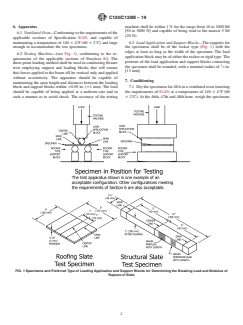
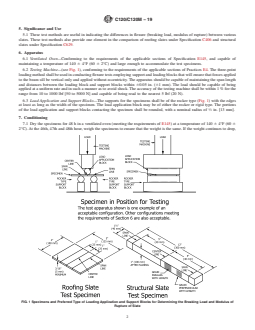
FIG. 1 Specimens and Preferred Type of Loading Application and Support Blocks for Determining the Breaking Load and Modulus of
Rupture of Slate
C120/C120M−19
to ensure that the weight is the same. If the weight continues to 10. Report
drop, continue to dry the specimens until there are three
10.1 Report the following:
successive hourly readings with the same weight.After remov-
10.1.1 Date.
ing the specimens from the oven, cool them to room tempera-
10.1.2 Testing agency.
ture in a desiccator prior to testing.
10.1.3 Personnel responsible for reporting the test results.
10.1.4 Description of the testing equipment or apparatus
ROOFING SLATE BREAKING LOAD
used.
10.1.5 Identification of the samples, including name and
8. Sampling, Test Specimens, and Test Units
location of the quarry, date when sample was taken and trade
name or grade of stone.
8.1 Select the sample to represent a true average of the slate
shingles under consideration and of the quality supplied to the 10.1.6 Dimensions and weight of each individual specimen.
marketunderthetypedesignationtobetested.Thesamplemay
10.1.6.1 Report the span length, width of specimen, and
be selected by the purchaser, their authorized representative, or
average thickness of specimen along the center line.
the producer, from shingles fabricated from the quarried stone
10.1.7 Conditioning procedures used.
and shall be of adequate size to permit the preparation of the
10.1.7.1 Report the initial weight and the weight at each of
desired number of test specimens.
thelast3hof conditioning for each specimen.
10.1.8 Breaking load of each specimen.
8.2 Not less than ten specimens 4 in. [100 mm] in width, 5
in. [125 mm] or greater in length and minimum ⁄16 in. [5 mm] 10.1.8.1 Average value of the test results using the follow-
thick are required. When perceptible variations occur, as many
ing equation:
samples as are necessary may be selected for determining the
~sum of individual test results for each test condition!
Cav 5
variation in flexure.
number of tests for each test condition
~ !
8.3 Cut one 4 by 5 in. [100 by 125 mm] specimen from each
10.1.8.2 Standard deviation(s) of the test results for each
shingle. The saw blade shall be a continuous rim, diamond
test condition using the following relation:
impregnated type, mounted to a water-cooled sliding bed saw
2 1⁄2
S= sum of test result 2 Cav ! ⁄ number of tests 2
...
This document is not an ASTM standard and is intended only to provide the user of an ASTM standard an indication of what changes have been made to the previous version. Because
it may not be technically possible to adequately depict all changes accurately, ASTM recommends that users consult prior editions as appropriate. In all cases only the current version
of the standard as published by ASTM is to be considered the official document.
Designation: C120/C120M − 15a C120/C120M − 19
Standard Test Methods for
Flexure Testing of Structural and Roofing Slate
This standard is issued under the fixed designation C120/C120M; the number immediately following the designation indicates the year
of original adoption or, in the case of revision, the year of last revision. A number in parentheses indicates the year of last reapproval.
A superscript epsilon (´) indicates an editorial change since the last revision or reapproval.
INTRODUCTION
Breaking load test results of roofing slate under this test method are only valid for the commercial
supply of slates of that thickness or greater. For the commercial supply of thinner roofing slates, testing
on samples of the minimum specified thickness must be conducted.
When comparing roofing slates of equal thickness, but from various sources, slates which meet the
required breaking load at the lowest specimen thickness will yield the best performance on the roof
in terms of resistance to impact damage.
The reliability of the data produced under this test method is largely influenced by the care and
protocol used in obtaining and preparing the test specimens.
1. Scope
1.1 These test methods cover determination of the breaking load of roofing slate and modulus of rupture of structural slate by
use of simple three-point loading.
1.2 The values stated in either SI units or inch-pound units are to be regarded separately as standard. The values stated in each
system are not necessarily exact equivalents; therefore, to ensure conformance with the standard, each system shall be used
independently of the other, and values from the two systems shall not be combined.
1.3 This standard does not purport to address all of the safety concerns, if any, associated with its use. It is the responsibility
of the user of this standard to establish appropriate safety safety, health, and healthenvironmental practices and determine the
applicability of regulatory limitations prior to use.
1.4 This international standard was developed in accordance with internationally recognized principles on standardization
established in the Decision on Principles for the Development of International Standards, Guides and Recommendations issued
by the World Trade Organization Technical Barriers to Trade (TBT) Committee.
2. Referenced Documents
2.1 ASTM Standards:
C119 Terminology Relating to Dimension Stone
C406 Specification for Roofing Slate
C629 Specification for Slate Dimension Stone
E4 Practices for Force Verification of Testing Machines
E145 Specification for Gravity-Convection and Forced-Ventilation Ovens
3. Terminology
3.1 Definitions—All definitions are in accordance with Terminology C119.
4. Summary of Test Method
4.1 Prepared and conditioned test specimens are placed on two support blocks in a test stand and loaded vertically at their center
point by a third block.
These test methods are under the jurisdiction of ASTM Committee C18 on Dimension Stone and are the direct responsibility of Subcommittee C18.01 on Test Methods.
Current edition approved Nov. 15, 2015Nov. 1, 2019. Published January 2016November 2019. Originally approved in 1925. Last previous edition approved in 2015 as
C120/C120M-15.-15a. DOI: 10.1520/C0120_C0120M-15A.10.1520/C0120_C0120M-19.
For referenced ASTM standards, visit the ASTM website, www.astm.org, or contact ASTM Customer Service at service@astm.org. For Annual Book of ASTM Standards
volume information, refer to the standard’s Document Summary page on the ASTM website.
Copyright © ASTM International, 100 Barr Harbor Drive, PO Box C700, West Conshohocken, PA 19428-2959. United States
C120/C120M − 19
5. Significance and Use
5.1 These test methods are useful in indicating the differences in flexure (breaking load, modulus of rupture) between various
slates. These test methods also provide one element in the comparison of roofing slates under Specification C406 and structural
slates under Specification C629.
6. Apparatus
6.1 Ventilated Oven—Conforming to the requirements of the applicable sections of Specification E145, and capable of
maintaining a temperature of 140 6 4°F (60 6 2°C) and large enough to accommodate the test specimens.
6.2 Testing Machine—(see Fig. 1), conforming to the requirements of the applicable sections of Practices E4. The three-point
loading method shall be used in conducting flexure tests employing support and loading blocks that will ensure that forces applied
to the beam sill be vertical only and applied without eccentricity. The apparatus should be capable of maintaining the span length
and distances between the loading block and support blocks within 60.05 in. (61 mm). The load should be capable of being
applied at a uniform rate and in such a manner as to avoid shock. The accuracy of the testing machine shall be within 1 % for the
range from 10 to 1000 lbf [50 to 5000 N] and capable of being read to the nearest 5 lbf (20 N).
6.3 Load Application and Support Blocks—The supports for the specimens shall be of the rocker type (Fig. 1) with the edges
at least as long as the width of the specimen. The load application block may be of either the rocker or rigid type. The portions
of the load application and support blocks contacting the specimen shall be rounded, with a nominal radius of ⁄2 in. [13 mm].
7. Conditioning
7.1 Dry the specimens for 48 h in a ventilated oven (meeting the requirements of E145) at a temperature of 140 6 4°F (60 6
2°C). At the 46th, 47th and 48th hour, weigh the specimens to ensure that the weight is the same. If the weight continues to drop,
FIG. 1 Specimens and Preferred Type of Loading Application and Support Blocks for Determining the Breaking Load and Modulus of
Rupture of Slate
C120/C120M − 19
continue to dry the specimens until there are three successive hourly readings with the same weight. After removing the specimens
from the oven, cool them to room temperature in a desiccator prior to testing.
ROOFING SLATE BREAKING LOAD
8. Sampling, Test Specimens, and Test Units
8.1 Select the sample to represent a true average of the slate shingles under consideration and of the quality supplied to the
market under the type designation to be tested. The sample may be selected by the purchaser, their authorized representative, or
the producer, from shingles fabricated from the quarried stone and shall be of adequate size to permit the preparation of the desired
number of test specimens.
8.2 Not less than ten specimens 4 in. [100 mm] in width, 5 in. [125 mm] or greater in length and minimum ⁄16 in. [5 mm] thick
are required. When perceptible variations occur, as many samples as are necessary may be selected for determining the variation
in flexure.
8.3 Cut one 4 by 5 in. [100 by 125 mm] specimen from each shingle. The saw blade shall be a continuous rim, diamond
impregnated type, mounted to a water-cooled sliding bed saw capable of making a clean cut with no lacerated edges. Cut no part
of the specimen nearer than 1 in. [25 mm] to a sheared edge or nail hole. The 5 in. [125 mm] or longer dimension is to be measured
and cut parallel with the long dimension of the slate shingle. Do not resurface the split faces.
8.4 Condition specimens in accordance with 7.1.
9. Procedure
9.1 Rule the center line with a try-square perpendicular to one of the 5 in. [125 mm] edges of each specimen. Rule span lines
parallel to, and 1 in. [25 mm] from both sides of the center line.
9.2 Measure the specimen thickness at three points along the center line to the nearest 0.01 in. [0.1 mm] and record the average
as the specimen thickness.
9.3 Measure the width of the specimen along the center line to the nearest 0.01 in. [0.1 mm] and record this as the specimen
width.
9.4 Lay the specimen flat on the rocker type support blocks as shown in Fig. 1. Apply load at the center of the span through
a rocker or fixed type load application block. When the load of 10 lbf [50 N] has been applied, stop the loading and make all the
blocks coincide with the marks on the specimen by centering the specimen under the load application block and moving the support
blocks under the span marks. Apply loads at rates not exceeding 1000 lbf/min [5000 N/min] until failure and record the breaking
load to the nearest 5 lbf [20 N].
NOTE 1—When all three load application and support blocks are of the rocker type, care must be taken to adjust all three until the top face of the
specimen is horizontal when loaded.
10. Report
10.1 Report the span length, width of specimen, average thickness of specimen al
...