


ASTM F734-17(2022)
(Test Method)Standard Test Method for Shear Strength of Fusion Bonded Polycarbonate Aerospace Glazing Material
Standard Test Method for Shear Strength of Fusion Bonded Polycarbonate Aerospace Glazing Material
SIGNIFICANCE AND USE
5.1 At this writing, aerospace quality extruded transparent polycarbonate material is not available in thicknesses greater than 0.5 in. (12.7 mm). When a requirement exists for sheets thicker than 0.5 in. (12.7 mm), two or more sheets are fusion bonded together to form a single sheet of the desired thickness.
5.2 The structural integrity of the completed transparency depends on the integrity of the fusion bond. This test applies torsional shear loads to measure the structural integrity of the fusion bond. This test method is considered more reliable and more reproducible than shear tests in tension or compression.
SCOPE
1.1 This test method determines the shear yield strength Fsy and shear ultimate strength Fsu of fusion bonds in polycarbonate by applying torsional shear loads to the fusion-bond line.
1.2 This standard does not purport to address all of the safety concerns, if any, associated with its use. It is the responsibility of the user of this standard to establish appropriate safety, health, and environmental practices and determine the applicability of regulatory limitations prior to use.
1.3 This international standard was developed in accordance with internationally recognized principles on standardization established in the Decision on Principles for the Development of International Standards, Guides and Recommendations issued by the World Trade Organization Technical Barriers to Trade (TBT) Committee.
General Information
- Status
- Published
- Publication Date
- 30-Apr-2022
- Technical Committee
- F07 - Aerospace and Aircraft
- Drafting Committee
- F07.08 - Transparent Enclosures and Materials
Relations
- Effective Date
- 01-Nov-2008
- Effective Date
- 01-Nov-2005
- Effective Date
- 10-Nov-2000
Overview
ASTM F734-17(2022): Standard Test Method for Shear Strength of Fusion Bonded Polycarbonate Aerospace Glazing Material provides a reliable procedure for measuring the structural integrity of fusion bonds in polycarbonate glazing sheets used in aerospace applications. Fusion bonding is essential when thick, transparent polycarbonate sheets are needed for aircraft windows or canopies, and individual extruded sheets are not available in the necessary thickness. This standard delivers a reproducible and accurate method for quantifying both the shear yield strength and shear ultimate strength of the bond line through torsional loading.
Key Topics
- Fusion Bonded Polycarbonate: The standard defines and addresses the process of bonding two or more polycarbonate sheets together using heat and pressure to form thicker, high-strength aerospace glazing material.
- Shear Strength Measurement: Emphasizes measuring the shear yield strength (Fsy) and shear ultimate strength (Fsu) at the fusion-bond line by applying torsional shear loads.
- Test Specimens: Specifies preparation methods for test specimens to ensure consistent placement of the fusion bond and geometry.
- Testing Apparatus: Uses a torsional shear fixture, preferably with a universal testing machine, to accurately apply and measure shear forces.
- Calibration and Procedure: Provides detailed steps for equipment calibration and sample testing to produce reliable and reproducible results.
- Safety and Compliance: Encourages the implementation of safety and environmental practices, ensuring testing follows regulatory requirements.
Applications
ASTM F734-17(2022) is especially valuable in aerospace manufacturing and quality assurance for:
- Aerospace Glazing: Used to evaluate the fusion bonds in polycarbonate transparencies for aircraft canopies, windows, and windshields where material thickness requirements exceed standard manufacturing capabilities.
- Product Development: Helps manufacturers and engineers determine the suitability of fusion bonded transparent polycarbonate for critical aerospace enclosures by providing objective data about bond reliability.
- Quality Control: Ensures that polycarbonate glazing materials used in aerospace meet stringent mechanical and safety standards through standardized shear strength testing.
- Material Certification: Required by regulatory bodies and customers to certify that finished transparent enclosures meet specified strength and durability parameters.
Related Standards
Users of ASTM F734-17(2022) may also reference:
- ASTM D618: Practice for Conditioning Plastics for Testing, mandates environmental conditioning procedures for consistent plastic specimen testing.
- Other ASTM Aerospace Standards: Explore related standards from ASTM Committee F07 on Aerospace and Aircraft, specifically those focusing on transparent enclosures and structural testing.
- International Standards: The test method aligns with the World Trade Organization’s principles on international standardization, underlining its global applicability for aerospace glazing quality.
Practical Value
This ASTM standard provides a robust methodology to:
- Guarantee the structural integrity of fusion bonded polycarbonate used in safety-critical aerospace applications.
- Facilitate reproducibility and accuracy in shear strength measurement, improving material performance validation and traceability.
- Support manufacturers, engineers, and testers in meeting global industry demands for high-strength, compliant, and safe polycarbonate glazing products.
Keywords: ASTM F734-17(2022), fusion bonded polycarbonate, shear strength, aerospace glazing material, torsional shear test, polycarbonate transparency, quality control, aerospace standards, structural integrity, glazing material testing.
Get Certified
Connect with accredited certification bodies for this standard

DEKRA North America
DEKRA certification services in North America.

Eagle Registrations Inc.
American certification body for aerospace and defense.

Element Materials Technology
Materials testing and product certification.
Sponsored listings
Frequently Asked Questions
ASTM F734-17(2022) is a standard published by ASTM International. Its full title is "Standard Test Method for Shear Strength of Fusion Bonded Polycarbonate Aerospace Glazing Material". This standard covers: SIGNIFICANCE AND USE 5.1 At this writing, aerospace quality extruded transparent polycarbonate material is not available in thicknesses greater than 0.5 in. (12.7 mm). When a requirement exists for sheets thicker than 0.5 in. (12.7 mm), two or more sheets are fusion bonded together to form a single sheet of the desired thickness. 5.2 The structural integrity of the completed transparency depends on the integrity of the fusion bond. This test applies torsional shear loads to measure the structural integrity of the fusion bond. This test method is considered more reliable and more reproducible than shear tests in tension or compression. SCOPE 1.1 This test method determines the shear yield strength Fsy and shear ultimate strength Fsu of fusion bonds in polycarbonate by applying torsional shear loads to the fusion-bond line. 1.2 This standard does not purport to address all of the safety concerns, if any, associated with its use. It is the responsibility of the user of this standard to establish appropriate safety, health, and environmental practices and determine the applicability of regulatory limitations prior to use. 1.3 This international standard was developed in accordance with internationally recognized principles on standardization established in the Decision on Principles for the Development of International Standards, Guides and Recommendations issued by the World Trade Organization Technical Barriers to Trade (TBT) Committee.
SIGNIFICANCE AND USE 5.1 At this writing, aerospace quality extruded transparent polycarbonate material is not available in thicknesses greater than 0.5 in. (12.7 mm). When a requirement exists for sheets thicker than 0.5 in. (12.7 mm), two or more sheets are fusion bonded together to form a single sheet of the desired thickness. 5.2 The structural integrity of the completed transparency depends on the integrity of the fusion bond. This test applies torsional shear loads to measure the structural integrity of the fusion bond. This test method is considered more reliable and more reproducible than shear tests in tension or compression. SCOPE 1.1 This test method determines the shear yield strength Fsy and shear ultimate strength Fsu of fusion bonds in polycarbonate by applying torsional shear loads to the fusion-bond line. 1.2 This standard does not purport to address all of the safety concerns, if any, associated with its use. It is the responsibility of the user of this standard to establish appropriate safety, health, and environmental practices and determine the applicability of regulatory limitations prior to use. 1.3 This international standard was developed in accordance with internationally recognized principles on standardization established in the Decision on Principles for the Development of International Standards, Guides and Recommendations issued by the World Trade Organization Technical Barriers to Trade (TBT) Committee.
ASTM F734-17(2022) is classified under the following ICS (International Classification for Standards) categories: 49.025.40 - Rubber and plastics. The ICS classification helps identify the subject area and facilitates finding related standards.
ASTM F734-17(2022) has the following relationships with other standards: It is inter standard links to ASTM D618-08, ASTM D618-05, ASTM D618-00. Understanding these relationships helps ensure you are using the most current and applicable version of the standard.
ASTM F734-17(2022) is available in PDF format for immediate download after purchase. The document can be added to your cart and obtained through the secure checkout process. Digital delivery ensures instant access to the complete standard document.
Standards Content (Sample)
This international standard was developed in accordance with internationally recognized principles on standardization established in the Decision on Principles for the
Development of International Standards, Guides and Recommendations issued by the World Trade Organization Technical Barriers to Trade (TBT) Committee.
Designation: F734 − 17 (Reapproved 2022)
Standard Test Method for
Shear Strength of Fusion Bonded Polycarbonate Aerospace
Glazing Material
ThisstandardisissuedunderthefixeddesignationF734;thenumberimmediatelyfollowingthedesignationindicatestheyearoforiginal
adoption or, in the case of revision, the year of last revision.Anumber in parentheses indicates the year of last reapproval.Asuperscript
epsilon (´) indicates an editorial change since the last revision or reapproval.
1. Scope 3.1.4 torsional shear fixture, n—a device used to apply a
shear force in the circular section of the test specimen to
1.1 This test method determines the shear yield strength F
sy
produce a peripherally uniform stress distribution.
and shear ultimate strength F of fusion bonds in polycarbon-
su
ate by applying torsional shear loads to the fusion-bond line.
4. Summary of Test Method
1.2 This standard does not purport to address all of the
4.1 Test specimens are prepared with a fusion bond at the
safety concerns, if any, associated with its use. It is the
center of a polycarbonate laminate joined to two metal test
responsibility of the user of this standard to establish appro-
blocks. A twisting action is applied to one block and the load
priate safety, health, and environmental practices and deter-
required to fracture the fusion bond is transformed into the
mine the applicability of regulatory limitations prior to use.
torsional shear strength of the fusion bond.
1.3 This international standard was developed in accor-
dance with internationally recognized principles on standard-
ization established in the Decision on Principles for the
Development of International Standards, Guides and Recom-
mendations issued by the World Trade Organization Technical
Barriers to Trade (TBT) Committee.
2. Referenced Documents
5. Significance and Use
2.1 ASTM Standards:
5.1 At this writing, aerospace quality extruded transparent
D618Practice for Conditioning Plastics for Testing polycarbonate material is not available in thicknesses greater
than 0.5 in. (12.7 mm). When a requirement exists for sheets
3. Terminology thicker than 0.5 in. (12.7 mm), two or more sheets are fusion
bondedtogethertoformasinglesheetofthedesiredthickness.
3.1 Definitions of Terms Specific to This Standard:
5.2 The structural integrity of the completed transparency
3.1.1 fusion bond, n—thebondingoftwopiecesofthesame
depends on the integrity of the fusion bond. This test applies
material using heat and pressure.
torsional shear loads to measure the structural integrity of the
3.1.2 shear, n—internal force tangential to the section on
fusion bond. This test method is considered more reliable and
which it acts.
more reproducible than shear tests in tension or compression.
3.1.3 shear strength, n—the maximum allowable stress in a
bodyresultingfromforceswhichtendtocausetwocontiguous
6. Apparatus
parts of the body to slide relative to each other in a direction
NOTE 1—A standard torsional test machine is a suitable substitute for
the apparatus described in this section. The machine shall have variable
parallel to their plane of contact.
angular displacement rates from 8 to 800°/min. (0.14 to 14 rad/min.). If a
torsional test machine is used, the calibration and standardization in
Section 8 shall be disregarded.
This test method is under the jurisdiction of ASTM Committee F07 on
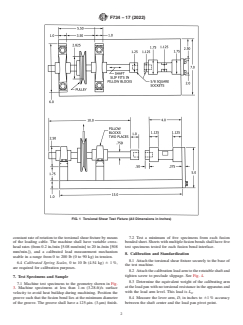
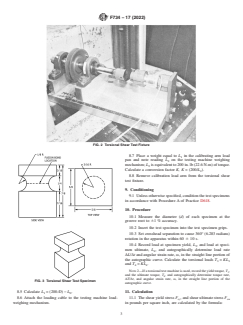
6.1 Torsional Shear Fixture—Illustrations of the fixture are
Aerospace andAircraft and is the direct responsibility of Subcommittee F07.08 on
shown in Figs. 1 and 2.
Transparent Enclosures and Materials.
Current edition approved May 1, 2022. Published June 2022. Originally
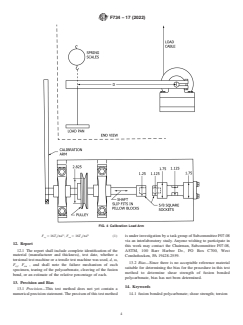
6.2 Calibration Load Arm—A lever arm with a load pan
approved in 1981. Last previous edition approved in 2017 as F734– 17. DOI:
shallbeprovidedforpurposesofcalibratingthetorsionalshear
10.1520/F0734-17R22.
For referenced ASTM standards, visit the ASTM website, www.astm.org, or apparatus.
contact ASTM Customer Service at service@astm.org. For Annual Book of ASTM
6.3 Universal Testing Machine—Anautographicallyrecord-
Standards volume information, refer to the standard’s Document Summary page on
the ASTM website. ing universal tensile testing machine shall be used to apply a
Copyright © ASTM International, 100 Barr Harbor Drive, PO Box C700, West Conshohocken, PA 19428-2959. United States
F734 − 17 (2022)
FIG. 1 Torsional Shear Test Fixture (All Dimensions in Inches)
constant rate of rotation to the torsional shear fixture by means 7.2 Test a minimum of five specimens from each fusion
of the loading cable. The machine shall have variable cross- bondedsheet.Sheetswithmultiplefusionbondsshallhavefive
head rates (from 0.2 in./min [5.08 mm/min] to 20 in./min [508 test specimens tested for each fusion bond interface.
mm/min.]), and a calibrated load measurement mechanism
8. Calibration and Standardization
usable in a range from 0 to 200 lb (0 to 90 kg) in tension.
...
Questions, Comments and Discussion
Ask us and Technical Secretary will try to provide an answer. You can facilitate discussion about the standard in here.
Loading comments...