

ASTM E573-01(2021)
(Practice)Standard Practices for Internal Reflection Spectroscopy
General Information
- Abstract
SIGNIFICANCE AND USE
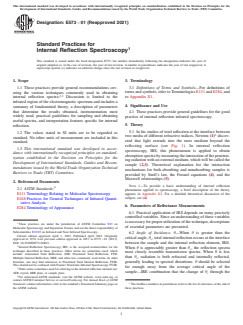
4.1 These practices provide general guidelines for the good practice of internal reflection infrared spectroscopy.
SCOPE
1.1 These practices provide general recommendations covering the various techniques commonly used in obtaining internal reflection spectra.2,3 Discussion is limited to the infrared region of the electromagnetic spectrum and includes a summary of fundamental theory, a description of parameters that determine the results obtained, instrumentation most widely used, practical guidelines for sampling and obtaining useful spectra, and interpretation features specific for internal reflection.
1.2 The values stated in SI units are to be regarded as standard. No other units of measurement are included in this standard.
1.3 This international standard was developed in accordance with internationally recognized principles on standardization established in the Decision on Principles for the Development of International Standards, Guides and Recommendations issued by the World Trade Organization Technical Barriers to Trade (TBT) Committee.
- Status
- Published
- Publication Date
- 31-Mar-2021
- Technical Committee
- E13 - Molecular Spectroscopy and Separation Science
- Drafting Committee
- E13.03 - Infrared and Near Infrared Spectroscopy
Overview
ASTM E573-01(2021) - Standard Practices for Internal Reflection Spectroscopy, developed by ASTM International, provides comprehensive recommendations and best practices for conducting internal reflection infrared (IR) spectroscopy. The standard is focused on the infrared region of the electromagnetic spectrum and offers a practical framework covering fundamental theory, variables affecting spectral results, recommended instrumentation, sampling protocols, and interpretation of spectra specific to internal reflection techniques. These guidelines support practitioners in achieving reliable, consistent, and high-quality results using methods such as Attenuated Total Reflection (ATR) and related internal reflection approaches.
Key Topics
- Internal Reflection Spectroscopy (IRS): The standard outlines the theory and practical execution of IRS, emphasizing total internal reflection and evanescent wave interaction with a sample.
- Parameters Influencing Measurements:
- Angle of Incidence: Choice of angle determines the efficiency of internal reflection and must exceed the critical angle for total reflection.
- Refractive Index Matching: Selecting internal reflection elements (IRE) with appropriate refractive indices is crucial to avoid spectral distortions.
- Number of Reflections and Pathlength: Sensitivity can be enhanced by increasing the effective pathlength through multiple reflections.
- Depth of Penetration: The distance electromagnetic radiation interacts within the sample.
- Sample Contact: Reliable spectra require intimate contact between sample and IRE.
- Instrumentation: Guidance is provided for selecting and maintaining spectrophotometers, IREs, and internal reflection attachments (IRAs). Recommendations cover fixed- and variable-angle IREs, horizontal ATR accessories, and considerations for beam alignment.
- Optical Materials: Properties such as hardness, refractive index, and chemical resistance should inform selection of IRE materials like germanium, silicon, KRS-5, diamond, sapphire, and cubic zirconia.
Applications
ASTM E573-01(2021) is invaluable for professionals engaged in infrared spectroscopy, particularly in scenarios where fast, non-destructive surface analysis is required. Example applications include:
- Polymer and Coating Analysis: Characterize surface composition, layer thickness, and chemical changes in polymers, paints, and adhesives using techniques such as ATR-FTIR.
- Contaminant Identification: Detect thin films and residues on surfaces, essential in quality control and forensic investigations.
- Pharmaceutical and Food Sectors: Monitor active ingredients and contaminants, ensuring compliance and product safety through rapid ATR-IR screening.
- Material Science Research: Investigate surface phenomena, interface chemistry, and molecular interactions on a microscale.
- Routine Quality Control: Streamline analysis of liquids, powders, solids, and thin films, offering robust performance even with limited sample sizes and diverse sample types.
Related Standards
- ASTM E131: Terminology Relating to Molecular Spectroscopy
- ASTM E168: Standard Practices for General Techniques of Infrared Quantitative Analysis
- ASTM E284: Terminology of Appearance
- Practice E275: General performance checks for IR spectrometers
These documents complement ASTM E573, providing terminology, general IR techniques, and guidelines for instrument performance and appearance characterization.
By adhering to ASTM E573-01(2021), laboratories, manufacturers, and researchers can ensure accuracy, repeatability, and high-quality data in their internal reflection infrared spectroscopy workflows. The standard’s optimization of measurement parameters, instrument setup, and sample handling enhances the reliability of spectroscopic analysis for both routine and advanced applications in materials science, industry, and research environments.
Relations
- Effective Date
- 01-Nov-2013
- Effective Date
- 01-Jun-2013
- Effective Date
- 01-Jan-2013
- Effective Date
- 01-Jul-2012
- Effective Date
- 01-Mar-2010
- Effective Date
- 01-Jun-2009
- Effective Date
- 01-Jan-2009
- Effective Date
- 01-Aug-2008
- Effective Date
- 15-Jul-2007
- Effective Date
- 01-Dec-2006
- Effective Date
- 15-Jul-2006
- Effective Date
- 01-Mar-2006
- Effective Date
- 15-Feb-2006
- Effective Date
- 01-Sep-2005
- Effective Date
- 15-Jun-2005
Get Certified
Connect with accredited certification bodies for this standard

ECOCERT
Organic and sustainability certification.

Eurofins Food Testing Global
Global leader in food, environment, and pharmaceutical product testing.

Intertek Bangladesh
Intertek certification and testing services in Bangladesh.
Sponsored listings
Frequently Asked Questions
ASTM E573-01(2021) is a standard published by ASTM International. Its full title is "Standard Practices for Internal Reflection Spectroscopy". This standard covers: SIGNIFICANCE AND USE 4.1 These practices provide general guidelines for the good practice of internal reflection infrared spectroscopy. SCOPE 1.1 These practices provide general recommendations covering the various techniques commonly used in obtaining internal reflection spectra.2,3 Discussion is limited to the infrared region of the electromagnetic spectrum and includes a summary of fundamental theory, a description of parameters that determine the results obtained, instrumentation most widely used, practical guidelines for sampling and obtaining useful spectra, and interpretation features specific for internal reflection. 1.2 The values stated in SI units are to be regarded as standard. No other units of measurement are included in this standard. 1.3 This international standard was developed in accordance with internationally recognized principles on standardization established in the Decision on Principles for the Development of International Standards, Guides and Recommendations issued by the World Trade Organization Technical Barriers to Trade (TBT) Committee.
SIGNIFICANCE AND USE 4.1 These practices provide general guidelines for the good practice of internal reflection infrared spectroscopy. SCOPE 1.1 These practices provide general recommendations covering the various techniques commonly used in obtaining internal reflection spectra.2,3 Discussion is limited to the infrared region of the electromagnetic spectrum and includes a summary of fundamental theory, a description of parameters that determine the results obtained, instrumentation most widely used, practical guidelines for sampling and obtaining useful spectra, and interpretation features specific for internal reflection. 1.2 The values stated in SI units are to be regarded as standard. No other units of measurement are included in this standard. 1.3 This international standard was developed in accordance with internationally recognized principles on standardization established in the Decision on Principles for the Development of International Standards, Guides and Recommendations issued by the World Trade Organization Technical Barriers to Trade (TBT) Committee.
ASTM E573-01(2021) is classified under the following ICS (International Classification for Standards) categories: 71.040.50 - Physicochemical methods of analysis. The ICS classification helps identify the subject area and facilitates finding related standards.
ASTM E573-01(2021) has the following relationships with other standards: It is inter standard links to ASTM E284-13b, ASTM E284-13a, ASTM E284-13, ASTM E284-12, ASTM E131-10, ASTM E284-09a, ASTM E284-09, ASTM E284-08, ASTM E284-07, ASTM E284-06b, ASTM E284-06a, ASTM E168-06, ASTM E284-06, ASTM E131-05, ASTM E284-05a. Understanding these relationships helps ensure you are using the most current and applicable version of the standard.
ASTM E573-01(2021) is available in PDF format for immediate download after purchase. The document can be added to your cart and obtained through the secure checkout process. Digital delivery ensures instant access to the complete standard document.
Standards Content (Sample)
This international standard was developed in accordance with internationally recognized principles on standardization established in the Decision on Principles for the
Development of International Standards, Guides and Recommendations issued by the World Trade Organization Technical Barriers to Trade (TBT) Committee.
Designation:E573 −01 (Reapproved 2021)
Standard Practices for
Internal Reflection Spectroscopy
This standard is issued under the fixed designation E573; the number immediately following the designation indicates the year of
original adoption or, in the case of revision, the year of last revision.Anumber in parentheses indicates the year of last reapproval.A
superscript epsilon (´) indicates an editorial change since the last revision or reapproval.
1. Scope 3. Terminology
1.1 These practices provide general recommendations cov- 3.1 Definitions of Terms and Symbols—For definitions of
termsandsymbols,refertoTerminologiesE131andE284,and
ering the various techniques commonly used in obtaining
2,3
to Appendix X1.
internal reflection spectra. Discussion is limited to the
infrared region of the electromagnetic spectrum and includes a
4. Significance and Use
summary of fundamental theory, a description of parameters
that determine the results obtained, instrumentation most 4.1 These practices provide general guidelines for the good
widely used, practical guidelines for sampling and obtaining
practice of internal reflection infrared spectroscopy.
useful spectra, and interpretation features specific for internal
5. Theory
reflection.
5.1 In his studies of total reflection at the interface between
1.2 The values stated in SI units are to be regarded as
two media of different refractive indices, Newton (1) discov-
standard. No other units of measurement are included in this
ered that light extends into the rarer medium beyond the
standard.
reflecting surface (see Fig. 1). In internal reflection
1.3 This international standard was developed in accor-
spectroscopy, IRS, this phenomenon is applied to obtain
dance with internationally recognized principles on standard-
absorptionspectrabymeasuringtheinteractionofthepenetrat-
ization established in the Decision on Principles for the
ingradiationwithanexternalmedium,whichwillbecalledthe
Development of International Standards, Guides and Recom-
sample (2,3). Theoretical explanation for the interaction
mendations issued by the World Trade Organization Technical
mechanisms for both absorbing and nonabsorbing samples is
Barriers to Trade (TBT) Committee.
provided by Snell’s law, the Fresnel equations (4), and the
Maxwell relationships (5).
2. Referenced Documents
NOTE 1—To provide a basic understanding of internal reflection
2.1 ASTM Standards:
phenomena applied to spectroscopy, a brief description of the theory
E131Terminology Relating to Molecular Spectroscopy
appears in Appendix X2. For a detailed theoretical discussion of the
subject, see (4).
E168Practices for General Techniques of Infrared Quanti-
tative Analysis
6. Parameters of Reflectance Measurements
E284Terminology of Appearance
6.1 Practical application of IRS depends on many precisely
controlled variables. Since an understanding of these variables
isnecessaryforproperutilizationofthetechnique,descriptions
These practices are under the jurisdiction of ASTM Committee E13 on
of essential parameters are presented.
Molecular Spectroscopy and Separation Science and are the direct responsibility of
Subcommittee E13.03 on Infrared and Near Infrared Spectroscopy.
6.2 Angle of Incidence, θ—When θ is greater than the
Current edition approved April 1, 2021. Published April 2021. Originally
criticalangle, θ ,totalinternalreflectionoccursattheinterface
approved in 1976. Last previous edition approved in 2013 as E573–01 (2013). c
DOI: 10.1520/E0573-01R21. between the sample and the internal reflection element, IRE.
Internal Reflection Spectroscopy, IRS, is the accepted nomenclature for the
When θ is appreciably greater than θ , the reflection spectra
c
technique described in these practices. Other terms are sometimes used, which
most closely resemble transmission spectra. When θ is less
include: Attenuated Total Reflection, ATR; Frustrated Total Reflection, FTR;
than θ , radiation is both refracted and internally reflected,
Multiple Internal Reflection, MIR; and other less commonly used terms. In older
c
literature, one may find references to Frustrated Total Internal Reflection, FTIR.
generally leading to spectral distortions. θ should be selected
This should not be confused with Fourier Transform Infrared Spectroscopy FT-IR.
far enough away from the average critical angle of the
Other terms sometimes used for referring to the internal reflection element are:
sample—IRE combination that the change of θ through the
c
ATR crystal, MIR plate, or sample plate.
For referenced ASTM standards, visit the ASTM website, www.astm.org, or
contact ASTM Customer Service at service@astm.org. For Annual Book of ASTM
Standards volume information, refer to the standard’s Document Summary page on Theboldfacenumbersinparenthesesrefertothelistofreferencesattheendof
the ASTM website. these practices.
Copyright © ASTM International, 100 Barr Harbor Drive, PO Box C700, West Conshohocken, PA 19428-2959. United States
E573−01 (2021)
6.4 Relative Refractive Index, n , of the Sample, n , and
21 2
IRE, n;(n =n /n )—Refractive index matching controls the
1 21 2 1
spectral contrast. If the indexes of the sample and the IRE
approacheachother,banddistortionscanoccur.Therefore,itis
necessary to select an IRE with a refractive index considerably
greater than the mean index of the sample.
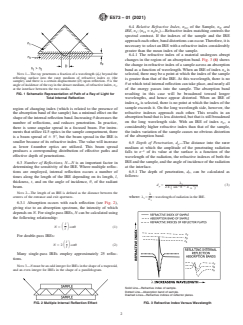
6.4.1 The refractive index of a material undergoes abrupt
changes in the region of an absorption band. Fig. 3 (6) shows
thechangeinrefractiveindexofasampleacrossanabsorption
band as a function of wavelength. When an IRE of index n is
A
NOTE 1—The ray penetrates a fraction of a wavelength (d ) beyond the
p selected,theremaybeapointatwhichtheindexofthesample
reflecting surface into the rarer medium of refractive index n (the
is greater than that of the IRE.At this wavelength, there is no
sample), and there is a certain displacement (D) upon reflection. θ is the
θatwhichtotalinternalreflectioncantakeplace,andnearlyall
angleofincidenceoftherayinthedensermedium,ofrefractiveindex, n ,
of the energy passes into the sample. The absorption band
at the interface between the two media.
FIG. 1Schematic Representation of Path of a Ray of Light for resulting in this case will be broadened toward longer
Total Internal Reflection
wavelengths, and hence appear distorted. When an IRE of
index n is selected, there is no point at which the index of the
B
sample exceeds it. On the long wavelength side, however, the
region of changing index (which is related to the presence of
refractive indexes approach each other. This results in an
the absorption band of the sample) has a minimal effect on the
absorptionbandthatislessdistorted,butthatisstillbroadened
shapeoftheinternalreflectionband.Increasingθdecreasesthe
on the long wavelength side. With an IRE of index n,a
number of reflections, and reduces penetration. In practice,
C
considerably higher refractive index than that of the sample,
there is some angular spread in a focused beam. For instru-
the index variation of the sample causes no obvious distortion
ments that utilize f4.5 optics in the sample compartment, there
of the absorption band.
is a beam spread of 6 5°, but the beam spread in the IRE is
smaller because of its refractive index.The value will increase
6.5 Depth of Penetration, d —The distance into the rarer
p
as lower f-number optics are utilized. This beam spread
medium at which the amplitude of the penetrating radiation
−1
produces a corresponding distribution of effective paths and
falls to e of its value at the surface is a function of the
effective depth of penetrations.
wavelength of the radiation, the refractive indexes of both the
IREandthesample,andtheangleofincidenceoftheradiation
6.3 Number of Reflections, N—N is an important factor in
at the interface.
determining the sensitivity of the IRE. Where multiple reflec-
6.5.1 The depth of penetration, d , can be calculated as
tions are employed, internal reflection occurs a number of
p
follows:
times along the length of the IRE depending on its length, l,
thickness, t, and on the angle of incidence, θ, of the radiant
λ
d 5 (3)
p 2 2 ½
beam.
2 π sin θ 2 n
~ !
NOTE 2—The length of an IRE is defined as the distance between the
λ
where: λ 5 5wavelengthofradiationintheIRE.
centers of the entrance and exit apertures.
n
6.3.1 Absorption occurs with each reflection (see Fig. 2),
giving rise to an absorption spectrum, the intensity of which
depends on N. For single-pass IREs, N can be calculated using
the following relationship:
l
N 5 cotθ (1)
S D
t
For double-pass IREs:
l
N 5 2 cotθ (2)
S D
t
Many single-pass IREs employ approximately 25 reflec-
tions.
NOTE3—NmustbeanoddintegerforIREsintheshapeofatrapezoid,
and an even integer for IREs in the shape of a parallelogram.
Solid Line—Refractive index of sample.
Dotted Line—Absorption band of sample.
Dashed Lines—Refractive indices of reflector plates.
FIG. 2Multiple Internal Reflection Effect FIG. 3Refractive Index Versus Wavelength
E573−01 (2021)
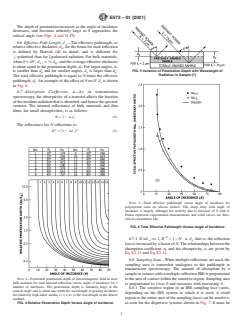
The depth of penetration increases as the angle of incidence
decreases, and becomes infinitely large as θ approaches the
critical angle (see Figs. 4 and 5) (7).
6.6 Effective Path Length, d —The effective pathlength, or
e
relative effective thickness, d , for the beam for each reflection
e
is defined by Harrick (4) in detail, and is different for
'-polarized than for i-polarized radiation. For bulk materials,
when θ=45°, d = ⁄2 d , and the average effective thickness
e' ei
isaboutequaltothepenetrationdepth, d .Forlargerangles, d
p e
is smaller than d and for smaller angles, d is larger than d . FIG. 5Variation of Penetration Depth with Wavelength of
p e p
Radiation in Sample (7)
The total effective pathlength is equal to N times the effective
pathlength, d .An example of the effect of θ on N· d is shown
e e
in Fig. 6.
6.7 Absorption Coeffıcient, α—As in transmission
spectroscopy, the absorptivity of a material affects the fraction
oftheincidentradiationthatisabsorbed,andhencethespectral
contrast. The internal reflectance of bulk materials and thin
films, for small abosrptivities, is as follows:
R 5 1 2 α d (4)
e
The reflectance for N reflections is:
N N
R 5 1 2 αd (5)
~ !
e
NOTE 1—Total effective pathlength versus angle of incidence for
polystyrene stain on silicon surface. The sharp drop with angle of
incidence is largely, although not entirely, due to decrease of N with θ.
Points represent experimental measurements and solid curves are theo-
retical calculations (4).
FIG. 6Total Effective Pathlength Versus Angle of Incidence
N
6.7.1 If αd << 1, R ≈1− N · α· d , that is, the reflection
e e
lossisincreasedbyafactorofN.Therelationshipsbetweenthe
absorption coefficient, α, and the absorptivity, a, are given by
Eq X2.13 and Eq X2.14.
6.8 Sampling Area—Whenmultiplereflectionsareused,the
sampling area is somewhat analogous to the pathlength in
transmission spectroscopy. The amount of absorption by a
sampleincontactwithamultiple-reflectionIREisproportional
NOTE 1—Fractional penetration depth of electromagnetic field in rarer
totheareaofcontactwithinthesensitiveregion.Samplingarea
bulk medium for total internal reflection versus angle of incidence for a
is proportional to 1/cos θ and increases with increasing θ.
number of interfaces. The penetration depth is infinitely large at the
6.8.1 The sensitive region of an IRE sampling face varies,
critical angle and is about one tenth the wavelength at grazing incidence
depending on the IRS system in which it is used. A small
for relatively high index media. λ = λ⁄n is the wavelength in the denser
1 1
regionortheentireareaofthesamplingfacescanbesensitive,
medium.
FIG. 4Relative Penetration Depth Versus Angle of Incidence as seen for the dispersive systems shown in Fig. 7. It must be
E573−01 (2021)
reflection attachment for obtaining internal reflection spectra
(Note 4). The optical efficiency of internal reflection infrared
systems can be nearly equal to theoretical. However, in some
IRAs only half of the spectrophotometer energy may be
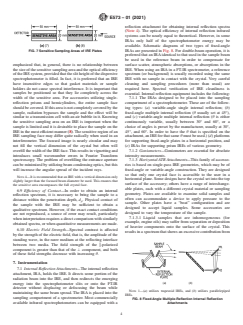
available. Schematic diagrams of two types of fixed-angle
FIG. 7Sensitive Sampling Areas of IRE Plates IRAs are presented in Fig. 8. For double-beam operation, it is
preferred that an IRAidentical to that used in the sample beam
be used in the reference beam in order to compensate for
emphasized that, in general, there is no relationship between surface scatter, atmospheric absorptions, or absorptions in the
thesizeofthesensitivesamplingareaandtheopticalefficiency
IRE. When using an IRAin a FT-IR spectrometer, a reference
oftheIRSsystem,providedthattheslitheightofthedispersive spectrum (or background) is usually recorded using the same
spectrophotometer is filled. In fact, it is preferred that an IRE
IRE with no sample in contact with the crystal. Very careful
have insensitive edges so that gasket materials or sample cleaning and sampling procedures (more than usual) are
holders do not cause spectral interference. It is important that
required here. Spectral verification of IRE cleanliness is
samples be positioned so that they lie completely across the essential. Internal reflection equipment includes the following:
width of the sensitive area. For accessories utilizing single- 7.1.1 The IRAs designed to be placed into the sampling
reflection prisms and hemicylinders, the entire sample face compartment of a spectrophotometer. These are of the follow-
shouldbecovered.Ifthisareaisnotcompletelycoveredbythe ing types: (a) variable-angle single internal reflection; (b)
sample, radiation bypasses the sample and the effect will be fixed-angle multiple internal reflection (θ usually set at 45°),
similar to a transmission cell with an air bubble in it. Knowing and (c) variable-angle multiple internal reflection (θ is either
the sensitive sampling area on an IRE is important when the continuously variable, usually between 30° and 60°, or a
sample is limited and it is desirable to place the sample on the choice of angles is preset by the manufacturer, usually at 30°,
IREinthemostefficientmanner (8).Thesensitiveregionofan 45°, and 60°. In order to have the θ that is specified on the
IRE sampling face may differ quite radically when used in an attachment,anIREforthatsameθmustbeused.)(d)platforms
interferometer. The focused image is nearly circular and may for supporting fixed-angle plates in a horizontal position, and
not fill the vertical dimension of the crystal but often will (e) IRAs for supporting prism IREs of various geometry.
overfillthewidthoftheIREface.Thisresultsinvignettingand
7.1.2 Goniometers—Goniometers are essential for absolute
introduces small wavenumber errors in Fourier Transform intensity measurements.
spectroscopy. The problem of overfilling the entrance aperture
7.1.3 Horizontal ATR Attachments—Thisfamilyofaccesso-
canbeminimizedbyutilizingbeamcondensingoptics,butthis ries is based on single-pass IRE geometries, which may be of
will increase the angular spread of the incident rays.
fixed-angle or variable-angle construction. They are designed
so that only one crystal face is accessible to the user in a
NOTE4—ItisrecommendedthatanIREwithaverticaldimensiononly
horizontalplane.Somedesignshavethecrystalsetintothetop
slightly larger than the focused beam diameter be used. This ensures that
surface of the accessory; others have a range of interchange-
the sensitive area encompasses the full crystal face.
able plates, each with a different crystal material or sampling
6.9 Effıciency of Contact—In order to obtain an internal
geometry. Plates are available to examine solid samples and
reflection spectrum, it is necessary to bring the sample to a
often can accommodate a device to apply pressure to the
distance within the penetration depth, d . Physical contact of
p
sample. Other plates have a “boat” configuration and are
the sample with the IRE may be sufficient to obtain a
designed to accept liquid samples. Some accessories are
qualitative spectrum. However, if the exact contact conditions
designed to vary the temperature of the sample.
are not reproduced, a source of error may result, particularly
7.1.3.1 Liquid samples that are inhomogeneous (for
wheninterpretationrequiresadirectcomparisonwithsimilarly
example, engine oils) may suffer from separation or deposition
obtainedspectra,orwhenquantitativemeasurementsaremade.
of heavier components onto the surface of the crystal. This
6.10 Electric Field Strength—Spectral contrast is affected
resultsinaspectrumthatshowsanexcessivecontributionfrom
bythestrengthoftheelectricfield,thatis,theamplitudeofthe
standing wave, in the rarer medium at the reflecting interface
between two media. The field strength of the i-polarized
component is greater than that of the' component, and both
of these field strengths decrease with increasing θ.
7. Instrumentation
7.1 Internal Reflection Attachments—The internal reflection
attachment, IRA, holds the IRE. It directs some portion of the
radiation beam into the IRE, and then redirects the emerging
(a)(b)
energy into the spectrophotometer slits or onto the FT-IR
detector without displacing or defocusing the beam while
NOTE 1—(a) utilizes trapezoid IREs, and (b) utilizes parallelepiped
maintaining the same beam spread. The IRAis placed into the
IREs.
sampling compartment of a spectrometer. Most commercially
FIG. 8Fixed-Angle Multiple-Reflection Internal Reflection
available infrared spectrophotometers can be equipped with a Attachments
E573−01 (2021)
the settled material contacting the plate. Pressure applied to a slightly different angle of incidence. The average θ is usually
non-adheringsamplebyusingapressureplatecannotbeeasily between 45° and 50°.
controlled. Use of pressure causes some polymeric samples to
7.3.2.3 Variable-Angle Multiple Reflection Plates, Single-
exude semiliquid onto the plate. and Double-Pass (Note 7)—Angle variation may be obtained
7.1.3.2 A variety of micro ATR accessories are commer- by use of IRAs that have provisions for repositioning IREs at
set angles of incidence. Where a knowledge of θ is not as
cially available. These include IRAS using single bounce
prisms, spheres and hemicylinders as well as single pass important as the effect of angle change, fixed angle IREs may
beusedinanybaseplatepositiontoeffectananglechange.For
multiple bounce prisms and parallelograms. Sampling areas
can be 0.5mm to 2mm in diameter. Common IRE materials example, if a KRS-5 IRE with θ=45° is placed into an IRA
positionforθ=60°,thentheactualangleofincidenceis51.3°.
used for these include zinc selenide, diamond, silicon and
germanium. Some of these allow the application of very high If the value of θ must be known, it can be calculated using the
pressures for achieving sample-IRE contact. following equation:
sin θ 2 θ
~ IRA IRE!
NOTE 5—It is not the intention of this practice to specify any particular
θ 5 θ 2 sin (6)
S D
IRA
instrumentation for IRS. It is assumed that the equipment used is of the
n
usual commercial quality and that the manufacturer’s instructions will be
where:
consulted for proper IRA operation.
θ = angle of incidence of the IRA position,
IRA
7.1.3.3 Caution is advised when using these accessories. In
θ = angle of incidence of the IRE, and
IRE
some IRA’s, the angle of incidence is an average of many
n = refractive index of the IRE material.
angles and is therefore not defined. Spectra will not be
NOTE 7—For further information on this subject, see (9).
comparable to those run at a 45 degree angle of incidence.
7.3.2.4 Cylindrical Internal Reflection Element, (CIRE),
Spectra obtained at discrete angles of incidence using different
(Fig.X3.1(f)—TheCIREsaremadefrompolishedcylindersof
IRE materials will sample different layers of a material. With
anysuitableIREmaterialwithpolishedconicalends.Thecone
germanium and silicon, the ATR spectrum may be that of a
angle will vary with the material used but should be roughly
surfacecoatingorexudateincontrasttodiamond,zincselenide
complimentary to the desired internal reflection angle. Al-
and KRS-5 where the spectrum can include surface and
though it is difficult to precisely describe the paths of all of the
substrate materials. In single reflection, accessories where less
rays entering the entrance cone of the CIRE, empirical studies
than the entire sample area is used (that is, the sample is
have shown that the equations for number of reflections (1),
smaller than the sample area), stray light effects can distort the
depth of penetration (3), reflection (5), and absorptions (ap-
spectrum.
pendix) hold with reasonable accuracy. The end face of the
7.2 Internal Reflection Elements—Infrared radiation is
CIRE matches the circular shape of the FT-IR beam. When
propagated through the internal reflection element by total
usedwithinstrumentsthatrefocustheFT-IRbeamonthecone
internal reflection. Where multiple reflections are employed,
endsattheproperangle,theCIREperformsefficientlybecause
the long pathlengths required place stringent demands on both
it utilizes the entire beam. The CIREs are useful for construct-
the quality and the preparation of optical materials for IREs.
ing liquid cells because they can be sealed into a sample
The geometries of more common types and the properties of
chamber by means of O-rings. Such sealed cells can be made
the best optical materials are presented in 7.3 and 7.4.
to withstand several hundred pounds of pressure.
Additional information is available in the literature (4).
7.3.2.5 Prism Internal Reflection Element, (PIRE) (Fig.
7.3 Geometry—Common IREs are classified as follows:
X3.1(h)—The PIREs are polished fixed-angle, elongated, four-
7.3.1 Single-Reflection IREs (Note 5): sided, double-pass prisms constructed from any suitable IRE
7.3.1.1 Fixed-angle prisms (Fig. X3.1(a)) material. These IRE’s are usually mounted vertically in a
chamber that can be used for liquid or solid powder sampling.
7.3.1.2 Variable-angle hemicylinders (Fig. X3.1(b)), and
Liquidvolume(whenusedasasealedliquidcell)orimmersion
7.3.1.3 Micro hemicylinders.
depth (when used as a probe by dipping the IRE into a powder
NOTE 6—Prior to 1964, single-reflection IREs were the only type
or liquid sample) controls the number of reflections used. The
commercially available. They are still used, but principally for strongly
throughput of a nine-reflection 45° angle double-pass ZnSe
absorbing materials. For weak absorbers, the angle of incidence must be
−1
prism liquid cell is about 40% at 4000 cm and 50% at 1000
set close to the critical angle and the kind of distortion depicted earlier
−1
(Fig. 3) can result. cm .
7.3.2.6 Use of Optical Fiber as IRE—Ifcladdingisremoved
7.3.2 Multiple-Reflection IREs (Diagrams of common types
from a short length of an IR transmitting optical fiber, light
are shown in Fig. X3.1(c), (d), (e), (f), and (n)):
passingthroughthefiberbecomesanIRE.Ifthatportionofthe
7.3.2.1 Single-Pass IRE—This is the simplest and most
fiber is immersed in a liquid or resin sample, the spectrum of
common. Radiation introduced through the entrance aperture
that material can be obtained.
propagates by multiple internal reflections down the length of
theplatetotheexitaperture.IntheseIREs, θisgenerallyfixed 7.4 Optical Materials—Aperfect IRE material is not avail-
able because some of the desirable properties are mutually
at 45°; however, plates are available with θ fixed at any angle.
exclusive. Important characteristics of useful materials are:
7.3.2.2 Double-Pass IRE—Inthistype,radiationpropagates
7.4.1 High mean refractive index, preferably n=2.5 to 3.5,
downthelengthoftheplateandisreflectedbackuponitselfby
a metalized end reflecting surface. The beam returns at a 7.4.2 High transmittance and spectral purity,
E573−01 (2021)
7.4.3 Ability to take high polish, considering the reflection losses at the entrance and exit
7.4.4 Toughness and resistance to cold flow, permitting apertures. If only these losses are considered, then:
pressing and clamping to optimize contact, and
T . 1 2 R (7)
~ !
7.4.5 Chemical inertness, offering resistance to chemical
where:
attack by samples and cleaning materials.
T = transmittance of the IRE,
NOTE 8—Properties of best available and most frequently used IRE
materials appear in Table 1. For a more complete coverage of the wide
and at normal incidence for the entrance or exit beam:
range of optical materials suitable for fabricating IREs, consult (10) and
~n 2 1!
(11) 1
R 5 (8)
n 11
NOTE 9—Coverage of all internal reflection instrumentation is beyond ~ !
the scope of these practices. For more extensive coverage of the subject,
Many IREs exhibit transmittances close to the maximum
see (4),(12), and(13).
value predicted by Eq 8 even when as many as 100 reflections
8. Internal Reflection Elements
are employed.
8.1 Selection—The refractive index of the IRE should be 8.2.1 Reasons for Poor Performance:
chosen so that measurements of bulk materials made at the
8.2.1.1 Poor Optical Material—Defects in the quality of
desired θ will not yield distorted spectra. Lower index yields
IRE materials are magnified because of the long pathlengths
higher transmission because reflection losses at the entrance
and large Ns employed in IRS. Some pieces of KRS-5 exhibit
and exit faces are reduced. For thin films (less than 100 nm),
internalhazinessthatcontributestoenergylosses,especiallyat
the lowest possible index should be used so that distortion will
shorter wavelengths. Other pieces are soft and soluble in
be absent, while absorption will be enhanced. Hardness and
organic solvents, leading to rapid deterioration of the surface.
inertness should also be considered. The system to be studied
8.2.1.2 Inadequate Surface Polish—This causes scattering
determines to some extent the choice of IRE material since the
losses for soft materials such as KRS-5. Harder materials like
surfaces must not be attacked chemically. Ionizable acids and
silicon and germanium are capable of excellent surface
bases,forexample,willetchthesurfaceofKRS-5.Germanium
polishing, and seldom need reconditioning.
and silicon, on the other hand, can be washed or soaked in
8.2.1.3 Poor Tolerance on Lengths and Angles—The length
dilute acids and alkalies.
to thickness ratio, l/t, of the IRE controls N (usually θ is
8.2 Evaluation—The quality of an IRE is judged by its predetermined) (see Eq 1). In single-pass IREs, l/t is chosen so
transmittance and the dependence of transmittance on wave- that the central ray enters and leaves by way of the entrance
length.Themaximumtransmittanceexpectedisdeterminedby and exit apertures. If Eq 1 does not yield an integer, then a
A
TABLE 1 Properties of Typical Optical Materials for Internal Reflection Elements
Useful Range, Mean Refractive Critical
Material Properties
−1
[µm] [cm ] Index Angle,θ
c
Silver chloride 0.45–16 2.0 30 soft, moldable, light-sensitive, easily scratched,
22 000–700 insoluble in water
Silver bromide 0.5–35 2.22 27 slightly harder than silver chloride, otherwise similar,
20 000–500 insoluble in water and alcohol
Zinc sulfide 0.7–10 2.22 27 relatively hard and inert, water insoluble, attacked by
14 000–1000 concentrated acids and bases
Diamond C 0.22–4; 6–FIR 2.4 25 hard, expensive, permanent, insoluble in water, acids,
45 000–2 500; 1 600–FIR and bases
KRS-5, thallous bromide iodide 0.7–40 2.35 24.6 relatively soft, convenient index, favorable combination
14 000–250 of properties, soluble in warm water, soluble in
bases; insoluble in acids
Zinc selenide 0.5–14.3 2.42 24.6 expensive, brittle, water insoluble, releases H Se, a
20 000–700 toxic material when used with acids, soluble in strong
acids, dissolves in nitric acid
Cadmium telluride 1.0–22 2.65 22.25 expensive, relatively inert, can be used with aqueous
10 000–500 solutions, insoluble in acids
Arsenic triselenide 0.9–11.8 2.8 20.9 brittle, can be soaked in 35 % HCL, 95 % H SO ,10%
2 4
11 000–900 nitric acid, attacked by alkali, concentrated nitric acid
and aqua regia
Silicon 1.06–6.7; 30–FIR 3.5 15.6 hard, high resistivity material, useful at high
9 500–1 500; 350–FIR temperatures, insoluble in most acids and bases,
soluble in HF and HNO
Germanium 2.0–11.4 4.0 14.5 limited range, sensitivity to temperature, becomes
5 000–900 opaque at 125°C, insoluble in water, soluble in hot
H SO and aqua regia, fine penetration depth
2 4
Sapphire 0.4–4.5 1.8 31.8 extremely hard, chemically resistant, low index, short
transmission range
Cubic zirconia 0.4–5 2.1 27.3 extremely hard, chemically resistant, nontoxic, good
index, relatively short transmission range
A
For various applications, a wide variety of optical materials have been employed as IREs. These materials include MgO, CaF , ZnSSe (zinc-sulfo-selenide solid solution),
NaCl, KCl, and KBr.
E573−01 (2021)
single incoming beam will yield two spatially separated beams keep a previously tested high-quality IRE in the reference
at the exit aperture that partially or completely miss the exit opticssothatchangesinasampleIREcanbereadilyobserved.
aperture. (This occurs when the aperture is larger than the
8.2.3 Evaluating an IRE by comparing it with an unused
source image.) In double-pass IREs (Eq 2), loss of energy reference IRE, using a double-beam internal reflection system,
occurs if N is not an integer, since the beam might strike the
requires that both the sample and reference beam IRAs be
entrance rather than the exit aperture, and so be directed back well-aligned. The sample-beam IRA must be realigned when-
toward the source. In this case, the condition for optimum ever a new (or refinished) IRE is to be checked and used
transmission can be satisfied by adjusting θ, provided that the because small differences of geometry always exist among
instrumentation permits angle variation. The tolerances on all IREs. An abbreviated procedure suffices for checking a used
anglesofthesurfacesfromwhichreflectionoccursandthrough IRE in the IRA that had previously been aligned with it.
which light is transmitted are strict. This is especially true for
8.2.3.1 The procedure for evaluating a new IRE in a
high-indexIREs,because,iftheangleoftheexitapertureisoff dispersive spectrophotometer in a double-beam internal reflec-
by δ degrees, the exit beam is deflected away from the normal
tion system is:
to that surface by nδ. (a)Partially align the IRA-IRE optical system,
8.2.1.4 Nonparallelism—If an IRE does not have parallel
(b)Turn the 100% control of the spectrophotometer to
surfaces, and the deviation from θ is by an angle δ, then after
move the recorder pen downscale to about 50% T,
N reflections, θ within the IRE is changed by Nδ for a
(c)Continue the alignment of the IRA to maximize trans-
single-passplate.Theexitbeamwillbedeflected n·Nδdegrees
mitted energy, and
away from the normal to the exit aperture. For double-pass
(d)Turn the 100% control of the spectrophotometer to
IREs, nonparallelism is not as serious, because any change in
place the recorder pen at about 80% T. Then run the IRE
θasthebeamtraversestheIREiscompensatedforinitsreturn
baseline.
path. A wavy surface in either single- or double-pass IREs
8.2.3.2 The procedure for evaluating a used IRE is as
might not be serious if the average flatness is maintained.
follows:
8.2.2 Quality Checks of an IRE—Check the quality of an
(a)Use a previously aligned optical system, having a
IRE by one or more of the following:
high-quality IRE in the reference beam and no additional
8.2.2.1 Visuallyinspectingforobvioussurfaceorgeometric
external reference beam attenuation,
defects,
(b)Place the IRE to be checked in the sample-beam IRA,
8.2.2.2 Employing the IRE as a transmission plate to deter-
and turn the 100% control of the spectrophotometer to place
mine its optical purity,
the recorder pen at about 80%, or as far upscale as possible if
8.2.2.3 Placing the IRE into a single-beam IRAin a disper-
this is less than 80%, and
sive spectrometer and measuring the transmitted power as a
(c)Record the baseline of the IRE.
−4
function of wavelength. Scattering, which goes roughly as λ ,
8.3 Care and Handling of IREs—For optimal performance,
is more severe at shorter wavelengths if the surface polish is
it is necessary to maintain the cleanliness of the IRE. When
inadequate. Spectra of IREs with good and bad surfaces are
cleaning sealed cells (see 10.3.7), chlorinated and ketone
shown in Fig. 9. Very low overall transmittance of new IREs
solvents should be used with caution, so that cements or glues
could indicate poor geometry or poor crystal structure,
are not attached. The particular properties of each crystal
8.2.2.4 Mounting the IRE on a goniometer and reflecting a
material dictate special handling precautions. Recommenda-
highlycollimatedlaserbeamfromthesurfaceinquestion,then
tions for care of most used IREs are as follows:
noting the angular displacements for flatness and poor toler-
8.3.1 Germanium, Silicon, Zinc Selenide, and Zinc Sulfide—
ance on angles, and
The IREs of these materials are hard and brittle, and subject to
8.2.2.5 Comparing with a reference IRE. When a double-
mechanicalfracture.Theydonotscratcheasilyandrarelyneed
beam internal reflection system is used, it is good practice to
repolishing. If necessary, they may be washed or soaked in
water or in any organic solvents, without damage to optical
properties.
8.3.2 KRS-5—This material is relatively soft, and it
scratches and deforms fairly easily. Rough or hard samples
may dent or scratch the optical faces. The quality of this IRE
is variable, some crystals being softer and hazier than others.
Commercially available IREs of KRS-5 display wide varia-
tions in hardness and resistance to ketone solvents. The best
optical materials are hard and insoluble in acetone solvent.
Crystals that display acetone solubility scratch, deform, and
lose surface polish easily. Warm water, ionizable acids and
NOTE 1—Comparison of the transmittance versus wavelength for a
bases, chlorinated solvents, or amines should not be used on
number of KRS-5 single-pass plates with various qualities of surface
polish; N=26, θ=45°. (a) Good polish; (b) hazy surface, needs resur-
these IREs. Hydrocarbon solvents, ketones, alcohols, and cold
facing; (c) scratched, poor surface polish, needs repolishing. (Courtesy of
water (for short intervals) may be used for cleaning.
G. D. Propster, Wilks Infrared Center, Foxboro Corp., South Norwalk,
CT.)
NOTE 10—Regarding the toxicity of KRS-5 and KRS-6, no extraordi-
FIG. 9Comparison of Transmittance Versus Wavelength nary hazard is encountered in normal handling as an IRE. Powdered or
E573−01 (2021)
granular material, which may be formed during grinding or polishing, is
they can cause spurious absorptions and overall reduction in
dangeroussinceitmaybeingestedorabsorbedthroughbreaksintheskin.
transmitted spectral energy. If the spectrum indicates that the
IRE is not clean, repeat 8.3.4.2 through 8.3.4.4.
8.3.3 Silver Chloride—Silver chloride (AgCl) is consider-
8.3.6.6 If the procedure in 8.3.4.5 reveals a poor IRE
ably softer than KRS-5, and much more flexible. The IREs of
this material scratch easily, and if they are left in contact with baseline (see Fig. 9), with a 15% to 20% transmittance in the
shorter wavelength region for a single-beam IRA, or a 60% to
metaloverafewhours,areactionoccursthatdamagesboththe
IRE and the holder. For this reason, it is recommended that 70% transmittance in a double-beam IRA, then the IRE needs
reconditioning to restore its optical properties. Using bad IREs
AgCl not come in contact with the metal holder. This material
is light-sensitive and accumulates surface-oxidation products leads to poorly resolved spectra caused by low energy trans-
mission. The IRE reconditioning should be left to operators
upon exposure to light and air, which can be removed by
washing a solvent-cleaned AgCl plate with a 0.2% hypo skilled in this art because there are precise geometric and
optical polishing requirements, and some IRE materials are
solution. The AgCl has a low initial cost and it may be most
economical to discard a worn AgCl IRE. toxic.
8.3.4 Sapphire—An extremely hard material, it is chemi-
9. Operation of Internal Reflection Attachments (9)
cally resistant to both strong acids and bases. With a relatively
9.1 Operating conditions for individual IRAs are best ob-
low index (1.8) and short transmission range (to 4.5 µm) it is
useful primarily in process applications where its nontoxicity tained from the manufacturer’s instructions. Some general
and resistance to corrosive streams are important. procedures that apply to most commercial internal reflection
instrumentation are (Note 11):
8.3.5 Cubic Zirconia—An extremely hard (third in the
hardness scale) durable material, it is superior to sapphire in
NOTE 11—It is assumed that the infrared spectrometer is operating
index (above 2) and transmission range (to 5 µm), and nearly
properly. Performance of the instrument can be evaluated in accordance
equal in chemical resistance. It is nontoxic and suitable for
with Practice E275. If radiation beam lengths are unequal, or if the source
is bent, the baseline will exhibit atmospheric absorptions even when a
process applications in foods and pharmaceuticals.
double-beam IRA is properly aligned.
8.3.6 General Recommendations—Preservation of optical
9.1.1 Single-Beam IRA Used in a Dispersive Spectropho-
surfaces for all IRE materials can be accomplished as follows:
tometer:
8.3.6.1 Removal of nonslippery solid coatings may be
9.1.1.1 Setthespectrophotometertotransmit100%at2000
accomplished in the following manner: Place the pressure-
−1
cm (5 µm).
sensitive side of an adhesive tape onto the sample across the
9.1.1.2 Place the IRA into the sample compartment of the
length of the IRE. Apply light pressure on the release side of
spectrophotometer with the IRE in position.
the tape with a finger. (This will not deform even the softest
9.1.1.3 Align the optics in accordance with the manufactur-
IREssincethetapeactsasacushion.)Atan180°angle,slowly
peel the tape away from the IRE. Most nonslippery, resinous, er’sinstructions,sothatthetransmittancereadingoftheIREis
maximized. For new KRS-5, with t=2 mm, l=50 mm, and
elastomeric, and powdered samples are substantially removed
by this technique. θ=45°, the transmittance reading should be between 25 and
50%.
8.3.6.2 For the removal of thin, organic films or residues
thatremainaftertheprocedurein8.3.4.1,flushtheIREwithan 9.1.1.4 Attenuatethereferencebeam,bringingthepentoan
85% or 95% transmittance reading.
appropriate solvent. For best results, a solvent wash bottle
should be used for all washing operations. This avoids unnec- 9.1.1.5 Check the pen response by interrupting the sample
essary handling of the crystal. For the removal of organic beam.
contaminantsongermaniumorsiliconIREsurfaces,ultrasonic
9.1.1.6 If pen response is low, increase the slit program or
cleaningmaybeused,butcautionmustbeusedwhencleaning the gain setting, or both, until the desired response is obtained.
KRS-5, as too much power damages this material. (Suggested
The peak-to-peak noise level should be less than 2% of full
cleaning time is 30 s.) scale.
8.3.6.3 Dab an IRE to dryness with soft rayon balls. Do not 9.1.1.7 Run the IRE baseline through the full range of the
rub. Soft IREs are scratched by many so-called soft tissues. spectrophotometer. The baseline should be flat within 5% if
These should be avoided for cleaning use. Many commercially the IRE is new.
available rayon balls contain solvent extractables.To eliminate
9.1.1.8 Position the sample on the IRE. Recheck optical
possible contamination of the IRE, wash the ball with the
alignment of the IRAbefore obtaining a spectrum, in order to
solvent used in the cleaning operation. compensate for any displacement of the IRE that might have
8.3.6.4 For the removal of fingerprints, saturate a soft rayon occurred when positioning the sample.
ball with cold water. Lightly wipe the contaminated area by 9.1.2 Double-Beam IRA Used in a Dispersive Spectropho-
dabbingtheIREsurface.DryingoftheIREmaybeaccelerated
tometer:
by flushing with reagent grade acetone, and then dabbing dry.
9.1.2.1 Align the optics in accordance with the manufactur-
8.3.6.5 To determine the absence of residues, place the er’s instructions. If more radiant power is transmitted through
cleaned IRE into the IRA. Then scan through the range of the the reference IRE, the recorder pen will be deflected
spectrophotometer. Residual organic materials are revealed by downscale, whereas an upward deflection indicates greater
C—H, C—F, Si—O stretching, or carbonyl absorptions. Fin- transmittance of the sample-beam IRE. Alignment of the
gerprints are obvious by visual inspection, but if not noticed, reference optics should be continued until the pen no longer
E573−01 (2021)
moves upscale. The central rays of both the sample and the 10.2.1 Withtackysolids,viscoussemisolids,orpastes,good
reference beam should be parallel and have matched vertical physical or optical contact is readily obtained by placing the
displacements as they enter the photometer. desired sample area against the IRE.
9.1.2.2 Set the desired transmittance reading using the 10.2.2 Dissolve soluble nontacky solids in a suitable sol-
spectrophotometer’s 100% control. vent. Control the thickness of the sample partly by adjusting
the concentration of the solids in the solution. Then draw the
9.1.2.3 Record the baseline. If an optical imbalance is
solution into a capillary tube and apply it to an IRE so that the
present,thebaselinewillexhibitatmosphericabsorptionbands.
tip of the capillary does not touch it. Hold the IRE by the sides
In this case, realign until the baseline is free of atmospheric
inatiltedposition,sothatthesolutionflowsdownandspreads
absorptions.
out. The area covered by the sample can be controlled to a
9.1.2.4 Proceed in accordance with 9.1.1.5 – 9.1.1.8 for
certainextentbyamanualtiltingmotionoftheIRE.Permitthe
single-beam operation.
sampletodryuntilthesolventbandsdisappear.Ifthespectrum
9.1.2.5 For best results, it is desirable to use matched IREs
is too intense, remove the excess sample by saturating a soft
in the sample and the reference beam.
rayon ball with the solvent used, then carefully wipe off the
9.1.3 Single-Beam IRA in an FT-IR Spectrometer:
sample at the edges until the sample produces the desired
9.1.3.1 Place the IRA in the sample compartment and
spectral contrast.
partially align with the internal alignment source, if available.
10.3 Nonadhering Samples:
9.1.3.2 Monitor the system energy (for example, interfero-
10.3.1 Solid Sample Holder—Use a solid sample holder to
gram centerburst intensity, energy meter, or sample beam) and
support nonadhering samples. To obtain uniform contact be-
align in accordance with the manufacturer’s instructions to
tween the sample and the IRE, apply pressure by adjusting the
maximizethissignal.Thesignalshouldbe25%to50%ofthe
pressure plate. Apply pressure reproducibly by using a torque
signal observed with the IRA not present.
wrench.Thisisparticularlyimportantwhenanattemptismade
9.1.3.3 Record a background single-beam spectrum using a
to obtain spectra of reproducible contrast. If the pressure is not
clean IRE.
uniformly distributed across the IRE surface, brittle IREs will
9.1.3.4 Carefully remove the IRE and position a sample on
crack and soft IREs will be deformed. Distribute the pressure
it. Replace the IRE to the IRA as reproducibly as possible.
by lining the metal pressure plate with a relatively soft
9.1.3.5 Record the sample single-beam spectrum, ratio
neoprene-backed or TFE-fluorocarbon(heavy gage) backed
againstthebackgroundrecordedin9.1.3.3toobtainaspectrum
pressure-sensitive adhesive tape. If the entire area of the lined
in transmittance units.
pressure plate is not completely covered with sample, there is
NOTE 12—A poor baseline (either low transmittance or highly sloped) apossibilityoftheliningmaterialmakingcontactwiththeIRE
may indicate loss of alignment between background and sample collec-
surface. This could lead to erroneous interpretation of the
tion. This necessitates starting at 9.1.3.1 and repeating all steps through
sample spectrum. To eliminate possible mistakes of this type,
9.1.3.5.
the dimensions of the lining material should not exceed those
of the sample.
10. Sampling Techniques
10.3.2 Films—Cut the sample to siz
...