

ASTM E1213-14(2022)
(Practice)Standard Practice for Minimum Resolvable Temperature Difference for Thermal Imaging Systems
General Information
- Abstract
SIGNIFICANCE AND USE
5.1 This practice relates to a thermal imaging system's effectiveness for discerning details in a scene.
5.2 MRTD values provide estimates of resolution capability and may be used to compare one system with another. (Lower MRTD values indicate better resolution.)
5.3 Due to the partially subjective nature of the procedure, repeatability and reproducibility are apt to be poor and MRTD differences less than 0.2 °C are considered to be insignificant.
Note 1: Values obtained under idealized laboratory conditions may or may not correlate directly with service performance.
SCOPE
1.1 This practice covers the determination of the minimum resolvable temperature difference (MRTD) capability of the compound observer-thermal imaging system as a function of spatial frequency.
1.2 The values stated in SI units are to be regarded as standard. No other units of measurement are included in this standard.
1.3 This standard does not purport to address all of the safety concerns, if any, associated with its use. It is the responsibility of the user of this standard to establish appropriate safety, health, and environmental practices and determine the applicability of regulatory limitations prior to use.
1.4 This international standard was developed in accordance with internationally recognized principles on standardization established in the Decision on Principles for the Development of International Standards, Guides and Recommendations issued by the World Trade Organization Technical Barriers to Trade (TBT) Committee.
- Status
- Published
- Publication Date
- 30-Nov-2022
- Technical Committee
- E07 - Nondestructive Testing
- Drafting Committee
- E07.10 - Specialized NDT Methods


Overview
ASTM E1213-14(2022), Standard Practice for Minimum Resolvable Temperature Difference for Thermal Imaging Systems, provides a widely recognized method for assessing the resolution effectiveness of thermal imaging systems. By establishing a procedure to determine the minimum resolvable temperature difference (MRTD), this standard enables accurate comparison of thermal imaging systems’ capabilities to discern details based on temperature variations in a scene. The standard is essential for industry professionals involved in the evaluation, development, and use of thermal imaging technologies.
Key Topics
Minimum Resolvable Temperature Difference (MRTD):
MRTD is a key metric that quantifies the smallest temperature difference a thermal imaging system can distinguish at various spatial frequencies. Lower MRTD values indicate better system resolution.Assessment Procedure:
- Utilizes a standard four-bar target combined with a differential blackbody, presenting zones at controlled temperatures.
- The observer monitors a thermal imaging display, incrementally increasing temperature differences until the four bars are visually resolvable.
- The critical temperature difference at which this occurs is recorded as the MRTD.
Spatial Frequency Dependency:
MRTD is measured as a function of spatial frequency, providing a comprehensive assessment of performance across various detail levels.Observer Variability:
The test’s partially subjective nature means reproducibility may be limited; differences less than 0.2°C are considered insignificant.Reporting Requirements:
Full documentation of spatial frequency, MRTD, probability of resolution, and background temperature is required for accuracy and traceability.
Applications
ASTM E1213-14(2022) is invaluable for a range of applications involving thermal imaging systems:
Product Development and Quality Assurance:
Manufacturers use this standard to benchmark and optimize the resolution performance of infrared cameras, sensors, and thermal imaging devices before market release.System Comparison and Procurement:
Organizations and engineers rely on MRTD values to compare thermal imaging technologies and select the most suitable systems for specific operational requirements.Nondestructive Testing (NDT):
In industrial sectors, thermal imaging is key for nondestructive testing, enabling the detection of flaws and anomalies based on slight temperature differences.Preventive Maintenance:
Facility managers utilize thermal imaging systems guided by MRTD values to conduct regular monitoring of electrical and mechanical systems to identify early-stage faults.Research and Calibration:
Laboratories conducting research on infrared imaging or calibrating equipment implement the standard method to ensure consistent, repeatable measurement protocols.
Related Standards
ASTM E1316 – Terminology for Nondestructive Examinations:
Provides definitions and terminology relevant to nondestructive testing practices, including those referenced in ASTM E1213.General Nondestructive Testing Standards:
Other ASTM E07 standards address broader topics in nondestructive evaluation and complement the precise measurement of MRTD.
Practical Value
Adhering to ASTM E1213-14(2022) assures thermal imaging system manufacturers, users, and service providers of robust, internationally recognized testing practices. The standard's structured approach supports reliable selection, quality assurance, and ongoing validation of thermal imaging technologies, ultimately improving safety, efficiency, and accuracy across various fields that depend on precise thermal measurements.
Keywords: minimum resolvable temperature difference, MRTD, thermal imaging systems, infrared, nondestructive testing, ASTM E1213, thermography, temperature resolution
Relations
- Effective Date
- 01-Feb-2024
- Effective Date
- 01-Dec-2019
- Effective Date
- 01-Mar-2019
- Effective Date
- 01-Jan-2018
- Effective Date
- 15-Jun-2017
- Effective Date
- 01-Feb-2017
- Effective Date
- 01-Aug-2016
- Effective Date
- 01-Feb-2016
- Effective Date
- 01-Dec-2015
- Effective Date
- 01-Sep-2015
- Effective Date
- 01-Jun-2014
- Effective Date
- 01-Jun-2014
- Effective Date
- 01-Dec-2013
- Effective Date
- 15-Jun-2013
- Effective Date
- 01-Jun-2013
Get Certified
Connect with accredited certification bodies for this standard

BSMI (Bureau of Standards, Metrology and Inspection)
Taiwan's standards and inspection authority.
Sponsored listings
Frequently Asked Questions
ASTM E1213-14(2022) is a standard published by ASTM International. Its full title is "Standard Practice for Minimum Resolvable Temperature Difference for Thermal Imaging Systems". This standard covers: SIGNIFICANCE AND USE 5.1 This practice relates to a thermal imaging system's effectiveness for discerning details in a scene. 5.2 MRTD values provide estimates of resolution capability and may be used to compare one system with another. (Lower MRTD values indicate better resolution.) 5.3 Due to the partially subjective nature of the procedure, repeatability and reproducibility are apt to be poor and MRTD differences less than 0.2 °C are considered to be insignificant. Note 1: Values obtained under idealized laboratory conditions may or may not correlate directly with service performance. SCOPE 1.1 This practice covers the determination of the minimum resolvable temperature difference (MRTD) capability of the compound observer-thermal imaging system as a function of spatial frequency. 1.2 The values stated in SI units are to be regarded as standard. No other units of measurement are included in this standard. 1.3 This standard does not purport to address all of the safety concerns, if any, associated with its use. It is the responsibility of the user of this standard to establish appropriate safety, health, and environmental practices and determine the applicability of regulatory limitations prior to use. 1.4 This international standard was developed in accordance with internationally recognized principles on standardization established in the Decision on Principles for the Development of International Standards, Guides and Recommendations issued by the World Trade Organization Technical Barriers to Trade (TBT) Committee.
SIGNIFICANCE AND USE 5.1 This practice relates to a thermal imaging system's effectiveness for discerning details in a scene. 5.2 MRTD values provide estimates of resolution capability and may be used to compare one system with another. (Lower MRTD values indicate better resolution.) 5.3 Due to the partially subjective nature of the procedure, repeatability and reproducibility are apt to be poor and MRTD differences less than 0.2 °C are considered to be insignificant. Note 1: Values obtained under idealized laboratory conditions may or may not correlate directly with service performance. SCOPE 1.1 This practice covers the determination of the minimum resolvable temperature difference (MRTD) capability of the compound observer-thermal imaging system as a function of spatial frequency. 1.2 The values stated in SI units are to be regarded as standard. No other units of measurement are included in this standard. 1.3 This standard does not purport to address all of the safety concerns, if any, associated with its use. It is the responsibility of the user of this standard to establish appropriate safety, health, and environmental practices and determine the applicability of regulatory limitations prior to use. 1.4 This international standard was developed in accordance with internationally recognized principles on standardization established in the Decision on Principles for the Development of International Standards, Guides and Recommendations issued by the World Trade Organization Technical Barriers to Trade (TBT) Committee.
ASTM E1213-14(2022) is classified under the following ICS (International Classification for Standards) categories: 17.180.20 - Colours and measurement of light. The ICS classification helps identify the subject area and facilitates finding related standards.
ASTM E1213-14(2022) has the following relationships with other standards: It is inter standard links to ASTM E1316-24, ASTM E1316-19b, ASTM E1316-19, ASTM E1316-18, ASTM E1316-17a, ASTM E1316-17, ASTM E1316-16a, ASTM E1316-16, ASTM E1316-15a, ASTM E1316-15, ASTM E1316-14e1, ASTM E1316-14, ASTM E1316-13d, ASTM E1316-13c, ASTM E1316-13b. Understanding these relationships helps ensure you are using the most current and applicable version of the standard.
ASTM E1213-14(2022) is available in PDF format for immediate download after purchase. The document can be added to your cart and obtained through the secure checkout process. Digital delivery ensures instant access to the complete standard document.
Standards Content (Sample)
This international standard was developed in accordance with internationally recognized principles on standardization established in the Decision on Principles for the
Development of International Standards, Guides and Recommendations issued by the World Trade Organization Technical Barriers to Trade (TBT) Committee.
Designation: E1213 − 14 (Reapproved 2022)
Standard Practice for
Minimum Resolvable Temperature Difference for Thermal
Imaging Systems
This standard is issued under the fixed designation E1213; the number immediately following the designation indicates the year of
original adoption or, in the case of revision, the year of last revision. A number in parentheses indicates the year of last reapproval. A
superscript epsilon (´) indicates an editorial change since the last revision or reapproval.
1. Scope 4. Summary of Practice
1.1 This practice covers the determination of the minimum
4.1 A standard four-bar target is used in conjunction with a
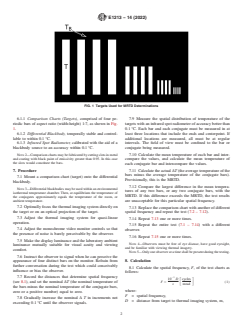
resolvable temperature difference (MRTD) capability of the differential blackbody that can establish one blackbody isother-
compound observer-thermal imaging system as a function of
mal temperature for the set of bars and another blackbody
spatial frequency. isothermal temperature for the set of conjugate bars, which are
formed by the regions between the bars (see Fig. 1). The target
1.2 The values stated in SI units are to be regarded as
is imaged onto the monochrome video monitor of a thermal
standard. No other units of measurement are included in this
imaging system where the image is viewed by an observer.The
standard.
temperature difference between the bars and their conjugates,
1.3 This standard does not purport to address all of the
initially zero, is increased incrementally only until the observer
safety concerns, if any, associated with its use. It is the
can distinguish the four bars. This critical temperature differ-
responsibility of the user of this standard to establish appro-
ence is the MRTD.
priate safety, health, and environmental practices and deter-
4.2 The spatial distribution of temperature of each target
mine the applicability of regulatory limitations prior to use.
must be measured remotely at the critical temperature differ-
1.4 This international standard was developed in accor-
encethatdeterminestheMRTD.Themeantemperatureofeach
dance with internationally recognized principles on standard-
bar must not differ from that of any other bar by more than the
ization established in the Decision on Principles for the
measured MRTD. A similar requirement applies to the tem-
Development of International Standards, Guides and Recom-
perature of each conjugate bar. Otherwise the MRTD value is
mendations issued by the World Trade Organization Technical
unacceptable.
Barriers to Trade (TBT) Committee.
4.3 The background temperature and the spatial frequency
2. Referenced Documents
of each target must be specified together with the measured
2 value of MRTD.
2.1 ASTM Standards:
E1316 Terminology for Nondestructive Examinations
4.4 The probability of resolution must be specified together
with the reported value of MRTD.
3. Terminology
5. Significance and Use
3.1 Definitions:
3.1.1 differential blackbody—an apparatus for establishing
5.1 This practice relates to a thermal imaging system’s
two parallel isothermal planar zones of different temperatures,
effectiveness for discerning details in a scene.
and with effective emissivities of 1.0.
5.2 MRTD values provide estimates of resolution capability
3.1.2 See also Terminology E1316.
and may be used to compare one system with another. (Lower
MRTD values indicate better resolution.)
5.3 Due to the partially subjective nature of the procedure,
This practice is under the jurisdiction of ASTM Committee E07 on Nonde-
repeatability and reproducibility are apt to be poor and MRTD
structive Testing and is the direct responsibility of Subcommittee E07.10 on
differences less than 0.2 °C are considered to be insignificant.
Specialized NDT Methods.
Current edition approved Dec. 1, 2022. Published December 2022. Originally
NOTE 1—Values obtained under idealized laboratory conditions may or
approved in 1987. Last previous edition approved in 2018 as E1213 – 14(2018).
may not correlate directly with service performance.
DOI: 10.1520/E1213-14R22.
For referenced ASTM standards, visit the ASTM website, www.astm.org, or
contact ASTM Customer Service at service@astm.org. For Annual Book of ASTM
6. Apparatus
Standards volume information, refer to the standard’s Document Summary page on
the ASTM website. 6.1 The apparatus consists of the following:
Copyright © ASTM International, 100 Barr Harbor Drive, PO Box C700, West Conshohocken, PA 19428-2959. United States
E1213 − 14 (2022)
FIG. 1 Targets Used for MRTD Determinations
6.1.1 Comparison Charts (Targets), comprised of four pe- 7.9 Measure the spatial distribution of temperature of the
riodic bars of aspect ratio (width:height) 1:7, as shown in Fig. targets with an infrared spot radiometer of accuracy better than
1. 0.1 °C. Each bar and each conjugate must be measured in at
6.1.2 Differential Blackbody, temporally stable and control- least three locations that include the ends and centerpoint. If
lable to within 0.1 °C. additional locations are measured, all must be at regular
6.1.3 Infrared Spot Radiometer, calibrated with the aid of a intervals. The field of view must be confined
...