

ASTM D2981-94(2019)
(Test Method)Standard Test Method for Wear Life of Solid Film Lubricants in Oscillating Motion
General Information
- Abstract
SIGNIFICANCE AND USE
5.1 This test method is used for determining the wear life properties of bonded solid lubricants in oscillating motion under the prescribed test conditions. This test method differentiates between bonded solid lubricants with respect to their wear life. If the test conditions are changed, relative wear life may change and relative ratings of the bonded solid film lubricants may be different.
SCOPE
1.1 This test method covers the evaluation of wear life of a bonded solid film lubricant under oscillating motion by means of a block-on-ring2 friction and wear testing machine.
1.2 This standard does not purport to address all of the safety concerns, if any, associated with its use. It is the responsibility of the user of this standard to establish appropriate safety, health, and environmental practices and determine the applicability of regulatory limitations prior to use.
1.3 This international standard was developed in accordance with internationally recognized principles on standardization established in the Decision on Principles for the Development of International Standards, Guides and Recommendations issued by the World Trade Organization Technical Barriers to Trade (TBT) Committee.
- Status
- Published
- Publication Date
- 30-Apr-2019
- Technical Committee
- D02 - Petroleum Products, Liquid Fuels, and Lubricants
- Drafting Committee
- D02.L0.05 - Solid Lubricants

Overview
ASTM D2981-94(2019), Standard Test Method for Wear Life of Solid Film Lubricants in Oscillating Motion, provides a systematic approach to evaluating the wear life of bonded solid film lubricants subjected to oscillating motion. Developed by ASTM International, this standard establishes consistent and reproducible testing conditions for determining the durability and effectiveness of solid film lubricants, typically used to reduce friction and wear in mechanical systems.
By defining test procedures and equipment requirements, ASTM D2981 helps manufacturers, suppliers, and end-users compare the performance of various solid film lubricants under controlled oscillatory conditions. Its standardized method is essential for product development, quality assurance, and meeting regulatory compliance in industries where reliable lubrication and wear resistance are critical.
Key Topics
- Test Method: Specifies the use of a block-on-ring friction and wear testing machine to assess the wear life of lubricants applied as solid films. The method measures the number of cycles until a predetermined frictional force or coefficient is reached, indicating lubricant failure.
- Wear Life Differentiation: The test differentiates lubricants based on their wear life under the set conditions, providing comparative performance data among products.
- Frictional Properties: Includes definitions and measurement methods for key tribological parameters such as coefficient of friction, friction force, and kinetic/static friction.
- Equipment Requirements: Details apparatus specifications, including the test block and ring materials, calibration processes, and environmental controls for temperature and humidity.
- Data Reporting and Repeatability: Outlines the need for thorough reporting of test conditions, wear life results, and friction values at specified intervals to ensure consistency and reproducibility across laboratories.
- Safety and Compliance: Reminds users to implement appropriate safety, health, and environmental precautions, and to consider local regulatory requirements.
Applications
ASTM D2981 is widely utilized in industries where solid film lubricants are essential for reducing wear and friction in oscillating or reciprocating components. Practical applications include:
- Aerospace Engineering: Evaluating lubricants for critical moving parts exposed to oscillating stresses, such as actuators, linkages, and control surfaces.
- Automotive Manufacturing: Testing the longevity of coatings in components like pivot joints, bushings, and sliding mechanisms.
- Industrial Machinery: Selecting suitable lubricants for high-performance moving assemblies in manufacturing and processing equipment.
- Product Development and Quality Control: Used by R&D and manufacturing teams to benchmark new lubricant formulations, ensure batch consistency, and verify supplier claims.
- Regulatory and Contractual Compliance: Supports meeting procurement specifications, international trade requirements, and quality standards relevant to solid film lubricant applications.
Related Standards
For comprehensive tribological testing and evaluation of lubricants, the following ASTM standards are referenced or provide additional guidance:
- ASTM D2714: Test Method for Calibration and Operation of the Falex Block-on-Ring Friction and Wear Testing Machine - essential for setting up the apparatus used in D2981.
- ASTM Committee D02: Covers petroleum products, liquid fuels, and lubricants, including subcommittees focusing on solid lubricants.
- General International Standards: Developed under principles aligned with the World Trade Organization (WTO) Technical Barriers to Trade (TBT) Committee, ensuring global acceptance and harmonization.
Summary
ASTM D2981-94(2019) is a vital standard for evaluating the wear life of bonded solid film lubricants under oscillating motion, providing industries with a reliable method for comparative analysis and product selection. Adhering to this test method ensures consistency, safety, and quality in applications demanding high-performance lubrication and wear resistance.
Relations
- Effective Date
- 01-May-2019
- Effective Date
- 01-May-2019
- Effective Date
- 01-May-2014
- Effective Date
- 01-Oct-2009
- Effective Date
- 01-Nov-2003
- Effective Date
- 10-Nov-1998
Frequently Asked Questions
ASTM D2981-94(2019) is a standard published by ASTM International. Its full title is "Standard Test Method for Wear Life of Solid Film Lubricants in Oscillating Motion". This standard covers: SIGNIFICANCE AND USE 5.1 This test method is used for determining the wear life properties of bonded solid lubricants in oscillating motion under the prescribed test conditions. This test method differentiates between bonded solid lubricants with respect to their wear life. If the test conditions are changed, relative wear life may change and relative ratings of the bonded solid film lubricants may be different. SCOPE 1.1 This test method covers the evaluation of wear life of a bonded solid film lubricant under oscillating motion by means of a block-on-ring2 friction and wear testing machine. 1.2 This standard does not purport to address all of the safety concerns, if any, associated with its use. It is the responsibility of the user of this standard to establish appropriate safety, health, and environmental practices and determine the applicability of regulatory limitations prior to use. 1.3 This international standard was developed in accordance with internationally recognized principles on standardization established in the Decision on Principles for the Development of International Standards, Guides and Recommendations issued by the World Trade Organization Technical Barriers to Trade (TBT) Committee.
SIGNIFICANCE AND USE 5.1 This test method is used for determining the wear life properties of bonded solid lubricants in oscillating motion under the prescribed test conditions. This test method differentiates between bonded solid lubricants with respect to their wear life. If the test conditions are changed, relative wear life may change and relative ratings of the bonded solid film lubricants may be different. SCOPE 1.1 This test method covers the evaluation of wear life of a bonded solid film lubricant under oscillating motion by means of a block-on-ring2 friction and wear testing machine. 1.2 This standard does not purport to address all of the safety concerns, if any, associated with its use. It is the responsibility of the user of this standard to establish appropriate safety, health, and environmental practices and determine the applicability of regulatory limitations prior to use. 1.3 This international standard was developed in accordance with internationally recognized principles on standardization established in the Decision on Principles for the Development of International Standards, Guides and Recommendations issued by the World Trade Organization Technical Barriers to Trade (TBT) Committee.
ASTM D2981-94(2019) is classified under the following ICS (International Classification for Standards) categories: 21.260 - Lubrication systems. The ICS classification helps identify the subject area and facilitates finding related standards.
ASTM D2981-94(2019) has the following relationships with other standards: It is inter standard links to ASTM D2981-94(2014), ASTM D2714-94(2019), ASTM D2714-94(2014), ASTM D2714-94(2009), ASTM D2714-94(2003), ASTM D2714-94(1998). Understanding these relationships helps ensure you are using the most current and applicable version of the standard.
ASTM D2981-94(2019) is available in PDF format for immediate download after purchase. The document can be added to your cart and obtained through the secure checkout process. Digital delivery ensures instant access to the complete standard document.
Standards Content (Sample)
This international standard was developed in accordance with internationally recognized principles on standardization established in the Decision on Principles for the
Development of International Standards, Guides and Recommendations issued by the World Trade Organization Technical Barriers to Trade (TBT) Committee.
Designation: D2981 − 94 (Reapproved 2019)
Standard Test Method for
Wear Life of Solid Film Lubricants in Oscillating Motion
This standard is issued under the fixed designation D2981; the number immediately following the designation indicates the year of
original adoption or, in the case of revision, the year of last revision.Anumber in parentheses indicates the year of last reapproval.A
superscript epsilon (´) indicates an editorial change since the last revision or reapproval.
1. Scope 3.1.1.1 Discussion—A distinction is often made between
static coeffıcient of friction and kinetic coeffıcient of friction.
1.1 This test method covers the evaluation of wear life of a
3.1.2 friction force—the resisting force tangential to the
bonded solid film lubricant under oscillating motion by means
interface between two bodies when, under the action of an
of a block-on-ring friction and wear testing machine.
externalforce,onebodymovesortendstomoverelativetothe
1.2 This standard does not purport to address all of the
other.
safety concerns, if any, associated with its use. It is the
3.1.3 kinetic coeffıcient of friction—the coefficient of fric-
responsibility of the user of this standard to establish appro-
tion under conditions of macroscopic relative motion between
priate safety, health, and environmental practices and deter-
two bodies.
mine the applicability of regulatory limitations prior to use.
1.3 This international standard was developed in accor-
3.1.4 wear—damage to a solid surface, generally involving
dance with internationally recognized principles on standard-
progressive loss of material, due to relative motion between
ization established in the Decision on Principles for the
that surface and a contacting substance or substances.
Development of International Standards, Guides and Recom-
4. Summary of Test Method
mendations issued by the World Trade Organization Technical
Barriers to Trade (TBT) Committee.
4.1 The test machine is operated using a coated steel testing
ring oscillating against a steel test block. The oscillating speed
2. Referenced Documents
is 87.5cpm 6 1cpm at a 90° arc. The specimens are worn-in
2.1 ASTM Standards:
for 1min at 13.6kg (30lb) normal load obtained by applica-
D2714Test Method for Calibration and Operation of the
tion of 0.454kg (1lb) of dead weight to the 0:1 ratio lever
Falex Block-on-Ring Friction and Wear Testing Machine
system.Wear-in is followed by application of a normal load of
283kg (630lb) obtained by application of 9.53kg (21lb) of
3. Terminology
dead weight to the 30:1 ratio lever system for the duration of
3.1 Definitions:
the test.
3.1.1 coeffıcient of friction, µ or f—in tribology, the dimen-
4.2 One measurement is made:
sionlessratioofthefrictionforce(F)betweentwobodiestothe
4.2.1 wear life—the number of cycles required for the
normal force (N) pressing these two bodies together.
frictional force to rise to a predetermined value.
µ or f 5 F/N (1)
~ !
5. Significance and Use
5.1 This test method is used for determining the wear life
This test method is under the jurisdiction of ASTM Committee D02 on
Petroleum Products, Liquid Fuels, and Lubricants and is the direct responsibility of
properties of bonded solid lubricants in oscillating motion
Subcommittee D02.L0.05 on Solid Lubricants.
under the prescribed test conditions. This test method differ-
Current edition approved May 1, 2019. Published June 2019. Originally
entiates between bonded solid lubricants with respect to their
approved in 1971. Last previous edition approved in 2014 as D2981–94(2014).
DOI: 10.1520/D2981-94R19. wear life. If the test conditions are changed, relative wear life
ThesolesourceofsupplyoftheBlock-on-Ringknowntothecommitteeatthis
may change and relative ratings of the bonded solid film
time is Falex Corp., 1020Airpark Dr., Sugar Grove, IL 60554. If you are aware of
lubricants may be different.
alternative suppliers, please provide this information to ASTM International
Headquarters.Your comments will receive careful consideration at a meeting of the
6. Apparatus
responsible technical committee, which you may attend.
For referenced ASTM standards, visit the ASTM website, www.astm.org, or
6.1 Block-on-Ring Test Machine, equippedwithoscillating
contact ASTM Customer Service at service@astm.org. For Annual Book of ASTM
drive, load cell transducer and recorder described in detail in
Standards volume information, refer to the standard’s Document Summary page on
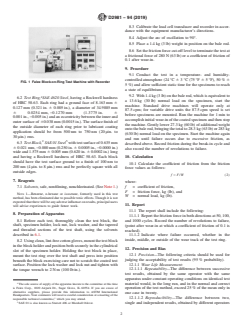
the ASTM website. AnnexA1 and illustrated in Fig. 1. (See Test Method D2714.)
Copyright © ASTM International, 100 Barr Harbor Drive, PO Box C700, West Conshohocken, PA 19428-2959. United States
D2981 − 94 (2019)
8.3 Calibrate the load cell transducer and recorder in accor-
dance with the equipment manufacturer’s directions.
8.4 Adjust the arc of oscillation to 90°.
8.5 Place a 1.4kg (3lb) weight in position on the bale rod.
8.6 Setthefrictionforcecut-offleveltoterminatethetestat
a frictional force of 280N (63lb) or a coefficient of friction of
0.1 after wear-in.
9. Procedure
9.1 Conduct the test in a temperature- and humidity-
controlled atmosphere (24°C 6 3°C (75°F 6 5°F), 50% 6
FIG. 1 Falex Block-on-Ring Test Machine with Recorder
5%) and allow sufficient static time for the specimens to reach
a state of equilibrium.
9.2 With1.4kg(3lb)onthebalerod,whichisequivalentto
6.2 Test Ring, SAE 4620 Steel, having a Rockwell hardness
a 13.6kg (30lb) normal load on the specimen, start the
of HRC 58-63. Each ring had a ground face of 8.163mm 6
machine. Standard drive machines will operate only at
0.127mm (0.321in. 6 0.005in.), a diameter of 34.9885mm
87.5cpm; for variable drive units the 87.5cpm speed is set
6 0.0254 mm, −0.1270 mm (1.3775 in. 6
before specimens are mounted. Run the machine for 1min to
0.001in.,−0.005in.)andaneccentricitybetweentheinnerand
accomplishinitialwear-inofthecoatedspecimenandthenstop
outer surface of 60.038mm (0.0015in.).The surface finish of
the machine. Gently lower 27.3kg (60lb) of additional weight
the outside diameter of each ring prior to lubricant coating
ontothebalerod,bringingthetotalto28.3kg(63lb)or283kg
application should be from 500nm to 750nm (20µin. to
(630lb) normal load on the specimen. Start the machine again
30µin.) rms.
and run until failure occurs due to excessive friction, as
2 5
6.3 Test Block, SAE 01 Steel withtestsurfaceof0.635mm
described above. Record friction during the break-in cycle and
6 0.021mm,−0.000mm (0.250in. 6 0.0005in.,−0.0000in.)
also record the number of revolutions to failure.
wideand1.575mm 60.005mm(0.620in. 60.0002in.)long
and having a Rockwell hardness of HRC 58-63. Each block 10. Calculation
should have the test surface ground to a finish of 100nm to
10.1 Calculate the coefficient of friction from the friction
200nm (4µin. to 8µin.) rms and be perfectly square with all
force values as follows:
outside edges.
f 5 F/W (2)
7. Reagents
where:
7.1 Solvents,safe,nonfilming,nonchlorinated.(SeeNote1.)
f = coefficient of friction,
F = friction force, kg (lb), and
NOTE 1—Benzene, n-hexane or isooctane, formerly used in this test
W = normal load, kg (lb).
method,hasbeeneliminatedduetopossibletoxiceffects.Thoughitisnot
expectedthattherewillbeanyadverseinfluenceonresults,principalusers
11. Report
will advise experiences
...