

ASTM D7444-18a
(Practice)Standard Practice for Heat and Humidity Aging of Oxidatively Degradable Plastics
General Information
- Abstract
SIGNIFICANCE AND USE
4.1 Since the correlation between the conditions specified in this practice and actual disposal environments (for example, composting, soil or landfill) has not been determined or established, the test results are to be used only for comparative and ranking purposes in the laboratory. No extrapolation to real world disposal expectations or predictions are to be made from results obtained by this procedure. Real world evaluations and correlations are needed for such claims.
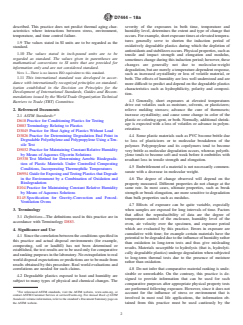
4.2 Degradable plastics exposed to heat and humidity are subject to many types of physical and chemical changes. The severity of the exposures in both time, temperature and humidity level, determines the extent and type of change that occurs. For example, short exposure times at elevated temperatures generally serve to shorten the induction period of oxidatively degradable plastics during which the depletion of antioxidants and stabilizers occurs. Physical properties, such as tensile and impact strength and elongation and modulus, sometimes change during this induction period; however, these changes are generally not due to molecular-weight degradation, but are merely a temperature-dependent response, such as increased crystallinity or loss of volatile material, or both. The effects of humidity are less well understood and are more difficult to predict and depend on the degradable plastics characteristics such as hydrophilicity, polarity and composition.
4.3 Generally, short exposures at elevated temperatures drive out volatiles such as moisture, solvents, or plasticizers; relieve molding stresses; advance the cure of thermosets; increase crystallinity; and cause some change in color of the plastic or coloring agent, or both. Normally, additional shrinkage is expected with a loss of volatiles or advance in polymerization.
4.4 Some plastic materials such as PVC become brittle due to loss of plasticizers or to molecular breakdown of the polymer. Polypropylene and its copolymers tend to beco...
SCOPE
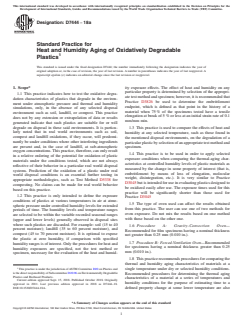
1.1 This practice indicates how to test the oxidative degradation characteristics of plastics that degrade in the environment under atmospheric pressure and thermal and humidity simulations, only, in the absence of any selected disposal environment such as soil, landfill, or compost. This practice does not by any extension or extrapolation of data or results generated indicate that such plastics are suitable for or will degrade on disposal in these said environments. It is particularly noted that in real world environments such as soil, compost and landfill oxidations, if they occur, will predominantly be under conditions where other interfering ingredients are present and, in the case of landfill, at sub-atmospheric oxygen concentrations. This practice, therefore, can only result in a relative ordering of the potential for oxidation of plastic materials under the conditions tested, which are not always reflective of their behavior in a particular real world disposal systems. Prediction of the oxidation of a plastic under real world disposal conditions is an essential further testing in appropriate methodologies, such as Test Method D5338 for composting. No claims can be made for real world behavior based on this practice.
1.2 This practice is only intended to define the exposure conditions of plastics at various temperatures in air at atmospheric pressure under controlled humidity levels for extended periods of time. The humidity levels and temperature ranges are selected to be within the variable recorded seasonal ranges (upper and lower levels) generally observed in disposal sites where such plastics are discarded. For example: soil (15 to 40 percent moisture); landfill (35 to 60 percent moisture), and compost (45 to 70 percent moisture). It is optional to expose the plastic at zero humidity, if comparison with specified humidity ranges is of interest. Only the procedures for heat and humidity exposures are specifi...
- Status
- Published
- Publication Date
- 14-Sep-2018
- Technical Committee
- D20 - Plastics
- Drafting Committee
- D20.96 - Environmentally Degradable Plastics and Biobased Products
Buy Documents
ASTM D7444-18a - Standard Practice for Heat and Humidity Aging of Oxidatively Degradable Plastics
REDLINE ASTM D7444-18a - Standard Practice for Heat and Humidity Aging of Oxidatively Degradable Plastics
Overview
ASTM D7444-18a – Standard Practice for Heat and Humidity Aging of Oxidatively Degradable Plastics establishes laboratory procedures for evaluating the oxidative degradation potential of plastics exposed to controlled heat and humidity environments. The main goal of this practice is to enable relative comparison and ranking of oxidatively degradable plastics under simulated atmospheric conditions. Importantly, results obtained from this practice should not be extrapolated to real-world environments, such as soil, compost, or landfill, since actual disposal conditions are more complex and involve additional variables not simulated by this practice.
ASTM D7444-18a serves as a valuable tool for research and development, quality control, and material selection for plastics intended to degrade through oxidation after use. This standard is principally used to define exposure conditions rather than to predict the actual rate or extent of environmental degradation upon disposal.
Key Topics
Scope and Purpose
- Laboratory simulation of heat and humidity aging for oxidatively degradable plastics.
- Not intended to predict real-world performance in environmental settings like compost, soil, or landfill.
- Used solely for comparative material ranking and quality assessment in controlled laboratory conditions.
Exposure Conditions
- Specifies temperature and humidity ranges common to various disposal environments:
- Soil: 15–40% moisture
- Landfill: 35–60% moisture
- Compost: 45–70% moisture
- Optional exposure at zero humidity to analyze material responses.
- Specifies temperature and humidity ranges common to various disposal environments:
Testing Procedures
- Specifies use of gravity-convection ovens for films (≤0.25 mm thickness) and forced-ventilation ovens for thicker specimens.
- Multiple exposure procedures to study effects across varying temperatures and humidity levels.
- Recommends following standardized physical property test methods (e.g., embrittlement endpoint determination).
Data Analysis and Reporting
- Guidance on statistical analysis, including variance analysis and regression for property changes over time.
- Comprehensive reporting requirements to ensure reproducibility and transparency.
Applications
ASTM D7444-18a is widely used in the plastics industry for:
- Material Development: Comparing the oxidative degradation behavior of different plastic formulations in a controlled environment.
- Quality Control: Assessing batch-to-batch consistency and the potential effects of additives or stabilizers on oxidative stability.
- Research and Testing: Establishing baseline data for new materials designed to be oxidatively degradable.
- Product Ranking: Providing comparative information to rank materials based on their relative susceptibility to oxidation under specified laboratory conditions.
This standard is especially relevant where manufacturers or researchers need to understand how plastics will respond to oxidative conditions during storage and handling - but not as a predictor for actual degradation behavior in composting, landfill, or soil burial.
Related Standards
ASTM D7444-18a references and relates to several ASTM standards and practices for plastics testing and conditioning:
- ASTM D618: Conditioning Plastics for Testing
- ASTM D3045: Heat Aging of Plastics Without Load
- ASTM D3826: Determining Degradation End Point in Degradable Polyethylene and Polypropylene
- ASTM D5338: Determining Aerobic Biodegradation of Plastic Materials Under Controlled Composting Conditions
- ASTM D6954: Exposing and Testing Plastics that Degrade in the Environment by a Combination of Oxidation and Biodegradation
- ASTM E104/E145: Practice and Specification for Oven Testing and Relative Humidity Control
Keywords: heat aging, humidity aging, oxidative degradation, degradable plastics, laboratory testing, ASTM standards, material testing, plastics oxidation, embrittlement, property change
By following ASTM D7444-18a, users ensure a consistent methodology for comparative analysis but must seek additional, real-world testing procedures to make claims about environmental degradability or disposal performance.
Relations
- Replaces
ASTM D7444-18 - Standard Practice for Heat and Humidity Aging of Oxidatively Degradable Plastics - Effective Date
- 15-Sep-2018
- Effective Date
- 01-Feb-2024
- Effective Date
- 01-Jan-2024
- Effective Date
- 01-Nov-2023
- Effective Date
- 01-Jan-2020
- Effective Date
- 01-Aug-2019
- Effective Date
- 15-Apr-2019
- Effective Date
- 01-Mar-2019
- Effective Date
- 01-Mar-2019
- Effective Date
- 01-Feb-2019
- Effective Date
- 01-Dec-2018
- Effective Date
- 01-Nov-2018
- Effective Date
- 01-Nov-2018
- Effective Date
- 01-Aug-2018
- Effective Date
- 01-Mar-2018
Buy Documents
ASTM D7444-18a - Standard Practice for Heat and Humidity Aging of Oxidatively Degradable Plastics
REDLINE ASTM D7444-18a - Standard Practice for Heat and Humidity Aging of Oxidatively Degradable Plastics
Get Certified
Connect with accredited certification bodies for this standard

DIN CERTCO
DIN Group product certification.

Smithers Quality Assessments
US management systems and product certification.
Sponsored listings
Frequently Asked Questions
ASTM D7444-18a is a standard published by ASTM International. Its full title is "Standard Practice for Heat and Humidity Aging of Oxidatively Degradable Plastics". This standard covers: SIGNIFICANCE AND USE 4.1 Since the correlation between the conditions specified in this practice and actual disposal environments (for example, composting, soil or landfill) has not been determined or established, the test results are to be used only for comparative and ranking purposes in the laboratory. No extrapolation to real world disposal expectations or predictions are to be made from results obtained by this procedure. Real world evaluations and correlations are needed for such claims. 4.2 Degradable plastics exposed to heat and humidity are subject to many types of physical and chemical changes. The severity of the exposures in both time, temperature and humidity level, determines the extent and type of change that occurs. For example, short exposure times at elevated temperatures generally serve to shorten the induction period of oxidatively degradable plastics during which the depletion of antioxidants and stabilizers occurs. Physical properties, such as tensile and impact strength and elongation and modulus, sometimes change during this induction period; however, these changes are generally not due to molecular-weight degradation, but are merely a temperature-dependent response, such as increased crystallinity or loss of volatile material, or both. The effects of humidity are less well understood and are more difficult to predict and depend on the degradable plastics characteristics such as hydrophilicity, polarity and composition. 4.3 Generally, short exposures at elevated temperatures drive out volatiles such as moisture, solvents, or plasticizers; relieve molding stresses; advance the cure of thermosets; increase crystallinity; and cause some change in color of the plastic or coloring agent, or both. Normally, additional shrinkage is expected with a loss of volatiles or advance in polymerization. 4.4 Some plastic materials such as PVC become brittle due to loss of plasticizers or to molecular breakdown of the polymer. Polypropylene and its copolymers tend to beco... SCOPE 1.1 This practice indicates how to test the oxidative degradation characteristics of plastics that degrade in the environment under atmospheric pressure and thermal and humidity simulations, only, in the absence of any selected disposal environment such as soil, landfill, or compost. This practice does not by any extension or extrapolation of data or results generated indicate that such plastics are suitable for or will degrade on disposal in these said environments. It is particularly noted that in real world environments such as soil, compost and landfill oxidations, if they occur, will predominantly be under conditions where other interfering ingredients are present and, in the case of landfill, at sub-atmospheric oxygen concentrations. This practice, therefore, can only result in a relative ordering of the potential for oxidation of plastic materials under the conditions tested, which are not always reflective of their behavior in a particular real world disposal systems. Prediction of the oxidation of a plastic under real world disposal conditions is an essential further testing in appropriate methodologies, such as Test Method D5338 for composting. No claims can be made for real world behavior based on this practice. 1.2 This practice is only intended to define the exposure conditions of plastics at various temperatures in air at atmospheric pressure under controlled humidity levels for extended periods of time. The humidity levels and temperature ranges are selected to be within the variable recorded seasonal ranges (upper and lower levels) generally observed in disposal sites where such plastics are discarded. For example: soil (15 to 40 percent moisture); landfill (35 to 60 percent moisture), and compost (45 to 70 percent moisture). It is optional to expose the plastic at zero humidity, if comparison with specified humidity ranges is of interest. Only the procedures for heat and humidity exposures are specifi...
SIGNIFICANCE AND USE 4.1 Since the correlation between the conditions specified in this practice and actual disposal environments (for example, composting, soil or landfill) has not been determined or established, the test results are to be used only for comparative and ranking purposes in the laboratory. No extrapolation to real world disposal expectations or predictions are to be made from results obtained by this procedure. Real world evaluations and correlations are needed for such claims. 4.2 Degradable plastics exposed to heat and humidity are subject to many types of physical and chemical changes. The severity of the exposures in both time, temperature and humidity level, determines the extent and type of change that occurs. For example, short exposure times at elevated temperatures generally serve to shorten the induction period of oxidatively degradable plastics during which the depletion of antioxidants and stabilizers occurs. Physical properties, such as tensile and impact strength and elongation and modulus, sometimes change during this induction period; however, these changes are generally not due to molecular-weight degradation, but are merely a temperature-dependent response, such as increased crystallinity or loss of volatile material, or both. The effects of humidity are less well understood and are more difficult to predict and depend on the degradable plastics characteristics such as hydrophilicity, polarity and composition. 4.3 Generally, short exposures at elevated temperatures drive out volatiles such as moisture, solvents, or plasticizers; relieve molding stresses; advance the cure of thermosets; increase crystallinity; and cause some change in color of the plastic or coloring agent, or both. Normally, additional shrinkage is expected with a loss of volatiles or advance in polymerization. 4.4 Some plastic materials such as PVC become brittle due to loss of plasticizers or to molecular breakdown of the polymer. Polypropylene and its copolymers tend to beco... SCOPE 1.1 This practice indicates how to test the oxidative degradation characteristics of plastics that degrade in the environment under atmospheric pressure and thermal and humidity simulations, only, in the absence of any selected disposal environment such as soil, landfill, or compost. This practice does not by any extension or extrapolation of data or results generated indicate that such plastics are suitable for or will degrade on disposal in these said environments. It is particularly noted that in real world environments such as soil, compost and landfill oxidations, if they occur, will predominantly be under conditions where other interfering ingredients are present and, in the case of landfill, at sub-atmospheric oxygen concentrations. This practice, therefore, can only result in a relative ordering of the potential for oxidation of plastic materials under the conditions tested, which are not always reflective of their behavior in a particular real world disposal systems. Prediction of the oxidation of a plastic under real world disposal conditions is an essential further testing in appropriate methodologies, such as Test Method D5338 for composting. No claims can be made for real world behavior based on this practice. 1.2 This practice is only intended to define the exposure conditions of plastics at various temperatures in air at atmospheric pressure under controlled humidity levels for extended periods of time. The humidity levels and temperature ranges are selected to be within the variable recorded seasonal ranges (upper and lower levels) generally observed in disposal sites where such plastics are discarded. For example: soil (15 to 40 percent moisture); landfill (35 to 60 percent moisture), and compost (45 to 70 percent moisture). It is optional to expose the plastic at zero humidity, if comparison with specified humidity ranges is of interest. Only the procedures for heat and humidity exposures are specifi...
ASTM D7444-18a is classified under the following ICS (International Classification for Standards) categories: 83.080.01 - Plastics in general. The ICS classification helps identify the subject area and facilitates finding related standards.
ASTM D7444-18a has the following relationships with other standards: It is inter standard links to ASTM D7444-18, ASTM D883-24, ASTM D6954-24, ASTM D883-23, ASTM D883-20, ASTM D883-19c, ASTM D883-19a, ASTM E145-19, ASTM D5032-19, ASTM D883-19, ASTM D883-18a, ASTM D3826-18, ASTM D883-18, ASTM D3045-18, ASTM D6954-18. Understanding these relationships helps ensure you are using the most current and applicable version of the standard.
ASTM D7444-18a is available in PDF format for immediate download after purchase. The document can be added to your cart and obtained through the secure checkout process. Digital delivery ensures instant access to the complete standard document.
Standards Content (Sample)
This international standard was developed in accordance with internationally recognized principles on standardization established in the Decision on Principles for the
Development of International Standards, Guides and Recommendations issued by the World Trade Organization Technical Barriers to Trade (TBT) Committee.
Designation: D7444 − 18a
Standard Practice for
Heat and Humidity Aging of Oxidatively Degradable
Plastics
This standard is issued under the fixed designation D7444; the number immediately following the designation indicates the year of
original adoption or, in the case of revision, the year of last revision.Anumber in parentheses indicates the year of last reapproval.A
superscript epsilon (´) indicates an editorial change since the last revision or reapproval.
1. Scope* ity exposure effects. The effect of heat and humidity on any
particular property is determined by selection of the appropri-
1.1 This practice indicates how to test the oxidative degra-
atetestmethodandspecimen;however,itisrecommendedthat
dation characteristics of plastics that degrade in the environ-
Practice D3826 be used to determine the embrittlement
ment under atmospheric pressure and thermal and humidity
endpoint, which is defined as that point in the history of a
simulations, only, in the absence of any selected disposal
material when 75% of the specimens tested have a tensile
environment such as soil, landfill, or compost. This practice
elongation at break of 5% or less at an initial strain rate of 0.1
does not by any extension or extrapolation of data or results
mm/mm min.
generated indicate that such plastics are suitable for or will
degrade on disposal in these said environments. It is particu-
1.3 This practice is used to compare the effects of heat and
larly noted that in real world environments such as soil,
humidity at any selected temperature, such as those found in
compost and landfill oxidations, if they occur, will predomi-
the mentioned disposal environments, on the degradation of a
nantly be under conditions where other interfering ingredients
particularplasticbyselectionofanappropriatetestmethodand
are present and, in the case of landfill, at sub-atmospheric
specimen.
oxygenconcentrations.Thispractice,therefore,canonlyresult
1.4 This practice is to be used in order to apply selected
in a relative ordering of the potential for oxidation of plastic
exposure conditions when comparing the thermal-aging char-
materials under the conditions tested, which are not always
acteristics at controlled humidity levels of plastic materials as
reflective of their behavior in a particular real world disposal
measured by the change in some property of interest (that is,
systems. Prediction of the oxidation of a plastic under real
embrittlement by means of loss of elongation, molecular
world disposal conditions is an essential further testing in
weight, disintegration, etc.). It is very similar to Practice
appropriate methodologies, such as Test Method D5338 for
D3045butisintendedforuseinevaluatingplasticsdesignedto
composting. No claims can be made for real world behavior
be oxidized easily after use. The exposure times used for this
based on this practice.
practice will be significantly shorter than those used for
1.2 This practice is only intended to define the exposure
Practice D3045
conditions of plastics at various temperatures in air at atmo-
1.5 The type of oven used can affect the results obtained
spheric pressure under controlled humidity levels for extended
from this practice. The user can use one of two methods for
periods of time. The humidity levels and temperature ranges
oven exposure. Do not mix the results based on one method
are selected to be within the variable recorded seasonal ranges
with those based on the other one.
(upper and lower levels) generally observed in disposal sites
where such plastics are discarded. For example: soil (15 to 40
1.6 Procedure A: Gravity-Convection Oven—
percent moisture); landfill (35 to 60 percent moisture), and
Recommended for film specimens having a nominal thickness
compost (45 to 70 percent moisture). It is optional to expose
not greater than 0.25 mm (0.010 in.).
the plastic at zero humidity, if comparison with specified
1.7 Procedure B: Forced-Ventilation Oven—Recommended
humidityrangesisofinterest.Onlytheproceduresforheatand
for specimens having a nominal thickness greater than 0.25
humidity exposures are specified, not the test method or
mm (0.010 in.).
specimen, necessary for the evaluation of the heat and humid-
1.8 Thispracticerecommendsproceduresforcomparingthe
thermal and humidity aging characteristics of materials at a
single temperature under dry or selected humidity conditions.
ThispracticeisunderthejurisdictionofASTMCommitteeD20onPlasticsand
isthedirectresponsibilityofSubcommitteeD20.96onEnvironmentallyDegradable
Recommended procedures for determining the thermal aging
Plastics and Biobased Products.
characteristics of a material at a series of temperatures and
Current edition approved Sept. 15, 2018. Published October 2018. Originally
humidity conditions for the purpose of estimating time to a
approved in 2011. Last previous edition approved in 2018 as D7444–18.
DOI:10.1520/D7444-18A. defined property change at some lower temperature are also
*A Summary of Changes section appears at the end of this standard
Copyright © ASTM International, 100 Barr Harbor Drive, PO Box C700, West Conshohocken, PA 19428-2959. United States
D7444 − 18a
described. This practice does not predict thermal aging char- severity of the exposures in both time, temperature and
acteristics where interactions between stress, environment, humidity level, determines the extent and type of change that
temperature, and time control failure. occurs.Forexample,shortexposuretimesatelevatedtempera-
tures generally serve to shorten the induction period of
1.9 The values stated in SI units are to be regarded as the
oxidatively degradable plastics during which the depletion of
standard.
antioxidantsandstabilizersoccurs.Physicalproperties,suchas
1.10 The values stated in inch-pound units are to be
tensile and impact strength and elongation and modulus,
regarded as standard. The values given in parentheses are
sometimeschangeduringthisinductionperiod;however,these
mathematical conversions to SI units that are provided for
changes are generally not due to molecular-weight
information only and are not considered standard.
degradation,butaremerelyatemperature-dependentresponse,
NOTE 1—There is no known ISO equivalent to this standard.
such as increased crystallinity or loss of volatile material, or
1.11 This international standard was developed in accor-
both. The effects of humidity are less well understood and are
dance with internationally recognized principles on standard-
more difficult to predict and depend on the degradable plastics
ization established in the Decision on Principles for the
characteristics such as hydrophilicity, polarity and composi-
Development of International Standards, Guides and Recom-
tion.
mendations issued by the World Trade Organization Technical
4.3 Generally, short exposures at elevated temperatures
Barriers to Trade (TBT) Committee.
drive out volatiles such as moisture, solvents, or plasticizers;
2. Referenced Documents relieve molding stresses; advance the cure of thermosets;
2 increase crystallinity; and cause some change in color of the
2.1 ASTM Standards:
plastic or coloring agent, or both. Normally, additional shrink-
D618Practice for Conditioning Plastics for Testing
age is expected with a loss of volatiles or advance in polym-
D883Terminology Relating to Plastics
erization.
D3045Practice for Heat Aging of Plastics Without Load
D3826Practice for Determining Degradation End Point in
4.4 Some plastic materials such as PVC become brittle due
DegradablePolyethyleneandPolypropyleneUsingaTen-
to loss of plasticizers or to molecular breakdown of the
sile Test
polymer. Polypropylene and its copolymers tend to become
D5032PracticeforMaintainingConstantRelativeHumidity
very brittle as molecular degradation occurs, whereas polyeth-
by Means of Aqueous Glycerin Solutions
ylene tends to become soft and weak before it embrittles with
D5338Test Method for Determining Aerobic Biodegrada-
resultant loss in tensile strength and elongation.
tion of Plastic Materials Under Controlled Composting
4.5 Embrittlement of a material is not necessarily commen-
Conditions, Incorporating Thermophilic Temperatures
surate with a decrease in molecular weight.
D6954GuideforExposingandTestingPlasticsthatDegrade
in the Environment by a Combination of Oxidation and
4.6 The degree of change observed will depend on the
Biodegradation
property measured. Different properties do not change at the
E104Practice for Maintaining Constant Relative Humidity
same rate. In most cases, ultimate properties, such as break
by Means of Aqueous Solutions
strength or break elongation, are more sensitive to degradation
E145Specification for Gravity-Convection and Forced-
than bulk properties such as modulus.
Ventilation Ovens
4.7 Effects of exposure can be quite variable, especially
when samples are exposed for long intervals of time. Factors
3. Terminology
that affect the reproducibility of data are the degree of
3.1 Definitions—The definitions used in this practice are in
temperature control of the enclosure, humidity level of the
accordance with Terminology D883.
oven, air velocity over the specimen, and exposure period
which are evaluated by this practice. Errors in exposure are
4. Significance and Use
cumulative with time; for example certain materials have the
4.1 Sincethecorrelationbetweentheconditionsspecifiedin
potentialtobedegradedduetotheinfluenceofhumidityrather
this practice and actual disposal environments (for example,
than oxidation in long-term tests and thus give misleading
composting, soil or landfill) has not been determined or
results. Materials susceptible to hydrolysis (that is, hydrolyti-
established, the test results are to be used only for comparative
cally degradable plastics) undergo degradation when subjected
andrankingpurposesinthelaboratory.Noextrapolationtoreal
to long-term thermal tests due to the presence of moisture
worlddisposalexpectationsorpredictionsaretobemadefrom
rather than oxidation.
results obtained by this procedure. Real world evaluations and
correlations are needed for such claims. 4.8 Do not infer that comparative material ranking is unde-
sirable or unworkable. On the contrary, this practice is de-
4.2 Degradable plastics exposed to heat and humidity are
signed to provide information that can be used for such
subject to many types of physical and chemical changes. The
comparative purposes after appropriate physical property tests
are performed following exposure. However, since it does not
For referenced ASTM standards, visit the ASTM website, www.astm.org, or
account for the influence of stress or environment that is
contact ASTM Customer Service at service@astm.org. For Annual Book of ASTM
involved in most real life applications, the information ob-
Standards volume information, refer to the standard’s Document Summary page on
the ASTM website. tained from this practice must be used cautiously by the
D7444 − 18a
designer, who must inevitably make material choices using 6. Test Specimen
additional information, such as moisture, soil-type and
6.1 Thenumberandtypeoftestspecimensrequiredshallbe
composition, and mechanical-action effects that are consistent
in accordance with the ASTM test method for the specific
with the requirements of the particular application.
property to be determined; this requirement must be met at
each time and temperature and humidity selected. Unless
4.9 It is possible for many temperature indices to exist, in
fact, one for each failure criterion (time to reach failure is otherwise specified or agreed upon by all interested parties,
expose a minimum of three replicates of each material at each
dependent on the exposure temperature and humidity).
Therefore, for any application of the temperature index to be time and temperature and humidity selected.
valid, the thermal-aging program must duplicate the intended
6.2 The specimen thickness is to be comparable to but no
exposure conditions of the end product. If the plastic material
greater than the maximum thickness of the intended article in
isexposedintheenduseinamannernotevaluatedintheaging
its application, and its method of fabrication must be the same
program, the temperature index thus derived is not applicable
as that for the intended application.
to the use of the plastic material.
6.3 All test specimens for a series of temperatures must be
4.10 In some situations, a material can be exposed to one
of the same age, preferably from the same manufacturing run
temperature and humidity, for a particular period of time,
and date.
followed by exposure to another temperature at the same
humidity, for a particular period of time. This practice can be
7. Conditioning
used for such applications. The heat-aging curve of the first
7.1 Conduct initial tests in the standard laboratory atmo-
temperatureandhumidityisderived,followedbyderivationof
sphere as specified in Practice D618, and with the specimens
the heat-aging curve for the second temperature at the same
conditioned in accordance with the requirements of the test
humidity,afterexposureofsamplestothefirsttemperatureand
method for determining the specific property or properties
humidity.
required.
4.11 There can be very large errors whenArrhenius plots or
7.2 Whenrequired,theconditioningofspecimensfollowing
equations based on data from experiments at a series of
exposure at elevated temperature and prior to testing, unless
temperaturesandhumidityareusedtoestimatetimetoproduce
otherwisespecified,shallbeinaccordancewithPracticeD618.
a defined property change at some lower temperature. This
estimateoftimetoproducethepropertychangeorfailuremust
8. Procedure
always be accompanied by a 95% confidence interval for the
range of times possible based on the calculation or estimate.
8.1 Select oven type depending on thickness of the speci-
mens being tested (5.2).
5. Apparatus
8.2 Select the exposure procedure to be used, depending on
5.1 Provisions for Conditioning, at specified standard con-
whetheronlytemperature,ortemperatureandhumiditywillbe
ditions.
controlled.
8.2.1 Procedure A, single exposure temperature at constant
5.2 Oven Type:
relative humidity.
5.2.1 Gravity-Convection Oven—Recommended for film
8.2.2 Pro
...
This document is not an ASTM standard and is intended only to provide the user of an ASTM standard an indication of what changes have been made to the previous version. Because
it may not be technically possible to adequately depict all changes accurately, ASTM recommends that users consult prior editions as appropriate. In all cases only the current version
of the standard as published by ASTM is to be considered the official document.
Designation: D7444 − 18 D7444 − 18a
Standard Practice for
Heat and Humidity Aging of Oxidatively Degradable
Plastics
This standard is issued under the fixed designation D7444; the number immediately following the designation indicates the year of
original adoption or, in the case of revision, the year of last revision. A number in parentheses indicates the year of last reapproval. A
superscript epsilon (´) indicates an editorial change since the last revision or reapproval.
1. Scope*
1.1 This practice indicates how to test the oxidative degradation characteristics of plastics that degrade in the environment under
atmospheric pressure and thermal and humidity simulations, only, in the absence of any selected disposal environment such as soil,
landfill, or compost. This practice does not by any extension or extrapolation of data or results generated indicate that such plastics
are suitable for or will degrade on disposal in these said environments. It is particularly noted that in real world environments such
as soil, compost and landfill oxidations, if they occur, will predominantly be under conditions where other interfering ingredients
are present and, in the case of landfill, at sub-atmospheric oxygen concentrations. This practice, therefore, can only result in a
relative ordering of the potential for oxidation of plastic materials under the conditions tested, which are not always reflective of
their behavior in a particular real world disposal systems. Prediction of the oxidation of a plastic under real world disposal
conditions is an essential further testing in appropriate methodologies, such as Test Method D5338 for composting. No claims can
be made for real world behavior based on this practice.
1.2 This practice is only intended to define the exposure conditions of plastics at various temperatures in air at atmospheric
pressure under controlled humidity levels for extended periods of time. The humidity levels and temperature ranges are selected
to be within the variable recorded seasonal ranges (upper and lower levels) generally observed in disposal sites where such plastics
are discarded. For example: soil (15 to 40 percent moisture); landfill (35 to 60 percent moisture), and compost (45 to 70 percent
moisture). It is optional to expose the plastic at zero humidity, if comparison with specified humidity ranges is of interest. Only
the procedures for heat and humidity exposures are specified, not the test method or specimen, necessary for the evaluation of the
heat and humidity exposure effects. The effect of heat and humidity on any particular property is determined by selection of the
appropriate test method and specimen; however, it is recommended that Practice D3826 be used to determine the embrittlement
endpoint, which is defined as that point in the history of a material when 75 % of the specimens tested have a tensile elongation
at break of 5 % or less at an initial strain rate of 0.1 mm/mm min.
1.3 This practice is used to compare the effects of heat and humidity at any selected temperature, such as those found in the
mentioned disposal environments, on the degradation of a particular plastic by selection of an appropriate test method and
specimen.
1.4 This practice is to be used in order to apply selected exposure conditions when comparing the thermal-aging characteristics
at controlled humidity levels of plastic materials as measured by the change in some property of interest (that is, embrittlement
by means of loss of elongation, molecular weight, disintegration, etc.). It is very similar to Practice D3045 but is intended for use
in evaluating plastics designed to be oxidized easily after use. The exposure times used for this practice will be significantly shorter
than those used for Practice D3045
1.5 The type of oven used can affect the results obtained from this practice. The user can use one of two methods for oven
exposure. Do not mix the results based on one method with those based on the other one.
1.6 Procedure A: Gravity-Convection Oven—Recommended for film specimens having a nominal thickness not greater than
0.25 mm (0.010 in.).
1.7 Procedure B: Forced-Ventilation Oven—Recommended for specimens having a nominal thickness greater than 0.25 mm
(0.010 in.).
1.8 This practice recommends procedures for comparing the thermal and humidity aging characteristics of materials at a single
temperature under dry or selected humidity conditions. Recommended procedures for determining the thermal aging characteristics
This practice is under the jurisdiction of ASTM Committee D20 on Plastics and is the direct responsibility of Subcommittee D20.96 on Environmentally Degradable
Plastics and Biobased Products.
Current edition approved July 1, 2018Sept. 15, 2018. Published August 2018October 2018. Originally approved in 2011. Last previous edition approved in 20112018 as
D7444–11. DOI:10.1520/D7444-18.–18. DOI:10.1520/D7444-18A.
*A Summary of Changes section appears at the end of this standard
Copyright © ASTM International, 100 Barr Harbor Drive, PO Box C700, West Conshohocken, PA 19428-2959. United States
D7444 − 18a
of a material at a series of temperatures and humidity conditions for the purpose of estimating time to a defined property change
at some lower temperature are also described. This practice does not predict thermal aging characteristics where interactions
between stress, environment, temperature, and time control failure.
1.9 The values stated in SI units are to be regarded as the standard.
1.10 The values stated in inch-pound units are to be regarded as standard. The values given in parentheses are mathematical
conversions to SI units that are provided for information only and are not considered standard.
NOTE 1—There is no known ISO equivalent to this standard.
1.11 This international standard was developed in accordance with internationally recognized principles on standardization
established in the Decision on Principles for the Development of International Standards, Guides and Recommendations issued
by the World Trade Organization Technical Barriers to Trade (TBT) Committee.
2. Referenced Documents
2.1 ASTM Standards:
D618 Practice for Conditioning Plastics for Testing
D883 Terminology Relating to Plastics
D3045 Practice for Heat Aging of Plastics Without Load
D3593 Test Method for Molecular Weight Averages/ Distribution of Certain Polymers by Liquid Size-Exclusion Chromatog-
raphy (Gel Permeation Chromatography GPC) Using Universal Calibration (Withdrawn 1993)
D3826 Practice for Determining Degradation End Point in Degradable Polyethylene and Polypropylene Using a Tensile Test
D5032 Practice for Maintaining Constant Relative Humidity by Means of Aqueous Glycerin Solutions
D5338 Test Method for Determining Aerobic Biodegradation of Plastic Materials Under Controlled Composting Conditions,
Incorporating Thermophilic Temperatures
D6954 Guide for Exposing and Testing Plastics that Degrade in the Environment by a Combination of Oxidation and
Biodegradation
E104 Practice for Maintaining Constant Relative Humidity by Means of Aqueous Solutions
E145 Specification for Gravity-Convection and Forced-Ventilation Ovens
3. Terminology
3.1 Definitions—The definitions used in this practice are in accordance with Terminology D883.
4. Significance and Use
4.1 Since the correlation between the conditions specified in this practice and actual disposal environments (for example,
composting, soil or landfill) has not been determined or established, the test results are to be used only for comparative and ranking
purposes in the laboratory. No extrapolation to real world disposal expectations or predictions are to be made from results obtained
by this procedure. Real world evaluations and correlations are needed for such claims.
4.2 Degradable plastics exposed to heat and humidity are subject to many types of physical and chemical changes. The severity
of the exposures in both time, temperature and humidity level, determines the extent and type of change that occurs. For example,
short exposure times at elevated temperatures generally serve to shorten the induction period of oxidatively degradable plastics
during which the depletion of antioxidants and stabilizers occurs. Physical properties, such as tensile and impact strength and
elongation and modulus, sometimes change during this induction period; however, these changes are generally not due to
molecular-weight degradation, but are merely a temperature-dependent response, such as increased crystallinity or loss of volatile
material, or both. The effects of humidity are less well understood and are more difficult to predict and depend on the degradable
plastics characteristics such as hydrophilicity, polarity and composition.
4.3 Generally, short exposures at elevated temperatures drive out volatiles such as moisture, solvents, or plasticizers; relieve
molding stresses; advance the cure of thermosets; increase crystallinity; and cause some change in color of the plastic or coloring
agent, or both. Normally, additional shrinkage is expected with a loss of volatiles or advance in polymerization.
4.4 Some plastic materials such as PVC become brittle due to loss of plasticizers or to molecular breakdown of the polymer.
Polypropylene and its copolymers tend to become very brittle as molecular degradation occurs, whereas polyethylene tends to
become soft and weak before it embrittles with resultant loss in tensile strength and elongation.
4.5 Embrittlement of a material is not necessarily commensurate with a decrease in molecular weight. Test Method D3593 is
used to characterize any molecular-weight changes that are suspected to have occurred during thermal exposure.
For referenced ASTM standards, visit the ASTM website, www.astm.org, or contact ASTM Customer Service at service@astm.org. For Annual Book of ASTM Standards
volume information, refer to the standard’s Document Summary page on the ASTM website.
D7444 − 18a
4.6 The degree of change observed will depend on the property measured. Different properties do not change at the same rate.
In most cases, ultimate properties, such as break strength or break elongation, are more sensitive to degradation than bulk
properties such as modulus.
4.7 Effects of exposure can be quite variable, especially when samples are exposed for long intervals of time. Factors that affect
the reproducibility of data are the degree of temperature control of the enclosure, humidity level of the oven, air velocity over the
specimen, and exposure period which are evaluated by this practice. Errors in exposure are cumulative with time; for example
certain materials have the potential to be degraded due to the influence of humidity rather than oxidation in long-term tests and
thus give misleading results. Materials susceptible to hydrolysis (that is, hydrolytically degradable plastics) undergo degradation
when subjected to long-term thermal tests due to the presence of moisture rather than oxidation.
4.8 Do not infer that comparative material ranking is undesirable or unworkable. On the contrary, this practice is designed to
provide information that can be used for such comparative purposes after appropriate physical property tests are performed
following exposure. However, since it does not account for the influence of stress or environment that is involved in most real life
applications, the information obtained from this practice must be used cautiously by the designer, who must inevitably make
material choices using additional information, such as moisture, soil-type and composition, and mechanical-action effects that are
consistent with the requirements of the particular application.
4.9 It is possible for many temperature indices to exist, in fact, one for each failure criterion (time to reach failure is dependent
on the exposure temperature and humidity). Therefore, for any application of the temperature index to be valid, the thermal-aging
program must duplicate the intended exposure conditions of the end product. If the plastic material is exposed in the end use in
a manner not evaluated in the aging program, the temperature index thus derived is not applicable to the use of the plastic material.
4.10 In some situations, a material can be exposed to one temperature and humidity, for a particular period of time, followed
by exposure to another temperature at the same humidity, for a particular period of time. This practice can be used for such
applications. The heat-aging curve of the first temperature and humidity is derived, followed by derivation of the heat-aging curve
for the second temperature at the same humidity, after exposure of samples to the first temperature and humidity.
4.11 There can be very large errors when Arrhenius plots or equations based on data from experiments at a series of
temperatures and humidity are used to estimate time to produce a defined property change at some lower temperature. This estimate
of time to produce the property change or failure must always be accompanied by a 95 % confidence interval for the range of times
possible based on the calculation or estimate.
5. Apparatus
5.1 Provisions for Conditioning, at specified standard conditions.
5.2 Oven Type:
5.2.1 Gravity-Convection Oven—Recommended for film specimens having a nominal thickness not greater than 0.25 mm
(0.010 in.).
5.2.2 Forced-Ventilation Oven—Recommended for specimens having a nominal thickness greater than 0.25 mm (0.010 in.).
When it is necessary to avoid contamination among specimens or materials, it is desirable to use a tubular-oven procedure, such
as described in Specification E145, in accordance with Type 1A and Type IIB, with 50 6 10 air changes/h and the requirements
for uniformity extended to include the range of test temperatures. Recording instrumentation to monitor the temperature and
humidity of exposure is recommended.
5.3 Specimen Rack—A specimen rack or frame of suitable design to allow ready air circulation around the specimens.
5.4 Relative Humidity Control:
5.4.1 The chamber shall be able to control relative humidity to within 65 % when the set point temperature has an operational
tolerance of 61°C.
5.4.2 Relative humidity at different temperatures can be controlled within a narrow range by using saturated aqueous solutions
in accordance with Practice E104 or Practice D5032.
6. Test Specimen
6.1 The number and type of test specimens required shall be in accordance with the ASTM test method for the specific property
to be determined; this requirement must be met at each time and temperature and humidity selected. Unless otherwise specified
or agreed upon by all interested parties,
...