


ASTM D7291/D7291M-22
(Test Method)Standard Test Method for Through-Thickness “Flatwise” Tensile Strength and Elastic Modulus of a Fiber-Reinforced Polymer Matrix Composite Material
Standard Test Method for Through-Thickness “Flatwise” Tensile Strength and Elastic Modulus of a Fiber-Reinforced Polymer Matrix Composite Material
SIGNIFICANCE AND USE
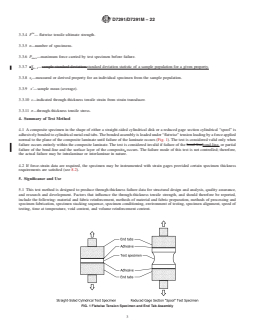
5.1 This test method is designed to produce through-thickness failure data for structural design and analysis, quality assurance, and research and development. Factors that influence the through-thickness tensile strength, and should therefore be reported, include the following: material and fabric reinforcement, methods of material and fabric preparation, methods of processing and specimen fabrication, specimen stacking sequence, specimen conditioning, environment of testing, specimen alignment, speed of testing, time at temperature, void content, and volume reinforcement content.
SCOPE
1.1 This test method determines the through-thickness “flatwise” tensile strength and elastic modulus of fiber reinforced polymer matrix composite materials. A tensile force is applied normal to the plane of the composite laminate using adhesively bonded thick metal end-tabs. The composite material forms are limited to continuous fiber (unidirectional reinforcement or two-dimensional fabric) or discontinuous fiber (nonwoven or chopped) reinforced composites.
1.2 The through-thickness strength results using this test method will in general not be comparable to Test Method D6415 since this method subjects a relatively large volume of material to an almost uniform stress field while Test Method D6415 subjects a small volume of material to a non-uniform stress field.
1.3 Units—The values stated in either SI units or inch-pound units are to be regarded separately as standard. The values stated in each system are not necessarily exact equivalents; therefore, to ensure conformance with the standard, each system shall be used independently of the other, and values from the two systems shall not be combined.
1.3.1 Within the text, the inch-pound units are shown in brackets.
1.4 This standard may involve hazardous materials, operations, and equipment.
1.5 This standard does not purport to address all of the safety concerns, if any, associated with its use. It is the responsibility of the user of this standard to establish appropriate safety, health, and environmental practices and determine the applicability of regulatory limitations prior to use.
1.6 This international standard was developed in accordance with internationally recognized principles on standardization established in the Decision on Principles for the Development of International Standards, Guides and Recommendations issued by the World Trade Organization Technical Barriers to Trade (TBT) Committee.
General Information
- Status
- Published
- Publication Date
- 14-Oct-2022
- Technical Committee
- D30 - Composite Materials
- Drafting Committee
- D30.06 - Interlaminar Properties
Relations
- Effective Date
- 01-Feb-2024
- Effective Date
- 01-Nov-2023
- Effective Date
- 01-Oct-2023
- Effective Date
- 01-Apr-2022
- Effective Date
- 01-Jun-2020
- Effective Date
- 01-May-2020
- Effective Date
- 01-Mar-2020
- Effective Date
- 01-Jan-2020
- Effective Date
- 15-Oct-2019
- Effective Date
- 01-Aug-2019
- Effective Date
- 15-Apr-2019
- Effective Date
- 15-Apr-2019
- Effective Date
- 01-Feb-2019
- Effective Date
- 01-Dec-2018
- Effective Date
- 01-Nov-2018
Overview
ASTM D7291/D7291M-22 is the Standard Test Method for Through-Thickness "Flatwise" Tensile Strength and Elastic Modulus of a Fiber-Reinforced Polymer Matrix Composite Material. Developed by ASTM Committee D30 on Composite Materials, this standard provides a test procedure to reliably determine the out-of-plane (through-thickness) tensile properties of composite materials. The method is vital for structural design and analysis, quality assurance, and research and development of advanced composites, where accurate measurement of material integrity and performance under perpendicular tensile loading is essential.
Key Topics
- Scope of Test Method: Evaluates through-thickness tensile strength and elastic modulus of fiber-reinforced polymer matrix composites, offering data critical for assessing structural integrity.
- Applicable Material Types: Focuses on composites with continuous or discontinuous fiber reinforcements, such as unidirectional, two-dimensional fabric, nonwoven, or chopped fiber forms.
- Test Principles: A tensile force is applied normal to the laminate plane using adhesively bonded, thick metal end-tabs. Specimens are typically cylindrical disks or "spool" shaped to ensure uniform stress distribution.
- Critical Test Factors: Through-thickness properties are influenced by several variables that must be reported, including:
- Material and reinforcement type
- Preparation and processing methods
- Stacking sequence and specimen conditioning
- Testing environment and alignment
- Reinforcement volume and void content
- Units and Consistency: The standard accommodates both SI and inch-pound units, with explicit instructions not to mix unit systems within a single evaluation.
Applications
ASTM D7291/D7291M-22 is widely used across industries that rely on composite materials for lightweight strength and durability. Typical applications include:
- Aerospace Engineering: Certification of composite structural elements, ensuring resistance to through-thickness failures.
- Automotive Manufacturing: Evaluation of composite panels and parts to verify quality and structural reliability in safety-critical areas.
- Wind Energy: Qualification of blade materials and other components subjected to complex loading.
- Marine Construction: Assessment of sandwich panels and hull components for durability under out-of-plane forces.
- Quality Control: Used in production environments to ensure consistent manufacturing quality and material properties.
- Research & Development: Gathering data for new composite systems and validating models for material performance.
Related Standards
ASTM D7291/D7291M-22 is part of a suite of composite material test methods and is complemented by several related ASTM standards, including:
- ASTM D792 - Density and Specific Gravity of Plastics
- ASTM D883 - Terminology Relating to Plastics
- ASTM D2651 - Preparation of Metal Surfaces for Adhesive Bonding
- ASTM D2734 & D3171 - Determination of Void and Constituent Content in Composites
- ASTM D5687/D5687M - Preparation of Flat Composite Panels
- ASTM D6415 - Curved Beam Strength of Fiber-Reinforced Composites
- ASTM E4, E1012 - Force Calibration, Testing Machine and Alignment
Practical Value
Utilizing the ASTM D7291/D7291M-22 standard ensures that manufacturers, engineers, and researchers can:
- Compare material performance using repeatable, standardized procedures.
- Identify manufacturing defects or inconsistencies in composite laminates.
- Obtain reliable data for design optimization and safety assessments.
- Meet supplier and agency requirements for material certification.
- Advance the development of innovative composite materials through rigorous testing.
Proper application of this standard ultimately contributes to safer, lighter, and more reliable composite structures across multiple high-performance industries. For best results, users should ensure strict adherence to sampling, preparation, and reporting requirements as outlined in the standard.
Buy Documents
ASTM D7291/D7291M-22 - Standard Test Method for Through-Thickness “Flatwise” Tensile Strength and Elastic Modulus of a Fiber-Reinforced Polymer Matrix Composite Material
REDLINE ASTM D7291/D7291M-22 - Standard Test Method for Through-Thickness “Flatwise” Tensile Strength and Elastic Modulus of a Fiber-Reinforced Polymer Matrix Composite Material
Get Certified
Connect with accredited certification bodies for this standard

Smithers Quality Assessments
US management systems and product certification.

DIN CERTCO
DIN Group product certification.
Sponsored listings
Frequently Asked Questions
ASTM D7291/D7291M-22 is a standard published by ASTM International. Its full title is "Standard Test Method for Through-Thickness “Flatwise” Tensile Strength and Elastic Modulus of a Fiber-Reinforced Polymer Matrix Composite Material". This standard covers: SIGNIFICANCE AND USE 5.1 This test method is designed to produce through-thickness failure data for structural design and analysis, quality assurance, and research and development. Factors that influence the through-thickness tensile strength, and should therefore be reported, include the following: material and fabric reinforcement, methods of material and fabric preparation, methods of processing and specimen fabrication, specimen stacking sequence, specimen conditioning, environment of testing, specimen alignment, speed of testing, time at temperature, void content, and volume reinforcement content. SCOPE 1.1 This test method determines the through-thickness “flatwise” tensile strength and elastic modulus of fiber reinforced polymer matrix composite materials. A tensile force is applied normal to the plane of the composite laminate using adhesively bonded thick metal end-tabs. The composite material forms are limited to continuous fiber (unidirectional reinforcement or two-dimensional fabric) or discontinuous fiber (nonwoven or chopped) reinforced composites. 1.2 The through-thickness strength results using this test method will in general not be comparable to Test Method D6415 since this method subjects a relatively large volume of material to an almost uniform stress field while Test Method D6415 subjects a small volume of material to a non-uniform stress field. 1.3 Units—The values stated in either SI units or inch-pound units are to be regarded separately as standard. The values stated in each system are not necessarily exact equivalents; therefore, to ensure conformance with the standard, each system shall be used independently of the other, and values from the two systems shall not be combined. 1.3.1 Within the text, the inch-pound units are shown in brackets. 1.4 This standard may involve hazardous materials, operations, and equipment. 1.5 This standard does not purport to address all of the safety concerns, if any, associated with its use. It is the responsibility of the user of this standard to establish appropriate safety, health, and environmental practices and determine the applicability of regulatory limitations prior to use. 1.6 This international standard was developed in accordance with internationally recognized principles on standardization established in the Decision on Principles for the Development of International Standards, Guides and Recommendations issued by the World Trade Organization Technical Barriers to Trade (TBT) Committee.
SIGNIFICANCE AND USE 5.1 This test method is designed to produce through-thickness failure data for structural design and analysis, quality assurance, and research and development. Factors that influence the through-thickness tensile strength, and should therefore be reported, include the following: material and fabric reinforcement, methods of material and fabric preparation, methods of processing and specimen fabrication, specimen stacking sequence, specimen conditioning, environment of testing, specimen alignment, speed of testing, time at temperature, void content, and volume reinforcement content. SCOPE 1.1 This test method determines the through-thickness “flatwise” tensile strength and elastic modulus of fiber reinforced polymer matrix composite materials. A tensile force is applied normal to the plane of the composite laminate using adhesively bonded thick metal end-tabs. The composite material forms are limited to continuous fiber (unidirectional reinforcement or two-dimensional fabric) or discontinuous fiber (nonwoven or chopped) reinforced composites. 1.2 The through-thickness strength results using this test method will in general not be comparable to Test Method D6415 since this method subjects a relatively large volume of material to an almost uniform stress field while Test Method D6415 subjects a small volume of material to a non-uniform stress field. 1.3 Units—The values stated in either SI units or inch-pound units are to be regarded separately as standard. The values stated in each system are not necessarily exact equivalents; therefore, to ensure conformance with the standard, each system shall be used independently of the other, and values from the two systems shall not be combined. 1.3.1 Within the text, the inch-pound units are shown in brackets. 1.4 This standard may involve hazardous materials, operations, and equipment. 1.5 This standard does not purport to address all of the safety concerns, if any, associated with its use. It is the responsibility of the user of this standard to establish appropriate safety, health, and environmental practices and determine the applicability of regulatory limitations prior to use. 1.6 This international standard was developed in accordance with internationally recognized principles on standardization established in the Decision on Principles for the Development of International Standards, Guides and Recommendations issued by the World Trade Organization Technical Barriers to Trade (TBT) Committee.
ASTM D7291/D7291M-22 is classified under the following ICS (International Classification for Standards) categories: 83.120 - Reinforced plastics. The ICS classification helps identify the subject area and facilitates finding related standards.
ASTM D7291/D7291M-22 has the following relationships with other standards: It is inter standard links to ASTM D883-24, ASTM D883-23, ASTM D2734-23, ASTM E456-13a(2022)e1, ASTM E251-20a, ASTM E251-20, ASTM D5229/D5229M-20, ASTM D883-20, ASTM D3878-19a, ASTM D883-19c, ASTM D3878-19, ASTM D883-19a, ASTM D883-19, ASTM D883-18a, ASTM D883-18. Understanding these relationships helps ensure you are using the most current and applicable version of the standard.
ASTM D7291/D7291M-22 is available in PDF format for immediate download after purchase. The document can be added to your cart and obtained through the secure checkout process. Digital delivery ensures instant access to the complete standard document.
Standards Content (Sample)
This international standard was developed in accordance with internationally recognized principles on standardization established in the Decision on Principles for the
Development of International Standards, Guides and Recommendations issued by the World Trade Organization Technical Barriers to Trade (TBT) Committee.
Designation: D7291/D7291M − 22
Standard Test Method for
Through-Thickness “Flatwise” Tensile Strength and Elastic
Modulus of a Fiber-Reinforced Polymer Matrix Composite
Material
This standard is issued under the fixed designation D7291/D7291M; the number immediately following the designation indicates the
year of original adoption or, in the case of revision, the year of last revision. A number in parentheses indicates the year of last
reapproval. A superscript epsilon (´) indicates an editorial change since the last revision or reapproval.
1. Scope Development of International Standards, Guides and Recom-
mendations issued by the World Trade Organization Technical
1.1 Thistestmethoddeterminesthethrough-thickness“flat-
Barriers to Trade (TBT) Committee.
wise” tensile strength and elastic modulus of fiber reinforced
polymer matrix composite materials.Atensile force is applied
2. Referenced Documents
normaltotheplaneofthecompositelaminateusingadhesively
2.1 ASTM Standards:
bondedthickmetalend-tabs.Thecompositematerialformsare
D792Test Methods for Density and Specific Gravity (Rela-
limited to continuous fiber (unidirectional reinforcement or
tive Density) of Plastics by Displacement
two-dimensional fabric) or discontinuous fiber (nonwoven or
D883Terminology Relating to Plastics
chopped) reinforced composites.
D2584Test Method for Ignition Loss of Cured Reinforced
1.2 The through-thickness strength results using this test
Resins
method will in general not be comparable to Test Method
D2651GuideforPreparationofMetalSurfacesforAdhesive
D6415 since this method subjects a relatively large volume of
Bonding
material to an almost uniform stress field while Test Method
D2734TestMethodsforVoidContentofReinforcedPlastics
D6415 subjects a small volume of material to a non-uniform
D3171Test Methods for Constituent Content of Composite
stress field.
Materials
1.3 Units—The values stated in either SI units or inch-
D3878Terminology for Composite Materials
pound units are to be regarded separately as standard. The
D5229/D5229MTestMethodforMoistureAbsorptionProp-
values stated in each system are not necessarily exact equiva-
erties and Equilibrium Conditioning of Polymer Matrix
lents; therefore, to ensure conformance with the standard, each
Composite Materials
system shall be used independently of the other, and values
D5687/D5687MGuide for Preparation of Flat Composite
from the two systems shall not be combined.
Panels with Processing Guidelines for Specimen Prepara-
1.3.1 Within the text, the inch-pound units are shown in
tion
brackets.
D6415 Test Method for Measuring the Curved Beam
Strength of a Fiber-Reinforced Polymer-Matrix Compos-
1.4 This standard may involve hazardous materials,
ite
operations, and equipment.
E4Practices for Force Calibration and Verification of Test-
1.5 This standard does not purport to address all of the
ing Machines
safety concerns, if any, associated with its use. It is the
E6Terminology Relating to Methods of MechanicalTesting
responsibility of the user of this standard to establish appro-
E122PracticeforCalculatingSampleSizetoEstimate,With
priate safety, health, and environmental practices and deter-
Specified Precision, the Average for a Characteristic of a
mine the applicability of regulatory limitations prior to use.
Lot or Process
1.6 This international standard was developed in accor-
E177Practice for Use of the Terms Precision and Bias in
dance with internationally recognized principles on standard-
ASTM Test Methods
ization established in the Decision on Principles for the
E251Test Methods for Performance Characteristics of Me-
tallic Bonded Resistance Strain Gages
This test method is under the jurisdiction of ASTM Committee D30 on
Composite Materials and is the direct responsibility of Subcommittee D30.06 on
Interlaminar Properties. For referenced ASTM standards, visit the ASTM website, www.astm.org, or
Current edition approved Oct. 15, 2022. Published November 2022. Originally contact ASTM Customer Service at service@astm.org. For Annual Book of ASTM
approved in 2007. Last previous edition approved in 2015 as D7291/D7291M–15. Standards volume information, refer to the standard’s Document Summary page on
DOI: 10.1520/D7291_D7291M-22. the ASTM website.
Copyright © ASTM International, 100 Barr Harbor Drive, PO Box C700, West Conshohocken, PA 19428-2959. United States
D7291/D7291M − 22
E456Terminology Relating to Quality and Statistics 3.3.6 P —maximumforcecarriedbytestspecimenbefore
max
E691Practice for Conducting an Interlaboratory Study to failure.
Determine the Precision of a Test Method
3.3.7 S —standard deviation statistic of a sample popula-
n−1
E1012Practice for Verification of Testing Frame and Speci-
tion for a given property.
men Alignment Under Tensile and Compressive Axial
3.3.8 x —measured or derived property for an individual
i
Force Application
specimen from the sample population.
3. Terminology
3.3.9 x¯—sample mean (average).
3.1 Definitions—Terminology D3878 defines terms relating 3.3.10 ε—indicated through-thickness tensile strain from
to high-modulus fibers and their composites. Terminology strain transducer.
D883definestermsrelatingtoplastics.TerminologyE6defines
3.3.11 σ—through-thickness tensile stress.
terms relating to mechanical testing. Terminology E456 and
Practice E177 define terms relating to statistics. In the event of
4. Summary of Test Method
a conflict between terms, Terminology D3878 shall have
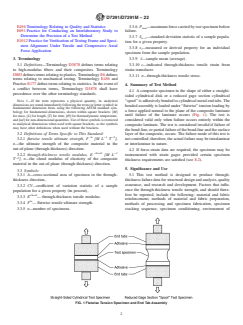
4.1 Acomposite specimen in the shape of either a straight-
precedence over the other terminology standards.
sided cylindrical disk or a reduced gage section cylindrical
NOTE 1—If the term represents a physical quantity, its analytical
“spool”isadhesivelybondedtocylindricalmetalendtabs.The
dimensionsarestatedimmediatelyfollowingtheterm(orlettersymbol)in
bondedassemblyisloadedunder“flatwise”tensionloadingby
fundamental dimension form, using the following ASTM standard sym-
a force applied normal to the plane of the composite laminate
bology for fundamental dimensions, shown within square brackets: [M]
until failure of the laminate occurs (Fig. 1). The test is
formass,[L]forlength,[T]fortime,[Θ]forthermodynamictemperature,
and[nd]fornon-dimensionalquantities.Useofthesesymbolsisrestricted considered valid only when failure occurs entirely within the
to analytical dimensions when used with square brackets, as the symbols
composite laminate. The test is considered invalid if failure of
may have other definitions when used without the brackets.
thebond-line,orpartialfailureofthebond-lineandthesurface
3.2 Definitions of Terms Specific to This Standard: layer of the composite, occurs. The failure mode of this test is
tu −1 −2
3.2.1 flatwise tensile ultimate strength, F [M L T ],
notcontrolled;therefore,theactualfailuremaybeintralaminar
n—the ultimate strength of the composite material in the or interlaminar in nature.
out-of-plane (through-thickness) direction.
4.2 If force-strain data are required, the specimen may be
chord −1
3.2.2 through-thickness tensile modulus, E [M L
instrumented with strain gages provided certain specimen
−2
T ], n—the chord modulus of elasticity of the composite
thickness requirements are satisfied (see 8.2).
material in the out-of-plane (through-thickness) direction.
5. Significance and Use
3.3 Symbols:
3.3.1 A—cross-sectional area of specimen in the through- 5.1 This test method is designed to produce through-
thickness direction, thicknessfailuredataforstructuraldesignandanalysis,quality
assurance, and research and development. Factors that influ-
3.3.2 CV—coefficient of variation statistic of a sample
ence the through-thickness tensile strength, and should there-
population for a given property (in percent),
fore be reported, include the following: material and fabric
chord
3.3.3 E — through-thickness tensile modulus.
reinforcement, methods of material and fabric preparation,
tu
3.3.4 F — flatwise tensile ultimate strength.
methods of processing and specimen fabrication, specimen
3.3.5 n—number of specimens. stacking sequence, specimen conditioning, environment of
FIG. 1 Flatwise Tension Specimen and End Tab Assembly
D7291/D7291M − 22
testing, specimen alignment, speed of testing, time at 7. Apparatus
temperature, void content, and volume reinforcement content.
7.1 Micrometers and Calipers—A micrometer witha4to
8mm[0.16to0.32in.]nominaldiameterball-interfaceoraflat
6. Interferences
anvil interface shall be used to measure the specimen thick-
6.1 Material and Specimen Preparation—Poormaterialfab-
ness. A ball interface is recommended for thickness measure-
ricationpractices,lackofcontroloffiberalignment,voids,and
ments when at least one surface is irregular (for example, a
damage induced by improper specimen machining are known
coarse peel ply surface which is neither smooth nor flat). A
causesofhighmaterialdatascatterincompositesingeneral.In
micrometer or caliper with a flat anvil interface shall be used
addition,surfacefinishofthecylindricalmachinedsurfaceand
for measuring length, width, and other machined surface
lack of control of parallelism of laminate surfaces can lead to
dimensions. The use of alternative measurement devices is
erroneous through-thickness strength results. Laminate stack-
permitted if specified (or agreed to) by the test requestor and
ing sequences that are not balanced and symmetric could lead
reported by the testing laboratory. The accuracy of the instru-
to adhesive bondline failures.
ment(s) shall be suitable for reading to within 1% of the
specimen dimensions. For typical specimen geometries, an
6.2 Material with Coarse Structure—This test method as-
instrument with an accuracy of 60.0025mm [60.0001in.] is
sumes that the material is relatively homogeneous with respect
adequateforthicknessmeasurements,whileaninstrumentwith
to the size of the test section. Certain fabric and braided
an accuracy of 60.025mm [60.001in.] is adequate for
composites with large repeating unit cell sizes (>12mm
measurement of length, width, other machined surface dimen-
[0.5in.]) should not be tested with this specimen size. It may
sions.
be possible to scale-up the specimen size and fixtures to
accommodate such materials, but this is beyond the scope of
7.2 Fixtures—The apparatus consists of three different fix-
this test method.
tures.
6.3 Load Eccentricity—Bending of the specimen during
7.2.1 Theloadingfixturesareusedtoloadthespecimenand
loading can occur, affecting strength results. Bending may
endtabassembly.Theycanbeeitherself-aligningorfixedgrip
occur due to poor specimen preparation, non-parallel laminate
and shall not apply eccentric loads.
surfaces, improper bonding of the specimen to the end tabs, or
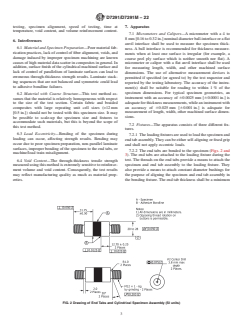
7.2.2 The end tabs are bonded to the specimen (Figs. 2 and
machine/load train misalignment.
3). The end tabs are attached to the loading fixture during the
test. The threads on the end tabs provide a means to attach the
6.4 Void Content—The through-thickness tensile strength
specimen and end tab assembly to the loading fixture. They
measuredusingthismethodisextremelysensitivetoreinforce-
ment volume and void content. Consequently, the test results also provide a means to attach constant diameter bushings for
the purpose of aligning the specimen and end tab assembly in
may reflect manufacturing quality as much as material prop-
erties. the bonding fixture.The end tab thickness shall be a minimum
FIG. 2 Drawing of End Tabs and Cylindrical Specimen Assembly (SI units)
D7291/D7291M − 22
FIG. 3 Drawing of End Tabs and Cylindrical Specimen Assembly (inch-pound units)
of 12.7 mm [0.5 in.]. Subsection 8.3 provides further require- 7.3 Testing Machine—The testing machine shall conform
ments for the end tabs. with Practice E4, and shall satisfy these requirements:
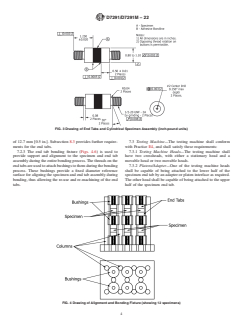
7.2.3 The end tab bonding fixture (Figs. 4-6) is used to 7.3.1 Testing Machine Heads—The testing machine shall
provide support and alignment to the specimen and end tab have two crossheads, with either a stationary head and a
assemblyduringtheentirebondingprocess.Thethreadsonthe movable head or two movable heads.
endtabsareusedtoattachbushingstothemduringthebonding 7.3.2 Platens/Adapter—One of the testing machine heads
process. These bushings provide a fixed diameter reference shall be capable of being attached to the lower half of the
surface for aligning the specimen and end tab assembly during specimen end tab by an adapter or platen interface as required.
bonding, thus allowing the re-use and re-machining of the end The other head shall be capable of being attached to the upper
tabs. half of the specimen end tab.
FIG. 4 Drawing of Alignment and Bonding Fixture (showing 12 specimens)
D7291/D7291M − 22
FIG. 5 Drawing of Alignment and Bonding Fixture (SI units)
FIG. 6 Drawing of Alignment and Bonding Fixture (inch-pound units)
7.3.3 Drive Mechanism—The testing machine drive mecha- 7.5 Strain-Indicating Device—For the measurement of
nism shall be capable of imparting to the movable head a through-thickness modulus, bonded resistance strain gages
controlled velocity with respect to the stationary head. The shall be used to measure strain. Either two strain gages at
velocity of the movable head shall be capable of regulation as locationsthatare180degreesapartorthreestraingagesat120
specified in 11.3. degrees apart are required around the cylindrical surface of the
7.3.4 Force Indicator—The testing machine force-sensing specimen at the center of the gage section.
device shall be capable of indicating the total force applied to 7.5.1 Bonded Resistance Strain Gages—Strain gage selec-
the test specimen. This device shall be essentially free from tion is a compromise based on the type of material.An active
response lag at the specified testing rate and shall indicate the gage length of 1.5 mm [0.062 in.] is recommended for most
force with an accuracy over the load range(s) of interest of materials,althoughlargergagesmaybemoresuitableforsome
within 61% of the indicated value, as specified by Practice woven fabrics (with consolidated tow thicknesses larger than
E4.Theloadrange(s)ofinterestmaybefairlylowformodulus 1.5 mm [0.062 in.]), provided the specimen gage length can
evaluation, much higher for strength evaluation, or both, as accommodatesuchgages(asspecifiedin8.2).Gagecalibration
required. certification shall comply with Test Method E251. For lami-
nated composites, the strain gage should cover a minimum of
7.4 Force versus Displacement Record—An X-Yplotter, or
three laminate plies.
similardevice,shallbeusedtomakeapermanentrecordofthe
force versus displacement during the test. Alternatively, the 7.6 System Alignment—Poor system alignment can be a
data may be stored digitally and post-processed. major contributor to premature failure, to elastic property data
D7291/D7291M − 22
scatter, or both. Practice E1012 describes bending evaluation specimens, such as in the case of a designed experiment. For
guidelines and describes potential sources of misalignment statisticallysignificantdata,theproceduresoutlinedinPractice
during tensile testing. Alignment should be checked using a
E122 should be consulted. The method of sampling shall be
cylindrical metal specimen with a minimum of three strain
reported.
gages equally spaced around the circumference per Practice
8.2 Geometry—The coupons are cylindrical with either a
E1012. While the maximum advisable amount of system
constant cross-sectional area (Figs. 2 and 3) or a reduced gage
misalignment is material and location dependent, good testing
section (Figs. 7 and 8). The nominal diameter where the
practiceisgenerallyabletolimitpercentbendingtowithin5%
specimen is bonded to the metal end tabs, for both specimen
at moderate strain levels (>1000 µε). A system showing
types, is 25mm [1.0in.]. However, this diameter can be in the
excessive bending for the given application should be re-
range of 20 to 28 mm [0.8 to 1.1 in.] to allow the re-use and
adjusted or modified.
re-machining of the end tabs. For through-thickness failure
7.7 Conditioning Chamber—When conditioning materials
stress measurement, the minimum specimen thickness shall be
at non-laboratory environments, a temperature-level/vapor-
2.5mm [0.1in.]. For the measurement of through-thickness
level controlled environmental conditioning chamber is re-
strainsandmodulus,theminimumspecimenthicknessshallbe
quiredthatshallbecapableofmaintainingtherequiredrelative
6mm [0.25in.]. The reduced gage section geometry is often
temperature to within 63°C [65°F] and the required relative
used for materials that have a through-thickness strength that
vapor level to within 63%. Chamber conditions shall be
approaches the bond strength of the adhesive. This is also the
monitored either on an automated continuous basis or on a
preferred geometry for laminates that are at least 25mm
manual basis at regular intervals.
[1.00in.] thick.
7.8 Environmental Test Chamber—An environmental test
8.3 Use of End-Tabs—Tabs are required. The key factor in
chamber is required for test environments other than ambient
the selection of specimen tolerances and gripping methods is
testing laboratory conditions.This chamber shall be capable of
the successful introduction of load in the specimen and the
maintaining the test specimen and fixture at the required test
prevention of premature failure due to misalignment. It is of
environment during the mechanical test. The test temperature
primary importance that the bonding surfaces and threaded
shall be maintained within 63°C [65°F] of the required
temperature, and, if specified by the requestor, the relative sections are perpendicular to minimize misalignment of the
composite coupon and end-tab assembly. An additional con-
humidity level shall be maintained to within 63%RHofthe
required humidity level. In addition, the chamber may have to sideration is the thermal residual stress caused by the signifi-
be capable of maintaining environmental conditions such as cant difference between the laminate in-plane coefficient of
fluid exposure during the test (see 11.4). thermal expansion (CTE) and the metal end tab CTE. This is
especially important during end tab bonding, as well as during
8. Sampling and Test Specimens
non-ambient testing. The end tab bonding surfaces shall be
machined to the surface finish recommended by the adhesive
8.1 Sampling—Test at least five specimens per test condi-
tionunlessvalidresultscanbegainedthroughtheuseoffewer manufacturer.
FIG. 7 Drawing of End Tabs and “Spool” Specimen Assembly (SI units)
D7291/D7291M − 22
FIG. 8 Drawing of End Tabs and “Spool” Specimen Assembly (inch-pound units)
8.3.1 End-Tab Geometry—The end-tab geometry is shown specimens also needs to be considered.Auniform bond line of
in Figs. 2 and 3. For alignment purposes, it is essential that the minimum thickness is desirable to reduce undesirable stresses
tab surfaces be parallel. in the assembly.
8.3.2 End-Tab Material—The most commonly used materi-
8.6 Specimen Bonding—Prior to bonding, the composite
als are Titanium (Ti-6Al-4V) and Steel. The end tab material
coupons shall be dried and the bonding surfaces wiped with a
should be selected appropriately for environmentally condi-
suitable cleaning solvent that will not chemically or physically
tioned testing such that the conditioning does not chemically
affect the surfaces. Cleaned surfaces shall not be touched with
affect the end tabs. Aluminum is not recommended for most
the skin following cleaning. Consult Guide D2651. Apply the
graphite composite materials since the low modulus ofAlumi-
adhesive to the bonding surfaces of both end tabs and both
numleadstoexcessivedeformationsintheendtabsatthebond
sides of the composite specimen and place in a suitable
line leading to premature bond failures.
bonding fixture. The bonding fixture shall be designed to
provide support and alignment to the assembly during the
8.4 Specimen Preparation—Panels shall be fabricated and
entire bonding process. Figs. 4-6 provide drawings of a
machined according to Guide D5687/D5687M. Panels with a
suggested fixture. Care must be taken to ensure that the
balanced and symmetric cross-ply or quasi-isotropic stacking
composite coupon will not move during the bonding process.
sequencearepreferred.Thedimensionsofthespecimenblanks
Cure the adhesive to the manufacturer’s suggested cure cycle
shall be large enough to ensure that no damaged material
so long as this does not physically or chemically alter the
remains after final sample preparation. Prior to bonding, the
composite. Label the coupon and end tabs assembly for
parallelism and flatness of the sample surfaces shall be
traceability of the coupon back to the raw material.
checked. Surface machining is not desirable, but grinding on
oneorbothsurfacesispermissibleincaseswhereitisrequired
NOTE2—Ifenvironmentalconditioningofthetestmaterialisconducted
to achieve the desired alignment.
prior to bonding of end tabs, the effect of the bonding conditions on the
test material condition must be considered. For example, elevated tem-
8.5 Adhesive—Any high-elongation (tough) adhesive sys-
perature cure of a tabbing adhesive will result in a loss of moisture from
tem that maintains a complete bond between the end tabs and
humidity conditioned test material. In addition, environmental exposures
the specimen up to failure of the composite may be used, such as humidity conditioning, salt fog exposure, and fluid soaks will
affect the ability of tabbing adhesive to adhere to the test material.
provided it does not influence the specimen behavior by
physicallyorchemicallyalteringthecomposite.Strengthofthe 8.7 Machining—After bonding, the composite specimen
adhesive and flow characteristics during the cure cycle are two andendtabassemblymustbemachinedtoobtainthespecified
of the important adhesive properties that must be considered
concentricity. Low stress grinding or turning techniques com-
when selecting an adhesive. Suitability of the adhesive to the bined with the use of water as a coolant are the preferred
anticipated test conditions and to any pre-conditioning of the method of machining. The machining process shall produce a
D7291/D7291M − 22
smoothsurface(betterthan0.8µm[32µin.]),freeofnicksand 10.3 If no explicit conditioning process is performed, the
irregularities such as undercuts. The coolant used in the specimen conditioning process shall be reported as “uncondi-
grinding or turning process, if water is not used, must not tioned” and the moisture content as “unknown.”
adversely affect the material. Specimens should be dried prior
totestingtoremoveanymoistureabsorbedduringthemachin-
11. Procedure
ing process. The end tabs can be re-used until their diameter
11.1 Parameters to be Specified Prior to Test:
after machining is 20 mm [0.
...
This document is not an ASTM standard and is intended only to provide the user of an ASTM standard an indication of what changes have been made to the previous version. Because
it may not be technically possible to adequately depict all changes accurately, ASTM recommends that users consult prior editions as appropriate. In all cases only the current version
of the standard as published by ASTM is to be considered the official document.
Designation: D7291/D7291M − 15 D7291/D7291M − 22
Standard Test Method for
Through-Thickness “Flatwise” Tensile Strength and Elastic
Modulus of a Fiber-Reinforced Polymer Matrix Composite
Material
This standard is issued under the fixed designation D7291/D7291M; the number immediately following the designation indicates the
year of original adoption or, in the case of revision, the year of last revision. A number in parentheses indicates the year of last
reapproval. A superscript epsilon (´) indicates an editorial change since the last revision or reapproval.
1. Scope
1.1 This test method determines the through-thickness “flatwise” tensiontensile strength and elastic modulus of fiber reinforced
polymer matrix composite materials. A tensile force is applied normal to the plane of the composite laminate using adhesively
bonded thick metal end-tabs. The composite material forms are limited to continuous-fiber or discontinuous fiber (tape or
2-dimensional fabric, or both) continuous fiber (unidirectional reinforcement or two-dimensional fabric) or discontinuous fiber
(nonwoven or chopped) reinforced composites.
1.2 The through-thickness strength results using this test method will in general not be comparable to Test Method D6415 since
this method subjects a relatively large volume of material to an almost uniform stress field while Test Method D6415 subjects a
small volume of material to a non-uniform stress field.
1.3 Units—The values stated in either SI units or inch-pound units are to be regarded separately as standard. Within the text, the
inch-pound units are shown in brackets. The values stated in each system are not necessarily exact equivalents; therefore, to ensure
conformance with the standard, each system mustshall be used independently of the other. Combiningother, and values from the
two systems may result in nonconformance with the standard.shall not be combined.
1.3.1 Within the text, the inch-pound units are shown in brackets.
1.4 This standard may involve hazardous materials, operations, and equipment.
1.5 This standard does not purport to address all of the safety problems,concerns, if any, associated with its use. It is the
responsibility of the user of this standard to establish appropriate safety safety, health, and healthenvironmental practices and
determine the applicability of regulatory limitations prior to use.
1.6 This international standard was developed in accordance with internationally recognized principles on standardization
established in the Decision on Principles for the Development of International Standards, Guides and Recommendations issued
by the World Trade Organization Technical Barriers to Trade (TBT) Committee.
This test method is under the jurisdiction of ASTM Committee D30 on Composite Materials and is the direct responsibility of Subcommittee D30.06 on Interlaminar
Properties.
Current edition approved Oct. 1, 2015Oct. 15, 2022. Published November 2015November 2022. Originally approved in 2007. Last previous edition approved in 20072015
as D7291/D7291MD7291/D7291M – 15.-07. DOI: 10.1520/D7291_D7291M-15.10.1520/D7291_D7291M-22.
Copyright © ASTM International, 100 Barr Harbor Drive, PO Box C700, West Conshohocken, PA 19428-2959. United States
D7291/D7291M − 22
2. Referenced Documents
2.1 ASTM Standards:
D792 Test Methods for Density and Specific Gravity (Relative Density) of Plastics by Displacement
D883 Terminology Relating to Plastics
D2584 Test Method for Ignition Loss of Cured Reinforced Resins
D2651 Guide for Preparation of Metal Surfaces for Adhesive Bonding
D2734 Test Methods for Void Content of Reinforced Plastics
D3171 Test Methods for Constituent Content of Composite Materials
D3878 Terminology for Composite Materials
D5229/D5229M Test Method for Moisture Absorption Properties and Equilibrium Conditioning of Polymer Matrix Composite
Materials
D5687/D5687M Guide for Preparation of Flat Composite Panels with Processing Guidelines for Specimen Preparation
D6415 Test Method for Measuring the Curved Beam Strength of a Fiber-Reinforced Polymer-Matrix Composite
E4 Practices for Force Calibration and Verification of Testing Machines
E6 Terminology Relating to Methods of Mechanical Testing
E122 Practice for Calculating Sample Size to Estimate, With Specified Precision, the Average for a Characteristic of a Lot or
Process
E177 Practice for Use of the Terms Precision and Bias in ASTM Test Methods
E251 Test Methods for Performance Characteristics of Metallic Bonded Resistance Strain Gages
E456 Terminology Relating to Quality and Statistics
E691 Practice for Conducting an Interlaboratory Study to Determine the Precision of a Test Method
E1012 Practice for Verification of Testing Frame and Specimen Alignment Under Tensile and Compressive Axial Force
Application
E1309 Guide for Identification of Fiber-Reinforced Polymer-Matrix Composite Materials in Databases (Withdrawn 2015)
E1434 Guide for Recording Mechanical Test Data of Fiber-Reinforced Composite Materials in Databases (Withdrawn 2015)
E1471 Guide for Identification of Fibers, Fillers, and Core Materials in Computerized Material Property Databases (Withdrawn
2015)
3. Terminology
3.1 Definitions—Terminology D3878 defines terms relating to high-modulus fibers and their composites. Terminology D883
defines terms relating to plastics. Terminology E6 defines terms relating to mechanical testing. Terminology E456 and Practice
E177 define terms relating to statistics. In the event of a conflict between terms, Terminology D3878 shall have precedence over
the other terminologies.terminology standards.
NOTE 1—If the term represents a physical quantity, its analytical dimensions are stated immediately following the term (or letter symbol) in fundamental
dimension form, using the following ASTM standard symbology for fundamental dimensions, shown within square brackets: [M][M] for mass, [L][L]
for length, [T][T] for time, [Θ][Θ] for thermodynamic temperature, and [nd][nd] for non-dimensional quantities. Use of these symbols is restricted to
analytical dimensions when used with square brackets, as the symbols may have other definitions when used without the brackets.
3.2 Definitions of Terms Specific to This Standard:
tu −1 −2
3.2.1 flatwise tensile ultimate strength, F [M L T ] , ], n—the ultimate strength of the composite material in the out-of-plane
(through-thickness) direction.
chord −1 −2
3.2.2 through-thickness tensile modulus, E [M L T ] , ], n—the chord modulus of elasticity of the composite material in
the out-of-plane (through-thickness) direction.
3.3 Symbols:
3.3.1 A—cross-sectional area of specimen in the through-thickness direction,
3.3.2 CV—coefficient of variation statistic of a sample population for a given property (in percent),
chord
3.3.3 E — through-thickness tensile modulus.
For referenced ASTM standards, visit the ASTM website, www.astm.org, or contact ASTM Customer Service at service@astm.org. For Annual Book of ASTM Standards
volume information, refer to the standard’s Document Summary page on the ASTM website.
D7291/D7291M − 22
tu
3.3.4 F — flatwise tensile ultimate strength.
3.3.5 n—number of specimens.
3.3.6 P —maximum force carried by test specimen before failure.
max
3.3.7 sS —sample standard deviation.standard deviation statistic of a sample population for a given property.
n−1
3.3.8 x —measured or derived property for an individual specimen from the sample population.
i
3.3.9 x¯—sample mean (average).
3.3.10 ε—indicated through-thickness tensile strain from strain transducer.
3.3.11 σ—through-thickness tensile stress.
4. Summary of Test Method
4.1 A composite specimen in the shape of either a straight-sided cylindrical disk or a reduced gage section cylindrical “spool” is
adhesively bonded to cylindrical metal end tabs. The bonded assembly is loaded under “flatwise” tension loading by a force applied
normal to the plane of the composite laminate until failure of the laminate occurs (Fig. 1). The test is considered valid only when
failure occurs entirely within the composite laminate. The test is considered invalid if failure of the bond-linebond-line, or partial
failure of the bond-line and the surface layer of the composite, occurs. The failure mode of this test is not controlled; therefore,
the actual failure may be intralaminar or interlaminar in nature.
4.2 If force-strain data are required, the specimen may be instrumented with strain gages provided certain specimen thickness
requirements are satisfied (see 8.2).
5. Significance and Use
5.1 This test method is designed to produce through-thickness failure data for structural design and analysis, quality assurance,
and research and development. Factors that influence the through-thickness tensile strength, and should therefore be reported,
include the following: material and fabric reinforcement, methods of material and fabric preparation, methods of processing and
specimen fabrication, specimen stacking sequence, specimen conditioning, environment of testing, specimen alignment, speed of
testing, time at temperature, void content, and volume reinforcement content.
FIG. 1 Flatwise Tension Specimen and End Tab Assembly
D7291/D7291M − 22
6. Interferences
6.1 Material and Specimen Preparation—Poor material fabrication practices, lack of control of fiber alignment, voids, and damage
induced by improper specimen machining are known causes of high material data scatter in composites in general. In addition,
surface finish of the cylindrical machined surface and lack of control of parallelism of laminate surfaces can lead to erroneous
through-thickness strength results. Laminate stacking sequences that are not balanced and symmetric could lead to adhesive
bondline failures.
6.2 Material with Coarse Structure—This test method assumes that the material is relatively homogeneous with respect to the size
of the test section. Certain fabric and braided composites with large repeating unit cell sizes (>12 mm [0.5 in.]) (>12 mm [0.5 in.])
should not be tested with this specimen size. It may be possible to scale-up the specimen size and fixtures to accommodate such
materials, but this is beyond the scope of this test method.
6.3 Load Eccentricity—Bending of the specimen during loading can occur, affecting strength results. Bending may occur due to
poor specimen preparation, non-parallel laminate surfaces, improper bonding of the specimen to the end tabs, or machine/load train
misalignment.
6.4 Void content—Content—The through-thickness tensiontensile strength measured using this method is extremely sensitive to
reinforcement volume and void content. Consequently, the test results may reflect manufacturing quality as much as material
properties.
7. Apparatus
7.1 Micrometers—Micrometers and Calipers—The micrometer(s) shall use A micrometer with a 4 to 6 mm 8 mm [0.16 to 0.25
in.] diameter ball-interface on irregular surfaces such as the bag-side of a laminate, and 0.32 in.] nominal diameter ball-interface
or a flat anvil interface shall be used to measure the specimen thickness. A ball interface is recommended for thickness
measurements when at least one surface is irregular (for example, a coarse peel ply surface which is neither smooth nor flat). A
micrometer or caliper with a flat anvil interface on machined or very-smooth tooled surfaces. The shall be used for measuring
length, width, and other machined surface dimensions. The use of alternative measurement devices is permitted if specified (or
agreed to) by the test requestor and reported by the testing laboratory. The accuracy of the instrument(s) shall be suitable for
reading to within 1 % of the sample diameter and thickness. specimen dimensions. For typical specimen geometries, an instrument
with an accuracy of 625 μm [60.001 in.] is desirable for both diameter and thickness measurements.60.0025 mm [60.0001 in.]
is adequate for thickness measurements, while an instrument with an accuracy of 60.025 mm [60.001 in.] is adequate for
measurement of length, width, other machined surface dimensions.
7.2 Fixtures—The apparatus consists of three different fixtures.
7.2.1 The loading fixtures are used to load the specimen and end tab assembly. They can be either self-aligning or fixed grip and
shall not apply eccentric loads.
7.2.2 The end tabs are bonded to the specimen (Figs. 2 and 3). The end tabs are attached to the loading fixture during the test.
The threads on the end tabs provide a means to attach the specimen and end tab assembly to the loading fixture. They also provide
a means to attach constant diameter bushings for the purpose of aligning the specimen and end tab assembly in the bonding fixture.
The end tab thickness shall be a minimum of 12.7 mm [0.5 in.]. SectionSubsection 8.3 provides further requirements for the end
tabs.
7.2.3 The end tab bonding fixture (Figs. 4-6) is used to provide support and alignment to the specimen and end tab assembly during
the entire bonding process. The threads on the end tabs are used to attach bushings to them during the bonding process. These
bushings provide a fixed diameter reference surface for aligning the specimen and end tab assembly during bonding, thus allowing
the resusere-use and re-machining of the end tabs.
7.3 Testing Machine—The testing machine shall conform with Practice E4, and shall satisfy these requirements:
7.3.1 Testing Machine Heads—The testing machine shall have two crossheads, with either a stationary head and a movable head
or two movable heads.
D7291/D7291M − 22
FIG. 2 Drawing of End Tabs and Cylindrical Specimen Assembly (SI units)
FIG. 3 Drawing of End Tabs and Cylindrical Specimen Assembly (inch-pound units)
7.3.2 Platens/Adapter—One of the testing machine heads shall be capable of being attached to the lower half of the specimen end
tab by an adapter or platen interface as required. The other head shall be capable of being attached to the upper half of the specimen
end tab.
7.3.3 Drive Mechanism—The testing machine drive mechanism shall be capable of imparting to the movable head a controlled
velocity with respect to the stationary head. The velocity of the movable head shall be capable of regulation as specified in 11.3.
7.3.4 Force Indicator—The testing machine force-sensing device shall be capable of indicating the total force applied to the test
specimen. This device shall be essentially free from response lag at the specified testing rate and shall indicate the force with an
D7291/D7291M − 22
FIG. 4 Drawing of Alignment and Bonding Fixture (showing 12 specimens)
FIG. 5 Drawing of Alignment and Bonding Fixture (SI units)
accuracy over the load range(s) of interest of within 61 % of the indicated value, as specified by Practice E4. The load range(s)
of interest may be fairly low for modulus evaluation, much higher for strength evaluation, or both, as required.
7.4 Force versus Displacement Record—An X-Y plotter, or similar device, shall be used to make a permanent record of the force
versus displacement during the test. Alternatively, the data may be stored digitally and post-processed.
7.5 Strain-Indicating Device—For the measurement of through-thickness modulus, bonded resistance strain gages shall be used
to measure strain. Either two strain gages at locations that are 180 degrees apart or three strain gages at 120 degrees apart are
required around the cylindrical surface of the specimen at the center of the gage section.
7.5.1 Bonded Resistance Strain Gages—Strain gage selection is a compromise based on the type of material. An active gage length
of 1.5 mm [0.062 in.] is recommended for most materials, although larger gages may be more suitable for some woven fabrics
(with consolidated tow thicknesses larger than 1.5 mm [0.062 in.]), provided the specimen gage length can accommodate such
D7291/D7291M − 22
FIG. 6 Drawing of Alignment and Bonding Fixture (inch-pound units)
gages (as specified in 8.2). Gage calibration certification shall comply with Test Method E251. For laminated composites, the strain
gage should cover a minimum of three laminate plies.
7.6 System Alignment—Poor system alignment can be a major contributor to premature failure, to elastic property data scatter, or
both. Practice E1012 describes bending evaluation guidelines and describes potential sources of misalignment during tensile
testing. Alignment should be checked using a cylindrical metal specimen with a minimum of three strain gages equally spaced
around the circumference per Practice E1012. While the maximum advisable amount of system misalignment is material and
location dependent, good testing practice is generally able to limit percent bending to within 5 % at moderate strain levels (>1000
με). A system showing excessive bending for the given application should be re-adjusted or modified.
7.7 Conditioning Chamber—When conditioning materials in other than ambient laboratory at non-laboratory environments, a
temperature/vapor-leveltemperature-level/vapor-level controlled environmental conditioning chamber is required,required that
shall be capable of maintaining the required relative temperature to within 63°C [65°F] and the required relative vapor level to
within 63 %. Chamber conditions shall be monitored either on an automated continuous basis or on a manual basis at regular
intervals.
7.8 Environmental Test Chamber—An environmental test chamber is required for test environments other than ambient testing
laboratory conditions. This chamber shall be capable of maintaining the gage section of the test specimen within 63°C [65°F]
of test specimen and fixture at the required test temperatureenvironment during the mechanical test. The test temperature shall be
maintained within 63 °C [65 °F] of the required temperature, and, if specified by the requestor, the relative humidity level shall
be maintained to within 63 % RH of the required humidity level. In addition, the chamber may have to be capable of maintaining
environmental conditions such as fluid exposure or relative humidity during the test (see 11.4).
8. Sampling and Test Specimens
8.1 Sampling—Test at least five specimens per test condition unless valid results can be gained through the use of fewer specimens,
E122
such as in the case of a designed experiment. Consult For statistically significant data, the procedures outlined in Practice
to determine statistically appropriate sample sizes. should be consulted. The method of sampling shall be reported.
8.2 Geometry—The coupons are cylindrical with either a constant cross-sectional area (Figs. 2 and 3) or a reduced gage section
(Figs. 7 and 8). The nominal diameter where the specimen is bonded to the metal end tabs, for both specimen types, is 25 mm [1.0
in.]. 25 mm [1.0 in.]. However, this diameter can be in the range of 20 to 28 mm [0.8 to 1.1 in.] to allow the re-use and
re-machining of the end tabs. For through-thickness failure stress measurement, the minimum specimen thickness shall be 2.5 mm
[0.1 in.]. 2.5 mm [0.1 in.]. For the measurement of through-thickness strains and modulus, the minimum specimen thickness shall
be 6 mm [0.25 in.]. 6 mm [0.25 in.]. The reduced gage section geometry is often used for materials that have a through-thickness
strength that approaches the bond strength of the adhesive. This is also the preferred geometry for laminates that are at least 25
mm [1.00 in.] 25 mm [1.00 in.] thick.
D7291/D7291M − 22
FIG. 7 Drawing of End Tabs and “Spool” Specimen Assembly (SI units)
FIG. 8 Drawing of End Tabs and “Spool” Specimen Assembly (inch-pound units)
8.3 Use of End-Tabs—Tabs are required. The key factor in the selection of specimen tolerances and gripping methods is the
successful introduction of load in the specimen and the prevention of premature failure due to misalignment. It is of primary
importance that the bonding surfaces and threaded sections are perpendicular to minimize misalignment of the composite coupon
and end-tab assembly. An additional consideration is the thermal residual stress caused by the significant difference between the
laminate in-plane coefficient of thermal expansion (CTE) and the metal end tab CTE. This is especially important during end tab
bonding, as well as during non-ambient testing. The end tab bonding surfaces shall be machined to the surface finish recommended
by the adhesive manufacturer.
8.3.1 End-Tab Geometry—The end-tab geometry is shown in Figs. 2 and 3. For alignment purposes, it is essential that the tab
surfaces be parallel.
D7291/D7291M − 22
8.3.2 End-Tab Material—The most commonly used materials are Titanium (Ti-6Al-4V) and Steel. The end tab material should be
selected appropriately for environmentally conditioned testing such that the conditioning does not chemically affect the end tabs.
Aluminum is not recommended for most graphite composite materials since the low modulus of Aluminum leads to excessive
deformations in the end tabs at the bond line leading to premature bond failures.
8.4 Specimen Preparation—Panels shall be fabricated and machined according to Guide D5687/D5687M. Panels with a balanced
and symmetric cross-ply or quasi-isotropic stacking sequence are preferred. The dimensions of the specimen blanks shall be large
enough to ensure that no damaged material remains after final sample preparation. Prior to bonding, the parallelism and flatness
of the sample surfaces shall be checked. Surface machining is not desirable, but grinding on one or both surfaces is permissible
in cases where it is required to achieve the desired alignment.
8.5 Adhesive—Any high-elongation (tough) adhesive system that maintains a complete bond between the end tabs and the
specimen up to failure of the composite may be used, provided it does not influence the specimen behavior by physically or
chemically altering the composite. Strength of the adhesive and flow characteristics during the cure cycle are two of the important
adhesive properties that must be considered when selecting an adhesive. Suitability of the adhesive to the anticipated test
conditions and to any pre-conditioning of the specimens also needs to be considered. A uniform bond line of minimum thickness
is desirable to reduce undesirable stresses in the assembly.
8.6 Specimen Bonding—Prior to bonding, the composite coupons shall be dried and the bonding surfaces wiped with a suitable
cleaning solvent that will not chemically or physically affect the surfaces. Cleaned surfaces shall not be touched with the skin
following cleaning. Consult Guide D2651. Apply the adhesive to the bonding surfaces of both end tabs and both sides of the
composite specimen and place in a suitable bonding fixture. The bonding fixture shall be designed to provide support and alignment
to the assembly during the entire bonding process. Figs. 4-6 provide drawings of a suggested fixture. Care must be taken to ensure
that the composite coupon will not move during the bonding process. Cure the adhesive to the manufacturer’s suggested cure cycle
so long as this does not physically or chemically alter the composite. Label the coupon and end tabs assembly for traceability of
the coupon back to the raw material.
NOTE 2—If environmental conditioning of the test material is conducted prior to bonding of end tabs, the effect of the bonding conditions on the test
material condition must be considered. For example, elevated temperature cure of a tabbing adhesive will result in a loss of moisture from humidity
conditioned test material. In addition, environmental exposures such as humidity conditioning, salt fog exposure, and fluid soaks will affect the ability
of tabbing adhesive to adhere to the test material.
8.7 Machining—After bonding, the composite specimen and end tab assembly must be machined to obtain the specified
concentricity. Low stress grinding or turning techniques combined with the use of water as a coolant are the preferred method of
machining. The machining process shall produce a smooth surface (better than 0.8 μm [32 μin.]), free of nicks and irregularities
such as undercuts. The coolant used in the grinding or turning process, if water is not used, must not adversely affect the material.
Specimens should be dried prior to testing to remove any moisture absorbed during the machining process. The end tabs can be
re-used until their diameter after machining is 20 mm [0.8 in.].
8.8 Re-use of End-Tabs—The end-tabs may be reusedre-used and remachinedre-machined as long as the geometry requirements
for the end-tabs specified in Section 8.2 are met. Before reuse,re-use, the bonded specimens and adhesive need to be removed using
an appropriate procedure. One such procedure is to heat the bonded specimen and end-tab assembly for an hour above the glass
transition temperature of the adhesive. After specimen removal, the end-tab bonding surface can be grit-blast and cleaned using
a suitable solvent.
8.9 Void Content and Fiber Volume—Through-thickness tensiontensile strength is very sensitive to void content and fiber volum
...
Questions, Comments and Discussion
Ask us and Technical Secretary will try to provide an answer. You can facilitate discussion about the standard in here.
Loading comments...