

ASTM D546-17
(Test Method)Standard Test Method for Sieve Analysis of Mineral Filler for Asphalt Paving Mixtures
General Information
- Abstract
SIGNIFICANCE AND USE
4.1 The method is used to determine compliance of mineral fillers with the grading requirements of Specification D242.
SCOPE
1.1 This test method covers the sieve analysis of mineral fillers used in asphalt paving mixtures.
1.2 The values stated in either SI units or inch-pound units are to be regarded separately as standard. The values stated in each system may not be exact equivalents; therefore, each system shall be used independently of the other. Combining values from the two systems may result in nonconformance with the standard.
Note 1: Regarding sieves, per Specification E11, “the values stated in SI units shall be considered standard for the dimensions of the wire cloth openings and the diameter of the wires used in the wire cloth.” When sieve mesh sizes are referenced, the alternate inch-pound designations are provided for information purposes and enclosed in parentheses.
1.3 The text of this standard references notes and footnotes which provide explanatory material. These notes and footnotes (excluding those in tables and figures) shall not be considered as requirements of the standard.
1.4 This standard does not purport to address all of the safety concerns, if any, associated with its use. It is the responsibility of the user of this standard to establish appropriate safety and health practices and determine the applicability of regulatory limitations prior to use.
1.5 This international standard was developed in accordance with internationally recognized principles on standardization established in the Decision on Principles for the Development of International Standards, Guides and Recommendations issued by the World Trade Organization Technical Barriers to Trade (TBT) Committee.
- Status
- Published
- Publication Date
- 31-Mar-2017
- Technical Committee
- D04 - Road and Paving Materials
- Drafting Committee
- D04.51 - Aggregate Tests
Buy Documents
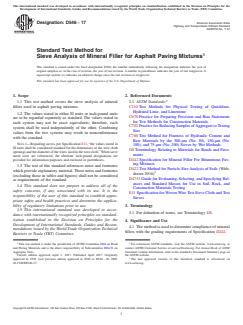


ASTM D546-17 - Standard Test Method for Sieve Analysis of Mineral Filler for Asphalt Paving Mixtures
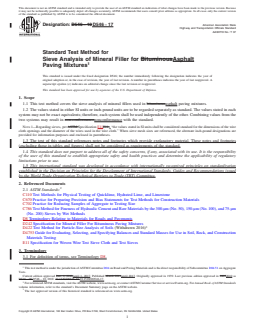
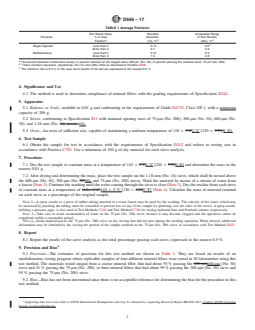


REDLINE ASTM D546-17 - Standard Test Method for Sieve Analysis of Mineral Filler for Asphalt Paving Mixtures
Overview
ASTM D546-17 is the internationally recognized standard test method for conducting a sieve analysis of mineral filler used in asphalt paving mixtures. Issued by ASTM International, this standard outlines procedures to determine the particle size distribution of mineral fillers, a critical component impacting the quality and performance of asphalt pavements. The test ensures that mineral fillers meet the grading requirements of ASTM D242, thereby supporting reliable quality control in road construction and paving projects.
The methodology described by ASTM D546-17 plays an essential role in the construction industry by supporting compliance, optimizing asphalt mixture design, and maintaining pavement durability.
Key Topics
Test Scope and Applicability
- Provides comprehensive guidance for performing sieve analysis on mineral fillers used in bituminous (asphalt) paving.
- Specifies the procedure for both SI and inch-pound units; systems must not be combined in a single analysis.
Standardized Equipment
- Requires balances and sieves conforming to ASTM standards, specifically referencing E11 for sieve specifications.
- Outlines requirements for sieves with nominal opening sizes such as 1.18 mm, 600 μm, 300 μm, and 75 μm.
Sample Preparation and Handling
- Sample collection and reduction methods must adhere to best practices, as detailed in supporting ASTM standards.
- Adequate oven drying and accurate weighing to ensure measurement precision.
Step-by-Step Sieve Analysis Procedure
- Drying the sample, washing it through specified sieves, and drying the retained material again.
- Calculation of percentage passing each sieve, reported to the nearest 0.5%.
Precision and Reporting Requirements
- Includes clearly defined precision and repeatability values, enhancing consistency across different laboratories.
- Mandates clear reporting of results and adherence to specified accuracy.
Applications
Practical Uses in the Asphalt Industry
ASTM D546-17 is widely applied across multiple stages of asphalt paving mixture production and quality control:
Material Acceptance and Quality Assurance
- Helps producers and contractors verify that mineral fillers conform to specified grading standards before incorporation into mixes.
Mixture Design Optimization
- Ensures appropriate filler gradation, impacting workability, compaction, and long-term pavement performance.
Construction Compliance
- Enables agencies and engineers to enforce specification compliance, reducing premature pavement failures due to inadequate filler quality.
Research and Development
- Supports laboratory studies involving new filler sources, recycled materials, or alternative mix designs, facilitating data-driven innovations.
Utilization of the sieve analysis method according to ASTM D546-17 helps minimize variability, optimize binder-aggregate interaction, and ultimately deliver safer, longer-lasting road surfaces.
Related Standards
To ensure a comprehensive approach to mineral filler grading and analysis, ASTM D546-17 references several pertinent ASTM and AASHTO standards, including:
- ASTM D242 - Specification for Mineral Filler for Bituminous Paving Mixtures
- ASTM E11 - Specification for Woven Wire Test Sieve Cloth and Test Sieves
- ASTM C702 - Practice for Reducing Samples of Aggregate to Testing Size
- ASTM D8 - Terminology Relating to Materials for Roads and Pavements
- ASTM C110, C670, C786 - Covering related sample preparation and fineness criteria
- AASHTO T 37 - Equivalent AASHTO standard for mineral filler grading
For accurate and compliant results, all procedures involving mineral filler analysis in asphalt mixtures should reference these documents alongside ASTM D546-17.
Keywords: ASTM D546-17, sieve analysis, mineral filler, asphalt paving mixtures, grading specification, bituminous paving, quality control, road construction standards, particle size distribution.
Relations
- Effective Date
- 01-Apr-2017
- Effective Date
- 01-Feb-2024
- Effective Date
- 01-Feb-2024
- Effective Date
- 01-Jan-2024
- Effective Date
- 01-Aug-2019
- Effective Date
- 15-Dec-2018
- Effective Date
- 15-Aug-2018
- Effective Date
- 01-Jul-2018
- Effective Date
- 01-Feb-2018
- Effective Date
- 15-Jul-2017
- Effective Date
- 15-Jun-2017
- Effective Date
- 01-May-2017
- Effective Date
- 01-Mar-2017
- Effective Date
- 01-Dec-2016
- Refers
ASTM C110-16 - Standard Test Methods for Physical Testing of Quicklime, Hydrated Lime, and Limestone - Effective Date
- 01-Dec-2016
Buy Documents
ASTM D546-17 - Standard Test Method for Sieve Analysis of Mineral Filler for Asphalt Paving Mixtures
REDLINE ASTM D546-17 - Standard Test Method for Sieve Analysis of Mineral Filler for Asphalt Paving Mixtures
Get Certified
Connect with accredited certification bodies for this standard

Zavod za gradbeništvo Slovenije (ZAG) - Inšpekcija
ZAG inspection body for construction products, structures, and materials.
Sponsored listings
Frequently Asked Questions
ASTM D546-17 is a standard published by ASTM International. Its full title is "Standard Test Method for Sieve Analysis of Mineral Filler for Asphalt Paving Mixtures". This standard covers: SIGNIFICANCE AND USE 4.1 The method is used to determine compliance of mineral fillers with the grading requirements of Specification D242. SCOPE 1.1 This test method covers the sieve analysis of mineral fillers used in asphalt paving mixtures. 1.2 The values stated in either SI units or inch-pound units are to be regarded separately as standard. The values stated in each system may not be exact equivalents; therefore, each system shall be used independently of the other. Combining values from the two systems may result in nonconformance with the standard. Note 1: Regarding sieves, per Specification E11, “the values stated in SI units shall be considered standard for the dimensions of the wire cloth openings and the diameter of the wires used in the wire cloth.” When sieve mesh sizes are referenced, the alternate inch-pound designations are provided for information purposes and enclosed in parentheses. 1.3 The text of this standard references notes and footnotes which provide explanatory material. These notes and footnotes (excluding those in tables and figures) shall not be considered as requirements of the standard. 1.4 This standard does not purport to address all of the safety concerns, if any, associated with its use. It is the responsibility of the user of this standard to establish appropriate safety and health practices and determine the applicability of regulatory limitations prior to use. 1.5 This international standard was developed in accordance with internationally recognized principles on standardization established in the Decision on Principles for the Development of International Standards, Guides and Recommendations issued by the World Trade Organization Technical Barriers to Trade (TBT) Committee.
SIGNIFICANCE AND USE 4.1 The method is used to determine compliance of mineral fillers with the grading requirements of Specification D242. SCOPE 1.1 This test method covers the sieve analysis of mineral fillers used in asphalt paving mixtures. 1.2 The values stated in either SI units or inch-pound units are to be regarded separately as standard. The values stated in each system may not be exact equivalents; therefore, each system shall be used independently of the other. Combining values from the two systems may result in nonconformance with the standard. Note 1: Regarding sieves, per Specification E11, “the values stated in SI units shall be considered standard for the dimensions of the wire cloth openings and the diameter of the wires used in the wire cloth.” When sieve mesh sizes are referenced, the alternate inch-pound designations are provided for information purposes and enclosed in parentheses. 1.3 The text of this standard references notes and footnotes which provide explanatory material. These notes and footnotes (excluding those in tables and figures) shall not be considered as requirements of the standard. 1.4 This standard does not purport to address all of the safety concerns, if any, associated with its use. It is the responsibility of the user of this standard to establish appropriate safety and health practices and determine the applicability of regulatory limitations prior to use. 1.5 This international standard was developed in accordance with internationally recognized principles on standardization established in the Decision on Principles for the Development of International Standards, Guides and Recommendations issued by the World Trade Organization Technical Barriers to Trade (TBT) Committee.
ASTM D546-17 is classified under the following ICS (International Classification for Standards) categories: 93.080.20 - Road construction materials. The ICS classification helps identify the subject area and facilitates finding related standards.
ASTM D546-17 has the following relationships with other standards: It is inter standard links to ASTM D546-10, ASTM C670-24a, ASTM D4753-24, ASTM C670-24, ASTM D8-19, ASTM D8-18c, ASTM D8-18b, ASTM D8-18a, ASTM D8-18, ASTM D8-17c, ASTM D8-17b, ASTM D8-17a, ASTM D8-17, ASTM D8-16b, ASTM C110-16. Understanding these relationships helps ensure you are using the most current and applicable version of the standard.
ASTM D546-17 is available in PDF format for immediate download after purchase. The document can be added to your cart and obtained through the secure checkout process. Digital delivery ensures instant access to the complete standard document.
Standards Content (Sample)
This international standard was developed in accordance with internationally recognized principles on standardization established in the Decision on Principles for the
Development of International Standards, Guides and Recommendations issued by the World Trade Organization Technical Barriers to Trade (TBT) Committee.
Designation: D546 − 17 American Association State
Highway and Transportation Officials Standard
AASHTO No.: T 37
Standard Test Method for
Sieve Analysis of Mineral Filler for Asphalt Paving Mixtures
This standard is issued under the fixed designation D546; the number immediately following the designation indicates the year of
original adoption or, in the case of revision, the year of last revision. A number in parentheses indicates the year of last reapproval. A
superscript epsilon (´) indicates an editorial change since the last revision or reapproval.
This standard has been approved for use by agencies of the U.S. Department of Defense.
1. Scope 2. Referenced Documents
1.1 This test method covers the sieve analysis of mineral 2.1 ASTM Standards:
fillers used in asphalt paving mixtures. C110 Test Methods for Physical Testing of Quicklime,
Hydrated Lime, and Limestone
1.2 The values stated in either SI units or inch-pound units
C670 Practice for Preparing Precision and Bias Statements
are to be regarded separately as standard. The values stated in
for Test Methods for Construction Materials
each system may not be exact equivalents; therefore, each
C702 PracticeforReducingSamplesofAggregatetoTesting
system shall be used independently of the other. Combining
Size
values from the two systems may result in nonconformance
C786 Test Method for Fineness of Hydraulic Cement and
with the standard.
Raw Materials by the 300-µm (No. 50), 150-µm (No.
NOTE 1—Regarding sieves, per Specification E11, “the values stated in
100), and 75-µm (No. 200) Sieves by Wet Methods
SI units shall be considered standard for the dimensions of the wire cloth
D8 Terminology Relating to Materials for Roads and Pave-
openingsandthediameterofthewiresusedinthewirecloth.”Whensieve
ments
mesh sizes are referenced, the alternate inch-pound designations are
D242 Specification for Mineral Filler For Bituminous Pav-
provided for information purposes and enclosed in parentheses.
ing Mixtures
1.3 The text of this standard references notes and footnotes
D422 Test Method for Particle-SizeAnalysis of Soils (With-
which provide explanatory material. These notes and footnotes
drawn 2016)
(excluding those in tables and figures) shall not be considered
D4753 Guide for Evaluating, Selecting, and Specifying Bal-
as requirements of the standard.
ances and Standard Masses for Use in Soil, Rock, and
1.4 This standard does not purport to address all of the
Construction Materials Testing
safety concerns, if any, associated with its use. It is the
E11 Specification for Woven Wire Test Sieve Cloth and Test
responsibility of the user of this standard to establish appro-
Sieves
priate safety and health practices and determine the applica-
bility of regulatory limitations prior to use.
3. Terminology
1.5 This international standard was developed in accor-
3.1 For definition of terms, see Terminology D8.
dance with internationally recognized principles on standard-
ization established in the Decision on Principles for the
4. Significance and Use
Development of International Standards, Guides and Recom-
4.1 The method is used to determine compliance of mineral
mendations issued by the World Trade Organization Technical
fillers with the grading requirements of Specification D242.
Barriers to Trade (TBT) Committee.
1 2
This test method is under the jurisdiction of ASTM Committee D04 on Road For referenced ASTM standards, visit the ASTM website, www.astm.org, or
and Paving Materials and is the direct responsibility of Subcommittee D04.51 on contact ASTM Customer Service at service@astm.org. For Annual Book of ASTM
Aggregate Tests. Standards volume information, refer to the standard’s Document Summary page on
Current edition approved April 1, 2017. Published April 2017. Originally the ASTM website.
approved in 1939. Last previous edition approved in 2010 as D546 – 10. DOI: The last approved version of this historical standard is referenced on
10.1520/D0546-17. www.astm.org.
Copyright © ASTM International, 100 Barr Harbor Drive, PO Box C700, West Conshohocken, PA 19428-2959. United States
D546 − 17
TABLE 1 Average Precision
Test Result Value, Standard Acceptable Range
Precision %inSize Deviation, of Test Results,
A B B
Fraction (1s), % (d2s), %
C
Single Operator Less than 2 0.14 0.5
More than 2 0.7 2.0
Multilaboratory Less than 2 0.17 0.5
More than 2 1.0 2.8
A
The percent between consecutive sieves, or percent retained on the largest sieve, 600-µm (No. 30), or percent passing the smallest sieve, 75-µm (No. 200).
B
These numbers represent, respectively, the (1s) and (d2s) limits as
...
This document is not an ASTM standard and is intended only to provide the user of an ASTM standard an indication of what changes have been made to the previous version. Because
it may not be technically possible to adequately depict all changes accurately, ASTM recommends that users consult prior editions as appropriate. In all cases only the current version
of the standard as published by ASTM is to be considered the official document.
Designation: D546 − 10 D546 − 17 American Association State
Highway and Transportation Officials Standard
AASHTO No.: T 37
Standard Test Method for
Sieve Analysis of Mineral Filler for BituminousAsphalt
Paving Mixtures
This standard is issued under the fixed designation D546; the number immediately following the designation indicates the year of
original adoption or, in the case of revision, the year of last revision. A number in parentheses indicates the year of last reapproval. A
superscript epsilon (´) indicates an editorial change since the last revision or reapproval.
This standard has been approved for use by agencies of the U.S. Department of Defense.
1. Scope
1.1 This test method covers the sieve analysis of mineral fillers used in bituminousasphalt paving mixtures.
1.2 The values stated in either SI units or inch-pound units are to be regarded separately as standard. The values stated in each
system may not be exact equivalents; therefore, each system shall be used independently of the other. Combining values from the
two systems may result in non-conformancenonconformance with the standard.
NOTE 1—Regarding sieves, per ASTM Specification E11E11,, “the values stated in SI units shall be considered standard for the dimensions of the wire
cloth openings and the diameter of the wires used in the wire cloth.” When sieve mesh sizes are referenced, the alternate inch-pound designations are
provided for information purposes and enclosed in parentheses.
1.3 The text of this standard references notes and footnotes which provide explanatory material. These notes and footnotes
(excluding those in tables and figures) shall not be considered as requirements of the standard.
1.4 This standard does not purport to address all of the safety concerns, if any, associated with its use. It is the responsibility
of the user of this standard to establish appropriate safety and health practices and determine the applicability of regulatory
limitations prior to use.
1.5 This international standard was developed in accordance with internationally recognized principles on standardization
established in the Decision on Principles for the Development of International Standards, Guides and Recommendations issued
by the World Trade Organization Technical Barriers to Trade (TBT) Committee.
2. Referenced Documents
2.1 ASTM Standards:
C110 Test Methods for Physical Testing of Quicklime, Hydrated Lime, and Limestone
C670 Practice for Preparing Precision and Bias Statements for Test Methods for Construction Materials
C702 Practice for Reducing Samples of Aggregate to Testing Size
C786 Test Method for Fineness of Hydraulic Cement and Raw Materials by the 300-μm (No. 50), 150-μm (No. 100), and 75-μm
(No. 200) Sieves by Wet Methods
D8 Terminology Relating to Materials for Roads and Pavements
D242 Specification for Mineral Filler For Bituminous Paving Mixtures
D422 Test Method for Particle-Size Analysis of Soils (Withdrawn 2016)
D4753 Guide for Evaluating, Selecting, and Specifying Balances and Standard Masses for Use in Soil, Rock, and Construction
Materials Testing
E11 Specification for Woven Wire Test Sieve Cloth and Test Sieves
3. Terminology
3.1 For definition of terms, see Terminology D8.
This test method is under the jurisdiction of ASTM Committee D04 on Road and Paving Materials and is the direct responsibility of Subcommittee D04.51 on Aggregate
Tests.
Current edition approved Dec. 1, 2010April 1, 2017. Published March 2011April 2017. Originally approved in 1939. Last previous edition approved in 20052010 as
D546 – 05.D546 – 10. DOI: 10.1520/D0546-10.10.1520/D0546-17.
For referenced ASTM standards, visit the ASTM website, www.astm.org, or contact ASTM Customer Service at service@astm.org. For Annual Book of ASTM Standards
volume information, refer to the standard’s Document Summary page on the ASTM website.
The last approved version of this historical standard is referenced on www.astm.org.
Copyright © ASTM International, 100 Barr Harbor Drive, PO Box C700, West Conshohocken, PA 19428-2959. United States
D546 − 17
TABLE 1 Average Precision
Test Result Value, Standard Acceptable Range
Precision % in Size Deviation, of Test Results,
A B B
Fraction (1s), % (d2s), %
C
Single Operator Less than 2 0.14 0.5
More than 2 0.7 2.0
Multilaboratory Less than 2 0.17 0.5
More than 2 1.0 2.8
A
The percent between consecutive sieves, or percent retained on the largest sieve, 600-μm (No. 30), or percent passing the smallest sieve, 75-μm (No. 200).
B
These numbers represent, respectively, the (1s) and (d2s) limits as described in Practice C670.
C
The minimum d2s is 0.5 % in this case since results of the test are expressed
...